Tuesday, 9 February 2021

Hellions #9 - Comic Review


There are a lot of good X-Men book at the moment, the new status-quo for the Mutants seems to be a really good thing, and is delivering some interesting teams and engaging stories. One of the books that has been consistently great, and a load of fun to read every month, is Hellions. The mixture of weird characters, violence, and humour, make it one of the books that I look forward to.

The latest issue sees the team having to go on something of a personal mission when their 'leader' Mr Sinister is kidnapped off of Krakoa. The first scene of the book shows the audience this kidnapping, during a meeting with the mutant Jason Wyngard, Mastermind, who appears to poison Sinisters tea; though this could be a false reality and that's what he used his powers to make Sinister believe.

It's interesting that Mastermind is already back alive, considering how many more beloved mutants there are who haven't been through the resurrection process yet it's something of a surprise that someone as loathed as Wyngard made it higher up the list than some of the friends and loved ones of our heroes. But then this is Krakoa, where past misdeeds are forgotten and villains given a second chance, so perhaps the council believed that Wyngard was worthy of being given that second chance sooner than most. Unfortunately, it seems like he's not planning on taking that opportunity.


Luckily for Sinister, his team are there to try and save him, even though it's clearly obvious that most of them really don't want to. I love how the 'therapy' of the Hellions has actually seemed to work somewhat, and seeing the team come together, even if it's just in their hatred for Sinister is a lot of fun; the moment where several of the team start cracking jokes about going for lunch when they learn Sinister is the person they have to rescue is genuinely funny, and shows that very real friendships are forming here.

The rest of the issue focuses on the team travelling to New York to try and find Sinister, and almost immediately falling into Masterminds trap, falling victim to his abilities as their perception of reality is warped around them. It really begins to set the idea in place that despite not being much of a physical threat Mastermind could actually challenge the team in ways their previous opponents haven't yet. Although, the end reveal that Arcade is using Wyngard to get hold of the Hellions for his own games indicates that they could have more than one foe to deal with in the next few issues.

This issue is really just setting the stage for the next story-line after the last few issues dealt with the fall out from X of Swords, yet it still manages to be fun and engaging, and have some character development that feels earned and worth while.


Buy Amy A Coffee

Go to Amy's Blog

Girl Haven by Lilah Sturges - Book Review


'When seventh-grader Ash, his crush Eleanor, and their friends are transported to a girls-only imaginary world, Ash must come to terms with the fact that he may actually be a transgender girl. Full of wonder, humor, and heart, Girl Haven is the newest original story from the author of Lumberjanes.

'Three years ago, Ash's mom, Kristin, left home and never came back. Now, Ash lives in the house where Kristin grew up. All of her things are there. Her old room, her old clothes, and the shed, where she spent her childhood creating a fantasy world called Koretris.

'Ash knows all about Koretris: how it's a haven for girls, with no men or boys allowed, and filled with fanciful landscapes and creatures. When Ash's friends decide to try going to Koretris, using one of Kristin's spellbooks, Ash doesn't think anything will happen. But the spell works, and Ash discovers that the world Kristin created is actually a real place, with real inhabitants and very real danger.

'But if Koretris is real, why is Ash there? Everyone has always called Ash a boy. Ash uses he/him pronouns. Shouldn't the spell have kept Ash out? And what does it mean if it let Ash in? '

Lumberjanes has long been on my list of things to read, as I'd heard nothing but great things about it, but trying to find time to get caught up on a series that has been going on for a while can be a bit of a challenge, so when I saw that this book was coming out I jumped at the chance to read some of Lilah Sturges' work.

Girl Haven tells the story of four teens who go to the Marsha P. Johnson Middle School (which should tell you a little bit about the type of subject matter the book will be dealing with). There's Ash, Eleanor, Chloe, and Junebug. Eleanor, Chloe, and Junebug are all friends, and part of the schools Pride Club, and after attracting the attention of Ash one lunchtime they invite him to come along and see what the club is all about. 

Ash doesn't seem to have many friends, and jumps at the opportunity to make three new ones, especially as they have a bit of a crush on Eleanor. After the club Ash invites the three of them to their house, where he shows them the shed where their mother used to pain pictures and write books about the fantasy land of Koretris before she left several years before. The girls love the things that Ash's mother left behind, and instantly want to dress up as adventurers and pretend that they're in Koretris. But there's a problem, Ash doesn't think that he can play, because only girls can go to Koretris. Eleanor tells him it's only make believe, and that he can put on one of the dresses and just pretend if he wants.


It's then that Chloe reads one of the spells from a book of magic that's supposed to take you to Koretris, and the four of them find themselves in this amazing fantasy world. Not only is it real, but this world might hold the secret as to what happened to Ash's mother. However, it also presents an important question, if only girls can be in Koretris, how was Ash allowed in. Not only is Ash having to grapple with the idea that this fantasy world is real, and that his mother might still be alive, but he's also forced to take a look at his own gender identity, and what ultimately makes him happiest.

I have to be honest, I had no idea that Lilah Sturges was trans before reading this book, and didn't even realise until after I was done reading it and looked her up online. I was worried at the start of the book that perhaps this was going to be a book about the trans experience that was going to be written by a cis person, someone who sympathised with the difficulty of having to examine your own gender identity and wanted to make a story about it, but had never experienced it themselves. But because Sturges herself has been through that, has had to look at their own gender and how they fit into the world she's able to pour a lot of that emotional journey into the pages of Girl Haven.

There are a few early scenes where Ash seems uncomfortable with who they are, like when they're given the dress to wear that touch upon this. You can see the look on their face and you could hand wave that away as 'a boy's been told to wear a dress and doesn't really want to', but it's more than that, that hesitation Ash shows is a longing, its them wanting to do that, but being afraid to. This is something that I'm sure a lot of trans women will be familiar with, that closely held desire to be like other girls, the want you feel to just be like them and to be treated like a girl, but the fear that if you tried you'd face ridicule or disgust; or even knowing that if you were surrounded by friends like Eleanor, who accepted it and didn't make you feel bad you know that you'd still have to take the dress off and go back to being a boy, and knowing that it's not forever hurts.

The moments where Ash is encouraged to just be herself, to put on the dress and be the person she wants to be are weighed down by these fears, these self doubts, and you can see the character struggling with this. For readers who have never been through this themselves they might feel frustrated that Ash isn't jumping at the chance to just be a girl, but that struggle, the fear of taking that step is something so real and so genuinely debilitating that it can be a hard choice to make.

Sturges gives these moments the weight and time that they need, she makes it so that readers have to follow Ash on a journey not just to adventure and fantasy realms, but of self acceptance too. Ash has to learn to accept herself for who she is, even if others already do, even if the reader does. This is a story that anyone could write, but its a story that I think only really works this well if the person writing it knows how hard it is, if they're able to channel some of that emotion into the work.


I think I might have painted too dour a picture of this book, because it's not all about Ash and her gender, or her pain, there's a lot more to the book too. The world of Koretris is bright and colourful, and has some really awesome stuff in it, some which only makes brief appearances but makes a big impact. The Rabbits of the Reeds are a group of warrior bunnies who I instantly fell in love with. Okay, this might have had a little bit to do with the fact that I've got four bunnies running around my house, but they're so cool. I would have been happy for a book all about them because fantasy adventures with rabbit people is something that I didn't even realise I wanted until I read this book, and now it's something that I'm going to be hoping for in everything I read.

There's so much about Koretris that is only touched upon briefly here that I want to know more about, there's the slightly creepy Scarionettes, which are giant living marionettes that look like Dracula, the wolf-man, a mummy, and the Bride of Frankenstein. I don't know what these things are, but I really want to because they're one of the most unique fantasy creations I've ever seen. Then there's also the moral implications of the Sweet Deliveries, little baby like creatures made of candy, who eat candy. Chloe tries to talk to them about this, asking if that makes them cannibals, but this isn't really put to bed and I feel a more in depth discussion on that subject is in order.

Koretris is a strange world, one that has some cool and interesting inhabitants, and one that I want to spend more time in. Whilst the book ends with the idea that Ash and her friends aren't finished with this magical world I don't know if there's more planned for the series, but I certainly hope so.

Girl Haven is a fun and engaging adventure story that has some important things to say about gender identity and the journey to accepting and embracing who you are. It will appeal to readers of all ages, and I think that because of that it's going to be a hell of a popular book.


Buy Amy A Coffee

Go to Amy's Blog

Monday, 8 February 2021

Future State: Wonder Woman #2 - Comic Review


One of the things that keeps amazing me about Future State is how some of these writers are getting me so invested in these characters and stories in just two issues. I think Future State: Wonder Woman might be one of the most impressive, however, as it's not just introducing me to a whole new Wonder Woman and her mythology, but getting me emotionally attached to her too.

This issue picks up where the last one left off, and sees Yara travelling into the underworld to try and rescue her friend, Potira, who died in battle on Themyscira. Despite the fact that Yara is travelling into the underworld, a dark and depressing place filled with horrors, there's a surprising amount of fun to be found in this story; something that's in pretty short supply across most of Future State. With so many of the stories having dark and depressing overtones, like the Gotham books being set in a police state, or Swamp Thing being about the literal end of humanity, it's nice to have a story where the hero is having a bit of fun, and even cracking some jokes.

This humour is one of the things that has really endeared me to Yara, and sets her apart as different from Diana. When she arrives in Tartatus and comes face to face with a creepy trio of demonic looking dudes she doesn't launch into an attack or a rousing speech like Diana would, she does a stupid magic trick to try and impress them. It's so bad I'm not even sure you could call it a magic trick. But the way she does it and the look on her face when she does made me genuinely laugh out loud and realise I wanted more from this character.


Despite this fun and silliness there's something really important at the heart of this issue, Yara having to learn that there are some things that she can't change. Sadly, it's a lesson that she learns in a heart breaking way as she manages to get Potira out of the sea of souls and begins to flee the underworld, only for a cave in to trap her friend. It's in this moment that Yara is forced to confront the fact that no matter how strong she is, no matter how much she can fight for something, sometimes you just can't win. The moments when she realises Potira is lost to her all over again is really, really sad, and touched me in a way that I wasn't expecting for a relationship I only discovered this very issue. That's just how damn good Joelle Jones' writing is, that she's able to elicit such emotions from me in such a short amount of time.

Jones isn't just the writer, however, but also produces the art on the book, alongside colourist Jordie Bellaire. The visuals in this book are downright amazing, and the way that the underworld is presented is one of the more unique visions I've seen. There's a strange sense of beauty to the whole thing, even when it's dark and depressing. Whether it's the field of flowers that transforms into dying plants as Yara approaches a winged reaper, the ethereal beauty of the boatman, or the sharp contrast in light and darkness in Hades and Persephone, everything about this place manages to evoke beauty in different ways. 

I'm sad to be seeing this story coming to an end, but really enjoyed my time with it whilst I had it. Luckily, it's been announced that Yara will be returning in the regular timeline when things go back to normal after Future State, and that she will be taking on the mantle of Wonder Girl in her own ongoing series; a series that's going to be written and drawn by Jones. This is brilliant news, both because it means that we're going to get more from this character, but it also a fantastic creator. 


Buy Amy A Coffee

Go to Amy's Blog

The Deep-Sea Duke by Lauren James - Book Review


'When Hugo and Ada travel to their friend Dorian’s planet for the holidays, android Hugo is anxious about being accepted by Dorian’s powerful family. But when they arrive on Hydrox, there are more pressing things to worry about, as the planet has been overrun by refugee butterflies. Displaced from their home by climate change, the butterflies have been offered sanctuary by Dorian’s parents, but they’re quickly running out of space. Meanwhile, beneath the seas, a strange creature is wreaking all kinds of havoc. Can Hugo, Dorian and Ada step in before the crisis gets out of control?'

The Deep-Sea Duke is the follow up to The Starlight Watch Maker, and I'm sad to say that I haven't read the first book, but despite that I never felt like I got lost in this engaging and interesting story about this collection of unusual friends and the love they have for each other.

The story is about a trio of friends who met in the previous book, where two of them were students at an academy for children of wealthy and influential people from across the galaxy. There's Dorian, the price of the planet Hydrox, a green skinned young man from a species who lives under water and evolved from aquatic life. Ada is a stark contrast, being a member of a species of sentient rock people. Not only is she made from stone and has lava inside her, but her species increases their mass as they age, and she'll one day become her own sentient planet. And lastly there's Hugo, a boy who was made in a factory. An android that was created to serve, and eventually left behind by his former owner, he created his own watchmaking business. 

The three leads are one of the most mismatched trio's I think I've ever seen in a book. They're so completely different to each other, so fantastic and unusual, but their friendship and love for each other form a bond where it doesn't matter the kind of person you are on the outside, only who you are on the inside that matters.

Together, the three of them have travelled to Dorian's home planet of Hydrox, where they plan to spend their summer break before Dorian and Hugo return to the academy; Ada has already graduated and won't be returning with them, so they're seeing this as their last time together. Expecting a relaxed summer in Dorian's family home, full of swimming in the sea and eating algae ice cream, the three of them are shocked to find the floating platforms that make up part of Hydrox filled with butterfly people, who seem to be living in tents.

The three friends discover that the butterfly people have had to leave their home-world after climate change has made it deadly to their children, who can no longer survive their cocoon stage of life thanks to the pollutants in the air and the increased heat. Despite having known that their reliance on fossil fuels and their lifestyles would lead to such change they were too late to prevent the outcome, and have had to leave their home in order to survive. Thankfully, Dorian's family have agreed to take them in and prove a home for them. However, it seems like they may have brought a new species of otter with them that is causing havoc for the inhabitants of Hydrox, and may be leading to disaster. Now it's down to Hugo and his friends to try and save everyone.

One of the things that I really enjoyed about The Deep-Sea Duke was how writer Lauren James manages to weave a very important message into the narrative without it feeling like it's overwhelming things. There are children's stories that deal with climate change, and how destructive that can be, but often these kind of messages are very clear from the outset, and make the story about that. Whilst it's good that more children's literature are covering this subject, it can put some kids off, children who might not want to read about such a big and scary topic. What this book does, however, is present this in a very subtle way.

The loss of the butterfly's planet is the event behind the issues being faced in this book, it informs the story and puts the trio of heroes into conflict as they try to save everyone, but it's still a story about these three friends getting into an adventure. The book does the clever thing of shining a light onto the subject of environmentalism and climate change without it seeming preachy or overwhelming. And it all comes in a fun science fiction package too.

James also manages to create an interesting universe for things to happen in, one that is full of weird and wonderful people. Most science fiction that I've read will involve humans in some way, and will incorporate aliens and machines into the stories, but here there wasn't a single human person present. All of the characters were aliens, or Hugo who was an android. Because I'd not read the first book I don't even know if humans do exist in this universe or not? Either way, it's a bold choice to have a story where there are no human characters, and instead children are left to identify with the characters by their personalities alone. No one is going to look at Ada and identify with her because they're a huge rock person who's going to be a planet one day, but they can relate to her sense of fun, her kindness, and her willingness to help others. These are the kinds of qualities that really matter, and ones that kids will love about these characters.

Now, to get a bit spoilery about the ending. If you don't want to know how the book ends just jump to the ext paragraph, I completely understand not wanting to have things spoilt if you've not read the book yet, but I have to talk about the ending because I loved it so much. At the end of the book, when Dorian is talking about when he's finished with his studies and will go on to rule Hydrox as its king he asks Hugo if he wants to be with him as his partner. Now, I had a feeling this was coming thanks to stuff mentioned earlier in the book, but what I did not expect was what happened next, when Dorian made it clear that he meant as his romantic partner, and asked Hugo to be prince regent. Seemingly out of nowhere the book had the sweetest, loveliest queer love moments I've read and I completely adored it. Even though Hugo is an android he's referred to with only male pronouns throughout the book, so this is definitely a same sex paring, and I loved it. For this book that was about friendship and helping others, with this climate change message in there too to suddenly have an LGBTQ+ romance was just the best. 

I enjoyed The Deep-Sea Duke a lot more than I thought I would. I was worried that I might be left behind a little as I hadn't read the first book, but it was so easy to pick up and get into. It has some wonderful characters who I quickly came to care for, a world full of amazing people and moments, and an ending that melted my heart. I hope that we get more from these characters in the future, though because of the way the book ended it would be in a very different form, but I still hope that we can check in on Hugo, Dorian, and Ada some day in the future.


Buy Amy A Coffee

Go to Amy's Blog

Saturday, 6 February 2021

Star Wars: The High Republic #2 - Comic Review


I know that the High Republic was going to be going into unexplored reaches of the Star Wars universe, that readers would discover new worlds and darkness that we've not encountered before; but after the brightness of the first issue, the amount of grandeur and hope there seemed to be around the opening of the Starlight Beacon I wasn't expecting the very next issue to become a horror story.

Following the knighting of Keeve Trennis in the last issue, and the official 'ribbon cutting' of Starlight Beacon we're settling into the daily routine of the Jedi stationed in this remote part of the galaxy, and seeing some of the issues that they'll be dealing with following the Great Disaster.

The issue opens with Trennis, her former master, Sskeer, and the Kotabi bond-twins Ceret and Terec being sent to investigate a distress call, finding a huge debris field in deep space. Finding part of the ruined ship still has an atmosphere the four Jedi board, finding the interior filled with gas and bodies everywhere. It becomes clear to them that this was the result of the Nihil, a group of brutal marauders responsible for the Great Disaster, and the loss of Sskeer's arm.

I knew it wouldn't take long for the Nihil to make an appearance in Star Wars: The High Republic, particularly after the amount of damage they cause in Star Wars: Light of the Jedi and the comic really builds up their their eventual reveal in this issue, using the carnage they'd left behind to build tension and set a very dark tone. It also becomes clear that Sskeer is still suffering from the wounds that he received at the hands of the Nihil, mentally if not physically. I like that we're seeing some fall out from Sskeer's last encounter with the Nihil being explored here. His physiology means that his arm will regrown, but it was still an incredibly traumatic experience, and I could be wrong, but it might have even been made worse for him due to being a Trandoshan. 

Every other Trandoshan I've seen in Star Wars are written as aggressive, as hunters who live for the kill, and show little sympathy for anyone who crosses their path; something that is opposite to every Jedi teaching. It could be that Cavan Scott is going to use his trauma as a gateway to explore the dichotomy of his Trandoshan heritage and the Jedi way. It seems to be a possible scenario, as later in the issue he comes across a Nihil left behind on the ship and seems to lose control. His eyes seem to lose their pupils, and Sskeer enters a rage, cutting his foe down without mercy. It's a shocking moment, and one that's incredibly effective.

Another shocking moment comes shortly before this, when Keeve and Ceret discover that the ship was a Hutt transport, finding a Hutt dead. It's a stunning splash page that sells the brutality and horror of the Nihil, with the room filled with gas and fire, the Hutt's guards dead around it, some hanging from the ceiling, whilst the Hutt is filled with blaster holes and deep gashes. We know that despite looking like giant slugs the Hutts are formidable opponents not to be taken lightly, especially when surrounded by their guard. This image makes it incredibly clear that the Nihil are going to be a serious threat, one that will take more than Force powers and light sabres to tackle.


Even when leaving the dark confines of the Hutt's ship and moving the action to the bright farm world of Sedri Minor the book manages to keep the chills coming, with something strange and terrifying living in the large corn-like stalks. Something that is able to spirit Ceret away without Sskeer realising. It's one thing to make a dark spaceship full of dead bodies frightening, but a sunny farm? That's impressive.

And that's probably the word I'd most use to describe this issue. Impressive. It took the bright and shiny promise of the first issue, of this new setting and flipped things completely, showing a much darker side to this setting and putting our heroes immediately on the back foot. It managed to not just set up a new mystery for the Jedi to investigate, but established the brutality of the Nihil, and gave several characters moments of development. Even characters new to the comic like Ceret and Terec were given enough of the spotlight that by the time it was done I had a good sense of who they were, how their bond works, and why I should care about them.

It's not just down to the writing though, though the writing is brilliant, but the fantastic work of the art team. Artist Ario Anindito, inker Mark Morales, and colourist Annalisa Leoni come together to breath so much life into the book. This issue we get to see the inside of the team's transport, the Starlight Beacon, the Hutt ship, and Sedri Minor, and they all have their own look and feel. They're distinct locations, sometimes with hugely contrasting looks, and some of the work elevates the story to new heights. The previously mentioned page where you see the dead Hutt is such a triumph of this team coming together that it's an image that's going to stick with me long after I've read more issues.

If Star Wars: The High Republic manages to maintain this level of quality, this is going to be one of the best parts of the Star Wars universe.


Buy Amy A Coffee

Go to Amy's Blog

Mrs Death Misses Death by Salena Godden - Book Review


Originally published on Set The Tape


'Mrs Death tells her intoxicating story in this life-affirming fire-starter of a novel.

'Mrs Death has had enough. She is exhausted from spending eternity doing her job and now she seeks someone to unburden her conscience to. Wolf Willeford, a troubled young writer, is well acquainted with death, but until now hadn’t met Death in person – a black, working-class woman who shape-shifts and does her work unseen.

'Enthralled by her stories, Wolf becomes Mrs Death’s scribe, and begins to write her memoirs. Using their desk as a vessel and conduit, Wolf travels across time and place with Mrs Death to witness deaths of past and present and discuss what the future holds for humanity. As the two reflect on the losses they have experienced – or, in the case of Mrs Death, facilitated – their friendship grows into a surprising affirmation of hope, resilience and love. All the while, despite her world-weariness, Death must continue to hold humans’ fates in her hands, appearing in our lives when we least expect her . . . '

Mrs Death Misses Death is not a normal kind of book. If you come to this expecting a prose story you’ll be a little surprised with what you find here, because it’s more like a series of poems and lyrical text that comes together to tell one story, but in a way that I’ve not really seen any other books do before. The narrative follows Wolf Willeford, a ‘Biracial, Bisexual, Bigender and Bipolar’ writer, who one day just before Christmas sees the perfect writing desk in the window of an antique shop that’s closing down; a desk that they know they need to help them with their writing; and a desk that once belonged to Mrs Death.

But the book isn’t just about Wolf, it’s also about Death. Not just the process of life coming to an end, although that does feature heavily in the narrative, but the actual person who travels through the world moving people on from life to death.

But Death isn’t a black robed figure holding a scythe, it’s not a pale old man or a skeleton; instead Death is the someone invisible, someone who society has trained people to ignore and overlook. Death is a ‘poor old black woman, a homeless beggar-woman’. Not only does this make the Death, or rather Mrs Death, of this book a fairly unique take on the personification of death, but it also makes a lot of sense. It makes sense because Godden acknowledges that there are hierarchies to the world, that there are people who are looked down upon, or simply ignored altogether because of the way society has trained people to act, and Mrs Death would have to be one of the most ignored types of people to move so freely around us all.

Together Mrs Death and Wolf talk about the role of death in the world, the reasons why death happens, the people it happens to, and the effect it has on people. At times the book feels more like a stream of consciousness rather than a story, and there are sections written from Mrs Death’s point of view where we become swept up in her unique perspective. We get to see the world as she sees it, this being who has existed since the dawn of time, since humans took their first breaths. We see what hundreds of thousands of years of walking through the world unseen and ignored, crossing people over the threshold of death has done to her, how tired it has made her.

It soon becomes apparent that as much as Wolf feels like they need Mrs Death to help them with their writing, Mrs Death needs Wolf too, she needs someone to talk to, to make her feel more human. But this also makes the book hard to read at times, because it’s not an easy topic to experience. We follow two characters who are struggling, with life, with death, and we get into their heads and see how much their existences have taken a toll on them, and whilst the book is about death it’s also heavily centred on mental health.

Mental health is such a strong component of Wolf’s story, and there are times where the narrative will have you questioning if what you’re reading is even real. There’s a part of the book where Wolf admits that they’re Bipolar, and there are a handful of moments where you begin to question if Mrs Death is even there or if it’s all part of Wolf’s mind, their worsening mental health; and this is even before their Bipolar is even brought up. Even by the end of the book it’s unclear if we’ve actually experienced a story of a troubled young person meeting the personification of Death, of if it’s simply the story of a troubled young person trying to find some sense of stability and happiness in their life.

But I’m actually glad that we don’t get given a strong answer to this, that Godden allows the reader to look at the book and make up their own mind instead. Maybe we were hearing stories of people across time and their brushes with death, or maybe we just got to hear Wolf making up tales for their writing. In the end, it’ll mean whatever you want it to, and whatever conclusion you come to will be your own interpretation of this wonderfully dark, yet uplifting book that does its own thing in its own way.


Buy Amy A Coffee

Go to Amy's Blog

Friday, 5 February 2021

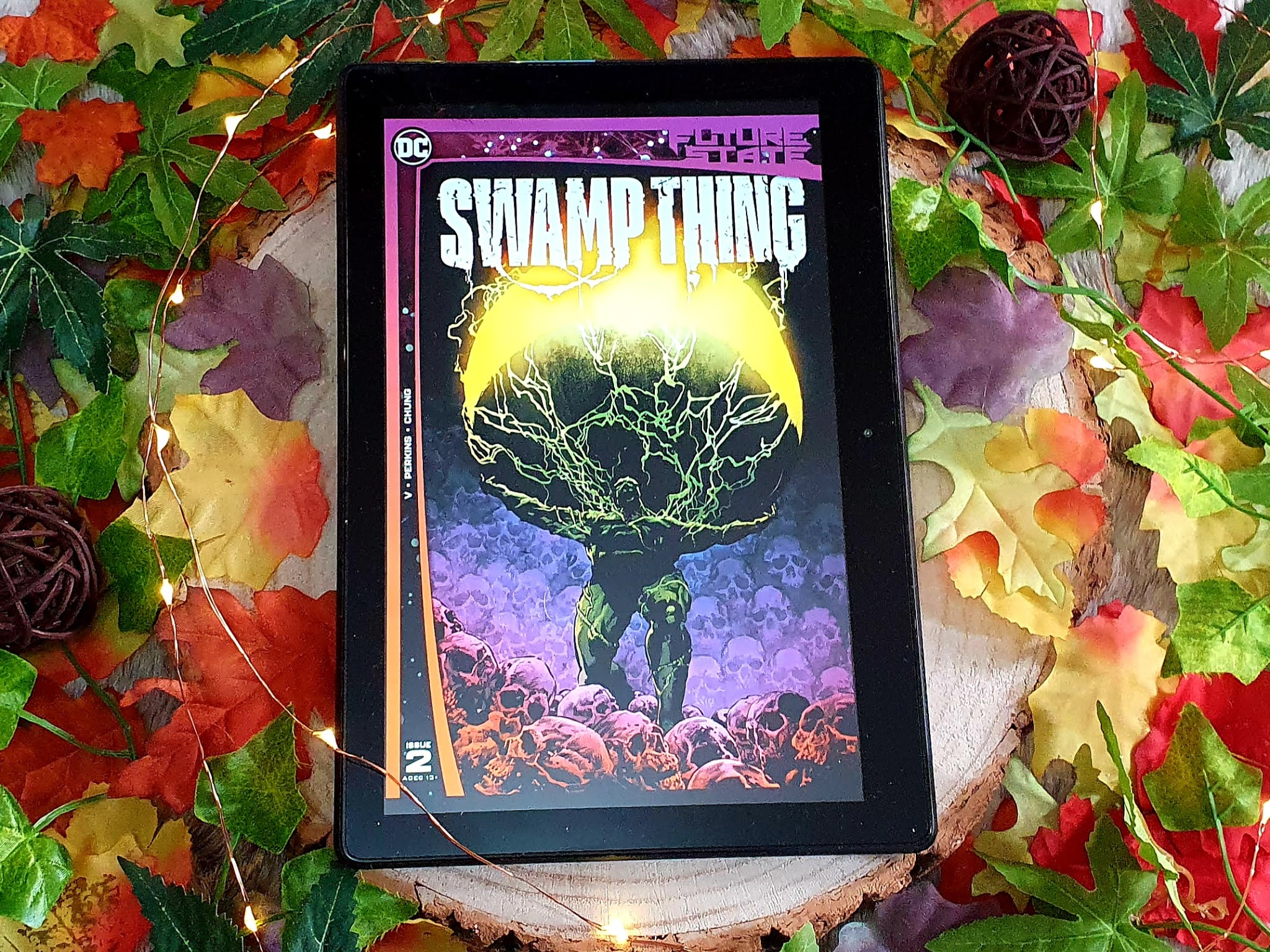
Future State: Swamp Thing #2 - Comic Review


The first issue of Future State: Swamp Thing was one of my favourites of the entire Future State event, being one of the darkest books that really seemed to embrace the horror at the core of its character, and being really bold in the future story it was trying to tell, bolder than most of the others in the event. The first issue set up an exciting new world order where humanity has long since died out, and plant beings living in the ruins, with Swamp Thing as their leader. However, when a lone human arrives in their camp they learn that more people have survived, and a threat is waiting for them all in the frozen north.

Whilst the previous issue focused primarily on Swamp Thing and his people, especially on how Swamp Thing went about constructing their plant bodies, this issue delves more into the story, and spends more time with the human characters hold-up inside S.T.A.R. Fortress than it does Swamp Thing and his children. 

We learn that Jason Woodrue is living withing the fortress, and has used the remains of the hero Obsidian to create a device that he intends to use to block out the sun; one last ditch attack against The Green, taking away the sunlight that the plants need to survive.

Despite this issue seeing the return of Swamp Thing's most iconic villain, and seeing the two characters doing battle one last time, it's not really a story about that. It's not a super powered showdown. Instead, this is a story about Alec Holland, about the pain that he carries inside of him, and his willingness to sacrifice everything to do the right thing.


We learn that he was the one responsible for the the state the world is in, for the destruction of humanity. It's a weight he carries on his soul, something that haunts him; and it's the motivation for his years of searching for survivors of humanity. Not because he wants to finish whatever it was that caused him to turn on people all those years before, but because he wanted to atone for his sins. We also discover that despite the interludes where he's explaining how he went about creating his plant children the one thing that he couldn't recreate was the spark of life, the essence that makes them living beings. 

It's at this point that we discover we've been lied to, and that these people aren't his children, but fractured parts of himself. They represent his innocence, doubt, and ambition. They're part of himself, never really alive, because it takes the soul of humanity to really live, even for a creature such as him. This shows us that this is a Swamp Thing that has come to see humanity and The Green very differently over the years, and has learned that humans are important, and chooses to ultimately give his life to save them.

Future State: Swamp Thing turns into a story about redemption, about one man trying to erase the stain on his soul. The fact that Ram V was able to write a compelling, emotional, and rich story that is easily one of the better Swamp Thing stories in decades in just two issues is simply astounding. The story never felt rushed, it never felt light on content. It wasn't stripped down of content to fit into just two issues, it simply told the story it wanted to tell with heart and emotion and became one of the best stories DC has produced in years. 

Part of the goal of Future State was to tease things to come, to give glimpses of possible futures, new characters, and to tease what some writers will be bringing to the new titles in March. If this is any indication of what readers will have waiting for them when Ram V takes over Swamp Thing it's a series that people definitely need to keep an eye on.


Buy Amy A Coffee

Go to Amy's Blog

Warhammer Adventures: Warped Galaxies - Secrets of the Tau by Cavan Scott - Book Review


'Brave champions and the forces of the Imperium battle alien beasts and mechanical tyrants across the gulf of space.

'Journeying to the bustling spaceport of Hinterland after being saved from certain death by a dubious Rogue Trader, Zelia, Talen and Mekki continue their quest to reach the Emperor’s Seat. But much here is not what it seems. Alone in a strange place and surrounded by aliens, who can they really trust and what are the secrets of the Tau? '

The Warhammer 40,000 universe is one where there aren't really any good guys. I've seen people come to the hobby and assume that the Imperium must be the heroes of the universe because they're the humans out in a galaxy filled with scary aliens and literal daemons. A rookie mistake, as it doesn't take much scratching of the surface to discover that the humanity of the future is an absolute nightmare state, one that none of us would really want to live in if we gave it any real thought. 

These kind of stories, where people have to try and fund the less of the evils, or the horrible regimes that they're able to live with, can be difficult for adults to connect with, and I don't think that I've ever really seen it done in media for children. As such, setting a kids series in the Warhammer 40,000 universe feels like a bold move, and one that has worked out pretty well so far in the Warped Galaxies series. This, I think, is mainly because there have been pretty clear villains up to now. The Necron in the first book destroy an entire world, and are merciless killing machines. The Genestealers in the second book a monsters, ones who want to rip the kids apart, or worse. 

The ambiguity of this setting hasn't really been called into question, until now. The third book in the series, The Secrets of the Tau, takes our teen heroes to a colony on the edges of human space and presents a much more realistic view of this universe, one where everyone is out for themselves, and there are no good guys.

Upon arriving at this space station, after being saved from the Genestealers by the Rogue Trader Harleen Amity, the kids see a dirty, run down, and depressing place, filled with humans, aliens, and abhumans. This is the first time that the reader really sees the level of hatred and xenophobia that exists in this setting, especially as Talen reacts badly to Beastmen and Tau, treating them like disgusting creatures rather than thinking and feeling beings. 

This is something that disgusts Zelia, and drives something of a wedge within the group. It shows that Talen is largely a product of his upbringing, especially as his father was in the Imperial Guard. He's been raised to see anything that's not human as an enemy, something to be distrusted, and destroyed. This does seem to come a little out of nowhere, especially as it's pointed out that he's been around Flea-Pit for a long time, and shows the struggle that Talen is going through. He's been through a lot with his Jokaero companion, and has come to see him as a friend despite him being an alien; but being surrounded by so many different peoples seems to have brought those prejudices back out it him.

Because of this, and because of the less sanitised version of the Warhammer 40,000 setting this particular volume is giving us, I think it might be the best one in the series. It doesn't try to hide the way this future is from its audience, and shows that even characters they've come to care for, like Talen, are capable of prejudice. I think it has an important message for children, that even if you've been taught something since you were young, told something over and over by a figure of authority, it doesn't make that thing true. Prejudice's and hates are learnt, they're drilled into people, and it's only by realising how wrong those arguments are, by seeing that being different doesn't make you a monster, that kids can realise that they have the power to stand up against that kind of hate, and can be better kinds of people.

As well as dealing with some pretty heavy themes, the book furthers the children's adventure, giving them information that can help to track down Zelia's mother; though they're given a number of possibilities as to where the Emperors Seat is, so the journey isn't exactly guaranteed to be smooth sailing for them.

They also get a new ally in the form of Harleen, who despite being an adult doesn't begin to try and take over the kids journey. Over the course of the narrative she learns that these kids are very capable, and have the ability to not just survive, but to do incredibly well in a very dangerous universe. It sets up for a potentially interesting dynamic going forward, where I can see her listening to her young friends, valuing their input, and treating them more like adults than children.

This volume also sheds some light onto the mysterious figure that has been trailing the group, and we learn that he is Inquisitor Jeremias, a member of the Ordo Xenos. This makes him potentially a very dangerous person, depending on what he wants from the children, at it seems like he's going to be one step behind the kids as they continue on their journey to find Zelia's mother.

Secrets of the Tau is definitely my favourite book in the series (and not just because I'm a Tau player either!) mainly because it begins to show the moral greys within the setting, it puts the characters in conflict with each other for real, moral reasons, and sets up for some exciting new things to come. I'm certainly looking forward to seeing how the series goes on from here.


Buy Amy A Coffee

Go to Amy's Blog

Thursday, 4 February 2021

Star Wars #11 - Comic Review


Okay, so one character I'd never thought I'd become attached to was Lobot, I mean, he doesn't speak, he does practically nothing, yet somehow Charles Soule has managed to make Lando's attachment to him into something that I'm really invested in, and I spent a good portion of this issue hoping that he was going to be okay. That's definitely a sign that Soule is doing some damn good things with the series.

Issue #11 picks up where the last one left off, with Starlight Squadron unable to contact the Rebel fleet, and being engaged by Commander Zahra and her Imperial forces, whilst Lando tries desperately to save his friend's life. It's a high stakes issue for sure, and one that never slows down or gives the reader a break in the tension until the final moments.

What makes the issue really goo, even better than the last one, is that you really feel like you get a lot from it, and the book uses its twenty pages well. We get great character moments, like Lando trying to risk his life for Lobot, or Leia putting Lobot at risk in order to achieve her goals; which ultimate lead to Lando feeling like he can't trust the Rebellion and doesn't belong there. There's clever action beats like Starlight Squadron using the tractor beam on Tarkin's Will to propel themselves into the hanger bay where they'd be safe from the ships guns, and can steal an astromech so that they can escape. Plus the issue manages to set up some exciting things to come with the obvious eventual rescue of Shara Bey that has to happen, as well as Lando's deal with Jabba. And all of that managed to happen without the issue feeling crowded or rushed.


With some of the issues leading up to this point having felt like they've taken a while, or been pretty thin on the ground, it really feels like Star Wars has found its feet, and has settled into a decent storytelling rhythm. The important characters and plots have been introduced, and now we get to see how it all plays out.

What I've been enjoying with the series is how it's going out of its way to give the smaller characters a chance to shine. Whilst Zahra is driven by her vendetta to get Leia it doesn't mean that Leia has to be the focus, and it's people like Shara, Kes, Wedge, and L'Ulo who get things to do, who get the heroic moments and the emotional beats. As we've seen time and time again with things like Clone Wars, Rebels, and The Mandalorian, Star Wars is about more than the Skywalker family and their friends, and that by giving other people in that universe the chance to shine makes for more diverse and interesting tales.

That being said, one major character that is getting some development in these issues is Lando, and it's making him such a better character. Yes, he's always been a fan favourite (mainly due to people just being unable to to hate Billy Dee Williams), but his change from reluctantly selling out the heroes in Empire Strikes Back to being on their side in Return of the Jedi was always a pretty quick thing, something that seemed relatively easy. These issues are showing that actually, this was a pretty long process, and as much as he had to show the Rebellion that he could be trusted, they also had to show him they were worth fighting for too. It's adding a whole new layer of depth to the character that I didn't even realise I wanted.

The issue ends with the possible betrayal from an important character, and this just opens more avenues to more dramatic stories to come; and I'm certainly looking forward to seeing what Charles Soule does next.


Buy Amy A Coffee

Go to Amy's Blog

Swan Song by Gill Lewis - Book Review


'Dylan is struggling. Since he started high school, everything has become too much to handle. Now he's been expelled and is forced to more to the tiny village in Wales where his granddad lives. But when Granddad invited Dylan out on his boat to watch the Hooper swans return to their winter feeding ground, things begin to change. Granddad doesn't judge or question; he just lets Dylan be.

'Out on the water, with no distractions or pressure, Dylan beings to feel like himself again. But when the swans and their home are threatened, and tragedy strikes at home, can Dylan keep going when it feels like everything is slipping out of control again?'

Swan Song is one of those stories that I went into expecting to find moderately interesting, going to a setting I've not read many books about, and seeing an interesting slice of the lives of the characters; and whilst it did deliver all of that, I wasn't ready for how affecting the story was, and how emotional it left me.

Swan Song begins with Dylan having reached breaking point, sitting in his head teacher's office after being given the told that he's being permanently excluded. Gill Lewis doesn't give us any build up, she doesn't tell us what's bothering Dylan, or how he's got to this point. Instead we begin at what might be the lowest point of his life, and see a young teen who just doesn't seem to care anymore. It's a brave way to start a book, to introduce us to the protagonist in a way that could make us dislike him, hate him even. He's punched his friend, left him injured, and torpedoed his mothers entire life.

It's not just just that he's been thrown out of school, but that his mother can't get him into another school. She has to home school him, which means that she can't keep her job, and as such can't afford their home. The books opening shows us a young man whose actions have completely altered the course of his family's lives. It's clear that this is just the final piece in something that's been building for a long while, and that this was just the final straw.

Unable to stay in their home Dylan and his mother travel across the country to move in with Dylan's grandfather in a small coastal town in Wales. With no friends, no internet, no television, and the wide open countryside around him, Dylan is left at something of a loose end and isn't really sure what to do with himself. Enter the perfect opportunity for some bonding with this grandfather.

The two of them go out into the bay on his granddad's boat, and its the first time that we get to see Dylan as something other than depressed and unwilling. Something about the wide openness, the freedom to steer the ship, and the small wonders of nature around him speaks to him and starts to draw him out of his shell. It's here that we get introduced to one of the best parts of the town, the Swan Field, the place where hundreds of Hooper Swans come to to spend the winter months. Not only is Dylan immediately interested in this, but it's something that his grandfather loves too, and its the perfect thing for them to bond over.

Later on Dylan discovers a sick swan and brings it home and begins to care for it, spending time just sitting with his swan, feeding it, reading aloud to it. It's here that we really see that despite his temper, despite seeming to not care about anything, Dylan was simply hurting. He's a young man struggling with depression and anxiety, who needed space and time to find himself and reach a degree of peace. Together Dylan and his swan begin to heal and form a bond.

Unfortunately, it's not all smooth sailing for Dylan and his family. When it comes to light that the Swan Field is going to be bought by a local businessman, who plans to turn the field into a holiday park, tragedy strikes. Not only does this mean that the swans are in danger, and could never return, but Dylan discovers that the swans were the one thing that helped his granddad through the loss of his wife, and that they mean everything to him. The possibility of losing them hurts him so much that he suffers a stroke. Not wanting to lose the swans, or to see his grandfather suffer, Dylan sets out to try and save the Swan Field.

Swan Song is one of those stories that I could very easily see being made into one of those feature length television special, one of the those feel good shows that leaves you feeling happy come the end, but slightly teary eyed. There were a few moments during the book where I felt the tears starting to form, where I realised that I'd become so engrossed in this family and their struggles that I was worried for their future. I wanted Dylan and his family to be okay, and I wanted the swans to have a happy ending.

It was a story that I thought was just going to be about a teenager learning to deal with their issues, to see the world differently and realise that things weren't as bad as they thought once they got a chance to step back from things and reflect; and whilst it is it's also about the healing power of nature. Swan Song is a story about finding things that mean something to you, that give you a sense of passion, that do good, and giving them a shot. In this story its the swans, but it could be anything, it could be something that means something to you. I think that's the main message of this story, to try and do good and be happy.

Whether you have an interest in nature or not, or whether you've had to deal with depression or isolation, I think that there's something in this story for a lot of people. It's a feel good story that helps to show kids that even when you feel at your lowest, when everything seems to have gone wrong, there's still hope and beauty in the world.


Buy Amy A Coffee

Go to Amy's Blog