Monday, 9 September 2024

Knock Out Blonde: The Kellie Maloney Story - Film Review


2024 is a frightening time to be transgender. I speak on this with experience. I see daily 'think pieces' about us in the papers. News media report on us using sensationalised, or outright lying, headlines. Trans people are abused and hounded on social media, as is anyone who speaks up for us. The government is rolling back our rights and limiting our ability to exist. Transphobia is that widespread that one of the Conservative Party leader hopefuls announced her campaign off the back of David Tennant telling her to leave trans people alone in some kind of defiant act of monstrosity that seems to hint that she's planning to be even more bigoted. And in the world of sport, something relevant to this new documentary, a cisgender woman is hounded across the world because JK Rowling, one of the worst transphobes alive, decided that she was a man and began a smear campaign so virulent that legal proceedings have followed. Hell, she even decided to keep going and went after an actual trans athlete in the Paralympics the day before I wrote this.

Trans people are living in fear. There's a sense of general unease to the community that I've seen, and even experienced myself. In the last several years there's been a huge spike in anti-trans hate and hate crime that just daring to live as the person you are is an act of defiance and bravery. So to do so in the public sphere takes even more determination than I can imagine. I have largely stepped back from being more vocal about trans issues compared to how I was in the past as I got so tired of the constant death threats, harassment, and deluge of depression (even though this was when things were relatively better for the community) that I couldn't imagine putting myself forward in the way that Kellie Maloney has.

Knock Out Blonde: The Kellie Maloney Story takes viewers through the life of the titular subject, a life that some people, particularly here in the UK, are probably somewhat familiar with. Born in a very religious and conservative household, Kellie seemed to have a somewhat normal childhood, one that wouldn't hint at the kind of journey she would go on later in life. There are a lot of sensationalised stories of younger trans people in todays media that it's refreshing to see a story focused on someone who did not come out as trans until later in their life. Though, as Kellie and the film makes very clear, that doesn't mean that this was not something that was always looming over her, a spectre from which she could not escape.

Most people would be familiar with Kellie as the manager of boxer Lennox Lewis, who would become one of the greatest boxers in British history. The film briefly covers Kellie's time as his manager, detailing the travel and stress involved in the job, how it put the spotlight on both her and Lennox, and how it affected her personal life. But this isn't a film about boxing, and even when dealing with this part of her life the film continues to discuss her journey as a trans woman, whether that be learning about trans people for the first time, to speaking to trans sex workers on the other side of the world, or hearing first hand about the violence inflicted on trans women by her peers in the boxing world. 


This part of the film is interesting, and gives a very honest insight into what it's like living in the closet as a trans woman. For those that haven't been through it themselves there's no real way of comparing it to other things, but Kellie manages to convey a lot of the emotion of this period of her life, the way it was always with her, how it consumed her thoughts, and how the fear of what she might lose and how society would treat her kept her from living her authentic life for so long. She speaks about it very simply and honestly, and I think that a lot of people who've likely never thought about what this might be like will come away with a better understanding of it.

When the film comes to the time when Kellie came out things take a bit of a shift. Watching through the footage of Kellie pre-transition there's something about her that feels off. She's subdued, seems very quiet and lonely, and there's a look of sadness in her eyes a lot of the time. But as soon as she gets to be herself you can see a wonderful change come over her. And I'm not talking about a simple physical change of presenting herself as a woman, there's a change in the way she holds herself; she's no longer seemingly trying to fade away into the background, she's smiling more, there's a light in her eyes, and she genuinely seems happy to be alive. I've seen this change with people, I've been through it myself, and anyone who knows a trans person and is even slightly open and understanding will be able to tell you that a person becomes immediately happier and freer when they come out, and viewers can see that first hand here.

It helps that Kellie had a decent support network around her, and we see this from her eldest daughter Emma, who supported her through every stage of her journey. Seeing footage of the two of them together, or listening to Emma talk on the topic, it seems clear that she was Kellie's biggest supporter. Kellie's younger daughters also make an appearance in the film, and discuss the difficulty that they had at the beginning of Kellie's journey, but how they ultimately came to accept her. 


Sadly, Kellie's ex-wife, Tracey seems less of a supporter. She appears in the film only as a talking head, never in footage with Kellie or the rest of the family, and spends the entirety of the film deadnaming and misgendering Kellie. And before anyone comes in with comments like 'but she was talking about Kellie before she transitioned so it's okay', that's not a reason to do that and is still wrong, but also misgenders and deadnames her for every part of their story. The fact that she also expresses opinions like wanting Kellie to stay in the closet and suffering for years to 'make it easier for the kids' makes her come across as horribly bigoted, and her inclusion in the film, able to express such sentiments, feels rather gross. But then again, this does showcase the kind of negativity and disgusting attitudes trans people can experience from the people who are supposed to love them.

Despite this one inclusion, everyone else in the film showcases the beauty of Kellie's new life now. Her conservative, religious mother accepts her fully, and loves having a daughter. Kellie's brother, who at one point admits that in the beginning he wanted to kill Kellie for transitioning not only uses the right name and pronouns for her, but appears on camera with her, showing his support and love for his sister. The film shows that whilst transition is not easy, it doesn't have to end badly, that most people will see that it's the best thing for the person going through it, that it allows someone to live, to be happy, and that ultimately it doesn't hurt anyone.

I've seen some reviews of the film mentioning how the film stretches itself out, or becomes self indulgent, and even some that claim it 'overstretch itself as it proselytises for the transgender cause' (but that's the deeply transphobic Guardian, so they can fuck off straight away). I can't help but think that perhaps these publications are coming to this from the point of view that any discussion on trans people, especially trans joy, is too much. With the loudest voices around trying to monster a minority group anything that shows them as people is going to get some pushback. Perhaps I'm a bit too close on this subject, and I may get accused of giving the film a free pass because I'm trans, but I honestly think that it's a well put together, deeply honest story about the trans experience and one woman's journey. And whilst Kellie's story is very, very different from the average trans person, it's still one that is worth hearing.

Trans people have always been here, and we'll always continue to be here no matter how many laws are passed against us, or how many of us you kill. Our stories deserve to get told, and Knock Out Blonde: The Kellie Maloney Story does that with care and grace.


Knock Out Blonde: The Kellie Maloney Story is available in select UK cinemas, and on the IFC Channel today with a home release available on 7th October,


Support Amy on Patreon

Buy Amy A Coffee

Go to Amy's Blog

Friday, 6 September 2024

Subservience - Film Review


I'm sure that we could all use a little extra help in our lives, another person who can give us a hand with the laundry, can pick up the toys scattered around the house, and get the kids off to school on time. People have had a complex relationship with 'the help' across history, with many cultures, if not all of them, using humans as slaves at one time or another. As society has grown and bettered ourselves we've begun to leave that practice behind and pay people to do these jobs instead; though often in ways that's barely above the absolute minimum they're entitled to. So of course, it's not a huge leap to believe the when humanity finally figures out how to make machines do it for us we'll use them as mechanical slaves, things that we own and would feel no shame in making do every job that we hate. 

Subservience is set in an unspecified near future, one that is very similar to our own, with recognisable smartphones and cars, but with very subtle differences, such as every vehicle being electric, and computers being much more advanced than they first appear. We're eased into this new time as we meet a family going through a crisis. The mother of the family, Maggie (Madeline Zima) falls ill suddenly, and is rushed into hospital where she has to stay whilst waiting for a heart transplant. Her husband, Nick (Michele Morrone) is left to manage the household, including his young daughter Isla (Matilda Firth) and baby Max (Jude Allen Greenstein). 

Having to hold down his job as a construction foreman, as well as taking care of both kids and the house, Nick decides to purchase a Kobol android, a robot that looks exactly like a person, but can perform any task that the family needs. With the help of Isla, Nick picks out Alice (Megan Fox) from the showroom, one of the most advanced models on the market with smart learning AI. As Alice settles into the family home things go well, with her cleaning up after the children, making the family dinner, and tucking the kids into bed at night. However, when Nick messes with Alice's program just a tiny amount, to get her to forget the plot of Casablanca so that she can watch his favourite movie with him, it opens the door for things to start going wrong.


As Alice begins to learn her core programming of doing what's best for her primary user, Nick, puts her at odds with the wellbeing of others. She sees Nick as her sole focus in the world, and when she learns that sometimes you have to do something people don't like because it's what's best for them in the long run Alice sets out down a road that will lead to murder. 

Subservience is a mixture of domestic drama with a dash of The Terminator thrown into the mix. For much of the film's runtime we're spending out time with Nick and the family, watching as they adapt to life with Maggie in the hospital. There's added drama such as Nick's construction crew being replaced by machines and how he has to navigate the guilt of being kept on, and Maggie's recovery having ups and down, but for the main part it's a very normal kind of movie. You could easily replace Alice with a human character and the film could follow many of the same steps in its journey.

The main thrust of the movie (no pun intended) comes when Nick has sex with Alice. Alice does this as a way of lowering Nick's stress to keep him and the family safe and happy, whilst Nick does it because he can't stand by his sick wife without cheating with the help. Again, a very common trope for this kind of story which isn't at all surprising in large part due to a large percentage of husbands leaving their wives when they fall sick (some studies has this as high as 20%). Substitute in the maid becoming obsessed for her boss with a robot whose wires have gotten crossed, and we've got the core plot of subservience. The problem is, even when a human goes crazy and wants to be with another person to the point where they do terrible things they can be stopped, but a robot is much more dangerous than a person. And this is where the film takes on an almost Terminator-like approach.

Whilst we spend a large part of the film focusing on family drama the latter half turns into a fight for survival as Alice will stop at nothing to remove Nick's burdens that would allow the two of them to be together, namely his wife and kids. Whilst this portion of the movie doesn't take up a huge amount of the runtime it's very entertaining, and the shift in tone works well thanks to the foundational work that went into the first half. It's easy to believe Alice takes this turn, and some of the more uncomfortable moments in the film are before she becomes and out and out villain as you have to witness some very tense domestic scenes.


To this point, the main cast all do a fantastic job throughout. Fox has perhaps the hardest task in the movie, playing a character who can't really show emotion for most of the film. She plays machine well, with the kindness and care she displays to the family having this sense of fakeness to it that sells the fact that she's not human. As Alice becomes more and more of a 'person' you can see cracks starting to form, and you end up watching her performance very closely, waiting to see the mask slip for just a second to reveal the obsessed, murderous robot beneath. 

Morrone and Zima are great throughout too, with Morrone going through a huge range of emotions as Nick's life falls apart in multiple ways. There are times where he feels like a man on the brink of a complete breakdown, but the tenderness and care that he shows towards his wife in the quieter moments are some of the best. Zima is relegated to spending much of the first half confined to hospital rooms, or recovering at home, but as the film progresses ant it becomes clear that her family is at risk she shows a strength and drive to protect her children from the murderous machine that would make Sarah Connor proud. One of the best scenes in the film sees her and Nick verbally sparring over the fact that he slept with Alice, not least because it feels like his excuses and reasonings absolutely deserve to be shot down, and Maggie goes for it full force.

Director S.K Dale does a great job at building an interesting world, and whilst the focus on the family always keeps you interested you keep finding yourself wanting to learn more and more about this world with all of the small peeks at it we get scattered throughout. There are a number of scenes where things seem very recognisable to our own world before you realise that someone in the scene isn't actually human, and that these machines have become enmeshed in almost every part of people's lives. It's a world you want to spend more time in, you want to know how far this goes, and the final scene of the movie will likely have you wanting more; even if just so it can answer the question of if the robot uprising began because a man put his dick in something he shouldn't have.


Support Amy on Patreon

Buy Amy A Coffee

Go to Amy's Blog

Monday, 2 September 2024

The Group - Film Review


People are quick to demonise those that transgress against what society considers normal, and people with addiction are very susceptible to this kind of hate and preconceptions. How quickly are people with drug problems labelled as 'junkies' who are undeserving of help, for example? Those who fall into the trap of drug addiction are often left to sink further into it, as society deems their problems to be self inflicted, something that they chose. This largely ignores how addiction is considered a disease by most major medical associations, and how societal inequality is often a factor for those with drug addiction ending up in situations where they need to turn to crime to fund their addiction. Drug addicts are painted as monsters, as people who failed and turned to a 'lifestyle', and who deserve to suffer. 

The Group takes a more nuanced approach, and whilst it never talks about how addiction is a disease, or how people are driven to crime to fund their addiction, it does treat its cast of drug addicts and recoverees as real people, with varied stories and experiences. The film, from first time writer and director William Higo, makes audiences uncomfortable as these people trying to make their lives better become the victims of a twisted and vicious man who sees them as nothing more than junkie scum deserving of an awful fate.

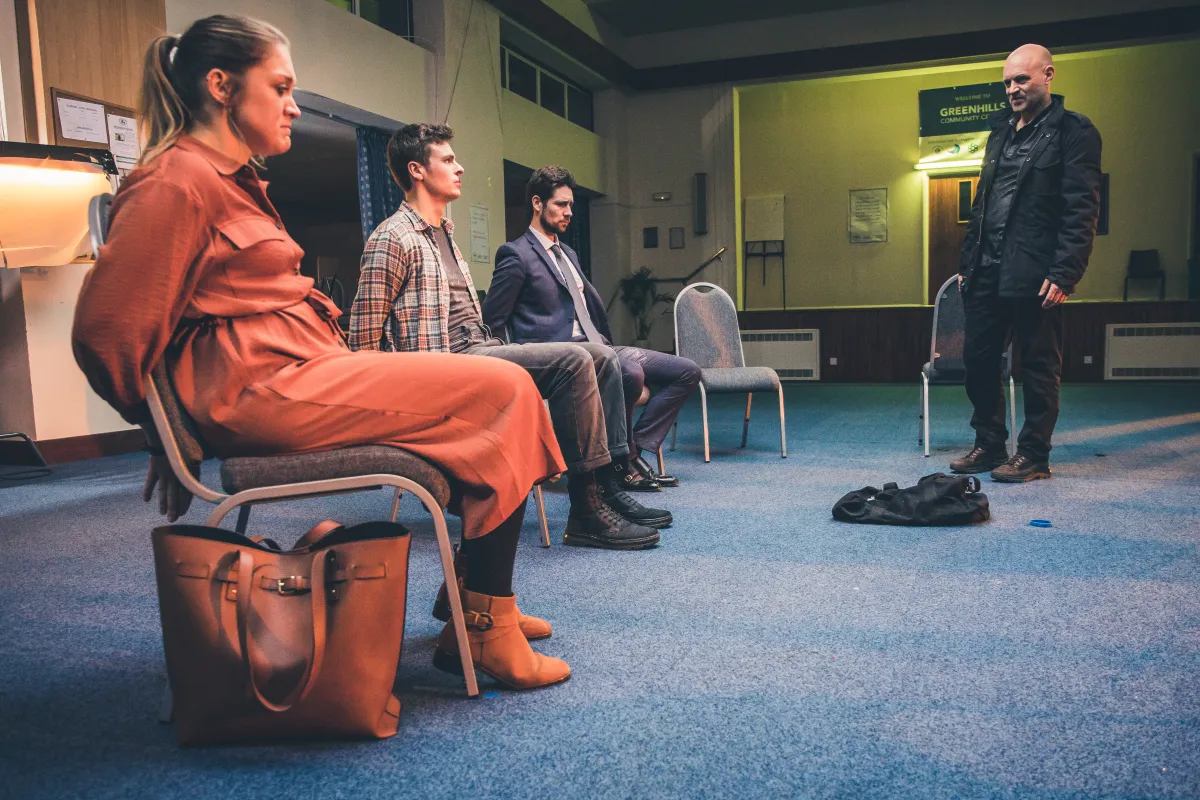
The film begins by introducing us to Kara (Evangeline Burton), a young addict who ends up in hospital when accidentally overdoses. As soon as she's out of the hospital she heads to the local addiction support group, needing the help of her peers in order to figure out what she's to do next. However, it quickly becomes clear that Kara has some sour history with the group, and that her presence there isn't fully welcomed. Despite this, the group allows her in, and the small collection of people present settle in for an uncomfortable, at times almost adversarial, night.

Shortly into their meeting a man named Jack (Dylan Baldwin) arrives, having gained access to the building and locked the exit behind him. Jack is clearly there for trouble, and when the group attempts to leave he pulls a gun and shoots one of them. Tying the others to their chairs, Jack begins to torture them with the skeletons in their closets, forcing them to confront the things they did whilst at their worst, making them reflect on the lives that they damaged. With their lives on the line, and Jack willing to kill any of them, the group have to come together in order to try and survive. 


The Group is a small film. Other than a couple of brief scenes set in a hospital room and a shitty looking flat everything takes place within the confines of a local community centre, the kind of hall that most people will have been to for a party or event at some point or another. It's a non-descript, banal location. And the singular, ordinary setting helps to hammer home the terror that Jack brings with him. It's violence and fear brought somewhere where you would least expect it to rear its head. The sole location channels the focus of the film onto the central cast, all of whom seem to be actors who've had small roles in the past, appearing in a few scattered episodes of British television and independent movies.

However, despite being made up of a cast of relative unknowns everyone here is on top form. Independent and small scale films tend to get looked down upon, especially by people who think that a film will be bad if they don't recognise any cast names in the credits. And whilst there are a lot of small films out there that do have some bad acting in them, The Group absolutely shines due to the central cast. The various members of the titular support group each have a well thought out backstory, with each of them having different reasons for being there and different ghosts haunting them. As the night progresses, and Jack moves from one member of the group to another, each of them get a time in the spotlight.

Jennifer Aries plays Charley, a young mother who's two years sober, working towards getting her son back after her neglect whilst on drugs led to her losing custody. She has a desperation to her that the others don't, a need to make sure that she never goes back to drugs so that she can be the parent her son deserves, and you can see how her past actions weigh heavily upon her. Mike Kelson plays ex-cop Dave who looks at the others as being beneath him, hating them for being 'junkies' where he sees himself as a man with an addiction, thinking that they're somehow not the same. Despite putting out the most 'normal' front there's things in his past that makes him one of the worst people in the room, and discovering that makes for a great moment that has you wondering if out of all of them there he perhaps deserves what he's going through.


Tom Coulson's Henry is a complete dick. He's a businessman who thinks his wealth and power makes him better, makes him important. He doesn't see his drug use as an addiction, just a fun part of the business life that got him into a bit of trouble. He has no desire to better himself, and just wants to tick off the required number of meetings to get the courts of his back before returning to his old ways. Nobuse Jnr plays Eddie, the member of the group who seems to be at his lowest. He's clearly struggling to get by, barely able to pour himself a cup of coffee at one point, who sneaks off to the toilets to shoot up. He's the one who needs the most help, and so it's beautifully ironic that he ends up as the only member of the group not captured by Jack, and so the only one who can help the rest. Alicia Novak plays Ellen, the person leading the recovery group, and perhaps the one we know least about. She plays the part of overly nice by slightly judgemental group leader well, and you're never sure if she's going to have words of encouragement or if she's going to chastise.

Seth, played by Luke Dayhill, is the person who at first seems to be the most put together. He's recovering from his addiction, making amends and fixing his family life, but there's also hints that there's something darker going on beneath the surface. He seems to be the first to want to try and do the right thing, but as the film progresses you start to question the motives he has. Kara, our lead, is perhaps the ideal of the stereotypical drug addict. She's a person who fell on bad times, but isn't a bad person, she's had to turn to crime to fund her addiction, but is trill trying to get better. She ticks a lot of the boxes when it comes to drug addict tropes, but she never feels like a trope thanks to the way that Burton plays her. There's a sense of vulnerability to her, and you feel like her sarcasm and quick comebacks are a defence mechanism designed to stop her from getting too hurt. She's incredibly human, and it makes her the ideal candidate to be the focus.

And then there's Jack, played by Dylan Baldwin. As soon as he's first on screen there's an edge to Jack that makes him uncomfortable, to the point where you can see the rest of the group getting immediately defensive, ready to deal with someone who seems like an asshole. However, he's much more sinister than just being a dick, and when things take a turn it's not too unbelievable. He has an intensity to him that even shines through in his calmer moments where you can see he's a man ready to snap at any moment. He's frightening because he feels so realistic, and will likely remind you of someone that you've probably met at some point.

The Group is a tight, personal story, one with minimal set and cast that makes the most of these limitations. Thanks to a tight scrip from Higo there's not really a moment to be bored, and you end up being drawn further and further into the awful events taking place on screen. Sitting at just an hour and fifteen minutes long, the film flies by, to the point where I felt a little disappointed that it wasn't longer. I found myself so engrossed in these characters and this story that I wanted more; but the film doesn't outstay its welcome, leaving me happy with the experience that I had, which is often more than can be said for some big budget blockbusters.


Support Amy on Patreon

Buy Amy A Coffee

Go to Amy's Blog

Tuesday, 27 August 2024

The Daemon - Film Review


Lovecraftian horror can mean different things to different people. To some it's stories about vast, unknowable monsters from beyond the stars hidden beneath the waters of Earth, to others it's a slow descent into madness, and it can be a twisting of the body into something less human. Depending on who's writing the story it can even forgo a lot of this and just have a tiny sprinkling of one and still be considered a Lovecraftian cosmic horror. The Daemon, however, tries to do a little bit of everything as it charts the horrors that befall a small group of friends who visit a remote lakeside cabin.

The Daemon opens with Elliot (Nick Searcy), frantically writing a letter to his son, experiencing wild and disturbing visions at his remote lakeshore cabin. From here we jump to the city, where his son, Tom (Tyler Q. Rosen) receives the news that his father is dead, along with the note that we saw Elliot writing. As to be expected, the news of a parents unexpected death can have a shocking affect on someone, and Tom essentially vanishes on his partner Kathy (Sara Fletcher), leaving her in the lurch and ignoring her calls. Kathy turns to her brother, Mark (Oscar Wilson) and his wife Jess (Adriana Isabel) for help, and the three of them travel to the cabin to try and help Tom. However, they find something dark and twisted waiting for them instead.

Grief is the main theme of The Daemon, and not just the grief of losing a parent. The two lead characters of the film are Tom and Jess, and each of them seems to have a well of trauma to deal with. From the opening scene of the film where Elliot is leaving a frantic message for his son it's clear that this is a family with a lot of baggage, and as the film progresses we learn more of this and see how it's managed to seep into Tom with the loss of his father. He's not just dealing with that loss, but all of the painful childhood memories that it's brought to the surface; everything that happened up at the lake decades before, and the tragic events that surrounded his mother.


Tragic mothers seem to be the go to here too, as Jess lays out her own trauma and backstory in her very first scene of the film. A therapist and meditation guide who works with criminals and addicts, Jess it trying to help a hardened career criminal named Mani (Mario Daggett) and opens up about her own past, a past that clearly directed her into the life she now leads, and also still hangs over her like a shadow. Whilst this does not help in the moment, and Mani uses it as ammunition against her, it feels like it informs Jess' entire character and the way that we're supposed to think about her moving forward from here. Whilst Mark and Kathy are sympathetic to Tom they're also somewhat dismissive and abrasive to him, but Jess is the only one who seems to understand grief and trauma and tries to connect with him on a different level.

And if this was just a film about family trauma, childhood trauma, and the loss of loved ones it would be fine; however, there's something dark and twisted waiting for these people up at the lake, and it's ready to use these emotions as a way of getting inside them. The horror of The Daemon is kind of subtle for the most part, and goes for a feeling of unease rather than out and out monsters and gore; though the film does have this too. There's a feeling of madness that creeps its way into the narrative the more the story unfolds, and there are times where you start to question if what you're seeing on screen is supposed to be real in the moment or not, nicely reflecting the characters own slipping sanity.


There are a number of moments in the film of more overt horror, moments that employ some interesting make-up effects, gore, and body horror. These are done particularly well, and thanks to the rest of the film having this sense of quite unease mixed in with the mundane these moments tend to land with a great deal of shock. The titular daemon, the thing living beneath the waters of the lake, has a pretty good design, and feels like it's lifted out of the pages of Lovecraft's work. The lake itself is so huge that you could be forgiven for thinking it's the ocean coast, and so something titanic like this existing just beneath the waves isn't too unbelievable. The creature looks good whenever it's on screen, and the final shots of the film are some of the most interesting and beautifully made in the movie that led to me leaving the film with a huge sense of interest and the desire to know more.

But tying all of this horror together are the central cast. It's hard to particularly like many of the characters in the film. Most of them have some pretty big faults, they're abrasive, they're sarcastic, they're annoying, and most of them don't seem to care about the emotional wellbeing of their friend. For example, Kathy is more annoyed at her husband for vanishing during his grief and cares about getting her credit cards working again instead of actually wanting to help heal her partner. The cast play these roles well, and somewhat gear you towards being excited to see them get killed off. Adriana Isabel is the stand out in the film, and manages to bring a lot more complexity to Jess than you first expect. She plays the character as a woman who seems to have her life together, but could fall apart with just a little push. This is demonstrated wonderfully with her opening scene and the way that Mani shapes her for the rest of the film. And whilst Mani himself is only in this one scene, Mario Daggett appears in some dream sequences and hallucinations that expand his role and makes him an interesting presence in Jess' life.

The Daemon feels like a small movie that's trying to take some big swings. It has a fairly small cast, and doesn't have too many locations with which to work. It focuses the horror on the characters rather than a set or some external threat. However, there are moments where you can see a larger budget at play when the special effects work gets put on screen that showcases the creativity of the filmmakers. The Daemon is an interesting movie, one that I feel raises more questions than it answers, and as such might not be to everyone's tastes; but if you have a love of cosmic horror it might just be the thing for you.


Support Amy on Patreon

Buy Amy A Coffee

Go to Amy's Blog

Monday, 19 August 2024

The Strangers - Limited Edition Blu-ray Review


Horror can be a very subjective thing, and there are some parts of the genre that just don't do it for people. Things like ghost stories can get under some people's skin, whilst others will be very bored by it. This is because when dealing with the fantastical not everyone is going to buy into the premise; ghouls and goblins won't really entertain those who have no interest in them. But there are parts of the horror genre that seem to frighten a lot of people, those that deal with the realistic. 2008's The Strangers plays into realism to a large degree, and builds its story around a very easy premise, one that's likely to have creeped most people out at some point in their life; the idea of someone breaking into your home and harming you.

The Strangers tells the tragic story of James Hoyt (Scot Speedman) and Kristen McKay (Liv Tyler), a couple staying in James' family house out in the countryside after attending a friends wedding. The night was planned to be a good one, with James having set up a romantic scene for Kristen after his surprise proposal. However, after turning him down the two of them are struggling to figure out what this means for their relationship. Their personal issues are disrupted though when a strange woman appears at the door, asking if someone named Tamara lives there. 

Despite sending the woman away strange things begin to happen around the house, and when James leaves to buy cigarettes for Kristen things intensify, and she realises that there's someone in the house with her. Thus begins a series of events that will see the young couple being tormented and hunted through the home as three masked killers descend on them. 


I first watched The Strangers when it was released in 2008, having heard a great deal of positive reaction to it, particularly with people citing how the film gets under your skin. Much of this praise seemed to be down to the realism of the plot, and the fear that people had that something so monstrous could possibly happen to them. However, I didn't really connect much with the movie at the time, and never revisited it. But, with the release of Second Sight's new Limited Edition blu-ray I thought now would be a perfect opportunity to rewatch the film that has gone on to spawn an entire franchise.

The film itself is kind of much as I remembered it, a very slow burn of a movie. Slow enough that you'll question if there's even a fire at times. This does mean that there's time to get to know the characters better, but despite this there's still relatively little that I know about James and Kristen. The two of them are struggling to know what her saying no to marriage means for their relationship, but that's about all I know about them. The film doesn't really tell us much about them, and neither character actually seems to want to have the tough conversation as to if they're even still together. A generous view of this would be that the two characters are left somewhat blank intentionally, so as to allow audience members to project more of themselves onto the leads. However, I found that it went the opposite way, and found them to be two of the most blank and least interesting characters in any film that I'd ever watched. It wasn't even as if they felt like bad characters, as even bad ones would have been entertaining; instead, they were just kind of nothing.  

The plot kind of does similar too, and the single sentence summation of 'people break into a house to try and kill those inside' is about all there is here. As mentioned, the relationship story doesn't really do much, and other than that there's big spaces of the movie where nothing much really happens. There are long periods of the film where you'll be watching Liv Tyler wandering around a house on her own, looking out of windows at nothing. By the time the killers get inside and actually start doing something I'd reached the point where I didn't really care much.

Speaking of the killers, the motivation they have for targeting our characters is  potentially not a bad one, with the complete randomness of it all being a big part of the horror of this being capable of happening to anyone. However, when packaged in a film that's already feeling kind of flat and lacking in plot or character it doesn't really stand out to me as shocking or horrifying, and feels like a lack of care or thought from the creators part. 


The best part of the film for me was the end, and not because it was over. The final scene of the truck with the killers inside driving away, stopping to talk to the two kids, and the children then making their way to the house and grizzly sight within had a kind of grittiness to it that made it feel very grounded and unsettling. It had that feel of an 80's horror film trying to make itself seem like it was based on a true story. It's a quality that made this moment in the film stand out, and if the rest of the movie was able to feel this way then I'm certain that I would have enjoyed it a whole lot more. 

Perhaps most interesting of this new release is the extras. I enjoy learning about how films are made, and have been known to spend more time watching through making-ofs as I do the films they accompany. I was very interested to see how the film was made, and learning that the house was as et created within an old warehouse was interesting to me, and seeing the take where the sound hadn't been corrected and you could hear Tyler's screams echoing around the gigantic space was a moment that stood out more than the film itself. The new Limited Edition comes with a number of extras, including these behind the scenes features, and some interviews with cast and crewmembers that are brand new to this release. 

Whilst my opinion on The Strangers didn't change much I was glad to be able to give the film another chance, and the extra features and behind the scenes stuff make this a release that I came away at least entertained by. With two new movies in the series being released in 2024, and a third yet to be given a date, it's a great time to revisit the film that began it all, and this new release will certainly entertain fans. 


The Strangers is available now from Second Sight Entertainment for £17.99.


Support Amy on Patreon

Buy Amy A Coffee

Go to Amy's Blog

Thursday, 15 August 2024

Lore - Film Review


Horror is a perfect genre for the anthology format, with it taking relatively little time to frighten an audience if the creator has enough skill to do so. Because of this, there has been a large influx of horror anthology movies in recent years, often with a very thinly constructed through-line that barely impacts that other narratives on offer. Lore is the latest entry into the genre, and one that actually seems to have taken the time to try and construct an interesting overall narrative that includes every part of the movie into a more interesting whole.

The British horror sees four friends setting out for an adventure get away. Having engaged in horror experiences and escape rooms, the four of them are looking for the next thrill. This leads them deep into a remote forest where Darwin (Richard Brake), the man running the excursion, tells them to set up camp for the night. Once the tents are pitched and the camp fire is roaring he tells them of the discovery of a mass grave in the area years before, and the strange things that happen around the woods. Telling them that the veil between the living and the dead is thinnest here, he gets each of the four friends to tell a story that frightens them to call out to the spirits of the dead.

This leads up into four separate stories, each told by a different member of the group. The first is 'Shadows', and follows Daniel (Andrew Lee Potts), as he runs for his life from a couple of criminal heavies who want either money or blood. Taking refuge inside an old building, Daniel thinks he's gotten away from his pursuers, but once they come in after him he's left hiding in the shadows. However, he's not the only thing in the shadows, as something sinister begins to hunt them down. 

Written and directed by James Bushe, 'Shadows' begins as a fairly traditional horror scenario, of a remote location, a couple of key players, and the monster hunting them in the dark. And the monster design is pretty solid with some decent suit work too. However, as the story continues to unfold it becomes clear that there's something a little different happening and viewers are treated to some fun twists on the formula. Lee Potts does well in the lead role here too, and delivers a fairly strong performance.


The second story is 'The Hidden Woman', by director Patrick Michael Ryder, co-written by Christine Barber-Ryder. It tells the story of a single mother and her young son who inherit a large house when the grandmother of the family passes away. The two of them start to settle into their sprawling new home, but strange things begin to happen, including odd figures glimpsed in the dark of night, and heavy footsteps throughout the house. This is a fairly straightforward ghost story, and it doesn't really do anything new with the haunted house formula. It's fairly comfortable in the sense that you know what kind of things to expect here. However, it's absolutely the best story of the bunch. It's the scariest of the four stories, with some genuinely creepy visuals and some decent frights, and the ghost, played by Jordaine Lincoln, has some truly unnerving and creepy movement that comes from Lincoln's dance and contortionist skills. 

From a haunted house we move on to the much less creepy environment of a seedy hotel, where a lecherous husband, played by Rufus Hound, has pressured his reluctant wife into swapping partners with another couple to 'celebrate' their anniversary. However, when the kinky foreplay leads into the man being handcuffed and seemingly prepared for a sacrifice by the woman he's hooking up with, things take a twisted turn. This story, titled 'Cross Your Heart' and written and directed by Greig Johnson, is something of a comedic tale, and doesn't seem to take itself too seriously. Part of this tone absolutely comes from Hound, who's more well known for his comedic roles, and injects his character with a sense of fun despite you wanting to loathe him.

It's not all fun and games, however, as this story features a substantial amount of blood and gore as the cult takes over the hotel and rushes towards their twisted end game. The effects are pretty gnarly, and there are a few moments that will turn your stomach. Thankfully, the grosses of these borders on being a bit too over the top and so it makes things a bit easier to stomach. Overall, it's a pretty fun chapter in the movie.


The final of the four stories, 'The Keychain Man' written by Patrick Michael Ryder and Christine Barber-Ryder, and directed by Patrick Michael Ryder & James Bushe, is the lightest of the four, and feels like it's bordering on a light hearted spoof of the slasher genre that still wants to be a horror story. It tells the tale of a group of friends who head to the cinema for a midnight screening, but find themselves trapped in the building with a murderous employee who's gone on a killing spree after being fired. From the first moment we see the killer, where he's so large that his head is out of frame, and we get him having to call the manager to help with the till because he's messed it up, it's clear that this story isn't taking things too serious.

This tone follows through with a lot of the character moments, such as the guy in the front row getting angry that people are talking through a washing-up liquid advert, or the cinema employee who assumes one of the survivors is a pervert when he's hiding from the kill in the women's room, being built around having fun more than anything else. And even though this story doesn't skimp on the blood and guts it never feels gratuitous, and borders on the ridiculous, such as a character being bisected with a popcorn scoop. The segment feels like something of a cheeky love letter to slasher movies that fans of the genre will like.

The film ends with the framing narrative, in a way that will raise a few questions as to the true nature of what you've just seen. You'll want to stick around during the credits, however, as some of the lingering questions I had come the end are answered a few minutes later with a nice little coda that puts a decent little bow on things and left me feeling pretty satisfied.

Lore doesn't really do anything new or different, and the kinds of stories we have here will feel familiar to horror fans. But, it feels like the filmmakers approach every aspect of the film with the desire to deliver fun, and they largely succeed. The movie isn't too scary, it's got some humour, there are some great practical effects, and the framing narrative actually feels like an important part of the tale rather than an afterthought to justify the anthology format (a trap that a lot of other horror anthologies fall into). For those looking to have a bit of fun for a couple of hours and want to see a decent collection of British horror, Lore makes for a great choice. 


Lore will be available to stream exclusively on the IFC Channel from 26th August, will be in Select UK Cinemas from 27th September, and then available on Home Entertainment from 21th October.


Support Amy on Patreon

Buy Amy A Coffee

Go to Amy's Blog

Wednesday, 14 August 2024

I Was a Teenage Slasher by Stephen Graham Jones - Book Review


'1989, Lamesa, Texas. A small west Texas town driven by oil and cotton—and a place where everyone knows everyone else’s business. So it goes for Tolly Driver, a good kid with more potential than application, seventeen, and about to be cursed to kill for revenge. Here Stephen Graham Jones explores the Texas he grew up in, and shared sense of unfairness of being on the outside through the slasher horror Jones loves, but from the perspective of the killer, Tolly, writing his own autobiography. Find yourself rooting for a killer in this summer teen movie of a novel gone full blood-curdling tragic.'

Slashers are a popular bunch, often going on to spawn entire multi-media franchises that feature them gleefully killing teens and other victims in a variety of over-the-top ways. You just have to look at the fact that characters like Chucky, Jason Vorhees, and Ghostface get announced in projects like Mortal Kombat or Dead by Daylight as ways of bringing in players to see that slashers are big business. Part of this is that you kind of come to enjoy these costumes killers, eager to watch their antics, to see imaginative kills, or to hear them crack bad one-liners as they gut some hapless teen. But you rarely come to care for them in any real or meaningful way. I Was a Teenage Slasher changes this, however.

Set in the small Texan town of Lamesa towards the end of the 1980's, the book follows Tolly Diver, a young teen who begins the story as a pretty decent, average kid. Tolly works in the local hardware store, helping his mother out where he can. He hangs out with his childhood best friend and secret crush, Amber. He's getting by in life the best he can, neither excelling nor failing. He is, for most part, fairly normal. 

This makes things even more surprising then as Tolly is the titular Teenage Slasher, a young man who will go on to engage in a murderous rampage, killing a lot of people in horrific ways. After Tolly is the target of a cruel prank that takes advantage of his peanut allergy, things spiral out of control, and the kind, decent Tolly becomes a figure of fear.

Written in the first person, the book reads as a memoir of sorts, a confession from a young man who knows what he's done is so unusual, so bizarre and evil that he needs to leave behind an explanation for why he did what he did. Because of this fairly unique point of view for a slasher story, you come to care for Tolly a great deal; more than a murderer deserves by a long mile. There was a fairly recent horror film called In A Violent Nature, that presented a slasher movie from the killers point of view. The film was, for the most part, roundly rejected as being pretty bad. I've even seen some reviews that call it downright boring. I Was a Teenage Slasher is the kind of story that In A Violent Nature wanted to be, as it puts the killer at the centre of the narrative and makes you actually care.

This is not an easy feat, as most of the time fans of the slasher genre like their killers to be either faceless monsters who are more representations of horror than people (think Jason Vorhees or Michael Myers), or they're campy killers who revel in murder and mayhem (Chucky and Freddy Kruger instantly come to mind). Most slasher stories don't want to delve into the inner workings of these people, they don't want to tell you why or how because of the most part it tends to take away from the killer's charm. We know that Michael Myers killed his sister and spent years in an asylum, we don't need to see those years or see how broken he is. Every time a Ghostface killer is unmasked and reveals their motive a Scream film becomes a little less interesting. So, a book that's doing this the entire time probably falls into these same traps, right?

No. Stephen Graham Jones does something that I would never have thought possible, and made the slasher a character that I actually cared about on an emotional level. Tolly is a killer, he does terrible things, but you feel for him at the same time. There are points in the book that actually made me emotional, and I found myself caring for Tolly quite a bit. The book manages to juggle the meta commentary, the winks and nods of the genre, and the bloody gore-filled kills with a story about friendship, love, and family. 

I Was a Teenage Slasher is a fairly unique novel, one that puts in the villains shoes in ways that you don't expect, and gets you to reconsider the way you look at characters like this. A roller-coaster narrative that is packed full of shock and schlock, yet manages to contain a ton of heart too. 


I Was a Teenage Slasher is available now from Titan Books for £9.99.


Support Amy on Patreon

Buy Amy A Coffee

Go to Amy's Blog

Tuesday, 13 August 2024

A Sorceress Comes to Call by T. Kingfisher - Book Review


'Cordelia knows her mother is unusual. Their house doesn’t have any doors between rooms, and her mother doesn't allow Cordelia to have a single friend—unless you count Falada, her mother's beautiful white horse. The only time Cordelia feels truly free is on her daily rides with him. But more than simple eccentricity sets her mother apart. Other mothers don’t force their daughters to be silent and motionless for hours, sometimes days, on end. Other mothers aren’t sorcerers.

'After a suspicious death in their small town, Cordelia’s mother insists they leave in the middle of the night, riding away on Falada’s sturdy back, leaving behind all Cordelia has ever known. They arrive at the remote country manor of a wealthy older man, the Squire, and his unwed sister, Hester. Cordelia’s mother intends to lure the Squire into marriage, and Cordelia knows this can only be bad news for the bumbling gentleman and his kind, intelligent sister.

'Hester sees the way Cordelia shrinks away from her mother, how the young girl sits eerily still at dinner every night. Hester knows that to save her brother from bewitchment and to rescue the terrified Cordelia, she will have to face down a wicked witch of the worst kind.'

Fairy tale retellings are a popular genre. People know the original story pretty well, even if it's not something they've read for decades, thanks to it being a part of their childhood. As such, there will be times when you just want to return to a story that feels familiar, yet still does it's own thing and contains a number of surprises for you. T. Kingfisher has a brilliant grasp at this, and this isn't their first time using stories that you'll know to create her own work. Even her original tales have little nods, even if just tonally, to other writers and stories. Because of this, the normal trepidation I sometimes feel going into a retelling wasn't a factor here, as I knew Kingfisher would steer us right. 

A Sorceress Comes to Call introduces readers to Cordelia, a young 14-year-old who lives alone with her mother, Evangeline. Evangeline isn't your average single mother, however, and the book doesn't hide the fact that she's our villain. We learn that Cordelia is as much a prisoner in her home as anything else, and Evangeline abuses the poor girl at an almost constant rate. Added onto this is the fact that Evangeline has magical abilities and uses these to torture the girl. Despite the terrible conditions, Cordelia manages to find some solace in Falada, her mothers horse familiar, who provides the girl with the only companionship and freedom that she knows. 

When Evangeline makes the two of them leave their home in the middle of the night, and sets her sights on a wealthy squire, Lord Evermore, it sets into motion a series of terrible events. Fortunately, Hester, Evermore's companion, knows just what Evangeline is, and sets out to stop her from achieving her wicked aims, hoping to rescue Cordelia from her abuse at the same time. 

One of the things that I absolutely adored about A Sorceress Comes to Call is the fact that Kingfisher gives readers an older, slightly worn down, female lead, rather than putting all hope of good triumphing over evil onto the pack of some young woman. Hester is pretty no-nonsense, having this air of having been everywhere and seen everything. She gets stuff done and commands respect, and her struggling with her bad knee is the kind of tiny touch that just makes me fall in love with a character. I'll admit, I'm getting on in years, I'm not going to be the young heroine of any kind of story, especially with all of my disabilities, so having an older woman with some bad joints having to step up and be the hero was a wonderfully refreshing and unique feeling spin on the genre.

This is the kind of thing that I really love about Kingfisher's work, those moments of the unexpected, where you think the story is going to go a certain way but then things take a sudden shift. She's also great at melding different genre's together, and despite being a dark fair tale A Sorceress Comes to Call also manages to incorporate a lot of humour into the mix, with some genuinely funny moments that help to break up the tension and the sense of creeping horror. This balances well with so truly dark and twisted moments to create a story with plenty of chills and thrills, along with carefully constructed moments of peace throughout. Like I said, Kingfisher is so good at this kind of thing. 

T. Kingfisher is a writer who I love to read, and I'll pick up her books without even reading the back because I trust her to deliver a fantastic, engaging read that leaves me wishing for more. And A Sorceress Comes to Call is no exception to this. Despite the book being a decent length at 400 pages it flew by, and by the time I got the to end I wished that there was more. Yes, the story was wrapped up and things were done so there wasn't really anything else for the book to do, but I'd happily just hang out in that world following some random side character just to get more of Kingfisher's prose.

Whether you're familiar with the original fairy tale or not, A Sorceress Comes to Call will keep you not only entertained throughout, but will dig its claws in and refuse to let go. T. Kingfisher is one of the best writers out there, and you'd be an absolute fool to miss out on yet another fantastic addition to her catalogue. 


A Sorceress Comes to Call is available now from Titan Books for £9.99.


Support Amy on Patreon

Buy Amy A Coffee

Go to Amy's Blog

Thursday, 25 July 2024

Smothermoss by Alisa Alering - Book Review


'Ferns grow knee-deep along the shoulder, laced with briars and unripe raspberries, so thick they could hide a bear. Could hide anything, really.

'In 1980s Appalachia, life isn’t easy for Sheila. She endures relentless taunting and bullying at the hands of her classmates; she takes care of her great-aunt, the garden and home, and the rabbits; and forages for mushrooms in the forest, all while her mother works long, back-breaking shifts at the nearby state asylum. But it’s her peculiar little sister, Angie, who worries her the most. Angie is obsessed with nuclear war, Rambo, zombies, a Russian invasion of their community, and the ominous, tarot-like cards that she creates that somehow speak to her. As if all that weren’t enough, Sheila feels an unexplainable weight around her neck. Is it the ancient and strange mountain that they live on that casts its shadow on her, or something or someone else unknown? Unseen?

'When a pair of female hikers are brutally murdered on the nearby Appalachian trail, Sheila and Angie find themselves inexorably drawn into the hunt for the killer. As the ever-present threat of violence looms larger, the mountain might be the only thing that can save them from the darkness consuming their home and their community.'

Appalachia is a place where I'm used to seeing horror; it's a creepy setting that writers have returned to time and time again over the years. And whilst I'm used to seeing it in a historical setting Smothermoss surprised me by being a more modern Appalachian horror; though the 1980's is now classed as a historical setting and that alone feels like something that should elicit horror.

Smothermoss tells the story of two teenage sisters, Sheila and Angie. Sheila is the older of the two, seventeen years old, and lives with her thirteen year old sister Angie, their great aunt, and their mother. Whilst their mother is out working every hour she can get at the local asylum Sheila has to step up and run the household. Added on top of this, the family is poor, struggling to get by, and Sheila is the target of relentless bullying by her peers. Life isn't great for her. When two young women are murdered close to their home on the remote mountain trail, Sheila and Angie set out to find out what happened.

Despite having a relatively short length of just over two hundred and fifty pages, Smothermoss never feels light, and Alisa Alering packs a lot into the pages of her debut novel. However, there are times where there was so much happening within the book that I did on occasion feel a little lost, and wondered if perhaps I was missing some details or two. This could also be down to the fact that there's a lot of strangeness in Smothermoss, the kind of horror that blurs the lines between real and the bizarre, and leaves you questioning if what you read was real, or simply the strange imaginings of our central characters.

The book is very dark too, and there's a heavy tone to it from the very first few pages. The atmosphere is bleak, and at times outright oppressive, and despite our characters living out in the beuatiful nature of Appalachia it feels more claustrophobic than you'd think. Nature is less something of beauty here, and more of an oppressive and even brutal force that shapes the lives of all those who live within in. There are few moments to be found where our characters get a chance to smile or joke around, and the joy that does happen is so fleeting it almost feels like it doesn't happen. This somewhat plays into the imaginary worlds that play a large part in the narrative, ways in which Sheila and Angie are able to escape from the horror and misery of their everyday life.

Magic realism is a bit part of the story, and because of this it can sometimes be hard to discern if things are real or not. Is there really an invisible, magical rope around Sheila's neck that ties her to the mountains, or is this just her imagination conjuring a metaphor for her situation? The book doesn't really provide an answer, or at least one that I picked up on, and as such leaves a lot down to the readers to decide. You can come away from Smothermoss having experienced a story steeped in the magical and mystical, whilst another person can read the book and dismiss a lot of those moments as simply not being real. It's a novel that each reader is going to get something a little different from. 

The novel also has a lot of themes for growing up, for navigating teenage life, and exploring queerness and gender identity and expression. But it also feels a little like Alering was a bit reluctant to fully explore this in any great depth. Again, much like the supernatural side of things, readers can come away with different reads on the characters and their journeys, and the reluctance to take a firm stance means that some important themes can likely be easily brushed off, seen more as audience projection that actual content within the book. 

I'm still not sure exactly how I feel about Smothermoss. There are a lot of parts that I really liked, whilst there were others that I failed to connect with and didn't really understand. Despite being a short book it felt like a long, heavy read at times, and there was certainly a lot going on within the pages. Smothermoss might really connect with you, however, and the fact that it didn't with me is by no means a condemnation of it. I'm probably just not the ideal reader for it; but there will absolutely be readers out there that are going to love it. 


Smothermoss is available now from Titan Books for £9.99.


Support Amy on Patreon

Buy Amy A Coffee

Go to Amy's Blog

Wednesday, 24 July 2024

The Double-Crossers - Blu-ray Review


The Double-Crossers is the latest Hong Kong action movie from Eureka Entertainment to receive the Blu-ray treatment, offering fans of the genre the chance to discover this lesser known film. 

The movie begins with the brutal murder of the father of police officer Lung (Shin Il-ryong), who's found stabbed to death in his shop. Unsure of why anyone would want to kill his father, Lung is shocked when he finds a cassette tape left for him, one in which his father explains why someone would come to kill him. It turns out his father used to be a major criminal before Lung was born, that he and two of his partners were into some very questionable things. Having left his life of crime behind to be a husband and father, he's sure that one of his old partners would one day come for him. 

Angered by the news, Lung swears to get revenge against the man who ordered his fathers murder. Lung publicly resigns from the force, but secretly goes undercover as a cop turned criminal, and set out to Hong Kong to take down Wang (Chao Hsiung), his father's former partner and head of a criminal empire. With the help of a smuggler named Chang (Chan Sing), and a young woman that Lung begins to fall for, a plan is formed to bring Wang down for good. 


At the time of The Double-Crossers release, 1976, Bruce Lee was a huge cinematic draw, and everyone was trying to cash in on martial arts movies, and was trying to find the next Bruce Lee. It's not too hard to see how The Double-Crossers fits into the 'Bruce-spolitation' mould. Despite this, the film has it's own identity, and very shortly into the movie you begin to forget about the time in which it was made and simply start to enjoy it for what it is; largely due to the film just being a lot of fun.

One of the things that the film has going for it is that it moves at a pretty fast pace, and goes through a number of different plots that could in itself be their own movies. For example, there's a point early in the movie where Lung and Chang rob an armoured car filled with cash from Wang's men, posing as cops to do so, in order to disrupt his operations and get the cash they need to enact their further plans. This could easily have been the main focus of the film, a heist movie where getting the cash was the end goal to bringing Wang down. Instead, it was the warm-up act, the things to get you into the rest of the story, and to showcase our protagonists as competent. The film moves on quickly, but it doesn't feel rushed, none of the plots in The Double-Crossers does. Instead, the film feels well packed, with a number of different plots and characters that all get their chance to shine.


The cast does a great job throughout too, and Shin Il-ryong proves to be very charming in the lead role. He often comes across as quite cold and intense, trying to keep to himself whilst on his quest for revenge, but as the film progresses you see him opening up to more and more people, letting his guard down and finding moments of happiness despite everything that's happening to him. Come the end he's even laughing and joking. I can't help but feel that it's rare to see a revenge movie where the lead isn't just depressed or angry the whole time, and as such Shin Il-ryong absolutely stands out to me here. 

The new Blu-ray release features both two versions of the movie (the original Hong Kong release version, and the English language export cut) and brand new audio commentaries for both. Frank Djeng provides the commentary on the Hong Kong version of the film, and anyone who's familiar with the Eureka releases will know to expect the usual insightful and jam packed commentary from Djeng. The other commentary covers the export version, and features mainstays Arne Venema and Mike Leeder, who take on a more relaxed, conversational approach to things. Unfortunately, other than the commentary tracks the release is fairly light, and only offers a trailer to go along with things. 

Despite not having many extra features, this new release absolutely offers a lot for fans, with two versions of the movie and two in depth commentary tracks there's a lot here for fans of Hong Kong cinema to sink their teeth into. Whether you're a fan of The Double-Crossers, or this is your first time with the movie, this new release is a great experience. 


Support Amy on Patreon

Buy Amy A Coffee

Go to Amy's Blog