Saturday, 22 June 2024

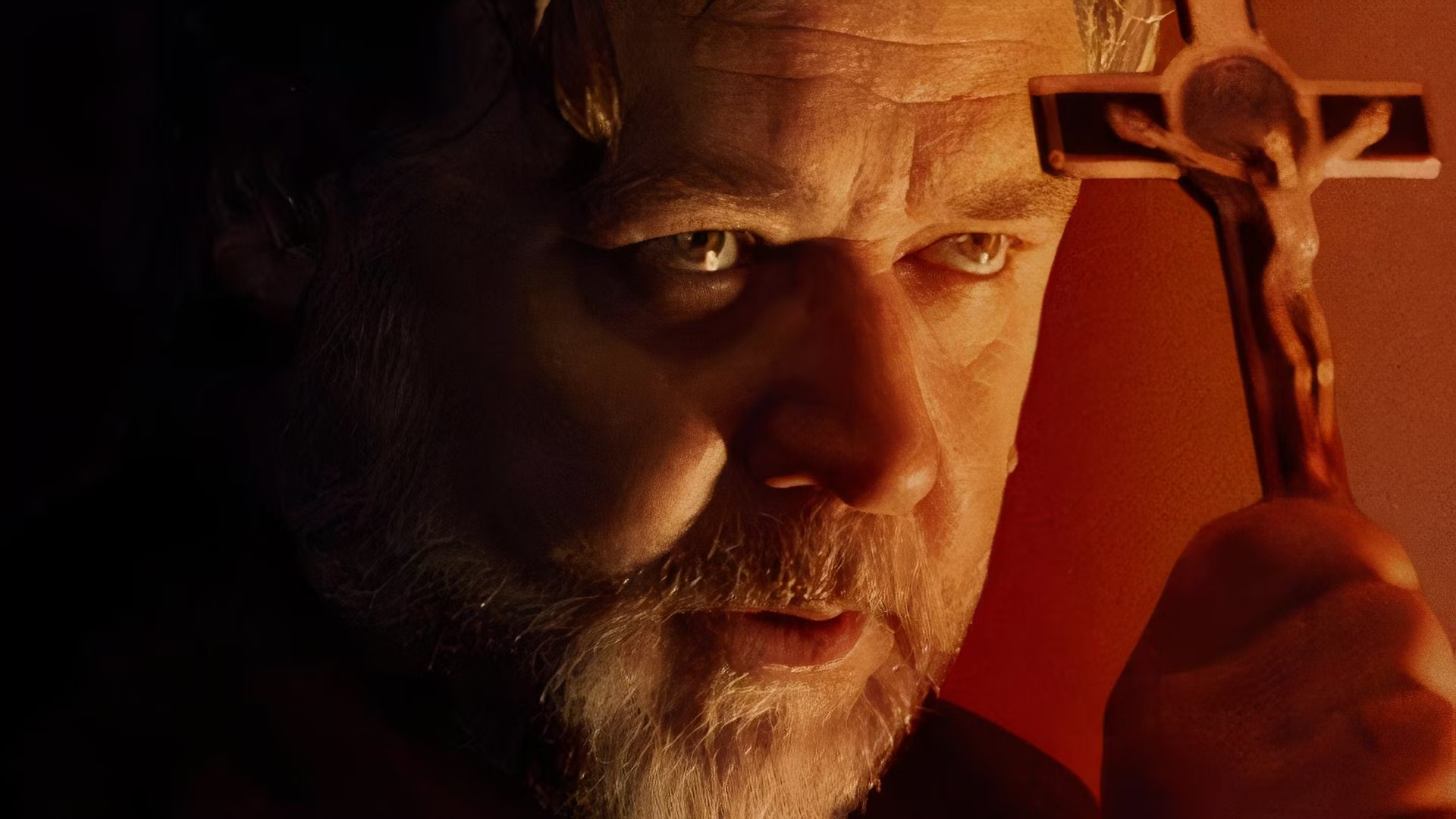
The Exorcism - Film Review


The Exorcist was a film that redefined the horror genre, and sparked a whole slew of exorcism themed movies that still exist to this day. It's impact was so felt that any movie released even fifty years later that touches upon exorcisms and demonic possession will invariably be compared to; hell, it's the first thing I've spoken about here. The Exorcism, Russell Crowe's second exorcist movie in a year, This time however, he's not actually playing a priest, he's playing a man playing a priest in a film.

The Exorcism opens with a monologue about how a man has lost his faith, a speech which very quickly proves to be lacking any real conviction, as we see a man reading from a script. Stepping out of a car, he walks up to a house, whilst reading lines and stage directions from the script in his hand, and enters the home. Walking through the house, he ascends the floors until he reaches the third floor bedroom. At this point the camera pulls back to reveal a life sized doll house in one of the more interesting shots in the film. Our film as begun within the soundstage of a movie, and we're following an actor as he practices for his role as a priest called in to exorcise a teenage girl. However, some unseen force quickly dispatches him, leaving his role open for a recast.

From here we meet Anthony Miller (Russell Crowe) and his teenage daughter Lee (Ryan Simpkins). Anthony is a washed up actor, a man who lost it all after his wife died of cancer and he retreated into drink and drug addiction. With his career and reputation all but ruined, he's trying to find a way to claw it back, whilst also doing his best to repair his strained relationship with Lee. This sees Anthony audition for the role of Father Anthony on 'The Georgetown Project', a movie clearly influenced by, or possibly being a remake of, The Exorcist.  Fighting through a tough audition that sees director Peter (Adam Goldberg) getting Anthony to push deep and draw upon his own history of trauma, Anthony gets the part that he hopes will reignite his career. However, not long after getting the role Anthony starts to undergo a change, one that Lee thinks may be more than a slip back into addiction, and may involve otherworldly forces.


There's a lot to The Exorcism to like, but there's also an equal amount of the film that feels somewhat frustrating as it never fully explores or commits to most of the ideas it presents. The first of these is the film within the film. I loved the meta angle of The Exorcism, and the exploration of the making of the movie. The film makes mention of how some movies in the genre have had troubled productions in the past, the idea that they attract bad things to it. This feels like a clear reference to the original Exorcist, and is a perfect cover for the people working on The Georgetown Project to dismiss the paranormal incidents, or to lean into their belief that dark forces are at work. The fact that we also see special effects artists making an animatronic head that can spin around, and the basic plot seeming to mirror The Exorcist makes it feel like this is a film about a remake movie. However, it's never outright said that that's what we're seeing. It's likely a rights issue, but the failure to commit fully to it does feel like a wrinkle in the narrative.

This is something that I felt throughout the film, a failure to fully invest in the ideas that are presented. Anthony is a recovering alcoholic and drug addict, and this has damaged his relationship with his daughter. This addiction is used throughout the movie, as Anthony begins drinking again. But we're not shown his fall back into addiction, we just have other characters talking about how he's drunk, then we see him downing a bottle of whiskey. The moment of his relapse, of this man desperate to put his life back together and failing is an important one, but we don't get it. 

Similarly, there's mention of childhood trauma around the church, with Peter making the implication that Anthony was abused by a priest. This seems to be a root cause of a lot of issues for him in the film, especially in playing a priest, yet we never really explore this past. There are flashbacks scattered throughout the film that hint that perhaps the abuse was less sexual in nature, and some kind of dark, satanic type incident, which opens a whole load of questions about his possession here and if the seeds were laid for it decades before. But again, the film doesn't explore this angle. Both Anthony's alcoholism and his childhood abuse are huge parts of the story, but neither of them feel like they're given the appropriate time or space to really matter.

Despite this, Crowe seems to do his best to deliver a layered performance to his character, and the earlier moments in the film where he's back drinking, sleepwalking around his apartment, and speaking in bizarre, broken Latin are great as you question whether or not this is the sign of the supernatural, or the mental breakdown of an incredibly broken and traumatised man. If it wasn't for the opening scene involving a clearly otherworldly force you could very much go through a lot of the film wondering if it was going to be a real possession or not.


Ryan Simpkins, the film's secondary protagonist, manages to match Crowe's performance well, shifting from the indignant, rebellious daughter to a more caring role as she witnesses her fathers deterioration. She's the only person who seems to care for him, with others relegating him to the 'pathetic drunk' category. Simpkins, however, pushes the narrative forwards, and tries to do what she can to help Anthony. She gets help from The Georgetown Project's young star, Blake Holloway (Chloe Bailey), with whom a strong relationship begins to form, and the movie's religious advisor, Father Conor (David Hype Pierce), who comes to believe that a true evil is taking over Anthony. 

Despite the decent performances the film failed to really grab my attention. The plot felt mostly predictable, with the expected journey playing out without much depth or even any innovation. The film felt lacking for most of it's runtime, even if I couldn't really place my finger on what. Perhaps the film would have been more interesting if it explored the film within a film more, or if it showed more of Anthony's journey, or if it gave more definitive answers. As it is, The Exorcism feels like it's trying to do several things at the same time, and as such doesn't have the time to fully commit to any of them. Shallow would perhaps be the best word to describe it.

Whilst there's nothing obviously bad about the film that makes it unworthy of a higher score there's nothing about it that stands out as particularly memorable and I honestly can't see myself thinking about this film at all in the future; except perhaps the occasional memory of Niles Crane trying to get a demon out of Russell Crowe whenever my mind goes to Frasier. The Exorcism has some interesting ideas, but don't expect them to really pay any of them off. Not a bad way to spend an hour and half, but there are much better ones too. 


The Exorcism is released in cinemas 21st June 2024.


Support Amy on Patreon

Buy Amy A Coffee

Go to Amy's Blog

Friday, 21 June 2024

The Sacrament - Limited Edition Blu-ray Review


The found footage genre comes with a number of expectations thanks to most of them falling into certain tropes, the chief of these being a group of people grabbing a camera they don't really know how to use in order to capture some kind of paranormal event on film. However, there is one other style that often gets notice even though it's not used very often, the documentary style. The Sacrament, written and directed by Ti West, fits nicely into that subgenre, and presents a very realistic and grounded horror story that will get under your skin more than any film about ghosts and monsters can.

The Sacrament tells the story of a trio of journalists, fashion photographer Patrick (Kentucker Audley), Vice reporter Sam (A.J. Bowen), and cameraman Jake (Joe Swanberg), who start looking into a mysterious commune deep in the jungles of South America called Eden Parish. The group comes to their attention after Patrick receives a letter from his sister, Caroline (Amy Seimetz), who has been off the radar for a time whilst dealing with her drug addiction. Wanting to learn more about this remote community, and to check in on Caroline, the three of them decide to travel there and document the journey.

Arriving at the remote location, accessible only by helicopter, they find armed guards protecting the newly constructed commune. Allowed inside, the trio begin to learn more about Eden Parish, talking to others who have given up their worldly possessions to move across the world to live there in peace and harmony, away from the temptations and evils of the outside world. It's all hailed as the work of a man known only as Father (Gene Jones), a charismatic figure who brought them all together, and leads them in their religious ways. As the reporters learn more about Father and this community it becomes clear that there's something more sinister at work, and when some of the residents of Eden Parish come to them for help it sparks a series of events that leads to terrifying results. 


If, like myself, you know a little about true crime and cults the inspiration for The Sacrament will jump out of the screen at you barely ten minutes into the movie. As soon as our protagonists began to describe Eden Parish I was getting distinct Jonestown vibes, and seeing it, deep in the rainforest with its wooden buildings and large open fields, only cemented that feeling. And as soon as you're aware that this is where the director has drawn inspiration you're waiting for things to go bad. The film doesn't have jump scares, it doesn't have frightening things on screen for the vast majority of its run time, because it doesn't need to. Instead, it slowly builds dread as you learn more and more about this brainwashed community, revealing small hints at the darkness hiding beneath the surface.

The movie is genuinely one of the most tense I've watched in a long while, and the feeling never really leaves. It's built up well, and like the characters in the film there's nothing you can openly point to as a clear sign of something bad, but you know it is. The way that the supporting cast talk about their community, and Father, is unsettling, even though you can't argue against them. And this is where Gene Jones comes into play wonderfully. The first time we meet Father is during a community gathering where he comes out to answer questions for the reporters. Jones has incredible charisma in this scene, and his answers are all well thought out, and sound well meaning. It's hard to argue against him, he sounds reasonable and caring, and it really hammers home how easily the people who create these kinds of cults in the real world are able to do so. 

With the inspiration for the film pretty clear, the destination is extremely obvious, and I don't think it's too much of a spoiler to say things go horribly wrong in Eden Parish. The scenes of Father instructing his followers to willingly take their lives are some of the most harrowing I've ever seen on film. There's nothing obviously violent here, people are just taking a drink, but the level of tension involved, the way the extras play it, and the ever mounting dread make it a shocking things to watch. The fact that you see parents and caregivers feeding poison to children and babies makes your stomach drop. Perhaps it's because I knew about Jonestown, that I knew this was basically what happened in real life, but the reality of this moment made it all the more horrific; this isn't just something that could happen in real life, it already had.

The latter portion of the film manages to be more horrific than you first expect, and the quietly chilling scenes of people drinking poison are only the opening act in a conclusion that had me holding my breath more than once. It left me feeling shaken, and may be one of the more affecting horror film endings that I can think of. The fact that the film has been shot and presented in a documentary style absolutely helps with this, and whilst the film would still work fantastically as a regularly shot movie the first person camera style drops you square into events and makes them hit all the harder as you feel less like an outside observer and more of an active participant. 


Whilst the core cast of characters do well, and the three journalists are great in their roles, it's the members of Eden Parish that really shine. Amy Seimetz is fantastic as Caroline, a young woman who presents perfectly reasonably to begin with, someone who's battled addiction to put their life together again; but as the film progresses we see a more manic, fervent side to her, a craziness that reveals a chilling side to her that was hidden the whole time. The turn is fantastic, and hers is perhaps the most fear inducing performance in the film. Gene Jones, on the other hand, frightens in other ways. He never loses his cool, he never stops sounding caring, and it's this that makes him frightening. You can believe that he could convince people to follow him into the jungle, to give up everything, and even take their own lives. He presents the best depiction of a cult leader I've ever seen, and every scene he was in he stole from everyone else.

Whilst the film itself is exceptional, the rest of the new Blu-ray presentation packs in a decent amount of behind the scenes features. The disc comes with four new interviews with the main cast of the film. These range in time from ten minutes to around thirty minutes, and offer some extra insight into the film. The interviews cover how the actors came to be in the film, what it was like to make, and the impact that it had on their careers. Jones in particular stands out, especially when he speaks with such love for how the movie affected his career. There is also an interview with producer Peter Phok, who covers his career and work with Ti West outside of The Sacrament as well. There's an hour long making of that has some behind the scenes footage and interviews. And there's a video essay by Alexandra Heller-Nicholas, who looks at the found footage genre and how The Sacrament plays into it. The only thing that really feels like it's missing from the disc are interviews with Ti West himself (which is not always possible with working directors and their busy schedule), and a commentary track. Whilst the commentary in particular would have been nice to have, and is usually include in Second Sight releases, it's absence is far from a deal breaker. 

Having never heard of The Sacrament before watching it I was shocked by how hard hitting a film this was. Forgoing many of the tropes of the found footage genre, of ignoring dark, spooky locations, and basing itself squarely in reality, the film already feels like it's setting itself apart. However, when you include the very realistic, very disturbing content and the frankly phenomenal performances, I'm shocked and appalled that it's not a film I'd heard of before. The Sacrament very much deserves to be on lists of top horror films, and if like me it's one that you've never stumbled across before this new Limited Edition release is the perfect way to discover it. 


The Sacrament is released on Blu-ray and Limited Edition Blu-ray on 24th June 2024 from Second Sight.


Support Amy on Patreon

Buy Amy A Coffee

Go to Amy's Blog


Thursday, 20 June 2024

The Valiant Red Peony: Red Peony Gambler 1–3 - Blu-ray Review


Whilst films from the US have struggled to really centre a female action lead Japan has been comfortable letting female protagonists take the centre stage for a while, and the Valiant Red Peony film series from the late 1960's and early 1970's showcases this well. Collecting together the first three films in the eight film series, Eureka Entertainment has given modern audiences a chance to discover these classic female led action films.

The series follows OryĆ« ​​Hibotan, played across all eight films by Junko Fuji, a young woman who finds her life thrown upside down when her father, a Yakuza boss, is murdered. Despite her father wanting OryĆ« to get away from the family business his death ends up dragging her into a world of murder and revenge. OryĆ« vows to 'be a man', seeking our revenge and taking on the name Red Peony after the tattoo on her shoulder. Becoming a wandering Yakuza, the series follows OryĆ« from one adventure to another.

The first of the films charts her origins as the Red Peony, going after the people who murdered her father with the aid of a fellow wandering Yakuza named Katagiri Naoji (Ken Takakura). The second film sees OryĆ« getting involved with a gang trying to take over the silk trade in the area as they put the local villagers through hell; becoming the hero the village needs, she sets out to make things right for them. The third and final film in this sets sees OryĆ« on the trail of another female warrior, one who has been claiming to be her. Trying to repair her tarnished reputation, she discovers a pair of star-crossed lovers being used as pawns by rival gangs, and must try to broker a peace between the warring groups. 

Having never heard of the Red Peony Gambler series before this set was announced I was interested to discover another lengthy Japanese film series. Having recently watched the first three films in the Abashira Prison series I was interested to see another crime series from the same era, though one with a completely different tone to that one. Set during the Meiji era, the series is historical, and as such every location and set is something made to be on the screen, and the films look fantastic because of this. The films are visually stunning, and whilst each of the three directors for these films have their own particular styles and signatures they all work together well, and create a visually interesting trio of films. 


Junko Fuji is the biggest draw to these films however, and the actress is hugely impressive here. She plays OryĆ« as a somewhat aloof character at times. She's hard to read, with little to no emotion on her face for the most part, a trait that a wandering gambler would need. However, there are other times when you can see the emotions peeking through, where her stoic mask begins to crack and you can see the pain and depth of emotions underneath. Fuji is phenomenal in these three movies, and it's easy to see how she was able to headline a series of eight films. She's beautiful and talented in equal measure, and there are a number of scenes here that prove she has the chops to be both a brutal action star and the headliner for more serious movies. It's a shame that this series ended with her retirement from acting, as you can really see that she'd go on to become one of the best actresses in Japan if she'd have continued on; and that it's like this series would have had a lot more than eight films. 

The new release from Eureka offers new audio commentary tracks on each of the films with film experts and historians that offer unique insight into the films and their place in Japanese film history. Each of them prove to be interesting, and it's clear that the people involved, Chris Poggiali, Mike Leeder, Arne Venema, and Tom Mes, are all knowledgeable on the subject. There's also a brand new interview with Asian film expert Tony Rayns, who talks about the films in a general sense, as well as going into further detail on the third films director Tai Kato. There is also the accompanying booklet, which features some informative new writing.

Overall, this is a very fine set that can either be a fantastic introduction to this series for new fans like myself, or a great way of watching a trio of old favourites. The set makes a great addition to any Asian film collection, and will hopefully be the first of the series released as there are still five more movies to go. 


Support Amy on Patreon

Buy Amy A Coffee

Go to Amy's Blog

Wednesday, 19 June 2024

Gonjiam: Haunted Asylum - Limited Edition Blu-ray Review


I've been a fan of horror my entire life, and have enjoyed finding new horror films to seek out, a search that has led me to some wonderful gems that don't get enough attention. One film that I had heard recommended over and over again was Gonjiam: Haunted Asylum. However, I was never able to find a copy of it. It seemed like DVD's of the film were few and far between, and whenever I thought to look for it it was never available on streaming. It became a film that I desperately wanted to watch but never could. However, with their new Blu-ray release Second Sight have given me the opportunity to finally see it, and even with all of the hype and whispers I've heard about it over the years it still managed to exceed my expectations to become one of my new favourite horror films.

The film follows a group of online ghost hunters, Horror Times, as they plan to live stream an investigation into the abandoned Gonjiam mental asylum. The asylum is on their radar since featuring on a list of most haunted places in the world (something taken from real life), and some footage of schoolkids trying to get into a locked room within the hospital went viral. Hoping to make millions off the sponsorship deal if they're able to get a million viewers at the same time, the people at Horror Times recruit some volunteers to head into the hospital with them. 

Gonjiam: Haunted Asylum is a found footage horror movie, a sub genre that is often immediately written off as being bad. Whether it's the fact that there was a huge boom in the style in the 2000's following the success of films such as Paranormal Activity and The Blair Witch Project thanks to the affordability of better personal camera equipment, or that many of the films in the genre emulated each other, the found footage genre seems to be one of the most hated. However, I think it can also be one of the more creative, especially when the filmmakers are trying to say something. Gonjiam does try to do things a little different, and is one of the first found footage films to move away from the guy with his home camcorder trying to capture ghosts approach and instead moves towards a critique of the internet ghost hunting boom.


Entertainment has changed with the creation and increasing popularity of YouTube, and it has become one of the chief sources for video entertainment in the modern age, with certain YouTubers having becomes incredibly rich and receiving celebrity status. It's a place where the ghost hunting shows have made great headway, with multiple channels engaging in both personal ghost hunts, and clip compilations of paranormal footage. This is what Gonjiam uses as it's basis for the film, as its main cast are either YouTubers, or people brought in to take part in a livestream. This isn't just used as the framing for the movie though, and it's also used as a justification for things continuing on where normally you'd run screaming. The people involved want to make money, they're convinced to keep going with the promise of fame and fortune, and they keep filming because they're literally strapped into a camera rig and can't drop their camera. It's a great justification that sidesteps a lot of the criticisms of the found footage genre well.

The first part of the film follows this group of characters as they get to know each other, travelling through the country to reach the Gonjiam asylum. Some of the characters come across as honest, whilst others already seem to be acting up for the cameras, putting on a false persona for their viewers. This is something that follows across into the actual investigation when it becomes apparent that the people at Horror Times are faking the paranormal encounters in order to drive up viewership and make more money. It feels very much like Jung Bum-shik, the writer and director, is taking shots at the kind of content creators who produce over-the-top entertainment for engagement and money, rather than trying to make a true and honest piece of art. 

However, this is a horror film, so of course the fake paranormal encounters are just the prelude to the true horrors that await within the walls of Gonjiam. The film does this well, making you believe that the fake encounters are real for a while, before revealing to the audience that some of the characters are being tricked. When it becomes apparent, however, that not everything you're seeing is staged it makes the creepiness from earlier in the film hit a lot harder. The reveals in Gonjiam are incredibly well done, and there are multiple moments where you can feel your stomach suddenly drop as you realise you've seen something truly horrifying. 

If there's other found footage films that I can compare Gonjiam: Haunted Asylum to it would be As Above, So Below and Grave Encounters. Both of these films begin fairly normally, and very quickly descend into a form of cosmic horror. Things don't make sense, reality warps, and you soon realise that even if the protagonists wanted to run away and get away from the horrors they literally can't. Gonjiam is like this, it subverts expectations and bends the rules in order to keep the horror going. Unlike Grave Encounters though, which is also set in a long abandoned mental hospital, Gonjiam doesn't try to explain itself. There's no final act reveal that the hospital staff were engaging in black magic or anything as silly as that. Instead, the horror just happens with no rhyme or reason and you're left to grapple with it all by yourself, further adding to the unease and wrongness of it all.


I'm trying to avoid talking about the actual plot or the types of scares in the film as this is very much a movie where the less you know about it before going into it the better. All I knew was that it was set in an asylum and was found footage, and because of that I had an absolute blast with the movie. Every twist and turn in the story, every jump scare, every long, tense scene that didn't follow the rules, and every horrific entity that we encountered just kept ratcheting up the tension. The film sits at a decent 91 minutes in length, which is about average for this kind of film, but by the time the end comes it feels like it's barely begun. The film has such a great pace to it, with a story that draws you in so much that by the time it comes to an end you'll be upset that there wasn't more to the film to keep you in longer.

However, that's where Second Sight has us covered quite nicely. Alongside the film the new set comes with a brand new audio commentary by Mary Beth McAndrews and Terry Mesnard, horror experts and hosts of the Scarred For Life podcast that's very engaging and almost relaxing to listen two as the two hosts engage in a comfortable banter. There's also a new video essay by horror journalist ZoĂ« Rose Smith who goes into haunted house movies and their appeal, alongside several older featurettes that have been on previous releases. These older releases delve into the making of the movie a lot more, chatting with the cast and their experiences as actors, as well as going into the technical challenges the movie faced with some key members of the crew.

Gonjiam: Haunted Asylum might not be the most original horror film ever made, and whilst it's one of the first to explore the online streaming side of found footage much of the plot and scares are the kind of thing you'll have seen in other releases. However, the way that it's all put together and the execution make it one of the most entertaining, and frightening, horror films I've seen from the last ten years. The film did exceptionally well in South Korea, and it's not hard to see why. This is absolutely going to be a film that I'm going to watch several more times, and will be recommending to any horror fan.


Gonjiam: Haunted Asylum Blu-ray and Limited Edition Blu-ray are released on 24th June 2024 from Second Sight.


Support Amy on Patreon

Buy Amy A Coffee

Go to Amy's Blog

Tuesday, 18 June 2024

The G - Film Review


There are some very messed up laws in the world, this is nothing that is news to any of us. However, some laws that a lot of people will be unaware about are those in the US that grant someone guardianship over another. Perhaps the most famous was the conservatorship of Britney Spears, but it's more often than not something that affects the elderly in the States. Nichelle Nichols, best known for playing Uhura in Star Trek is under such a law, and people have been campaigning to free her from it for years now as it's believed those around her are abusing her financially. Sadly, her story is far from the only one, and it's something that has, and continues to, affect a great many number of people. This is the basic premise of the new film The G, which sees an elderly couple placed under the guardianship of some shady criminals who want nothing more than to get their money and assets. Unfortunately for them, they picked the wrong woman to mess with. 

Opening with a scene of two men in digging a hole in the middle of some wasteland during the cold winter, we see that they're burying an old man in an unmarked grave. Already a grizzly sight in itself, things become even more horrifying when we see that the man is still alive whilst they're doing it. This scene sets the tone for The G early on, and the terrifying grimness of that moment compels the viewer to keep on watching, even if only to see them men performing such a heinous act be brought to some form of justice.

From here we meet Anna Hunter (Dale Dickey), a grouchy and vicious elderly woman affectionately named The G by her granddaughter Emma (Romane Denis). Anna is a fiercely independent woman, one who doesn't take crap from anyone and will call any who try every swearword under the sun. However, her health is failing, and her sick husband relies on her to take care of him. Despite trying her best, things are not going perfectly for the couple. This brings them into the attention of a group of criminals. This group, who have doctors and judges working with them, find elderly people that they think have money, and have them signed into a guardianship without their knowledge. These guardians then ship them into a prison-like facility, selling off their homes and taking possession of their bank accounts.

Despite how cruel and despicable this is, it's perfectly legal, and as such Anna finds herself at the mercy of these men, men who are happy to beat her husband in front of her to try and get more money out of the two of them. Thus begins a story that sees Emma trying to find a way to get her grandmother out of the facility she's being held in, whilst Anna reaches out to some old, powerful, and violent family connections she has back home in Texas.


Dale Dickey takes the centre stage in The G, and is an actress that I think a lot of people will recognise for small parts in various projects over the years, such as Fallout, Breaking Bad, and True Blood. Dickey has been in a lot of things, bit always seems to be in supporting roles. The G, however, gives her the chance to shine as the worlds most unexpected grandmother. Hard drinking and hard swearing, Dickey is less grandmother and more enforcer for much of the film, and apart from one particular scene in which she lets her walls down is stoic and hard for the entire thing. It's a hell of a performance, especially in the moments where you see that mask slip and there's a softer woman underneath. There's a genuine sense of menace to her, and when the time comes for Anna to strike back against the people hurting her it's absolutely believable that this woman in her 70's is capable of it. 

Romane Denis leads the movie whenever Dickey isn't on screen, and has a hard act to follow, standing in the shadow of Anna's larger than life character. This is something that her character Emma has to contend with in the film too, as she tries to emulate The G and be more like her, more ruthless and brave, in order to make it through. Whilst Emma doesn't succeed in being like her grandmother Denis does bring a lot of emotional depth to the character, having her barely holding together in moments of extreme stress, showing the fear hiding just beneath the surface as she wades into a world of criminals and murder. 

The plot for The G feels both incredibly unbelievable, and totally real at the same time, and you find yourself wondering if it could actually be possible for such criminal conservatorship rings to exist. It makes the movie incredibly dark and depressing at times, and when we spend time within the facility the criminals are keeping their wards hostage in it makes your gut churn. The scenes of elderly people tied to their beds, covered in wounds are some of the most harrowing in the film, and as a result you're desperately waiting for the bad guys to get what's coming to them. And when it comes at the hand of an angry old woman willing to kill it's oh so sweet. There has been an increase in films with aging male action heroes over recent years, but it's about time a female hero took centre stage like this.


The G is released in cinemas 21st June 2024. 


Support Amy on Patreon

Buy Amy A Coffee

Go to Amy's Blog

Monday, 17 June 2024

You're All Gonna Die - Film Review


Horror can be a tough genre to crack, hence the prevalence of 'b-movies', films that attempt horror but come off as cheap and dull because somewhere along the way the people making it have forgotten to actually make it frightening in any way. Unfortunately, You're All Gonna Die is one of these kinds of films, a film that has flat and lifeless characters, a dull and predictable plot, no tension or visual flair, and terrible sound design throughout. 

The film opens with a woman being chased down by tow truck in the middle of the desert, a chase that results in her gruesome death. Jumping forward in time, we learn that the man the police believe to be responsible has been arrested, and is sitting on death row. A group of young investigators who work for a group that finds evidence to help falsely imprisoned people, believes that he's another case of a forced confession, and that the real killer is still out there. 

The five of them head out into the desert to try and find some kind of proof that the man didn't do it, and start checking through an old, abandoned camp site in the middle of nowhere. Of course, however, the real killer is there, waiting for them, and sets out to kill them all one by one. 

The first real hurdle for You're All Gonna Die is the basic premise of the plot. It's never made clear what this group is hoping to find in the middle of the desert that would prove a man didn't commit several murders, and there's no explanation given for why the killer is there. Later on in the movie we see that the killer lives far away from the camp site, so it's not like they stumbled into his lair, and instead he just happened to be out there. Was he waiting for them intent on killing them, or did he just stumble across them and decide to make them his victims? It's not explained. Neither is him going from hunting down lone women to taking on a group of people. It's all a bit barebones.

It doesn't help that when all of the killing kicks off it's the middle of the day. Visual atmosphere is a big part of horror, and a film need to make you feel on edge. Having the audience checking every shadow and dark space, looking for the killer as he sneaks around is a good way of getting the viewer involved. Having a killer just walking straight towards his victims through a sparse desert environment in bright daylight produces no tension, and comes across as fairly dull and lacklustre, especially as it means when characters vanish suddenly, or fail to notice something it raises questions of how.


Visually, the film struggles with its gore too. There is almost no physical gore effects used in the film, other than the occasional bloodstain or splatter on an actors face or clothing. When the kills come it's done using CGI, and not very great CGI at that either. One character is gutted, and the blood that drips down the side of her body looks static and fake, and you can see that it doesn't completely cover everything and join up with the wound site in one moment too. Another character has their head bashed with a hammer, and we get a rather comical dent in their head that breaks any kind of meagre tension there was in the moment. Muzzle flashes on guns, and people being shot, are all added via CGI as well, and as such the violence has no reality or weight behind it.

Sound is another issue that You're All Gonna Die struggles with. The volume of the voices, music, and background effects varies from scene to scene. There are some parts of the movie where it's almost impossible to make out what characters are saying as their voices drop to little more than muffled background noise as the music swells to dominate the scene. It feels like there are a few moments in the film where someone mixed up their settings for the sound levels, and no one bothered to check through it. These moments are so noticeable and so jarring it makes you think that there has been no quality control for the film at all, or that no one cared enough to go back and fix things. 

The acting is the only saving grace for the film, even if that also has harsh drops in quality from character to character. The main group of young people feel less like people and more like approximations of how an older person thinks a younger generation focused on justice and fairness would talk. Dialogue is stilted, and the delivery on a lot of the lines comes across like even the actors didn't want to say them. The older cast are by far the better ones, but unfortunately their screen time is quite limited. Lori Petty, best known for her roles in films like Tank Girl, Free Willy, and Point Break, is enough to save the film, even if her scenes are the best ones. 

I've always been a fan of what some people wild describe as 'bad' movies, the kind of films that some people would look down on for being popcorn entertainment with no real substance. A lot of the time these low budget, shakyily made films still contain a lot of passion, and some moments of real quality to be found. Unfortunately, You're All Gonna Die isn't one of these films. It's dull, uninspired, and left me bored throughout. By all means, try it yourself, but it's not one that I can recommend. 


Support Amy on Patreon

Buy Amy A Coffee

Go to Amy's Blog

Friday, 14 June 2024

Arcadian - Film Reivew


The end of the world is story that fiction keeps coming back to, especially in our modern age. Perhaps it's because of the way humanity has already irrevocably damaged our world, and with the end of humanity very likely on the horizon, but more and more fiction is exploring the idea of what might come after the end of our society. Arcadian is the latest film to enter this genre, and whilst it doesn't give away too many answers it absolutely does draw you in to a world that you're going to want to know more about. 

The film begins closer to the end of the world, as our lead character, Paul (Nicolas Cage), scavenges inside a city that's in the middle of a collapse. Sirens blare in the background, and you can hear distant screams and gunfire as Paul makes his way through the streets and alleys, trying to avoid notice. Escaping the unnamed city, he watches it burn in the distance, before returning to the ruined building here he left his two infant sons. 

From here, we jump forward fifteen years, to a time where Joseph (Jaeden Martell) and Thomas (Maxwell Jenkins) have grown up into smart, resourceful teens who live in a remote farm house with their father. They spend their days scavenging for supplies, fixing things up around the farm, and doing their best to keep going, whilst at night they lock the house down, barring the doors and windows as creatures from nightmares go on the prowl. Something has happened since the end of the world, and now humanity isn't on top of the food chain. As the three of them try to live their lives, cracks begin to form between the brothers thanks to Thomas' new obsession with Rose (Sadie Soverall), a young girl who lives on the neighbouring farm, a young love that sees Thomas neglect his duties, drawing his family into danger. 


One of the things that I liked about Arcadian was that after a brief introduction, which gives away nothing as to why the world has ended, we're dropped into life after the apocalypse and have to keep up. We see the family rushing home as the sun goes down, locking all of the door and windows and boarding them up, but we're not told why. The first time something tries to get into the house the family talk about it as an unexpected, but not completely new occurrence, but we're not told what's outside. The characters have more information than we do, and they're treating the unusual and the frightening as commonplace, leaving the audience in the dark and creating mystery.

Whilst some of this mystery is revealed later on, with the creatures that were trying to get in being revealed in a pair of truly frightening and surprising scenes, we don't really get much of an explanation. And that's a good thing. The characters don't really know how the world ended, they don't really know what these monsters are, and so we don't get that information either. There is a moment where a child-like game posits a couple of possible explanations for the end of the world, but these are just wild theories with no evidence to back it up. Compared to many other films in the post-apocalypse genre it's a refreshing change to not be told why. It feels more realistic, as if the end of the world came and you somehow made it through you could very well have little to no information about it. It heightens the mystery of the world, and makes it a lot more frightening too. 

And whilst the film is frightening, it doesn't revel in the horror or push it to the forefront of the film. Instead, the family story takes centre stage instead. Cage is well cast as the boys father, and manages to combine together moments of deep caring with those of desperation. He's a man whose children are quite literally his entire world, who he'd do anything for, and he's watching them grow up into young men. The way he quietly watches the two brothers interact, their very distinct personalities playing off each other is lovely to see, and there's a definite sense of sadness to him in some scenes as he considers the fact that Thomas wants more than just the three of them, as his first brush with love starts to take him away from the family home.


The two brothers, however, are the main focus of the film, and Jaeden Martell and Maxwell Jenkins are the centre of most of the films scenes. The film is pretty much told through their eyes, with one or both of them in almost every scene of the movie. Martell plays Joseph as a very quiet young man, one who often gets lost in his own thoughts. He's the more learned of the two, happy to get lost in books, and uses his intelligence to try and craft the three of them a better, safer existence. Thomas is a stark contrast to this. He's more brash, and often times more selfish. He puts himself and his wants first, and it's this that leads the family into trouble in big ways. Despite this, you don't come to hate Thomas, even if there are times you can find him quite frustrating and even foolish. Rounding out the cast is Sadie Soverall, who doesn't get as many scenes, but brings a great energy into the family dynamic and ends up playing a bigger part than expected towards the latter half of the film. 

I won't talk much about the monsters of the movie, as they're best discovered as the film goes on. What I will say, however, is that their slow introduction is done well, and their presence is felt long before you final get your first glimpse of one; and when you do finally see one it makes for the kind of moment that will have you yelling at your screen. Their designs are very interesting, and the more you see them the more you realise there's more to them than your first impression would have you believe. They're monstrous, yet fascinating in a way that most movie monsters aren't, and whilst there are moments they look more unusual than frightening they're always threatening. 

Arcadian isn't a very long film, sitting at just 90 minutes, and it uses it's time well, balancing the more mundane and human aspects of the post-apocalypse with scenes of horror. I would have liked to have spend more time in this world and with these characters, and would have happily enjoyed a film that was closer to the two hour mark. It's a world that I wanted to know more about, and wished we could have explored more of outside of the quiet countryside where our characters had sought refuge. As it is, this is a well paced movie that doesn't overstay its welcome, leaves you wanting more, and could even kick off a whole new film universe if the creatives behind it wanted to go further; and that's a rare and wonderful thing to find in an age of horror films that don't feel like they're putting a whole lot of effort in.


Arcadian is released in cinemas 14th June 2024.


Support Amy on Patreon

Buy Amy A Coffee

Go to Amy's Blog

Thursday, 13 June 2024

The Moor - Film Review


There are certain places that will always feel a little bit creepy, places where humanity have failed to really make much of a dent thanks to the in hospitability of the land, and where nature still rules. In Britain this is the moors. A desolate, dangerous place, they're creepy enough on their own, but when coupled with murder it makes it all the more spine chilling. The Moor makes great use of this location, and will end up leaving you wary of ever setting foot in the place. 

Beginning with a flashback to the 1990's, we meet a young girl, Claire, and her friend, Danny. The two of them want some sweets but don't have the money to get any. Claire, set up as something of a troublemaker here, forms a plan with Danny where he'll distract the shopkeeper by pretending to be lost whilst she fills her bag with stolen sweets. The plan works and Claire grabs the goods, but there's no sign of Danny. Heading into the shop, she asks the owner about her friend, who informs her that everything is okay because his dad collected him; except Claire knows Danny's dad is away on business. And thus, Danny becomes the latest victim in a series of child abductions.

Following an credits scene that shows the impact of the child abductions on the small Yorkshire community we jump forward to the present day where Claire (Sophia La Porta) has grown up and moved away from her old home, having tried her hand at being an entertainment podcaster. She's come back, however, to see Bill (David Edward-Robertson), Danny's father, who's still out searching the moors for any sign of his son. Despite the killer being in prison many of the missing children have still never been found, and this haunts Bill and has forever changed his life. Despite her reservations, Claire is convinced to help Bill, to try and raise awareness of his search using her media influence. 

The two of them begin searching the moors, but when talking to one of the police investigators at the time, played by the late great Bernard Hill, Claire realises that they're searching a small part of the massive moors, and that it's miles away from where the police looked back in the 90's. This is how Claire learns that Bill is making use of a dowser, Alex (Mark Peachey) and his psychic daughter Eleanor (Elizabeth Dormer-Phillips) to narrow the search. The sceptical Claire soon comes to see that there might be something more than the ordinary at play, and that there is something dark waiting for them out on the moors. 


The Moor is a film that likes to play it slow, and spends a great deal of its time building up the character and story before anything overtly frightening happens. It's a choice that I think does the film a great service, and you begin to get drawn into the very realistic drama playing out before you. Anyone with a familiarity with true crime documentaries will feel at home with a lot of The Moor, and Claire's documentary she's building with various people from the community talking about the kidnappings brings to mind multiple real life examples. You almost start to forget that the film is billed as a horror movie, and it settles much more comfortably into the realm of dark thriller.

It's perhaps this that makes the more overt horror hit a lot harder, as up to that moment things feel much more grounded in reality, and it's inclusion feels like a sudden shocking inclusion that makes those moments hit much harder. The latter half of the film leans into this much heavier, and the last half hour is particularly unsettling to the degree where you both want to see more and also want to look away from the screen in equal measure. 

One of the biggest ways that director Chris Cronin does this is with atmosphere. The moors are almost like a character in the film. They're a looming presence in the background at the beginning, mentioned multiple times and built up into an almost mythical quality. The first time that Claire steps out onto it it's something that she has to build herself up to do, standing on the edge of the road, psyching herself up to take that final step and actually touch the moors. It's an innocuous thing, yet it feels like a big moment, something filled with tension that will dictate the path the rest of the film will have to take. 

The visuals of the moors are also incredibly striking, wreathed in mist, home to strange stones and monoliths, and odd sheep that appear in the distance, there's nothing about it that's overtly wrong, yet every second the film spends on them the moors gets under your skin and makes you feel like it's trying to do something to you. The atmosphere in these scenes is phenomenal, especially towards the end of the film, and it left me wishing we'd have had a lot more of it; even though the film was already rather long for a horror movie at two hours. The film gives you just enough information, enough hints, that you can come away with an idea of what happens without ever being told outright. It's the kind of horror where not knowing for sure is part of the fright, as it feels unknowable, ancient, and powerful, something that you can never hope to understand for real. 


But it's not just the locations that grabs the audience, as the central cast deliver stand out performances across the board. La Porter is a young woman running from the guilt and trauma of her past, having blamed herself for Danny being taken. And you can see that, you can see the unease and guilt behind her eyes throughout the film as she feels obligated to try and do something to make up for her past mistakes. She has to overcome the fear of going onto the moors, of taking that step into the unknown and the frightening in order to move on with her past trauma. It's a subtle yet deep performance that goes across as somewhat dethatched and aloof at first, but makes complete sense when you understand her motivations. 

David Edward-Robertson is almost the exact opposite, and Bill makes all of his feelings known. He's a man so worn down with loss and grief that he doesn't care about hiding it anymore. He doesn't care what people think, because why should their opinions matter when he's trying to bring his lost son home? Most of the scenes he's in Edward-Robertson is playing the character as either openly angry, full of regret, or barely holding it together. It's a wonderful depiction of grief and loss that has played out over decades, wearing him down day after day. There are multiple scenes in the film where any other time you'd be calling him an arsehole for his words and actions, yet you understand why he's like this, and can see the pain he's going through, and you end up feeling a lot of pity for him. 

The supporting cast are decent too, with Mark Peachey and Elizabeth Dormer-Phillips making an interesting father daughter combo. Both of them bring the more unusual and supernatural into the film, yet manage to make their characters feel incredibly grounded. Unlike some films where the psychic medium character can derail things somewhat, feeling a little over-the-top or ridiculous for the tone, these two play the role well, especially the young Dormer-Phillips, who has perhaps the more difficult scenes in the film to pull off. I also can't finish without mentioning Bernard Hill, who sadly passed away last month. Whilst his appearance in the film is brief, playing a retired police officer, his scenes are important ones, ones that bring new context to the film and push Claire's narrative forward. It's a shame there wasn't more room for him in the film, but what we do have of his is great. 

The Moor is a wonderfully dark and brooding movie, one that isn't afraid to take its time and let tension build. With some fantastic performances and some truly creepy moments, it's the kind of horror that gets under your skin and leaves you wanting more; even if you're not completely sure what you've just seen.

The Moor is released in cinema 14th June in the UK, with digital download available 1st July. 


Support Amy on Patreon

Buy Amy A Coffee

Go to Amy's Blog

Wednesday, 12 June 2024

Cyber Manhunt 2: New World - Game Review


It's been many years since I've gamed on my PC with any degree of regularity, and as such there are certain types of games that I just never really play as they tend not to make the leap to consoles. Cyber Manhunt 2: New World falls squarely into this kind of category, being a point and click mystery game, and whilst I was unsure if it was going to be something that I'd enjoy when I started playing it I was very quickly sucked into the narrative and the fiendishly simple gameplay.

Cyber Manhunt 2: New World makes the player give up their humanity in order to play as an AI, created to assist Ashley Grayson, a senior team member at Titan, a company who specialises in tech advancement and the development of artificial intelligence. You get a little bit of freedom to decide what kind of AI you want to be at the start, when you get asked a number of questions about what you'd do in certain ethical situations. I don't know if this dictates any changes in the game itself, but it's at least nice to click on the options that say you won't harm humans (no Skynet here).

After a quick set-up you get put through a tutorial level, in which Grayson needs you to investigate another member of the Titan team who may be leaking information to a disgraced former colleague. Using their company information you're able to search for their social media accounts, where you can gather other important info such as their age and where they live, and who he's been having conversations with. Using the data you gather you can unlock more sources to hack, such as their instant messages and emails, where you can continue your search for clues and start ton build a bigger picture of what's going on. If you come across anyone else along the way that strikes you as possibly being a shady individual you can do the same process with them, further expanding the narrative. 


After this introduction to the basics of the game the story starts in earnest as a man enters the Titan lobby with a bomb strapped to his chest. He's screaming about getting even with the people at Titan, and claims that they've ruined his life. From here, you are able to start investigating the man, trying to find out if his claims of people being out to get him are true so that this can be passed on to the negotiators to try and deescalate things. However, it quickly becomes apparent that there is a lot more going on here than you first think, and a much larger story begins to form as you look into his life.

Cyber Manhunt 2: New World is not the kind of game that I normally play, and I've had some bad experiences in the past with puzzle games that are so obtuse that I would get stuck on relatively simple things (or at least simple if you know what you're doing). Looking at everything in the game, how you can hack into multiple different accounts, how you can break into phones, and even create fake voiceprints to trick people into talking about their crimes, it can all feel a little overwhelming. However, the game introduces you to a lot of these things very slowly, letting you get used to one area of the game before moving on to another. 

It also helps that there's not a huge amount to do other than to click on buttons and occasionally type some snippets of code. As you're playing an AI you don't exist in the real world, there's no environment for you to explore, and your domain is the computer display. As such, you simply point your mouse and click. It's incredibly simple, but thanks to the appearance of complexity you feel like you're achieving something. I can barely do more than post here to my blog in real life when it comes to tech, but the game let me feel like I was hacking my way through security code with a couple of simple command prompts and a click or two. 

The simplicity of the gameplay works brilliantly in conjunction with the complexity of the story. Very early on I thought I knew what was happening, why this man had entered a building ready to blow himself up and kill people. However, my assumptions were proven wrong, multiple times. During my investigation I would come up with a theory, and then the game would throw a curveball at me. I thought I understood a certain character, but then they'd shift and reveal a very different motivation that changed the entire trajectory of the story. There was never a time where I accurately guessed every twist or turn, but I also found that I wasn't trying to. By being involved and actively searching for the answers I was enjoying things on the fly, rather than trying to see the next stage. 


I knew the game had hooked me when I had to leave it for a while in order to go and do something else and all I could think about was getting back to it in order to find the next clue and to see what the story had in store. There are a lot of games I play that fail to hook me that way, and it's a large part of why I don't game nearly as much as I used to, but this game gave me that high, that drive to dive back into it.

Graphically, the game is very simple, and doesn't need to do anything flashy in order to get you invested. Instead of opting for a more realistic approach, the game has an animated flavour to it, with characters on screen represented by artwork, and cutscenes playing out like motion comics. It works well, and removes the game from reality somewhat by making it less real. I don't know how easy it is to hack into things, my experience of it is what film and TV tell me, and it's never really been something that has interested me; so I can't help but feel if the game tried to be realistic, or used real actors in filmed scenes it would be too close to reality to grab me in the same way. 

The final thing to talk about is the game's music. The music for Cyber Manhunt 2: New World is very subtle, and most of the time I didn't even realise it was there. The music is repetitive, sitting in the background as you search for clues, accompanying the tone of the game without overpowering it or distracting you. If anything, it helps to get you into the zone.

I'm glad I took a shot with Cyber Manhunt 2: New World as it's been a game that I've genuinely loved playing. Not only has it brought me a lot of enjoyment, but its made me consider an entire new genre of games to try out. I'll certainly be diving back into it soon, and can't wait to see what the team behind it does next. 


Support Amy on Patreon

Buy Amy A Coffee

Go to Amy's Blog

Monday, 10 June 2024

The Valiant Ones (1975) – Blu-ray Review


Originally published on Set The Tape


Set during the Ming Dynasty, The Valiant Ones paints itself as a historical epic that plays it more realistic than most Wuxia movies, yet manages to still fall into the realm of the delightfully ridiculous at times. As part of Eureka Entertainment‘s Masters of Cinema collection, fans of the genre are given the chance to add this hard to find film to their shelves.

Directed by King Hu, the film tells the story of a nation under attack, as China has fallen victim to a band of Japanese pirates and bandits who routinely raid, pillage, and kill. The Jiajing emperor, shown to be mostly disinterested in the plight of his people and generally lazy, puts one of his officials, Zhu Wan (Tu Kuang-chi), in charge of putting an end to these attacks.

Zhu Wan begins working with a skilled tactician, Yu Dayou (Roy Chiao), and his band of expert warriors, who hatch a scheme to bring an end to the Japanese attacks by killing their leadership, thereby leaving the rest of the pirates leaderless and lost. Part of their plan involves using the highly skilled married fighters, Wu Ji-yuan (Pai Ying) and Wu Ro-shi (Hsu Feng), whose skills have become legend.


The Valiant Ones sits in a strange place in terms of tone, and those looking for a pretty straight historical movie will find that there’s a little too much ridiculousness here to be fully pleased with the way that King Hu presents the movie; whilst those looking for the extravagant, and fantastical elements associated with some of the better known Wuxia movies may find the more realistic tone too dull to keep their attention.

The film seems to jump backwards and forwards with what kind of movie it wants to be, and this is perhaps the biggest downfall in an otherwise very entertaining film. King Hu presents things well at least, and there’s a strong use of striking colour in order to draw the viewer’s eye, with good use of lighting and smoke in enclosed sets that create a pretty decent atmosphere that sets it apart from some of the more hastily produced and less cared about films in the genre.

The character introductions are strong, with some of the early scenes that showcase why these heroes have been recruited being some of the first action scenes in the film. Thanks to a somewhat slower start, when our protagonists come to the aid of a small town about to be attacked by bandits it almost comes as something of a surprise. You have almost begun to forget that this is a martial arts film thanks to the quieter moments.

As the film progresses these moments become more frequent, with bigger and more elaborate scenes being used. There are a number of scenes where it almost feels impossible that our heroes will make it through, outnumbered by several degrees, and these are the best parts of the film. The action is choreographed well, and King Hu uses a moving camera and interesting angles that elevate the feel of the film.


There are times, however, where certain scenes begin to feel like they go on a little too long, and with the overall run-time of the movie being close to two hours I couldn’t help but think that some of these scenes could have been trimmed down, or cut altogether, to help with the pace.

There’s a scene where two of our protagonists go undercover, and the raiders insist that they show off their fighting ability. And then again, and again, and again. Every time they fight an opponent or showcase a skill the enemy wants them to try a different opponent, and by the third time the scene has already overstayed its welcome, no matter how good the martial arts skills are. Despite this, the film is filled with some good moments, and the group of heroes makes for an enjoyable team that are a genuine delight to follow.

The new Blu-ray release comes with a 1080p HD presentation of the film, restored from the original negatives, and looks absolutely fantastic. Alongside this is an audio commentary from Frank Djeng, who delves into the history of the setting, as well as his usual dive into the histories of the cast and crew who worked on the film. There are a number of new interviews about the film, a video essay, and some archival material, alongside a collector’s booklet with some interesting writings inside by John Clements that makes this a release that fans of the genre are going to want to check out.


Support Amy on Patreon

Buy Amy A Coffee

Go to Amy's Blog
