Wednesday, 20 September 2023

Green Lantern #3 - Comic Review


Hal Jordan has a pretty unusual power ring. Not only did he previously charge the ring from Manhunter powered armour, but in this issue we learn, via flashback, that it has some powers and abilities that sets it apart from the standard Green Lantern weapon. After almost falling to his death when his loses power as he attempts to leave the Earth, Hal manages to create a burst of willpower that reignites the ring and saves his life. After this, he learns that he's able to create projections that can look realistic, losing the all green energy construct to become indistinguishable from the real thing. 

It very much feels like this series is both doing new things, but also regressing in other ways. The ring that seems to only work on Earth, tying Hal to the planet, is an interesting idea, and can make for a cool status quo as Hal becomes a GL purely for the planet (to the point where going up in space to the Watchtower would result in a loss of powers). However, the costume is very classic GL, and the ring being able to make full colour replicas of things also has a very Silver Age feel to it. In those early Green Lantern books the ring was basically able to do anything Hal wanted, with new powers and abilities added every issue. And making perfect, indistinguishable replicas of people and objects was one of these powers.

The fact that the supporting cast for the book also feels like it's taken from older comics, with a big focus on Hal and Carol and Ferris Air. So far, Carol has become the biggest co-star of the book, and she's become the main focus of Hal's life, with him wanting to get into a relationship with her again, and doing whatever he can to stay in her life; including getting a job as her personal pilot. This stuff, however, feels a bit gross in some ways. There's a moment in this issue where Carol calls him and needs to talk and the first thing that he thinks is that she's broken up with her partner and wants Hal back. He's become almost single minded in his desire to be with Carol, and it feels a bit creepy at times. Hal is close to just being a creepy stalker, and I don't want that. The relationship stuff between the two of them has always been the weaker parts of Green Lantern books, and if we're going to be stuck on Earth and watching Hal be a creepy stalker it's going to drag the quality down a lot.

Whilst Hal is trying to force his way back into Carol's life, however, Sinestro is plotting and scheming. He approaches a mysterious group of aliens hiding out on Earth, and makes a deal with them to gain access to tech and weapons that they have; even getting a few goons thrown in too. Together with his new crew of lackeys, Sinestro attacks Ferris Air and causes a ton of damage and kills several people. The security footage gets back to Carol, who immediately shares it with Hal. Hal retreats to a bar to formulate a plan to find Sinestro, when the villain just walks right up to him.

So, this issue finally feels like it's beginning to actually do something with the plot. The first two issues spent some time laying the groundwork, showing us Hal's new civilian life and his special ring, but it hadn't done much with an overarching narrative. With Sinestro stepping up and causing some shit, however, it feels like we're finally getting somewhere. Where is that? Honestly, I have no idea. So far Sinestro's motivations are not obvious. He could have some convoluted scheme, or he could just want to mess up Hal's life. The fact that it could be anything, and that he could be a big arch villain, or a petty bitch makes Sinestro a lot of fun in this series so far. Whatever way it goes, with their history it's sure to be an interesting scenario.

The art on the issue is really good, and the book looks fantastic. The art has been a big part of my enjoyment for the series so far. As mentioned, I found the first two issues somewhat slow, and the art kept my interest as the book spent its time setting things up. Here, however, we get to see some bigger moments, with Sinestro's assault on Ferris Air adding some much needed action to the story, and being presented in a way that felt genuinely frightening at times too. We've not really seen Sinestro operate this way before, attacking with a gun, getting up in people's faces, and he feels a lot more threatening this way than when he's just using a ring.

The back-up story continues to set the stage for the upcoming John Stewart title, focusing on this alternate universe version of John where he's a living power battery and leader of the corps. The other universe lacks anything that really stands out or feels interesting, mostly because we're dropped in the middle of things with no real explanation of who people are or what's going on. However, with their villain having been cast out into the multiverse (wonder which Earth she'll end up on) I'm sure we'll start getting things explained when out John ends up involved.

This issue does have a nice scene where John and Guy have a personal conversation with each other which reminded me of the older Green Lantern Corps series where the two of them were often put together and developed a really strong and interesting friendship. This is something that I hope the new series will give us more of, as their friendship was a big selling point in that series for me when it was coming out and I'd love to see it make a return.

Overall, this is perhaps the best issue of the series yet as it feels like stuff is finally happening. As a long time GL fan who has been somewhat disappointed in the books we've been given for the characters since 2018 (Far Sector not included as it was great) I've been hoping that this new wave of Lantern books are going to be great. So far, this series has been enjoyable, but it has also been a struggle at times. Hopefully from here on out it'll just continue to improve in quality.


Support Amy on Patreon

Buy Amy A Coffee

Go to Amy's Blog

The Comic Cave – Old Man Logan


Originally published on Set The Tape


The Comic Cave is a fortnightly feature where we spin the Wheel of Comics and see what graphic novel story it brings up for us to deep dive into! This week we take a look at Old Man Logan, a Wolverine story that’s often held up as one of the character’s best. But is it actually any good?


It’s hard to think of the X-Men and not imagine them as one of Marvel Comics’ biggest properties. 1991’s X-Men #1 is the highest selling comic of all time, when Marvel was in danger of going bankrupt in the 90s the various X books kept them going, they’ve had successful television shows and films. They’re big money for Marvel. That’s why people are often surprised to learn that the X-Men were originally cancelled, and it wasn’t until they were given a second chance with Giant Sized X-Men under the creative leadership of Len Wein that the franchise really took off. Part of this was down to the new roster of mutants in flashy costumes unique to each of them. And one that stood out immediately was Wolverine.

Originally introduced in an Incredible Hulk story, Wolverine made the jump to the X-Men and got a lot of his details smoothed out and improved, and soon became one of the most popular characters in Marvel. Over the years the character has had multiple mini-series, his own title, and his mysterious hidden past has been explored and revealed in depth. He’s even been allowed to join the Avengers, which – considering he routinely horribly murders people with knives that come out of his hands – is a bit of a surprise for sure. But, when a character is that popular there’s pretty much nothing the Marvel will say no to them doing. And this might be a large part of why we got Old Man Logan, a story originally published in the third volume of the solo Wolverine title.

Written by Mark Millar, with art by Steve McNiven, Old Man Logan transports readers 50 years into the future of the Marvel Universe, to a dark time where the heroes have fallen and the US is a wasteland of crime and corruption. We find Logan, older, with grey hair and a weathered face, living with his wife on a small pig farm in California, struggling to get by. They have got issues with sick pigs, and no one wants to buy from them, leading them to struggle to make their rent. His wife raises the idea of selling their kids’ toys to try and make some cash, which Logan instantly shoots down. Instead, he takes the beating given to him by his landlords, the Hulks.

Bruce Banner is the warlord who rules over California, and he does so thanks to his children, a group of inbred, disfigured rednecks that he created by raping his own cousin, and eventually then having sex with his own daughters. The result is a gang of cruel, even more monstrous Hulks who could easily fit into stories such as The Hills Have Eyes. Shortly after Logan takes his beating from the Hulks, an old friend arrives on his doorstep: the former Avenger Hawkeye. Hawkeye, now an old blind man, needs to transport a package across the US, and offers to pay Logan to help him get it there. Knowing that this is his best hope at raising money, and enough money to keep the Hulks happy for a long while, he agrees to go with Hawkeye. He has one condition, however: he will not fight.

Thus begins a cross-country road trip as the two old heroes jump into the spider-buggy, and head for New Babylon, the new US Capital. This gives Millar an excuse to show off the state of the rest of the country, as we spend several issues watching the two leads go from place to place, getting into awful situations. We get small insights into what happened when the heroes fell, learning that the key villains divided the country between them, and see all kind of odd things such as Ghost Rider gangs, roving dinosaurs, giant dead bodies, and natural disasters.

Along the way Hawkeye learns that his daughter from his third wife (and Spider-Man‘s daughter) Ashley, has decided to become a hero, taking inspiration from her grandfather, wearing a Spider-Man inspired costume and taking up the name Spider-Bitch. Spider-Bitch and a couple of other new heroes go after Kingpin, but get captured. When Hawkeye learns of this he and Logan go to help her get free, but learn that she didn’t go to take on the Kingpin to free people from his rule, but to take over. With her now in control of his criminal empire the two men are forced to flee as Ashley tries to kill her own father.

Later, Logan (who still hasn’t stepped into any of the fights) reveals why he’s a pacifist. It turns out that the big fall of the heroes happened because all of the villains banded together, swapped notes, switched up which heroes they fight, and all attacked at the same time. When the attack on the X-Mansion came, Logan was present as dozens of villains such as Omage-Red, Sabertooth, Bullseye, Mr Sinister, and Doctor Octopus broke in and tried to kill the children. Logan jumped into action and killed as many of them as he could, wondering desperately why he was the only X-Man protecting the school. After an hour of fighting he killed the last assailant, and it’s revealed that he was never fighting villains. Only one bad guy came to Xavier’s, Mysterio. Using his tech, he made the X-Men look and smell like the other villains, and tricked Logan into murdering all of his friends. This is why, 50 years later, Logan refuses to ever pop his claws again.

After several issues along the way, such as sink holes, and a Venom-infected T-Rex, the two make it to the capital, where it’s revealed to the reader that Red Skull rules over his territory from a swastika-emblazoned White House. Hawkeye reveals that he was transporting a case full of vials of super soldier serum for a fledgling resistance force hoping to create an army of Captain America-powered heroes, and take on the Red Skull. But it turns out the whole thing is a sting operation, and he and Logan are shot and murdered.
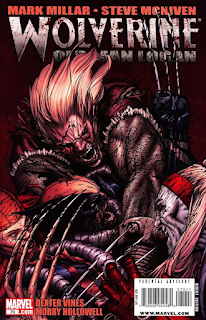
Their bodies are brought before the Red Skull in his trophy room, a room filled with pieces of the heroes he helped to kill, such as Iron Man‘s armour, a piece of the Silver Surfer board, one of the Thing’s arms, and Doctor Strange‘s cloak. Logan bursts out of the body bag he’s in, and attacks the Red Skull, decapitating him with Captain America’s broken shield. Grabbing the case full of cash from the bogus deal, he puts on Iron Man’s armour, and flies out of the building, heading home to California. Unfortunately, when he arrives he learns that the Hulks came back a few days after he left, and his wife and children have been murdered.

Wolverine pops his claws, and sets out for revenge. Over the final issue of the story Wolverine methodically makes his way through the Hulk clan, killing each and every one that he can find. Eventually he comes face to face with Bruce Banner, who’s become a tiny and pathetic man. Banner transforms into a giant, monstrous version of the Hulk, and eats Wolverine. Believing that Wolverine is dead, the Hulk relaxes, but is ripped apart from the inside as Wolverine claws his way out. Looking at the murdered and mutilated remains of the Hulk clan, Logan finds a tiny Hulk baby in the ruins, and takes it with him. The book ends with Logan burying his family, and setting out to try and make the world a better place whilst raising his new son.

Old Man Logan, as you’ve probably realised from the description, is not a nice book. It is filled with violence, gore, and general nastiness that feels very much at home in Mark Millar’s writing. Millar is perhaps one of my least liked writers in comics, and there are very few of his books that I find actually enjoyable. Civil War is perhaps the best of his work even if it runs out of steam at the end, ends horribly, and turns a number of heroes into horrible people. But crafting horrible people is a key feature in Millar’s work, and Old Man Logan exemplifies a lot of that in a number of ways.

The entire premise of the book hinges on something that feels slightly ridiculous: the idea that all it takes to destroy the world is for the villains to have a meeting and decide to work together. The book doesn’t reveal an amazing scheme, a piece of tech or magic that swung the war in their favour, instead it makes the heroes look ineffectual and weak by just having the villains all jump them at the same time. And this kind of sums up a lot of the book; stuff just happens with little to no explanation, purely because Millar thought it would be cool.

Things such as dinosaurs roaming through the US gets a hand-wave explanation. Venom goes on a T-Rex because it would look cool. Emma Frost and Black Bolt have a super special safe haven carved out for them and the last few mutants. Why? Millar doesn’t appear to care, and doesn’t fill us in on it. How does a biker gang have Ghost Rider bikes, when you have to be a Ghost Rider to have one, and they’re just regular people? Don’t worry about it, just look at the flaming motorcycles. It’s all spectacle and flash with nothing to it, that could be removed from the book and you’d lose nothing from it.

And it wouldn’t be a Millar book if rape wasn’t included somewhere in the story, this time with the Hulk raping his own cousin and his daughters. Rape is a subject that seems to pop up whenever Millar is able to get it into a book. In Nemesis, the story’s lead character kidnaps a girl, impregnates her with her own brother’s baby, and sets up her womb to collapse if she tries to have an abortion, rendering her infertile if she doesn’t have an incest baby. In Kick-Ass 2 the hero’s girlfriend is gang raped by the villains to get at him. In Wanted, the protagonist commits rape multiple times. In The Authority, a villain travels back in time and molests one of the heroes to mess with them in the future, a hospital victim gets raped, villains are punished with rape, and one of the series’ prominent gay heroes is raped by a villain. And, in the 90s, when DC killed Superman and broke Batman‘s back, Mark Millar pitched a similar story for Wonder Woman, ‘The Rape of Wonder Woman‘ which reportedly would have been a full issue sexual assault scene that ended with Wonder Woman raped in public.

When coupled with stories of his that have included depictions of domestic violence, racism, brutal violence, excessive swearing, and other ‘edgy’ content it’s hard for me to see Millar as nothing but a writer pandering to the teen boy demographic, or those readers who delight in the awful, who hate superhero comics as they normally exist, and who don’t see harm in the depictions of sexual violence against women. It’s made even worse that Millar has seemingly shown no care in how this constant depiction of rape has been used. In an interview with The New Republic, when asked about it, he said: “I don’t really think it matters. It’s the same as, like, a decapitation. It’s just a horrible act to show that somebody’s a bad guy.” With that kind of attitude it’s hard to really get on board with Millar.

The awful writing aside, the art in Old Man Logan is, at least, good art. The times where McNiven isn’t having to draw incest hillbillies or gruesome murders make for some decent parts of the book. The desolate landscapes looks eerily beautiful, the characters all have a sense of realism to them that you don’t always get, and some of the designs for the locations and characters the heroes meet along their journey are very interesting. It’s a shame that so much time is given over to the violence and gore, and we couldn’t have spent more time seeing more of this dark future, as McNiven seems to be doing his best to make the world work, and it would have been good to see more of that.

Old Man Logan took place within the pages of Wolverine, in the middle of another writer’s run on the character. This, along with the future setting, makes the story feel very out of place, and it’s odd that the series wasn’t released as a stand alone mini-series, as it had no effect on the main title. However, this wouldn’t be the last time this character and setting would be used. A younger looking version of this Logan, along with his now adult Hulk son, Bruce Jr, would appear in Fantastic Force, as part of a new superhero team setting the future world right. Old Man Logan would return years later as part of the Secret Wars crossover event, which would see the older version of Logan come into the main Marvel 616 universe, where he headed up his own 50-issue series, as well as appearing in other books.

Old Man Logan is a book that often gets brought up in discussions about great Marvel stories, and stand out Wolverine books. But with the story being both an alternate future and a different universe it bears little to no impact upon the Wolverine we know, or the main universe. As a standalone story it will either deeply appeal or deeply disgust. Millar is a divisive writer, and how you feel about him and the things that he puts into his stories will affect how you enjoy this book. If you have no issue with that, and love Old Man Logan, then it’s a great book, and if not, then perhaps it’s hard not to agree with Grant Morrison’s feelings on the man.


Old Man Logan was originally published in Wolverine from June 2008 to September 2009 by Marvel Comics .


Support Amy on Patreon

Buy Amy A Coffee

Go to Amy's Blog

Tuesday, 19 September 2023

Daredevil #1 - Comic Review


Matt Murdock died and went to hell, but now he's back amongst the living, with a degree of amnesia, and working as a priest in Hells Kitchen. How long will his new blissful lease on life last? About half an issue.

The new Daredevil run begins by having us follow Father Matthew as he goes about his day, having attended a meeting to argue for keeping his church open, he returns home to help his colleague, Father Javi, to care for the handful of kids that they've taken in and are caring for. We learn that someone is paying to keep the church open, and that despite pressure from those higher in the church, and within the city, the church is staying. The two priests have no idea who's been helping them out from the shadows, but are grateful for that help non-the-less.

The mystery is pretty quickly solved, however, as we learn that Elektra has been slipping money under the door of the church for a while now, and has been using favours, threats, and bribes to keep the place from being closed down. She's doing this to help Matthew out, to let him live the peaceful life that he's earned for himself. Unfortunately, a demonic entity is also keeping an eye on Matthew, and possesses Elektra's body.

The possessed Elektra breaks into Matt's room at the church, and her presence begins to unlock memories within him. After Elektra leaves, Matt takes off across the city rooftops, dressed all in black and with a rag ties over his face, heading towards her apartment that he now remembers the location of. Here, he battles the demon, and eventually exorcises it. After a chat, Elektra offers to step down as Daredevil, and is willing to help Matt get his old life back. Matt, however, doesn't want to give up on his church, as wants to remain a priest. This looks like it might not be on the cards for Matt, however, as the issue ends with police banging on the church doors, demanding Father Matthew give himself up.

So, having jumped onto Daredevil with this new issue one I found that despite establishing a new status-quo from the previous run it was pretty easy to figure out where Matt is, and what his situation in. The book outlines his new life as a priest really well, and takes a 'it doesn't really matter' approach to why he's back from hell. I'm sure that this is something that the series is keeping in reserve until the right moment. So all in all this does feel like a pretty easy place for new or returning readers to get into the series with.

There's one problem I had with the issue though, it felt really dull. Nothing happened here that excited me. There was never a moment that felt truly original, nor new enough that I felt glad to be reading the book. The fact that the book also doesn't seem to want to let anything sit for a while also felt a bit off to me too. Matt has amnesia, wait, no he doesn't. Matt isn't Daredevil anymore, actually, he's in the costume again. Matt wants to keep his new life, oh no, the cops are here and look to be after him. The book gives us this new status-quo, then immediately seems to want to get rid of it. Perhaps I'd have found more in the story to interest me if some of these things were given some time to breathe before things were changed.

One thing that was very well done, however, was the art. Don't worry, despite the cover having John Romita Jr art he doesn't do the interiors, instead that falls to Aaron Kuder and Jesus Aburtov on art and colours respectively. The book looks really neat and bright, and has a very light feel to it. However, the stand out moments are when the demon possesses Elektra. The demon, who's human-like but huge, kind of wears Elektra like a beard. His head takes the place of her own head, with her body hanging beneath, whilst his own body lays around behind her. It creates this really odd, really jarring visual of this huge monster man with a woman's body hanging under his head. These pages are worth checking out just to see how well the team execute the set-up.

Overall, I was somewhat dissapointed with this as the start to a new Daredevil series. Whilst it felt easy and accessible, it also did little to get me excited for the next issue.


Support Amy on Patreon

Buy Amy A Coffee

Go to Amy's Blog

Black Hammer Omnibus Volume 2 - Graphic Novel Review


Originally published on Set The Tape


We’ve previously covered the first volume in the Black Hammer Omnibus series, a book that collected the first dozen issues of the award winning series. A love letter to the superhero genre, particularly the books of the golden and silver ages of comics, the first volume of the omnibus series presented itself as something of a mystery story.

Several heroes who helped to save the world from the evil Anti-God find themselves stuck on a farm just outside a small town, unable to pass a barrier that means their death. Having been there for years, some have resigned themselves to that being their life now, whilst others are still trying to find a way home. When the daughter of one of their dead colleagues arrives on the farm things begin to get complicated.

The first volume ended with Lucy, the new Black Hammer, having gained her father’s powers, and the knowledge of what’s happened to the collected heroes. But now, before she can tell them what’s going on, she’s dragged away to another place, a plane of existence that claims to be part of the afterlife. In order to make her way back to her friends, Lucy will battle through hell, and meet the gods of stories, but all of it pales in comparison to what happens when she’s able to make it back and deliver the truth to the others. Now the fate of the entire universe hangs in the balance, and the heroes have to decide what role they want to play in what comes next.

Black Hammer is a phenomenal series, and this second omnibus collects together all twelve issues of Black Hammer: Age of Doom, the first real sequel series to the first story. Having ended the original Black Hammer on a cliff-hanger, the creator, Jeff Lemire, told some spin-off tales, before finally continuing the main narrative a year later. This book skips those spin-off titles, choosing to focus on the core story. This is a decent move, as the ending of the first volume is one that really grabs the reader, and you end up desperately wanting to know the answers that Lucy has. And whilst we get to jump back into that story straight away, it’s not a quick reveal. Instead, Lemire manages to craft another mystery story, another story that has more twists and turns than your average superhero tale.

Much like with the first volume, Lemire is drawing from things that long-time readers of comics, and those with extensive comic knowledge, will pick up on. Characters are all nods to existing characters that you can find in both Marvel and DC. Black Hammer is a bit of Thor mixed with the New Gods, Golden Gail is Captain Marvel (Shazam), and Colonel Weird is Adam Strange. The love that Lemire had for the genre is so easy to see here, as genre conventions are woven into the narrative, but never mocked nor made nasty. This isn’t a book like The Boys, where it almost seems to hate the genre that it’s sending up and always acts mean-spirited. Instead, this is a love letter to the comics it’s imitating, all whilst crafting a story engaging enough to be considered not only a worthy addition to the genre, but a stand-out example of it.

The second omnibus carries across the same artistic team as the first book, with Dean Ormston and Dave Stewart providing most of the art on the book. The style works well for the story, and it manages to feel both modern and gritty, and also classic old comics. It marries the two feels of the narrative well. There are a couple of issues part way through the series that follow Colonel Weird off on his own very meta adventure that change artist to Richard Tommaso, and the style change is very Jarring. I personally really didn’t like the art on these two issues, and the story does get very weird here too; this is definitely Lemire going a bit Grant Morrison on us. The last two issues included in the collection feature a whole host of artists, as one of them is a guide to the characters of the Black Hammer universe, with character art provided by more than a dozen artists.

Black Hammer has very quickly become a series that has grabbed my attention. As someone who loves comics, and really appreciates the quirky and cheesy nature of classic comics, this book is right up my alley. It feels modern and old at the same time. It’s doing its own thing and making nods to what’s come before. It’s filled with new and exciting characters and stories, but also feels like it could easily slip into the comic worlds we know. Lemire has done a fantastic job at crafting something that’s so enjoyable to read, and this new collection is the perfect way to experience the series for the first time.


Support Amy on Patreon

Buy Amy A Coffee

Go to Amy's Blog

Monday, 18 September 2023

Lost Boy - Graphic Novel Review


Originally published on Set The Tape


Lost Boy tells the story of a young teen travelling home from a skiing trip with his father, passing along a remote road in they Wyoming mountains. Jack, the boy, didn’t want to go skiing, just wants to be back home in Los Angeles, and doesn’t seem to enjoy spending time with his father. The atmosphere between the two of them on the drive back is colder than the snow-covered mountains outside. When a deer steps out onto the road, Jack’s father swerves in an attempt to avoid it, and crashes through the safety barrier, plunging the car off a cliff into the forest below.

When Jack comes to, the sun has fallen, and he’s been thrown through the car’s windshield. Finding the wrecked car, his father sits inside, dead. At first just curling up with his deceased father, hoping that he might wake up and be fine, Jack begins to drift asleep. It’s then that a voice in his head tells him that he has to move, that if he falls asleep he’ll die too. So, grabbing what supplies he can from the ruined car, he starts to try and make his way back to the road. But, with the cliff seemingly un-climbable, and a pack of wolves closing in on him, Jack sets off down the mountain. Along the way he finds an injured fawn, and the two of them work together to survive.

Lost Boy is a grim story. It begins with one off the worst things that can happen, a young boy losing his father to tragedy, but it also ramps things up by having the last moments they had together be one where they’re arguing and upset with each other. However, rather than wallow in the guilt that Jack must be feeling, the book instead chooses to put his journey to safety at the forefront. And all things considered, Jack is a pretty smart teen. He knows enough not to just wait by the car, he grabs useful stuff from the wreck before setting off, and he has something of a plan in mind. However, he is still just a kid, so ends up doing some pretty bad things along the way.

The main cause of Jack’s strife are the wolves that are following him, and the fawn that he befriends. There’s not much that can be done about the wolves, but there are a couple of times when Jack ends up putting himself in danger and makes things worse for himself to save the fawn. But I also know I’m the kind of person who’d act the same so can’t hold it against him. These moments help to humanise Jack, however, and it gives him something to focus on, and something to talk to. Jack ends up needing that baby deer to survive, because it keeps him sane, and it keeps him fighting.

The book is both written and drawn by Jay Martin, who does a really good job at bringing the story to life. The Wyoming wilderness looks absolutely fantastic throughout, and Martin makes it feel cold and remote. From the moment the car goes over the edge you’re worrying for Jack, because the place he’s in is not one humans are built for. One of the ways the book conveys this is through colour, with the night scenes in particular looking fantastic thanks to the use of darker tones, and lighting effects.

Lost Boy isn’t a long read, and you’ll get through it pretty quickly, but it’s an enjoyable journey. It’s the story about the fight to survive in a terrible situation and against awful odds, and the fact that it’s been crafted by the same writer and artist makes it stand out as a labour of love.


Support Amy on Patreon

Buy Amy A Coffee

Go to Amy's Blog

Sunday, 17 September 2023

Uncanny Avengers #2 - Comic Review


There's a very famous quote by Stan Lee, that every comic is someone's first comic, and that writers should make sure it's not their last by being accessible. I feel like this has been something that Marvel has struggled with in recent years, especially with the X-Men. The Krakoa era is a time that feels very inaccessible if you've not been reading from the beginning. I've seen a lot of folks saying that you need to go back to where it started and read basically everything, others have made handy lists of the bare bones books to read that are still dozens of volumes in length. As someone who loves X-Men but wasn't reading them when Krakoa began I've been left feeling like I can't just jump back in. 

With some loosely connected X-Men books being released as part of 'Fall of X' I've tried to tentatively get back involved, with mixed results. the new Ms Marvel series felt like I had no idea what anything was, and Uncanny Spider-Man felt like it was doing its own thing for about half the issue, and the rest felt steeped in the ongoing stuff. Uncanny Avengers feels the same way, where if you've not been keeping up with every X book there will be some things here that just won't make sense; but at least it seems to be trying to help you to do so. 

The second issue picks up where the last one left off, with Captain America and his Unity Squad fighting against Captain Krakoa and his group of misled mutants. Cap has had his arm broken by Krakoa, and lays writhing on the ground in pain. Considering that Cap is putting himself and his entire reputation on the line by fighting alongside mutants at this time, this is bad optics for him, as it looks like he's getting his ass beat trying to defend a group many are seeing as villains.

This becomes a big point for the issue, and is a part of this series that I've really enjoyed. Whilst most of the world is willing to believe Orchis and just accept that mutants are all evil, that they're a threat that needs dealing with, Cap takes one look at that and sees fascists at work and goes 'fuck no'. It ties nicely into what the new Captain America book is focusing on too, with a young re-powers Steve dealing with fascism in America. This is Cap at his best for me, not when he's fighting costumed villains or going on big cosmic adventures, but when he's standing up to very real, very human evils.

And this comes around again later in the issue when Rogue tries to take over the team. The group wants to be in charge of their own destiny, and they agree that they need Cap around, but are also aware of the fact that if Captain America dies fighting for mutant rights, at the hands of a mutant, that it could galvanise anti-mutant sentiment. Thankfully, Deadpool of all people is there to point out how stupid a decision that is on the rest of the teams part. He gives them a delightful speech about how mutants keep losing, how they go from one awful event to the other, and now they're pushing Captain America away. Waid points out that he's the one guy that you should always bet on, the one guy who never loses, and firmly establishes himself as 'team Cap'. It's a great moment.

The art on the book by Javier Garron and Morry Hollowell looks great, and has a more cartoon-like look at times really nice. All of the characters are distinct and clear, and stand out from each other; which is always handy for a team book. The action is great too, and the book starts off really strong in the middle of a fight; and gives us a great entrance for Black Widow.

Even though I've been struggling to get back into X-Men, and don't have the time to go back and read a few hundred issues to get caught up, this book has been pretty accessible and enjoyable. Hopefully more of the X-titles will be easier to jump into soon too.


Support Amy on Patreon

Buy Amy A Coffee

Go to Amy's Blog

It’s Only Teenage Wasteland - Graphic Novel Review


Originally published on Set The Tape


It’s the end of the world in It’s Only Teenage Wasteland, and a group of four misfit friends have to try to find a way to survive in the ruins of the old world in this new book from Curt Pires and Jacoby Salcedo.

Beginning after the end of the world, where our lead character Javi is hiding beneath a gas station counter from roaming bandits, the first issue of the four part book quickly jumps backwards in time to the 2020s, showing life before the end.

Javi is a typical teen in America. He’s a bit of an outsider, but not outright hated and bullied like some kids, and he’s managed to make himself a decent group of friends, including Scott, who’s popular enough to hang with the actual popular kids, Gort who’s somewhat quiet, Sione who’s the tougher guy of the group, and occasionally Fogelman, a kid who actually does get picked on because he’s autistic. When Javi’s parents go away he manages to convince his older sister to let them throw a party.

The party goes well, until a bunch of racist bullies from the school arrive on the scene and start harassing Fogelman. Scott gets involved to help, and gets knocked around. Then things go white, and Javi wakes up in the ruins of their home town, giant white crystal-like structures growing from the ground and impaled through buildings. Setting out to try and find his friends, Javi tries to learn what happened to the world, all whilst dodging dangerous raiders who’ve made the ruins of the world home.

It’s Only Teenage Wasteland begins pretty strong, and much of the first issue you begin to forget that this is supposed to be a post-apocalypse story, and you end up enjoying reading about this group of friends just trying to have a fun party, and trying to get laid. Pires does a good job at writing teenage drama, and it feels like it might be the strongest part of the book. This is chiefly down to the fact that once the main focus of the book turns to the post-apocalypse segments things kind of get a bit boring. There’s a mysterious figure following Javi, and you can pretty much guess who it is before the reveal. And the bandits that are out to get the teens are treated like a joke half the time, and it ends up taking away a lot of the edge they have.

The art, by Jacoby Salecedo and Mark Dale, is decent, and the bright, colourful nature of the art keeps things looking visually interesting throughout. A lot of the humour in the book is conveyed through the art, particularly in the variety of ridiculous ways that the raiders and bandits are dressed. It feels like the art team were having some fun coming up with all of the costumes and looks that the villains would be wearing, and it’s fun to see what they come up with.

The book ends with something really wild happening, and I hope that it indicates that this is simply the first volume of a larger story. If it is, then that’s fine, and there are still tons of unanswered questions and things to clear up. However, if the story doesn’t continue on from here it’s a terrible end to the book, one that will leave the reader feeling like there’s been zero resolution.


Support Amy on Patreon

Buy Amy A Coffee

Go to Amy's Blog

Saturday, 16 September 2023

Outlast – Throwback 10


Originally published on Set The Tape


For a long while, horror video games followed a very similar formula, where you fought against monsters and creatures from nightmares however you could. Whether it was as specially trained police in Resident Evil, super-powered demon hunters in Devil May Cry, or people tormented by their own personal demons in Silent Hill, these games seemed to always give you some way of fighting against the monsters, and something with which to defend yourself.

When the early 2010s came around, a new kind of survival horror experience began to rise in popularity: ones where you can’t fight back, popularised by 2010’s Amnesia: The Dark Descent. Thanks to the success of Amnesia: The Dark Descent, other studios would try their hand at similar games, and one of the first that made it big, that inspired the camcorder survival horror sub-genre, is Outlast.

Outlast puts players in the shoes of investigative journalist Miles Upsher (Shawn Baichoo), who receives documents claiming that the remote Mount Massive Asylum is conducting illegal and unethical experiments upon its inmates at the behest of the shady Murkoff Corporation, which owns the facility. Armed only with his handheld camcorder, Miles sneaks his way into the facility late at night, only to find the halls trashed, the staff dead and mutilated, and the monstrous inmates roaming the halls. Unable to leave the way he came in, Miles begins to search for a way of escaping the facility.

Unfortunately for Miles, the inmates don’t care that he’s not one of the staff who tortured them, and he’s soon hunted by the people he’s trapped with. One of the inmates, a priest named Father Martin (Andreas Apergis) sabotages Miles’ escape, and shows him security camera footage of a ghostly entity killing Murkoff’s private security staff, an entity he calls the Walrider. With it becoming clear that there’s something more than just crazed patients at work within the Asylum, Miles has to find a way out before he’s caught and tortured to death.


It doesn’t take Outlast long to show players what it’s all about. Shortly after climbing inside the creepy Asylum you quite literally have a body thrown in your face; a jump scare that will test your preparedness to continue on with the game. This level of fright, of things suddenly throwing themselves at the player when you think all is safe and quiet, is a big part of Outlast, and the game rides this fine line between carefully crafted atmosphere and jump scares.

In most games these kinds of moments wouldn’t be too bad, and I’ve played a number of games where something jumps out at your character in order to frighten you, before you’re then able to pull out a weapon and put the monster down, bringing a sense of calm and even joy that you’ve managed to deal with the thing that just frightened you. This is not an option in Outlast. Your character has his camcorder, and that’s about it. You can’t grab a knife off a surgical table to defend yourself with, and those broken table legs scattered across the floor can’t be picked up and used as a club. You have two options here: run or hide.

This element of the game is what truly makes Outlast frightening. Miles is a fairly regular guy, he’s probably been in zero fights his entire life, so he’s not going to turn into some unarmed combat master and walk out of the asylum after killing everything in his way. If he tried to fight back he’d be killed. So running and hiding are all he can do. This leads to some incredibly tense moments where you crawl under a bed, waiting for the person chasing you to lose track of you and walk off, giving you a chance to move on to the next area. And these segments aren’t always a result of you messing up somewhere along the way, with the game sometimes forcing you into these near death experiences.


The only thing that Miles has to help him is his camcorder, which he’s using to gather evidence for his story, but is also a vital tool for navigating the environment. With much of the asylum bathed in darkness, and no torches or flares around to light the way, Miles will have to rely on the night vision function of the camera to help him navigate the twisting halls. There are parts of the game where you’ll be slowly creeping down a dark corridor when your camera will pick up an inmate standing in the middle of the hall in the darkness. Squeezing past them, knowing that they can’t see you, but if you make too much noise they might throw themselves at you, makes for a tense moment, and is only capable thanks to this very restrictive way of navigating the game.

One of the most impressive things about the game is that it was made by a very small team, with only ten people working on it. Red Barrels, the Canadian studio responsible for creating Outlast, was founded just two years before the release of the game. Outlast was the first game developed by Red Barrels, though various members of the team had worked on other large games previously, such as Assassin’s Creed, and Uncharted. Thanks to being unable to find initial investors, the development team worked for months without salary.

Fortunately, Outlast would go on to become a huge hit upon release, and that early hard work paid off for the team. Initially released on the PC, the game was ported to both the Xbox and Playstation the following year (with a Nintendo Switch release in 2018). Reviews were generally favourable, with praise being given for the level of atmosphere and the various jump scares throughout. Despite being fairly short in length, the fear that it gave players, and the need to replay some segments caused by player death, Outlast seemed to satisfy most players and left them feeling happy. The game would go on to sell millions of copies, and a DLC scenario and sequel were both released over the following years.

There have been many attempts to make horror games scarier in recent years, and there have been some great games that have come from this. And whilst Outlast might not have pioneered this new style it certainly made a big splash when it arrived on the scene. There are numerous elements from the game that have appeared in other releases, and it’s hard to say that it’s not gone on to inspire others, and to push the genre upward to new heights.


Support Amy on Patreon

Buy Amy A Coffee

Go to Amy's Blog

Friday, 15 September 2023

Shazam! #3 - Comic Review


The Captain is in trouble once again as his powers continue to be corrupted by outside forces in the latest issue of Shazam, and the identities of those messing with him are revealed to the reader.

In previous issues of the new series we've seen the Captain scream at people, a rage taking over him in public in a way that makes him look more like Black Adam than anything else. We saw a couple of figures hiding in the shadows that were responsible, and in my review of the first issue I speculated that one of the figures was Zeus; well it looks like I was right, as we learn that all of the gods who make up the Shazam name are messing with Billy, trying to be the one to push him over the edge. Worse still, they've made Freddy their unwilling accomplice, putting a spell on him to see through his eyes to spy on Billy.

Back on Earth, Billy is trying desperately to avoid turning into the Captain again, and has even changed his YouTube channel to focus on Metamorpho instead in a moment of panic. It's quite fun to see Billy dealing with this situation from a mortal child's perspective, trying his best but really not doing terribly well. Unfortunately for him, the gods are determined to have their games, and force his hand. After transforming in order to save a bus (filled with visiting dignitaries from Gorilla City!) he ends up travelling to Gorilla City, where he hears a story about the Emperor of the Moon, who's preparing to attack Earth. The Captain heads up to the moon to fight this evil menace, little knowing that the gods are toying with him.

Oh yes, and a space T-Rex is still patiently waiting for Billy to come home in order fill out a huge pile of paperwork, lest the Auditors take notice and come instead.

Mark Waid and Dan Mora feel like the current power duo at DC right now. Their Batman/Superman: World's Finest series is an absolute delight each and every month, and is a celebration of the history of the DC Universe, and of the Silver Age of comics. And Shazam feels a little like that too. Whilst the book is set in the modern tires, with references to other characters and events making that clear, it has a lot of the weirdness and fun from the Silver Age thrown in too. Rescuing a bus full of talking gorillas, a Moon Emperor, and a top hat wearing space T-Rex having a chat with Billy's talking tiger friend all feel a bit too silly and weird to be anything but a celebration of older comics. Most other books simply wouldn't be able to get away with this, but Shazam not only does, but makes it wonderfully fun too.

Speaking of Mora, the art is, as always, phenomenal. This book has a lot of moments that some could call 'dull', with pages where gods are talking to each other and scheming, and where Billy is refusing to  become a hero again. Despite having nothing big or flashy happening on the page these moments still feel dynamic and cool looking, because they're done by Mora. Mora has a way of making the most ordinary thing look like it's amazing, and this issue showcases that. I also suspect that Waid might be throwing things like talking Gorillas, space T-Rex's, and Moon Emperors at Mora just to see him draw these cool things. If that's the case, please keep doing it, as the result is wonderful.

We're only three issues into this new Shazam run, and this is already one of the best titles that character has had. The story is delightfully weird, full of action, has great character moments, and keeps you wanting to read more to find out what happens next. The Waid/Mora dream team at work.


Support Amy on Patreon

Buy Amy A Coffee

Go to Amy's Blog

Star Wars: Hyperspace Stories #8 – Comic Review


Originally published on Set The Tape


The focus on the villains continues in the latest issue of Star Wars: Hyperspace Stories as we jump forward in time to the Rise of the First Order, to events that lead into the sequel trilogy. Last couple of issues we got to see the seedy underbelly of the galaxy, following bounty hunters and pirates; this time we’re focusing on a force for order in the galaxy, though a fascist one.

The First Order, in their mission to slowly take control over the galaxy and impose their will onto others, have come to the planet Karaxia, where they wish to force the population to serve them, supplying them with anything they want. The presence of Storm Troopers and Star Destroyers has failed to bring the population to heel, however, and as such Supreme Leader Snoke has summoned General Hux and Kylo Ren, tasking them with bringing the planet firmly under the control of the First Order.

Anyone who’s seen the films knows that these two characters do not see eye to on most things, and that difficulty and refusal to work together plays out here in this story too, showing that they’ve been long time enemies. Hux believes that his way is the best, and demands Kylo follow his lead, whilst Kylo is trying to make himself into a big scary Force user, trying to capture some of the fear and respect that his grandfather carried. Over the course of the book we’ll see how the two of them end up doing their own things, and how their plans don’t work out on their own. But this isn’t a ‘you should have learned to work together’ type story, and neither villain learns a valuable lesson come the end.

The book gives us a little insight into how the First Order became the power that it was in Star Wars: The Force Awakens, and how so many worlds fell to them. Thanks to their massive fleet and their troops they’re able to force their way onto worlds and basically act like thugs to get what they want. The pretence of making the galaxy a better place through unity that the Empire had isn’t even here for the First Order, and they’re little more than bullies. This plays into the lore of them being built from the remnant of the Empire, and of wanting to punish the galaxy for having pushed them out in the first place.

The continuous plot thread that has been present in all of these issues, the Wookie doll, pops up here, just for a panel or two, but this time feels like the first time we’ve been offered any kind of insight into what it is. Kylo, still mostly untrained in the Force, senses some kind of Force presence near the doll. We knew in issue #1 that something important was placed inside it, but now we know that it has some kind of power to it too. Hopefully, this will be explained in future issues, and it being connected to the Force is certainly a good way to justify it keeping appearing in these stories, getting close to important and powerful players in the Star Wars saga.

The art on this issue is provided by Andy Duggan, with Dan Jackson on colours, and it looks decent enough. The established characters look enough like their on screen counterparts to be easily identifiable, though Hux is the weakest of these as he has less to distinguish him. There are some moments of action in the issue, but none of them have anything truly exciting or special about them, and even the inclusion of a giant monster does little to make it really stand out.

Overall this was a perfectly serviceable entry in the series, though one that seems to be playing it safe. It doesn’t really add much to the narrative, nor does it reveal anything new or interesting about the characters features. Compared to the last issue, it feels like a big step backwards in terms of care and desire to tell an engaging story. It’s Star Wars, but it’s forgettable Star Wars.


Support Amy on Patreon

Buy Amy A Coffee

Go to Amy's Blog