Wednesday, 5 April 2023

Lazarus Planet: Revenge of the Gods #2 - Comic Review


The first issue of Lazarus Planet: Revenge of the Gods didn't really feature much of the super hero Shazam, with his alter-ego Billy Batson getting to appear in about two panels of the entire book. Thankfully, the second issue starts to bring the Shazam characters more into the central narrative as both Billy and Mary get some stuff to do this month.

The last issue saw the ancient gods of the world declaring war against humanity, using fear and intimidation in order to frighten them into worshipping the gods once again. Under the direction of Hera, who has murdered Zeus, the gods plan seems to be working. Wonder Woman went to challenge them, and was turned into a god herself. 

This issue picks up back on Earth, where Billy is left trying to figure out what's going on as everyone else in town is under the magical effects of the gods, and monsters seem to be running amok. Turning into Shazam, Billy fights a number of giants that are attacking his school, getting some help when Mary arrives. Leaving Mary to battle the monsters alone, he heads off to figure out what's causing all of the chaos, where he gets a mysterious message to head to Washington D.C. to find his guide to Mount Olympus by an ethereal glowing figure.


Arriving in D.C., Billy meets the mysterious hooded figure that was knocking around last issue (confirmed to be a man in the last issue of Wonder Woman), before coming across Wonder Girl (who all of a sudden doesn't like the name Wonder Girl for some reason). The two of them head to Mount Olympus and try to confront Hera. However, the Wizard Shazam interferes, and strips Billy of his powers. Now Billy is left as an old, wizened version of Shazam, and the Wizard is young and buff.

In some ways it still kind of feels like the story is still in set-up mode, putting pieces in place by making Diana a god, and stripping Billy of his powers. Which is odd as we're technically halfway through the event. I say technically because the Wonder Woman title is taking place within this story and is filling some of the gaps in, so we've got a bit more than the four issues for this particular title in which to deal with everything. 

The team on this book are good at writing Diana, and I enjoy the way that Hera is written as just openly evil and unapologetically cruel, but this issue has me unsure about some of the other characters. As mentioned earlier, I'm not sure why Yara is suddenly against her super hero name; I'm pretty sure that I've read ever appearance she's had since she was introduced, and unless I forgot something, this hasn't come up before. Her suddenly being against the title Wonder Girl feels kind of odd. 


At the same time, Billy acts a bit weird at times too, when he leaves Mary to deal with the giants in order to find out what's going on he doesn't go off as Shazam, but ends up running around the streets as Billy. I don't know why he'd do this, as surely he's faster and safer as Shazam. It kind of ended up looking like Billy just wanted to run away from the situation. He was also incredibly chatty when on the buss with the hooded man, basically just giving up all of his mission and is rundown of the situation, telling a complete stranger loads of important info. Billy doesn't really seem to have a very consistent way of being written because a lot of different writers have been handling the character for the last few years; but this does feel like an odd way of depicting him.

The art on the book looks really good, and there are several action scenes and cool moments scattered throughout that look really cool. We get both Shazams fighting mythological monsters, Yara taking down hydras and giant beasts, and her and Billy storming the doors of Mount Olympus. It's a visually fun and engaging book, with a few moments that will make you smile at just how awesome they are.

Overall, this was a pretty decent issue, though one that wasn't perfect. The event opened very strong, but now seems to be losing steam a little. Hopefully this is just a blip, and things will pick up a bit now that Shazam has been put into a new situation to get out of, similar to Diana. This could be a very good event with some long reaching repercussions, but right now it's kind of up in the air as to how that's going to go.


Support Amy on Patreon

Buy Amy A Coffee

Go to Amy's Blog

Fear Before the Fall: Horror Films in the Late Soviet Union by Alexander Herbert – Book Review


Originally published on Set The Tape


'Alienation, generational tensions, rampant nationalism and the pervasiveness of atomic danger are all topics that haunted late Soviet citizens, and those fears are reflected in the films meant to represent their horror genre. In the late 1970s and throughout the 1980s, production of horror movies from independent filmmakers and Hollywood skyrocketed. It was a time of intense Cold War conflict and a resurgence of conservative ideals. It's not difficult to imagine that the ascent of horror occurred in conjunction with an increasingly scary and alienated world, and horror reflected those freights in the form of nuclear holocausts, toxic waste pollution, alien clown invaders and undead houseguests. Everyone was at risk - teenagers especially - because their present and future remained most uncertain. If we can agree that such feelings underpinned American viewers in the age of Reagan and neo-liberalism, then what about late socialism? How did film makers depict Soviet society's fears?'

The horror genre is a popular one, that has always been around in some form or another. Whether it be scary stories around a fire at night, the written word, cinema, or interactive media, the genre has continued to evolve with humanity over the centuries and doesn’t seem to be going anywhere, despite some campaigns to get rid of it lest it ‘harm’ society. One medium that has done exceptionally well with horror is film, with one of the very first films ever made, a fifty second shot of a train arriving at a station, L’ArrivĂ©e d’un train en gare de La Ciotat, reportedly causing fear and panic in the audience perhaps unintentionally making it the very first horror film.

Over the years the medium has evolved and expanded, with early works such as Thomas Edison’s 1910 production of Frankenstein, and the 1922 Nosferatu being some of the best known early examples of overt horror in film. As the medium grew, horror films grew with it, and would go on to reflect social issues and societal fears of the time.

The 1950s saw an influx of science based horror films as a result of the fears in society from nuclear science, with films such as Godzilla, The Blob, and The Fly warning of the dangers of science. As time moved on and the Cold War set in, horror began to cover fear of ‘the other’ and of assimilation, with films like Invasion of the Bodysnatchers, and Night of the Living Dead. Eventually we’d move on to fear of the killers amongst us as the slasher genre came into popularity with Halloween, The Texas Chainsaw Massacre, and Black Christmas. Even later still, in more modern times we’ve come to fear the unexplained and unknown, with paranormal horror taking the spotlight in titles like Paranormal Activity, Insidious, and The Conjuring.

But the vast majority of these examples, and similar ones that I’m sure you could come up with, all concern what would be called ‘western’ horror films, focusing on the output from the US and the UK most of all. For the most part these are the films that the average cinema-goer will be aware of, with those who would call themselves cinephiles probably also being able to run of a list of Japanese and Korean horror films that had a boom in the 90s onwards. But even those who consider themselves connoisseurs of the genre might be hard pressed to name many, if any, Soviet horror films. Thanks in large part to the division between East and West during the height of the Cold War, much of Soviet cinema has been a secret for those outside of the former Soviet influence. But now author Alexander Herbert is is here to help you discover some of these very well hidden films.

Fear Before the Fall: Horror Films in the Late Soviet Union does pretty much what the title suggests it will, and delves into the films of the late Soviet Union. However, this is more than just a film guide, as Herbert also tries to take a look into the cultural significance of the film, how it came about, what it’s trying to say, and how it fit into the ever changing landscape of the Soviet Union. Herbert states early on that this book, despite the academic sounding title, is not ‘an academic monograph’, instead stating that this book was made, and designed to be read, for fun. And it does become apparent as you make your way through the book that despite the author’s clearly well researched and well presented knowledge on the subject you yourself don’t need to be an expert on either cinema, or the Soviet Union, in order to take something away from this. Instead, you can settle in for an enjoyable read that will introduce you to some new films.

The films covered by the book include Viy, one of the earliest films made under the rule of the Soviet Union, that sees a young priest being tormented by spirits from hell as he watches over the body of a young woman in his church. Viy very much feels like the beginning of Soviet horror, and Herbert outlines well how it draws upon older folk tales, whilst also drawing in more modern concerns and issues in a way that marries the past and present, bringing the traditions of the past into the new way of life that the Soviet people were living through. The book also covers films such as Gothic horror tale Savage Hunt of King Stakh, futurist horror The Veldt, and vampire film Sem’ia Vurdalaka.

Each chapter, which covers a film, is split into several sections/ The first introduces the film itself, the second deals with the narrative, another the context, and a final one deals with the creation of the film and the impact it had. Each chapter ranges in size, but is roughly around ten or so pages each, giving you enough time to really delve into each of the films and get a good sense of it before moving onto the next. The book includes pictures from the films, though as they’re presented in black and white, and there are few high quality stills from some of the films, it can sometimes be a bit difficult to fully understand or appreciate what is being shown.

As someone who enjoys the horror genre, and has an interest in film history and how film interacts with society, this was a really interesting read. It was great to see how cinema worked in a setting where I’d not really thought about it before. Us in the ‘west’ have heard all kinds of stories about what life was like within the Soviet Union; usually stories that paint it as an awful place thanks to residual anti-Soviet propaganda and hate, so we’ve probably either never thought about their film industry, or assumed that it was all government-made pro-communist propaganda. To actually see a well researched and well presented breakdown of what it was like was not only incredibly interesting, but hugely informative. Plus, you come away from the experience with a few new films to add to you watch list. Fear Before The Fall might be something of a niche read, but it’s one that will appeal to a lot of readers if given the chance.


Support Amy on Patreon

Buy Amy A Coffee

Go to Amy's Blog

Tuesday, 4 April 2023

Harley Quinn #27 - Comic Review


Originally published on Patreon


Stephanie Phillips' time as the writer of Harley Quinn comes to an end in the final issue of the 'Who Killed Harley Quinn' story line, a story that has brought yet another 'Who Laughs' character into existence. But how does the end to this pretty enjoyable arc go? Kind of just average sadly.

The build up of this story has been okay, and it's been getting better as it's gone on. The introduction of an evil Harley travelling the multiverse out to kill all the versions of herself isn't a bad idea; and the introduction of all of the different Harley variants into the story has been quite enjoyable too. And with the Harley Who Laughs having Poison Ivy tied up as her prisoner it looks like things are about to become fraught for our anti-heroine. 

So it's such a shame that this final issue feels incredibly rushed. I don't know if Phillips knew that her run was going to end here, or if it was brought to a close earlier than expected, but a lot of this issue's pacing feels like someone rushing to get everything resolved before the unexpected deadline. And in order to get everything resolved Harley starts to break the fourth wall.

There are a lot of people out there who say that Harley is the DC Deapool, that she's the same because she's wacky, she wears red and black, and because she does similar stuff to him. One thing that really sets her apart from DP, and kind of makes that comparison not really make sense, is that she doesn't know she's in a comic, she doesn't start messing with the story and going against comic conventions. She's weird and makes jokes, yes, but she still plays by the rules of the universe. Except here she starts to break them.

In order to travel to a different universe to save the Ivy Who Laughs for the Harley Who Laughs to get a happy ending with she freezes everything happening on the page, and goes and steals a dimension portal device from the evil Harley whilst explaining her plan to the reader. Later on she tells the reader that they've thrown in an action scene so that we don't get bored, and then a few pages later tells the readers we have to stay outside the fortress they're attacking because they can't do any more action scenes for brevity sake.

I honestly kind of hated this. This is some rule breaking and universe bending stuff that the series hasn't done before, that Harley doesn't usually do, and breaks the flow of the story and makes everything feel kind of cheap. It seems like the only reason Harley is breaking the universe here is so that the story can rush to its conclusion. If she's always been able to control the flow of the narrative why hasn't she before? Why didn't she stop the evil Harley from shooting her? Why hasn't she done anything to alter the story until the very end? Harley Quinn isn't Deadpool, and I don't like that this issue turned her into him.

Because of this, I kind of checked out early. This was the end of this story, and this creators run, but by the final pages it was already long over for me. I'd stopped caring because the book had told me to, it'd told me that the story doesn't matter because there are no stakes, because Harley has god powers now, and because after five issues of set-up the end was just nothing. I've enjoyed Phillips' run on the book, but this final issue made me question what the point was, and if it was worth it, as the book and the writer just didn't seem to care by then.


This article, and many others, can be read a month early on my Patreon for as little as $3 a month!


Support Amy on Patreon

Buy Amy A Coffee

Go to Amy's Blog

Dead Bride (2022) – Film Review


Originally published on Set The Tape


Italian horror has a big fan-base, and rightly so, as many of the horror and Giallo movies of the 70s and 80s are fantastic films. Whether it’s the mystery of gory murder films like Tenebrae, otherworldly horror that plays with the mind like Suspiria, or out and out monster movies like Demons, the Italian film industry was able to knock out hits left and right. Sadly, Francesco Picone’s Dead Bride fails to recapture a lot of what made those older films special.

Dead Bride begins decently enough, as an older man is lured through his home by strange spooky noises. A shadow figure sits in a chair, vanishing when he throws a sheet over it, only for a figure to rise up inside the sheet, looming over him. It’s a fun little sequence that feels spooky enough to get you on board. Unfortunately, this is perhaps the scariest the film will ever get.

From here we meet Alyson (Jennifer Mischiati) and her husband Richard (Christoph HĂĽlsen) as they move into Alyson’s estranged father’s home following his death. The young couple and their baby son begin settling in when Richard is sent away on a business trip, leaving Alyson alone in the house. This is when spooky thing start happening around the home: shadowy figures, spooky voices coming over the baby monitor, and things moving from place to place. Alyson begins to become convinced that something awful is happening in the house; something that is connected to the mother she barely remembers who died when she was just a girl. As she begins to investigate the hauntings, she learns that something truly evil is lurking inside her new home.

One of the things that becomes immediately apparent when watching Dead Bride is that the film is taking a lot of inspiration from other horror films that have come before. Dead Bride has huge similarities to 2011’s Insidious, and much like in that film we get spooky shenanigans that build up to the family reaching breaking point. Alyson is told by a helpful priest (Sean James Sutton) that moving won’t help because the family itself is haunted, not the house. And much like Insidious, a member of the family gets snatched away by supernatural forces, which necessitates a psychic (Douglas Dean) being called in, and a parent going into the spirit world to get them back. If you’ve seen Insidious you’ll see the ‘twist’ coming a mile away because it does the exact same damn thing. It even has the same jump scare of the spooky looking figure hissing at the lead from behind another person, looming over their shoulder. It feels as though Dead Bride hasn’t so much drawn inspiration from the other film, and more filed off the serial number, hoping no one will notice.


As well as the familiarity of the script, the quality of the special effects are a bit of a let down. The titular Dead Bride (Francesca Albanese) who haunts the family seems to change look and style from scene to scene depending on what the scare demands, with varying quality. Sometimes presented as a regular looking woman, we see her through flashbacks and brief moments, but for the most part she’s a desiccated, withered corpse in a ruined wedding dress.

The times we see her like this she comes across as a puppet or model that will pop into frame for a moment as it hisses at the camera. However, there are a few scenes that require the Dead Bride to do more than just pop into frame, and here she’s played by a person in a suit. The thin, withered, almost skeletal Bride is then replaced by someone in a bulky rubber suit that makes her look three times as big, and the tattered wedding dress looks more like rotten pieces of fabric wrapped around her. The result is that there are a few moments in the movie where Alyson is being chased not by a corpse of a bride, but a mummy.

Perhaps the most glaring thing about the film, though, is the audio. It looks like the film was shot in English, with the actors’ lips matching the dialogue we’re hearing. But every single line in the movie appears to have been re-recorded in ADR, and dumped over the scenes. Whilst this does seem to match the style of the older Italian horror films, which would record some parts in both Italian and English and re-dub the whole thing depending on the audience, it fails to recapture any of that nostalgia by being quite bad. The vast majority of the characters sound bored throughout most of the film, even in scenes where something hugely weird or frightening is happening. The result is a film where the dialogue feels detached from the images, and any tension or emotion that could be conveyed through speech is non-existent.

Dead Bride didn’t have to be a terrible movie, it could have been a cheesy, low budget take on the haunted house genre that borrowed from other films. But, thanks to just how much it seemed to copy from a much more popular, and better made film, and thanks to every line of dialogue in the film breaking immersion, it failed to even be so bad its fun, and just ended up as plain old bad.


Support Amy on Patreon

Buy Amy A Coffee

Go to Amy's Blog

Monday, 3 April 2023

Harley Quinn #28 - Comic Review


I've seen some complaints about the previous run on Harley Quinn, with people not being one hundred percent happy on the direction the character was taken. Harley making the leap from villain to anti-hero was always going to be one that would divide fans; some would like the shift and evolution of the character, whilst others would disagree with it completely. I, personally, liked seeing the changes that she went through, and the ways in which she tried to make amends for her past and do some good in Gotham. Whether it was her going undercover at Arkham Tower in Detective Comics, or her teaming up with Batwoman on occasion in her own title, it was cool to see her trying to be better.

A lot of that seems to have been dropped with issue twenty eight, the start of a new run under writer Tini Howard. The issue opens with Harley battling with Two-Face, not because he's a criminal and she's kind of a vigilante now, but because she thinks it'll be fun to annoy him and make him angry. This feels like the first bit of character regression for me, as Harley now seems less concerned with doing good and more focused on having fun. The previous twenty seven issues showed Harley learning some hard lessons about the kind of person she wants to be, and how she fits into the world, and they feel kind of forgotten now.

This continues across the rest of the issue as Harley settles into her new life staying in Poison Ivy's apartment with her two hyenas as Ivy is off doing stuff for her own book. Gone is Harley's ferry home, her alien parasite pet, and Kevin, as she's dropped all of that to talk to herself in an empty apartment. Once again, this feels like a big step backwards for her, and like Howard simply wished to ditch everything from the previous issues and give Harley a fresh starting point simply because they could. This goes even further when Kevin does make an appearance in the book, acting nothing like the character that we got to know, and even goes on to betray Harley by selling her out to the police so that she can receive some kind of punishment in order to teach her a lesson. I know Kevin isn't exactly a long standing or beloved character, but this feels so out of character for him it might as well be character assassination.


And so Harley gets taken to court to receive punishment for all of the crimes she's been doing. But don't worry, she's not going to be joining Catwoman in prison, because the judge likes the fact that she has a girlfriend (don't worry, Harley will hammer that point home repeatedly across the book, complete with puns, innuendo, and sex jokes) and so sentences Harley to community service, teaching at the local community college. And so Harley is off to teach psychology at the local community college as punishment like she's off to Greendale in what feels like a really weird and contrived explanation for why she's now a teacher.

She's barely into her first day teaching when Two-Face smashes his car into the room in order to come after Harley again. This is the third time that he's come up in the book, and the third time that he's made out to be a complete fool. He can't not too different from Harley, beaten the first time because he loses his shoe and stops the fight to go look for it, and this time he smashes his expensive car through a wall, but then yells at Harley for touching it because she could damage it. He's been changed from a threatening, dangerous criminal into a cartoon.

Speaking of cartoons, Harley manages to beat him in the fight by picking up a big cartoon fish and slapping him with it. Initially thinking that she's simply imagining it, she's shocked when others see the big smiling fish. What could it all mean? Well, we get an absolutely ridiculous explanation for this as Lady Quark appears, taking the fish back. She tells Harley that she basically pulled the giant fish out of another reality in the multiverse, and caused damage to the multiverse because of it. She warns Harley that if she messes with the multiverse again she'll come back and deal with Harley. 


So, I honestly kind of hate this. Harley Quinn just did a story dealing with the multiverse, there's also a mini-series called Harley Quinn Screws Up The Multiverse going on right now, and now she's able to pull objects out of other realities. Why has Harley become a multiverse character all of a sudden? If this is somehow fallout from the previous story it'll feel a bit cheap, but at least it would work, but if not and this is something else it feels like a terrible direction to take a street-level anti-hero. I also have a suspicion they might try and explain away her craziness and all of the weird stuff she sees and does as somehow being connected to her seeing other realities, or pulling things from them.

This is the first issue of a new run, and so far it's the worst of this title. Everything feels horribly disjointed and badly connected together, none of the characters seem to act in character, little makes much sense, the humour is pretty bad and borders on annoying. The previous writer seemed to have found a decent way of writing Harley where sometimes it didn't quite work, but at least it felt like Harley in the wider DC Universe. This feels like it's taking place in a cartoon pastiche of DC to the point where if the multiverse stuff ends up revealing this isn't the mainline universe I'd believe it, because it doesn't feel like it fits at all.

The art on the issue similarly feels very cartoonish, and Erica Henderson art is nice, but it ends up adding to the feeling like this book just doesn't fit into the wider universe. Everything is big, bright, and pretty to look at, and there are some moments where the art really sells the idea that Harley isn't stable, but there are also some moments where the expressions on Harley's face look a little too inhuman to be completely comfortable. 

I'd come to enjoy Harley Quinn as a fun book that didn't take itself too seriously, could have some fun, and occasionally did some cool stuff, but it's very quickly dropped to a title that I really didn't enjoy. I'm hoping that this might be first issue jitters, that things change as the series goes on; or it could just be that this new era of Harley just isn't for me.


Support Amy on Patreon

Buy Amy A Coffee

Go to Amy's Blog

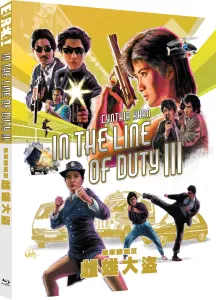
In The Line of Duty III (1988) / In The Line of Duty IV (1989) – Blu-ray Review


Originally published on Set The Tape


In The Line of Duty is a film series that fans of Hong Kong cop action movies might be familiar with, though you might not be aware that you are thanks to some weird shenanigans with the naming of the series. Originally beginning as the Michelle Yeoh film Yes, Madam!, a sequel called Royal Warriors was released the following year. After Yeoh retired from film for a while following her marriage, the producers wanted to continue on the hit series. This is where In The Line of Duty III comes in. Having retroactively re-named the other two films to make them the first and second parts of the franchise, this third film introduced viewers to a new star in the form of Cynthia Khan (real name Yang Li-tsing). With the other two films now established as the start of this new franchise, it’s up to Khan to breathe new life into the series.

In The Line of Duty III begins strong, introducing viewers to their new heroine, police officer Rachel Yeung (Cynthia Khan) as she chases a criminal down the streets of Hong Kong, getting into a fist fight with him, tearing her uniform skirt open in order to perform some impressive kicks, and deals with an armed stand-off. Within ten minutes Yeung has been established as a young cop who’s not just prepared to sit around and take the easy life like her partner, and will rush into danger to uphold the law. From here the film begins its real story, as two Japanese Red Army members launch a campaign of terror across the city.

Throughout the film Yeung is forced to push for inclusion on the case with her over protective uncle, who also happens to be her boss, whilst also being the most competent officer they have. Yeung has several run-ins with the criminal duo, and is eventually partnered up with a Japanese cop, Hiroshi Fujioka (also the name of the actor) who’s come to Hong Kong looking for revenge against the duo over the death of his partner.


In The Line of Duty III is the kind of film that will appeal to fans of 80’s cop action movies. The film has plenty of shoot-outs and explosions to keep the action fans happy, with some really cool and ridiculous moments such as the criminals piloting a remote control helicopter packed with explosives into a hospital, that feels more akin to a cheesy Bond movie. Where the film really excels, however, is in the fighting. Yeoh is a tough act to follow, but Khan seems more than up for the challenge. The scenes in which she’s able to cut loose and fight the villains are the highlights of the movie, and you can see her experience as a dancer coming through in the fluidity of her movements and the stunts she pulls off. There’s a sequence with several crashed cars where Khan slips in and out of them, and hangs off the edges without touching the ground in order to avoid detection, that’s incredibly impressive just from how easy the actress manages to make everything look.

Whilst the film does side-line Khan somewhat in order to hand focus over to her male co-star, the times she is on screen are exceptional. Khan has an easy confidence and presence in her scenes that makes her more than – as some people have described her – a ‘Michelle Yeoh replacement’. It’s clear watching this film that the actress is going to go on to have a long career in film.


In The Line of Duty IV sees Khan return, this time dealing with the evil machinations of the CIA. This time round Madam Yeung has been sent over to the US to help tackle Chinese cocaine dealers. Along with her new partner, Captain Donnie Yan (Donnie Yen), Yeung ends up getting caught up in a plot that sees the CIA selling drugs in order to fund their war against communism (absolutely fictitious of course, the CIA would never, ever do something so heinous) when an illegal immigrant, Luk Wan-ting (Yat Chor Yuen) accidentally comes into possession of incriminating evidence.

When Luk smuggles himself back to Hong Kong after a failed attempt on his life that kills his friend, Yeung and Yan follow after him. Now they have to make a choice: whether they follow their orders to bring him in (orders that will deliver him into the hands of the people out to kill him), or whether they go rogue in order to bring the criminals to justice.

In The Line of Duty IV feels like a big step up over the other film, and features some absolutely phenomenal moments. Khan in particular gets a fight scene that is astonishing to watch, as she takes on some thugs trying to take over the ambulance she’s riding in. Khan battles on the roof of the moving vehicle, hangs half out the smashed windows, and grips onto the front fender as it tries to run her over, all whilst the vehicle is speeding along. It’s a scene that really highlights some of the differences between Hong Kong action films over US ones. In US movies you’ll see the moments where it’s a stunt performer, or you’ll catch glimpses of the harness keeping the actors safe, or half the scene will be shot so that you can’t tell the vehicle isn’t really in motion. But here it’s hard to see the moments where Khan would be wearing a harness, and it really does look like she’s hanging half out of a speeding vehicle.

Later scenes in the film also impress, particularly with Donnie Yen in the mix now too. Yen sometimes got pushed to the forefront of the posters and home release covers for the film thanks to his fame in the US, but it never feels like he’s trying to take anything away from his female co-star in this film. The two of them work well together, and both get some intense fight scenes that showcase their skills. Perhaps more so than the previous movie, this one also manages to find a balance between action and comedy, due in part to the addition of Yat Chor Yuen’s Luk, who plays a pretty normal guy dragged into an extreme situation.


Both releases come with very little extras in terms of behind the scenes features of making-ofs. They do come with a pair of trailers each, as well as two commentary tracks. Both films come with a track by Asian film expert Frank Djeng (a mainstay on Eureka releases) who goes into the history of the films, the careers of the cast and crew, and gives a lot of additional context to what you’re watching. There is also a commentary for each with action cinema experts Mike Leeder and Arne Venema. In The Line of Duty IV does fare a little better than its predecessor, coming with some archival interviews and featurettes.

Overall, fans of Hong Kong action films, and action films in general will find a lot to enjoy with these releases. Despite the weirdness of the series’ releases and the attempts to retroactively create a franchise, both films are great pieces and deserve to be watched. The ‘rule’ that sequels tend to diminish in quality over time definitely doesn’t apply here, as both films are a great watch, with the fourth one being the best of the two.


Support Amy on Patreon

Buy Amy A Coffee

Go to Amy's Blog

Sunday, 2 April 2023

Star Wars: The High Republic Adventures #3 – Comic Review


Originally published on Set The Tape


The first volume of Star Wars: The High Republic Adventures was a series that I really enjoyed. The conflict between the Jedi and the Nihil was clear and easy to understand, the cast of characters were interesting and engaging, and the story was pretty easy to get along with. In comparison, this new volume, set within the second phase of The High Republic, feels like it’s struggling with each of these things.

This volume has shifted the focus away from galaxy-spanning threats, and multiple Jedi protagonists, to instead focus on a smaller group of people dealing with an issue with much smaller odds. We’ve been following Jedi padawan Sav Malagan as she sweet-talks her way onto the crew of the infamous pirate queen Maz Kanata, as she and her crew deal with a gang of criminals who have stolen their ship. In this issue the team catch up to the bad guys, who have headed to a shipyard to try and get hold of some ships that can cause some damage.

Perhaps the two biggest issues for me when I read this series are that the story doesn’t really feel like it has a clear direction, and that none of the characters feel particularly fleshed out. The first might be something that is eventually dealt with over time, but so far the story feels kind of aimless, like the characters are just spinning their wheels. Is the story just going to be one gang chasing another issue after issue, with the occasional action set-piece along the way to keep it interesting? If so, I can’t really see the appeal in that. It really feels like it needs more than that in order to keep itself interesting; some kind of over-arching narrative that means something, and so far that hasn’t been present at all.

You’d think that with no big story to deal with, and most of the last three issues being one group in a ship chasing after another group in a ship it would at least mean that we’d have time to get to know that group. But that doesn’t really seem to be the case. Maz’s crew all have cool designs, and we’ve been given a small taste as to what their personalities and backgrounds are (though some are still very blank slates), but none of them have been expanded upon in any real way. I couldn’t tell you the defining feature of each of them; I don’t know what they’d do in a given situation; I don’t know what their goals and drives are. They’re a group with weird and interesting designs that make them stand out, but that’s it, they don’t really feel like characters yet, which is a huge shame.

As with previous issues, this one moves either at a snail’s pace, or incredibly fast, and there are moments where not a huge amount really happens, followed by a second half of the book that really crams things in. The result is a book that kind of drags for the first several pages, barely keeping you engaged, whilst the latter half tries to do everything and wants to up the excitement, but it’s such a tonal whiplash with the first half that it’s hard to really feel engaged by that point.

I really wanted to like this series. The first volume is one of my favourite Star Wars comics, and I adored the characters that it introduced, but this series has failed to grab me in the same way. Even with the easy start of already having a character like Sav (who is fantastic in the future) the series isn’t really doing anything new, interesting, or engaging. I really hope that this is just an anomaly, a rocky start for the series, and that it doesn’t continue on like this for much longer.


Support Amy on Patreon

Buy Amy A Coffee

Go to Amy's Blog

Saturday, 1 April 2023

Unstoppable Doom Patrol #1 - Comic Review


Whilst I've read books with the Doom Patrol in it, this is the first actual Doom Patrol comic that I've picked up. Thanks to having picked up a few things in other comics, and to the popularity of the television series, I'm aware enough of who the characters are and how they operate before I went into this issue; but I was still excited to see what they'd be like out on their own adventures.

It seems like this new Unstoppable Doom Patrol series, and the team's mission, is spinning out of the the events of Lazarus Planet. Following the Lazarus Rain that caused people to mutate and develop powers there have been more new meta-humans popping up all over the place. Whilst some are simply gaining new powers, others are becoming more obviously different, and no longer look human. With the Doom Patrol being all about being outsiders and weirdos, they want to try and help those who've found their lives changed thanks to the Lazarus Rain.

It looks like they've started doing this before the series begins, as they're already joined by a new member; Best Girl. Beast Girl is a small, purple furred girl with horns who's able to manipulate the fight of flight responses in other people. She seems like a pretty cool new character, and has a fairly pleasant personality and seems eager to help. I also like the fact that her code name is Beast Girl, as a nod towards Beast Boy, who was a member of the team for a while when he was younger.


The team head into Gotham in order to help a new meta-human who's being experimented on by a corporation that's been conducting experiments on the new metas. When they arrive the windows of the building above them shatter, and monstrous creatures come pouring out. The Doom Patrol have to try and fight off the creatures, along with the security guards who come after them; as well as the meta that they're there to save, who's grown into a huge hulking creature.

It's at this point that Batman and Robin (Tim) arrive on the scene ready to take over. I love how Crazy Jane, now the group's Chief, just instantly shuts him down on this matter. This might be his city, but this is their mission, and their kind of area, so she doesn't allow him to take over or dictate what's going to happen. It almost feels like a bit of meta commentary on how Batman will suddenly appear books that aren't even Batman books, and will take over things. Unstoppable Doom Patrol teases the idea of that happening here, but say no, because the Doom Patrol are not your average super heroes, and aren't going to step aside out of the spotlight for Batman. There are also some fun moments where Jane talks about the revolving doors at Arkham and the repeating systems villains find themselves in.

Whilst all this is happening Robot Man and Beast Girl manage to get through to the new meta, and are able to calm him down enough to get him to agree to go with them. This new member of the team, called Degenerate, is powered by his anger, and seems to be a big, lumpy ball of rage ready to kick off at any moment. He makes a nice counter balance to Best Girl, the other new member, who just seems super chipper. After things settle down in Gotham we see a brief scene that shows that the government is up to something, and that Peacemaker has selected someone from Taskforce X's espionage unit to infiltrate the team; giving us hints that there's something big coming for the Doom Patrol.


Scattered throughout are scenes that follow Monsieur Mallah and the Brain, who has now got himself a robotic ape body like his friend. The two of them battle through hordes of the undead to enter the stronghold of General Immortus. Once inside, Mallah turns against Brain, and the two of them have a fight that leaves one of them apparently dead. This is a pretty surprising turn, as the two characters always come as a pair, and it seems to be showing that not only is Dennis Culver going to be trying new and interesting things for some of these familiar characters, but that you're going to struggle to be able to predict everything that's going to happen.

The art on the book, by Chris Burnham and Brian Reber as artist and colourist respectively, looks fantastic. Burnham has a style that fits in the super hero universe, but kind of also feels very different. The work reminds me of Frank Quietly a lot of the time (one of my favourite comic artists), and much like Quietly, Burnham's art is able to marry the 'normal' parts of the universe with the really bizarre. Characters like Degenerate and Beast Girl look fantastic, with Degenerate looking lumpy, misshapen, and gross thanks to all of the little details and flair that Burnham give him. Beast Girl manages to look completely alien and weird, but also incredibly cute too. The panel where she uses her powers to scare off some enemies is one of the most adorable things around. The writing on the book is great, and the art makes everything pop and grab your attention. I honestly can't wait to see what this creative team does together, because it seems like it's going to be fantastic.

This might be my first real Doom Patrol comic, but it's definitely not going to be my last. This series is going to be one that I'm eagerly awaiting each month, and I've definitely been given a jolt to go back and try some of the older stuff. If you're similar, if you've never really tried a Doom Patrol book before and are unsure about giving this series a try, just try it. It's only six issues long (so far, hopefully more!) and if the first issue is any indication it's going to be a fantastic six issues that you're not going to want to miss out on.


Support Amy on Patreon

Buy Amy A Coffee

Go to Amy's Blog

Snow Angels: Library Edition – Graphic Novel Review


Originally published on Set The Tape


Jeff Lemire is one of those writers whose work you’ll find at ‘The Big Two’, having written some great stuff for both Marvel and DC Comics, but if you really want to see Lemire’s best work you have to look at his creator owned stuff: things like Sweet Tooth, or Black Hammer. Snow Angels: Library Edition brings together the complete ten issue run of the Lemire (and artist Jock) science fiction tale for the first time, and is an absolute must read.

The story begins on a cold, desolate world. A world covered in ice and snow. We meet a father and his two daughters: twelve-year-old Milliken, and eight-year-old Mei Mei, who are living in The Trench. The Trench is a huge rift in the never-ending show, a canyon that allows the small group of humans to survive in conditions that would otherwise guarantee their deaths. There are only really three rules in regards to The Trench, rules that the girls have had drilled into them since they were born because they could mean the difference between life and death.

The first rule: The Trench provides. Anything that the people might need to survive, from food, to scavenged items, are all present within The Trench. Rule two: you must never, ever leave The Trench. There is only death awaiting anyone who decides to leave The Trench; with winds that can strip the flesh from your bone, snow in every direction, and the mysterious Snowman prowling the ice, leaving The Trench is a death sentence. The final rule: The Trench never ends. It goes on forever, and trying to find the end will only bring madness and death.


The three of them are out hunting one day, tracking food for their community, but return to find everyone dead. The bodies have been torn open, sliced apart, and blood stains the snow. The Snowman has finally come for them. The old children’s tale seems to be true, as a mysterious figure begins chasing the three survivors, hunting them through The Trench. However, when the three of them discover the impossible, the end of The Trench, nothing will ever be the same for them.

Snow Angels is a story with a ton of mystery to it. As the story begins we’re dropped into the middle of an unrecognisable world, one where the constant snow and ice have made just surviving a constant battle. But where is this place? Is this an Earth that has gone through an ice age, or is it an alien world? Where does The Trench come from? Who or what is the frightening Snowman who’s hunting the central family? What are the mythological Colden Ones, and do they really exist? It feels like every new concept we get introduced to throughout the story is a further puzzle, an additional mystery that needs answering in order to solve the greater questions. But despite this, the book never feels overwhelming, you never feel like you’re getting lost. This is down to the strength of the writing.

Lemire is very clever with Snow Angels because he gives the reader enough time to get used to each new shift and twist in the tale before introducing a new one. We have time to get to know the three characters, to see what kind of people they are, and to understand their way of life before that’s forever changed with the arrival of the Snowman. We’re given time to get used to the idea that they’re being hunted by this thing through The Trench before the book takes The Trench away from us completely. Upon seeing the length of the book I was initially a bit apprehensive, as near to 300 pages is a big commitment.


However, it never once feels like you are reading a huge, bloated story. Because each of the pieces of the tale are given enough time to breathe and to settle in before something new is brought in, the book is big, but it isn’t long. I completed Snow Angels in a single sitting because the story moved at such a brisk pace, kept me wanting to find out what happened next, and I just didn’t want to put it down. Lemire has done an amazing job at balancing pace, action, and length to create a story where it feels like you get a lot more time with it than most creator owned one-off tales – though you do also come away wishing it had been even longer.

Jock’s art is also another huge factor in the book being such a good read. His artwork lends itself brilliantly to this story and setting, and some of the best parts of the book are the moments where Jock delivers a huge, two page spread of the vast nothingness of these locations. The stark white, the effects of the howling, snow filled winds, the tininess of the characters on the page, all come together to sell us on the almost hopelessness of the situation. But there are lots of moments of beauty to be found here too, and Jock is able to turn desolate and barren locations into scenes that look beautiful on the page. It’s hard to see this book working as well as it does with any other artist working on it, and it feels like the perfect marriage between artist and script.

Snow Angels is a story that might have slipped under some readers’ radars when it was first released, but this new edition is a book that I will absolutely be recommending that people pick up. From the mystery of the story and setting, to the tense action and horror of the Snowman chasing our heroes, to the tender moments of love this family shares, there’s something here for every reader. Plus, it just looks absolutely gorgeous too.


Support Amy on Patreon

Buy Amy A Coffee

Go to Amy's Blog

Friday, 31 March 2023

Tim Drake: Robin #6 - Comic Review


Originally published on Patreon


With issue six the first arc of Tim Drake: Robin comes to a close, and this might be one of the worst Robin comics I've ever read. I really wanted to like this series, I love Tim as a character, he was my first Robin, and I love that he's being allowed to be bisexual and that this book would explore that. But it is just so dull, so uninteresting, and so off-putting to read that the only thing keeping me with this title has been sheer stubbornness. 

The main thing that's not helped this series for me has been the story. I just haven't cared about it. The plot feels overly convoluted and doesn't make much sense to me. Tim is the detective Robin, so yes, give him a mystery story; but this isn't really much of a mystery as all of the mystery is someone redoing existing mystery stories. Tim isn't really solving crimes, he's remembering fictional detectives solving crimes and working back from there.

The villain, once revealed, also doesn't really do much for me. It's basically just another Clayface. And yes, the book can claim that its not, that it's alchemy mixed with Clayface clay, but it's still the basic Clayface model with a few new bells and whistles. And Moriarty himself is a bit of a nothing. He's a Robin fanboy who wants to be Tim's arch nemesis. Well, then do something to earn that, don't just turn up and whine that Tim doesn't want to play with you.

Even when out of his hero guise the book fails to make Tim feel interesting for me. He just doesn't feel like Tim Drake. There's not a single moment in the book where it felt like the Tim I'd been reading for the last couple of decades. This could have had any name attached to the character and I'd have believed that it was a new creation rather than Tim. 

The artwork doesn't help with that either, as the Tim presented here doesn't look anything like Tim. The artwork kind of doesn't look anything like any other DC book or character. Having variety in art style is important, and it's great to have new artists with their own distinct style, but the characters should at least look like the characters. I honestly don't get on with the art in this book, and I know that's a me issue because it's down to personal taste, but the weirdly shaped and overly large heads with the almost stick thin bodies just feel off to me. 

Another criticism of the art that I've seen, which I kind of have to agree with, also ties into how the book seems to be handling Tim's queerness. Tim is drawn very effeminately at various points throughout the book. I don't know why. It's not how Tim normally is, and it's not how he's been portrayed in other books since he came out either. Being queer and effeminate is absolutely fine, and if that's how Tim always is that'd be cool, but this is the only book that does it. And that just adds to the feeling that this just isn't Tim. It's like the book is trying too hard to go 'Tim's queer now, see, look how queer he is' and it feels like it's gone too far into that and lost what makes this character who he is. Tim isn't defined by his relationship with Bernard, and doesn't need to be. He's strong enough to stand on his own.

I'm honestly glad this arc is done, and that we're getting new artists going forward. Whilst I'm not holding out much hope in the quality of the writing improving, at least the new art might make it easier to read. I really want this book to be good, to showcase how fantastic Tim is; but so far it's become one of my most hated DC titles each month.


This article, and many others, can be read a month early on my Patreon for as little as $3 a month!


Support Amy on Patreon

Buy Amy A Coffee

Go to Amy's Blog