Monday, 3 October 2022

Wonder Girl Annual 2022 - Comic Review


Originally published on Patreon


So the Wonder Girl annual is a bit of a weird one. It's story is split all over the place, and with four different artists working on the book it never manages to feel like a coherent whole.

The issue begin strong enough, with the best part of the issue, with a history for Jerry the Pegasus. Jerry has been Yara's partner since her solo series, but we've had relatively little info about him. Here we get a pretty dark and sad backstory for him that makes it so that you'll never really look at him the same way again.

The rest of the issue sees Yara head to a festival to try and find Joao, one of the guys that she was flirty with in her series. Unfortunately for her, since they last saw each other he's gotten himself a girlfriend. However, Yara's amazon sisters recognise the woman as The Cuca, an evil magic being.

The Cuca reveals herself to the group and a fight ensues. Meanwhile, monster begin to attack the amazon city of Akahim, which might be connected with The Cuca. We also get flashbacks to The Cuca's origin, and how she became cursed.

There's really about four different things happening in this issue, and whilst Jerry's story is nicely kept to one side as a prologue, the other three intercut with each other at multiple points, jumping from narrative to narrative. Each segment also has its own artist, and you end up changing between three different artists too.

The biggest problem is, none of the stories here feel particularly interesting. It feels a lot like this issue is trying to tidy up hanging plot threads from the previous Wonder Girl run, but there's not really much let to do that for. We didn't know where Jerry came from, but he didn't really need an origin. Joao and Yara were flirty with each other and then we never saw him again, but I didn't really need to see him again as he brought little to the series. And The Cuca was featured in maybe a panel or two in one issue and made a vague threat-like thing, so she's back now, but I'd honestly forgotten about her.

Yara is an interesting and fun character, but I think she needs her world to be better built. This issue shows off that the supporting cast that surround her aren't really that well defined, nor interesting. Her intro series was pretty short, and since then she's been in parts of other peoples stories. It feels like she needs to be the focus a bit more.

Hopefully Yara will be back again, and that we'll keep seeing more from her as she's a character I really do like; but this issue doesn't really do much to show her off.


This article, and many others, can be read a month early on my Patreon for as little as $3 a month!


Support Amy on Patreon

Buy Amy A Coffee

Go to Amy's Blog

Dark Horse – New Releases!


Originally published on Set The Tape


Dark Horse have a lot of new books out this week, with a variety of titles on offer. There are some superhero comics, some dark religious horror, and a couple of romance titles too – a little bit of something for everyone!


Love and War

Love and War has something of a unique flavour to it. It has the feel of a sports manga, where everything is focused around this one game, where everyone’s lives are centred on it, and even the world seems to care about it to a degree that feels unrealistic. In the case of this story, it’s tug of war, with rival schools all competing in huge, televised competitions for championships in huge arenas that seem built purely for tug of war. But it also has a very European setting, with everything taking place in an unspecified country somewhere in Europe that has visual qualities taken from places like Sweden, Austria, and northern Italy.

The story centres on Domo, a member of the Aster Academy tug of war team. We begin at the start of a new school year, where Domo learns that the team captain, his friend Gabe, has left to join one of the rival schools. Worse, he hasn’t spoken to Gabe since they kissed last year. Learning that the boy he loves is gone, Domo tries to focus on tug of war, but faces challenges there when both he and Jocasta have been signed up as co-captains, and he is going to have to compete for the position. And when a new student, dancer Emil, joins the team, Domo finds himself falling in love all over again.

Love and War is a very queer book. All of the romances that take place here are gay ones, the book doesn’t shy away from putting LGBTQ+ relationships at the front and centre of this sports romance series. And as you can imagine, this being a sports competition book focused on teens in love, it does get a bit intense. Everything is high stakes here, with futures, reputations, and dreams constantly on the line. Andrew Wheeler does a good job of capturing that teenage feel of everything being hugely important, and I’m not entirely sure if everything in this world is focused around tug of war, or if we’re just seeing it that way because that’s how our characters see it.

The artwork, by Guillermo Saavedra, Killian Ng, and C.R. Chua, is all nicely presented, with clean line-work and a nice colour palette that draws upon pastel shades a lot. The scenes where we’re outside and we get to see the city and all of the huge buildings and fancy sights are some of the best moments in the book, with everything else being decent. If you’re a fan of sports dramas, teen drama, or romance, this book will probably have some appeal for you.


Virtually Yours

The second romantic title this week, Virtually Yours does things a little differently, and feels more like your average rom-com than high octane school sports drama. In this story we meet two adults struggling through some hard times in their life. Eva Estrella is living at home with her parents, trying to find a job in journalism, whilst her overbearing mother fawns over Eva’s pregnant, married sister, badgering Eva about when she’s going to get her life in order. To try and get her mother off her back Eva signs up to Virtually Yours, a new online dating service with a twist.

Virtually Yours provides its users with the appearance of being in a relationship without ever having to be. You get photos of your partner, proof that you’ve gone on dates, and flowers and gifts can be sent to your work or home. The aim is convince the others in your life that you’re not desperately single. Eva ends up matching up with Max Kittridge, a former child movie star who’s going through a messy divorce from a wife who used to abuse him, and is working at Virtually Yours to try and get some financial stability. The two of them get on well on the app, using fake names, but when Eva and Max end up becoming friends in real life without even realising they know each other, and romance begins to bloom, things get a bit more complicated.

I get the feeling that Jeremy Holt, the book’s writer, has a thing for romantic comedies, as Virtually Yours follows a lot of the conventions of the genre. The book has people who find their lives missing romance, who end up falling for someone, but things get complicated, there are misunderstandings, people from their past mess things up, there are the best friends there trying to help. It features all of that; but despite having a lot of the hallmarks of the genre it never feels dull, or like it’s just ticking boxes. A lot of this is down to the charm and care that Holt puts into their writing, and the way they bring the characters to life.

The book’s art is provided by Elizabeth Beals, and looks really nice. Beals puts a lot of care and attention into all of the scenes, and there’s always a ton of tiny detail and things filling the backgrounds. It never feels like things are happening in a void, in blank panels where only the character exists. It’s a fully realised world, and you’ll spend a decent amount of time just checking out all of the details that make it feel bigger and lived in. This is a great book that has very little tension or drama, and feels much more people focused. If you like rom-com stories this is one that you’re going to love.


Daisy

Daisy is a much darker book than the others on this list, and defintiely falls into the realm of horror. Telling the story of a woman searching for her missing son, who’s been gone for years, we learn about a small town and the strange religion that they’ve developed. Daisy Phillips is a giant of a girl, towering feet above those around her. She’s been told that she’s descended from angels, and that she may hold the key to speaking the language of God, which will enable her to reshape reality.

The biggest problem is she, and the rest of the town’s children, don’t want to be pawns in the religious experiments of the adults, and they’re tired of being used, changed into twisted, painful forms. With the help of this now desperate mother, and magic from beyond our world, Daisy believes that she will be able to go against the church and their charismatic leader.

Daisy is an odd story. It’s steeped in Christian religious mythology, and tries to do some of its own things, creating this weird kind of hybrid between things that feel familiar, and things that seem wholly unique. There are times that the narrative seems to be trying to make a point about religious fervour, of how cult-like followings can harm innocent people, with literal children forced to live in agony here. But the book never really fully commits itself, and tries to walk this line between that and religious dogma being real. Perhaps one of the worst things, for myself, that Colin Lorimer does here, however, is to make the people who have been cursed because of their ‘dark souls’ be deformed and disabled. It feels incredibly ableist to say that those with physical deformities, those who use mobility aids and limb braces, are the way they are because God looked at them and saw they were evil and wanted the outside to reflect that. It didn’t sit right with me at all.

The book’s visuals are very good, and Colin Lorimer also provides the art along with colourist Joana Lafvente, and there are some truly visually disturbing scenes, such as monstrous biblical giants, undead animals, and people without skin. The book embraces the gore and the visceral horror, and puts those images front and centre. Whilst I personally found parts of the narrative hard to understand, and did not like the ableist parts of the book, some horror fans might enjoy it.


Black Hammer Omnibus Volume 1

Black Hammer is a series that will appeal to fans of superheroes, who want something a bit different from your average hero story. It doesn’t tell the story of heroes saving the world, nor does it try to reinvent the genre with twists on the themes like evil heroes; instead it gives us a character-focused mystery story that feel like a love letter to the Golden Age of comics.

Black Hammer tells the story of a group of superheroes who vanished saving the world from total destruction by the Anti-God (Galactus mixed with Darkseid) ten years before. There’s Abraham “Abe” Slamkowski, also known as Abraham Slam, a street level fighter; Gail Gibbons, aka Golden Gail, who transforms into a super powered kid when she says the magic word Zafram; Mark Marz, the alien shape-shifter from Mars; Joseph Webber, who transforms into the hero Black Hammer when he picks up his magic mallet; Colonel Weird, an astronaut detached from material reality; the alien robot TLK-E WLK-E, more commonly referred as Talky-Walky; and the witch Madam Dragonfly. These heroes didn’t die like everyone thinks, however, and are instead stuck on a farm in a small town.

The group have been unable to leave the area around the farm, Black Hammer having tried and died in doing so, and have been stuck there for ten years, trying to find a way home and make a life for themselves. No one in town has heard of these or any heroes before, and some of their powers don’t work as they should, with Gail being stuck as a child despite being in her fifties. As they reach their tenth anniversary stuck together, relationships begin to fray, mysteries deepen, and help tries to find them.

Black Hammer is, at its heart, a supernatural mystery. It feels like a Twilight Zone story, with the small town that you can’t leave. And as the book unfolds and we learn more it starts to become obvious that things here aren’t quite right, and that there’s something really bad going on. All of this is between extensive flashbacks to the heroes’ past lives as both civilians and heroes, which feed into the events in the present and helps to flesh out the character and the world. Jeff Lemire does an excellent job at weaving all of the disconnected threads together to make this hugely engaging narrative, and a world you want to know more about.

As a fan of superhero comics, there’s also a lot here to love, as there are nod and winks to all kinds of things. Gail is a reverse Captain Marvel/Shazam; Mark Markz is Martian Manhunter; Black Hammer is a cross between Thor and the New Gods; and Colonel Weird is Adam Strange with a bit of Flash Gordon mixed in. The covers are made to look like older, Golden Age books, with banners and titles that match some well known Marvel and DC images. It feels steeped in comic history, and it clearly loves the genre.

There are a few different artists who worked on this book, as it gathers together the first twelve issues and a giant sized annual, but the majority is done by Dean Ormston, who has a wonderful style that captures the feel of Golden Age books, but has a darker, more down to earth feel that also works well with some of the more horror elements that pop up from time to time. If you love superhero stories, or if you’ve gotten tired of seeing the same kind of thing from the genre time and time again, Black Hammer is a book for you. It’s a love letter to the history of comics wrapped up in an amazing character focused mystery.


Support Amy on Patreon

Buy Amy A Coffee

Go to Amy's Blog

Sunday, 2 October 2022

The Flash Annual 2022 - Comic Review


Originally published on Patreon


I've been really enjoying The Flash since Future State, with Wally having taken over the reigns whilst Barry has been off doing wild stuff in the multiverse. His family are great, there have been some fun stories, and there's lots of intrigue and genuinely wonderful moments. This years annual, however, might be one of the worst issues of The Flash I've ever read.

So, first off, those hoping for some cool Flash action in this issue, or even good character moments, this is not the book for you. Very, very little happens here. This is because the vast majority of this issue is taken up by Linda's new novel; which Wally reads through. And oh boy is Linda an awful writer.

Her book tells the story of a young woman who wants to become a writer, who sets out with a plan to become the best in the field, but whose life gets dragged off course slightly over the years. She has a failed marriage, and has become a reporter instead of a writer; but eventually finds herself enjoying her life.

One day the woman is investigating a series of cattle mutilations, when a huge monster appears and starts to attack. She's rescued by a red headed man who's basically the Rocketeer, who kills the monster. She and the man are transported aboard his spaceship, which looks like a cheap Enterprise-D knock-off, where she meets a guy who looks like Captain Cold, and another who's a Green Arrow engineer.

The ship comes under attack from a black hole, and a giant golden space cobra, and they teleport away as the ship is destroyed. They end up in the home of their employer, a space magician, who is behind the attack. He's going to make the black hole giant to destroy all life in the universe. Eventually the woman manages to stop him, save the day, and romances the dashing space hero.

So everything in Linda's story is just fucking awful. The book goes on for multiple chapters like it's a regular literary fiction, before taking a turn into b-movie sci-fi schlock. Every situation is more ridiculous than the last, with characters and plot that makes no sense, and the absolute worst self insert character ever created. And apparently not only does Wally love this, but the book is getting published and Linda's going on a big book tour. Books must be seriously shit in the DC universe if this is an example of a potential best-seller.

A good 75% of this book was given over to Linda's writing, and it was honestly some  of the worst stuff I've ever read. If I wasn't invested in this series already I'd have put the book down and skipped it. And I kind of wish I had. The only thing that happens here that feels like it has any baring on anything, or could even matter, is that Linda and Wally suddenly think that perhaps Linda could be pregnant. Whilst this could explain the reason why she suddenly developed speedster powers, it's the only thing to come from the issue that has any kind of weight or purpose. And it could have been done in half a page.

It honestly feels like Jeremy Adams didn't get told there was going to be a Flash annual until the last minute, realised his story was already planned out for future issues, so had to throw something together that is mostly a throwaway. Either that, or this is supposed to some kind of comedy, but if that's the case none of it ever actually lands.

I truly hope that this isn't an indication of how the series is going to change going forward, because it the regular book turns into this The Flash will go from one of my favourite reads each month to my most hated.


This article, and many others, can be read a month early on my Patreon for as little as $3 a month!


Support Amy on Patreon

Buy Amy A Coffee

Go to Amy's Blog

The Raven Boys by Maggie Stiefvater – Throwback 10


Originally published on Set The Tape


'It is freezing in the churchyard, even before the dead arrive. Every year, Blue Sargent stands next to her clairvoyant mother as the soon-to-be dead walk past. Blue herself never sees them—not until this year, when a boy emerges from the dark and speaks directly to her.

'His name is Gansey, and Blue soon discovers that he is a rich student at Aglionby, the local private school. Blue has a policy of staying away from Aglionby boys. Known as Raven Boys, they can only mean trouble.

'But Blue is drawn to Gansey, in a way she can’t entirely explain. He has it all—family money, good looks, devoted friends—but he’s looking for much more than that. He is on a quest that has encompassed three other Raven Boys: Adam, the scholarship student who resents all the privilege around him; Ronan, the fierce soul who ranges from anger to despair; and Noah, the taciturn watcher of the four, who notices many things but says very little.

'For as long as she can remember, Blue has been warned that she will cause her true love to die. She never thought this would be a problem. But now, as her life becomes caught up in the strange and sinister world of the Raven Boys, she’s not so sure anymore.'

In previous book related throwbacks I’ve mostly been covering books that I’ve already read, or books that I’ve wanted to read for a long while, and have used their anniversaries as an excuse to finally get around to reading them. And whilst I’ve enjoyed them all and seen why they’ve been considered classics, this is the first book I’ve actually regretted sitting down to read, as The Raven Boys left me feeling baffled more than anything else.

The book, the first in a series of four, follows the character of Blue Sergeant, a totally plain and boring teenage girl who is way more than plain and boring. Blue has moved to the small town of Henrietta in Virginia, where she’s staying with a group of female relatives who all have psychic powers. Unfortunately, Blue doesn’t follow in the family footsteps, and doesn’t really have any psychic abilities of her own, though she does have a power that makes other psychics around her more powerful. Whilst living with her psychic relatives, it gets predicted that if Blue kisses her true love they will die.

When attending a traditional watching of spirits that pass through the town, Blue ends up talking to the spirit of a teenage boy named Gansey. Her aunt tells her that the spirits are of people who are doomed to die within the next year, and that the spirit of Gansey is her true love. Blue discovers that Gansey is a real boy, Richard Gansey III, who’s part of a gang of teens called the Raven Boys, who all attend one of the local rich schools. Over the course of the book we learn that most of the group have dark, tragic, and mysterious pasts that will absolutely become big plot points across the series.

Despite wanting to stay away from the boys so as not to fall in love with Gansey and kiss him (because it will kill him), Blue ends up befriending the group and joins them on their mission to search one of the mystical ley lines around the town. The Raven Boys are searching for the body of Welsh king Owain Glendower, who is thought to be near the ley line. In their search they find a magical forest that can talk to them, learn that one of the group is secretly a ghost, and get involved in other supernatural shenanigans.

The Raven Boys starts off being one book: a story about a teenage girl who has grown up being told that if she kisses her true love then he’ll die, and is trying to deal with that. The book is about whether or not Gansey is actually her true love, whether she should stay away from him or not, and all kinds of teen love angst drama. Whilst I get that love angst is a big part of YA stories this one feels a bit off to me. It’s not a love triangle type situation, or a will-they-won’t-they, it’s something a bit different. The way I see it, there are some really simple solutions for Blue here. Blue can either stay away from Gansey, or just not kiss him. Call me weird, but you can be in love with someone, be in a relationship with someone, and not kiss them. There are happily married people who are asexual and don’t have sex, so I’m sure you can be in a relationship with someone and just not kiss them. It doesn’t make it a lesser relationship or anything. But alas, teen drama needs to be had.

Another thing that I found odd about the book is the sudden shift towards over-the-top and confusing supernatural plots. The Raven Boys are searching for an ancient Welsh king who may or may not be dead, and is for some reason buried in the US. Magic talking forests exist. One of the boys turns out to secretly be a ghost. There are also domestic abuse plots thrown in, dangerous gunmen, people doing strange rituals, human sacrifices… it all feels very cluttered and not a huge amount is really explained or makes sense. Perhaps this is something that ends up making more sense if you continue reading the rest of the series, but as it stands I find myself hard pressed to carry on with it.

I’d heard a lot of good things about The Raven Boys, and it had been on my list of stuff to read for a while, and whilst it seems to be a popular YA series it definitely seems to be a niche one. It tries to do a lot of things and uses as many tropes and cliche’s as it can in an attempt to try and tick all the boxes. Unfortunately, this results in a book that fell far short of being great for me.


Support Amy on Patreon

Buy Amy A Coffee

Go to Amy's Blog

Saturday, 1 October 2022

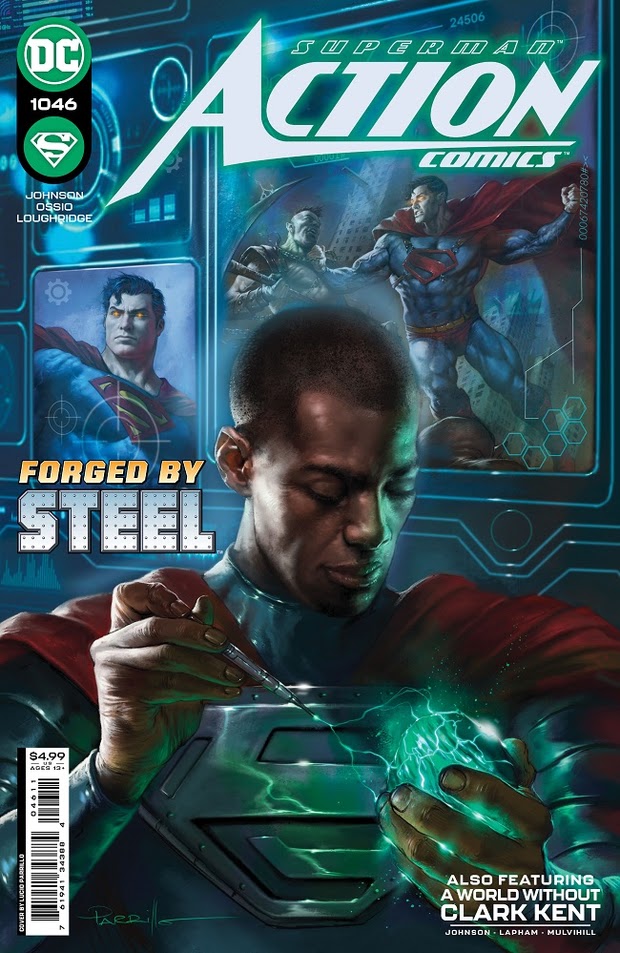
Action Comics #1046 - Comic Review


Originally published on Patreon


The latest issue of Action Comics gets things ready for the big, final showdown on Warworld as the story comes to a close in the next, special issue. But first, Superman finds himself fighting his way towards a fabled artefact, buried deep beneath the planet's surface, hoping that it will provide him with enough power to take on Mongul.

I really liked this issue, due in large part to the fact that the focus was solely on Clark, rather than it being split between the different teams as has been done in previous issues. Yes, there's more going on elsewhere as the rest of his team, and the resistance movement that has formed around them, fights for their freedoms. But Clark is the most important one, and his mission is the one that may most turn the tables; and so focusing on him makes a lot of sense.

But other than that, this issue is also one of the best for showing how wonderfully kind of a person he is. Whilst fighting to get this ancient artefact he is acknowledged as having never killed anyone, something that sets him apart on Warworld, and whilst that seems to stand him in good stead with the forces protecting the artefact it's his kindness that wins the day. He risks his life to protect this being, this energy-like creature that may not even really be alive in the way that we understand it; and that proves that he's the kind of man worthy of wielding this power.

This is, what I think, most encapsulates what makes Superman he kind of hero he is. He's fighting for his life, fighting to get a power so that an evil despot doesn't, fighting to save the lives of millions, but risks it all to save one more person. That's who Superman is, that's what makes him worthy of the name.

It feels like this was a nice issue to remind readers of who he is, of what he stands for because for months we've seen him leading a crusade to free an alien world. We've seen him fighting to overthrow a tyrant. He's been leading a resistance group, fighting in arenas, and he's less like the man we think of as Superman all the time. But he's still him. He still does the right thing and is a kind and decent man. And next issue he's going to finish this fight.


This article, and many others, can be read a month early on my Patreon for as little as $3 a month!


Support Amy on Patreon

Buy Amy A Coffee

Go to Amy's Blog

DC Mech #2 - Comic Review


Originally published on Patreon


DC Mech is a strange series, and this second issue already starts to show the cracks as things start to grate a little as the story falls into some rather annoying tropes.

One of the biggest things that makes this second issue drag is that because this is the first time some of these heroes are coming together in this universe it means that they have to fight each other. Because god forbid we have a team origin story where we don't have the misunderstanding fight. I know it's just the done thing for these kinds of stories, but I'm bored of it. I don't need to see heroes clashing because they don't know if they can work together or not yet.

This issue does introduce us to some cool new mech designs, however. The Green Lantern mech is a transforming jet fighter that turns into a humanoid suit, that has two pilots inside it; Hal Jordan and John Stewart. The suit isn't based on any kind of Oan technology, however, but is instead powered by the Star Heart and Alan Scott's equipment.

There's also Wonder Woman's mech, which is an ancient battle suit that has a Grecian warrior design, covered in gold and wielding a sword and shield. One of the cooler parts of this mech is that where others work along the same lines, with pilots in their seats working controls, Diana is standing inside a special chamber where the maps her movement onto the machine, making it faster and more fluid in combat.

Whilst our heroes fight against each other and do the typical 'I can't trust you even though you're clearly a good guy' type rubbish the villains launch the next stage of their assault on Earth, with Kalibak and the Female Furies attacking a Luthor compound.

The series had a somewhat interesting start, but I'm beginning to feel like perhaps the conceit should have maybe been done as a one-shot rather than a miniseries. Things are already starting to feel a bit stale, and this makes for the second drastic re-imagining of the Justice League where the big villain is Darkseid (the other being Jurassic League).


This article, and many others, can be read a month early on my Patreon for as little as $3 a month!


Support Amy on Patreon

Buy Amy A Coffee

Go to Amy's Blog

Poltergeist – Throwback 40


Originally published on Set The Tape


Ghost stories are a popular genre of film, and over the last few decade they’ve begun to come back into popularity, with stories of families being haunted by sinister spirits and having to call upon help from ghost hunters being a plot used in big franchises like The Conjuring and Insidious. But one of the first films to do this, and to become a big hit, is Poltergeist, which has just turned forty years old.

Telling the story of the Freeling family, the film introduces us to this average American family living in a new housing estate in California. The father, Steve (Craig T. Nelson) works for the company building the new community, and got to move into one of the very first houses along with his wife Diane (JoBeth Williams), his teenage daughter Dana (Dominique Dunne), and two young children Robbie (Oliver Robins) and Carol Anne (Heather O’Rourke). Strange events begin to happen around the house, such as furniture moving on its own, and the television acting strangely, hinting at something sinister in the home with them.

The small events begin to build, and the benign haunting soon starts to turn sinister, with a tree coming to life and attacking the sleeping children. When the family try to flee the home, Carol Anne is pulled into a portal inside the closet, vanishing. The family search for the girl, but find no trace for her apart from her voice, which comes through the television. The family are forced to call upon a paranormal expert and her team in order to try and save their daughter.

The plot for Poltergeist is one that is fairly familiar, because it’s one that’s been used a lot since Poltergeist came out four decades ago. And considering how well received the film was it’s no surprise that it’s been emulated time and time again over the years. However, the film wasn’t always what it ended up being, as it began life as something very different.


Poltergeist was not originally supposed to be a film about ghosts, instead it was envisioned as a horror sequel to Steven Spielberg‘s 1977 sci-fi film Close Encounters of the Third Kind, titled ‘Night Skies’. The script told the story of a family farm being terrorised by a group of alien visitors, and would lean much more heavily into the horror elements than science fiction. Whilst MGM loved the idea, and wanted to make it, Spielberg would eventually change his mind about the project, and would shift towards a story about a more friendly alien visitor, creating E.T. the Extra-Terrestrial instead. However, he had agreed to help produce a horror film for the studio.

Instead of directing the film himself, which he was unable to do as he was working on E.T. the Extra-Terrestrial, he recommended that horror director Tobe Hooper helm the project instead. Whilst Hooper was happy to make a horror film with Spielberg, he was less excited by the science fiction side, and suggested turning the film into a ghost story. Bringing in writers Michael Grais and Mark Victor, the film was reworked into the story that fans know and love.

And people did love Poltergeist, as it became an instant hit upon its release in cinemas. The movie made $78 million in the United States alone, making it the highest grossing horror film that year, beating out films like The Thing. Whilst some horror films, like The Thing, were met with a poor reception and built their following in the subsequent years, Poltergeist was given rave reviews as soon as it was released, with publications such as The New York Times giving it high praise and promoting it to its readers. The movie would go on to be nominated for a number of awards, including Oscars, and eventually won a number of Saturn Awards and BAFTAs.


However, not everything was great for Poltergeist, as soon after the film was released there was talk that Tobe Hooper was not the true director of the film, with some claiming that Spielberg, the producer, was more of a co-director. Some claims even said that he was the ‘real’ director of the movie and Hooper was merely a presence on set. These claims would go on to dog the film for decades, with cast and crew frequently being asked about it in interviews even to this day.

Another thing that ‘haunts’ the film, and that I feel almost can’t be ignored when talking about Poltergeist is the film’s ‘curse’. There have been claims that the film is a cursed production thanks in part to one of the key scenes making use of real human skeletons in place of plastic ones because it was cheaper. The idea of the curse was continued when four actors connected to the film and its sequels died. Julian Beck, who appeared in the sequel, passed away from stomach cancer shortly after working on Poltergeist II: The Other Side. Will Sampson, who also appeared in the sequel, died during a heart-lung transplant procedure after being sick for a while.

But the most tragic stories centre on the two Freeling daughters. Dominique Dunne, who played Dana, was tragically murdered by a former partner at her Hollywood home in November of 1982, just a few months after the film’s release; which is the reason why Dana would not appear in the sequels, as the studio did not want to recast the character. Heather O’Rourke, who plays the young Carol Anne was the only member of the Freeling family to appear in all three films, but sadly passed away a few months before the third film’s release due to suffering a cardiac arrest following emergency bowel surgery, dying at the age of just twelve. Due to these tragedies, the film, and the series in general, was seen as cursed, and there have been many articles written about it, as well as documentary television specials.

Despite these tragic connections, Poltergeist has remained a classic of horror cinema, and is beloved by many fans of the genre and casual viewers alike. It has had a huge impact upon horror, changing the way that haunted house stories have been told ever since, inspiring other stories in the decades since it was first released. Whatever you believe about the curse, or the directorial rumours, it can’t be denied that Poltergeist is deserving of its iconic status.


Support Amy on Patreon

Buy Amy A Coffee

Go to Amy's Blog

Friday, 30 September 2022

Harley Quinn #21 - Comic Review


Originally published on Patreon


The more this story-line goes on the less and less it becomes a Harley story. Whilst it is enjoyable to read, Harley is relegated to being a part of a team here, and the book reads more like a story from the pages of Suicide Squad rather than Harley's own book. 

A large reason for this is because it becomes pretty clear who the lead of this story is in this issue; Luke Fox. The book is filled with narration from Luke's point of view, with his opening and closing the book. We follow him for much of the story, and his moral and emotional dilemma is the big focus here that Harley has to help with. Plus, he debuts a new, unnamed, super hero identity.

Whilst I'm not against this, and have bee enjoying the story since it first began, the longer its been going on the less it feels like it should be in the pages of Harley Quinn. Perhaps this is because the stories up to now have been very focused on her, with the stories having happened because of her actions, or to people wanting to get some kind of revenge against her; but even then I look at other series and even when the characters team up with others the headline character always maintains the focus and gets the biggest part.

That's not been happening here, however, as this issue hardly features the titular vigilant at all. This results in an issue that might work well as part of the whole, but feels a little odd on its own. I think it's a good thing that the Harley Quinn issues are coming weekly at the moment, as it means that this doesn't have too long to take up spotlight before the next part of the story begins.

Overall, this is an okay entry in this particular story, and it helps to get all of the pieces in place for the finale in next week's annual; but it could have been better. Hopefully Harley will get to come out on top in the final part, justifying the reason for this being a story in her series.


This article, and many others, can be read a month early on my Patreon for as little as $3 a month!


Support Amy on Patreon

Buy Amy A Coffee

Go to Amy's Blog

Deathstroke Inc #12 - Comic Review


Originally published on Patreon


There's a lot of action in the latest issue of Deathstroke Inc as the masked mercenary comes face to face with his first superhero, Green Arrow.

Slade, having been used and thrown away by the military after the experiment he was a part of was deemed to be a failure, has agreed to murder the man responsible to prevent him from revealing the secrets of the programme to the public. Whilst Slade could be seen to take the job on as a means to make money, and as part of his duty for his country, it becomes very clear that it's also because he harbours a lot of trauma, and wants revenge.

This is a big reason why when faced with overwhelming odds, with a vigilante able to counter his every move and to actually hurt him, he still refuses to back down. It's interesting to see a relatively young Slade, one who hasn't fully become the super human killer we know he ends up, starting to head down this path. His stubbornness at giving in, his always wanting to fulfil a contract no matter the odds, we see it rooted in a much more personal stake here in this story.

This is also the issue where he chooses to take on the name Deathstroke, speaking it for the first time when Green Arrow demands to know who he is. And it feels like a big moment, because it's here that you realise Slade really has become Deathstroke, that he's not going to back down or give in. That small moment becomes the end of the soldier and family man that we've seen struggling to find his place in the world in the early part of this story.

These character moments are scattered throughout the tons of action that make up the bulk of this issue, where we get to see Slade fighting Ollie for the first time, taking on government agents, soldiers, helicopters, and more as he tries to take down his target. It's not the biggest fight we've seen Slade in in regards to scale, but it still feels big, with each moment escalating more and more until the big, dramatic conclusion.

I wasn't sure if I was going to like a Deathstroke origin series when this arc first began, as when they're not done well character origin stories can end up being some of the most boring ones around; but this series does it incredibly well. For a few issues now I've reached the end and been upset that I've got to wait another month to find out what happens next; and that's the sign of a great comic.


This article, and many others, can be read a month early on my Patreon for as little as $3 a month!


Support Amy on Patreon

Buy Amy A Coffee

Go to Amy's Blog

Godzilla vs Mighty Morphin Power Rangers #5 – Comic Review


Originally published on Set The Tape


The final issue of Godzilla Vs. Mighty Morphin Power Rangers is finally here, and it feels kind of good that the mini-series has come to a close. As a fan of both Godzilla, and Power Rangers, I was looking forward to this series, and was excited to see these two franchises come together. Unfortunately, thanks to a threadbare story, little to no variation in what’s happened issue to issue, and a lack of any real characters, this has ended up being one of the comics I look forward to least each month.

Over the last four issues the Power Rangers followed their evil adversary, the moon witch Rita Repulsa, to another dimension as she used an ancient artefact to leave her own world seeking out new places to conquer. However, despite finding a world without Power Rangers, they did not find a world free from conflict, as both groups landed in a version of Angel Grove under attack from alien invaders, and giant monsters called Kaiju. And since the first issue set up the basic premise of the story it’s been hard to keep track of what’s been happening. In the broad strokes it’s easy, there have been giant robots fighting giant monsters, but as to which issue had which bits, I’d be hard pressed to tell you.

The series has been one long monster fight, and that’s essentially what we get more of here. The Rangers and Godzilla manage to find a way to beat King Ghidorah, not through any tactic or by gaining anything special in helping them in the fight, but simply by shooting him over and over with their big weapons. There’s nothing here that screams originality, especially because we’ve seen it in pretty much every other issue so far when they’ve fought against all the other monsters, but also because it feels no different from every other Zord fight that has taken place across the last three decades and 900 plus episodes of the show. They win simply because they keep on fighting even when they’re being beaten, because they never gave up, and because they kept on shooting.

Other Power Rangers comics have offered readers stories where the Rangers are given character, where they struggle through adversity and have to overcome stuff by learning and evolving. They have conversations about their lives, their hopes, their worries. In this book, the Rangers are barely more than one dimensional. Other than Tommy being given different things to do because he’s Tommy and Tommy is always the special one, none of the Rangers do anything that feels like that particular Ranger. None of their personalities are on show, and you could swap around any of their lines to any other Ranger and it’d read exactly the same. There’s nothing here that makes me think of these characters, other than their costumes and robots, and the Power Rangers have always been more than that, even back at the beginning of the show when they had nothing more than a slight gimmick each.


Godzilla feels a bit better served, but only really because he has very little personality to get wrong. He does what he does in the films and other comics (fights other big monsters) and that’s it. And whilst that’s fine and you can’t really say that it’s bad, people who love the Godzilla franchise will tell you that the best films are the ones where interesting things are happening around the monsters. Some of my favourite films in the series have great stories with fun characters that just happen to include Godzilla. But it seems like this story is expecting to be considered that way simply because Godzilla is here, because nothing much else really happens.

After five issues of build up, the conclusion comes incredibly abruptly, and you get two pages of any kid of wrap-up to bring the story to a close. This results in the ending feeling incredibly rushed, and I can’t help but feel that perhaps if a monster fight or two had been lost or trimmed down along the way then we’d have been able to have some character moments and a proper ending. The only real highlight of the issue is the final page, which shows the shared multiverse with images from all the different Godzilla reboots and refreshes, and the various Power Rangers universes. But that’s about all. The biggest thing of note about the whole issue was one of the variant covers including the Zeo Megazord amongst Mighty Morphin Power Rangers stuff for some unexplained reason.

The art on this issue is once again provided by Freddie Williams III, and is perfectly fine. Everything looks good, the action looks dynamic, and it’s great to see these iconic monsters and machines sharing the same panel. But decent artwork alone isn’t enough to save a book that has been testing my ability to care for a while now.

Overall, this is a series that had a great concept, but started to drop in quality very quickly out of the gate. Reading it all at once in graphic novel form, or with all of the issues waiting for you, might result in this being an okay, middle of the road kind of story. However, reading it month to month, seeing the same basic thing of monster arrives, they fight, beat it, new monster, with no real characters or story, had ended up with this being one of the biggest disappointments. As a fan of both franchises this felt like an easy win, but it ended up being a major loss.


Support Amy on Patreon

Buy Amy A Coffee

Go to Amy's Blog