Tuesday, 30 August 2022

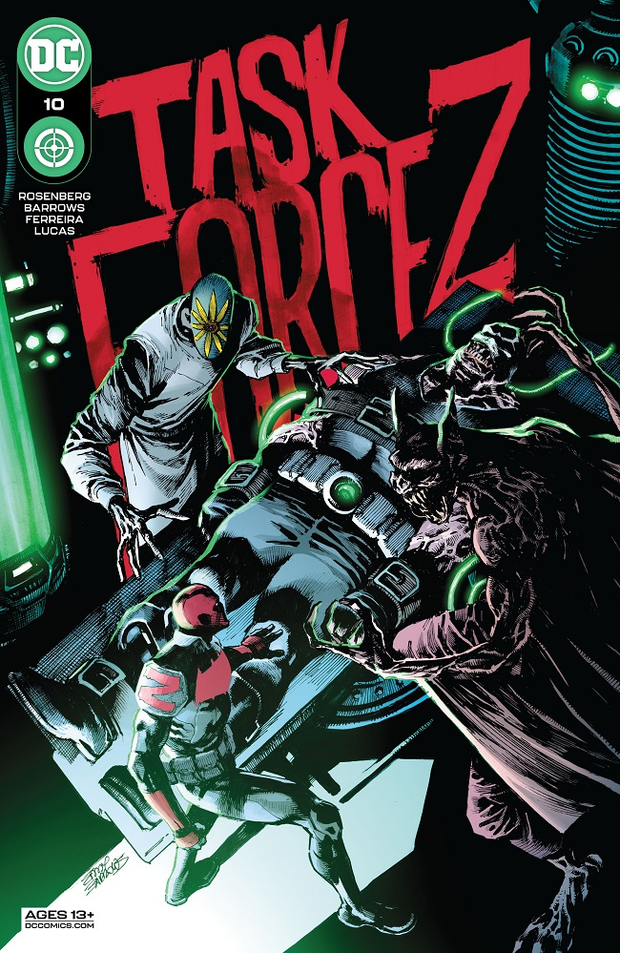
Task Force Z #10 - Comic Review


Originally published on Patreon


Task Force Z issue ten is an issue where we get some answers to some mysteries, have some new curve balls thrown at us, and have some pretty fun moments tossed in the mix too.

If you've been reading this series, but not picked up The Joker you might be in for a bit of a surprise to learn this issue that Bane isn't really Bane. Since the reveal in The Joker a few months ago that Bane faked his death on A-Day I've been wondering where this series fits in, if it even does. Was this a case of the writer on this book got told Bane was dead, but didn't get told it was a fake out?

Well no, because as we see here via a series of flashbacks, the zombie Bane we've been following isn't Bane at all, but was made to think he was. You see, it turns out that Doctor Bloom and Harvey Dent, with the help of Amanda Waller and some of her people, developed a method for implanting memories, effectively making one person into another.

This process was done onto a corpse that was then put into a Bane costume and pumped full of Venom, effectively making a zombie Bane copy. This was all done to help get Jason on side, as he'd jump at the opportunity to hurt the man who killed Alfred Pennyworth.

However, this tech comes back to bite our protagonists in the butt when we learn that Bloom has used it to turn several members of Task Force Z into sleeper agents who will turn into copies of him when needed. This leads to some inter team fighting, and some frankly delightful moments from Solomon Grundy.

The issue ends with a reveal as to who the person behind the Bane mask was that I won't spoil, but is certainly going to be interesting going forward. 

This is a series that keeps throwing new and interesting things at the reader, and manages to pull it off consistently well. I've had fun with each and every issue, and always look forward to seeing what new wild crap is going to happen.


This article, and many others, can be read a month early on my Patreon for as little as $3 a month!


Support Amy on Patreon

Buy Amy A Coffee

Go to Amy's Blog

Camping Trip – Film Review


Originally published on Set The Tape


The Covid pandemic has been a big disruption to our lives for the past two years. It brought the world as we know it to a standstill for months, changed the way we operate, and has highlighted how people will ignore major dangers in a effort to ‘go back to normal’ by acting like Covid is a thing of the past even whilst still around. It’s something that has left a lasting mark on our times, and as such there will be storytellers that use this time. The latest film to use the Covid pandemic as its backdrop is Camping Trip.

Directed by the Fucia brothers, Demian and Leonardo (Leonardo also wrote the movie and starred in it), Camping Trip introduces us to two couples trying their best to make it through the pandemic, who decide to get away from the stress of everything once the first lockdown comes to an end. Enzo (Leonardo Fucia) and his girlfriend Polly (Caitlin Cameron) meet their friends Ace (Alex Gravestein) and Coco (Hannah Forest Briand) with socially distanced greetings as their nosey neighbours watch on from the windows, and try to figure out how to navigate their desire to be close with Covid safety.

We get a bit of an insight into the two groups in this early scene, learning how times have been tough on each, and how they’ve been struggling through the pandemic financially. We also learn that despite his outward appearance at being careful and following safety guidelines, Enzo got fined for having a party during the pandemic; something that hints at the character’s future capacity to make absolutely ridiculous mistakes that put everyone at risk. With the stage set and the characters introduced we head out into the woods with them as they find a remote location by a lake so that they can relax, get away from the stresses of reality, and have a big orgy.


Unbeknown to them, however, there are other people in the forest. A scientist of some sort (it’s never made clear), is making a shady deal with a couple of criminals out in the remote wilds. However, deciding that he doesn’t want to give the two criminals the $1 million he’s agreed, he stashes the cash in the friends camp whilst they’re away. When the criminals realise they’ve been double crossed they kill the scientist and set out looking for the money – a path that leads them straight to the four friends.

The plot of Camping Trip isn’t entirely terrible; unfortunately, the execution of it is. Despite spending time getting to know the four main characters there’s never a sense that you know anything about any of them. There are no real personality traits or distinctive things that set any of them apart from the others. Other than Enzo, who seems to flip flop between being selfish and wanting to do the right thing, none of them particularly stand out. Any of them could be speaking anyone else’s lines and it wouldn’t feel out of place. They seem less well thought out characters, and more just pieces on the board, being moved around scene to scene doing whatever the script needs them to do.

The group is also quite unlikable, and I never once felt like I was supposed to be rooting for any of them, or hoping that they get through things. They make some pretty awful mistakes in this movie, and I don’t just mean your average horror film mistake of heading into a clearly haunted house. They find a freshly murdered man near their camp, a supposed cure for Covid worth millions, and a million in cash, an instead of getting the hell out of there they start blasting music, singing and dancing to celebrate their good fortune. I don’t think they could have drawn the killers attention any quicker if they’d have sent up a flare. And sadly, this is far from the only thing that they did that left me shaking my head.


For example, the directing choices. There’s a scene that should have lasted about a minute, but thanks to everything going into slow motion it seemed to go on for at least five. Everything was dragged out and slowed down, and rather than making things feel tense, or dangerous, or horrific, as I assume the intention was, it made the scene boring. Everything overstayed its welcome, and a number of shots ended up looking undersold, as you could see plainly that some of the actors were pulling punches and not really landing any blows.

Another scene, the big moment where the story all comes to a head, felt ruined by the baffling choice to have the camera slowly spinning around, rather than focusing on the characters. Instead of watching the people we’ve been following for this whole story reach their dramatic conclusion, the camera spins round and round, showing trees, the lake in the distance, more trees, then a brief glimpse of the characters, before moving on again. It threw me out of the scene entirely, and left me wondering what was happening, why I should care, and what the entire point was. I was left not caring about any of the characters or their story at the dramatic conclusion; so what was the point of it all? It was a directing choice that ruined the conclusion of the film for me.

Camping Trip tries to tell a compelling and interesting story, but thanks to a script that drags, characters that never grab you, and some directing choices that ruin some key scenes, I was left bored throughout, and glad when it came to an end.


Support Amy on Patreon

Buy Amy A Coffee

Go to Amy's Blog

Monday, 29 August 2022

The Swamp Thing #15 - Comic Review


Originally published on Patreon


The penultimate chapter of The Swamp Thing felt like a jump in quality over the previous issue, which felt too vague, and concerned with lofty and complex questions over actually moving the plot forward in any big ways. That seems to have been rectified here as the final pieces are moved into place for the conclusion to this story that's been building for more than a year.

That all being said, I still struggled to enjoy this as much as I did at the start of the series. I don't know whether this is because the book was extended, whether Ram V has had to find more story with which to extend things, or if he was always hoping to write the story at this length; but it felt different in those early issues than it does now, more focused.

I think this is one of those books where a month to month read can sometimes be something of a hindrance, and that sitting down with all fifteen issues and reading them together will give you a much better experience. As it is, I'm still enjoying it, but I'm also kind of glad that it'll be coming to an end next month.


This article, and many others, can be read a month early on my Patreon for as little as $3 a month!


Support Amy on Patreon

Buy Amy A Coffee

Go to Amy's Blog

Glorious – Film Review


Originally published on Set The Tape


People go to many places to find God. They go to church, they go out into nature, they can sit in self reflection. It seems there’s no shortage of places where people can find God, but finding him in the end stall in a rest stop bathroom might seem like a pretty strange place to come across him.

Glorious tells the story of Wes (Ryan Kwanten), as he drives across the US. Wes is clearly upset, and seems to be barely keeping himself together, and as such pulls into a remote rest stop to get a break. However, Wes seems to get lost in his heartbreak and spends the night burning several possessions and getting drunk. Waking up the next morning with an extreme hangover, and missing his pants, he rushes into the nearby bathroom in order to throw up.

Whilst in the beaten up stall, complete with a glory hole decorated in artwork that can only be described as a cross between a woman and a Cthulian nightmare, Wes hears a voice coming from the stall beside him. The voice starts to strike up a conversation with him, and despite Wes not wanting to talk to some random stranger in a rest stop bathroom he finds himself chatting away to the man – or at least what he at first believes to be a man. The voice identifies itself as Ghatanothoa, an ancient god who needs Wes for something; and he’s not going to let Wes go until he gets what he needs.


The concept of Glorious is pretty ridiculous. It’s a single character, trapped alone in a bathroom with a disembodied voice to keep him company. It shouldn’t work, it should fall apart somewhere, but it never does, ending up with a film that’s one of the most delightfully creative movies I’ve seen in years.

The biggest strength of the film is the acting, and the chemistry between the two leads. Ryan Kwanten is a great lead actor, and is the man upon whose shoulders much of the success or failure rests. Other than a handful of people who make brief appearances in flashbacks, he’s the only real character that we ever get to see, and he’s present in every single scene. Even when he’s not the focus, he’s there, he’s reacting, and he’s still keeping the story alive. I’ve seen Kwanten in several film and television projects in the past, and whilst his acting has been fine it’s never really been something that I’ve taken note of before. Here, however, he manages to keep you hooked to the screen throughout.

Kwanten plays Wes with a sense of mystery to him. We don’t know what’s happened to him to drive him to come out to the middle of nowhere to burn this mysterious red box and its contents, and whilst there are subtle clues that hint at a man with a broken heart there’s something more too. There are times where Wes comes across as slightly sinister, and you’re not sure if you’re supposed to think that he might be something of a bad guy beneath everything. There are small moments where the expression on Kwanten’s face says a lot more than the words coming out of his mouth ever do, and you begin to realise that he’s a lot more complex than first appears.

But, Kwanten isn’t in this alone, as he shares most of his scenes with the voice of Ghatanothoa, J.K. Simmons. Simmons feels perfectly cast in this role, and manages to bring a level of humanity to a being that’s not only inhuman, but utterly and completely alien. Simmons has done some great voice acting work in the past, but this might be one of his best roles I’ve seen (heard?) him in. When they first meet Wes believes he’s just a guy who’s perhaps a bit unused to personal boundaries, and talks to strangers in bathrooms, and he very much does come across as an affable, kindly guy just trying to start a conversation. Even when he reveals his true nature he comes across as honest, and at times quite pleasant. It would have been easy to have Simmons turn from charming to scary, to have his booming voice cow Wes beneath him, but that never really happens, and Ghatanothoa instead talks to him like a person.


It’s these kinds of choices that make Glorious stand out from other Cosmic Horror stories. The film doesn’t take the expected course, and deliberately chooses to take the creative option. Some of this is down to the great writing, which manages to deftly weave together moments of absolute horror with genuine comedy. Where the film really excels though is the visuals. Director Rebekah McKendry makes some interesting choices in the execution of the film, and thanks to some clever camera trickery, fun shifting perspectives and angles, there are some moments that will leave you pleasantly delighted as something unexpected happens.

The film also leans into the Cosmic Horror staples, though, and there are plenty of otherworldly colours, odd tentacles, showers of slow motion blood, and twisting, shifting biological masses that can’t be explained. The film does its best to keep you in the loop, however, and there’s a wonderful scene where Ghatanothoa explains what it is, where it comes from, and what it wants that comes complete with moving bathroom wall graffiti as its history is shown to us, rather than simply told. There’s a sense that the same script, and the same cast under a different director would have come out very differently, as the sense of style that McKendry has brought to the movie is a big part of why it all just works.

Glorious is not your average horror film. It has minimal locations, almost no cast, and relies quite heavily on the chemistry of two characters who never even get to see each other. It has a premise that’s incredibly ridiculous, one that feels like it should be laughed at rather than taken seriously. But thanks to an amazing cast, a tight script, and some stunning visuals Glorious has become a film that I not only want to watch again, but to recommend to others, as it’s a high point of creativity amongst other films that are happy to play it safe.


Support Amy on Patreon

Buy Amy A Coffee

Go to Amy's Blog

Sunday, 28 August 2022

Robin #16 - Comic Review


Originally published on Patreon


Damian Wayne is having girl trouble. But where most teens have the kind of girl problems where you're worried about how to play it cool around them, how to impress them, and how to make sure you treat them right, Damian has bigger worries on his plate; such as worrying that his kind-of girlfriend has become some kind of monster.

With Lord Death Man having arrived on Lazarus Island to find Damian at the end of the last issue, we learn here the reason for his unexpected visit. He tells Damian and Connor that Flatline went feral, and started trying to kill him. Unable to break her out of whatever was making her act this way, he decided to come to Lazarus Island to find help.

Not really trusting the villain, Damian leaves him chained up on the Island whilst he and Connor head to Japan to try and track down Flatline. Arriving in Japan the two of them are met by Jiro Osamu, the Batman of Japan, (though he's referred to as Hiro here for some reason), who helps them to track down one of Lord Death Man's lairs.

After getting in a fight with a robot oni, the three of them end up in the throne room of Flatline, who's given herself a new Talia al Ghul inspired makeover. It turns out that she's not gone feral at all, and the whole thing was a lie concocted by Death Man to get onto Lazarus Island. Back on the Island we see him being freed from his chains by Mother Soul; who he proceeds to kiss.

So whilst I was expecting Death Man to be lying in some way, him and Damian's great grandmother getting it on was not on my bingo card; but I kind of dig it. It's something that does kind of make sense when you think about it, and Death Man wanting to take over the island with the giant skull mountain is the kind of vanity move he's make for sure.

I also really enjoyed the growth Damian seems to have had that's on display in this issue, welcoming his cousin with open arms despite their recently being on the opposite sides in a war. His relationship with Connor is also another highlight, and I love how easy and natural their relationship feels. I love that Connor is able to be open and honest about coming out as ace with Damian, and the small inclusion that his mother is proud of him was so heartwarming. That all being said, Damian may have slightly jumped the gun by putting a label on whatever he and Flatline are, and it's kind of adorable seeing him losing his head slightly over a girl. And of course it's the girl who's a trained killer who literally ripped his heart out too.

Robin has been a great title the entire run, and the relationships between the young heroes are some of the best on offer from DC right now, and I'm really enjoying just seeing these characters hang out and be friends. But, it looks like a new threat is on the horizon too; and it'll be fun to see where that goes.


This article, and many others, can be read a month early on my Patreon for as little as $3 a month!


Support Amy on Patreon

Buy Amy A Coffee

Go to Amy's Blog

The Dark Knight Rises – Throwback 10


Originally published on Set The Tape


Looking back at the Christopher Nolan trilogy of Batman films it’s hard to believe that there was a point where people looked at these films with anything but respect. Despite it having been eight years since Batman & Robin came out, there was still some confusion around at the time when Batman Begins was being promoted. Some people were claiming that it was a part of the canon of the previous movies, which put some people off, and even those who knew that it wasn’t still had a lingering bad taste in their mouth from the previous live action outing.

This was still a few years away from the release of Iron-Man, and the other comic book movies at the time were a hugely mixed bag in both quality and tone. People didn’t know what to expect. Thankfully, Batman Begins wowed audiences who saw it, and a sequel was soon on the way. And just as with the first film, people judged the sequel harshly before it came out, decrying the casting of Heath Ledger as The Joker. But after The Dark Knight was released people finally got the message: this was a series of films where you should just trust the director, because he got Batman. Unfortunately, The Dark Knight Rises, the one film in the trilogy no one was worried about before it was released, proved to be where the trilogy stumbled at the final hurdle.

According to interviews and behind the scenes books, the plan for the third film in the series was put into place before the second was even made, with The Joker set to play a big part in the final film, essentially giving the character a two film arc. However, following the untimely death of Heath Ledger, this plan fell through. Nolan didn’t simply want to recast the character, and felt that a complete new story would be needed. The studio asked him to return for the third film, pushing for the villain The Riddler to be the main antagonist, feeling that he was close to The Joker, and would recapture some of the magic of the second film.


Nolan refused, stating that the film would need something vastly different from its predecessors to stand on its own, and decided that Bane would be the villain of the final film. Taking inspiration from several comics, including Batman: Knight Fall, and Batman: No Man’s Land, Nolan and the film’s writers came up with a story that would push this version of Batman to his limits.

The film picks up several years after the events of the second, with Batman (Christian Bale) having vanished following the death of District Attorney Harvey Dent (Aaron Eckhart). Commissioner Gordon (Gary Oldman) kept the crimes of Dent, including murder, a secret, pinning blame on Batman, so as to prevent Dent’s work from being undone, and a number of criminals being released onto the street. Whilst organised crime in Gotham has been almost completely eradicated, a secret figure known as Bane (Tom Hardy) has begun to form a network of criminals and terrorists beneath the streets of the city.

Bane, using go-betweens, hires the cat-thief Selina Kyle (Anne Hathaway) to steal the fingerprints of Bruce Wayne in order to commit an attack on the city’s stock exchange, which ends up leaving Bruce bankrupt, and having to give over his control of Wayne Enterprises. All this was done in order to allow Bane access to a new kind of reactor, which he in turn alters into a nuclear bomb. When Batman tries to stop Bane, he’s badly beaten, and left with a broken back. Blowing up all of the bridges and tunnels into Gotham, Bane declares the city his own kingdom, promising to destroy the city if anyone interferes.

The plot for The Dark Knight Rises is pretty convoluted, and seems to be trying to be the exact opposite of the previous film, where the villain had no real plan, acting like a force of chaos. Bane instead plans out every detail, and has multiple schemes running at once. Whilst not completely awful, it does make for a film that at times feels a little bloated and overly long. But this is not the biggest sin of the movie. It seems that in between making the last two films in the trilogy Christopher Nolan forgot everything about how these characters are supposed to act.


Commissioner Gordon broke the law. He lied, he committed crimes, and he acted in a corrupt manner. It doesn’t matter that he did so for a good reason, he still subverted the law and lied. This is something that feels completely antithetical to everything about the character. He’s a man who never did wrong, who always stood against corruption, who believed in the law and what’s right. And Nolan made him a corrupt cop. Over the course of the film Alfred (Michael Caine) gives up on Bruce. He stops supporting him, he turns his back on the man who is essentially his son, and walks away. This is so far from who Alfred is it’s kind of insulting. In every comic, every adaptation, Alfred has always stood by Bruce. He may not always have approved, he may have sometimes called him out, but he was always there to protect and help his son; walking away like he does in this film is against everything that Alfred is.

Then there’s Batman himself. Batman is a character born from tragedy, a man who made a vow to never let anyone else go through the pain that he did, who vowed to stop criminals and the corrupt so that he could make the world a better place. His mission became his life, to the point where Bruce Wayne was the costume he wore, and Batman was who he was. And Nolan made his version of Batman give up not just once, but twice. Batman saves the day and runs away forever by the end of the movie, and that just feels wrong. The comics have shown us that this would never happen, to the point where he’d be working from the Bat-Cave, directing his replacement when he’s too old to go out and fight himself. Batman would never give up, and Nolan didn’t get that basic fact about the character.

The Dark Knight Rises was supposed to be this grand, epic conclusion to the ‘best’ Batman films. And it wasn’t. The characters were mismanaged and badly written to the point they might as well not have been the characters they were supposed to be. The plot was all over the place, and made little sense when you stopped to think about it. And whilst the acting and action was fine enough, without a decent story and decent characterisation it resulted in very little. The Dark Knight Rises was not have been the conclusion of the trilogy Nolan had in mind, and it shows through in a film that feels ill thought out, and often poorly executed.


Support Amy on Patreon

Buy Amy A Coffee

Go to Amy's Blog

Saturday, 27 August 2022

Deathstroke Inc #11 - Comic Review


Originally published on Patreon


The first issue of the new Deathstroke Year One story was okay, it was a decent look at the man that Slade Wilson used to be before he became the masked mercenary Deathroke, and how he was driven to the point where he was willing to become a killer for hire.

This second issue really kicks things into gear, however, and we get to see Slade's first mission, being hired to kill the scientist who experimented upon him.

Across the course of the issue we see Slade justifying taking on the job, rationalising taking money to kill a man, and to most likely kill bodyguards and federal agents in order to do so. We get to see inside his head, and perhaps begin to see how the experiments changed his mind too, as he puts up an outward facade of being a kind father, and of wanting to kill the doctor as a sense of justice for the other soldiers that lost their lives in the experiments; but inside his head we see that he's started to hate his son, and hiss family life, and how he wants to kill the scientist for his own revenge.

Because we didn't really get to see much of Slade before this point it's not clear if perhaps he was always like this, if maybe he has always been harbouring a dark heart and a lack of care for others, but I wouldn't be surprised to see a 'you've changed' style moment with his wife at some point in this story.

We also see the origin of his iconic suit in this issue, albeit with a few tweaks yet to come. It's kind of amusing to see him hating on the bright orange, considering he keeps it and it becomes an iconic part of his identity. It's a silly  moment, but I did appreciate it being in there.

Once the mission begins we see the Slade we know, a man willing to gun down anyone who gets in his way. He kills multiple agents in his pursuit of his target, and seems to feel no remorse in doing so. We're only two issues in, but it already feels like he's become Deathstroke the Terminator, at least mentally anyway.

Unfortunately for him, there is someone to stand between him and his target; and we get a great reveal as an arrow jams up his rifle. Green Arrow. I honestly can't wait to see the next issue, to see these two fight. They're both favourite characters of mine, and I'm looking forward to seeing them go toe to toe here. we've had a few different versions of how Slade loses his eye, and Ollie has jammed an arrow into that eye socket in the past (Identity Crisis I think?) so am interested to see if perhaps they give us another version here, and that he loses it to an arrow.

Two issue in, and this is easily the best arc in the series so far that isn't part of a big event.


This article, and many others, can be read a month early on my Patreon for as little as $3 a month!


Support Amy on Patreon

Buy Amy A Coffee

Go to Amy's Blog

Aquaman & The Flash: Voidsong #2 - Comic Review


Originally published on Patreon


The second issue of this team-up comic begins to explain just what the hell is going on when giant alien ships descend from space and turn everyone but Flash and Aquaman into frozen people singing a creepy song. It's weird to say the least, and this issue does begin to clear some thing up for us.

Barry and Arthur actually come face to face with one of the aliens, and thanks to some experimental combat from Barry we learn that the creatures aren't effected by the laws of physics. It also turns out that they have a connection to the Speed Force somehow.

When the two heroes are able to damage one of the floating ships it disrupts the signal enough to allow some of the inhabitants of Atlantis to come out of their strange state, and we learn from Mera that the Atlanteans were working on their own space programme. In order to launch craft capable of reaching space from the depths of the oceans, they found a way of tapping into the Speed Force. And these experiments have drawn the attention of these otherworldly beings.

Barry is justifiably furious at the idea, and wants nothing more to do with Arthur, especially as he stole Barry's medical data in order to experiment with the Speed Force. Unfortunately, the threat isn't gone yet, and the two of them will have to keep working together, especially now that another, gigantic ship has arrived; a ship that dwarfs the entire planet.

Voidsong is a story that feels very complex, and has some interesting ideas that haven't yet been fully explained. This was a big problem I had with the first issue, where it felt like I had no idea what was going on, and whilst I know a little more at the end of issue two I still couldn't tell you how it all works and fits together.

This is one of the biggest problems I have with comic stories where there are big sci-fi concepts and complex plots, reading it once it's all done is fine, but month to month can sometimes feel like a mixed bag. This issue is a definite improvement over the first, but whether the quality gets worse, stays the same, or improves remains to be seen.

One of the better parts of this issue was the change in dynamic between the two heroes. They had some snipey comments and were a bit dickish towards each other in the first issue, which I didn't really like that that much. They didn't feel like two people who were friends who'd gone into battle with each other in life and death situations before, but two folks who have to pretend to get along at work because they've got no other choice.

They felt more natural this issue, and more like the Barry and Arthur I'm used to seeing in their various Justice League books. However, the discovery that Arthur stole Barry's medical records injects some justified anger, and a reason for the two of them to be having a go at each other whilst trying to save the world. Whilst I am expecting the two of them to end up being okay come the end, I do like the fallout that they're having here because it's actually earned. 

It still feels like this mini series could end up being a bit of a disappointing mess, but at least now there seems to be promise of something better too. I hope that the series continues to improve like this as it goes on, and that it can stick a decent landing.


This article, and many others, can be read a month early on my Patreon for as little as $3 a month!


Support Amy on Patreon

Buy Amy A Coffee

Go to Amy's Blog

Dark Horse Comics – New Horror Releases!


Originally published on Set The Tape


It’s been a good release week for fans of horror, as Dark Horse have dropped multiple titles. Whether you’re looking for something a bit weird, something that will get you thinking, or just a nice simple monster fest, these three new releases are worth your time.


Cold Bodies

Cold Bodies, written by Magdalene Visaggio, creator of the hit comic series Vagrant Queen, is an homage to the slasher horror films of the 1980s, albeit one with a strange, psychological twist to it.

The story focuses on Denise Stokes, a woman living in New York City in the early 1990s. She has a decent life working for a well paying magazine, and has a loving partner; but Denise carries a heavy past with her. A decade before, Denise was the only survivor of the deadly Winter Man massacre.

The Winter Man, and his crimes, have become a pop culture icon thanks to the film made based upon the murder spree that Denise survived. More films were spawned, and Denise watched as the most tragic and traumatic event of her life became another piece of entertainment for the masses, another film like Friday the 13th or Halloween. When a huge storm begins to roll into the city, and with a new Winter Man film on the horizon, Denise begins to feel her old fears resurfacing, as past trauma rears its head; but this time perhaps she has a reason to be afraid, as the Winter Man reappears.

Cold Bodies sets itself up to be a simple slasher style story, yet manages to not only sidestep a lot of the conventions and cliches of the genre, but also turn many of the expectations on their head. Visaggio takes some risks with the storytelling, makes the survivor and her trauma the focus, and never revels in the blood and gore. The artwork, provided by Andrea Mutti, feels of the time too, with the art style being quite reminiscent of comics from the 1990s. Mutti’s art style really comes to life in the winter scenes too, where the snowstorms and the overbearing whites lend the comic an almost ethereal glow.

This book is a great read for anyone who’s a fan of the slasher genre, but is tried of seeing the same kinds of stories where little effort has been put into the characters, and it’s all about the kills. An examination of the human mind and survivors guilt, Cold Bodies is a stand out piece.


Criminal Macabre: Spirit of the Demon

I wasn’t aware of the Criminal Macabre series before picking this book up, I didn’t know that it was a franchise that has been around for more than thirty years, and that its lead character has appeared in stories across different mediums. Normally, this could spell disaster for a book, but thanks to the way Steve Niles writes this Cal McDonald outing you don’t actually need to have read anything that’s come before to enjoy it.

Criminal Macabre: Spirit of the Demon opens with supernatural detective Cal McDonald being questioned by police about a series of murders. Having been caught in one of the murder scenes, they quite naturally suspect him of involvement. Cal starts to explain away the predicament the cops found him in with a story about a serial killer priest with a blood draining knife, demonic possessions, and a portal to hell itself.

The story of Criminal Macabre: Spirit of the Demon is pretty straightforward, a tale of evil spirits and monsters from hell causing havoc on Earth, and the few people prepared to try to stand against them. If, like myself, this is your first introduction to Cal, it’s a really good read, as we see very early on that he’s a no-nonsense kind of man, someone who understands the evil lurking in the shadows of the world and is prepared to fight it at the risk of his own life. There’s a lot of action in the story, and some interesting characters that make it a pretty enjoyable read.

Szymon Kudranski provides the art on the book, and has a wonderful style that lends itself really well to the story. The art is almost black and white, though not simple line drawings like some comics, as every panel is filled with shades of grey that really brings things to life. There are odd times where colour is used too, such as the bright reds of blood, and eerie purple of the demon portal, that make certain scenes jump off the page. It feels like a dark, noir story thanks in large part to the art.

Whether you’re new to Cal McDonald, or have been reading about the character for years, Criminal Macabre: Spirit of the Demon is an entertaining and engaging read with some great visuals and a lot of flair.


Creeping

Creeping introduces readers to the internet craze of creeping, where people sneak into abandoned, supposedly haunted locations and hunt around for ghosts whilst getting scared, not leaving the location until morning. We meet one friend group who have made creeping their new hobby: wanna-be internet star Petro, his best friend and rich boy Junjie, his medical student girlfriend Kiara, and Junjie’s girlfriend Izzy. The four of them have been looking for the one big thing that they can do together, and that will get Petro the internet stardom he wants.

When Petro hears about Draghici Asylum, an old medieval castle turned mental asylum, long abandoned in the Romania forests, he knows that it’s the perfect location. With a little convincing the four friends head off to Europe to experience adventure and fame. The four of them hire a local guide to show them the way to the Asylum, and soon begin to get creeped out in the eerie, remote location. When they arrive at the castle they begin to experience strange incidents, and when a huge storm hits and causes the rivers to burst they find themselves trapped at Draghici, and even worse, something there is hunting them.

Creeping is probably the most traditional horror story of the three here, and presents a pretty decent story of a group of teens trapped in a remote location being hunted by monsters. Zack Keller and Mike Richardson, the two writers on the book, do a good job of letting the reader get to know the characters, and a good portion of the book is spent just seeing the four of them in their normal lives before things go horribly wrong for them. The book understands that you don’t need to rush into things, that you can spend some time exploring the mundane before the horror begins, and that it can sometimes make the horror ever scarier.

When things do get scary, however, Creeping is really quite good. The creatures that call Draghici home are some really cool monsters, with interesting designs, a neat origin, and some rather disturbing qualities to them. Whilst I was really happy that the book spent time building the tension before introducing them I wish it could have been a bit longer in the second half so that we could have seen more from these things.

The artwork is provide by Doug Wheatley and Rain Beredo, and is the most traditional comic art style of the three here. The book doesn’t really try anything different in a visual sense, and isn’t too dissimilar to what you’d find in most decent quality big company comic books. This isn’t a criticism, though, as the artwork is solid throughout with clear character designs, some great locations, and wonderfully scary monsters.

If you’re a fan of monster stories and love Gothic, scary locations, Creeping is a great read. It’s also a great look into Internet fads, the sometimes destructive nature of the drive to become famous and recognised, and surprisingly, about coming to accept yourself and to be proud of who you are even if some people consider you to be different.


Support Amy on Patreon

Buy Amy A Coffee

Go to Amy's Blog
Friday, 26 August 2022

King Kong vs. Godzilla (1962) – Throwback 60


Originally published on Set The Tape


Despite the success of 1954’s Godzilla, which led to a sequel one year later with Godzilla Raids Again, there was a surprisingly long period where Godzilla was off Japanese screens; something that wouldn’t happen again until the mid ’70s. His triumphant return, his first time in both widescreen and colour, was also a big deal for another reason. He wasn’t alone. King Kong had come with him!

King Kong vs. Godzilla began as a concept from Willis O’Brien, the stop motion animator on the original 1933 King Kong. O’Bien developed an idea called ‘King Kong Meets Frankenstein’, in which the titular ape would travel to San Francisco, where he would battle a creature made from multiple stitched together animals in a big boxing match. The idea was taken to producer John Beck, who shopped it around under the title ‘King Kong vs. Prometheus’. However, no US studio wanted to take on the project. However, Beck found one that did in Japan: Toho.

Whilst Toho loved the idea, and were excited to produce a King Kong movie, they cut the new monster out, and instead decided to bring back their own heavy-hitter, Godzilla. Toho’s 30th anniversary was approaching, and the studio were considering producing a new Godzilla film anyway, so bringing the two monsters together felt like the perfect way to celebrate the studio’s birthday. To help make the film a success, and to recapture some of the magic of the original Godzilla, director Ishiro Honda was brought back, along with composer Akira Ifukube.


Unfortunately, things didn’t go smoothly with the initial deal, in which Beck was supposed to pay half the cost of the King Kong license. When Beck ducked out it left Toho to pay $220,000 in licensing to RKO Pictures. As a result, some cost saving measures had to be taken, including cutting of filming in Sri Lanka, and a less than perfect Kong suit. Despite these difficulties, the filming went well.

The film tells the story of a pharmaceutical company looking to find the next big thing to attach their products to in order to gain attention. The TV shows they sponsor are dropping in ratings, and they need something to grab the public attention. When they hear of a giant monster on a remote island, they decide to send a team in to locate and capture the creature, hoping to use it as an advertisement. Arriving on the remote island, the team discover the giant ape King Kong, and proceed to knock him out using the strange berries that grow on the island.

Meanwhile, a US submarine gets stuck in an iceberg out in the ocean. Whilst breaking free the submarine accidentally frees Godzilla from inside the ice, where he was left at the end of Godzilla Raids Again. Godzilla destroys the sub and begins to journey towards Japan. When the two titular creatures both arrive in Japan at the same time they clash, and cause extensive damage. The Military decide that the best way to deal with the two creatures is to lure them both into a remote location, letting them fight each other.

Whilst the first two Godzilla films, and the first two King Kong films, were a more serious affair, Toho made the decision to make a more family friendly and comedic film for their team-up. Part of the decision was influenced by the fact that they’d paid a huge amount to RKO, and needed to attract as wide an audience as possible. The designs for both monsters were made with this in mind, with Godzilla in particular being made less frightening than his previous incarnations.


Both suits were also designed to have freer movement, and suit actors Shoichi Hirose (King Kong) and Haruo Nakajima (Godzilla) were left to choreograph much of the fighting themselves. The two of them took influence from professional wrestling, which was hugely popular in Japan at the time, and worked it into their performance. A number of gags such as the two creatures playing volleyball with boulders, and Kong’s eyes going wide upon first seeing Godzilla were thrown in for younger audiences.

The film received a summer cinematic release in Japan, where its initial release run was extended. It would go on to be rereleased in cinemas and at festivals multiple times over the following years, and would be used to celebrate the 25th anniversary of Godzilla in 1979. The film did extremely well at the Japanese box office, and still has the highest number of box office attendance for a Godzilla film to date, and became the fourth highest grossing film of that year.

Not only did King Kong vs. Godzilla become a huge financial success, but it helped to launch Godzilla on a trajectory that would see the iconic monster star in a film almost every year for the next few decades, becoming a Japanese institution. Sadly, whilst it spawned a formula that would see Godzilla reach new heights of popularity, the same could not be said for King Kong, who would only go on to have a handful more film appearances. Although, one of these appearances saw him reunite with Godzilla in 2021’s Godzilla vs. Kong.


Support Amy on Patreon

Buy Amy A Coffee

Go to Amy's Blog