Saturday, 5 February 2022

Maneater - Game Review


The beauty of the Xbox Gamepass is that you can try out games that you think look good, but that you'd probably not pick up in a shop. There are some games where the very concept of them sounds cool, but thanks to lack of funds you just can't justify buying them. Maneater is one of these games for me. I'd seen it on the Xbox store, saw the trailer for it and thought 'I definitely need to try this one out'; and I am so glad that I had that opportunity to.

The game begins by putting you in control of a bull shark, whose life is being narrated by a voice over like you're on a nature documentary; a voice over that some folks may recognise as Chris Parnell, well known for his roles in Rick and Morty and Archer. This immediately sets the tone for the game, telling the player that this is not a game that you're going to be taking seriously, and where you should expect to have a lot of fun. 

From here players head into a small bay, where you're introduced to the various ways to control your fishy avatar, including how to attack and eat everything in the water (humans included), before going up against a shark hunter named Scaly Pete, who captures and kills the bull shark. Thus it is revealed that we're not going to be playing as this shark, but instead the one inside her. Our new shark is born, managing to chomp of Pete's hand in the process, before being dropped into the bayou. 


Now in control of our real character, a tiny baby shark, we begin the game in earnest, exploring our environment, chomping down other fishies to level up and get bigger, and trying to avoid larger predators. This early stage of the game is actually genuinely challenging, and I found myself having to run away from large predators a number of times as I swam into range of an alligator whilst scouting out the area. The first few hours were spent carefully exploring, ticking off objectives from my map, whilst trying to gain enough experience to level up to a point where the other nasties wouldn't mean an instant death sentence for me.

After a while you're able to collect enough experience, as well as the various elements that you will need to unlock and upgrade different abilities, and the game becomes a little less challenging, and a lot more fun. By completing missions and grabbing collectables more locations begin to open up, including a polluted bay, an island golf resort, a tourist filled beach, and the deep ocean. Each new area brings with it more stuff to find and unlock, as well as new prey and challenges. Despite being the same water, with every area connected, it feels surprisingly varied, and some of the final locations are starkly different from those at the beginning. 

Simply exploring these areas is a huge part of the fun of the  game. Swimming through shoals of fish, gliding through sunken ship and over coral reefs is actually quite relaxing, and if you keep on grabbing food as you go simply swimming around taking everything in will keep you in enough elements to keep unlocking upgrades at a steady pace. Exploring also allows you to find 'locations', points of interest around the maps that grab you experience. These are always worth checking out, not just for the upgrades and to fully tick off all your tasks, but because they're usually a lot of fun to see, and contain some decent jokes. One location took me to a sea sponge home which turned out to be a pineapple, another had me discovering giant doors on the bottom of the ocean kept closed with chains that had the narrator confirming the existence of kaiju, and a bag filled with hockey stick on the golf course seemed to imply that this game takes place in the same universe as Happy Gilmore.

The humour of the game is easily one of the biggest selling points, as it means that you're never left sitting there thinking 'this thing is too silly', because the game lives on being silly. The jokes scattered around the map do this, as do the ridiculous things your shark can do, like flopping up onto land and eating people in the street. If the game didn't embrace the silliness it wouldn't be half as enjoyable as it is.

As well as unlocking locations around the map your shark will be going up against some Apex Predators, mini-bosses that will range from no problem at all to ones where you'll be taking a few attempts to beat depending on how much you level up. Early game bosses like barracuda's and alligators won't be too much of an issue f your the same level or higher, but as the game caps your level at thirty, the later game bosses like level forty killer whale, or the level sixty sperm whale will present a genuine challenge where most other things won't. But, as I was comfortably eating great white sharks at this point suddenly having to play smart and use tactics was a pleasant surprise.


The game also has some great unlockables for your shark, with mutations that allow you to customise your play style. You'll be able to equip different base bodies, tails, teeth, heads, and fins that allow you to do different attacks, and alter your speeds and bonuses. Not only do these upgrades allow you to change the way you play, but it will mean your shark will take on some interesting attributes, and come away looking like a monster from myth.

I really enjoy games where I get to explore open worlds and grab collectables; even if there are no achievements or challenges connected to going everywhere and doing everything I'll often find myself doing it anyway as I need to tick off every item and remove every marker from my map. And in some cases a lot of those kinds of games can begin to feel generic, and samey. Maneater, however, felt so different and fresh. Getting to swim through these environments, rather than just running and climbing, added a whole new feel. It felt fresh and new and unique in ways I've not experienced for a while.

As someone who doesn't get to play nearly as many video games as I used to I had an absolute blast sinking a couple of days into this game. I had fun exploring and collecting, the combat was different, and it was packed full of humour. I think this is going to be one of those games that I'll be recommending to folks for a good while to come.


Support Amy on Patreon

Buy Amy A Coffee

Go to Amy's Blog

Friday, 4 February 2022

Star Wars: The High Republic Adventures: Galactic Bake-Off Spectacular – Comic Review


Originally published on Set The Tape


The Star Wars franchise is well known for its space battles, gunfights, and light sabre duels; it’s got Wars in the name for a reason. But sometimes it’s the quieter moments in the franchise that can really stand out. Whether it’s watching Boba Fett become part of a tribe of Tuskens in The Book of Boba Fett, or watching Omega bond with her siblings in The Bad Batch, the moments that aren’t about fighting and conflict can be some of the ones that not only bring a lot of joy, but shows people what’s worth fighting for in this universe. Star Wars: The High Republic Adventures: Galactic Bake-Off Spectacular is the second time we’ve got to see the Jedi of the High Republic take a break from all of the terrible things that are going on, and it’s a delight.

The last time we saw our heroes having some fun was in issue eleven, where the teens took part in the Great Jedi Rumble Race, a competition where they dashed through the halls of the Starlight Beacon having fun and competing against each other. This issue, which seems to take place slightly before those events, sees our characters having fun in a very different way.

The issue begins with Master ‘Buckets of Blood’ Buck announcing that it’s the ‘Great Jedi Baking Day of Baking Baked Things’ as he and several others burst their way into the kitchens of the Starlight Beacon. I swear, this man can’t do anything subtly and I absolutely love it. He’s like a big blue Brian Blessed Jedi. Buck has gathered together some of the other Jedi, and a handful of Padawans, to help him to make Yoda’s recipe for Special Baked Sweet Story Custard Cakes. The cakes, which everyone is desperate to get, has a special ingredient though: you have to tell a story about cooperation whilst making them.

This leads to Buck and Kantam telling the young students a story about how the two of them had to come together and cooperate in order to make it out of the Great Disaster alive. From here the book jumps backwards and forwards between the Great Disaster and the Jedi making their sweet treats, with more and more people arriving to help and listen to the story each time we cut back to the Starlight Beacon.

The issue is written by series regular writer Daniel Jose Older, but he’s also been joined by Vita Ayala, who has been doing some fantastic work writing Nubia and the Amazons over at DC Comics. As the story is skipping between two different times I wasn’t sure if Older and Ayala would be taking one section each, or sharing the writing across all parts, and after reading it I really can’t tell. The two of them write really well together, and this is very much a comic where the creative team seem to be on the same page and crafting a great story together. With how good Ayala’s work has been on other titles I hope that we get to see more of them in future Star Wars titles, as their character work and attention to important themes and narratives fits perfectly in this universe.

Whilst the writing is pretty seamless, there are two very distinct art styles on this issue, with two different teams working on the two time periods. Toni Bruno, who has worked on the High Republic books in the past, provides the artwork for the sections that deal with the Great Disaster. Bruno’s art style uses thick lines, and messy edges to give a more gritty, lived in feel, and this works really well for a flashback to a time where everything is falling apart and breaking around our heroes, and their lives are in danger.  Jo Geyong, in contrast, has a very light art style, with thin, neat lines, and lighter, brighter colours decorating their pages.

The result is that not only are the two times visually distinct, but that they build upon the feelings the authors are trying to get across. The Great Disaster is a dangerous, awful time, so it is darker, moodier, and messier in places to help convey this without even needing the words; in contrast, things are bright and airy when the Jedi are all gathered together making food. It’s a happier time where nothing bad is happening, and the artwork not only reflects that, but makes you feel it.

Whilst not a huge amount happens in this issue to move the story forwards it’s not really about that. This issue is about taking a breather, and showing our heroes in a happier time, one where they can relax and feel some joy. But, we do also get to learn more about Buck and Kantam, and where they were during the Great Disaster too, so it does fill in some blanks for us. We also get an actual recipe in the back to make Yoda’s cakes too, and I don’t know about you, but I’m definitely going to be making those at some point.


Support Amy on Patreon

Buy Amy A Coffee

Go to Amy's Blog

Thursday, 3 February 2022

Star Wars: The High Republic Adventures #12 – Comic Review


Originally published on Set The Tape


The High Republic era has dealt with a number of threats since it began, with fights between the Jedi and the Hutts, and the monstrous plant-like Drengir, but the main antagonists have remained the Nihil, the roving band of space bandits. Whilst IDW‘s Star Wars: The High Republic Adventures has focused on this threat a lot of the time, rather than being grand in scope it’s taken the much more personal approach, showing the conflict through the eyes of two childhood friends on either side of the conflict. And now, that conflict comes to a head as these two friends are forced to clash once again.

The issue begins with the Jedi making plans to track-down and combat the Nihil before they’re able to launch another assault on an unsuspecting world. They’ve called in a lot of people to help with this, and are having to split their forces into different groups to do so; and one of these groups is going to be led by the Jedi padawan Lula Talisola. This news comes as something of a surprise to her, as she’s still a student, but it’s a sign of how far she’s come, how much respect she commands from her teachers, and how close she is to becoming a Jedi Knight herself.

Unfortunately, this new development puts Lula into a strange state of mind, as she contemplates her changing role in the Jedi order and what it means for her relationship to Zeen Mrala. Zeen’s been around since the first issue, and has come to live and work with the young Jedi, forming bonds with the group. But Zeen isn’t a Jedi herself, despite her force abilities. Being too old to be trained as a Jedi, she’s essentially a tag-along, though one they all care about. But both she and Lula understand that Jedi aren’t supposed to have strong attachments, and that their connection might not be able to continue on.

There’s no real explanation as to why these feelings have come to a head recently, as the two of them have been close friends throughout and there have been no issues, but connecting it to Lula being closer to graduating from Padawan to Knight makes sense, as it’s causing her to question a lot of things. One of the things that stood out about the way she and Zeen talk about this connection in the narration, however, was how they talk about love more than anything else. Whilst friends can and do love each other, and more people should acknowledge that non-romantic love is a thing, there were moments here where it felt a little more than that, and that Zeen and Lula could have a romantic relationship forming. If that’s the case, it’s definitely something I want to see explored more in later issues, especially as the other times we’ve seen Jedi form romantic relationships with non-Jedi it’s never ended well.

Outside of these character moments the issue manages to pack in a decent amount of action as the two sides come into conflict with each other. The action is fast paced and dynamic as always, and there are a few times when I was genuinely unsure whether the heroes were going to make it or not, as Daniel Jose Older managed to make the issue feel really tense in places.

Art on the issue is provided by Harvey Tolibao, Pow Rodrix, and Rebecca Nalty, who have worked on the series before. I really like a lot of the art on this issue, and the action scenes work very well. When things are blowing up they feel like more than just fireballs, with debris and detritus flying around and making it feel like something substantial has happened, and there are some really nicely framed panels where what could have been a pretty flat moment ends up coming across as dynamic.

My only complaint about the art is that there are a few times where the characters don’t seem to track from scene to scene with how old they look. There are moments when Zeen and Lula look to be in their very early teens, barely more than children, whilst others they look like young adults. This has always been something that seems to change across the series depending on who’s drawing it, but this felt like the first time it happened inside the same comic.

Overall this proved to be an exciting new chapter in the High Republic saga, one that begins to raise the stakes on a more personal level. It’s beginning to seem like the conflict between the Nihil and Jedi might be coming to a close in some ways, or at least for this handful of characters, but now it seems like they’re going to be facing some personal trials.


Support Amy on Patreon

Buy Amy A Coffee

Go to Amy's Blog

Wednesday, 2 February 2022

The Last Thing Mary Saw – Film Review


Originally published on Set The Tape


Historical horror is a genre that doesn’t receive that many entries, but when these films do come out they tend to do things quite different with the genre; they push into strange new directions and end up being quite memorable and talked about. I’m sure you’ll be thinking of some titles already, things like The Witch, The Woman In Black, or Hagazussa that stand out from the more conventional modern set horror films.

The Last Thing Mary Saw takes some influence from these films in the sense that it’s a very slow building story, one that’s filled with tension, long silences, and quietly paced scenes that allow the audience to linger uncomfortably. Because of this, the film manages to ramp up the sense of unease that pervades the story to the point where you’re waiting for something truly terrible to happen, even if just to end the growing unease that’s been building for the last ten minutes.

The story begins in New York state in 1840, following an awful event that the audience has not been let in on yet. We join a group of investigators as they try to get the truth of what happened from the only witness/suspect, Mary (Stefanie Scott), a young woman who has been horribly blinded; her wounded eyes slowly bleeding from behind her mask. As the men question Mary at gunpoint, afraid that the young woman may be some kind of witch or supernatural being, the story takes us backwards in time as Mary begins her tale.


We learn that Mary comes from a brutal, puritanical household, one where religion reigns supreme under the heel of the family Matriarch (Judith Roberts). It’s in this home that Mary is secretly having an illicit relationship with the household maid, Eleanor (Isabelle Fuhrman); an affair that they must keep secret at all costs or suffer literally crippling punishment for going against god’s laws. Whilst the two of them manage to keep their relationship secret, their obvious closeness keeps getting them in trouble. Unfortunately, one night the two of them are finally caught together; leading to a series of tragic events.

Whilst there are certainly subtle supernatural elements involved in The Last Thing Mary Saw these don’t really take centre stage, and it’s the horror of people’s inhumanity to ourselves that makes this such a horrific film to watch. Even before Mary and Eleanor are caught together we see the brutal hand of the Matriarch at play, forcing people to kneel on hard rice as they quote biblical verse for hours on end; a punishment that has led to the groundsman being unable to walk properly anymore. It’s a home where the ever present threat of punishment keeps the inhabitants on edge, always wary of angering the head of the family.

This approach may be too hands off for some, and the smattering of supernatural elements might not be enough to keep some horror fans happy – those who like seeing monsters and killers stalking helpless victims. But, I think that this is a much more realistic and relatable approach to horror. This is the kind of horror that people still live with to this very day, that a lot of people will have had experienced to some degree or another. It might not be to the extremes of being tortured by religious zealots (though that very much does happen), but I think most of us will have experienced being in an environment where we’ve been too scared to be ourselves, to speak out and be true to who we are for fear of some kind of punishment from a figure of authority.


This is something that I think a lot of queer people will recognise too. Being a part of the LGBTQ+ community myself, watching this relationship having to take place in secret, hidden away as much as possible because you know that the people around you will harm you, is a very real experience that I can connect with. Whilst I’m luckier than Mary in the sense of having a loving and accepting family, I grew up discovering my queer identity in a Britain under Section 28, and this film did dredge up some of those old feelings of pain and hurt that I grew up with, which certainly made the film hit a lot harder.

That being said, I’m starting to get a bit fed up with historical queer stories, or queer stories in general, that only focus on queer suffering. There is more to being queer than pain. It can be a beautiful, wonderful thing, even in a historical setting where it was much less accepted. There have been recorded queer relationships thriving in history, so I’d like to see that for once rather than a story dictated by pain. But I know this is a horror film, and that doesn’t really fit with the genre. But if you’re going into this as a queer viewer perhaps just make sure you’re in a good head-space first, because this isn’t an easy viewing experience.

The Last Thing Mary Saw is a tense, heart-wrenching, and at times painful film to watch; one with a solid central cast who really drag you in and get you invested in their stories. If you’re looking for a creepy, subtle period horror film this is one that should definitely be given your time.


Support Amy on Patreon

Buy Amy A Coffee

Go to Amy's Blog

Tuesday, 1 February 2022

The Chosen Twelve by James Breakwell – Book Review


Originally published on Set The Tape


'There are 22 candidates. There are 12 seats.

'The last interstellar colony ship is down to its final batch of humans after the robots in charge unhelpfully deleted the rest. But rebooting a species and training them for the arduous task of colonisation isn’t easy – especially when the planet below is filled with monsters, the humans are more interested in asking questions than learning, and the robots are all programmed to kill each other.

'But the fate of humanity rests on creating a new civilisation on the planet below, and there are twelve seats on the lander. Will manipulation or loyalty save the day?'

The Chosen Twelve tells the story of the last of humanity. Deep in space, in an ancient colony ship on a moon orbiting the planet Dion, twenty two twelve-year-old children are all that remain of the human race. The children, who thanks to the manipulations of the machines that ‘care’ for them, have been twelve for almost sixty years, their physical ageing paused as they’re trained to one day land on the planet below and build a civilisation.

Their guardian, Edubot, has been happy to teach them advance degrees and academic subjects for decades, allowing the children to practice their future task in simulations that often end in chaos as they have their people start strange religions, ride around on unicycles, and release weird plagues on each other. The children are used to this strange life, and despite having little real freedom they’re happy with their lot.

This all changes, however, when another AI arrives, one who is determined to use the humans to mine the planet for resources to help spread artificial life into the galaxy, and he wants them to begin soon. The only problem is, the ship they’ll be using to travel to Dion only has twelve seats. Now the children are being forced to prove they have what it takes to restart the human race and survive on this hostile world, or risk being left behind to age and die in the cold of space.

The Chosen Twelve is a story that does a good job at hiding the stakes. When the story begins we meet one of our twenty two children, Gamma, as he tries to reach a vending machine where he believes god lives inside, but he has to get past a murderous automatic door in order to do so. To begin with things seem very weird, and the book has this odd sense of things not being quite right, and almost bordering on silly. But after a while you begin to see that this is because our protagonists, despite having been alive for more than sixty years, are a bunch of children, and as such we see this dark, brutal future through the eyes of these immature beings.

To begin with the book manages to walk this fine line between the serious and the bizarre, and thanks to the children being given free reign to explore their creativity in their simulations and pursue whatever course of action they choose we get things like war elephants with diarrhoea, or a planet where there must be a sanctuary for geese. It feels close to the weirdness of something like a Douglas Adams book; but this doesn’t last.

As the story progresses a darkness begins to creep into things. At first there are hints that this isn’t the jovial, weird world that these kids seem to see it as, as Gamma learns when the murderous door very nearly succeeds in killing him in a painful, brutal way. But it’s only when SCASL, the chief AI arrives that the underlying darkness is revealed. His single-minded goal of using the humans for his own ends, despite the pain it will cause them allows him to push these children in brutal ways; and the bonds between them are soon tested as they begin to compete against each other for their place on the ship.

These twenty two children who have only ever had each other for their entire lives start out treating it like a game, competing to see who’s the best, but it soon devolves into a desperate fight to survive. Alliances are formed and broken, old wounds are reopened, and violence breaks out. The blurb for the book describes this as being The Hunger Games meets Hitchhikers Guide To The Galaxy, but there’s also a lot of Lord of the Flies mixed in there too, as we see tribalism spread through the group as factions begin to form as things get desperate, leading to a book that becomes surprisingly brutal compared to how it first begins.

When I began reading The Chosen Twelve I was worried that it was going to be a bit too weird for me, that it would veer too much into the ‘wacky’ territory for me to really get invested, but by the end I was on the edge of my seat as I wanted the character I cared about to survive, as I saw friendships fall apart, and death came to this small group of humans. By the time things came to a close I was even a little angry that the book ended where it did, because I was desperate to find out what happened next, and would have been happy to stay with these characters for even longer.

I don’t know what I expected from reading the description of this book, but by the end I’d had a journey into a very different future, one that felt unique and different to a lot of other books I’d read. This would have been an interesting story with any kind of protagonists, but putting young children at the heart of it made this feel like a very different kind of survival story; one that absolutely sucked me in. If you’re looking for science fiction that feels very different this is a book that is very much worth reading, and one that I’m sure you’ll enjoy.


Support Amy on Patreon

Buy Amy A Coffee

Go to Amy's Blog

Monday, 31 January 2022

Three Swords: A Marvel Legends of Asgard Novel by C.L. Werner - Book Review


'The Warriors Three must traverse space and time to save their realm from magical villainy, in this swashbuckling fantasy adventure from Marvel’s Legends of Asgard

'During a fierce battle to free the people of Skornheim, the valiant Warriors Three – Fandral, Volstagg, and Hogun – encounter an ancient mystic who bears ominous tidings for Asgard. Three sorcerous brothers who call themselves the Enchanters have wrought evil across the realms, and are building armies with which to conquer the Realm Eternal. It has been foreseen that only one heroic trio can end their wicked plot… But the Enchanters are scattered through time and space, each fortified by their magical Living Talisman. The Warriors Three must be cast across the cosmos, to explore strange worlds, and risk life and limb against unimaginable odds to stop these sorcerers before they can overthrow Odin’s rule.'

The Marvel Legends of Asgard novel series has felt like it's had a pretty consistent style since it began. It's been telling stories about the early days of warriors who would go on to become great heroes, some of them even becoming gods as they grow older. As such, I was surprised when the latest entry, Three Swords took a slightly different approach, instead telling a story about the brave Warriors Three after they've been heroes for a while; and its a fun break to the formula.

The story begins with the Warriors Three, Fandral, Volstagg, and Hogun, helping a rebel movement in Skornheim to overthrow their new, corrupt leaders. Working from underground locations, the three legendary heroes are helping to transform the brave folks of Skorheim into warriors who can fight back for their very freedoms. When one of these bases comes under attack the Warriors Three stay behind to buy everyone else time, taking on the soldiers in a desperate fight.

Fleeing the area, hoping to meet back up with the rest of the resistance, the three of them are given shelter by an old man. The three of them soon discover, however, that he's no ordinary villager, and find themselves in the company of an old mystic. With Hogun having no love for magic users the three of them are prepared to fight, but the old wizard informs them that he's there for their help; and that all of Asgard and beyond are at stake. The Warriors Three learn that there are three brothers scattered across the nine realms, in different times and places, who have in their control artefacts that would make them a powerful threat to all life. The old wizard begs the Warriors Three to travel to these places, to fight these magic users, and to secure the artefacts in order to save every realm. Never ones to back down from a noble cause, the three of them set out to save the universe.

The Warriors Three are characters that I've encountered a few times, but usually in supporting roles for heroes such as Thor, Valkyrie, or Loki; and as such I hadn't really spent any great deal of time with these three iconic figures. Three Swords really allows the reader to do this, as not only are there no other Asgardian heroes in the book, I'm struggling to remember if they're even mentioned; as this is very much a story about these three saving the day.

The main plot of the book sees the three heroes having to travel across space and time in order to combat these evil sorcerers, and this leads to some interesting settings, and chances for the three of them to show how capable they are in vary ways. The first location is a futuristic world where alien lizard creatures have taken over, which mirrors nicely with the beginning of the book with the new regime in Skorheim, especially as the three of them have to hook up with the local resistance in order to achieve their goals. 

As with any time you combine together fantasy and science fiction this is an interesting part of the book. We have three warriors armed with swords and ancient weaponry fighting aliens flying around on hover bikes, shooting lazers. It's a big tonal whiplash; but it really works. There's something about these characters being thrown into a completely alien environment, surrounded by things they don't understand that's really entertaining.

The second place they go to couldn't be more different, however, and might be my favourite part of the book. The trio find themselves in Nottingham somewhere around the 1640's, as we learn that the British Civil War is either taking place or soon to break out. Its here where we get to explore more of Fandral's time on Earth as Robin Hood (something I knew nothing about until this book!). The pace of the adventure slows down a little here, and we have some quiet moments as Fandral spends time thinking about his past life here, the people he lost, and how much it still pains him. He gets to mourn for his wife, and this shows a side of him we don't often get to see; a more vulnerable man beneath the brave exterior. It was also delightful to have part of this huge fantasy epic take place just up the road from me; as well as in the home of Aconyte Books too!

The final location takes the three heroes to a primordial world filled with dinosaurs that have been twisted by dark magic into vicious monsters. If the Warriors Three fighting aliens and strange plant monsters wasn't cool enough we get them flying around on Pterodactyls; which is a hell of an image for sure. This part of the book might be one of the most unusual, and boldest things that we've had in a Marvel Legends of Asgard book that it might feel too over the top and ridiculous, but you'll be having so much fun with it that you'll not even care.

Over the course of this adventure we spend some time with each member of the Warriors Three, getting to see how they think, their motivations, and what drives them as heroes. Each of them also gets multiple chances to shine, proving that the three of them really are a team, and that if you didn't have all of them together the others simply wouldn't be able to survive. The only one I really felt got any significant development was Fandral, thanks in large part to the section of the book taking place in Nottingham and the exploration of his loss, and I think in some ways it's a shame I didn't feel that greater connection with the other two. 

Perhaps this is in part down to the fast paced nature of the story, as things move very quickly across the book, with the characters and readers never really being given a chance to rest and collect their thoughts before being plunged into the next challenge. Whilst I really did enjoy the book I do find myself wishing it had been longer, so that we could have gotten a few more slower paced moments where we could have connected with the characters more. 

Three Swords is a fast paced, action packed, fantasy epic that mixes in the science fiction, historical locations, and ridiculously cool concepts into one huge story that shouldn't work, but lands perfectly. It's a real testament to the writing talent of C.L. Werner that they were able to pull it off; and I think their experience in writing both fantasy and science fiction in the past really shows here, as they're able to craft the two together flawlessly. Whether you're a long time fan of the Warriors Three, or just discovering them now, Three Swords will make them a trio that you'll be keeping an eye on in the future.


Support Amy on Patreon

Buy Amy A Coffee

Go to Amy's Blog

Sunday, 30 January 2022

Rainbow Girls: Let's Save Lulu by Carbone - Book Review


'When middle school friends Mel, Lisa, and Gwen, along with a pet rat named Razzie, go looking for Gwen’s missing older sister, they find themselves in a greenhouse with giant carnivorous plants, a mad scientist with an evil plan, menacing thugs, and… newly developed superpowers that they mysteriously develop just in time to save the day (and their own butts)!'

Super hero comics are a big business; they're what a lot of people think about when you say the word comics. But with decades long histories and characters that have long and complex worlds around them it can be hard for some people to know where to begin; and some younger readers might not want to delve into dark and gritty super hero worlds and could want something lighter instead. Rainbow Girls seems to be the kind of book that's an ideal introduction to super hero stories for younger readers.

The story begins with three young girls, Lisa, Melanie, and Gwen having to work together on a school project. Whilst Gwen and Lisa are already friends, the two of them are unsure about working with Melanie, a girl who's obsessed with shopping and fashion. The three of them head over to Gwen's house, ready to get their homework out of the way, but when Gwen is unable to find her older sister, Lulu, she begins to get worried.

When there's no sign of Lulu, and she seems to have simply vanished without a trace, the three girls try to figure out what might have happened to her. Their investigation leads the three of them to a dodgy building where they find that someone has been stalking Lulu, and learn that she was kidnapped and taken to an abandoned greenhouse that has a secret lab beneath it. Heading to the green house, the three of them are determined to find Lulu; but none of them are ready for the strange things that happen once they get there, or the odd powers that they will end up developing because of it.

Rainbow Girls: Let's Save Lulu is very much a superhero origin story, and because of this most of the book is spent not with three powerful heroes, but some ordinary schoolgirls. This isn't a bad thing though, as even without powers and abilities Gwen, Mel and Lisa prove to be a competent and clever trio. After learning that Lulu is gone and that it doesn't seem like she left home of her own free will they start trying to put the pieces together, and make some good deductions to do so. They manage to find the clue that will lead them to Lulu's kidnapper, they track down his location, and they manage to sneak in and get the next important piece of information that will lead to her location.

These are not easy things, especially for a group of pre-teens who have never had to think like this before, let alone breaking into scary buildings searching for clues to a kidnapping. These moments also allow the three girls to show off how different they are to each other too, and it allows Mel the chance to win the other two girls over to seeing that despite her love of fashion and shopping she isn't just an empty-headed bimbo as they first thought.

Once the three of them arrive at the hidden lab they find themselves developing strange powers thanks to a combination of hiding in drums filled with chemical waste, as well as being bitten by mutant plants. Mel gains the ability to change her size, shrinking or growing at will. Lisa is able to project force-fields and protective bubbles around her and her friends. And Gwen gains the ability to talk to her sisters pet rat. Okay, so Gwen definitely gets the really short end of the deal with her powers as the others get things that are good in a fight, or useful to helping them escape the facility; whilst Gwen gets to talk to a rat who already seemed to be able to understand people anyway.

If I were Gwen I would feel really, really annoyed with my powers. There isn't really any time during the book that she's able to talk to Razzie the rat where it seemed to actually do much to help. She tells him to attack the plant monster, which he probably would have done anyway, and she listens to him when he tells her Lulu is close, but they'd also interpreted his messages pretty well up to that point anyway. If I were Gwen I'd be hoping I could talk to other animals too, as I'd be super annoyed and jealous of my friends powers right now as she's kind of useless as a hero.

That's probably my biggest complaint about the book, that one of this trio of super heroes kind of seems a bit like a joke. Her powers do nothing to help, she can't get involved in combat, she isn't useful when trying to escape. She's like the useless kid mascot of the team, except she shouldn't be. Perhaps this is something that will change as the series goes on, and she will discover that she can do more with her powers; but for now she's pretty rubbish.

The book has some nice art, provided by Helene Canac. The style is very simple, with a cartoonish and bold look to it that makes it easy to understand; and probably makes it an easy style for children reading the book to emulate, allowing them to draw the Rainbow Girls fairly easily. There are times where I think older readers might find the style too simplistic and stylised; but this is a book for younger readers, and the style works perfectly for that.

With hints that there is more to come at the end Rainbow Girls: Let's Save Lulu is definitely laying the groundwork for things to come. It's the origin story for this trio of heroes, and as such it's not full of bright costumes and super powers; but it does a good job at setting everything up for future instalments.  If you've got a young reader who's into super heroes, especially young girls, this is a great book to try them on.


Support Amy on Patreon

Buy Amy A Coffee

Go to Amy's Blog

Saturday, 29 January 2022

Pupperazzi - Game Review


There are times where you find yourself wanting to play something that doesn't require too much commitment. Whether that's a game that you don't need to sink fifty plus hours into, one that doesn't have too difficult game play, or simply one where you can relax and enjoy things without having to worry about timers, health bars, or objectives. Pupperazzi is one of these kinds of games.

Set in a world seemingly mostly inhabited by dogs, with a smattering of 'humanorphs' wandering around a few of the environments helping to keep the world running for their furry, happy pups. You're cast in the role of a living camera robot, something I discovered with a shock when I was able to unlock selfie mode and discovered I wasn't a humanorph myself. The game begins at a lovely cove, where you meet a cute little dog in a yellow raincoat and hat who asks you to take a photo of her. From here you begin to receive new missions that involve wandering through your environment, finding doggies to take photos of.


Some of these missions are quite simple, such as 'take a photo of a happy dog', some require a bit of skill, like taking a photo of a dog with a lighthouse in the background whilst crouching', and others will see you having to jump around your environment searching for a way to the next area so that you can grab a snapshot and open it up for future photo opportunities. No matter how complex these tasks at first seem they never take too much thought to figure out, and it tends to be about finding the right angle to get the shot you need.

There are a handful of areas to unlock explore, starting at the cove, and including the boardwalk and beach, the town centre and park, the great outdoors, a space centre, and the moon. Each area is fairly contained, some being larger than others, and you'll soon have figured out where everything is and where you need to go to complete your missions. A system whereby you can unlock the locations at different times of the day, which comes with new missions and new doggies doing new activities, stops the game from getting too boring.

The dogs that inhabit the world are a lot of fun too, and there were a number of times when I found myself stopping to just watch the little guys and girls to see what they would do. The various toys that they play with, activities they perform, and costumes that they wear also mean that its never dull; and even provide a number of laughs and moments of going 'awwwww' out loud. And yes, of course, you can pet the dogs, which leads to situations where you find yourself wandering around the levels trying to pet everyone you can find to make sure that they're all your friends.


Over the course of the game you earn currency to purchase different types of film and new lenses. These are often used to complete certain missions, such as needing to take a 'classic' portrait so needing black and white film, or a doggy video game designer wanting you to use a lens that pixelates everything to take photos of dogs riding mine carts to help with their new games. Currency is earned by completing missions, as well as being round throughout the environments, and whilst there's enough for everything you're never rolling in cash; meaning that you will occasionally be having to think about what you want at the moment, and planning your purchases ahead.

I'd had a bad week this week, and had been dealing with something personal and traumatic; and when I wanted a nice, distracting video game to help me cope through that Pupperazzi proved to be the perfect game for that. It helped me to feel better, if helped to distract me, and it made me feel good because it's just a genuinely nice, sweet game that I think a lot of people will enjoy. And as it's currently free to play if you have the Xbox Game Pass it's the perfect time to give it a try.


Support Amy on Patreon

Buy Amy A Coffee

Go to Amy's Blog

Friday, 28 January 2022

Shock - Blu-Ray Review


Originally published on Set The Tape


Shock, the final film from acclaimed Italian Giallo director Mario Bava, gets a brand new Blu-ray presentation thanks to Arrow Video, a release that offers fans the perfect opportunity to experience this dark and disturbing horror mystery.

Shock tells the story of Dora Baldini (Daria Nicolodi), a woman who has just moved back into her old home with her son Marco (David Colin Jr), and her new husband Bruno (John Steiner). Whilst Marco is excited to move into this new house, Dora feels trepidation, and it’s revealed that she lived here several years ago with her first husband, Marco’s father, before his suicide at sea. Despite these feelings the family begins to settle into their new life together in the house.

Soon after they’ve moved in, however, Marco begins acting strangely; speaking to some unseen presence, acting violently towards his mother, and destroying his toys. Over time the strangeness begins to affect Dora too, and she begins losing sleep, having mood swings, and starts to believe that there might be a ghostly presence inside the house; one that’s using Marco against her in its attempt to harm her.


Mario Bava is a director who has produced some of the more popular Italian horror films; films that have stood the test of time as creepy, gory films that deal with some strange subjects. As such, I was kind of surprised by how subtle Shock turned out to be. This isn’t a film that pushes horror in any bold new directions, nor does it test the viewers sense of reality; instead it’s a small scale story of one woman’s journey into despair and madness thanks to trauma and the ghostly presence in her home.

Daria Nicolodi is an actor that Giallo fans will recognise, a woman who’s had parts in hits such as Deep Red, Tenebrae, and Phenomena, and whilst she’s great in all of those films Shock is possibly one of her best roles. Daria is the focus for much of the film, often being the only character on screen, and she carries this story. To begin with she’s a normal, happy woman with a young son and a husband who loves her, but by the end she’s left unable to tell reality from the hauntings around her, forced to drag up trauma and face her own demons. Daria is phenomenal in these scenes, and her portrayal of  a person barely holding on, close to the point of breaking is so wonderfully done that it becomes a genuine highlight of the movie.

Outside of Daria’s central performance much of the film feels kind of safe in a lot of ways. There aren’t many weird camera tricks going on, the home they live in doesn’t feel particularly odd or Gothic, and the soundtrack is intense, but not what you’d expect from a horror film. That being said, it all really works. Mario Bava, and his son Lamberto who also directed on this film, clearly know how to turn the ordinary into the unsettling, and do it well with Shock.

Sadly, there are times where the story feels predictable thanks to how safe it plays it with the script, and I was predicting a lot of the events before they were happening. But this never really took away my enjoyment of the film, because whilst I may have known what some of the destinations were going to be the journey to get there was still entertaining. That being said, there are a couple of odd twists and turns in the tale that I don’t think you’d be able to see coming, and the film has one of the more surprising and effectively executed jump scares I’ve ever seen.


Alongside the new 2k restoration of the film, the disc is packed with extra features. The movie comes in both its original Italian audio and its English dub, in which some of the cast provide their English dialogue, both of which are worth watching. There’s also a new audio commentary for the film from author Tim Lucas, an expert on Mario Bava who’s able to go into great detail on the making of the film, the stars, and Bava himself.

As well as this, Arrow Video have put together some other new features, including a video essay by author and critic Alexandra Heller-Nicholas, and new half hour long interviews with co-director and co-writer Lamberto Bava, and co-writer Dardano Sacchetti. All this, and more, makes this an in-depth and detailed resource for those wanting to learn more about Shock.

Shock is an interesting addition to the ever expanding collection of Italian horror films on offer from Arrow, and the last film by one of the more noted directors of the era. It’s a movie that might not push many boundaries, but manages to be engaging and entertaining throughout. Plus, with the host of extra features and the new restoration, this may be one of the best ways to experience the final film from Mario Bava.


Thursday, 27 January 2022

Magic: The Girl With The Purple Hair by Lylian K. - Book Review


'A baby girl born with purple hair is promptly handed over to a convent by her horrified father, who fears she bears the sign of the witch. And indeed, little Evelyn seems to have strange powers and to attract supernatural manifestations as she grows up among the nuns, who patiently put up with it as best they can. But after one scary “trick” too many, she is entrusted to the care of a hat-maker, who whisks her off to London, where she will learn about much more than making hats! For as Evelyn and her talking cat Benedict will soon find out, Master Neil Farfadet has a few tricks up his sleeve, too, and his hat shop might not be exactly what it seems…'

Magic: The Girl With The Purple Hair is the first volume in a new series of children's graphic novels from Europe Comics that follows the adventures of Evelyn, a young girl raised in a convent to hide her magical abilities from the outside world, and what happens to her as she discovers more of what her powers hold.

The story begins quite dramatically, with men watching as a large estate burns in the distance. These men, it is revealed, are the 'law' of the land, and that they're burning this home, with its owner inside, because they're a witch. This version of Victorian era England, it seems, is home to many a witch; and that there are also still people around who will go out of their way to hunt them down.

Inside the burning building Melinda, the witch who lives there, is trying to perform one last spell; one that will allow her to leave this world before the fires kill her. As her cat companion, Benedict, watches, imploring her to try and escape instead, Melinda tells him to watch out for a new witch who will take her place as his mistress. Melinda leaves our world in a flash of magic, leaving Benedict alone.

Nearby, at the home of one of the men who helped to burn Melinda's home to the ground, a pregnant woman watches on, fearful for her friend who used her magic to help her and her husband conceive. A few months later, on a rainy night, the baby is born. The father is horrified to learn that he doesn't have the son he was hoping for, but instead has a purple haired daughter. Knowing that purple hair is the sign of magic, he takes the child away from her mother, and sends her away to a convent to be raised away from them, never to be seen again.

From here we skip forward several years to see the baby, now a mischievous young girl named Evelyn, and her best friend Benedict living amongst the kindly nuns. Evelyn is, as her father feared, a magical child, and causes trouble across the convent because of this; though not always on purpose. Despite trying her best, the magics begin to make issues for the nuns, and so they send for Mr Farfadet, a hat maker from London, to take Evelyn under his wing. Leaving the only home she has ever known, Evelyn faces an uncertain future.


This book was a genuine delight to read. The story is, despite its dark subject matter at times, a lot of fun; packed with humour and good natured characters who are mostly trying to do their best in the world. And as such, the moments where the story isn't really being moved forwards, where we're just spending time with the characters and seeing the weird things they get up to makes for some of the more delightful parts of the book.

Evelyn herself is a wonderful protagonist. She's full of energy and excitement, desperate to learn more about the world and to experience new things; even if she's not quite ready for that. She's naughty, but never malicious; getting up to small little pranks that don't really harm anyone. She is, in all honestly, a kid; and it's refreshing to have a child lead character who acts like a little kid.

Benedict proves to be a pretty good foil to Evelyn, being her opposite in a lot of ways. Where she's excitable he's grumpy, where she's eager to do new things he wants a quite life, and together they make for a pretty fun pair who spend much of their time bouncing off each other. There are hints that there may be more to Benedict than simply being a cat that Evelyn can understand, and this makes for an exciting prospect for future instalments of the series.

The book very much feels like a beginning, and much of the time is given over to setting up for future things. It's pretty clear even before opening the book, thanks to the wonderful front cover, that Evelyn is a little witch; so when the book takes its time building up to this revelation for her it's not a big shock for the reader; in fact it's something I was waiting for. But, the book isn't trying to do too much too quickly. Instead, it's happy to spend time letting the reader get to know the characters and build a sense of this world. As such, not a huge amount has happened by the time the book comes to an end; but it does leave us in an excellent position going forward into future instalments.

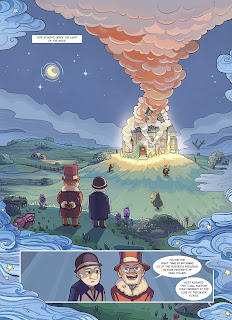
I can't talk about this book without talking about the absolutely gorgeous art. Audrey Molinatti provides the artwork for the book, and her work is stunning. I don't know how to go about describing the art other than cute, fun, beautiful, and just perfect for this story. The book has a style to it that feels its own, and it doesn't look like what most people will think of when they think of comics. The closest I can equate it to is that it sometimes made me think of a video game. There are a lot of fantastic independent video games that have this wonderful, animated look and feel to them; and this book feels like it could be one of them a lot of the time. The characters feel like they could suddenly start moving around like characters on a screen, and the small, fairly simply shaped bodies and overly large heads are definitely a part of this feeling. I doubt I'm doing the work justice in any real way; but I absolutely loved it.

Magic: The Girl With The Purple Hair is a great start to this new series; a book that takes its time setting up the world and the characters, letting the reader take their time with things before beginning the main story. The artwork and story work perfectly together, and the book has a look and feel to it that's so uniquely its own. I honestly believe readers of all ages will find a lot to enjoy with this one.


Support Amy on Patreon

Buy Amy A Coffee

Go to Amy's Blog