Thursday, 27 January 2022

Magic: The Girl With The Purple Hair by Lylian K. - Book Review


'A baby girl born with purple hair is promptly handed over to a convent by her horrified father, who fears she bears the sign of the witch. And indeed, little Evelyn seems to have strange powers and to attract supernatural manifestations as she grows up among the nuns, who patiently put up with it as best they can. But after one scary “trick” too many, she is entrusted to the care of a hat-maker, who whisks her off to London, where she will learn about much more than making hats! For as Evelyn and her talking cat Benedict will soon find out, Master Neil Farfadet has a few tricks up his sleeve, too, and his hat shop might not be exactly what it seems…'

Magic: The Girl With The Purple Hair is the first volume in a new series of children's graphic novels from Europe Comics that follows the adventures of Evelyn, a young girl raised in a convent to hide her magical abilities from the outside world, and what happens to her as she discovers more of what her powers hold.

The story begins quite dramatically, with men watching as a large estate burns in the distance. These men, it is revealed, are the 'law' of the land, and that they're burning this home, with its owner inside, because they're a witch. This version of Victorian era England, it seems, is home to many a witch; and that there are also still people around who will go out of their way to hunt them down.

Inside the burning building Melinda, the witch who lives there, is trying to perform one last spell; one that will allow her to leave this world before the fires kill her. As her cat companion, Benedict, watches, imploring her to try and escape instead, Melinda tells him to watch out for a new witch who will take her place as his mistress. Melinda leaves our world in a flash of magic, leaving Benedict alone.

Nearby, at the home of one of the men who helped to burn Melinda's home to the ground, a pregnant woman watches on, fearful for her friend who used her magic to help her and her husband conceive. A few months later, on a rainy night, the baby is born. The father is horrified to learn that he doesn't have the son he was hoping for, but instead has a purple haired daughter. Knowing that purple hair is the sign of magic, he takes the child away from her mother, and sends her away to a convent to be raised away from them, never to be seen again.

From here we skip forward several years to see the baby, now a mischievous young girl named Evelyn, and her best friend Benedict living amongst the kindly nuns. Evelyn is, as her father feared, a magical child, and causes trouble across the convent because of this; though not always on purpose. Despite trying her best, the magics begin to make issues for the nuns, and so they send for Mr Farfadet, a hat maker from London, to take Evelyn under his wing. Leaving the only home she has ever known, Evelyn faces an uncertain future.


This book was a genuine delight to read. The story is, despite its dark subject matter at times, a lot of fun; packed with humour and good natured characters who are mostly trying to do their best in the world. And as such, the moments where the story isn't really being moved forwards, where we're just spending time with the characters and seeing the weird things they get up to makes for some of the more delightful parts of the book.

Evelyn herself is a wonderful protagonist. She's full of energy and excitement, desperate to learn more about the world and to experience new things; even if she's not quite ready for that. She's naughty, but never malicious; getting up to small little pranks that don't really harm anyone. She is, in all honestly, a kid; and it's refreshing to have a child lead character who acts like a little kid.

Benedict proves to be a pretty good foil to Evelyn, being her opposite in a lot of ways. Where she's excitable he's grumpy, where she's eager to do new things he wants a quite life, and together they make for a pretty fun pair who spend much of their time bouncing off each other. There are hints that there may be more to Benedict than simply being a cat that Evelyn can understand, and this makes for an exciting prospect for future instalments of the series.

The book very much feels like a beginning, and much of the time is given over to setting up for future things. It's pretty clear even before opening the book, thanks to the wonderful front cover, that Evelyn is a little witch; so when the book takes its time building up to this revelation for her it's not a big shock for the reader; in fact it's something I was waiting for. But, the book isn't trying to do too much too quickly. Instead, it's happy to spend time letting the reader get to know the characters and build a sense of this world. As such, not a huge amount has happened by the time the book comes to an end; but it does leave us in an excellent position going forward into future instalments.

I can't talk about this book without talking about the absolutely gorgeous art. Audrey Molinatti provides the artwork for the book, and her work is stunning. I don't know how to go about describing the art other than cute, fun, beautiful, and just perfect for this story. The book has a style to it that feels its own, and it doesn't look like what most people will think of when they think of comics. The closest I can equate it to is that it sometimes made me think of a video game. There are a lot of fantastic independent video games that have this wonderful, animated look and feel to them; and this book feels like it could be one of them a lot of the time. The characters feel like they could suddenly start moving around like characters on a screen, and the small, fairly simply shaped bodies and overly large heads are definitely a part of this feeling. I doubt I'm doing the work justice in any real way; but I absolutely loved it.

Magic: The Girl With The Purple Hair is a great start to this new series; a book that takes its time setting up the world and the characters, letting the reader take their time with things before beginning the main story. The artwork and story work perfectly together, and the book has a look and feel to it that's so uniquely its own. I honestly believe readers of all ages will find a lot to enjoy with this one.


Support Amy on Patreon

Buy Amy A Coffee

Go to Amy's Blog

Wednesday, 26 January 2022

All The White Spaces - Ally Wilkes Interview


After reading through the latest chilling horror novel from Titan Books, All The White Spaces I had a chat with author Ally Wilkes about what it was like creating this terrifying tome of a book. My review for the book can be found here.


This is your first published novel, was it a daunting process to create this book?

I think creating any book is daunting, but All the White Spaces was in many ways an absolute labour of love. They always say to ‘write what you know’, but I set about writing a historical novel (taking place 100 years ago) set in Antarctica (a place I’ve never been) from the perspective of a trans man, which added a whole new challenge: it was really important to me to portray Jonathan’s identity sensitively and accurately, and some of the most creatively fruitful – and interesting! – parts of the process were working with my wonderful sensitivity readers to try to make that happen. 

It was also my first ‘finished’ novel – by which I mean the first one I’d taken through the painstaking, tear-your-hair-out processes of rewriting, restructuring, editing, line editing, going back to square one… I think it taught me everything I now know about writing, to be honest. Daunting certainly, but also wildly educational, and I wouldn’t have changed any of it!


What inspired the story behind All The White Spaces?

This book really combines a lot of the things I love: survival horror, Antarctic exploration, and supernatural chills. In that respect it was simply a matter of taking my favourite things and putting them in a blender! But more seriously, I’ve always been fascinated by the Heroic Age of Antarctic exploration, in which small teams of woefully under-prepared men pitted themselves against the unforgiving forces of nature for the sake of abstract ideas such as ‘discovery’, ‘sacrifice’ or ‘England’. It’s a fantastic setting to really dig into some of the tropes of the adventure novel, and a very atmospheric one as well: reading some of the accounts of early expeditions, I was always struck by off-hand remarks about how creepy the place was! For example, here’s Apsley Cherry-Garrard (from Scott’s doomed expedition) talking about spending the night in some abandoned huts: “The whole place is very eerie… not only do I feel it but the others do also. Last night after I turned in, I could have sworn that I heard people shouting to each other…”

What really brought All The White Spaces’s story into focus, however, was the idea of a post-WW1 setting. This came to me from a remark by Francis Spufford in the introduction to my much-loved copy of Shackleton’s South: “the concept of heroism evaporated in the trenches”. Immediately I knew I wanted to take all those Edwardian certainties and fracture them with the horror of the Great War, creating a narrative propelled by grief and loss – and that this was where the supernatural element would come in. 


The horror of All The White Spaces is very much a slow build, with the tension growing over time as things get worse for the characters, rather than some kind of monster running around causing chaos. Do you prefer that kind of horror over monster stories?

I think both types of horror absolutely have their place! Some of my favourite novels place the ‘monster’ up-front and centre, like The Terror by Dan Simmons, by using framing devices such as a split timeline to allow for both a slow build and to put the characters in danger from day one. But I’m very much drawn to books which take a little bit longer to spin out the atmosphere and dread, particularly the sort where you start to fall in love with the characters and don’t want anything bad to happen to them… I think Dark Matter by Michelle Paver is a great example of this, or anything by Andrew Michael Hurley.

With All the White Spaces, I found that it demanded a slower build as a function of the type of story it was telling: a historical coming-of-age story with seafaring elements rather like C.S. Forester’s Hornblower novels. It felt natural to want to take the readers on a journey, as Jonathan goes on his journey, and since the horror they meet is very particular to Antarctica itself, it couldn’t show up immediately! I had a lot of fun leaning into that.


Whilst the book has a horror focus it’s very much a story of people, especially Jonathan. What made you choose Jonathan to tell this story, and did you always want to tell a trans story?

Thank you! I think my favourite part of this book has turned out to be the characters – they were such a joy to write, and I learnt so much about each one as I went along. 

The choice of Jonathan as a narrator was integral to the story I wanted to tell, which was about the very stereotypically ‘masculine’ worlds of the trenches and Antarctic expeditions, often viewed through similar lenses: bravery, sacrifice, glory, teamwork, and so on. But at the same time both worlds had some fascinating things to say about gender, I thought: there was a lot of nuance in how those men interacted, showed emotions (Scott, for example, ‘cried more easily than any man I have ever known’ according to Apsley Cherry-Garrard), and expressed qualities which at the time might have had ‘feminine’ connotations. For anyone who’s interested in this area, may I recommend Francis Spufford’s I May Be Some Time: Ice and the English Imagination, and Men of War: Masculinity and the First World War in Britain by Jessica Meyer?

Coming back to the question, I wanted a protagonist who was an ‘outsider’ to both those worlds, but not through choice: someone who’d been held back from taking their rightful place. While I played around with the idea of a character disguising their gender (yes, I grew up reading Tamora Pierce’s Alanna books), once I started writing All the White Spaces it became very clear to me that Jonathan was a trans man, although he wouldn’t necessarily have the language to express that clearly. I thought this opened up some fascinating avenues to explore within the story, not least in his relationships with the other men, and was excited to write the book from this – hopefully – quite fresh perspective. 


The book features some queer elements, and not just Jonathan being a trans man, was it important to you to include queer voices in a historical setting where they often get overlooked?

Absolutely. I think that sometimes readers can (consciously or unconsciously) put a lot of pressure on a sole character to encapsulate the whole range of queer experience, which is both reductive and impossible. It was very important to me that Jonathan didn’t stand alone as the only queer voice in the book. And I’m fascinated by the hidden histories of queer people and how they coped in historical settings which might have been less accepting or understanding of diverse identities – although it’s important not to take that as a given! One of the things I was delighted to discover in my research was how some queer people were able to live more or less openly in settings we wouldn’t necessarily expect. I wanted – in some small way – to emphasise that queer people have always been here, living their lives. 


I understand if you’re not willing to reveal, but the entity or force behind the frightening events is never definitely revealed in the book; do you know what it is, and can you reveal anything about it?

I don’t want to spoil anything for readers, as the exact nature of the supernatural force is an open question throughout much of the book, but yes: I do know what it is, and it was inspired by some of those very haunting, eerie descriptions of Antarctica in the writings of famous explorers. 


You managed to really capture the harshness of survival in such an extreme place, and you included some pretty horrific moments. What kind of research did you have to do to make the book historically accurate, or did you take some creative freedom with what you did?

Thank you! I feel with any book like this there’ll be a necessary blend of research and creative licence: I think it’s best summed up by the approach of Stuart Turton to his fantastic historical thriller The Devil and the Dark Water, as per his Afterword: “This is historical fiction where the history is the fiction.” I wanted to create a world which felt real and immersive by using as much detail as possible without weighing the reader down. This started with reading some of the fantastic accounts by Polar greats such as Shackleton and Apsley Cherry-Garrard, and expanding out to more modern books which weave together the journals, diaries and letters of the explorers with a factual account, such as The Lost Men by Kelly Tyler-Lewis. 

Of course, there was also the War to consider – I read a lot of first-hand sources from soldiers at the Front as well as books about things like the Casualty Clearing Stations, shell-shock, underage soldiers, and conscientious objectors. I did some physical research, too – visiting Scott’s Discovery in its dry dock in Dundee (which became the base model for the Fortitude, with some notable tweaks), going on a vintage sailing ship in the Baltic Sea in vintage costume (brr!), and learning to climb ropes to help me understand Jonathan’s love of the rigging. But my overarching intention was always to create an enjoyable reading experience, and you can’t research anything and everything, so yes – there was definitely some creative licence used!


There have been some great horror stories set in isolated, frozen locations. Are you a fan of any of these stories in particular?

I don’t think there’s a better ghost story than Michelle Paver’s Dark Matter. The isolation, the desolate location, and the absolute spine-chilling horror – it’s a masterpiece. I’m also a fan of her Thin Air, which has some similar themes (the fallen hero, brotherly rivalry and affection) to All the White Spaces. For a totally immersive experience it’s very hard to beat The Terror by Dan Simmons, which makes the most of those tantalising gaps in our knowledge of the Franklin expedition while being utterly grounded in reality at the same time. And my other favourite from recent years is The White Road by Sarah Lotz, which ticks off two of my morbid fascinations: horrible caving disasters and the rising death roll on Everest. 


Is the character of Macready a nod to Macready from The Thing? And if so, is that a particular favourite of yours?

The name must have stuck in my head for some reason – I love coincidences like that – because I didn’t actually see The Thing until I’d already finished the first draft! Rather stubbornly, I refused to watch a film about ‘a shape-shifting thing in Antarctica’ because I worried it’d be too similar to All the White Spaces – whereas in fact they couldn’t be more different in most respects... And yes, now it’s a favourite of mine. It’s such a paranoid, atmospheric film, and the practical effects are genuinely unnerving.


This is your debut book, but are you working on anything else at the moment, can we expect to see more from you soon?

I’m happy to say that I’m working on my second novel, tentatively entitled What Passes Through. It’s set in the 1800s Arctic – because I simply had to go there! – and will combine my love of spookiness and my morbid fascination with survival cannibalism. 


Support Amy on Patreon

Buy Amy A Coffee

Go to Amy's Blog

Tuesday, 25 January 2022

All The White Spaces by Ally Wilkes - Book Review


'In the wake of the First World War, Jonathan Morgan stows away on an Antarctic expedition, determined to find his rightful place in the world of men. Aboard the expeditionary ship of his hero, the world-famous explorer James “Australis” Randall, Jonathan may live as his true self—and true gender—and have the adventures he has always been denied. But not all is smooth sailing: the war casts its long shadow over them all, and grief, guilt, and mistrust skulk among the explorers.

'When disaster strikes in Antarctica’s frozen Weddell Sea, the men must take to the land and overwinter somewhere which immediately seems both eerie and wrong; a place not marked on any of their part-drawn maps of the vast white continent. Now completely isolated, Randall’s expedition has no ability to contact the outside world. And no one is coming to rescue them.

'In the freezing darkness of the Polar night, where the aurora creeps across the sky, something terrible has been waiting to lure them out into its deadly landscape…

'As the harsh Antarctic winter descends, this supernatural force will prey on their deepest desires and deepest fears to pick them off one by one. It is up to Jonathan to overcome his own ghosts before he and the expedition are utterly destroyed.'

There are certain places that get used as settings for horror a lot that feel overused, the old abandoned house, the spooky cemetery, the lifeless asylum. Whilst these kinds of places have become a staple of the genre they can often feel difficult to use as there's often a very obvious solution to getting away from the horrors found within; just run away somewhere safe. This is why the places where you can't just run away, for me at least, make for the scarier stories. The depths of the ocean, the vastness of the jungle, and the cold isolation of the Antarctica. When there's nowhere for you to go to get away from the horror, the story becomes so much scarier.

All The White Spaces seems to understand this, as it has all but a handful of scenes at the beginning of the book set in the cold, desolate frozen south, isolating our cast of characters in a place where even the weather is out to kill them.

The story follows Jonathan Morgan, a young trans man whose life is forever changed when he and his parents get the news that his two older brothers, currently away fighting in World War One, aren't coming home ever again. Still forced to hide who he really is, and facing the prospect of being sent to a finishing school to teach him to become a 'proper' young lady, Jonathan reaches out to his friend, and friend of his lost brothers, Harry Cooper to help him.

Together Jonathan and Harry make their way across the world, aiming to meet up with and join the latest Antarctic expedition of the legendary explorer James 'Australis' Randall. Jonathan grew up watching his brothers idolise Randall, always dreaming of joining him on one of his journeys south. Feeling lost in the world, desperate to become his true self, and wanting to feel closer to his brothers, Jonathan decides that sneaking onto the expedition will help him.

Several days into the journey Jonathan is discovered hiding on the ship, and thanks to an impassioned defence, gets the chance to prove himself to the crew. Now he has to show them that he's a capable young man, ready to face the harsh reality of a trip into the darkness of an Antarctic winter. And whilst he does well, winning over the crew and feeling like he's who he's always meant to be, strange things begin to happen on the ship as they journey ever southward. When disaster strikes and the crew is forced to abandon their ship, heading out into the frozen wilderness, things get even worse. 

Finding shelter from the oncoming darkness and the bitter cold, the men of the expedition begin to experience strange things; seeing odd figures in the darkness, and hearing the whispers of the dead. Now it's not just the cold and dark of Antarctica that they have to worry about as they desperately try to last out the months of blackness ahead of them.

I'm going to say this straight away, as it's pretty relevant to the review; All The White Spaces is creepy as hell. The atmosphere and slow burn building of tension really make this a scary read. Ally Wilkes does and amazing job at making everything feel like it could be leading to something horrific and haunting; even the most mundane scenes take on a sinister edge. I don't know how they do it, but their ability to make me afraid even when nothing is happening is wonderful. This is a book that's just shy of 600 pages long, one that I thought was going to take me several days to read; but because of how frightening it was, because of how I desperately wanted to find out what was coming next, I ended up devouring in two days.

I think one of the things that kept me reading long after I should have gone to bed was just how well Wilkes crafted their characters. Jonathan is our lead, and the person we spend the most time with, and I very quickly felt that I understood who he was and what was driving him. When we first meet him he's a young man having to hide who he is because he knows that his family wouldn't approve or understand. He hates the way people treat him, the life that's expected of him, and how his entire future is out of his control.

His plan to travel across the world and join a dangerous expedition into the harshness of the Antarctic might seem like a bold, even dangerous decision, but I get it. I completely understand it. He wants to prove to himself, and the world, that he really does know who he is. He's witnessed young men going off to war, proving themselves in the harshest and most awful circumstances; yet he's been unable to do so. So when he finally gets the chance to be himself of course he'd feel like he needs to prove he's just as strong, brave, and capable as everyone else; and this expedition is just the way to do so. The fact that he also feels like it'll help him get closer to his dead brothers is a bonus for him; and whilst he might tell people it's the main reason for his decision I don't think it's the only one.

Harry, Jonathan's only real friend when the book begins, is a complex figure. He lied about his age to go off to war, and has come back a very different person. He wrote to Jonathan whilst he was away, sharing the true horrors and the awful reality of what happened. Whilst Jonathan has still to some degree romanticised what it must have been like Harry has definitely had his life changed by it; having seen some of the worst humanity has to offer. He's been through hell once before, he doesn't really want to have to do so again; yet is willing to do so in order to help and protect Jonathan. Because of this, their friendship is really put to the test, and Harry's sanity is sorely tested when horrors begin to surround them.

Another character who's given a great deal of focus is James Tarlington, the chief science officer on the expedition. For someone with such a lofty title, Tarlington is not the kind of person you'd expect to find in that position. Not only is he fairly young and inexperienced, he's also fresh out of prison for being a conscientious observer. Being on a ship filled with people who fought in the war makes Tarlington a figure fit for derision, hatred, and open hostility. He's bullied by many on the expedition, and made to feel like less of a man. Because of this, and thanks to people automatically blaming him whenever stuff starts to go wrong for the journey, he becomes a character who you're never quite sure if you should trust or not. You begin to wonder if he might actually be out to ruin the expedition, to harm the crew, or perhaps because of the way everyone sees him you've begun to buy into the same hostility and irrational hatred that the crew are spreading. Over the course of the book I found my opinion of Tarlington shifting a lot, and he quickly became one of my favourite characters because of how much he challenged me, and because of the complex nature of my feelings towards him.

Whilst the rest of the expedition don't get the same degree of focus as these characters there is a lot of time to get to know a lot of them, and several characters have moments where they really get to shine. Randall is quickly established as something of a force of nature, a man who's become something of a myth. he uses this status, as well as his years of experience to command respect amongst his men; something that begins to fall apart once the horrors waiting for them begin their manipulations. Liam Clarke, Randall's second in command, is a more level headed man than Randall, one who's been out on the ice countless times before and knows how to keep things together. But his relationship with Randall, and his position within the expedition get pushed to breaking point over the course of the book. I also really liked Robert Macready, the cook, who proved to be a warmhearted man with a lot of wisdom and care to give out. I was also left wondering if his name was a nod to the character from The Thing, one of the best Antarctic horror stories.

With a strong and interesting cast of characters to play with Wilkes could have easily crafted a compelling story or survival and adversity with them. They could have told the story of these people and their struggle to survive the winter and it would have been engrossing enough. However, they also decided to add horror into the mix, and the quiet way that they did this was so much better than what I was expecting. In other horror stories set in frozen locations there tend to be physical threats for the heroes to contend with. There's the titular creature in The Thing, Tuunbaq the spirit bear in The Terror, and In The Mountains of Madness have the Elder Things. As such, I was waiting for some kind of creature to turn up in All The White Spaces.

Whilst I can't for certain tell you what is behind the horrific events that take place in this book (something that I love) I'm pretty sure I can say that it's not a monster. Ghosts, a force of evil, the spirit of Antarctica itself? I don't know what it is, but it's not something that our heroes can physically fight, and that, along with how it haunts and torments people, make it all the more frightening.

There are some moments of overt horror, shadowy figures standing watch, as well as some truly awful moments of body horror thanks to the harsh reality of surviving in such an environment, but for the most part the real terror of All The White Spaces is built up in nothing happening. It's the slow accumulation of unease, of the mounting tension of waiting for something terrible to appear that makes the book so effecting. It gets under your skin and keeps you on edge as Jonathan and the others keep a wary watch on the darkness around them, knowing that something's out there, watching them, but that they're unable to do anything about that makes this such a scary read.

There's one thing I want to talk about, but as it's something of a spoiler I'm going to give a warning here. So, if you've not read the book yet and don't want to know please skip on to the next paragraph. One of the things that I was expecting to happen in this story was for Jonathan's status as a trans man to come up at some point. I was waiting for some scene to happen where someone on the expedition discovered the truth of who Jonathan is and for things to suddenly go wrong for him. I thought that he'd be challenged in his identity, for all of the hard work he'd done to prove himself would go out the window, and he'd suddenly be having to defend himself from a group of desperate men who suddenly see him as a woman. But this never happened. Ally Wilkes didn't craft a story around Jonathan's trans status, and I absolutely loved that. I loved that he never had to face the awfulness of being outed, that he never had his validity of a man denied to him. It would have been easy to go down that route, to use the horror of that situation to make things even worse for him, but it would have felt too awful. As such, the scene where Jonathan does try to explain who he is to one of the members of the expedition that person doesn't seem to care. He doesn't want to know more, and doesn't want Jonathan to tell him anything he's not comfortable revealing. And most importantly, he doesn't see Jonathan as any less of a man after it. For me, that's the perfect way to tell a trans story in this kind of scenario.

All The White Spaces is a huge book, filled with tension, adventure, and horror. It conveys both the wonder and the terror that come with a place as isolated and dangerous as Antarctica. It has a wonderful cast of engaging and interesting characters who you come to care for and want to see make it to the end. This is the kind of smart and frightening story that I want to see more of. It deserves to be given the same kind of praise and adoration as the other big horror stories I've mentioned in this article. It should be a book that gets adapted to screens. Hopefully one day, when people are talking about their favourite horror stories set in cold, frozen environments it'll be included alongside the greats like The Thing, The Terror, and In The Mountains of Madness.


Support Amy on Patreon

Buy Amy A Coffee

Go to Amy's Blog

Monday, 24 January 2022

Star Wars Adventures: Tales of Villainy #13 – Comic Review


Originally published on Set The Tape


The latest issue of IDW Publishing‘s Star Wars Adventures: Tales of Villainy opens with the first part of a story set within the sequel trilogy time period, as Rey, Finn and Chewbacca transport a smuggler through First Order patrolled space on the Millennium Falcon.

‘Repair Stop’, written by George Mann, sees the Togruta people-smuggler, Moebin, working alongside the Falcon crew, who have agreed to take him to the planet Prahvin in exchange for information that will allow the Resistance to use secure routes through First Order territory. Unfortunately, the Falcon isn’t in the best condition, and mid-flight the ship’s static charge dissipator breaks, forcing the crew to make an emergency landing on Choss, where they hope to be able to find some replacement parts. Unfortunately, a bounty hunter has been following them, and the quick pit stop soon turns into a fight to get away.

Whilst this is the first part of the story, despite the title page not having the normal ‘part one’ attached to the name, it proves to be a pretty entertaining short story; one that I should have expected to be a first part thanks to how differently it’s paced from other one-off tales. We get to spend some time with the characters before things go wrong, getting to know Moebin and understanding the stakes before things really kick off; which is a nice change for these short stories.

It’s after landing on Choss that the story really opens up, as the artist, Charlie Kirchoff, really seems to be having some fun, filling the alien market with all kinds of background gags and familiar species. There’s also a great two page spread where Moebin and Rey dash through the market that really shows off the creativity and talent of Kirchoff. Overall, it’s a fun first part, and one where I’m interested to see what happens next because it ends in a way where you’re not quite sure how its going to be resolved, and I’m interested to find out how.

The second story of the issue, ‘The Last Chapter’ by Danny Lore, is a completely standalone story, and possibly one of the best we’ve had in the series. The tale begins on ‘a planet rarely thought about and barely named’, and sees an Imperial shuttle landing in the middle of a marketplace. When the ramp descends and Vader leads a group of stormtroopers out things erupt into chaos as they begin ransacking the place, taking prisoners, and destroying things.

Watching this chaos is a young human woman, one who quickly flees to an old Jedi temple where two of her colleagues are cataloguing artefacts. It turns out that she’s one of the people who protect and preserve the contents of the temple, and as such knows that this is Vader’s ultimate destination. Now she has to try to find a way of saving what she can before the Sith Lord comes to destroy it all.

I absolutely loved this story. It featured one of the most iconic characters in Star Wars canon, but it wasn’t focused on them, instead being about these nameless people who we’ve never seen before. Vader was less a character, and more of a force of nature, this looming threat moving ever closer. But then we didn’t really get to know anyone else either, as no one got to have a name, and not a single line of dialogue got spoken. Instead, we get these small snippets of context via the narration that allows the reader to know what’s going on.

This might seem like an odd choice, but it works really well. The people here don’t matter. This world doesn’t matter. It’s not a story about the caretakers of this temple, or even of Vader. It’s a story about what the Empire is, about the campaign of destruction the Emperor has been waging against the Jedi where even the preservation of their artefacts must be treated with total destruction. I don’t think the people or the place matter because this more of an insight into what the Empire does on countless worlds, and as such that story can’t be told on a personal level.

The art for the story is provided by Simone D’Armini, and their style is wonderful. There’s a lot of attention to detail in every panel of the book, and the planet feels incredibly lived in because of this. The marketplace is filled with people and things, junk that’s recognisable, creatures that are familiar; it feels like a working place and not just empty shops and stalls. There’s not a single blank background either, and every panel feels like its filled to the brim, even if it’s just moss and lichen covering the walls behind the characters. It’s a level of care that can sometimes feel lacking in these quick, one-off stories that, along with the great script, make this a superb short story.

Thanks to the wonderful one-off Vader story, and the interesting potential for what could happen next in the first story, this is a pretty damn good issue of Star Wars Adventures: Tales of Villainy, and a great way to start Star Wars comics in 2022.


Support Amy on Patreon

Buy Amy A Coffee

Go to Amy's Blog
Sunday, 23 January 2022

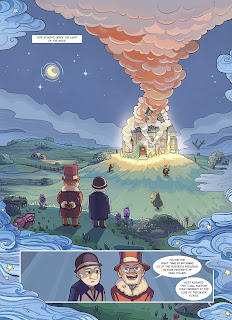
School of Love: Secrets of the Heart by Beka - Book Review


'Linon and Garance are best friends with very different ideas about love. To get to the bottom of what all this romance stuff is really about, they decide to conduct an investigation into some of the older students at their middle school. Why are certain kids more popular than others? Why do some already have a “bad reputation” by the 8th grade? Why is everyone so obsessed with appearances? Along the way, the pair discover that, for best friends who are supposed to share everything, they’ve both been keeping some pretty big secrets of their own.'

Love is a complex thing, it can be the best thing in the world, and it can be absolutely soul crushing. It's fun, its messy, its the thing people strive for, it can be the cause of and solution to problems. It's big and complex; and I think quite a lot of adults would struggle to rightly put into words all of the explanations about what love is. So imagine how hard it must be for kids.

School of Love shines a light onto how it can be for kids coming into their teens, discovering that they have all these messy feelings for other people, and how often it can be hugely confusing for them. This story is explored through two best friends, Linon and Garance; two girls who look at their lovesick classmates around them and think 'huh?'.

Over the course of the book the two of them decide that they want to try and figure out love, to work out what it is, how it effects people, and to pin down its complexities. Easier said than done. Luckily for the two girls, the school is absolutely rife with couples for them to study. This begins a series of investigations that see the pair hiding in bushes, sneaking around buildings, and getting lovesick teens to reveal their darkest secrets.


The events of the book are actually quite funny and at times even delightful. By trying to figure out what love is all about from a bunch of kids Linon and Garance get a very skewed view of the topic. They see couples who fall in and out of love fast; with the longest couple in the school holding the record at twelve days! Things get heated at times, and there's even a case of two best friends literally trying to tear each others hair out over a boy they both like who neither of them have even spoken to.

But it's not all weird and wonderful displays of love, as the book at times takes a much more grounded and serious approach. They talk to the most popular girl in their year, the girl that all the boys think is the prettiest, who they all want to date. It turns out that she actually hates the fact that people go mushy over her looks and have no interest in her as a person, thinking that she's some pretty airhead. This is something she uses to her advantage, however, as she allows people to underestimate her so that she can secretly study physics, and improve her brain. The two of them also talk to the goth girl, a girl with a reputation for being sexy and easy to sleep with, discovering that she was essentially sexually assaulted, and because the boy who did it boasted about it she got a reputation as a slut; something she rages against with her alternative appearance and reluctance to make friends.

Part of the reason the two girls want to make their study into love is due to the secrets that they two of them are holding; and I thought that I'd figured out what that was, but ended up being completely wrong. I was thinking that it was going to be revealed that they were trying to figure out love because they both had a crush on the other, and that they'd figure out how to express those feelings. It turns out I was completely off the mark, as Linon ends up hooking up with a boy whilst Garance is dealing with the loss of love between her parents and their looming divorce.

The lack of queer representation is actually my biggest gripe with the book. There's only ever one line where it's hinted at that anyone might be anything other than straight, but other than that there's nothing. With a book set in modern times, where being LGBTQ+ in school is much more open and accepted, and with the story being about love I was honestly shocked that there wasn't a single queer character, or discussion about same sex attraction. It left it feeling like we only actually explored one time, heterosexual avenue of love and relationships.

Outside of the story the book looks absolutely beautiful. The artist on the book, Maya, is phenomenal. Every single panel of the book is a work of art. The detail is great, and you can spend ages looking through all the backgrounds and picking out tiny bits and pieces. The characters are all well designed and look unique enough that you're instantly able to recognise who people are. And the colours are wonderful, working perfectly with the line work to make this bright, vibrant art that leaps off the page. This is easily some of the best art I've seen in a comic in a long while; and I'd happily read anything that Maya works on.

School of Love: Secrets of the Heart is a fun, engaging read with some interesting characters, some fun moments, some deep introspection, and some wonderful art. Whether you're a youngster trying to figure out love, or simply looking for a fun book to spend the day with, I'm sure that this is one that will entertain.


Support Amy on Patreon

Buy Amy A Coffee

Go to Amy's Blog

Saturday, 22 January 2022

Cinema 7 by Michael J. Moore - Book Review & Blog Tour


'Something has taken a liking to the children of Mount Vernon, Washington. Its eyes are orange, and glow like fire. Its hissing voice is the autumn wind. It hovers over them at night, casting snake-like shadows that dance on the walls. It laughs and taunts as they cry in their beds. It says it wants to take them trick-or-treating. Halloween is in a week.

'Kyle McIntosh is hardly aware when the first four kids are abducted, their families slaughtered. Though news-vans litter the streets, his 16-year-old heart has just been broken. Night-after-night, more children are taken. More bodies are left behind. When Kyle’s little brother claims an orange-eyed monster has been visiting him at night, ignorance ceases to be an option - because their family might just be next.'

I feel it might be slightly controversial to say this, but kids are damn creepy. I don't mean on a whole, generally they're fine little folks even if they're not for me. But as soon as kids start taking part in horror they turn the creep factor right up, and Cinema 7 is no exception; and if anything, it pushes the use of kids in horror into some disturbing directions.

The story follows the residents of the town of Mount Vernon, and the terror that comes to their peaceful lives one October. We begin with a little girl trying her best to stay in her room and sleep whilst her mother entertains her new boyfriend. The girl knows that she can't go and ask her mother for help, nor can she go and find shelter in her bed even though she desperately wants to; because there's a monster in her room. Stuck in her bed, alone and afraid, the girl listens as the monster tells her frightening things, before killing her.

Whilst this would be awful enough, the girl doesn't stay dead. She wakes back up, her body dead, and her eyes glowing with an orange light. Driven by dark urges and evil desires the girl kills her mother before leaving the home. This is a terrible and tragic event in itself, but it's far from the only one. Other children have suffered the same fate across the town, resulting in dead parents and missing children.

We then meet Kyle, a sixteen-year-old boy who's mostly just coasting through his life. He's not excelling in school, his love life has taken a recent hit, and he's spending his time smoking weed with his friend group. He's not a bad kid by any means, he's simply a little lost at the moment. When Kyle spots a group of dead children walking around town, covered in blood and with glowing eyes he tells the police what he's seen. Whilst the cops seem to believe him, they don't treat him too favourably, and it leaves a bitter taste in his mouth; especially as it gets him in trouble with his parents for skipping school to score some weed.

Kyle feels like there's something awful happening in his town, something that might be targeting his own little brother, who he hears crying at night. Determined to find out more Kyle ends up getting help from new girl, Marie, who believes Kyle's story, and thinks that something evil is out to destroy the town's children.

Cinema 7 feels like two books in one a lot of the time. There are two main narratives, which are of course connected. The first is the story of the possessed, dead children. These sections are scattered throughout the book, and are definitely some of the darker and most disturbing moments by a big margin. Michael J. Moore doesn't hold back in these parts of the book, and provides graphic descriptions of violence done both to and by children. 

These parts of the book reminded me a lot of the books by James Herbert, things like The Fog and The Dark, where people are driven to awful, evil acts of mutilation and murder. The children in this book go after their parents and their extended families with a viciousness that is honestly quite shocking. They don't just kill their family outright, which they easily could as some of them do have guns. Instead, they torture their parents, they take their time with their killings, and they revel in the harm that they cause. It takes a lot to make me feel squeamish whilst reading, but this book managed it a few times with some of the things that were happening here. So if you're adverse to graphic violence, or scary children, this is a book that will test your resolve for sure.

The other story is that of Kyle and Marie. As said earlier, Kyle is a very average kind of kid, just trying to get through life. When he meets Marie he's not too sure about her, she's attractive and fun to be around, but he's just been through a break-up and doesn't want to rush into anything. But through the course of their investigation into the strange events around Mount Vernon the two of them grow closer, and a genuine friendship begins to form between them; and it's no surprise when things turn romantic.

Their story feels like a nice mix of a mystery investigation and a teen romance story, and whilst their entire story and character arcs are connected to the greater events some of the best moments with the two of them were the quite times when they weren't running for their lives and just got to connect and bond. I also appreciated how the book didn't shy away from showing both of them as vulnerable, and that Kyle was allowed to be something more than the 'masculine' teen boy, and actually had times where things got too much for him and he needed to grieve. And I appreciated that Marie was there for him in these moments and was able to comfort him.

Cinema 7 is an intense read at times, one that has some dark and disturbing moments and some violent imagery; but it's also a book with a lot more going on in it than you'd first think. It has some interesting characters, and the themes of how abuse leads to more abuse are pretty out in the open. If you look at this book and just see a violent gore-soaked mess you're probably missing something. Definitely one worth reading, though probably not if your kid is sleeping in their room at the time.


Support Amy on Patreon

Buy Amy A Coffee

Go to Amy's Blog

Friday, 21 January 2022

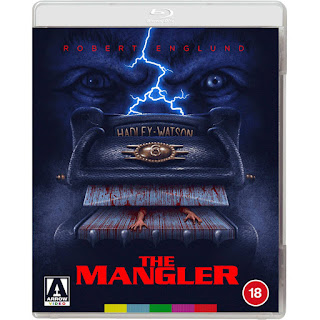
The Mangler – Blu-ray Review


Originally published on Set The Tape


There are a lot of Stephen King stories, and many of them have ended up being adapted for film and television over the years. There are certain stories that were so big and popular that they’ve become films that are equally as well known. Everyone knows that King’s work is behind films like The Shining, The Green Mile, and Carrie. But if I were to tell you that there was a film based on a short story of his about a laundry mangler that was possessed and was killing people you might not believe me. But it’s very real, and it’s actually rather good.

The Mangler comes from a short story in the anthology collection Night Shift, and tells the story of a machine in the Gartley’s Blue Ribbon Laundry service that causes an accident one shift, that sees one of the workers crushed to death. This in itself isn’t too unusual. Whilst accidents are rare, they do happen, and the site is quickly signed off as being safe, much to the joy of the boss, Bill Gartley, played by Robert Englund in full leg braces, age make-up, and with a performance that has him chewing the scenery.

However, local cop John Hunton (Ted Levine) feels like something isn’t right, and when more accidents begin to happen he suspects that there’s more going on that people want to admit. With the help of his demonologist brother-in-law Mark (Daniel Matmor) Hunton comes to believe that the mangler might have been used for dark rituals to bring Gartley long life and wealth, and that the machine has now become possessed by evil spirits that will stop at nothing to cause more death and mutilation.


On the surface, The Mangler sounds like a very silly movie. A possessed laundry mangler killing people isn’t something that you’d think could carry a film, and it’s not really that big of a threat; just don’t go near the mangler. However, the film is surprisingly good, and I think a large part of that is down to the cast and crew.

First of all, as already stated, the film is based on a King story, so it’s got pedigree there. Its been adapted and directed by Tobe Hooper, a name that horror fans will instantly recognise as the creator and director of The Texas Chainsaw Massacre, a film that’s widely regarded as one of the best horror films of all time. The cast has Robert Englund, an actor with instant recognition thanks to playing horror icon Freddy Krueger, who he would play across eight films, as well as Ted Levine, who is probably most famous for playing Buffalo Bill in The Silence of the Lambs, but has an extensive career of great roles. The film has pedigree, and thanks to the fact that the people making it clearly know what they’re doing, it elevates the film well beyond the schlocky concept and makes it genuinely enjoyable.


Levine is an absolute delight to watch as he stumbles from scene to scene as a tired and weary cop who just wants a quiet day but ends up seeing mangled bodies, and listening to people telling him the supernatural is involved. Quite reasonably, he sees much of what’s going on as being complete bullshit. He thinks demons and spirits are ridiculous, and watching him slowly come round, until he fully believes there’s a conspiracy to use dark magic to make certain people in the town rich, is quite enjoyable. Speaking about making people rich, the fact that the film has a wonderfully anti-capitalist message is a delightful surprise too. It literally tells a story about how the machines of industry are being fed the blood and flesh of the workers to make the bosses money – which is not something you’d expect to find in a film like this.

Thanks to the new release from Arrow Video these are themes that get explored in some of the extensive extras that come along with the new 2K restoration. The film comes with three audio commentaries. One by co-writer Stephen David Brooks offers insight into the creation of the film, and how you go from a King short story to a full film; alongside two brand new commentaries from film critics and historians such as Alexandra Heller-Nicholas, Josh Nelson, Matty Budrewicz and Dave Wain. The disc also comes with behind the scenes footage, an interview with Robert Englund, and a couple of video essays that cover Tobe Hooper’s work, as well as the work of Stephen King. All that and more, and you also get a collector’s booklet filled with new writing.

The Mangler is very much a film with hidden depths; a film that takes the ridiculous and makes it feel plausible and engaging, if only for a couple of hours. It’s the kind of film that people looking for something a bit different should definitely take the time to check out. Like Rubber or Maximum Overdrive, its a film that you kind of need to see to believe.


Support Amy on Patreon

Buy Amy A Coffee

Go to Amy's Blog

Thursday, 20 January 2022

The Last Legacy by Adrienne Young - Book Review


'When a letter from her uncle Henrik arrives on Bryn Roth's eighteenth birthday, summoning her back to Bastian, Bryn is eager to prove herself and finally take her place in her long-lost family.

'Henrik has plans for Bryn, but she must win everyone’s trust if she wants to hold any power in the delicate architecture of the family. It doesn’t take long for her to see that the Roths are entangled in shadows. Despite their growing influence in upscale Bastian, their hands are still in the kind of dirty business that got Bryn’s parents killed years ago. With a forbidden romance to contend with and dangerous work ahead, the cost of being accepted into the Roths may be more than Bryn can pay.'

When the Fable duology came to a close it felt like perhaps it would be the last time that we return to the world that Adrienne Young had created, that we'd say goodbye and move on to the next story. Whilst we might not be meeting up with Fable and her friends again, I was happy to learn that we would be going back to this setting with The Last Legacy, and that we'd be exploring some of the more interesting characters that made a brief appearance in Namesake.

The Last Legacy follows Bryn, a young woman who has grown up away from the port city of Bastian, where the rest of her family live, learning how to be the perfect young woman in high society. Once she reaches her eighteenth birthday her uncle, Henrick Roth, calls her back home to take her place as one of the Roths, a family of traders who aren't afraid to commit crimes and get their hands dirty.

Upon returning home Bryn is shocked to find a family unlike any she's ever experienced before. They don't stand on ceremony or put much stock in the ways of high society, and they all seem to live in fear of angering Henrick and incurring his wrath. Bryn is unsure how to operate in such a family, or even what her roles is going to be as all Roth need to be of use to the family if they're going to survive. 

However, Bryn soon learns why she's been summoned home. Her uncle is close to getting the merchant ring that will allow him to expand the family business, making them even more rich and powerful than they already are. The only problem is, they need to impress the right people in high society. To that end, Henrick wants to use Bryn to help they make the right impression. But that's not all, she will also have to start getting her hands dirty and helping in ways she's not used to. This sets Bryn down a path of double dealings, plots, and betrayals that will put her future at risk if she should fail to come out on top.

If Fable was the high seas adventure book this is definitely the crime thriller story. Where Fable spent its time at sea, exploring the world and the various port cities The Last Legacy focuses exclusively on one family, the Roths, and their bid for power. Because of this, I felt like I got a better sense of one of the more specific parts of the world that Young had crafted, by taking the time to explore how the various merchants operate, and how much political movement goes on behind the scenes. The story has much more in common with something like The Godfather than it does anything else; and I love that.

Bryn coming into things afresh, as someone raised away from this family and their business schemes is the perfect entry vehicle for the audience. We get to learn alongside her, seeing the strange things that her family does, getting hints of their criminal ways, and learning just how dark their past is. At first there are just hints that the Roths, and Henrick in particular, aren't great people as we see them engaging in things like corporate espionage and dealing in fake goods; but there's a sense that this isn't just them, but something that the other main families in Bastian would also be doing. However, as Bryn gets deeper and deeper into things we begin to see that Henrick is also willing to hurt, and even kill people.

Rather than being something that would distress her, or take her out of the picture all together, as you might expect from someone who was raised to e the perfect high society woman, Bryn discovers a strength within her as she begins to adapt to her family. She doesn't stoop to their level, she never physically hurts anyone, but there is the sense that she's probably a lot smarter than them, knowing how to manipulate people and twist a scenario to get what she wants without having to resort to having someone beaten.

Because of how clever Bryn is, of how quickly she adapts to a world she's never been exposed to before, and how well she manages to do things I actually think I prefer her in a lot of way to Fable. Fable always seemed capable, and she continued to prove herself over the course of her books, so it was never a surprise to see her coming out on top, espcially as she had friends around her helping her out. Bryn, on the other hand, begins feeling like the kind of character you expect to see outmanoeuvred and outsmarted. So when she rises to the challenge and becomes the smartest person in the room, all on her own, it feels a lot more impressive.

Like with the previous books set in this world there is some romance to be found in The Last Legacy, as Bryn finds herself falling for Ezra, the young man who lives with the Roths. A skilled silversmith, Ezra is seen by Henrick as an asset to be used as much as he is a person, and there's a strong sense of him being desperate to break free of the Roths and escape. The romance that forms between him and Bryn is not an easy one, and there are times where you're left wondering if they're going to kiss or take shots at each other as their passion leads to some explosive moments. But overall, I found their relationship to be rather enjoyable, and probably because they didn't end up together too quickly, and it felt like the two of them really had to earn being together.

The Last Legacy ends feeling like a complete story, and this feels like it could be the conclusion for both the Roth family as a whole, and Bryn in particular. That being said, I found myself wanting more when it was done, and would love to see Young return to these characters in the future. Even if it was another stand-alone sequel that explored other aspects of this world. I hope that this is the kind of series where we'll keep coming back to things, exploring new places and new people. But if that doesn't happen, this feels like a great conclusion to things.


Support Amy on Patreon

Buy Amy A Coffee

Go to Amy's Blog

Wednesday, 19 January 2022

AKKAD Volume One by Clarke - Book Review


'An alien invasion wreaks havoc on Earth. Conventional weapons seem harmless. In a desperate attempt, the US government experiments with chemical treatment on five teenagers. The objective: to increase their intelligence to a superhuman level. Then they can invent the weapon that will save us all. Unless they get out of control themselves...'

AKKAD is the story about a world where humanity has been left on the back-foot thanks to the appearance of strange, alien lifeforms that appear seemingly at random across the globe. These huge, insect-like creatures don't seem to really do much when they appear; they don't destroy buildings or kill anyone even though they carry huge weapons. their real weapons, however, are the force-fields that they erect, blocking off huge areas that become impassable, stealing territory from the human population.

Humanity have been fighting these invaders for years, but their weapons have been proving ineffective, and more and more land has been lost to these strange creatures; with almost the entire east coast of the US lost. It seems like nothing can be done to kill the creatures, and any attempts to reenter the locked off parts of the world meet with failure. Because of this, a desperate plan is put into motion. Knowing that no one alive is smart enough to come up with a solution the US government finances an experiment to use cutting edge science to turn five teens into geniuses, hoping that their increased intelligence will help find a solution. However, it appears that the people they have chosen may not be the perfect candidates, and soon the five of them plan to escape those keeping them locked away.

There was a lot about AKKAD that I really enjoyed. For a book that's about an alien invasion of Earth it didn't feel like your average alien invasion story. There was no real occupation force, no masses of alien troops keeping humanity under their heel. There's no spaceships or laser guns firing down from orbit. It felt very small in scale in a lot of ways, and it had more of a post-apocalypse tone at times thanks to the vast ruined cities left abandoned by the survivors.

I think the fact that even by the end of this first volume I knew nothing about these alien creatures helped a lot with this. They don't really have a name, with the only time they're called by a nickname the person being told not to do that. They're simply 'the invaders' or 'the aliens'. Their goals seem kind of nebulous, with no real endgame evident. They feel more like a force of nature, albeit one we don't understand, than monsters attacking us for our resources.

The book also stays pretty minimal on the exposition in other areas, allowing the reader to try and pick up information as we go along. We don't get any info dumps on the state of the world, nor do we know much about the five teens chosen to become super smart heroes. We're given small insight as the story progresses, but it's stuff that we have to try and make sense of for the large part. It's small hints and snippets of dialogue that give us insight. Clarke doesn't seem to want to hold your hand and walk you through things, instead letting you figure it out as you go.

Clarke doesn't just provide the writing on the book, but also produces the art; another strong point of the book. I really liked the artwork on AKKAD, the nice, neat line work was great, and the people looked nice and distinct from each other. The art style also worked well for the ruined locations, with the wrecked cities looking stark, with debris everywhere. The alien creatures also looked fantastic, and I love their insect-like design. They reminded me of giant ticks or fleas in the brief moments we get to see them, and I'm super interested to learn more about them and to see what other things Clarke can do with the design.

Overall this is an interesting start to the series, and Clarke crafts a solid base upon which to build the story. The characters have only just begun to be explored, and whilst there are one or two that intrigue me already most still feel like I haven't had the chance to know them yet; this is something that I'm hoping will be explored further in the upcoming volumes. If you're into interesting new sci-fi and want to something a bit different this book is definitely worth a go.


Support Amy on Patreon

Buy Amy A Coffee

Go to Amy's Blog

Tuesday, 18 January 2022

Temple of No God by H.M. Long - Book Review


'After a brutal war between the gods, Hessa – High Priestess of the Eangen – has brokered a fragile peace. Through great sacrifice, she has forged an alliance between warring tribes and introduced her people to the true god.

'But a new threat is growing across the southern border. In the remnants of the once-great Arpa Empire, three factions are vying for the imperial throne, and the vast well of raw magical power only accessible to the Arpa Emperor. Already beating back former Arpa legionaries at her borders, Hessa knows she cannot let this chance slip by. She must intervene, for the safety of her people.

'With the peace she has sacrificed so much for at stake, Hessa must venture into the heart of enemy territory, where warring Arpa factions are not the only danger she must face. A sinister new cult is on the rise, one with the power to suck the life from everything it touches. With enemies on every side and her fragile alliance beginning to waver, Hessa must decide who to trust – no matter what it may cost her…'

Temple of No God is the the continuation of last year's Hall of Smoke, a fantasy book that I really enjoyed. Picking up several years after the events of the first book Hessa, once a priestess of the war god Eang, she has now become the high priestess of Thvynder, an ancient god that came from a time before Eang. With the last book ending with the destruction of almost all of the gods at the hands of Thvynder, and Hessa's old life gone, there was always a sense that more could be told with these characters, that we could one day return to this world and find out what happens next. Temple of No God delivers on those hopes.

The book begins with Hessa leading her people into battle against the Arpa, the empire to the south of her homeland who have threatened her nation for years. During the fight we, and Hessa, learn that despite losing their pantheon of gods when Thvynder returned some of the Arpa warriors have powers, powers that none of them have ever seen before.

Years later, Hessa is approached by an Arpa faction. It turns out that there is a power struggle going on for the throne, with three factions all fighting to put their own Emperor in power. The catch is, to be crowned as an Emperor they will need someone able to enter the realm of the gods to perform the ceremony; someone like Hessa. Hessa is offered a deal, bring her people into Arpa territory, have them raid and pillage in the places where the other two factions hold sway as Hessa travels to the capital and crowns the new Emperor. In return, the Eangen people will be left alone, and their territory will never again come under threat from the Empire.

Knowing that this is the best way to secure a future for her nation, and curious to find out more about the strange new warrior priests allied with one of the rival factions, Hessa agrees to the terms, taking her people into war.

One of the things that I really enjoyed about Temple of No God is how different it feels from Hall of Smoke due in large part to how different the lead character is now. In the first book she was a fierce warrior priestess, but one who felt a little short sighted in some ways. She seemed like the kind of person who didn't think too far ahead, who concentrated on herself, and thought of the world in ways in which it directly effected her. Here, having been the leader of her people for almost a decade, Hessa has grown, becoming almost the opposite of who she was. She carefully weighs her decisions, she thinks about the larger impact, and she puts others before herself. And none of it feels unexpected or out of character, rather, it feels like the natural progression of what we've already seen.

The book also opens up in the sense of scope too, even though it also feels like a smaller scale story in some ways. There isn't the huge, world changing revelations of the first book, there's no huge battle with multiple gods at the end, but it still manages to feel like a bigger book because we explore more of the world H.M. Long has created, as well as getting to know more of the people who inhabit it. Much of the first book centred on Hessa, and the journey that she took. For most of that she was on her own, though occasionally joined by another person. As such, the story felt very focused on her; but here there's a much larger group around Hessa, and I came away from the book feeling like I'd gotten to know a lot more characters than I did in the first volume. So even if the events of the book didn't have as big an impact as the first it felt broader in scope thanks to the places we're taken to and the people we get to know along the way.

Temple of No God also felt like it could be read on its own too, as something of a stand-alone sequel; due in large part to the time gap between the two books and the changes in Hessa. Whilst there were times where I felt a little left behind because I'd forgotten small elements from the first book, I was never lost, and Long was able to catch up new and forgetful readers really well. Obviously, it would be best reading both books, and preferably both books together, but I'm sure that if you came to this book completely new without any previous knowledge you'd find a lot to enjoy here.

Temple of No God is the kind of sequel that I really love, one that takes what the first book did and does something that feels connected, but doesn't retread the same ground. It has allowed the characters to grow in believable ways, it's changed the world and had things evolve, and it's introduced a lot of new elements, yet it's still that world that I enjoyed in the first book. If Long continues to revisit this world and these characters I hope that they do so in the same way, popping in every decade or so to see how things have changed, and giving us unexpected new adventures.


Support Amy on Patreon

Buy Amy A Coffee

Go to Amy's Blog