Wednesday, 10 November 2021

Beyond: The Founding of Valdemar by Mercedes Lackey - Book Review


'The long-awaited founding of Valdemar comes to life in this new series from a New York Times bestselling author and beloved fantasist.

'Within the Eastern Empire, Duke Kordas Valdemar rules a tiny, bucolic Duchy that focuses mostly on horse breeding. Anticipating the day when the Empire’s exploitative and militant leaders would not be content to leave them alone, Korda’s father set out to gather magicians in the hopes of one day finding a way to escape and protect the people of the Duchy from tyranny.

'Kordas has lived his life looking over his shoulder. The signs in the Empire are increasingly dire. Under the direction of the Emperor, mages have begun to harness the power of dark magics, including blood magic, the powers of the Abyssal Planes, and the binding and "milking" of Elemental creatures.

'But then one of the Duchy’s mages has a breakthrough. There is a way to place a Gate at a distance so far from the Empire that it is unlikely the Emperor can find or follow them as they evacuate everyone that is willing to leave. But time is running out, and Kordas has been summoned to the Emperor's Court.

'Can his reputation as a country bumpkin and his acting skills buy him and his people the time they need to flee? Or will the Emperor lose patience, invade to strip Valdemar of everything of worth, and send its conscripted people into the front lines of the Imperial wars?'

My only experience of Mercedes Lackey's work have been a few of the entries in the Elemental Masters series, books that I really enjoyed as I love the way that she's able to mi interesting character development with intricate and accessible world-building. As such, when I saw Beyond: The Founding of Valdemar I was very excited to read more of her work, especially one in a purely fantasy setting, as I knew it would be something that she'd excel at. When I realised that this book was part of a much larger series, the 52nd story set in this particular world, I was a bit worried that I might not understand everything, that there would be some previous part of her work that I'd need to have read to understand and enjoy this. However, this being a prequel novel to much of those stories, and thanks to the accessible way Lackey writes, it was a brilliant experience to delve into this world.

The story begins in 'the Empire', an unnamed place where a cruel dictator rules over a vast empire where those who live there are constantly under the threat of their tyrannical leader coming in and taking everything away from them at a mere whim. With a war raging on the frontier, and magical beings and supplies being taken to the distant capital, those who have anything good are constantly afraid that they could lose whatever they have. It's in this world that we meet Kordas Valdemar, the Duke of a small region of the Empire, good for not much than the breeding of horses.

Thanks to the high quality of the horses that Valdemar produces the duchy has been left to do its own thing by the Empire, which has allowed Kordas to continue the daring plan put in place by his family before him. Having gathered as many mages and innovators as he can, hiding them away in secret chambers inside his manor, he's been trying to find a way to transport his people far away from the Empire, giving them the chance to live a life without fear. When one of the mages finds a way to open a teleportation gate to a distant land, one far beyond the reach of the Empire, Kordas believes the time has finally come to lead his people to freedom.

Unfortunately, this plan is suddenly put at risk when the Emperor summons Kordas to the capital shortly before the upcoming vast celebration that the people of Valdemar are planning to use as cover to escape. Forced to attend the Emperor, Kordas has to leave his people to tend to the plan without him, to establish a beachhead in their new home, and begin secretly transporting the population; but what he discovers in the capital will further complicate his plans, and he finds himself having to play the most dangerous game of his life.

I have to admit, I absolutely adored this book. Very quickly I found myself drawn into this story, of a persecuted and threatened population trying desperately to get out from under the heel of a despotic leader so that they could live in peace (I'm sure that there's nothing in the real world I can relate to this). Before I knew it the plight of Kordas and his people had hooked me, and for the first half of the book I was intrigued as to how the plan was going to unfold.

Mercedes Lackey did an amazing job at outlining the rules of the world, the way the society worked and how magic was a part of it, without it feeling like she was getting bogged down in the history or the details. As such, when the mages were discussing the science behind their magic, and how it was going to be used to escape the Empire it was something that made sense, that I was able to keep up with; and something that I found absolutely fascinating. The way that the plan was slowly revealed to the reader, seeing the people of Valdemar preparing to leave, keeping their movements and preparations secret, were great, and the exploration of their new home once they were able to establish a gateway was parts of the book that I'd have loved to have seen more of and gone into more detail.

The most engaging part of the book, however, was everything that happened once Kordas was to the capital. Suddenly those hints at how bad the Empire was, and how evil their leader is seemed to not be enough to describe what the reality was actually like. Kordas was thrust into a nest of vipers, having to play a very specific part, doing his best not just to survive, but to ensure that his people had the chance to play out the plan. To say it was tense would be an understatement. There were times I was expecting Kordas to be caught out, to be suddenly taken away to a prison cell. It was an engrossing read.

But we also got to discover so much once we reached the capital. It was a place that even Kordas was unfamiliar with, thanks to the changes that had taken place over the years, and we got to discover a lot of its wonder, and horrors, alongside him. The Capital also introduced what was, for myself, some of the best characters. The dolls. I won't go into detail about them so as not to spoil the book, but these magical servants created to run the Capital were so wonderfully intriguing, and developed so much over the course of the book that they're probably the thing I'm most excited to see more of in the book. I can't wait to see how they play out in what Lackey has set up for the next entry in the series, and how they'll further develop.

I really liked how Kordas was essentially a hero who doesn't think of himself as one. he doesn't see himself as standing up and doing the heroic deeds because he feels that doing so is simply his duty. It's not something brave to put the needs of his people first, it's simply the only decent and moral thing for him. He might be an outlier in regards to the other members of the leadership in the Empire, but to him, he's being the way everyone should be, the ideal that we should all strive towards. He doesn't look down on the people working the fields, he goes and talks to them to find out if there's anything that can be done to make things better for them; he doesn't expect others to do the dirty work for him, he goes and rolls his sleeves up and steps in to do it himself; and he doesn't persecute people for who they love, but tries to create a world where they're free and open to be themselves. He's a decent human being, and because of that he was a perfect lead character for this story; for this story of hope fighting against the worst of human nature.

This might have been my first experience reading a Valdemar novel, but it's definitely not going to be my last. After this one book I'm very much on board as a fan now. I'm going to be grabbing the next book as soon as i can, and I'll be going back to read the ones that came before. Mercedes Lackey created a world and characters that drew me in and enraptured me when I wasn't expecting it to. A perfect fantasy novel in every way.


Buy Amy A Coffee

Go to Amy's Blog

Tuesday, 9 November 2021

A Hole In The World by Weston Ochse – Book Review


Originally published on Set The Tape


'The town of Iron Hat, South Dakota, has disappeared and only one eccentric local remembers it ever existed. Investigators hear him out, but decide he's just gone crazy.

'When Graves Hill, a town near Leicester, also disappears with only the MP complaining he's missing some constituents, the Black Dragoons—a clandestine military unit dedicated to protecting Great Britain from supernatural threats—investigate.

'Soon, the Black Dragoons and their American counterparts are working together. Preacher's Daughter is on the case, but Great Britain may never be the same again...' 

Before reading A Hole In The World my only experience of Weston Ochse was his work on an Alien novel that tied into the recently released Aliens: Fire Team video game. He’d managed to craft an interesting story with engaging characters and interesting world building. And throughout it all he managed to create a creepy and atmospheric read. As such, when I read the description for A Hole In The World it sounded like an intriguing idea, one that could be very scary too.

The plot begins with the town of Iron Hat, in South Dakota, suddenly vanishing one day. Not only is the town itself gone, but no one can remember it even being there. People who head to the town turn their cars around and go home, people who work there don’t remember having a job, and records of it start to slowly vanish from databases across the world. Except one man seems to remember it, and appears to be the only one who does. This get the attention of a special branch of the military whose job it is to investigate strange events, and if needs be, kill monsters.

When they discover that another town also seems to have vanished, with only the one person remembering it, one of their operatives, Preacher’s Daughter, is sent across to the UK to assist their British counterparts in their investigation. As Preacher’s Daughter settles into this new team they begin to uncover evidence that something powerful is behind the disappearing towns, something that could lead to a lot of death and destruction.

When I first read the description of this book I thought that this was going to be a spooky mystery story, one where the reader gets to try and figure out what’s happening alongside our lead characters, and scary, spooky things happen. Whilst there are elements of this in the book it’s actually more of a military combat book, where more time is given over to focusing on soldiers being soldiers than the more interesting supernatural aspects of the world. Rather than focusing on monsters, fey spirits, and other creatures that exist we spend a lot of time reading descriptions of guns and equipment, complete with technical specs and names that mean very little to anyone who’s not a big gun fan, and needed to Google a lot.

Ochse does give a lot of time over to the characters as well, however, come the end of the book I still felt like I didn’t know much about these people; and in a lot of cases found that I didn’t really like them. Preacher’s Daughter, the lead of the book, felt very underdeveloped, despite the majority of the book following her, and that we spent as much time watching her hanging out with people and chatting shit with them as we do seeing her in action. I think one of the biggest reasons for this is the fact that despite nothing saying that this book is part of any of Ochse’s other series, such as Seal Team 666, and as such I came to believe that this was its own stand alone thing.

Perhaps this is my fault, maybe I didn’t think it through enough; but the end result was me being dropped into a story and a world that seemed to have expected me to be familiar with a lot of things. There were times where Preacher’s Daughter would be thinking about her old team, and we’d get long paragraphs about people and places from her past where she’d outline how important this was to her before it suddenly going ‘but they’re long dead now so it doesn’t really matter’.

I’m sure for someone who had read the previous books this would have been moments of great callback, or added insight into beloved characters, but for someone coming into it fresh it felt tangential and often frustrating. This would also be the case when Preachers Daughter would start talking about things like the time she fought an ancient god in a strange spirit plane, and drop a chunk of technobabble explaining it. Again, for anyone who’d already read her adventures in killing a god this must have been great, but for me it ended up pulling me out of the book.

Overall, A Hole In The World is a perfectly fine supernatural military shooter book. It has some interesting ideas and moments in it, but with it being part of a bigger universe it often felt inaccessible to a new reader, and there were times where I felt like I was lacking a lot of information. For anyone who’s already read Ochse’s series and enjoyed it I’m sure you’ll get a lot out of this one, but for anyone thinking of trying this out without that background it might not be the best place to start with Ochse’s work.


Buy Amy A Coffee

Go to Amy's Blog

Saturday, 6 November 2021

Air & Darkness: Tides of Darkness Book 2 by Sarah L. Blair - Book Review


'Darkness is coming for the city that never sleeps. A vicious vampire attack at New York City’s most popular nightclub puts the world’s biggest rock star in a body bag, and paranormal investigator Sidney Lake is on the case: at the top of the NYPD’s suspect list. Inconvenient, as Sidney is miles from Manhattan, hiding from the memories that haunt her. Too bad distance won’t stop the Darkness from chasing her down. . . Now she has no choice but to return and find out who—or what—has been wearing her face.

'Two millennia ago, Dimitrius Roman made a sacred oath, one he has battled and bled to uphold ever since. However, his faith is put to the ultimate test when a long forgotten foe emerges, threatening to destroy the sacred bloodline of the Goddess. With Sidney on the verge of coming into her true power, Dimitrius must face the unforgivable mistakes of his past in order to fulfil his vow and help Sidney as she confronts the ancient evil determined to end them both.

'With the long-held promise of the Goddess finally within reach, Dimitrius and Sidney must dig deeper than ever before to overcome their own demons, and rise above Darkness once and for all.'

Air & Darkness is the second book in the Tides of Darkness series, following on from 2016's Darkness Shifting, as well as last year's prequel novel Darkness Loves Company. Whilst this book is a direct sequel to the first, taking place only a few weeks after the closing moments of the first book, it incorporates a number of elements introduced in the prequel novel.

The story begins with our heroine, Sydney Lake, having hidden herself away from the world in her remote cabin, using her time away from New York and the various monsters and dark forces that make it their home, to try and get to grips with the loss of her lover, Mitch. However, those same dark forces refuse to give her the time she needs to grieve as her new home comes under attack from vampires.

At the same time Dimitrius, the two thousand year old immortal pledged to protect and follow Sydney, is playing host to one of the worlds biggest pop stars in his club. When she's found dead amidst a power cut the club becomes a crime scene, and Dimitrius a suspect; along with Sydney, who witnesses saw at the club. Dimitrius realises that the same force that killed the singer impersonated Sydney in an attempt to implicate her, making the both of them targets.

With Sydney having to return to New York following the attack she, Dimitrius, and their allies will need to try and figure out who this mysterious foes is, and how to stop them before the police decide that one of them is responsible for the murder.

Air and Darkness feels very different to the other two books in this series. Whilst the first book and its prequel featured a lot of the supernatural world, and small parts about Dimitrius and his history it was largely focused on Sydney and the cases that she was working on as a paranormal investigator. These other elements, especially the connection she and Dimitrius share were often secondary to the main thrust of the story. Here, however, it very much becomes one of the central themes of the book, and doesn't just dictate how Sydney interacts with Dimitrius, but how they respond to the threat that has set its sights on them both.

Whilst I enjoyed that a lot of these elements were left something of a mystery in the other books I was great to actually begin to learn more, to see how these characters all interact with each other, as well as learning small snippets about their long lives. Some of the best scenes in this book were the moments where we saw tiny peaks at stuff that adds flavour to their lives but isn't necessarily important; moments like getting to see the old photographs in Dimitrius' room that shows him and his group across the decades, or the hints of his affiliations with old mob families from a century ago.

That being said, thanks to the fast pace of the story Sydney never really gets a chance to slow down and ask any of her immortal friends what it's like living so long, and whilst we do get the occasional heavily embelished drunken story these moments are fleeting as the main antagonist of the book takes up a lot of their attention. Hopefully in future books Sydney will get the chance to delve more into this past when things are less dangerous for her; especially as I really want to know this myself.

A lot of the humour that was present in the previous books makes a return here too, and even though there's a constant sense of dread as the heroes are beset by the villain it feels like there's a lot more joviality here than in previous books. Perhaps this ties into the fact that there's also a lot more trauma being dealt with in this book too, and humour is often used to help deal with pain. Sydney has to face the loss of Mitch head on this book, alongside having to try and figure out how her feelings for Dimitrus work; but it's not all Sydney's story. Dimitrius himself gets a good deal of focus this time around, and probably gets the most development across the entire series to Sydney just in this book alone. Whilst he began the book a somewhat enigmatic figure with motivations I'm not sure I entirely trusted, come the end I felt like I knew him well, as well as cared for him.

Air & Darkness does a lot with its characters over a relatively short time, and whilst this is the second book in the series (third if you include the sequel) it also feels like a first in some ways. It feels like this is a starting point to new, bigger things to come. There's a new family forged by the end of this book, a group of heroes who look set to go off and challenge the world and do great things. And I hope that the tease we get in the final pages is stuff that we're going to get to read about in the next one.


Buy Amy A Coffee

Go to Amy's Blog

Friday, 5 November 2021

Star Wars Adventures: Tales of Villainy #11 – Comic Review


Originally published on Set The Tape


The latest issue of Star Wars Adventures: Tales of Villainy features two stories that couldn’t feel further apart if they tried.

The first story in the issue, ‘Squad Goals, Part One’ is written by Cavan Scott, and features artwork by Manuele Bracchi and Bracardi Curry, and follows the adventures of the famed Rebel Alliance pilots Rogue Squadron. Rogue Squadron was a name that has been around for many years, and the team has been the focus of a number of novels and video games, and whilst much of that was made into ‘Legends’ by the Disney acquisition of the franchise it’s good to see that Rogue Squadron have started to make more canon appearances ahead of the upcoming movie.

This story follows the five members of the team: Luke Skywalker, Wedge Antilles, Lyle Kullan, Ibti Myrak, and Isla Mantara, as they engage with Imperial forces whilst on a mission to destroy an Imperial shipyard. There to support and protect some B-Wings, things don’t go well for the team when their newest member, Ibti, decides that her ways are better, and doesn’t follow orders. Over the course of the story we see Ibti and the other members of Rogue Squadron knock heads more than once.

Making a space battle feel fun and exciting is easy when it’s in a medium where you can see the action. With ships flying around and shooting at each other, making near misses and pulling off wild manoeuvres, it’s not hard to get the audience feeling pumped; but when it’s just static images on a page like in a comic it’s a lot harder. Luckily, Cavan Scott seems to understand that another way to make these moments feel exciting an engaging is to inject character drama into it.

As such, this feels like one of the better comic book space battles that I’ve read in a long while. Thanks to the interpersonal issues, to Ibti showboating and going rogue (no pun intended), it makes things feel tense because you’re waiting for her decision to come back to haunt, either leading to a mission failure or an avoidable death. Despite only knowing two of these characters before coming to this issue I found myself quickly becoming absorbed in the drama, and wanting to see more of this team.

The art on this story is some of the best I’ve seen in a Star Wars Adventures story too. The line work by Manuel Bracchi is very nice, and he’s able to put a load of detail into the panels. It really brings the ships and the characters to life, and it feels like a lot of care and attention to detail has been given to making this look as crisp and accurate as possible. Isla Mantara’s colours are very well done too, and feel very natural and depict more what you’d expect to see on the screen, rather than being overly stylised or cartoonish.

The second story is ‘Done Dirty’, written by Anne Toole, with art by Nick Brokenshire, and it feels very different to the first. Instead of being focused on the battle between right and wrong, and spending time in the vastness of space we come down to the more rundown parts of the Star Wars universe as we head to Tattooine to follow a lowly Gran working for Jabba the Hutt, tasked with looking after Jabba’s pet, Bubo. However, Bubo has gone missing somewhere on Jabba’s Sail Barge and Jabba is prepared to quite literally throw the poor man off for losing track of Bubo. Luckily, the Gran is able to convince Jabba that a better punishment would be to clean the entire ship, which would also allow him to search everywhere for the little critter. Thus begins a journey through the parts of this well known vessel that we’ve never seen before as the man tries his best to find the missing animal before his last chance runs out.

Whilst the first story is focused on the large fight for the galaxy, this feels about as down to earth as you can get in Star Wars. It’s simply about one guy doing whatever he can to not get killed, even if it means crawling through the filth on Jabba’s ship. It’s an entertaining enough story, and whilst it offers a fun insight into a place we only see briefly in the films, and gives more depth to Jabba’s character (I was shocked to learn he would be concerned for a tiny creature) it doesn’t feel like the story does a great deal. It’s a throwaway story yes, but at least it’s an enjoyable one.

The art on the story is provided by Nick Brokenshire, who does both the line work and the colours, and it looks very different to the first story in this issue.The colours are much more muted, and even in the darker parts of the ship everything feels pretty light. There are no hard shadows or thick lines, and the end result is an art style that feels quite delicate and even fragile at times. A strange style to go for for a story set around Jabba the Hutt, but one that works really well.

Thanks to a great first part story with a genuinely good cliffhanger, and some good silly fun on Tattooine, the latest issue of Star Wars Adventures: Tales of Villainy has a lot to enjoy.


Buy Amy A Coffee

Go to Amy's Blog

Thursday, 4 November 2021

Grand Theft Auto III – Throwback 20


Originally published on Set The Tape


Today if you were to say the name Grand Theft Auto you’d be conjuring images of detailed cities, fast cars, crime and destruction, all rendered in 3D that your character is able to run around in to your heart’s content. But that’s not how the series started. When it first came out, Grand Theft Auto was a simple two dimensional top down game that saw the payer driving around town causing havoc. Whilst the spirit of the series was there, the things people think of now were still absent.

This all changed in 2001, however, when Grand Theft Auto III arrived on the Playstation 2. To say that the game is a game changer is something of an understatement. The innovations introduced in this title would not only change the Grand Theft Auto franchise forever, but would influence other open world games to do similar things. It is perhaps not too much hyperbole to claim that Grand Theft Auto III quickly became one of the most influential video games ever made.

Set in the fictional location of Liberty City, loosely based upon New York, players take control of Claude, a career criminal who is betrayed by his girlfriend and left for dead during a robbery. After being arrested, Claude is able to escape police custody during a prison transfer; releasing him onto the streets of Liberty City to try and rebuild his life. By befriending and working with different criminals across the city the player is able to transform Claude from a nobody into one of the biggest criminals in the city.


Thanks in part to the new freedoms allowed by the technical improvements of the Playstiation 2, the development team were able to push the game further than any previous entry in the series. Not only were they able to create large, interactive environments for the players to engage with, but they were able to incorporate thousands of lines of dialogue,, not just in pre-animated cut scenes, but across the game world where pedestrians would wander freely and interact with the player. Whilst pretty basic by today’s standards it was groundbreaking at the time, and the game soon won critical and public acclaim for the level of detail and care that developers had given it.

Unfortunately, the game wasn’t loved by all, and thanks to the player freedoms to go wherever they wanted and to do whatever they wanted, the game was criticised for promoting violence and criminal tendencies. Even before the game hit shelves there were media outlets condemning its existence. Game Spy reportedly gave the game an award for being the ‘Most Offensive Game of the Year’, and claimed that it was not only ‘reprehensible’, but questioned if it deserved a place within the games industry. They weren’t the only ones, as complaints about the game found their way into several publications, including The Boston Globe, and The New York Times.


The outcry against the game didn’t hurt the sales of the game largely, and if anything it brought more attention to it and helped with sales. However, after initially being released in Australia the game was soon banned after being reevaluated, and Rockstar were forced to remove all copies from the continent. A more sanitised version was released there the following year, with the ability to sleep with sex workers being one of the key features removed. The original and unaltered game wouldn’t be released in Australia again until 2019.

Despite all of these issues the game sold well upon release, and quickly became the highest selling game of 2001, and the second highest selling game of the next year, losing out to Grand Theft Auto: Vice City. Within a year of its release it had sold more than six million copies and made over $250 million. Grand Theft Auto was firmly established as a series to watch, and Grand Theft Auto III received numerous game of the year awards.

Two decades on it’s easy to see the influence the game went on to have on other open world games, and to find a lot of the criticism against it laughable, but when it first came out it was still a huge gamble for the developers; but a gamble that paid off. Now the game sits firmly on many lists of greatest games of all time, and recently it was announced that it was getting yet another re-release, this time as part of a remastered celebration of it’s 20th anniversary. Despite being an older game now, Grand Theft Auto III is one that’s going to be with us for many more years to come.


Buy Amy A Coffee

Go to Amy's Blog

Wednesday, 3 November 2021

Doctor Who: The Halloween Apocalypse - TV Review


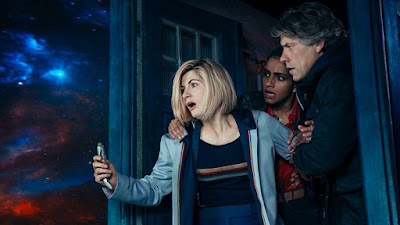
After almost two years away, and with very little advertisement or fanfare Doctor Who finally returns to the screens with the first of a six part series long story that, despite seeming to really try to do a lot, feels like a rushed, jumbled mess of parts with no clear connections so far.

This isn't the first time that there have been bigger stories in the Doctor Who universe. Even if you discounted the fact that every story before the revamp in 2005 was a multi-part story, there were things like 'The Key To Time', and more recently the third and fourth series of Torchwood were longer form storytelling. Of these mentioned examples the one that's easily my favourite is Torchwood: Children of Earth, a five part series that I think is still some of the most emotional and affecting things in the entire shared universe of Doctor Who

One of the ways that series worked so well is that it didn't rush with it's storytelling, yet managed to cram a lot into its five episodes. By the end of the first episode there was indications that big things were coming, that there was a threat on the horizon, there were new characters added, developments made with existing ones, a few mystery threads left hanging, and an explosive cliffhanger. The first episode of Doctor Who: Flux is very much not this, however. There are some similarities between the two, there's a threat established, a new character added, and a cliffhanger ending, but despite that this new episode feels very messy and confusing in comparison.


Now, I'm sure there are already going to be people yelling that this is only a first part, and that a lot, if not all of this, can get resolved in future episodes; and I very much hope that that's the case. I want this to be looked at as the set-up of a great series long story that is not only well received but lets Jodie end her tenure with a huge bang. But as something that I've watched without those other episodes yet, as something that I've experienced on it's own and have had to watch as a single episode I feel kind of dejected by the whole thing.

For starters, The Doctor didn't seem particularly good in this episode. There were times where there is clearly, obviously something bothering her, yet she never allows herself to open up to Yaz about it. There's the moment when the Tardis seems to be breaking down, leaking some kind of fluid and she just goes 'It's nothing, it's fine', or the few times where she experiences a psychic connection with one of the many villains of the piece yet won't talk about it even when prompted. Now, I understand that The Doctor doesn't always tell their companion everything, that sometimes they hide things so as not to seem like things are hopeless, or that they occasionally don't know answers, but it happened so often this episode that it felt like The Doctor either dislikes Yaz or didn't trust her. Even a simple 'I'm not sure' would have sufficed in response rather than acting like Yaz was some kind of child asking stupid questions.

Dan, the new companion for the series, was definitely the one cast member of the main three who actually felt like he got any kind of care or attention given over to him. His introduction was nice, and the scenes where he's helping out at the food bank and giving out sweets to trick or treaters were great because they showed he's a deeply kind and warm sort of person. He has a kindness to him that shows he's a decent and caring person, one that might be needed if The Doctor and Yaz continue to have this semi-antagonistic relationship develop over the course of the series.

Outside of Dan there are a number of other characters introduced. There's Claire, a woman who appears seemingly at random to tell The Doctor that they're going to meet in the past, then goes off and gets sent back in time by a Weeping Angel. The scene where the Angel appears is pretty good, but like much of the episode it feels like this inclusion is a scene where we're going to be waiting for it to mean anything. There's also another woman from Earth who's supposed to be meeting Dan for a date and gets grabbed by one of the villains for the series.


As for the villains, there's the already mentioned Weeping Angel, who appears for one scene, some Sontarans who make a few appearances setting up their inclusion in the next episode, a strange being who appears to have been  prisoner of 'the division' of millennia but escapes and causes havoc, as well as his sister who was posing as a human woman living in a house in the Arctic circle with a human man; she may have been under some kind of chameloen circuit, but no answer to that has been given yet. And there's a kind of but not really villain in the form of a dog alien who kidnaps Dan. All of this on top of the giant energy wave thingy that's tearing the universe apart that may or may not be connected to some of the other villains in the show. 

It's  lot of stuff, most of which isn't explained in the episode, and adds to the sense that things feel bloated and crammed in. Surely some of it could have been saved for later; like the Sontarans. Did we need to see them in episode one for their appearance in episode two to make sense? The flashback towards the beginning of the episode that shows construction in 1820's Liverpool will probably be important at a later time, but again, did we need that established here for it to work later?

I'm really hoping that the series goes well, and there's a lot of promise here, there are small parts that I found genuinely enjoyable and intriguing; but I'm just not completely sold on it yet. Let's hope that episode two helps to improve things. Though I will say, the line 'You look nothing like four bears' might be one of the best things in the Chibnall era.


Buy Amy A Coffee

Go to Amy's Blog

Tuesday, 2 November 2021

Star Wars Adventures: Ghosts of Vader’s Castle #5 – Comic Review


Originally published on Set The Tape


It’s a shame that the final issue of Star Wars Adventures: Ghosts of Vader’s Castle has already arrived. On the one hand, this has been a wonderfully fun and creepy series that has made the Halloween month great for Star Wars fans, but on the other it’s finally come to a close. Thankfully, this final issue manages to retain the amazing quality that we’ve had already, and perfectly sticks the landing.

The issue picks up where the last one left off, with our group of ragtag heroes on the volcanic planet of Mustafar, literally standing on the doorstep of Castle Vader. With Lina’s brother Milo having been kidnapped by the twisted villain Vanee, it’s down to them to come to his rescue, but returning to the frightening halls of the place where they’d previously barely survived is a big challenge for them.

There’s a genuine amount of tension as the book starts. We don’t know what’s inside the castle waiting for our heroes; we’re on just as much a back foot as they are. Vanee could be working alone, but the halls could also be filled with Imperial remnant waiting to hurt them. Or there could even be the spirit of Vader himself waiting to do something awful.

Now, having watched Return of the Jedi I know that after he died Anakin Skywalker became a Force Ghost. I know that he was somewhat redeemed and ceased to be Vader. I also know that there has been no hint or mention of a ghostly Darth Vader or a resurrected Darth Vader in other Star Wars canon set after his death. However, Cavan Scott genuinely had me wondering throughout whether something bad could really happen here. Part of me was thinking that this must be some kind of delusion by Vanee, or some other kind of entity behind it all, but I just couldn’t shake the feeling that Vader might come back, if even just briefly. The fact that he had me thinking a pretty impossible idea could be possible speaks to the strength of the writing of this book, and how much the theme of fear and horror had permeated the story.


I’m not going to say how the story ends because you definitely need to read it for yourself, but I will say that we do get a definitive answer by the time it comes to a close. That Scott does give us a conclusion that feels well earned and makes sense, whilst also being tense right up to the last moments. And speaking of last moments, I can’t tell you what it is, but the last page of the book gave me a genuinely wonderful reaction. I adored how this story wrapped up, and think that it makes a worthy addition to the canon.

Because this book doesn’t feature any of the weird dream sequences as has previously appeared in the other issues there’s only the one artist on this book, Francesco Francavilla. Francavilla has worked on the other four issues, providing the artwork for the sections set in the real world that bookend the spooky stories, but here they provide the art for the entire issue and it works really well. Their art style is perfect for a horror story, and the thick dark lines and heavy shadows, coupled with darker colours, really helps to improve the spooky atmosphere of the book.

Where some of the other Star Wars Adventures titles can sometimes lead to a mixed bag, Star Wars Adventures: Ghosts of Vader’s Castle has been the most consistently strong series so far, with quality writing and art throughout. If you’ve never picked up any of these titles before because you’ve dismissed them as being for younger readers you’ve definitely done yourself a disservice, and you’ll want to rectify that immediately by grabbing this title.


Buy Amy A Coffee

Go to Amy's Blog

Saturday, 30 October 2021

Truth of the Divine by Lindsay Ellis - Book Review


'The human race is at a crossroads; we know that we are not alone, but details about the alien presence on Earth are still being withheld from the public. As the political climate grows more unstable, the world is forced to consider the ramifications of granting human rights to nonhuman persons. How do you define “person” in the first place?

'Cora Sabino not only serves as the full-time communication intermediary between the alien entity Ampersand and his government chaperones but also shares a mysterious bond with him that is both painful and intimate in ways neither of them could have anticipated. Despite this, Ampersand is still keen on keeping secrets, even from Cora, which backfires on them both when investigative journalist Kaveh Mazandarani, a close colleague of Cora’s unscrupulous estranged father, witnesses far more of Ampersand’s machinations than anyone was meant to see.

'Since Cora has no choice but to trust Kaveh, the two must work together to prove to a fearful world that intelligent, conscious beings should be considered persons, no matter how horrifying, powerful, or malicious they may seem. Making this case is hard enough when the public doesn’t know what it’s dealing with—and it will only become harder when a mysterious flash illuminates the sky, marking the arrival of an agent of chaos that will light an already-unstable world on fire.'

I absolutely adored the first book in this series, Axiom's End was an absolutely wonderful read, and I loved talking to Lindsay about it last year. As such, I was super excited when I was accidentally sent my gorgeous hardback, sprayed edged, signed edition almost two weeks early. Yes, I went for the swankiest version I could find and I did not regret it. I had to get a couple of books out the way before getting into it, but couldn't wait to devour this book and have the review up as fast as I can. So if I'd gotten it early, why is the review coming out so long after release? Well, I could give you some excuses, but the real answer is that whilst I read the first book in a few days this one was a lot longer a read for me, but not because of the physical size of the book, but because it hurt to read it at times.

To clarify, I'm not saying it hurt to read because it was bad; it's not one of those books where it's so badly written that it feel like it's a pain to get through. This book hurt to read because of the content, and how well Lindsay was able to portray post traumatic stress, panic attacks, and trauma. It hurt to read because it so accurately captured what it's like to live with trauma, it reminded me of those kind of feelings, and it hurt.

Before the book even begins there's a small introduction that informs the readers that the book was going to be dealing with hard issues, that it include things that could be upsetting to some readers, but despite that I was hopeful that there would be a lot in this book to enjoy, that the wonderful story of Cora and Ampersand would continue on from the first book, and those hopeful, heartwarming final moments of Axiom's End would continue on. And at first we got this, the book picks up a few months later, and whilst Cora is dealing with a lot of trauma from the events of the first book Ampersand is there to help her through it. He's there to comfort her and care for her, he watches over her as she sleeps to keep the nightmares away. It was so wonderfully kind and sweet, and you very much felt like you were watching real love developing between these two.

Sadly, this doesn't last, as very quickly into the story a new player is introduced in the form of Enola Gay, another of Ampersand's race who has come to Earth. There's a lot about Enola that readers will find surprising, and he goes through a lot of complex changes across the course of the book that means he's not just a replacement antagonist for Obilus; if anything I'd struggle to really call him an antagonist even if his presence does spur pain and hardship for our main couple.

After Enolas arrival things change for Cora and Ampersand, and those moments in the early stages of the book where we see Cora struggling through her trauma with Ampersands help begin to pale in comparison compared to the pain that is to come. Pain that effects both of them. There are large portions of this book where I was genuinely afraid for both of them, especially Ampersand. I was worried that the things they were going through, the trauma that they were processing was going to be too much for them. I rarely find myself worrying about characters dying in books during big action scenes or dramatic moments, but a long, slow progression into more and more psychological pain that could at best leave the character forever changed, and at worst lead to their death? That was a threat that felt so real so often over the course of this story.

Thankfully, it isn't all a painful journey, thanks in part to Enola Gay and the new energy he brings to the book, but also thanks to the new human protagonist, Kaveh. An investigative journalist and writer, Kaveh is more mature and has more world experience than Cora, and is able to bring his experiences with some of the harder parts of life to Cora's struggle and help her through her trauma. 

Honestly, at first I wasn't sure what Kaveh was going to bring into the mix, and I was more than a bit suspicious of him and his motivations. Part of me was waiting for him to show his true colours and betray Cora and do something awful, but he was honestly one of the best, most engaging, and most wholesome characters in the book. I quickly came to like him, and I loved how much he just wanted to help his new friends and wanted to make sure that they were okay.

Outside of the character developments Truth of the Divine begins to explore this new world in some very big and very important ways. In videos on her Youtube, and in the interview I had with her, Lindsay has said that this is the book that made her want to write this story, and that in some ways the first book was what she had to get through in order to write the stuff that really interested her. And I can see why she was eager to explore this. 

The book begins with a world that's now well aware of alien life existing. And whilst they humanity as a whole might not have seen what these creatures are like, they understand that their mere existence is going to change the world. There are people who are open to accepting these aliens, to seeing them as people deserving of rights, whilst others believe that human rights should be restricted to humans only, and a new form of rights given to them instead. This opens the door to conversations about what it means to be a person, what defines us as humans, and how trying to categorise certain types of beings being allowed certain rights is a very dangerous, slippery slope that could see people falling into these categories, and these arguments being used to deny human rights to some.

It's heavy stuff for sure, and its intentionally reflective of the world we live in now, as well as our own history. With the book being set in the early 2000's the more direct focus of how these questions of rights and categories can be used against people in a world of heightened fear and hatred following the September 11th attacks, and the increase in Islamophobia and hatred of people from the middle east. But, this is something that you can see parallels to with other groups in the past, such as with people of colour, the Jewish community, women's right, the gay rights movement; as well as the attack on trans rights that's happening today. This may have been another factor that played into the feelings I had when reading this book, that the world that was being created here was is so frighteningly realistic and reminiscent of the fight for my own rights that's happening now that it made the already depressing feel of the book worse for me. But these are the kind of conversations that are important, and these themes are so incredibly relevant that they need to be discussed, even if it's in the form of our entertainment.

I don't want anyone to come away from this review thinking that I didn't like this book, or that it was a bad read because of how much I've focused on the more 'depressing' elements. This was a book that I loved. It took a story and characters that I absolutely adored and did some brave things with them, it pushed them in challenging directions and treated them in a realistic way. Was it always easy to read? No, but life isn't always easy. Sometimes you've got to fight through so awfully dark things in order to reach moments of true happiness and self acceptance. And this is what's happening here. It's an important part of Cora and Ampersand's journey. A journey that better involve them doing it in book three. You know we all want it Lindsay.

Truth of the Divine is easily one of the best books I've read this year, it's a fantastic follow-up to one of my favourite novels. If you enjoyed the first book I'm sure you're going to love this; but be prepared for one rocky journey.


Buy Amy A Coffee

Go to Amy's Blog

Friday, 29 October 2021

Yokai Monsters Collection – Blu-ray Review


Originally published on Set The Tape


I love Tokusatsu. Whether it’s television shows like Super Sentai and Ultra-Man, or films like Godzilla, there’s something about the Tokusatsu genre that just grabs me as being wonderfully weird and delightful in ways that other special effects projects don’t. One series that I’ve been eager to watch for a number of years, but have never been able to find outside of Japan, are the Yokai Monsters films. A trilogy of movies from the end of the 1960s, these period pieces see monsters from Japanese myth and legend punishing evildoers. Luckily for me, and everyone, Arrow Video have brought these hard to find gems to Blu-ray.

The first film, Yokai Monsters: 100 Monsters (1968), sees a corrupt land owner plotting to tear down a local shrine and halfway house; a plan that will see people down on their luck thrown out onto the street. Even worse, he intends to build a brothel on the site of the shrine to increase profits. To celebrate his plot, and to attract a powerful ally and investor, the land owner holds a Hyakumonogatari Kaidankai ceremony, where tales are told about various monsters. However, he fails to perform the proper cleansing ceremony at the end, allowing the monsters to come to life. Angered that the land owner is hurting people, and that he intends to desecrate a temple, the Yokai set out to punish him.

Despite the title of the film indicating that the movie is about monsters it’s actually a very human-centric film, with a major focus on the wickedness that people are capable of, and how far evil men are willing to go for power and wealth. The Yokai, for the most part, are a minor part of the film, and don’t appear that often. The first time we see them is as part of the Hyakumonogatari Kaidankai ceremony as we get to see the stories that are being told. However, once they do start to appear they’re treated as frightening entities, there to haunt and punish those doing wrong. Although there is one umbrella monster who befriends the landowners son and treats him well too.


The second film, Yokai Monsters: Spook Warfare (1968), is a very different type of movie.If the first film is a horror story this is more of an adventure film, and at times feels like it borders on having been made with a younger audience in mind. The story begins with the accidental release of the monster known as Daimon, a creature from ancient Babylon. Upon arriving in Japan, Daimon comes across a local lord, who he kills. Having drank his blood, Daimon is able to transform into the lord, and uses his power and position to begin terrorising the area. Fortunately, the local Yokai become aware of what’s happening, and decide to band together to combat the demon.

The first film almost treats the Yokai as a supernatural force of nature, there to punish humans doing wrong, but the sequel sees them as entities that exist alongside humanity, who will come together to help defend people if the need arises. Because of this the Yokai get a much bigger focus, get to develop personalities, and are the real heroes of the story. This is a big part of why the film feels like it’s been geared more towards children, and the brightly coloured and strangely designed monsters feel like friends of humanity, more than something to be feared.

The third film, Yokai Monsters: Along With Ghosts (1969), is much more in line with the first film, with the titular monsters going back to being a vengeful force that barely appear in the film. The plot focuses on a young girl whose grandfather is killed by a local gangster. Having been told to seek out her father in another town the girl sets out to find him, but is persued by the criminals who believe she may have taken a document that could implicate them. Along the way the girl is aided by a wandering samurai, as well the occasional ghostly Yokai, who target the criminals.


This film feel like an odd entry in the trilogy, in part because it seems to take a few steps backwards by being more like the original and making the monsters a small part of the narrative; but also because all of the creatures that appeared in the previous two films are absent. The film doesn’t have the visually distinct creatures like the Kappa, Kasa-Obake, or the Rokurokubi. Instead, the Yokai in this film look like wizened, half decomposed people. It’s creepy, yes, but it doesn’t feel like the films that came before it.

Whilst that might be the end of the Yokai Monsters trilogy, it’s not the last film offered in this collection, as Arrow have also included 2005’s The Great Yokai War, directed by Takashi Miike. Billed as being a loose remake of the second film from the trilogy, it’s very much its own thing and feels more like a fourth entry in the series rather than a retread of what came before; especially as it also draws from the GeGeGe no Kitarō manga as well.

It centres on a young boy named Tadashi (Ryunosuke Kamiki), who discovers that the world of Yokai not only exists, but that he is the Kirin Rider, a chosen warrior who can help to stand against the evil demonic force that is changing Yokai into mechanical monsters , and who plans on destroying the human world. Teaming up with a group of Yokai, including the Kappa and a beautiful water spirit, Tadashi sets out to save the world from the demon.


The Great Yokai War is very much an early 2000s Japanese fantasy movie. It has a big, world destroying villain, brightly coloured costumes and people in monster makeup, and slightly awful looking CGI that stays charming enough to not be completely off-putting. Much like the film it’s taking inspiration from, this feels much more geared towards an audience with younger viewers in mind, both because of the child hero and because of the odd humour that happens throughout. Whilst it might not be the best of the four films on offer here it is one of the most charming, and has a lot about it to enjoy.

As well as the four movies, the new set comes with a specially filmed documentary called ‘Hiding in Plain Sight’, which goes into the history and culture of Yokai and features some experts on the topic. There are also original trailers for the trilogy included too. The most extras come with the fourth film, due in part to it being the most recent. There’s a full length commentary track by Japanese cinema expert Tom Mes, as well as various shorts and behind the scenes interviews and event appearances from the cast and crew. Whilst I’d have liked to have seen commentaries included for the original trilogy as well, their absence doesn’t detract from the overall quality. There’s also a 60 page collector’s book with writing about the film, some postcards featuring brand new art, and a fold-out poster guide to the monsters.

If like myself this is a genre that you enjoy, and a series you’ve wanted to see for a while, this box set is an absolute must get. Packed full of wonderful moments, laughs, and some fantastic effects, it’s the perfect set for any Yokai fan.


Buy Amy A Coffee

Go to Amy's Blog

Thursday, 28 October 2021

Batman: Arkham City – Throwback 10


Originally published on Set The Tape


Before Batman: Arkham Asylum, superhero video games were pretty disappointing on the whole. There were some good games to be found sure – we’re mainly looking at you here Spider-Man games – but on a whole they weren’t great. And whilst he’d always been a hugely popular character across other mediums Batman failed to make an impact in the gaming world.

But Batman: Arkham Asylum changed all that. It was a game that made you feel like you were Batman, able to take down a room full of thugs, battle with super criminals, solve riddles, and fly through the air gliding with his cape. It was astounding; so a sequel to that would have a lot to live up to.

Released just two years after the first game, Batman: Arkham City took everything the first instalment did but went bigger in scope and scale in every way. Rather than setting another story inside the cramped corridors and strange grounds of Arkham Asylum, the story moved to an entire section of Gotham City that had recently been walled off to make a giant prison. Instead of running through halls past cells the player was given the freedom to explore the streets of Gotham, scale buildings, and glide from rooftop to rooftop.


This also meant that the designers were able to include a lot of interesting areas and variety to the game, as well as some iconic locations from Batman’s lore. There’s an old Maxie Zeus casino, a GCPD building complete with bat-signal on the roof, a courthouse decked up by Two-Face, the Penguin’s Icerberg Lounge, Ace Chemicals, and even the Monarch Theatre and Crime Alley, the place where Batman was born as Thomas and Martha Wayne were murdered. The game felt expansive and huge despite the limitations still placed on it by the technology because of all of these areas and inclusions.

It wasn’t just the game world that got an overhaul though, as the story was much bigger in scope and scale than what had come before. Paul Dini, often celebrated as one of the best Batman writers of all time, came back to contribute to the story, and along with Paul Crocker and Sefton Hill, the three of them were able to craft a story that would take players to several memorable locations, and present a mystery that would hold a number of genuine surprises (even though like all good mysteries there are a lot of hints early on that you’ll kick yourself for not having gotten first time round). If the first game felt like a small, six issue story, Batman: Arkham City felt like a sprawling year long Batman epic across multiple titles. It was the video game equivalent of an event comic, and fans lapped it up.

Another way in which the game was a vast improvement over the first was the boss fights. As good as the first game was the encounters with the iconic villains were a bit lacklustre at times. A lot of the fights relied on the player having to perform the same actions over and over again, and were some of the weakest parts of the game; especially the final fight with the Joker.


This was majorly overhauled in the sequel. Instead of dodging enemies so that they ran into walls you’d be fighting an electrified zombie under the city; instead of throwing batarangs at a big plant until it fell down and you could hit it you’d be stalking Mr Freeze through the GCPD, laying traps for him as he learns from what you’re doing and takes out your hiding places. Suddenly you had to think about how you approached situations instead of just being able to run in and fight like you could the first game, and it was so much better for it.

Upon release the game gained critical acclaim across several publications, with either perfect or near perfect scores from the vast majority of reviewers. It was called ‘the best licensed video game ever made’ by Game Informer, whilst it was held up as a standard for other games to meet by other reviewers. Thanks to the constant praise around the game, as well as excitement generated through a huge marketing campaign across multiple platforms, meant that when the game came out it became one of the fastest selling games in history. It topped the charts on every platform it was released on, and outsold the original in a matter of weeks.

Due in large part to the sales and the constant praise, but also to the somewhat less favourable reaction to the other games that would come after it, Batman: Arkham City is without a doubt the peak of the franchise, and one of the best superhero games that will ever be made.


Buy Amy A Coffee

Go to Amy's Blog