Sunday, 8 August 2021

Harley Quinn The Animated Series: Eat. BANG! Kill. Tour #1 - Comic Review


Since first appearing on screens in Batman: The Animated Series Harley Quinn has been an instant hit with fans. Originally the Joker's girlfriend and sidekick, over the years the character was given more depth and chance to grow, and has spent the last few years as her own person away from the abusive relationship she once had with the Joker; and has been so much better because of it.

Harley Quinn The Animated Series was the first time that the character got to headline her own show, an animated series was designed for an adult audience, a decision that allowed the writers to take Harley in fun new directions and explore her character in ways that the comics didn't often do; and all with frequent swearing and gore.

One of the things the show did in its second season was to explore the relationship between Harley and Poison Ivy, two characters that have been together in several versions of DC books, usually in separate universes and timelines than the main continuity. By the end of the second season Ivy's wedding to the costumed villain Kite Man was ruined, and the two women had declared their love for one another, driving off into the sunset like Thelma and Louise.

This is where Harley Quinn The Animated Series: Eat. BANG! Kill. Tour comes in, as the new comic series picks up right where the show left off. Written by Tee Franklin, the first ever Black queer disabled autistic woman to write Harley Quinn, the Franklin manages to capture everything that made the series one of the best shows that DC has ever made, as well as taking the characters in a wonderful new direction.

With the GCPD hot on their trail our two heroines (is that the right word?) spend the first several pages of the book racing around the Harley Quinn Highway, getting the cops off their back. This gives the reader the opportunity to get caught up on events as Harley recaps the events of the show, whilst also allowing for some cool action as she leaps from vehicle to vehicle doing damage to the cops.


Whilst this is all good and fun, and it is a lot of fun, it's the relationship between Harley and Ivy that a lot of us are here for. And it absolutely gets centre stage. There's been a panel of the comic doing the rounds in the build up to the release, of the two of them in their car with Ivy running her hand up Harley's leg to somewhere quite special, with a look of absolute delight on Harley's face. Fans have rightly gotten excited by this, as it's possibly one of the most physically intimate we've ever seen the two of them (Ivy's an inch away from the jackpot).

Well, having been allowed to read the issue before release I can confirm for folks that this is probably the most tame the two of them are, as things get a whole lot more physical between them. It's the queerest I think I've ever seen a DC comic, with the creative team not shying away from the fact that the gays fuck. It's delightful not just in its inclusion, but the sheer joy it brings the characters. I don't mean from a 'sex is fun' way, but because it's two people so deeply in love with each other getting to explore each other and learn about each other in ways they never have before; taking their relationship to an exciting new level.

But it's also treated with a lot of seriousness too, as there's a moment in the book where Ivy contemplates what has led her to this point, and it gets too much for her. We see in this moment that it's not just a physical relationship between Harley and Ivy, but an emotional one too as Harley holds her girlfriend as she cries. 

The entire creative team have done brilliantly with this book. Tee Franklin has made sure that this very much feels like part of the show, with the same level of humour and fun. The art team have done similarly, with Max Sarin, Marissa Louise, and Taylor Esposito making the book look like it came out of the TV show. Sarin is able to recreate the characters and locations from the series with staggeringly good effect, and Louise's colours make every panel and scene pop. 

In just a single issue this might be one of the best queer relationships DC has put to print, and there's still so much more to come. The issue ends with the promise of some wacky and weird stuff to come, and I'm honestly super excited for it. If anything I'm a little annoyed that we're all going to have to wait a month between each issue. If you were waiting to see how well the digital version of the book did before putting in an order for the physical book you should stop waiting around and make sure that you pre-order this whilst you can, as Harley Quinn The Animated Series: Eat. BANG! Kill. Tour is a comic that's going to sell fast, and be talked about for a long while.


Make sure to check back tomorrow as I get to chat to Tee Franklin about working on this amazing new series.


Buy Amy A Coffee

Go to Amy's Blog

Saturday, 7 August 2021

The Intergalactic Adventures of Zakk Ridley Volume 2: Sins of the Past #1 - Comic Review


After several years of waiting the story of intergalactic scoundrel and smuggler Zakk Ridley finally gets to continue in the latest comic release from Markosia Publishing, and it feels like the characters were never away.

Picking up almost immediately where the first volume left off, this new issue sees Zakk and his allies heading to ground after their confrontation with President Beckham, a confrontation that left the President wounded and Zakk a wanted man. This leads to some divide in the group as Zakk initially doesn't want anything to do with Kyouri's plan to find and join the resistance. This disagreement only seems to get worse when Zakk learns that Lianna, and an old ally Ethel, have been kidnapped by Danesh Kabli.

Now joined by Tiina, Ethel's daughter, the team decide to try to find a way of rescuing their allies. However, things only get worse for them as President Beckham has hired the Honourable Order of Interplanetary Assassination, space ninja's, to track down and kill them all.

You'd be hard pressed to tell that it's been several years since the first volume of the series came out, as the creative team seem to have picked up where they left off without any loss of quality. The story feels like it could have been written straight after the first book, with the same snappy humour and weird world building going on, whilst artist Ewan McLaughlin continues to provide art for the book.

The only real difference between this issue and what I've seen in the series before is the slight change in art style when the ship is travelling through the Caligan Rift. Instead of the usual painted look the style becomes a bit messier, a bit more angular and sharp. The line work is bolder and it looks more hand drawn than hand painted. This, along with the single colour infusing the whole scene really stands out against the rest of the issue, and makes the faster than light travel seem strange and different from everything else.

If you enjoyed the first volume then you're probably going to like this first issue. It carries on the story, but does some new things, and continues to build upon the ideas created in volume one. If this is your first time picking up the series, however, you may find yourself a little lost as this is very much just another part of the same story, and reading volume one is an absolute must before delving into this one.


Buy Amy A Coffee

Go to Amy's Blog

Friday, 6 August 2021

The Intergalactic Adventures of Zakk Ridley by Ian Sharman & Pete Rogers - Book Review


'Zakk Ridley is just your average smuggler and rogue until he and his robotic partner, Dan, get caught up in an intergalactic conspiracy. Zakk dreams of an easy life roaming the galaxy and making a fast buck or two, but as they say, in space no one can hear you dream..'

With the upcoming release of the new volume of The Intergalactic Adventures of Zakk Ridley just around the corner now might be the best time to check out the original four issue run, collected together in one graphic novel.

The story follows the grouchy and disagreeable space pirate Zakk Ridley, and his robot companion Dan, as they end up in trouble following a transport job that turns out to be more than they first realised. Barely escaping from the police, and taking damage to their ship, The Mary Jane, they head to an old friend to help get them back up to working order.

However, when it comes to payment their old friend simply asks for them to make a pick up for them. Forgoing having to pay for their repairs with a simple transport job can't be too bad right? Unfortunately for Zakk and Dan, they're not transporting cargo, but a woman with information that could prove the galactic president is behind a fanatical group of killers, using the chaos they've been causing to further his own goals. All Zakk wants to do is live a quiet life, but now it seems like he's being dragged into a conspiracy that could make him a target too.

The Intergalactic Adventures of Zakk Ridley is an odd book. In a lot of ways it has many of the trappings of American science fiction. The introduction to the book makes comparisons to Zakk and other popular space pirates, such as Mal Reynolds and Han Solo, and the book does at times feel like a story that's been inspired by these other works; but it's also a very British feeling book too. There are lines in the story that feel very much like they've come from a British writer, and it has a feel that you don't really get with American work.

This was only enhanced for me thanks to the artwork from Ewan McLaughlin. McLaughlin, who has also worked on the comic series Gun Viking, which has a very 2000AD feel to it. I don't think I could point to one particular artist that his style reminds me of, but the way that it's been coloured, the exagerated and sometimes ugly features of people, and the blocky, boxy quality of the vehicles and environments just scream British comics to me. 

The art and the writing seem to be made for each other, and they go well together, often with the art doing as much world building as the text, thanks in part to the amount of detail that's gone into each panel and the tiny things in the background that help this to feel like a lived in and worn world.

Writing for the book falls to Ian Sharman and Pete Rogers, and whilst I've read some of Sharman's work in the past I'm not familiar with Rogers at all. That being said, you'd be hard pressed to try and tell that there are two writers on the book. Sometimes with comics that have more than one writer the split can be quite obvious, with some scenes shifting so drastically in quality it's clear they've been done by different people; but that's not the case here. 

The two writers seem to work well together, and the world they created feels really interesting. I often wanted the story to slow down for a bit, just so that I could spend longer getting to know more about everything. I wanted to know about the strange worlds the heroes were travelling to, and the odd cultures that were being depicted. I'd have happily read a book that was a few issues longer to get this, even if it meant a bit of padding; that's how interesting some of the tiny background elements were.

It's obvious that the people working on this book have a love for British comics, for science fiction, and for Star Wars (there's a surprising number of Star Wars references scattered throughout the book, so see how many you can spot). It seems to be a book made through a passion and love of the genre and the craft, and sets the stage for more things to come in the next volume.


Buy Amy A Coffee

Go to Amy's Blog

Thursday, 5 August 2021

Godzilla vs. Hedorah – Throwback 50


Originally published on Set The Tape


Fifty years since it was first released in Japan, Godzilla vs. Hedorah might not be the worst Godzilla film of all time anymore, but it might still be one of the strangest.

A scientist discovers a strange kind of undiscovered tadpole living in Suruga Bay, and goes on a dive to observe the creatures in the wild. However, he’s quickly attacked by a large version of the animal, which leaves him covered in burns. It turns out they weren’t tadpoles at all, but are in fact sludge-like entities that feed on pollution. These creatures begin to form together, and soon grow to massive size.

This new creature, which the scientist names Hedorah, attacks Fuji City, but is repelled by Godzilla. After retreating, Hedorah appears in Tokyo in a new, mutated form. This new form unleashes poisonous gases into the air, gases that even hurt Godzilla. Hedorah moves on from Tokyo, appearing at Mt. Fuji in yet another horrifying form, one that makes it bigger than Godzilla. Godzilla and the humans manage to lure the creature into some power pylons, where it is eventually destroyed.


On the surface it doesn’t sound like there’s much about this story that makes this a particularly odd outing for the Godzilla franchise, but that’s because when I described the plot of the film I didn’t include the odd dream sequences, hallucinations, and animated segments that really push it into the bizarre.

The tone of the film is all over the place, and to begin with you’d be forgiven for thinking that it was aimed at a younger audience. Like the previous entry in the series, it has a child protagonist, so you’d imagine it would cater to the younger viewer. Instead, there are moments when Hedorah’s sludge body melts and deforms people, bodies litter the streets, and people are killed in their homes when the titular monsters battle.

Rather than sticking with a grim and gritty take on the Kaiju genre, showing the bloody destruction caused by these creatures, it decides to throw some frankly odd moments into the mix. The film goes into black and white for a short while, before jumping back into colour. There are dancing skeletons, people with fish heads, and shots of babies crying thrown into the middle of scenes. These moments have tended to be divisive with viewers, some of whom enjoy the odd nature of the movie, but one thing that most people can agree that the film misses the mark on is when it has Godzilla fly.


You might be reading that wondering how that would work, or how it could be considered bad, but Godzilla literally propels himself through the air using his atomic breath in order to catch Hedorah, and it just comes across as silly. Just search for ‘flying Godzilla’ and you’ll see what I mean.

Some of the issues with the film might be down to it being the first film for director Yoshimitsu Banno, who was given a smaller budget than previous films in the series, and only 35 days to complete shooting. The production seems to have been hampered by a number of issues, most notably being that suit actor Kenpachiro Satsuma, who was performing as Hedorah, suffered from appendicitis during filming. Unfortunately, due to how long it took to get in and out of the suit, and the need for an emergency appendectomy, the operation had to be performed whilst he was still partially in the costume. Most frighteningly, according to some reports, the painkillers didn’t work, and Satsuma felt the entire thing.

Godzilla vs. Hedorah is definitely one of the strangest entries in the Godzilla franchise, and possibly for Kaiju films in general. But, it certainly stands out amongst its brethren because of all its quirks and oddities. Love it or hate it, it’s definitely one of the more memorable films in the series.


Buy Amy A Coffee

Go to Amy's Blog

Wednesday, 4 August 2021

The Climbers by Keith Gray - Book Review


'In this compelling story of teenage rivalry and friendship, award-winning author Keith Gray captures the subtle agonies and reality of life growing up in a small town.

'Sully is the best climber in the village. He can scale the Twisted Sister’s tangled branches and clamber up Double Trunker with ease. But when new kid Nottingham shows up and astonishes everyone with his climbing skills, Sully’s status is under threat and there’s only one way to prove who’s best. Sully and Nottingham must race to climb the last unnamed tree. Whoever makes it to the top will become a legend. But something spiteful and ugly has reared its head in Sully ... Is it worth losing everything just to reach the top?'

The Clmbers is the latest release from Barrington Stoke books, and focuses on the struggles that teens can face living in small towns, and how they can pin their entire identity on one thing; even if that leads to them having to face awful consequences.

The story follows Sully, a teenage boy who lives in a town where there's not much for the kids to do, save climb trees. Climbing has become not just something to keep the kids busy, but something that they put all of their focus and energy into. For some, like Sully, it borders on an obsession. Whilst most of the trees in the town aren't much of a challenge for most of the climbers there are five that all the kids want to climb, the Big Five.

There's Twisted Sister, the Corkscrew Willow; Spider Trap, the Larch; Crazy Ash Bastard, the Ash tree; Double Trunker, the Oak tree spit in two by lightning; and The Last Tree, a huge Yew tree that hasn't been climbed by anyone yet, and as such hasn't been given a name. Sully has climbed the first four trees, and has set his sights on being the first to reach the top of the fifth, giving him the chance to name it.

However, when a new kid, Nottingham, arrives in town Sully sees his chances of naming the last tree beginning to slip from his fingers. Nottingham is a good climber, perhaps even better than Sully is. But rather than admitting that, rather than trying to make a friend, Sully sees Nottingham as nothing but a threat, and the two of them instantly clash. Their rivalry builds over just a few days, and the two of them agree to race up The Last Tree in the ultimate challenge of climbing skills. However, with Sully obsessing over his climbing he runs the risk of hurting his closest friend, and begins to realise that maybe he might be focusing on the wrong things in life.

The Climbers story struck me as one about addiction and obsession, and how destructive these feelings can be. Throughout the course of the book we see Sully obsessing over climbing above everything else. He pushes away his closest friend, he realises that he has no plans or cares about his future, and even begins to realise that his gloating and showmanship isn't appreciated by the other kids in the town. Sully begins the book believing that he's the best, and that everyone else must think the same and must love him because of that, but is slowly challenged as he learns that he's not as special or popular as he might think.

This might seem like a strange theme to build a kids book around, but I'd say it's pretty perfect. I remember clearly how many kids would make a certain aspect of their life their sole focus when I was a kid. It could have been who was the best at football, who was the best at Pokemon, who had the latest new fad, who had the most friends. Whatever it was, there was always something that kids would compete over, and it often led them to ignore everything else and make their whole personality this one thing. I dare say I even did it a few times.

Whilst this might seem harmless enough it's something that teaches some pretty bad habits, and kids who think this way can easily become adults who think this way. The Climbers takes the time show that this kind of thinking can often lead to you feeling alone or isolated, and that it can hurt those around you. It has an important lesson to its young readers that it's okay to not be the very best, to see that there are people that are better at certain things than you and not to be angry about it.

The book doesn't shy away from how nasty it can be to constantly be competing against other, or how putting yourself first can sometimes be cruel. There were times during the narrative that I found myself not liking Sully, where I saw what he was doing and I disliked him for it. He can be sneaky and vindictive, yet there are moments where he lets his guard down and those are when we see the good kid underneath trying to come out. Sully learns his lessons hard in this book, by causing real pain and suffering to others, but hopefully seeing it written out this way will help kids avoid doing the same in their real lives.

The Climbers is a story about having to fight your own inner demons to try and do the right thing, and about how failing to do so can have awful consequences. It's an important lesson that kids sometimes need to be shown.


Buy Amy A Coffee

Go to Amy's Blog

Tuesday, 3 August 2021

Jurassic Park III – Throwback 20


Originally published on Set The Tape


At one point the Jurassic Park franchise was a series that was always based off books, always adapted by Steven Spielberg, and pretty much always seen as being great films. But then Jurassic Park III came out and people began to look at the franchise a little differently. It wasn’t just books being made into films by a respected director, now it had become a monster movie franchise. And whilst the third film would be the last entry in the series for a decade and a half, it would be a film that forever changed how the franchise was seen.

Originally announced for a 2000 release date in 1998 (before a script had even been made) the project went through a number of directors and plots, including concepts where teenagers would become trapped on the dinosaur infested island, and where pteranodons terrorise Costa Rica. The story was only locked into place a month before filming was scheduled to begin.


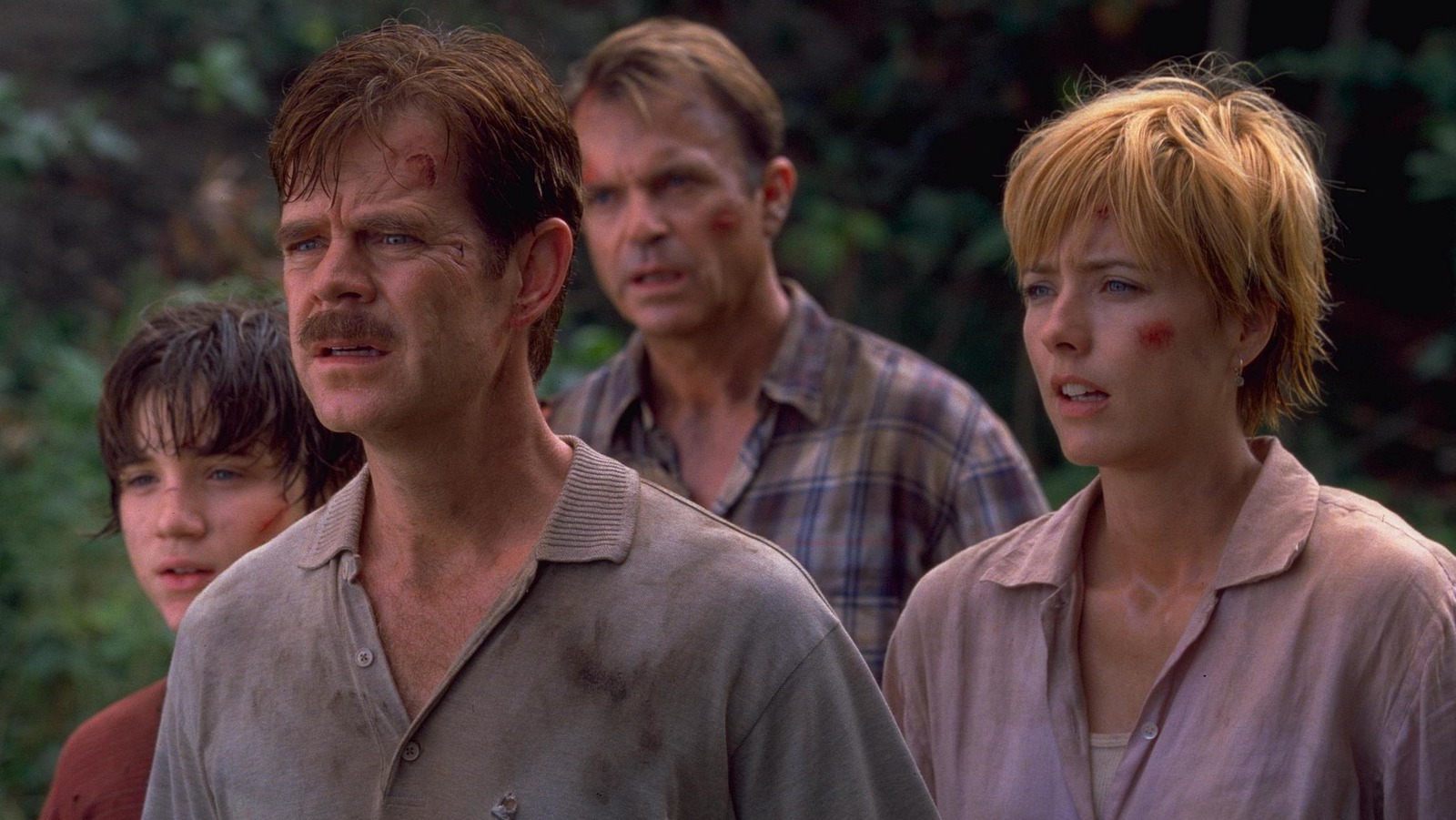
The final plot revolves around a divorced couple, Paul (William H. Macy) and Amanda (Tea Leoni), whose son goes missing when parasailing over the ocean near Isla Sorna, the Jurassic Park Site B. The two of them approach famous palaeontologist Alan Grant (Sam Neill) to give them an aerial tour of the island and the dinosaurs, posing as wealthy adventurers. Despite being reluctant, Grant agrees to do it to secure funding for his latest research.

When they arrive at the island, however, Grant discovers that he’s been lied to when they attempt to land their plane. After being knocked out he wakes up on the island as the search for the missing boy begins; a search that’s cut short when a massive predator attacks and destroys the plane. Separated on the dangerous island, the survivors have to find a way to escape, and find the missing kid before one of the island’s deadly predators gets them first.

Despite the troubled pre-production, Jurassic Park III ended up being a pretty decent and entertaining movie. It may not have had as complex or engaging a plot as the first two films, but it managed to recapture a lot of what audiences enjoyed about the series: people running away from dinosaurs. One of the things they did that helped with this was the inclusion of the deadly new predator, the spinosaurus. Bigger, faster, and more cunning than the iconic t-rex, this new threat would become the iconic creature of this entry in the series.


Whilst some people complained that the film lacked the narrative depth and engagement of the previous entries, many enjoyed the faster paced story, where the characters were quickly moved from one dangerous set piece to another. As well as having the human protagonists having to deal with returning favourites such as the velociraptor (now featuring feathers) the audience were treated to some long awaited moments; such as the inclusion of the pteranodons and their giant aviary.

For a lot of people Jurassic Park III has become the black sheep of the franchise, a film that you’re told isn’t good because it’s not as clever as the first two, because the cast isn’t as impressive, because it’s not based on the books, and because Spielberg isn’t directing. However, the film has some of the most impressive set pieces of the original trilogy, like the aforementioned aviary sequence, is able to balance the terror and gore with some genuinely funny moments, and never really lets the viewer have enough time to get bored with proceedings as it makes sure that the real stars of the film, the dinosaurs, are always the focus of the drama. It’s easy to overlook this entry in the franchise, but it still remains a film that will always bring a smile to my face when I watch it.


Buy Amy A Coffee

Go to Amy's Blog

Monday, 2 August 2021

Wild Search – Blu-ray Review


Originally published on Set The Tape


Wild Search is the latest Hong Kong 80’s action flick to get a beautiful new Blu-ray release courtesy of Eureka Entertainment, and it sees Chow Yun-Fat playing a police officer who ends up having to protect a little girl after her mother is killed when a gun smuggling deal goes wrong.

On the surface, Wild Search seemed like it was going to be a gritty cop drama. The synopsis made it sound like Chow Yun-Fat was going to be putting his life on the line to defend this little girl against killers and criminals, and the trailer featured a lot of violence and bloody moments. But once I actually started watching the film I was surprised by how much comedy was in the mix, and how the real story seemed to be a romance between Chow Yun-Fat’s character and the aunt of the girl he was protecting.

The story opens with an arms deal being made in a small Hong Kong flat. When the police arrive on the scene the deal goes wrong and the seller is killed, leaving her four year old daughter Ka Ka (Cheuk Yan Chan) as the only witness. Detective Lau Chung Pong (Chow Yun-Fat) tries to learn more about her and her family, which leads him to a rural family home in the countryside, where he meets Cher (Cherie Chung), Ka Ka’s aunt.


Lau and Cher become close over the course of his investigation, and working together they discover that a rich and powerful businessman named Mr. Hung (Paul Chun) was involved in the gun smuggling, and is also Ka Ka’s father. After confronting Hung, Lau and Cher become targets, and he sends deadly killers after them to make sure that his involvement in the illegal activities never comes to light.

Wild Search is a loose remake of the 1985 Peter Weir film Witness, and puts the focus squarely on the human drama rather than the action. The relationship between Lau and Cher is the focus of the film, and it’s never forced, instead building slowly over the course of the movie, helped in no small part by the clear chemistry that the two leads have. The small moments where the two of them are lightly teasing each other, or when Cher is trying to take care of Lau after he gets hurt, are some of the sweeter moments in the movie.

That being said, there are a good few action moments spread out across the film, though these do feel slightly forced at times. There’s a moment where Lau engages into a high speed chase after a suspect without knowing which car he’s after, or what direction he’s supposed to be going in, leading to a high speed drive around the city with no real purpose. The moments where the action serves the story are the best though, and the climactic fight at Cher’s rural family home is probably the best one the film has to offer, and features a rather spectacular end kill that had me laughing out loud.


The new Blu-ray release offers a couple of different versions of the film: the original Cantonese dub and the original English dub. Whilst the Cantonese version is the closest to the original vision of the director, I have to admit I had a lot more fun with the English dub, and it resulted in quite a few more laughs. This was mainly due to how Ka Ka was played in the English version, where it was quite clear that they’d gotten an adult to do the child’s voice. This rather creepy, slightly posh voice coming out of a four year old was unintentionally hilarious, and ended up making the child feel quite creepy at times too. Obviously, this is not what the film was aiming for, but if you’re already familiar with the film and are looking for something slightly different that’ll be fun to watch I’d definitely advise giving that version a go.

The disc also comes with a few extras, including a brand new feature length audio commentary by Asian film expert Frank Djeng, who offers a lot of insight into both the production and making of the film, as well as the impact the film had, and Asian cinema at the time. There’s also an archival interview with Roy Cheung, who plays the villainous killer Bullet in the movie, as well as a brand new interview with voice actor Simon Broad, who dubbed all of Chow Yun-Fat’s English language roles. The Limited Edition also comes with a great little booklet with writing by NEO Magazine’s David West, who provides insight into the movie.

Wild Search might not have been the film that I was expecting, but it turned out to be a very enjoyable film nonetheless, with some quirky comedy, some decent action, and a nice romance story at the heart of it.


Buy Amy A Coffee

Go to Amy's Blog

Friday, 30 July 2021

Werewolves Within – Film Review


Originally published on Set The Tape


Opening a film about werewolves with a quote from Mister Rogers about being kind and neighbourly is certainly a bold move, and it definitely sets the tone for Werewolves Within, the new horror-comedy from Josh Ruben, that adapts the PlayStation VR game of the same name.

Straight off it’s worth making it clear that whilst this film is technically a video game adaptation, it has very little in common with the source material. One of the things that other film adaptations do, and that can often lead to films that fall flat, is that they try to bring all of the characters and story of the games to the big screen, attempting to take what made those games successful in the first place and putting them in a new medium. Whilst this can be done well, it more often isn’t, and has led to video game movies being considered something of a bad genre.

Werewolves Within, however, takes a different approach. The original game sees you sitting around a camp fire in a medieval village,trying to figure out which of the people in the group is secretly a werewolf. Instead of adapting this, Ruben takes the basic seed of the concept and transplants it entirely, bringing it up to date.


The film sees Finn Wheeleer (Sam Richardson) travelling to the town of Beaverfield, where he’s set to be the new Park Ranger. Upon arriving Finn finds a small town that’s somewhat divided, as some residents want to sell up their land to a developer who wants to build an oil pipeline, whilst others refuse to give up their homes. He meets Cecily (Milana Vayntrub), another recent addition to the town, who gives him a small tour, introducing him to the various odd inhabitants.

It doesn’t take long for things in Beaverfield to go wrong, however, and the various members of the town soon find themselves trapped inside the local inn as a huge snowstorm rages outside. With the power out they think that their problems will soon pass, until they discover a viciously destroyed body under the inn; a body that’s been mauled by some strange animal. When more odd things start happening, the townsfolk come to the only logical conclusion: that it’s definitely a werewolf who did this, and it must be one of them. Now they’ve got to find a way of surviving the storm and this vicious killer; but who can they trust when one of them might be the monster?

Werewolves Within feels a lot like Clue with a dash of horror thrown in, and whilst the film deals with monsters and murders it’s the comedy that takes centre stage. Ruben focuses on the people of Beaverfield, and gets a lot of fun out of pitting this odd group against each other. There’s the pipeline industrialist, the environmentalist, the odd redneck couple, the staunch republicans, the womaniser, the gay couple; all kinds of arch, over the top stereotypes are thrown into the mix just to add more drama and weirdness. And for the most part it works pretty well.


With the film leaning more into the comedy aspect there are certain moments that feel a little bit too ridiculous, that lean into farce more than anything else, and even though the plot is dealing with a potential monster in their midst you kind of forget that this is even supposed to have any horror involved. And you can be forgiven for forgetting that there’s even a werewolf in the film, as we’re so focused on the people that you even begin to question if there is an actual monster in the movie or not.

There are some good performances in the film, especially from Sam Richardson and Milana Vayntrub, who just click really well together. The pair form a very quick bond, and there are sparks of romance between the two of them that are just delightful. I’d love to see them get to play against each other in a romantic comedy one day, as they really show a ton of chemistry and charm that makes their scenes together some of the highlights of the movie.

Werewolves Within might not be your standard video game movie, nor your average dark comedy, but it has a lot of charm and you get the sense that everyone involved in making it had a lot of fun doing it. If you’re looking for a good, fun movie to fill a couple of hours it’s definitely worth a watch.


Buy Amy A Coffee

Go to Amy's Blog

Thursday, 29 July 2021

Final Fantasy X – Throwback 20


Originally published on Set The Tape


Straight off the bat I’m going to say that I’m a little shocked and appalled that 20 years have gone by since the release of Final Fantasy X, a game I remember being hyped to play long before it came out, and one that felt like a huge leap forward for the classic Japanese RPG series. Now it’s older than the entire franchise was when it was released. Time, why must you punish us by continually progressing?

Final Fantasy X was the first entry in the beloved Square series to come to PlayStation 2, and was the first game in the series to break away from pre-rendered backdrops to fully three-dimensional backgrounds. It was also the first game in the franchise to use voice acting; something that many fans were unsure of when it was first announced. Until this point the series was well known for a particular style, and many were worried that this new, modern entry wouldn’t feel like a Final Fantasy game. Luckily, upon release it became a huge success.

The story takes players to the world of Spira, a place inspired by Japan, Thailand, and the South Pacific. These influences would inspire both the look and feel of the game, which along with the leap in technology made the game stand out amongst its brethren. We play as Tidus, a star Blitzball player who is transported to Spira from his home of Zanarkand following an attack from the monstrous entity known as Sin. Shortly after arriving in Spira, Tidus becomes the bodyguard to Yuna, a young woman who’s set out to defeat Sin.


The game still followed many of the main gameplay elements of previous entries in the series, presenting players with a large world to explore through a third-person perspective as they take control of Tidus. Most importantly for fans, the game retained the core combat element of the series, whereby the player is able to assemble a team of three characters to use in turn based fights. The game also retained the random combat encounters that was a staple of the franchise.

Final Fantasy X did, however, add some new features, including a Blitzball mini-game, where the player is able to compete in the fast paced underwater sport. Whilst being an optional part of the game in the later stages, Blitzball is an important part of the story early on, and thanks to this it encouraged players to go out of their way to seek out these mini-games, where they were sometimes completely forgotten in previous series entries.


Upon release Final Fantasy X was showered with critical acclaim, with many gaming publications giving it near perfect scores. The game was praised for the bold new innovations to the series, including its voice cast, and was seen as an improvement to a formula that, whilst popular, had become somewhat unchanged over the previous entries. The game still retains a high score on Metacritic today, with a score of 92 out of 100.

Due in large part to its success it’s also one of the few Final Fantasy games to get a direct sequel and was the first to do so, with Final Fantasy X-2 released on PlayStation 2 just two years later. This sequel shifted players into the shoes of Yuna, who along with two returning squad mates from the first game search for Tidus across Spira, whilst also trying to prevent the country from falling into politically motivated war. Both Final Fantasy X and Final Fantasy X-2 have received HD remakes over the years, first on the PlayStation 3, and most recently on the Nintendo Switch.

Final Fantasy X was something of a gamble for Square when it first came out, as they introduced a lot of new elements to the game, and took a very different approach to the type of story they wanted to tell. It not only worked out well for this game, but has gone on to become one of the most important entries in the franchise as the games that have come after it have taken many of these elements into their own structure. Final Fantasy X is one of the most important entries in the series, and one that will hold a special place for many fans.


Buy Amy A Coffee

Go to Amy's Blog

Wednesday, 28 July 2021

Gamera vs. Zigra – Throwback 50


Originally published on Set The Tape

Whilst most people outside of Japan will think of the Godzilla franchise whenever you talk about giant monster movies, a franchise that deserves recognition is Gamera. First appearing in 1965, the titular Kaiju has gone on to become an icon in his own right, and one that has been incredibly popular with children, making him the monster that’s ‘friend to all children’.

Because of his popularity with younger viewers, and the massive success of Kaiju Eiga during the 60s and 70s, several Gamera films were produced over a short period. Unfortunately, this also led to some entries in the series being a bit flawed in quality. Sadly, 1971’s Gamera vs. Zigra is one of these films.

When an alien spaceship, piloted by the creature called Zigra, attacks a base on the moon and kidnaps a female astronaut, the aliens take control of her, using her as an emissary to the people of Earth. Abducting two marine biologists, and two children, the woman displays her newfound abilities under the control of Zigra, using them to create massive earthquakes that destroy parts of Japan. When the children escape and head back to the mainland the woman goes after them, whilst the giant turtle Gamera attacks the UFO, releasing Zigra into the ocean.


Freed from his ship and exposed to Earth’s forces, Zigra grows to massive size, and begins attacking Gamera. The two giant creatures clash and Gamera is sent into a coma at the bottom of the ocean. With the help of the two children, Gamera is eventually awakened from his stasis and fights Zigra a second time, and manages to completely destroy the monster and save the people of Earth.

Whilst Gamera vs. Zigra begins well enough, with a good sequence showing the Zigran spaceship attacking the moonbase, once things head to Earth the film definitely slows down, with much of the plot centring around the Sea World Amusement Park in Kanagawa, which film company Daiei was in a cross-promotional agreement with. The film is so focused on showcasing the Park that much of the interesting parts of the story, such as the magnitude 18 earthquake, and the Zigran attack on the military, all happen off-screen.

The focus of the Gamera series has always been children, but it feels even more blatant in this film, with several important problems being solved by a pair of seven-year-olds. Whilst it’s important that children’s films put children in prominent roles, Gamera vs. Zigra goes a little too far, and it makes every adult in the film look like a bumbling idiot. The scenes where the kids are getting the best of a powered alien controlled woman are pretty painful, and I think even kids would look at them and feel embarrassed.


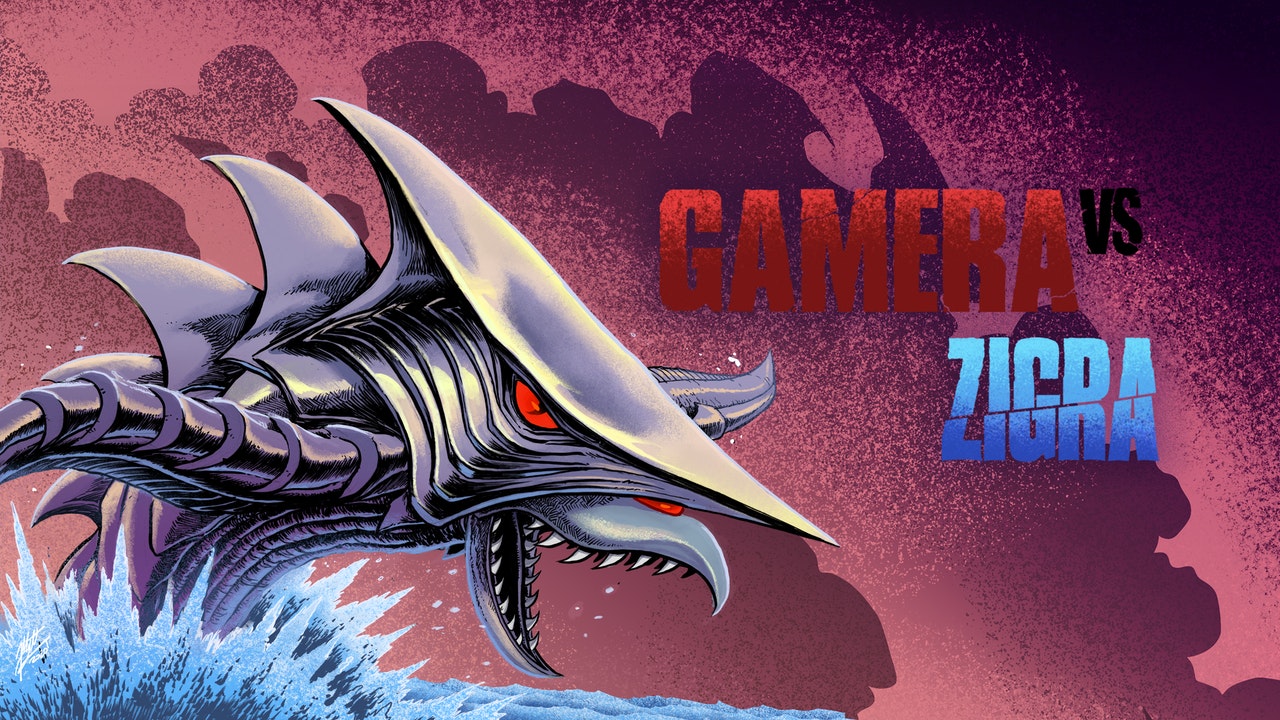
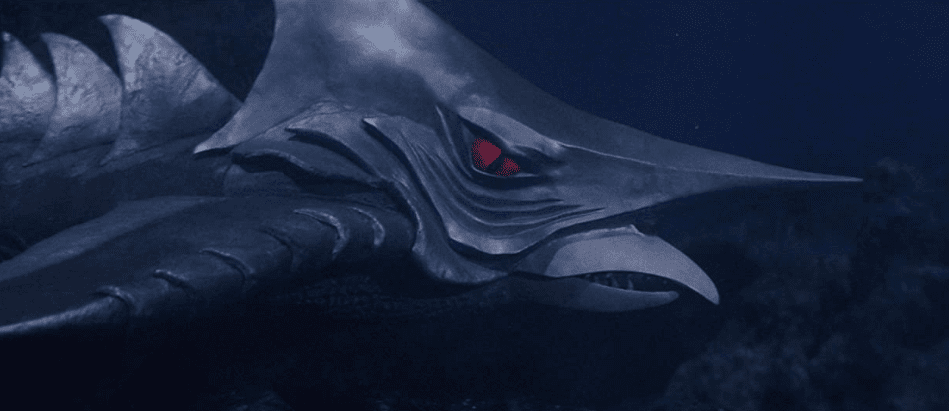
Zigra himself has a pretty interesting design, taking the form of a giant goblin shark. The suit looks pretty good, both on land and in the water, where he and Gamera fight. Some of the best moments for the monster are definitely when he’s on land, where he walks around on his tail, giving the creature an interesting look compared to a lot of other Kaiju. There’s one scene in particular where the shark design is utilised well as Zigra slices a ship in half; one of the few stand out parts of the piece.

Sadly, due to the relatively low budget of the film, neither Gamera nor Zigra get to really show off their stuff, and most of the fights happen either underwater or in sparsely populated areas. The large scale city destruction that has become a staple of the genre is missing, and its absence is definitely felt. But it’s not all bad. There are a few interesting moments, and a few fairly ridiculous ones too. At one point Gamera even plays part of his theme on Zigra’s fins whilst the monster is knocked down. It’s a bit too ridiculous, but you can’t help but be won over by it.

Whilst Gamera vs. Zigra isn’t technically the final film in the Showa era for Gamera, it’s the last entry in the original Gamera series, and is a poor note to leave on. The film was so unsuccessful that it didn’t reach the US until 1987 –  sixteen years later!


Buy Amy A Coffee

Go to Amy's Blog