Thursday, 14 January 2021

A Twist of Karma by Wendy Wanner - Blog Tour


'When a grieving mother turns to an ancient Buddhist ritual for solace and mistakenly awakens a vengeful spirit, dark karma threatens to destroy everything she holds dear….

'Struggling with depression after the death of her young daughter, Jennifer flees to a healing center in the Sri Lankan jungle. Encouraged to visit the local temple, she finds unexpected meaning in the beliefs of Buddhism. But it’s not long before she becomes entangled in the mystic—and dangerous—world of village folklore, and the slippery, transferable energy of karma.

'Still, the jungle works its magic, and Jennifer begins to recover. Returning to Santa Monica, she rebuilds her life through painting, even opening her heart to a new love. But when her deceased daughter appears begging for help, and mounting bodies baffle the police, she battles to repair the shift in karma and free her daughter’s soul.'

A Twist of Karma is one of those rare books that I really enjoy, where it makes you think that it's going to be one thing, but keeps changing gear and twisting genre until you're not sure what to expect anymore, yet don't care because you're just really enjoying the journey and don't want it to end.

The plot follows Jennifer, a single woman who recently lost her eight year old daughter to a tragic accident where she drowned in their back yard pool. As you can expect, Jennifer is something of a wreck when the book starts. She blames herself for what happened, and is deep into depression. She's sees the loss of her daughter as her whole world falling apart, and you can't really blame her for that. However, when the book starts she's set out to try and do something about this, having travelled to a healing and meditative retreat in Sri Lanka for a few months.

Over the first big chunk of the book we watch Jennifer as she tries to come to terms with her loss, and how finding the Buddhist faith comes to help her with this. We see her becoming more physically healthy, and more importantly, we see how the tenets of Buddhism help her emotionally. Her journey is so engaging that you begin to forget what the blurb of the book said, about the ghost of her daughter and police investigations, and just settle into this more personal and down to earth journey.

If this was all the book was going to be about it would have still been a great read, as there were parts of this section that really drew me in and made me invested in Jennifer and some of the other characters, to the point where I came really close to tears at one point. I didn't even realise how much the book was effecting me until it hit me hard with something upsetting.

However, the book is about so much more than this, so the last two thirds of the book changes things up as Jennifer returns to her home in Los Angeles, and we get to see her settling back into her old life, and bringing the teachings from Sri Lanka with her. Much like the first part of the book we spend a lot of time just seeing Jennifer interacting with the world around her, reconnecting with friends and family, going on dates, and returning to her art career. It's not until the first body turns up that things begin to take a twist.

When the murder plot came into the book I'd almost completely forgot to expect it, and it''s something that pretty drastically alters the course of both the book and Jennifer's life; yet it never breaks the narrative flow or feels out of place. This is also the same time that things start to begin getting very creepy, as Jennifer starts to have visions of her lost daughter, as well as a shadow figure.

Whilst the book never goes into full supernatural horror, something that I admit I was really hoping when I first read the description, it still manages to be quite chilling in places. I was hoping the book would lean into the horror more, but what we get instead is actually a lot better, it's a personal story that feels really grounded despite featuring spirits and murder because of it focusing so much on a very real, personal story about Jennifer and her loss.

I'm not going to talk too much about the latter parts of the book, because I don't want to spoil too much of the mystery or what happens, but the book did kind of go the direction I was expecting towards the end, yet still managed to throw a couple of curve balls in that took me by surprise and meant that I could never feel at ease with the narrative. There are so many twists and turns, and unexpected moments that I never got complacent, and was always excited to find out what was going to happen next.

A Twist of Karma managed to keep me entertained throughout, and I ended up reading it in big, long bursts because I wanted to know what happened next, and didn't want to put it down. I loved getting to know Jennifer and watching her journey. I look forward very much to seeing what Wendy Wanner does next.

Buy Amy A Coffee

Go to Amy's Blog

Wednesday, 13 January 2021

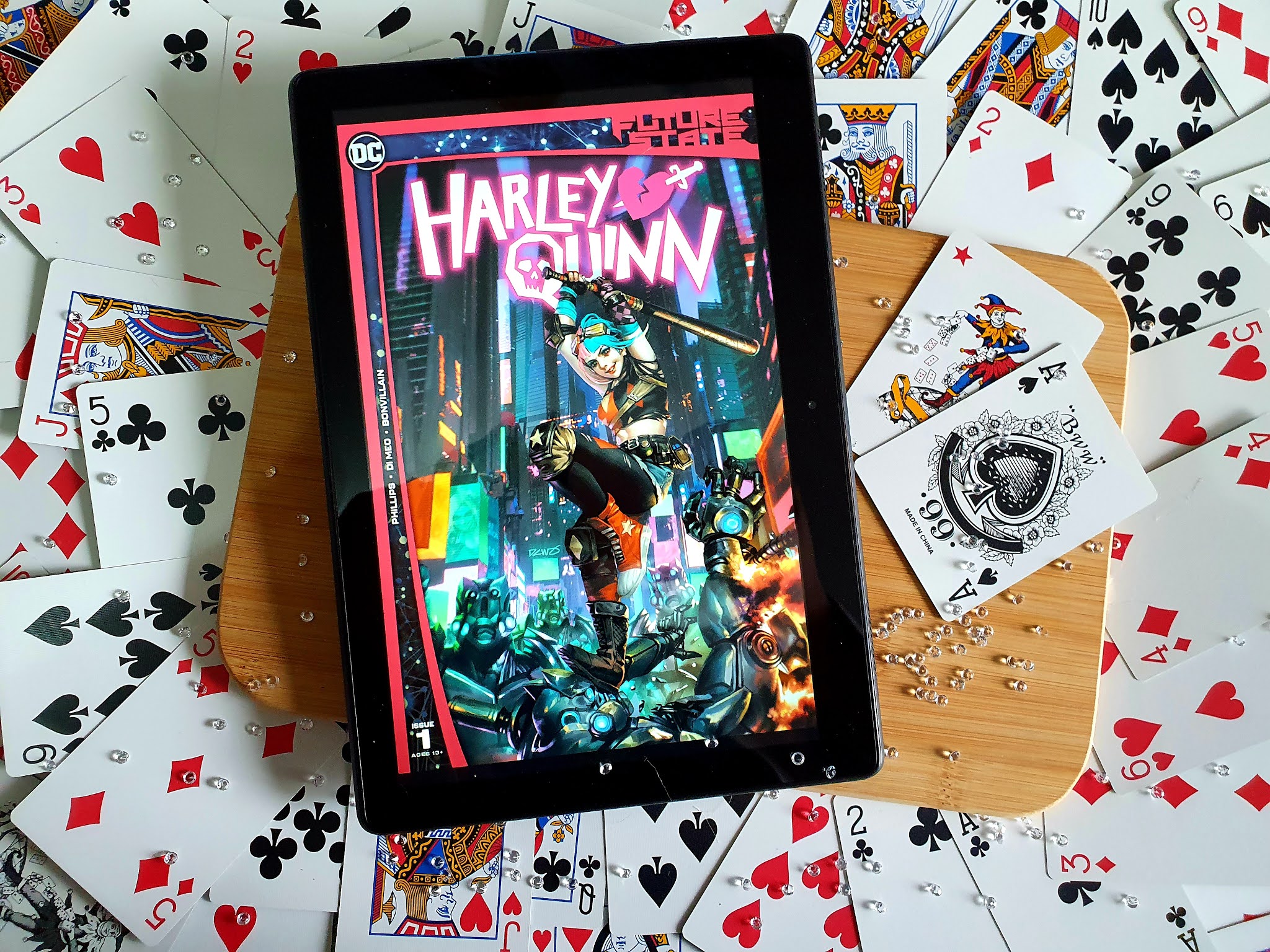
Future State: Harley Quinn #1 - Comic Review


Future State: Harley Quinn might be one of the prettiest books out this week from DC, with some absolutely gorgeous artwork from artist Simone DiMeo and colourist Tamara Bonvillain, but it's also the most engaging book that centres on Gotham City.

The story sees readers in a Gotham where masks have been outlawed, and the forces of the Magistrate are making it their mission to arrest or kill anyone in a costume, hero or villain. It's here that we see Harley Quinn get captured by the Magistrate's forces, and brought in to be questioned by Doctor Jonathan Crane, the former villain Scarecrow.

Having apparently been cured of the psychological trauma that made him act out as Scarecrow, Crane is now working for the Magistrates, using his background as a psychologist to hunt down the other costumed heroes from Batman's rogues gallery. However, rather than simply locking Quinn away he offers her the chance to do the same, to use her past as a psychologist to help him bring these criminals to justice, in exchange for a more comfy incarceration.

On some level the book feels a little like Suicide Squad, chiefly due to the fact that Quinn is being given a chance to make things better for herself by doing some good in the world. However, instead of this meaning that she will be going out into the field on missions, she's using her mind to come up with plan and tactics to capture other criminals. It's a neat twist on the formula, and one that shows that Harley is more than a costumed clown with a baseball bat, but an incredibly intelligent woman.

Over the course of the issue we get to see Harley help with the capture of both Professor Pyg and Firefly, and we learn a lot about those characters along the way. Harley goes into the minds of these criminals, explains what motivates them, what drives them to do what they do, and shows how you can use these insights to bring them out into the open so that they can be neutralised. We also learn that Crane's biggest goal is to bring down Black Mask, who's so far managed to avoid capture.


The book seems to be setting the stage for things to come, for future conflict between the forces of the Magistrate and Black Mask and his gang, yet manages to tell a pretty self contained and satisfying story as we watch Harley help to bring two of the city's criminals to justice. 

Stephanie Phillips really seems to know how to write Harley as more than an over the top, 'crazy' character, and walks that fine line where we can see the weirdness that inhabits Harley along side her educated intelligent side. It makes her feel like a more well rounded character, and someone who might be more of a challenge when she takes a step back and actually allows herself time to thin things through.

The book also looks gorgeous throughout, and there were times where panels felt more like they were frames lifted from an incredibly well polished and sleek animated movie rather than a comic, and the colour pallet and inclusion of things like lens flare here and there really add to that feel.

Out of all of the books from Future State set in Gotham City this is the most fun, and most engaging, one that actually did something interesting with its main character that didn't feel like a huge departure from their nature. I'm definitely interesting in seeing what else Harley will be doing in future issues, as well as seeing what happens next with Black Mask.


Buy Amy A Coffee

Go to Amy's Blog

Plainer Jane #1 – Comic Review


Originally published on Set The Tape


Starting a new comic can be a difficult and daunting prospect for a writer, especially for a book that isn’t part of a larger universe and can’t rely on excitement for existing characters to draw in new readers.

As such, authors of independent comics have to make sure that they deliver a stunning first issue in order to attract readers to stick with their books, and finding a great concept is a key part of that. This is something that writer David Wilburn seems to know is important, and has tried to deliver a comic that not only presents interesting and engaging characters, but a scenario that really grabs the reader’s attention.

Plainer Jane follows Jane, a school girl who’s drifting through her final years at school, unsure what she wants to do with her life. Presented with a number of options at career day, nothing really jumps out at her, so instead she turns to the thing that she would love to do – kill for money. Yes, Jane decides to become a killer for hire, even whilst still being a senior school student. Now that’s a plot outline that definitely grabs me. Wilburn presents it well too, having the book move around a lot using flashbacks in order to quickly draw the reader in with Jane on a job, before taking the reader back to explore her character further.

Whilst seeing Jane going around killing people, something she seems incredibly good at, it’s the exploration of the character and her decisions to become a killer that are the most interesting, and they take up most of the page count of the book. It would have been really easy for Wilburn to have simply focused on the action and gore, forgoing actually developing the character in favour of spectacle, but he made the bold decision to not make this first issue all flash, but gave it some real substance too, something that makes me a lot more interested in reading more of the book.

Whilst the cover of the issue is presented in full colour, and looks great, readers should be aware that the interior art is black and white, with the only colour used in the book being the red of blood, something that really makes the gory, violent moments stand out on the page. Whilst the artwork, provided by Wayne Lowden, is really nice, there were a few moments where I felt the lack of colour let the book down a little, particularly when Jane’s changing out disguises and wigs but doesn’t look too different, as I felt colour would have really helped this scene.

There’s also a moment where a character has her hair coloured black on one page, but seems to then have no shading on the next. This led to a little confusion if this was supposed to be the same character or not. Other than those couple of moments the book looks really good, and the darker, grittier black and white aesthetic adds to its down to earth feel.

If you’re looking for a new comic experience that’s different to the regular superhero fare, something that feels new in itself, and feels really British too, Plainer Jane is definitely worth checking out, and might just become one of your most anticipated books of 2021.

Plainer Jane #1 is out now from Broken Face Comics.


Buy Amy A Coffee

Go to Amy's Blog

Tuesday, 12 January 2021

Future State: Swamp Thing #1 - Comic Review


Some of the comics in the Future State series have been really dark in tone (and in the way they look too), and for me at least, the event has felt somewhat depressing. That being said, Future State: Swamp Thing is probably one of the most dark and depressing books yet, but is also one of my favourite.

This first issue transports readers to a future that's more distant than any of the other Future State titles, one where humanity seems to have died out and now plants have been left to rule the Earth in the ruins of our civilisation. Ruling over this group of humanoid plants as something of an ancient father/god figure is Swamp Thing, who is trying to find any signs of survivors of the human race.

The book follows Sampy and his children as they journey through the wreckage of New York, and then travel further north into the snowy wilderness, trying to see if there's any human life left on the planet. This is something that drives Swamp Thing, but seems to cause some divisions amongst this children, particularly the outspoken Indigo. 

These children make for a fascinating group, not only for their complex relationships with each other and Swamp Thing, but because of the small cutaways that take place throughout the narrative where we get these really cool anatomical illustrations of humanoid plants and Swamp Thing telling the reader the journey he went on to create these sentient plant people. 


These sections shed some light onto the complex journey that Swamp Thing has been through, and how difficult it has been for him to create these beings that inhabit the pages here here. It might be me projecting a little here, but these sections make me feel a little uneasy as they remind me a lot of Michael Fassbender's character of David in Alien: Covenant, and the strange experiments he was undertaking. 

This sense of unease and horror were there for me throughout the book, and as usual, Swamp Thing proves to be one of the best DC characters to tell a horror tale with. Where other Future State books felt weaker because of their darker tone this book felt all the stronger for it, and the incredibly distant future setting really helped with this. 

The book ends on a really strong note too, as Swampy discovers an actual surviving human, and learns about some really horrific stuff going on in what could be the last human colony. How this is all going to play out is yet to be revealed, but it makes for an exciting cliffhanger, and it turns Future State: Swamp Thing into the book I'm most excited to see an issue two of.


Buy Amy A Coffee

Go to Amy's Blog

Vic Lee's Corona Diary 2020 by Vic Lee - Book Review


'An extraordinary memento of a life-changing moment in history, artist Vic Lee’s visually stunning, graphic novel–style personal diary chronicles his experience of the corona-virus pandemic as it unfolded.

'With beautiful hand-drawn illustrations and typography, Vic Lee’s Corona Diary vividly captures what it was like to live through this unprecedented period. Listening to daily news stories, experiencing different ways of living and working as well as adapting to new and necessary social controls, renowned London artist, illustrator and storyteller Vic Lee documents the first six months of the pandemic in real time. An epilogue spread touches on the events of July, August and September.

'Reflect on and process the unforgettable events of the pandemic through an intimate account in images and lettering of the initial news from a place called Wuhan, Italy’s first cases then state of emergency, its spread across the world and the WHO’s declaration of a global pandemic, the lock-down and toilet paper shortages, the economic fallout, the unfathomable numbers of people dead, the immense gratitude to those on the front-line of the health services, the reactions and decisions made by leaders that would affect us all, the anxiety and isolation – all the twists and turns.

'While this work of art is a snapshot of one person’s experience, it conveys events experienced and emotions felt by billions around the world – a permanent record of a time we will never forget.'

Award winning artist Vic Lee brings readers a short graphic novel of his experiences during the year of 2020, a year where life changed in multiple ways as the deadly Corona Virus swept across the world.

Those expecting a traditional comic might be in for a bit of a shock by this book, because it's really quite different to many that I've read, where instead of the pages being separated out into panels that tell a story, it's more like the pages are murals, with some themes and ideas spreading over two page spreads.

Whilst this makes for a very different read, it also makes things a bit more difficult when reading it in a digital form, like I did. For single pages it's fine, but when the artwork is spread across two pages, and the messages it contains flows around the pages it can make it hard to follow when you're having to skip between two pages of art, scrolling back and forth. I'm not marking this against the book in this review at all, but I'm going to point this out to people so that you're aware of it before you go and grab a copy, and I'd advise you to try and get hold of a physical book in order to avoid some of the pitfalls that I went through.


Despite those small issues, the book itself is a very pretty thing, and the artwork is so different from what you find in a regular graphic novel. I can't really think of any other books that quite looked like this, and the stark black and white pallet really added to this. If felt less like a mass produced piece, and more like flicking through Vic's book, seeing the drawings he'd made with pen and ink. The style felt messy and flowing at times, yet always had a neatness and care to quality that it never looked like he'd lost control or just drawn thing because they could; everything on the page had purpose.

Vic is able to cover many of the major events of the last year, both here in the UK and around the world. He's able to capture the likenesses of world leaders and members of the British government so well that despite looking like slightly exaggerated caricatures you always knew who they were meant to be, and never felt unsure just what was supposed to be going on.

There are a few times in the book that things are written from a more personal point of view, and we get to see how Vic saw the pandemic, how he experienced lock down, or the times he saw people in the street not caring about safety or taking care. These were the better parts of the book, and the ones that held the most interest for me. The majority of the book, however, felt more like Vic simply just relaying a basic overview of what was happening in the world at the time. He talked about what major development happened on a certain date, or how the news unfolded, but didn't relate these parts to his own experience.

These segments often left me feeling a bit flat. Despite being presented in this intricate and interesting art form these were still all things that I knew. I knew when the lock down came into effect. I knew how the pandemic began. I knew how the government cocked it up. I knew all of this, this wasn't new information to me, and as such it didn't grab me. If I'd have been seeing how Vic processed this, how he felt when these events happened I'm sure the book would have grabbed me more, but it just felt like a list of dates and facts at the time. This approach might be fine for events that happened a long time ago, but when it's the same year I'm in now, and events I lived through, it felt like the least engaging way to convey this to me.

There's a lot of information in this book, presented in interesting ways. Some of it comes from a personal place, but sometimes it feels more detached and clinical. Because of that, I never ended up loving the book as much as I think I could have; but I do see how this book can go on to be received. This strikes me as a book that is interesting now, but will become even more so as time moves forward. I think that this is the kind of book that will be a useful way to get across some of the events of 2020 to people in the future, to people who are still to young now to fully understand just what's going on, or the global implications of these events. I think this is a book that will go on to become a valuable teaching resource in years to come, and is definitely one to keep an eye on.


Buy Amy A Coffee

Go to Amy's Blog

Monday, 11 January 2021

Future State: Wonder Woman #1 - Comic Review


Future State is an interesting new part of the DC Universe, giving readers a glimpse into the future of the comics, to what could be following the events of Death Metal and new versions of characters we all know and love, as well as some new heroes. One of these new heroes that immediately jumped out at me was Yara Flor, the new Wonder Woman.

Future State: Wonder Woman focuses on this new character, and frankly, out of all of the Future State books out this week is easily my favourite. Having the new Wonder Woman be Brazillian is one of those things that when you first hear it grabs your attention, why not have a new Amazon warrior come from the actual Amazon right? It gives an exciting new spin on the mythology, and this is  book really leans into.

The story follows Yara as she battles a Hydra deep in the forests of the Amazon, killing the beast so that she can use its horn to travel to the underworld so that she can free one of her Amazonian sisters from Hades. Aided by her Pegasus, Jerry, and a forest guardian spirit called Caipora, she travels into the underworld, but finds more trials awaiting her.

This issue sees a really cool blend of the Greek mythology we've come to expect from Wonder Woman books, whilst also doing new and exciting things by bringing some South America mythology into it too, chiefly in the form of Caipora, a childlike entity that we get to spend lot of time with in this issue. This mixing of mythologies and beliefs is done in a subtle way, and the book still feels like a classic Wonder Woman story, thanks to the inclusion of the Greek mythology too. This was a smart choice, as it means it hopefully won't discourage fans who really like the classic feel of Wonder Woman, yet gives people something that makes this feel like a fresh new book, and sets Yara apart from Diana.


I really enjoyed the books depiction of the underworld too, and the strange little creatures that work their actually made me chuckle out loud. Something about their weird little dudes made me think of Stitch from Lilo and Stitch, and their incomprehensible gibberish speech bubbles just sounded like his weird noises in my head. Joelle Jones has managed to craft something truly fin and interesting here, and it was these small funny moments that really won me over and made me invested in the book.

With so many of the books in Future State dwelling on the darker aspects of the DC Universe, and feeling really depressing because of this, it was really nice to have a book in the line that actually has a sense of fun and wonder to it, one that isn't always dark and dour, but is something that you'd actually want to read month to month as an ongoing.

Out of all of Future State released so far this is the best one, not just because of the interesting new characters, and the lighthearted nature of the book, but because it's the only one where I read it and thought 'yes, I want this to be a big part of the regular DC Universe'.


Buy Amy A Coffee

Go to Amy's Blog

Can We Talk About Consent? By Justin Hancock - Book Review


'What exactly is consent? Why does it matter? How can you negotiate your place in the world while respecting other people’s boundaries, and have them respect yours?

'Can We Talk About Consent? breaks down the basics of how to have healthy relationships in every aspect of life for readers aged 14 years and older. Consent is a powerful word, but not everyone understands exactly what it means. This clearly written, stylishly illustrated guide explains clearly what consent means and why it matters—for all of us. 

'With honest explanations by experienced sex and relationships educator Justin Hancock, children will learn how consent is a vital part of how we connect with ourselves and our self-esteem, the people close to us and the wider world. Readers will uncover how to develop and maintain relationships, how to manage and avoid negative relationships, and will learn more about equality and respect.

'Covers a broad range of topics, including: how we greet each other; how to choose things for ourselves; how we say no to things we don't want to do; communicating and respecting choices in sexual relationships; the factors that can affect a person's ability to choose; and how to empower other people by giving them consent.'

Consent is an incredibly important topic, and one that should be taught to all people, especially in schools where children and teens develop interpersonal skills that will stick with them for the rest of their lives. Unfortunately, I can't remember consent ever really being talked about when I was in school. Yes, there was the basics like 'rape is bad', but that's really just the tip of the iceberg when it comes to consent, and doesn't really cover how broad and important an issue it is. This is something that Can We Talk About Consent? is trying to address.

The book is aimed at the teen and young adult market, having been marked as suitable for 15+, and its written in such a way that it feels really easy to pick up and understand, and seems like the kind of book that would fit well in any classroom or school library. 

Justin Hancock has tried to make the topic as easy to understand as he can, and one of the ways that's been done is to relate consent to everyday scenarios and situations that young people will recognise. Not only does this help to make consent easier to talk about, as it's often included in conversations about sex, but also illustrates how consent matters in situations that don't have anything to do with sex. There's examples in the book how things as simple as greeting people ties into consent, and how the choice of shaking someones hand, giving them a hug, or not touching them at all falls into the conversation about consent, and how simple everyday interactions can force people into scenarios that they don't feel comfortable in.

The book acknowledges these situations in a number of ways, and often shows readers 'should stories', showing how things should be, but how that doesn't always line up with peoples lived experiences. These are incredibly useful moments, and helps to break down what could be something of an intimidating subject.

One of the things about the book that doesn't quite work for me, however, was the illustrations that accompanied the text. Now, there was nothing wrong with the quality of the artwork, and it was very well done, but the bright. bold, and sometimes simplistic images sometimes made the book feel like it was being aimed at a much younger audience than teens. There were times where the images bordered of humerus, and whilst this might make some people feel more relaxed about the subject they did sometimes make me feel like not enough weight was being given over to what's an incredibly important issue. And sadly I can't help but feel that the illustrations will put adult readers off the book, an audience who probably never had consent covered with them when they were the age of the book's target audience, and who could really benefit from this book too.

Despite these few small issues I found the book to be incredibly well informed, and it make a big and sometimes intimidating topic easy to understand. Like I said before, I can easily see this book being used as a teaching resource, and I think that that's where it will excel for sure.


Buy Amy A Coffee

Go to Amy's Blog

Sunday, 10 January 2021

Generations Shattered #1 - Comic Review


Generation Shattered was a book that had my attention as soon as it was announced. The idea of a team of heroes coming together from various timelines to battle a threat to reality itself just sounded like a DC version of Exiles, a book I love, so I was sold on the concept straight away; but the I saw the line-up for the team and it became so much more intriguing.

The story begins in the distant future, where Kamandi, the last boy on earth, is fleeing from a wave of 'goneness' that's spreading across the world, erasing everything it touches from existence. Rescues at the last second by an elderly Booster Gold and Skeets, who is now a snazzy gauntlet like device that you can wear, Kamandi is sent back through time with the android to recruit a team of heroes to stop this wave from erasing every period of history.

Over the first half of the book we follow Kamandi and Skeets as they try to recruit an army of heroes, something that proves harder than expected as the nothingness wave keeps erasing times and places, and Kamandi makes a few wrong rescues along the way. However, over the course of his travels Kamandi is able to recover seven others to help him on his mission, Super-boy from his time with the Legion of Super Heroes, Starfire from her early days with the Teen Titans, Steel from the Reign of the Supermen era, Booster Gold from when he first came back in time to become a hero, Doctor Light shortly after she became a hero during the first Crisis, Sinestro when he was still a Green Lantern, and Batman from his very first appearance in 1939.

This probably isn't the kind of team that most people would build if given the free reign to do what this book does, and certainly isn't what I'd come up with, but it definitely makes for a very interesting group of people. We have a Batman who is straight out of the pages of his very first appearnace, who's a fish out of water because he's used to the technology of the 1930's. There's a Sinestro who is still a hero, though probably still battling with his own internal demons and his mistrust of the Gauradians of the Universe and their way of doing things. Starfire is still new to Earth and hasn't yet made those friendships and connections that helped to ground her to life on our planet. Booster is an arrogant dick who's only around to make a name for himself and become famous, and isn't the selfless hero that he will one day become.


This is a team of people who are new to what they do, who are heroes, but are inexperienced and unsure, who haven't grown as people, and whilst this means that they might not be the best group of people to set out to try and save reality itself, it does make for some interesting moments.

Sadly, we don't get much time to slow down and really spend time with the characters, despite the issue being 80 pages long. So much of the bulk of the issue is spent with Kamandi gathering his team, and then once they're together they're quickly beset by the villain. Despite the length of the book it really doesn't feel like an 80 page read because of the pace it moves at, and you'll end up getting through it much faster than you realise. Whilst this is good in some ways, as it makes the story move with a sense of urgency, it does leave it feeling lacking in the character development department; but hopefully this is something that will be given more time in later issues of the story.

The book has three writers working on it, Dan Jurgens, Andy Schmidt, and Robert Venditti, and you don't really get much sense of who wrote what parts of it, probably in part due to the fast pace of the narrative. But the book also has twenty artists working on the book. At first glance this seems pretty extreme, and you'd think that this would make the book feel unruly or hard to follow, especially as some of these artists have very different art styles, but the book uses its artists well. Every time the book moves to a different era to see different heroes the art style changes, both to signify that these are different places, but also to act as a nod to the art styles of the times these eras were set. The art styles suit the places where they are used, and really helps to sell the idea that we're travelling through multiple times and places.

Generation Shattered proves to be something of a love letter to the history of the DC Universe, and takes readers on a breakneck roller coaster ride across the comics of the past, filled with nods to things that readers will love. However, its fast pace does act a bit to its detriment as we're never given a chance to slow down and appreciate what we're reading, or to see the characters do much; but as the start of something it's a hell of a first issue, one that definitely gets you pumped to see what comes next.


Buy Amy A Coffee

Go to Amy's Blog

Goosebumps: Secrets of the Swamp #4 – Comic Review


Originally published on Set The Tape


Thanks to stunning revelations in the last issue of Goosebumps: Secrets of the Swamp, and a cliffhanger that promised excitement to come, I’ve been eagerly awaiting this issue, and the team on this book have certainly not let me down, delivering what might be one of the best issue of Goosebumps yet.

Thanks to the werewolf’s secret hideaway having been discovered by the vicious wolf hunters in the final moments of the last issue, the heroes of the book are facing some serious danger here, and it’s up to Bree to step up and take responsibility for her part in things. I won’t say what she does, because seeing her come up with a plan is a good portion of the fun of this issue, but I will say that her decisions are a brilliant character moment for her, and really feels like it’s what the whole series has been building towards.

Having spent all her free time fighting monsters in video games Bree is having to face the reality that not only are some monsters real, but they can be good people. This change to her world view could have rocked her to her foundations and left her unable to do anything, but instead she gets to step up and prove herself. It’s a wonderful moment of development for her.

As normal, the art provided by Yasmin Florez Montanez is simply gorgeous, and really makes the characters come to life, especially the werewolves. Whether they’re in their human form or their wolf form they’re all instantly identifiable, and they all stand out from each other and look unique; where it could have been easy for her to simply make generic werewolves that all looked the same she took the time to give each of them character. The panels where they’re mid-transformation, with fur growing out of their skin and their limbs changing shape, are some of my favourite parts of the book, and she manages to make these mid-transformation moments bold and striking.    

Where other Goosebumps series have ended with their third or fourth issue this story is getting to continue, and I’m so grateful for that. I’m excited by the way this issue ends, and am really looking forward to seeing what comes next. Hopefully the book will get more than five issues too, as I’d love to spend more time with these characters, and feel that this is one of the stories where writer Marieke Nijkamp could really deliver some great moments if allowed the space to spend time with the characters and develop them out even more. Whether or not the next issue is the last it looks set to be an explosive one.


Buy Amy A Coffee

Go to Amy's Blog

Saturday, 9 January 2021

Star Wars: The High Republic #1 - Comic Review


The High Republic has been coming for a while now, teased with some amazing artwork and brief glimpses of the story, this new age for the Star Wars universe has been one of the more anticipated parts of the franchise for a while now, and this month it finally arrives. As well as Light of the Jedi, a new prose novel by Charles Soule, readers also get to step into this new era in comics too, with Star Wars: The high Republic #1, written by Cavan Scott.

This first issue introduces new readers to the Stalight Beacon, a huge space station built by the Republic in the outer rim of the galaxy in the wake of The Great Disaster. The station will act as a beacon to those in this distant part of the galaxy, and will hope to bring the light of the High Republic to these remote systems.

We're also introduced to a number of new characters, the main one being Jedi Padawan Keeve Trennis, a young woman who has travelled to a remote planet with her master, the Trandoshan Jedi Sskeer, to perform her trial in order to prove herself ready to become a fully fledged Jedi Knight. Unfortunately, thing's don't go quite so smoothly for her, as disaster strikes the planet and its inhabitants.

Scott drops readers into a first issue that already has a lot of backstory to it, thanks to the aforementioned novel Light of the Jedi, and we see the High Republic dealing with the fallout of the events of that book. Despite this being a follow on from what came in that book it never feels absolutely necessary that you have to have read it going into this issue, and despite all of the stuff that's happening it feels really easy to slip into this new place, with these new characters. There are mentions of things that came before this, but the book manages to give enough context to those events for new readers to be able to follow along, without it feeling like he's going out of his way to explain things. It's very natural feeling, and because of this we're never bogged down in trying to catch up if you've not read the novel yet.

The book manages to balance the world building and construction of this exciting new era with characters and action really well too, and an issue that could easily become bogged down in world building and scene setting is actually a really fun adventure story too, one where we get to see Keeve shine, and she quickly becomes a character that you'll like and want to spend more time with.


There are a number of characters like this in the issue, people like Sskeer, who ends up becoming one of the more mysterious and intriguing characters by the end of the issue, and Estan Maru, the Jedi who seems to be juggling a lot of balls by acting as a facilitator on Starlight, keeping track of everything that's going on. Both of these Jedi really fascinated me, and I'm hoping that they both get more of a chance to shine in upcoming issues of the series. The High Republic also features, briefly, a very recognisable character in the form of Yoda, who is much younger here, and not on the Jedi Council. Seeing just one familiar face in this new time really helped to ground the book, and reassure that this is a part of the ever expanding Star Wars universe, and it really helped to make this book feel like a part of the franchise even when doing bold new things.

The artwork for the issue is provided by Ario Anindito, Mark Morales, and Annalisa Leoni, and it all looks gorgeous throughout. The three of them really help to sell the idea that this is the Republic, and the Jedi, at their height, and the Starligh Beacon and its inhabitants all look grand and elegant, and have a sense of beauty and wonder to it that is sometimes missing from later eras of the Star Wars franchise. It wasn't until I came to look at the people working on the book come having finished reading it that I even realised that there was more than one artist on the book, because the three of them work so well together that it all flows beautifully together. Sometimes when a book features multiple artists it can be really obvious where the change over happens, and it can throw you out of the book, but that was never the case here; the whole thing looked wonderful.

If this first issue is any indication of the quality of the series going forward then this is one of the most exciting and engaging parts of the Star Wars universe in a long time, and one that holds so much promise. This is a time and place where anything can happen, where any type of character can turn up, where any of the heroes could die, and where some true wonders can happen. I can't wait to see what happens next!


Buy Amy A Coffee

Go to Amy's Blog