If you asked people to list their favourite Arnie films I’m pretty confident that Total Recall would wind up high on most of those lists. There’s a point in his career where his films were definitely a bit dodgy, but Total Recall falls in that golden period between things like Predator, and Terminator 2, where he was definitely at his best. Despite the amazingness of the film we ended up with, the movie actually went through a bit of development hell.
Originally adapted from the Philip K. Dick story ‘We Can Remember It For You Wholesale’ by Dan O’Bannon and Ronald Shusett, the guys who created Alien, the film bounced around between directors and actors for decades before finally being made. David Cronenberg and Dino De Laurentis were set to direct at certain points, and the film had Richard Dreyfuss, William Hurt, and even Patrick Swayze set to star in the lead during the development. Eventually the film landed with Paul Verhoeven, who was still celebrating success from Robocop. Together he and Arnie would make a film that would become a classic.
Set in 2084, the film follows construction worker Douglas Quaid (Arnold Schwarzenegger), who really wants to get away from it all and have a vacation. He’s been dreaming of Mars and would love to visit, but his wife is set against it. Instead, he opts to get memories of this dream holiday implanted into his head. He decides to spruce things up, however, and opts for the spy package, where he’ll get memories of travelling to Mars to save the planet and beat the bad guys. When they go to implant these memories, however, they discover that Douglas Quaid is a false memory, and that he’s on the run from a mega corporation on Mars who wants him dead. With his cover blown Douglas has to travel to Mars to find out who he really is, and stop the bad guys from killing him.
The film is very much a fish out of water style story, with Doug being an average construction worker suddenly thrown into a world of corporate espionage, murder, and revolution. And the film really leans into the weirdness too, throwing alien ruins and psychic mutants into the mix. This, along with Quaid never being sure if his memories are real, or if he’s even stuck in a delusion, make it a bit of a trippy film at times. There’s even some discussion as to whether or not what we see happening is even real as the man selling Doug his memories basically outlines the plot, and we see the alien ruins and Melina (Rachel Ticotn) on one of their screens. I’ve seen this film dozens of times myself, and still don’t know where I stand on if it happened or not.
I think this is one of the reasons why Total Recall has endured as one of Arnie’s best movies. It has the cool action sequences and cheesy one-liners that fans come to expect, but it also gives you room think about the plot more, you get to discuss the story with people who have differing interpretations, and you can go through and analyse small images or snippets of dialogue from the start of the film and see how they play in to the whole.
The film might not be one of Arnie’s most memorable ones next to things like the Terminator franchise, but I think it’s definitely one of his most interesting films, one that can satisfy both the deeper thinkers and analysers, as well as those just coming for silly action.
Sherlock Holmes is one of the most famous literary characters in existence, and considering that he’s just a regular man, is incredibly recognisable no matter who is playing him. You could stick a deerstalker hat and magnifying glass on a bare shelf and someone would look at it and say ‘oh, Sherlock Holmes’. With how iconic the character is it’s no surprise that a new adaptation comes around every decade or so, but none have quite taken the world by storm the same way that BBC’s Sherlock did back in the summer of 2010.
The series came about during a conversation between long time friends and creators Mark Gatiss and Steven Moffat, who were on a train together at the time. The two of them talked through their love of the books, and the different adaptations that had been made over the years, and thought that it could be fun to try and update the classic Victorian tales for a modern world.
They pitched their idea to some BBC executives, and were given the go ahead to make a 60 minute pilot episode. The series cast Martin Freeman as John Watson, who was probably best known for The Office at the time, and the relatively unknown Benedict Cumberbatch at Sherlock Holmes. Whilst we can now look at this casting as something good, at the time people couldn’t believe that the BBC were spending so much money on a series with two ‘nothing’ actors. But more on the actors later.
The Sherlock team produced an hour long pilot episode loosely based on the first Sherlock Holmes story, ‘A Study in Scarlet’. This episode is still available on the series one DVD, and is well worth the look because it’s probably the best version of Sherlock around. Based on the strength of this pilot the series was green-lit, but with some slight changes. The show was only going to get three episodes, but each would be 90 minutes long. This is where the series began to run into problems.
The first episode was entirely re-shot, both to account for the new run-time, and to make use of the bigger budget available. The episode was padded with some unnecessary scenes, like the introduction of Mark Gatiss’ Mycroft Holmes to try and make some mystery and potential conflict that went nowhere, and to shoehorn hints of Moriarty (Andrew Scott) into the episode. Despite these changes, the first episode of the series, ‘A Study in Pink’, is still probably the best episode of the entire show, because it’s the closest to what Sherlock Holmes is supposed to be.
The first episode shows Sherlock being given a mystery and actively trying to figure out who the killer is. He makes mistakes along the way, letting the killer go at one point because he’s operating under a false assumption, but ultimately we see a little of how he does things. He picks up on small clues and uses his vast intelligence to try and make deductions.
However, as the series goes on this begins to fall by the wayside, and Sherlock solves mysteries because he just knows everything. He gives us the answers, sometimes without telling the audience how he reached those conclusions, and at other times having used information that the audience were never given. Mysteries are supposed to be fun because they give the audience the chance to try and work things out, but Sherlock seemed to forget that as the first series went on, instead making it more about how amazingly smart the lead was. And boy was that an issue by the time they got to series four.
This isn’t the only major problem with this first series, however. There’s also Moriarty. Professor Moriarty is one of the greatest and best known literary villains of all time. This is despite him only ever appearing in two stories. Gatiss and Moffat try to force the character into every episode of series one, though, having him pulling the strings behind everything just to mess with Sherlock it seems. That’s despite him making a point of saying he doesn’t want Sherlock getting in his way. There’s a huge inconsistency to the character in the way he’s written. They’ve turned a calculating genius into a bit of an idiot. And dear god, talk about queer coding. I’m not bashing Andrew Scott here, as he’s a good actor who was only doing as he was told, but the sheer amount of camp in his performance is so over the top it becomes both distracting and insulting.
I’m sure this is the point where you’ve either switched off or are just grumbling at me for writing about a series I’m not a fan of. But I am a fan. I like this series, to a point, and adore Sherlock Holmes in general. My biggest issue is that the series was run by two people who just don’t seem to understand what makes the characters and stories great, and just wanted to show how clever they are.
The series isn’t completely bad though. They have some great production values and do some very clever things with presenting information to the viewer, such as having text messages flash on screen or displayed on a part of the set rather than cutting to a phone. Yes, the show got more extreme with this as time went on, but series one has a great balance and uses it well.
Sherlock also gave us Una Stubbs as Mrs Hudson, who is hands down the best version of the character ever put to film. Yes, she has moments where she gets a bit silly (looking at you again series four), but for the most part she’s a great mother figure to the two man-children that are Sherlock and John. She’s also the member of the cast who was best known when the show came out, and her casting definitely helped get the series some attention.
Despite some of the issue that I’ve covered here, series one of Sherlock took the public by storm, and made it one of the biggest hits the BBC has ever had, as well as making the series’ stars into hot commodities. I’m confident in saying that Benedict Cumberbatch wouldn’t be a household name without this series.
Yes, it’s flawed, and the flaws here become huge problems later on, but series one is still the best the show ever was, and has some genuinely good moments in it too. If you haven’t already seen it, I hope that this article doesn’t put you off, and that you’ll go give the show a go yourself.
'Georgia has never been in love, never kissed anyone, never even had a crush – but as a fanfic-obsessed romantic she’s sure she’ll find her person one day. As she starts university with her best friends, Pip and Jason, in a whole new town far from home, Georgia’s ready to find romance, and with her outgoing roommate on her side and a place in the Shakespeare Society, her ‘teenage dream’ is in sight.
'But when her romance plan wreaks havoc amongst her friends, Georgia ends up in her own comedy of errors, and she starts to question why love seems so easy for other people but not for her. With new terms thrown at her – asexual, aromantic – Georgia is more uncertain about her feelings than ever. Is she destined to remain loveless? Or has she been looking for the wrong thing all along?'
I'm not normally one for literary fiction, I normally like something a little fantastical to be a part of the books I read, and I don't really read much queer fiction, despite being quite gay myself. But there was something really special about Loveless that made it really hard for me to put down.
One of the biggest appeals of this book was the subject matter, not necessarily a young queer girl going to university and discovering their sexuality, because that's not too uncommon; instead, it's that the book gives representation to asexual and aromantic people. This is a part of the LGBTQ+ community that are often not given a voice, and in some cases are even denied their identity actually existing. My computer has even tried to get me to change aromantic to aromatic.
I know some people who fall into these categories, some of them are people that I love, and it's so good to get to read a book that gives this community a chance to take centre stage.
The story follows Georgia as she and two of her best friends, Pip and Jason, move to Durham University. Georgia has never kissed anyone, and is plagued by this. She thinks that there must be something wrong with her, and really thinks that she should be in a relationship or in love because shes a big fan of love stories, but nothing ever feels right to her. She tries to kiss her 'crush' on prom night and the result is pretty spectacularly disastrous to say the least.
With the help of her friends and her outgoing room mate Rooney, Georgia tries to explore her sexuality and discover if dating and relationships are really right for her. As these are teenagers, there is of course a lot of drama involved, and things don't always go well for the group, leading to misunderstandings, arguments, and break ups.
Despite this, Georgia makes a new friend, the head of the Uni's Pride Society, and learns more about asexuality, and more begins to make sense to her about her life. Now Georgia has to learn to come to terms with her sexuality and her worries about her future, whilst repairing her friendship circle.
Loveless is full of drama and teen angst yes, but it's way more than that. It's about love. And whilst there is a sapphic enemies-to-lovers romance in here, it's not about romantic love. The book makes a big, clear point that platonic love is a real, important thing. The love that you have for your friends is real, and it matters. It might not be the same as love for family, or love for a romantic partner, but it can be just as strong and just as meaningful. This is an important thing for aro-ace people, and it's a big part of Georgia's journey in the book, but it's something that applies to everyone.
The book shows the reader through Georgia how important love is in all of its forms, and that you should never feel ashamed or weird for saying that you love your friends. Friendships can be so powerful and important, and you should be able to tell your friends that you love them dearly. Loveless is about learning to discover your true self, but also learning to not be afraid of your future or trying to force your life to fit the shape that society says it should. It doesn't matter if your life and your love isn't what society demands it should be, what the boring straight cis people would call 'normal'. We're all amazing and wonderful, our lives all matter, and everyone deserves to finds happiness in whatever form that takes.
I'd never read Alie Oseman's work before, but am definitely planning to read more of her stuff now. I'm going to be recommending this book to so many of my friends, especially the queer ones. And I hope that this kind of story becomes more common, that aro-ace people aren't a rarity in fiction, and that their stories aren't about having to 'fit in' or being 'fixed', but them just getting to live their own lives. This is amazing queer content, and I absolutely adored every minute of reading it.
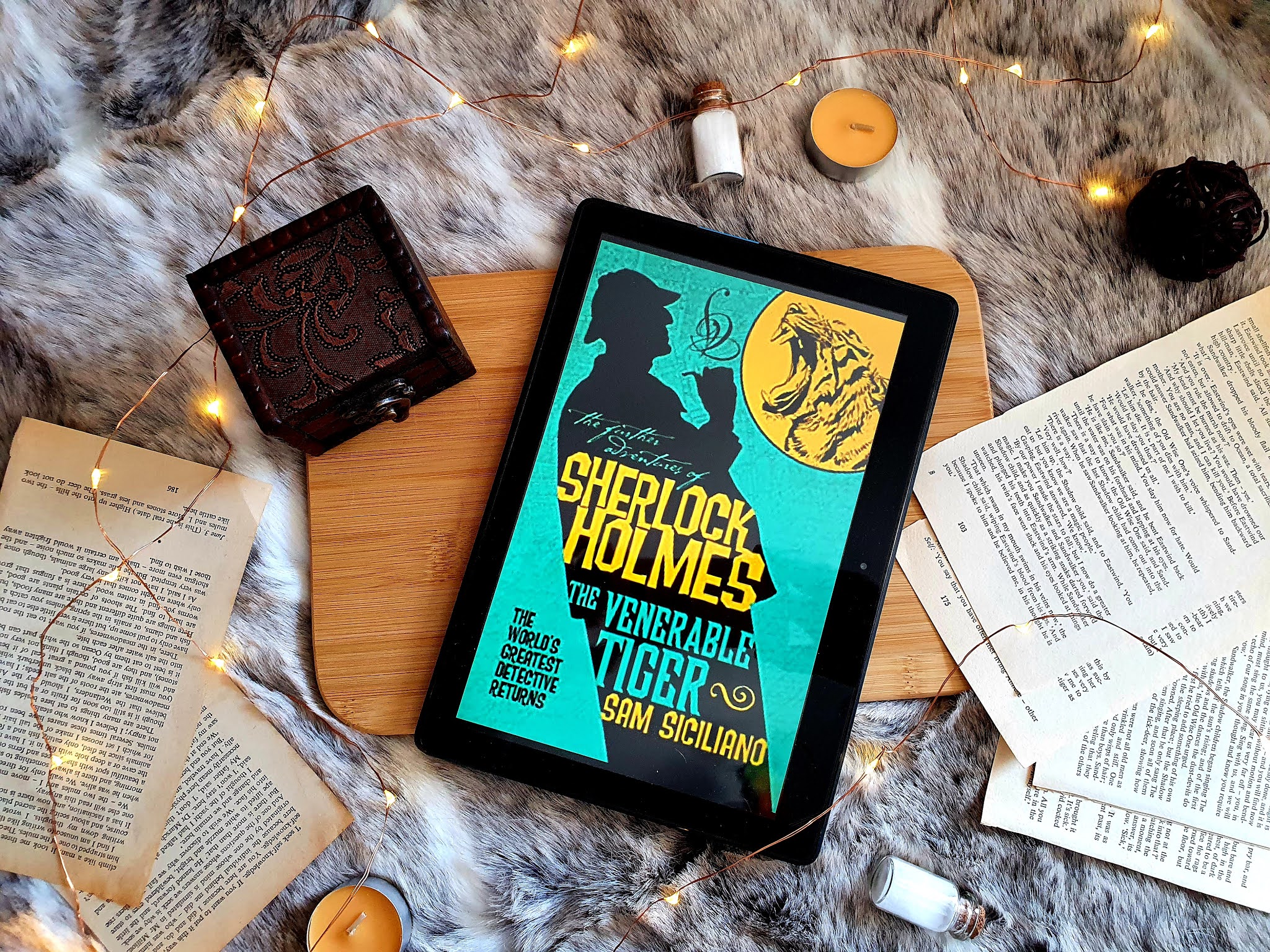
'Sherlock Holmes acquires a new client when a beautiful young woman, Isabel Stone, faints on the steps of his Baker Street rooms. She has come to beg his assistance in reclaiming some priceless jewels kept from her by her tyrannical stepfather, Captain Grimbold Pratt. But shortly after agreeing to take her case, Captain Pratt comes to Baker Street, not quite so tyrannical as Isabel would have them believe. Holmes and his cousin, Dr Henry Vernier, must unravel a tense family mystery dating back to the Indian Mutiny, where neither of them is sure who to believe… '
Quite often I find myself thinking about what makes a good Sherlock Holmes story. Obviously there's the need for a good central mystery, these stories are mystery books after-all, and Sherlock Holmes without a case to solve is often something that's best left alone. There's also the need for a good grasp of the character, you need to understand why Sherlock and Watson are iconic and popular figures and bring some of that to the work. And one that I personally like, is does it feel like it could be put on television? Any Sherlock Holmes story that captures the feel of the Jeremy Brett television series from the 1980's and 90's is always going to win me over very quickly, and this is what happened with Sherlock Holmes: The Venerable Tiger. I could really picture the iconic Holmes actor walking around this vast country estate, interacting with tigers, and the over the top host, and it made me really enjoy the book even more.
Sherlock Holmes and the Venerable Tiger sees Holmes and his cousin, Doctor Henry Vernier, being presented with a potential case when a delicate young woman Isabel Stone arrives at 221B Baker Street, literally fainting into Vernier's arms when she gets there. She informs the detective that she's lost her fortune, and needs his help to get it back. Her father was one of three men who returned from military duty in India with a cash of jewels worth a fortune. Her father passed away, leaving the riches to Isabel and her mother, who married a friend of her father, Captain Grimbold Pratt. Now her mother has died too, and Grimbold refuses to give Isabel her inheritance.
Whilst Holmes doesn't seem initially interested in the case, but when the huge and imposing Grimbold arrives and threatens Holmes and Vernier the case sparks something in the detective and he agrees to try to get to the bottom of things. He and Vernier travel to Grimbold's estate, where they find even more mystery, and a host of exotic animals waiting for them.
One of the best things about this book is the relaxed nature of it. This isn't a murder investigation, there's no rush to find a killer before they strike again, so there's no real haste to the events. Holmes and Vernier take their time in trying to figure out what's actually happening, which gives readers a lot of time to get to know the characters, especially Grimbold. Over the course of the book the grouchy old military man goes from a potential antagonist to a brusk but lovable figure. He warms to the investigators, and we see that despite his outward appearance he's actually quite a generous and kind host; and one with some hidden depths.
The characters make more than one visit to the estate, and it feels more like they're on holiday more than an active investigation. Which suited me absolutely fine. There were times where I'd become so engaged in seeing the characters just spending time together and getting to know each other that when something happened to move the case forward it would take me a little by surprise, having forgotten the real reason they were there.
That's not something bad though, it's not like the main plot takes a back seat, as when you look back at it it's pretty clear that Holmes is constantly picking up on things and digging for information. It's a very subtle way of investigating that not every Holmes writer is able to make work, but Sam Siciliano does so perfectly here. He has such a good grasp of Holmes and his methods that even as a reader you forget that Holmes is constantly digging and solving the case, being fooled by Holmes just like the characters.
Speaking of the characters, even though Grimbold is the stand out character there's a lot of great characters that come in and out of the narrative, all of them first appearing to be one thing, but turning out to be something more. None of the characters are two dimensional, they've all got layers to them that a lot of side characters in Holmes fiction don't get. Each of them is interesting, and I always found myself wanting to be spending more time with them. If I had to find any fault with the book it was that it wasn't longer, because I'd wanted more time all of these people.
The central mystery has a pretty satisfying conclusion, and there are enough hints laid throughout that you can figure out much of what's happening if you put your mind to it, which is a good thing. There are times where Holmes will pull out a piece of information that the audience isn't privy to that changes the whole case, but Siciliano doesn't really pull this kind of cheap trick, instead allowing the reader to play detective too. There are a few things that are a little predictable, but these moments never feel cheap of lazy, and its always satisfying to see something you've guessed being proven right.
Overall there's a huge amount to love about this book. The characters are some of the best I've read in a Sherlock Holmes story, and I left the book with a huge smile on my face and the desire to read more about them. It kept me entertained throughout, and I never wanted to put the book down, instead wanting to read more and more even when I had other stuff that I needed to do. Easily one of the best Sherlock Holmes pastiche novels on the market. I'm hugely excited to see more of what Siciliano does with these characters.
'The moon has always been with us -- tempting us, enticing us, and enthralling us through the ages. Here you'll find thirteen stories involving this heavenly body -- sometimes tragic, magical, and other times mysterious, or horrific, but always, memorable.'
Moonlit Dreams, Moonlit Nightmares is one of the more interesting anthology books that I've read. Most anthologies have a theme that connects them, even if it's something as basic as being the same genre. This book is connected by the moon, and the stories within its pages are so varied in style and genre because of this that it makes for such an interesting and eclectic collection, one that I really enjoyed reading.
'A Consultation by Moonlight' by Thomas Vaughn is the first story in the book, and has a very dark tone. It follows a group of Roman politicians who have travelled a long way to talk to a witch, a woman who has the ability to glimpse into the future, so that Clodius can find out if he will come to rule the empire. The tale takes place in a creepy graveyard on a moonlit night, and is full of atmosphere and horror. The story builds up with a slow sense of dread, before it devolves into full horror. The story is great for setting the tone for the rest of the book, letting the readers know that they should expect stories that will take you by surprise, and go to some dark places.
'A Visitation' by Parineeta Singh is also a horror, but takes a more subtle approach, and doesn't rely on some of the shock and gore that the previous story does. In the story flora is a young woman who has travelled to spend Christmas with her boyfriend and her family, but because her partner is a bit shit, she has to find a hotel to stay in. She finds the Bull's Eye, a small hotel, and begins to see a strange spectral dog in the lounge area night after night. Flora begins to doubt her sanity, questioning if what she's seeing can really be true.
Lori Tiron-Pandit's 'Receiving Room' is a hugely fascinating story. It's presented in the form of a journal that logs a series of dreams that a young woman is having about her recently deceased friend Margo. Margo had been struggling with mental health struggles for years before she passed away. Over the course of these journal entries we learn more and more about Margo and her life, as well as getting a hint that something isn't quite right about the dreams being recorded on these pages. Each dream gets progressively darker, moving closer and closer to nightmares, and begins to hint at something dark on the horizon. It's a story that will definitely stick with you once it's done.
'The First Victims Club' by Shaun Avery is a very different feeling story, one that takes a strange and unique take on the classic slasher horror story. The story follows Greg, the victim of a vicious killer who wakes up in an afterlife where he and other 'first victims' have been brought together to view events back on earth following their deaths, allowing them to see how things have continued without them. Greg finds out that his girlfriend, Sindy, has turned Greg's death into something that she can profit from, and has made Greg into a villain. Alongside another first victim, Arabella, Greg must find a way to save his mother's life, and bring Sindy down. The story is so different from others in this collection, and takes such an interesting approach to death and the afterlife that it really stands out as something fun and different.
'Todd P. Taylor's 'The Experiment' is a particularly dark tale, one that sees the narrator becoming obsessed with a homeless man that he nicknames 'The Ratman'. The narrator decides to see how the homeless man will react to being left food, and devises a little experiment that he can perform. I won't say too much about what else happens in this story as it will spoil things, but I will say that the events are certainly disturbing. It's probably one of the darker and more upsetting of the stories because it doesn't rely on the supernatural like most of the other tales collected here, but is very grounded in the real world. The fact that a lot of this story could actually happen makes it scarier.
These are just some of the stories available in this collection, and show off the variety of stories that the book represents. Whether you're into stories that will make you think, that explore insanity and the extraordinary, or stories about ghosts and killers, Moonlit Dreams, Moonlit Nightmares will have something that will appeal to you, and a number of stories that could surprise you too. A brilliant anthology with something for everyone.
Bloodstone is the latest eighties’ release from Arrow Video that’s making the leap to Blu-ray for the first time, giving a whole new audience the chance to see it. Set in India, the film follows newlyweds Sandy (Brett Stimely) and Stephanie (Anna Nicholas) as they travel by train. They’re joined on their journey by a man who’s transporting the famous Bloodstone, a giant ruby that was taken from India by the British in the 18th Century, but was recently stolen. At the train station, the ruby is slipped into Stephanie’s bag to get past the waiting police.
Both the newlyweds, and their taxi driver Shyam (Rajinikanth) are targeted by criminals who want the Bloodstone. When Stephanie is kidnapped, Sandy and Shyam must work together to try to save her.
The basic concept for the film is pretty good, and whilst it has some slight ridiculousness to it, it’s the kind of misunderstanding or someone’s after the mcguffin type plot that’s been done countless times. What makes Bloodstone stand out, however, is the fact that it’s a joint venture between American and Indian production teams. Whilst this means that the film has a very different look and feel to other 80’s action fare, it also has a very Indian film style about it too (which the film’s extras do go into a little).
This is somewhat evidenced by the fact that the film’s biggest star is Rajinikanth, who plays Shyam. Rajinikanth was a huge star in Tamil cinema at the time, and still works to this day. With over 200 acting credits to his name, as well as a number of action roles, he was a big draw for Indian audiences. In the interview with producer and co-writer Nico Mastorakis, he talks about how crowds were so big when Rajinikanth was on set that there was even an accident where people caused a house to collapse. The film comes with a video essay about him, and it’s one of the most interesting parts of the set.
The extras prove to be more interesting than the film itself for a lot of the background details they included. I spent most of the film thinking that something about Brett Stimely’s voice sounded off, only to find out that they’d completely re-dubbed him with David Soul from Starsky and Hutch to make him sound more rugged.
Sadly, the film itself didn’t entertain as much as the extras did. The plot seemed to meander around a lot, and the story felt like it could have been tightened up a lot more, and the action sequences never really had a sense of energy to them that really sold them. They felt like stage fights rather than real fights because something about them felt slow and sluggish half the time.
One of the biggest things that drew out of the film, however, was the rather strange tone that it had. It was like the film wanted to be a straight action thriller, yet had moments of slapstick comedy that felt completely out of place. This was chiefly due to the main police character, who Mastorakis described as being a Clouseau-like figure. Not only were these scenes pretty bad because they didn’t fit the tone of the rest of the film, but because the character was played by Charlie Brill, complete with blackface, and a bad Indian accent.
Worst of all was the way he’d make his head sway around whenever he delivered a line. There were scenes with him where other characters would look fed up with him, and I wonder whether this was an acting choice to show his fellow officers didn’t like him, or was actually the Asian cast members being annoyed about his awful blackface impressionism.
Overall the film wasn’t the best I’d ever seen, and whilst it was interesting to see a co-production between a US studio and Indian film, I’d rather just watch an Indian-made action film instead. Luckily the disc has some good extras that I found to be more engaging than the film itself, otherwise it would have scored lower.
Vampire movies are always popular. Whether it’s something dark and horrific, or a comedy, or even a romance story, there’s just something about these creatures that seems to grab people’s attention. One type of vampire that hardly seems to get any attention, however, is the Jiangshi, or the Chinese hopping vampire.
Mr Vampire is not just one of the best examples of a Jiangshi film, but is the movie that led to something of a Chinese vampire film revolution, spawning four sequels, and countless imitators. Lovingly restored and presented in high definition, this new release from Eureka Entertainment is a must for horror-comedy fans, and anyone interested in the golden age of 80’s Hong Kong cinema.
The film follows Master Gau (Ching-Ying Lam), a Taoist priest, and his two bumbling assistants Man Choi (Ricky Lau) and Chou Sheng (Chin Siu-Ho). Master Gau is a well respected member of the community, and uses magic to help maintain control over harmful spirits and vampires. When he’s approached by a local businessman to help rebury his father, in order to bring better prosperity to his family, Master Gau agrees. However, when the coffin is raised from the ground they find that the body hasn’t decomposed, leading Gau to suspect that it has become a vampire. When the body is brought back to his home for further study it revives and escapes. Now it’s down to Gau and his assistants to find and stop the vampire that’s terrorising the town.
Mr Vampire is a great movie. It manages to walk the line between horror and ridiculousness very well, especially thanks to the strangeness of the Jiangshi. Due to rigor mortis in the body, Chinese vampires have to hop to get around, leading to tense moments of people being stalked by vampires feeling a little silly. Rather than fighting against this the movie embraces this silliness and actually has some great comedic moments too.
You get small moments, like a ghost stalking Chou Sheng getting knocked off the back of his bike by a low branch, but also entire scenes that are just there solely to get a laugh. There’s one moment where Chou Sheng thinks a woman coming into the shop to buy make-up is a sex worker, and the conversation they have is laugh out loud funny when she’s telling him how she learnt to put on make-up as a child thanks to her mother, and he thinks she’s talking about sex work. It’s so farcical and ridiculous, but it made me so endeared to the characters and set up early on that the film didn’t take itself too seriously and had a good sense of humour.
The film also has some great action sequences, and the fights with the vampires are creative and fun. There are some especially impressive stunts that make great use of the environments to make the sequences more dynamic, and it’s easy to see why Hong Kong cinema has some of the best practical stunt work in the world.
The new Blu-ray comes with some great interviews with cast members that goes into some of these moments in greater detail too. In one of the interviews Chin Siu-Hou tells the audience how he had to do a 14 foot jump with no crash-mats a number of times, despite hurting himself on the first jump. These interviews give great little background titbits like this that makes the film interesting to watch a second time around, having learnt a little more about the production of the movie. The extras also come with a full commentary from Asian film expert Frank Djeng that’s incredibly informative and fascinating.
I had a great time watching through Mr Vampire, and the extras on offer on the disc just added to this enjoyment as I found myself wanting to learn more about this crazy, fun movie that went on to have such a big impact on Hong Kong cinema. The film was fun and entertaining, with genuinely great comedy, some cool horror moments, and action sequences that really impressed. I hope that Eureka give the same kind of treatment to the other movies in the franchise too, as I’d love to see more.
Anthology books are a popular form of entertainment. They let you read several stories from a number of different creators, and allow you to pass the time experiencing quick tales that don’t take long to consume. With how popular the format is it’s a little surprising that this form of entertainment hasn’t made more leaps to the big screen. Creepshow 2 is one the few films that’s brave enough to break away from the traditional film structure, and go for an anthology instead.
The film is a follow up to the 1982 original, and is once again brought to life by George A. Romero and Stephen King. Whilst the first film gave us five stories, Creepshow 2 was the victim of a budget cut, and only has three horror tales to its name.
The first story, ‘Old Chief Wood’nhead’ has a group of young hoodlums kill the kindly owners of a small town convenience store. The wooden Native American statue out front of the shop comes to life and starts to exact revenge on the three men responsible.
The majority of this story is given over to set up, with long scenes establishing who the store owners are, and why we should care about them. The scene where the three criminals hold the store keepers hostage is probably the longest scene in the film, and despite the fact that these kind folks are being held at gunpoint it actually lacks tension. The scene drags quite a bit, so by the time the statue actually comes to life to get revenge there’s not much time left and we get a quick montage that only lasts several minutes.
It’s sad that so much time and effort was given over to the set up, yet so little time was given to the revenge scenes. The moments with the living statue came and went so quick that there wasn’t time to build tension or play up the horror of the moment.
The second story, ‘The Raft’, is probably the best of the bunch. It’s got a pretty simple premise, and sees four teens heading out to a lake to swim, have fun, and try to get laid. The four of them swim out into the lake to a raft in the centre. It’s then that they notice a strange substance in the water, a weird kind of oil slick that moves around the raft, circling them. One of the teens falls into the water and is enveloped by the slick. It strips the flesh from her body and devours her. The rest of the teens try to formulate a plan to get back to shore, but are slowly picked off one by one over the course of the story.
This is the kind of schlocky story that just wouldn’t work in another kind of format. There’s not enough here to make a full film out of this premise, but for the time it’s on screen it’s probably the most consistently good of the three. That’s not to say it’s perfect; the effects of the creature are a bit flimsy and it sometimes looks like a pool cover floating around, and there’s a scene of sexual assault. But despite this it manages to entertain and keep the tension throughout.
The final story is ‘The Hitch-hiker’, which follows a cheating businesswoman on her drive home late one night after visiting a sex worker. Desperate to get home before her husband realises she’s been out late she doesn’t pay attention and hits a hitch-hiker, killing him. Choosing to get out of the area rather than face the consequences, she takes off. During the drive, however, she keeps seeing the bloody hitch-hiker, and he begins attacking the car, trying to get in at her, repeating the phrase ‘Thanks for the ride lady’.
I know this story is supposed to be scary, but there were times where it felt a little farcical. The number of times that the hitch-hiker is knocked off the car, or thrown into a ditch, then comes back saying ‘thanks for the ride lady’ whilst hanging from the door actually started to get a little funny. Despite this, it was still a good story, and was probably more fun because it made me laugh a few times rather than it trying to keep the tension. Whether that was the intention or not, I can’t say.
Overall Creepshow 2 is a fun anthology movie. It has some good stories that didn’t wow me, but kept me entertained, and the animated interludes between them were pretty cool and had a very retro feel to them that brought a lot of 80’s fondness with it. A pretty good movie, though one that I’d say is more comedy than horror for the most part.
This new set also comes packed with a whole host of extra features and behind the scenes info. The film has a full audio commentary by director Michael Gornick, and there are a load of behind the scenes interviews with actors, make-up effects artists, and even George A. Romero himself. The special features are definitely worth the time, and really pack in the value for money with this set. If you’re anything like me you’ll love learning more about the film, and this set really delivers on that.
At a time when television shows seem to be competing to be the next Game of Thrones, big budget shows filled with sprawling storylines and massive casts, it’s nice to get a series that feels a little smaller. Vagrant Queen feels like a show that would have been at home in the 90s or early 2000s. It’s more concerned with having fun and telling a good story than wowing the audience with empty visual spectacle.
The show follows Elida (Adriyan Rae), a scavenger and outlaw. It’s revealed, however, that Elida is actually princess Eldaya, the ruling monarch of the planet Ariopa, who’s been forced into hiding following a political coup. When her longtime friend Isaac (Tim Rozon) arrives with information about Elida’s mother she sets out to find her with the help of Isaac and mechanic Amae (Alex McGregor), whilst being hunted by the deadly Commander Lazaro (Paul du Toit).
Despite the serious nature of the show, and the dark themes that it deals with, Vagrant Queen has a great sense of humour, and isn’t afraid to throw some downright silly moments in to break up the main quest to find Elida’s missing family. There’s an episode towards the end of the series that turns into a drunken murder mystery inspired by Cluedo, complete with the playing pieces, it’s so good.
The fact that the show doesn’t take itself one hundred percent seriously is a major bonus towards making it a lot of fun. The humour is well used, and doesn’t ever really feel forced, and it helps to balance out what could otherwise be a quite dark story. The humour also makes some of the more serious moments stand out too; there are some episodes that explore the backstory of characters like Elida and Lazaro that show that they’re more than just hero and villain, and that there is a lot more abuse and moral grey in their backgrounds that helped to shape them into who they are now.
The series clearly doesn’t have the same level of budget as some of the other sci-fi shows on offer at the moment, and there are times where some of the effects don’t quite fit, but this was never a problem for me, and actually went a long way towards adding to the charm of the series. The smaller budget, its sense of fun, and the amusing little detours it has amidst a series-long arc reminded me of shows I grew up watching in the 90s like Farscape.
The series has currently not been renewed for a second season, and fans are campaigning to bring Vagrant Queen back for another year. If this happens it’ll be great, as I’d love to have more of the show, but if not then this box set represents the complete show. Whilst it’s great to have the series all together in one set I was slightly disappointed that there was nothing on the discs other than the episodes.
Where other shows include trailers, behind the scenes details, and even commentaries, this is a pretty bare set; you can get more behind the scenes details by looking at the social media of the series’ stars than on these discs. This is the only thing that really brings down the box set from a full 5 star rating. The show is amazing, but I’d have loved to learn a little more about it with some extras.
Vagrant Queen was a ton of fun, and it’s got some great moments that still stand out as some of the most entertaining I’ve seen on TV this year. I really hope that season two does go ahead, but if not I’m really glad that the show has come to home release.
This month sees the release of Axiom's End, the new novel by YouTuber and film critic Lindsay Ellis, who has become popular online for her video essays and fun loving personality. Axiom's End centres on Cora, a young woman whose father is on the run from the government for leaking sensitive information, including claims that the government has made first contact with aliens. When Cora gets dragged into this mystery, however, she will learn a truth that will not only change her life, but the entire world.
I got the chance to sit down with Lindsay and talk about the book, her process of writing it, and some titbits about the next book in the series.
In the blurb for the book it talks a lot about the cover-up, and -
And that's not what it's about (laughs).
Yeah, it makes this big thing about the leaks and trusting the government.
I feel like I'm getting dinged for that, but I think thematically that's what it's about. It's kind of like a Simpsons episode where it starts in one place and veers in a very different direction. That was my call, my deep dark secret is that I pretend I don't have any control over it but I have all of the control over it because I wrote that into my contract. I had to be if not in charge of the marketing, then I needed to sign off on the marketing, they can't do anything without my permission. I have to okay everything, so I wanted to push it in this bury the shit out of the lead direction because I wanted to draw in an audience that might not think they're into that sort of thing. So it's like 'come for the government conspiracy, stay for this bizarre love story'.
I also wanted it to be un-gendered, because early on when they were doing the covers it was girly to the point that the first few covers that I got back were very 'is this for 10-year-old's?' They were pink and purple. We pushed it in this Saul Bass direction in the marketing because I wanted it to be as a-gendered as possible. I didn't want it to look girly or masculine, I didn't want it to look like a thriller, I wanted it to look like a vibe. So I guess I pushed it in that direction because I think burying the lead would allow people to accept it on it's own terms because it wasn't marketed like The Shape of Water.
One of the things that very quickly started jumping out at me was the relationship between the two leads, Cora and Ampersand. You'd spoken in some of your videos about misunderstood monsters and romances with monsters, was that the kind of story you've wanted to tell for a while, is that a theme that connects with you?
Yeah, totally. In the previous life of this book that's what I wanted, but was a total chicken-shit about it. The emotional core of it was buried and non-existent. So the result was, in my opinion, a story that was way more boring. Just people doing things in a sequence, not because they're motivated by any emotions. So it wasn't until Kayleigh Donaldson at Pajiba started tweeting about The Shape of Water and this other graphic novel that came out around the same time around the end of 2018 and she was like 'our day has come, monster fuckers of the world unite'. And there was this giant thread of people being like 'yeah', and I thought maybe that's what the kids are into. So I guess that's kind of what galvanized me to approach this story the way I always wanted to but was too cowardly to do in my younger years.
But also I wanted to play it completely straight. That's the other thing that makes this really challenging, because I didn't want it to be like a joke. But I also didn't want it to be like a hot boy that says he's a monster sometimes because that's really popular still. So that was my personal challenge, can I make this work, and not just for people who are already into that, but for a mainstream audience.
Did you ever get any push back on that, because as opposed to things like Twilight or Warm Bodies where they're a monster but still a hot boy Ampersand is so alien?
Yeah, I wanted to make it as physically alien as I could go without it being distracting or unbelievable, though I guess it is fundamentally unbelievable. Visually I like to think of him as this exact middle ground between Geiger's Xenomoprh from Alien and Eve from Wall-E. So whatever the exact middle point is where he lives. But I don't think you ever really see anything like that outside of movies because in books it does tend to be very conventional, they're almost always white, they're always young, they usually have brown hair; it's a very specific look. I just read one where his flaw was he had a scar on his cheek but he was otherwise the sexiest boy who ever sexied, and I just don't find that interesting.
It's a lot more of a challenge to make this believable. Because that's another problem I had with The Shape of Water was that there wasn't really a curve. In The Shape of Water Elisa and the fish man just instantly have a connection, they have an E.T. heart bond, and there's no real period of mistrust. There is a kind of learning about each other but it's always in complete good faith so their relationship doesn't really change as the movie progresses. And I think that's more appealing to me in this type of narrative, in a Beauty and the Beast story like 'barely even friends then somebody bends', that's the appeal.
Were there any monsters that helped inspire Ampersand or played into your creation of him and the other aliens?
Well the ironic thing is, and I'm sure this is coming down the pike, I had sold this book about a month after Bumblebee came out (laughs) and as I was watching Bumblebee I was enjoying the shit out of it as it's the only good Transformers movie, but I was also like 'oh no, I'm going to get accused of plagiarism' because similarities are there. There are a lot of similarities, but from a character perspective it is honestly kind of rare because usually it'll be for kids. If there's a sympathetic monster character it'll be E.T. or the Iron Giant, so usually whenever you have any genuinely inhuman looking character it's for children's media.
I think the Transformers movies are these weird outliers, but it totally does that, it doesn't do it well but it tries. Then Arrival kind of does it, but I think the thing about Arrival is the aliens are still kind of like ideas more than characters with personality, and I think that's the real trick, crossing the line from being almost like a plot device to having a personality and having understandable motivations that change over the course of the narrative. So I think its something that you don't really see, and a lot of people felt it was like YA, but it doesn't; it feels younger than that because you don't see that sort of thing in adult media very often, but it doesn't feel like YA because you never see anything outside of a hot white boy as the love interest.
But no, I can't say that he was. I think any media is kind of a reflection of the author, so I think he's sort of like that part of myself that's really distant, and self contained, and controlling, and micromanaging; and I guess fearful. I liked this idea of it being a mutual disgust. I think that's also something you don't see very often outside of thought experiments. 'We assume that the aliens are scary and bad, and are here to kill us but what does the reverse look like? What is potentially frightening about us?' And so I felt that at least in the first half a lot of his motivations are dictated by that.
Yeah, I enjoyed how there's that moment where he mentions about her being a meat eater and it seems to freak him out, and you realise he's just as scared of her, and seeing that change was great. There's the 'nesting' scene -
That's funny because that's what we called it too (laughs).
That moment where you realise he's figured out he doesn't have to be scared of her, and she's having almost the same realisation. That's the point where I thought 'okay, these guys are falling in love', and I suddenly realised I was starting to love this book.
Oh it's one of those (laughs). I had some many of my friends who were sort of like the Arrested Development scene with dead dove do not eat where they're like 'well I don't know what I expected from you'. I had one friend DMed me after finishing it saying 'you sneaky bitch, you wrote a monster boyfriend book', and I'm just like 'what did you expect?' (laughs).
Are there any designs for Ampersand? I had a really clear image of him in my head and I thought Lindsay's probably got a really clear idea what she wants him to look like and I don't know if my version is like that, but I can't translate that to drawing.
I think it's one of those things where it's out there, that's how prose works, you write the thing and however somebody reads it is correct. There's no wrong way to read a description and visualise it. But it's also kind of tricky. I did hire a concept artist to help me just get it down so I could have something to work from when I'm describing not just Ampersand, because there's about 30 of them in there and they're all roughly the same shape but different sizes. And it was really hard because instead of describing them the way I do in the book I was pulling from visuals like 'this more, or this dinosaur', stuff like that, and it was this back and forth that I found really hard because it kept not being correct and eventually I was kind of like 'well this is good enough' because working with a concept artist I could never get it quite right.
I feel like it's always going to be this wildly different thing in your head, or anybody's head, and that's fine, that's not wrong. It might not be what I had in my head, but it's sort of like this death of the author thing where I did the best I could but if the descriptions aren't vivid enough that's on me.
When I finished the book this was one of the first books that elicited quite a strong reaction in me. Film or TV I'll cry at the drop of a hat, but books don't tend to do that but there was something about this story, and I realised after sitting and thinking about it for days was that it's the way you wrote a 'monster' who turns out to be a really kind person and it's the fear of the unknown. And that connected with me because like most of these kinds of stories as a minority you kind of get a lot of that in real life and people have that kind of reaction to you. Did you think about that kind of thing while writing it or is that something that evolved in the process?
A lot of the details and the way things go down changed over the course of revising this over however many years the basic plot points, especially in regard to their dynamic were always set in stone. I'd see some reviews talk about how Cora's this really unsympathetic character which strikes me as very odd because to me the thing that makes her unique, her defining moment is basically an act of compassion which happens towards the first third of the book. She can't really articulate why she does this thing but it felt like the right thing to do, and that sort of being the catalyst for how their relationship develops.
Basically it takes Ampersand a while to see that for what it is, let alone place any value on it, because you can from this outside perspective see it as this arbitrary decision but the fact that it happens more than once and the fact that this is helping you more than the reason you came here and I think that was intentional and important. I think it does make her somewhat unique where you see this thing and you don't get it, and in some ways will never get it, but your instinct is to show compassion rather than aggression. That's sort of the central core to their relationship, compassion versus fear.
I'm sure the answer is going to be no, but are you able to tease anything that might happen in Truth of the Divine or where the characters might go?
I guess I had one friend kind of compare it to Into the Woods act two because effectively the second book is the one I had in my head before the first one. The second book is about the fallout. This is kind of a light spoiler, but one thing that I hadn't seen done very often, again except for Transformers, is how does society cope with the existence of first contact and the fact that it happened? The world didn't end, we have our economy, we get on with our lives and for all we know this is just the world now. You don't really see that happen. What I was interested in was how it shapes society, which is part of the reason why it's an alternate history so we can almost sort of have fun tracking the way the two different timelines diverge.
I wanted to tell a story that was just about that, how society copes with this change in our understanding of ourselves, and in order to do that I had to write the first one because I had to set it up. But at the same time it's also fundamentally about the relationship of these two characters. So I guess the second one is much more about the societal fallout, because that's in the background of the first book but it's not really front and centre. In the second book it's much more front and centre. These two have a fundamentally impossible relationship because they're so different and it's really frustrating and so the difficulty of having this relationship with this other being is also very front and centre. It's also a lot darker.
That's a bit worrying as this gets dark at times.
Really? I thought this was was the fun one.
No, there's a moment towards the end where I almost put the book down thinking 'if this goes the way I think it's going to go I can't finish this', but luckily it wasn't that dark.
I did see one review that wished it had gone the way I think you thought it was going to go and they said it would have been a lot braver and that it was the cowards way out, but I've got five books, come on. Other than this series do you plan to do more writing, is there a chance Commercial As Fuck will come out at some point?
No. This is kind of a difficult conversation to have because you have to be careful what you say, but part of the issue with Commercial As Fuck was very much 'stay in your lane'. I talked to my publisher about having this other book, and I that I was feeling kind of iffy on it. The only thing I told him about it was that the main character was a woman of colour who was also disabled, and he was like 'I'm going to stop you right there, no' and that was the end of that. He didn't need to know anything else. The answer was no.
We're in this ecosystem right now, and I don't want to start to claim that I have the answers, but we saw this big controversy around American Dirt and who gets to tell who's story. And when I was writing it in 2016/2017 it didn't really ping to me as a bad idea but then as time passed I grew more and more uncomfortable with it. Right now I think were, rightfully so, in a phase where Own Voices, the people who are living these experiences should be in charge of who tells their own story. Plus it also dealt with some other scientific things that are like an ethical minefield because it was near future and had to do with genetic engineering. That's the main reason why I don't think that one will be revisited anytime soon. But, I'm in talks with some more mainstream publishers to do some licensed work with characters that are not mine.
That's a very cool tease, I look forward to finding out what that might be.
It will surprise you (laughing), whatever you're thinking you're probably wrong. You'll be like 'wow, I did not see this for you'.
So you're not going to be writing the better sequel to Phantom of the Opera than Love Never Dies?
No joke, my co-writer Angelina and I have been sort of joking-not-joking about this for years. I think we might have gotten scooped because Netflix are doing a Phantom mini-series. But we're constantly joking that there is no good adaptation of Phantom of the Opera, the best we've got is the Andrew Lloyd Webber musical so we would always talk about how we would make it work and make a Phantom of the Opera adaptation that is good and works. We've seen it done in fan fic, we know it can be done, but we never stated it. But maybe if this book does well I'll be in a position to say 'hey, I hear you like phantoms, I've got a pitch'. (laughs)
You were saying the second book is exploring more of the fallout and that that's what initially drew you to it, is that the reason why book one is set in 2007, did you have to jump backwards so that the second one would be closer to the point where you were coming up with the idea?
The second one takes place in 2008, so that's why. I have this thread of neologisms of terms that didn't exist back then and I think people wrongly think that thread's about Axiom's End, and it's not, it's about Truth of the Divine, the second one. But no, it was more of an aesthetic thing, and the fact that the idea of the story happening now in Trump's America is more absurd than any of the alien shit (laughs). Because its like second Trump got elected people were saying we know there not aliens because he would have blown the lid off that in two seconds.
But also because a lot of the background stuff that happens in this in regards to the political fallout and keeping this thing secret depends on the assumption of political decorum and honouring ideals. Right now we have a scandal every day but you look back at the 90's where Bill Clinton got impeached for a blowjob and it's impossible to imagine that happening now. So it needed to be at a time where there are actual consequences for lying, and I think people are so used to this concept of aliens as a trope that it's hard to appreciate how much that would really shake society. At least for a little while. I think Carl Sagan oversold it, I think he thought it would completely change everything, but I don't know, I think it would for a little bit but it would settle back into new normal very quickly. That's just human history, that's what happens. It just couldn't happen now. After 2016 everything's just dashed on the sidewalk.
Is there anything that you changed along the way from previous drafts that you regret losing?
Not really. I think the axiom 'kill your darlings', I don't agree with that. It's only your darling when you write it, but then if it needs to go you realise it does. Although there is one exchange in this that I had to cut. There's a YouTube comedian called Chris Fleming. If you're a Phantom of the Opera fan google Chris Fleming Phantom docks his boat for the winter. I had an exchange that was an extended quote from that video, and the ten people who'd get it would have thought it was a knee slapper, but I had to cut it. So little things like that where if the scene doesn't work and there's a line or two that I had to cut that'll be kind of a bummer, but in general nah.
At first it was just coming up with this hypothetical civilisation and an evolutionary history for them, why there language is what it is, why there physiology influenced what we would call 'trans-human' or 'post-human', what an alien version of that might look like. In earlier drafts of the book I didn't spend a lot of time thinking about motivation, especially on Ampersand's part. What was he doing during this month or so before he enters the narrative proper, and why was he doing it? How does he feel about it? How does he feel being here? And I think it's much richer for me having thought about all that and working in biases.
Like being human we don't really think about what an anti-human bias would look like. Because a lot of times it'll be like 'you're inferior', but the narrative doesn't really explain why. But for him to have really concrete reasons to feel this way that makes sense. Like if you're descended from herbivores the idea of an omnivorous alien would be horrifying. And also if you were descended from a race that isn't as jealous or competitive; because I think if you take a step back our competitiveness is why we have advanced so quickly, and I can see where that would seem terrifying to outside eyes if that's a value they don't hold as a good thing.
When you were developing the alien race and thinking about their backstory, you mention in the book that there are three space faring races and two of them get explained. Did you know what the third one was going to be or did you leave that open for something that you could come back to later if you needed it?
Well, I know what it is. Ampersand describes them as post-biological and kind of leaves it at that. A lot of it is based on science fiction and future humans and speculation on where we might go. So effectively we had this one ancestral species and broke off and had a shit million attempts at establishing a civilisation, of which three have survived. But it's one of those things where if it feels like set-up it's because it is. The sister species we will meet eventually because they are very heavily foreshadowed in this one.
Other than Ampersand are there any of the aliens that jumped out at you as favourites of yours who you enjoyed writing, or might be looking forward to writing more of if they come back?
There's a new main character in the second one who is mentioned once in the first one, offhandedly and very quickly, and I hope that one will be a favourite with readers. He's a lot more eccentric than any of the other ones. Woodward and Bernstein, people really seem to like them, even though they're barely there. I like Esperus, but I think because I know what his deal is and the reader doesn't, so I guess that'll be a thing that gets explored.
In your YouTube video where you talked about the process of getting published you said about how people assume having a platform can help, and how it didn't help in the early stages. Did you ever consider doing something like publishing under a pseudonym to separate your YouTube from your writing?
No. Basically what my agent told me, and I think that this turned out to be true, is no publisher is going to buy your book if they would not have bought it anyway. It has to be good enough to stand up on its own. But, if you have a platform they might give you more money, and I think that's turned out to be true. So I don't think that would help, at least for this sort of thing. I think the only reason to do that is if you're trying to create a totally different brand that your established audience would not be interested in. But I think it doesn't really help because it's getting more and more to the point where publishers kind of assume you need a platform, even a modest one. It's becoming more and more of a prerequisite that was not the case five years ago for fiction writers. But it is becoming more and more the norm. So when I say it didn't help what I meant was it didn't help because they assume that's what you need to get your foot in the door.
You might not be able to answer this because you mentioned you've got something in the works, but if you could write in any universe is there one that you'd go for?
Transformers (laughs). Ten out of ten, definitely Transformers. You can never plan for where opportunities will come from but I feel like that's the only one that I know the universe well enough that I'd feel comfortable.
Do you have any advice to anyone who wants to get into writing?
It's funny because every time I do people get disappointing because it's never fun stuff. You don't need advice on the fun stuff, you already know what you like. But you've just got to get really comfortable with rejection. I found that the only way that I could move forward with it was to get really comfortable with the idea that this might never happen. You have to prioritise other things, otherwise you'd resent the shit out of the fact that people aren't reading your work the way you want them to. And you just have to be okay with the fact that you might be the only person who gives a shit, and that's the truth, most people who try to get published won't. We're not doing anybody any favours by pretending that's not the case.
I think the other truth is that people get really hung up on these extreme outliers of people that get a six figure book deal right out of college, like Tomi Adeyemi or Veronica Roth. People are like ' it does happen', so they'll get really disappointed when your first try doesn't sell, or your second try, or your fifth try. The only way to stay sane is to think that it might not happen this time, and it might never happen. You might be way too into a niche thing, because a lot of time it's genuinely not your craft. And it's impossible to tell too.
That's the dark secret of mine. When I was querying it last summer, and it was a very tepid query, but all the ones who requested came back saying 'I don't think I know how to sell this'. Which is funny because it sold in a week, which is really fast for a debut author. But the issue was Cora's age, because in the first draft that my agent read she was eighteen and was in college, but then i changed it to she's a drop out and temping. So we aged her up to nineteen, and then in the end aged her up to twenty one, and I'm glad we did that for a lot of reasons, but it was just this three year age difference that was the difference of being able to get an agent and selling it in a week. So that really is kind of arbitrary. My agent looked at it and said people are going to be a little squidgy about this because it feels a little YA curious and the genre is a little too borderline. But that was a really easy fix, and in hindsight it's bonkers to me that nobody saw it that way.
I guess I never thought about the age think making such a big difference, but certain books get lumped into being YA because the characters are a certain age.
Yeah. It is a marketing term. And people are like 'what's YA', but it doesn't really matter because it doesn't mean anything. It's just a marketing term, but it matters to publishers because they obsess over this sort of thing and they don't want to be having to push this thing that's in the wrong category. And that's another thing that I did, focusing more on the political angle to make it feel more adult. All of that was there in the earlier draft but it got played up. My point is that it's really hard to tell how much of it is you needing to improve your craft and how much of it is agents not thinking they can sell your work.
If this got picked up to be adapted into a film or TV show is there someone who you think would be best to capture what you've made?
I don't know. I'm not selling it as a film. This was a conversation I had, I told them it's TV or nothing. I don't trust film anymore, I think it's way too sprawling to work as a two hour film. I think television would afford a lot of opportunity to actually spend time with all of the stuff that happens off screen. Since you have one point of view character there's a lot of stuff that happens off screen that I feel television would afford the opportunity to expand on and make the world feel more realised. Because right now Cora's father Nills doesn't actually engage in the narrative, he's almost like this god figure that's dictating the events of the book from across the ocean, but in a TV show you would be able to actually spend time with him, see where he's getting his information and what his machinations actually are, what his plans are, and introduce new characters altogether. That would be my thing, but I'm not holding my breath. Ignoring the fact that we are in a plague year streaming television is a bubble, it's about to burst. But if I could sell the option for some money for doing literally nothing that would be nice.