Thursday, 11 January 2018

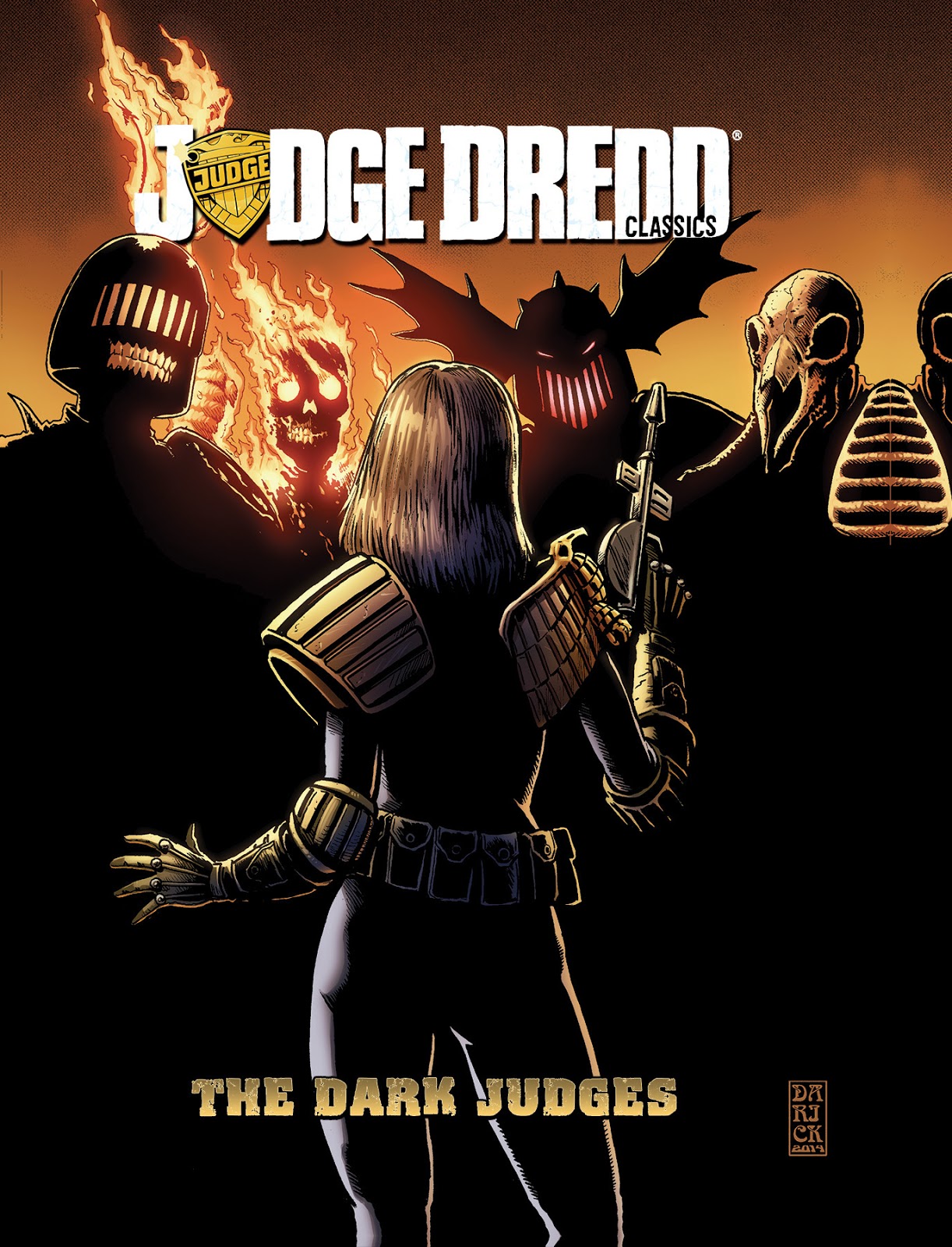
Judge Dredd Classics: The Dark Judges - Book Review


Originally published on Set The Tape

Judge Death. A name that is as recognisable and iconic as Judge Dredd, more recognisable to most people than more regular characters from the Judge Dredd books such as Judge Anderson or Judge Hershey. Before I’d even read a single page of Judge Dredd I’d hear about Judge Death and the other Dark Judges.

Judge Dredd Classics: The Dark Judges collects together the first three stories to feature Judge Death, and his three cohorts, in one single volume, allowing people such as myself, who know about the legacy of the Dark Judges but has never read it, a chance to see how it all began.

The three stories collected in this trade come from the early 80’s, and begins way back in 2000AD #149, and you can tell this. The first story in particular, ‘Judge Death’, is very simplistic in the way it’s written compared to a lot of later Judge Dredd stories, using a lot of narration boxes and captions to fill in the story beats. In a way, it reminds me of early DC books from the 1940’s and 50’s, where they had a lot of ‘tell me’ rather than a ‘show me’ way of telling a story.

This simplicity carries through most of the story, with Judge Death being beaten in an incredibly simplistic way. It’s actually extremely shocking that this was the first appearance of Dredd’s greatest foe, because he feels like a weak villain of the week style bad guy. Whether this was an intentional choice in order to lower expectations before his huge return a year later, or if he just proved so popular that they knew they had to bring him back, it’s still very jarring to read.

I was also surprised to learn in this first Judge Death story that it was also the first appearance of Judge Anderson, a character that would go on to play a major part in the Judge Dredd mythology and last for decades.


After this story, the book goes on to include the first introduction of the fellow Dark Judges, Judge Fear, Judge Fire, and Judge Mortis. This is where the book gets really good, building up the mythology of the Dark Judges and their home dimension, creating a solid foundation that would go on to remain relatively unchanged for years.

With the inclusion of the other Dark Judges we get to see how much more of a threat Judge Death is, as the four of them tear through Mega City One, leaving a trail of corpses in their wake.

Despite being a Judge Dredd book, all three of these stories firmly push Judge Anderson to the forefront, with the third story actually originally published as a Anderson Psi Division title, and Dredd himself only appearing in a handful of panels throughout. Whilst this may be surprising to some readers it does make for a nice change, and it gives another of the series’ main characters the opportunity to shine.

Because the older 2000AD books were produced in black and white, the story has been completely revamped, with the stories now presented in beautiful full colour. It’s a big change from the original source material, but the colours used here actually accentuate the story. The Dark Judges have dirty, muted colours, whilst the rest of Mega City One and it’s inhabitants are bright and colourful. It helps to tell the story, it allows the characters to leap from the pages in ways they didn’t before. And most importantly, it accentuates the original art without detracting from it.

Judge Dredd Classics: The Dark Judges is a great collection, bringing together the origins of some of the most iconic villains in both 2000AD and comics in general. Whether familiar with these stories, or only vaguely aware of who the Dark Judges are, this is a must read for any fans of the Judge Dredd mythology.


Go to Amy's Blog

Wednesday, 10 January 2018

Star Wars: Thrawn by Timothy Zhan - Book Review


Originally published on Set The Tape

‘After Thrawn is rescued from exile by Imperial soldiers, his deadly ingenuity and keen tactical abilities swiftly capture the attention of Emperor Palpatine. And just as quickly, Thrawn proves to be as indispensable to the Empire as he is ambitious; a brilliant warrior never to be underestimated.

‘On missions to rout smugglers, snare pirates, and defeat pirates, he triumphs again and again, inspiring even greater admiration from the Empire. One promotion follows another, but will be put to the ultimate test when Thrawn rises to admiral – and must pit all the knowledge, instincts, and battle forces at his command against an insurgent uprising that threatens not only innocent lives but also the Empire’s grip on the galaxy.’

When Disney acquired Star Wars and did away with the old expanded universe there were many things that fans were sad to see go, the Solo Twins, Mara Jade, Kyle Katarn, but one that the most people were sad to see go was Grand Admiral Thrawn, one of the most ruthless, and cunning bad guys in the Star Wars universe.

Star Wars Rebels surprised fans in the third season with the surprise return of Thrawn, casting him as the main antagonist for the series. Star Wars: Thrawn is set before his on screen debut, and tells the story of his arrival within the Empire, and his rise to the rank of Grand Admiral. The best thing, however, is that the book is written by Timothy Zhan, the original creator of Thrawn.

Whilst in the past books that have featured Thrawn have also had some major Star Wars characters competing for story time, with Thrawn sharing his pages with Luke Skywalker, Han Solo, and Princess Leia to name just a few. Here, however, Thrawn is front and centre of the book, though the story does include some small interludes with Arihnda Pryce.

Thanks to Thrawns cold, calculating manner, and his tight focus on his goals this book works so incredibly well. Any other character in this same story just wouldn’t be as interesting, but Thrawn himself exudes the same menace and awe here that he has on screen in Star Wars Rebels. Thanks to the inclusion of Eli Vanto, Thrawns aide and friend, we get more of a grounded and human insight into the character, though he never feels warm of kind at any time.

The book not only tells the backstory of Thrawn, but also shows how Pryce, who would go on to be Governor of Lothal in Star Wars Rebels. Seeing the twin stories is an interesting choice, seeing these two ruthless and calculating people rising to positions of huge power through very different paths. It also adds a little more depth to the scenes that characters share together in the television series as you discover that the two of them have a history and connections beyond the show.

Star Wars: Thrawn doesn’t add anything big to the Star Wars universe, there are no huge revelations or reveals here that will be effecting the wider universe, but it does explore a small portion of the past of one of the most popular Star Wars characters in a hugely well crafted and entertaining way.

With a second Thrawn book coming out in 2018, one that will be teaming him up with Darth Vader, it’s well worth going back and reading Star Wars: Thrawn before it’s release.


Go to Amy's Blog

Tuesday, 9 January 2018

Starship Troopers: 20 Year On


Originally published on Set The Tape

Released 20 years ago in the UK, Starship Troopers was a film that was misunderstood by many critics and journalists at the time, who failed to look past the glossy action movie exterior, to see the satirical war commentary that lies beneath.

Directed by Paul Verhoeven, director of celebrated classics such as RoboCop and Total Recall, and based upon the novel of the same name by Robert A. Heinlein, the film tells the story of three high school friends who join the military to fight an intergalactic a war with an alien race of bug-like creatures.

While the book was written as a celebration of the military that revelled in the glories of war, Verhoeven took his film in a different direction, using satire and over the top characterisation and events to paint the military as both ridiculous and dangerous. Verhoeven takes visual inspiration from the Nazi party, with many of the film’s uniforms, flags and iconography being similar to that of the Third Reich.

None of this is too shocking, however, given Paul Verhoeven’s history of growing up in Nazi occupied Netherlands and seeing a nearby German military base fall under attack from Allied forces on more than one occasion. Some view Starship Troopers as a satire of the military and war, but they can often fail to grasp just how anti-military the film is. Critic Phil Coldiron put it best when he called it “one of the greatest anti-imperialist films”.


This bleeds through the entire runtime, not just from the aforementioned designs, but in the casting of young blonde-haired and blue eyed actors, in having all older figures of authority missing limbs and covered in scars, and with blatant propaganda videos appearing throughout.

Despite these deeper themes, the overall experience is quite simple. Earth has gone to war with an alien race of insects from the planet Klendathu, a race that the human leaders claim want to wipe out all of humanity. Three high schoolers immediately join up for patriotism and glory, each entering a different branch of the military; Rico (Casper Van Dien) joins the mobile infantry, Carmen (Denise Richards) joins the Federation Fleet, and Carl (Neil Patrick Harris) joins Military Intelligence.

Over the course of the film we see the trials and tribulations of these three, along with a host of other characters, as humanity takes to the stars to kill the bugs. We see victories and defeats, mistakes and advancements, love and loss. The film shows us all aspects of the war, yet never glorifies it, never rewards the characters. Even come the end when they manage to reach their objective and capture one of the bug’s leaders, the characters simply go back to the fight.


Even for a film that’s now two decades old, it still looks great. Mixing together CGI and practical effects, it manages to look glossy and bright, with brightly coloured bugs swarming across desert planets as they try to kill their fragile human foes. The costume design makes the heroes stand out, their dark black and grey uniforms a stark contrast to the desert battlefields they fight in. The costumes were well received and would go on to be re-used in several film and television projects, including (surprisingly) Power Rangers Lost Galaxy.

With competent action choreography, huge explosions, and more expended rounds of ammunition than any other film to that point, the war sequences are loud, brash, and gory. The bugs explode in showers of disgusting fluids, and humans are stabbed, slashed, and ripped to pieces in deaths that don’t shy away from showing the brutality of war.

Starship Troopers is filled with over the top characters, action, and silly moments that makes it more than just a standard war movie, or more than a science fiction film. With war, fascism, and violence perhaps more prevalent today than the time of its original release, the film remains an important social commentary wrapped in a wacky sci-fi adventure.


Go to Amy's Blog

The Flash Mid Season Review


Originally published on Set The Tape

After three years of watching The Flash go up against evil speedsters the show needed something different for its fourth season in order to stand out from previous years. Yes, the characters have changed, with many now having powers and hero personas of their own, new people have come and gone, and the personal trials and tribulations are different, but rehashing the same type of villain for a fourth time would be a huge mistake.

Fortunately, the creators of the show seem to have paid attention to all of the grumblings and criticism that viewers have had during the third season, and have made an extra effort to make a change.  It might not seem like much, but the simple act of giving the fourth season a big bad that doesn’t have a carbon copy of the Flash’s powers makes a big change to the way the series has played out so far.

Using The Thinker (Neil Sandilands) as the villain took many people by surprise when it was first announced, however, after only a handful of episodes it has become clear that this was a brilliant choice. The villain can no longer have super speed fights with The Flash, he can’t travel in time, or skip between parallel worlds, but he’s able to challenge the character in a way never seen before.

Team Flash has always been a smart group, and they’re even better off now that Earth-2’s Harry Wells (Tom Cavanagh) is back, but now they all look like idiots next to their villain. They’re up against someone who’s not only smarter than them, but is able to predict their every move and reaction before they’ve even crossed the heroes minds. Even before the shock plot twist of the mid-season finale episode it was difficult to see how they might be able to beat The Thinker.


This is what has made this season great so far: they have given us a villain and problems that actually challenge our heroes in ways that they haven’t before, and it’s both exciting and scary.

As well as a new villain, this season has given us one of the best new additions to Team Flash, Ralph Dibney (Hartley Sawyer), the Elongated Man. The series has been great with it’s supporting characters, Cisco (Calros Valdes) as Vibe has been great, the roller coaster of Caitlyn (Danielle Panabaker) and Killer Frost has be awesome, but season three did drop the ball in a few ways. It didn’t really know what to do with Wally (Keiynan Lonsdale), and Julian (Tom Felton) was interesting but didn’t bring a great deal to the team dynamic. Ralph, on the other hand, is a great new wrinkle in the team dynamic, and a fun injection of energy.

The Elongated Man is a much beloved comic book character (his story line in Identity Crisis is still one of the most heartbreaking comic book stories DC has ever written), so the show needed to do something really special with him here. Yes, he might not be the Ralph we know and love from the books, he’s much more of an arse, but you can see the Ralph he’s going to become beneath it all, the hero he’s destined to become. His continued journey to becoming a hero, and the fun energy he’s bringing to the series, makes him a great addition to the show.

With the final episode of this first half of the series pulling the rug out from audiences feet by essentially having The Thinker beat Barry in a way that has never been done before, it’s putting the second half of the season in a position to go in some bold new directions. How Barry being framed for murder will play out, if he’ll be found guilty, if his identity as The Flash will come out, are exciting prospects.

The Flash, more than any of the other CW DC shows, has sometimes fallen into the trap of feeling slightly repetitive, but thanks to a drastically different villain, some new cast additions, and brave story choices, season four already stands out as a old and different direction for the show.


Go to Amy's Blog

Monday, 8 January 2018

2018 TV Preview – Agents of S.H.I.E.L.D.


Originally published on Set The Tape

The Marvel Cinematic Universe is getting bigger all the time, not just on the big screen with new heroes getting their own films, but on the small screen, with more and more shows being made that fit into the continuity of the MCU.

With new shows like The Defenders, The Punisher, Inhumans and Runaways in 2017, it can be easy to overlook some of the others that Marvel are producing. Agents of S.H.I.E.L.D is one of these that has often been overlooked since it began almost five years ago.

Initially beginning as a very simple tie in to the larger film Universe, the show focused on several members of S.H.I.E.L.D., led by Phil Coulson (Clark Gregg), who had been killed by Loki (Tom Hiddleston) during the events of Avengers Assemble. The show promised espionage and spy action, whilst also using the mystery of Coulson’s return from the dead to draw viewers in.


Whilst the first season did have something of a rocky start, once events caught up Captain America: The Winter Soldier things really shifted in gear. Suddenly S.H.I.E.L.D. was gone; how would the show manage to survive this? Well, it did so by carrying on the story of S.H.I.E.L.D. and Hydra beyond the events of The Winter Solider, pitting the team against each other as alliances were tested and traitors revealed. Ultimately, it had the team working in secret, chased by the government as it tried to destroy what was left of Hydra.

The second season carried on the Hydra story while introducing the Inhumans; something that was going to culminate in a feature film before plans changed. This season worked extremely well and revealed that one of the characters from the first season was actually the comic book character Quake (Chloe Bennet), bringing some much needed super powers to the series. It also introduced several new characters that would become strong additions to the cast, as well as the comic character Mockingbird (Adrianne Palicki).

Its third season rounded off much of the Hydra/Inhuman stories, even bringing them together in the form of Hive, a parasitic Inhuman that was in-part responsible for the creation of Hydra thousands of years ago. This season added some interesting backstory to the MCU and could have acted as a very fitting end to the show.


Nevertheless, it carried on and its fourth season felt like one where the creators were unsure what to do, mixing storylines that involved Ghost Rider (Gabriel Luna), LMD’s, and a Matrix-like computer world. The fourth season was disjointed, unsure of where it should go or the stories it could tell. As such, Agents of S.H.I.E.L.D. would need to do something pretty big in order to draw people back for its fifth season.

Fortunately, the series seems to have done this. With the end of season four showing the team kidnapped (and apparently in space), and trailers showing spaceships and aliens, it would appear that the show has embraced some more of the fantastical elements of the MCU and has gone galactic.

I don’t want to spoil too much for people who are unaware of where this new season will be heading, but having already viewed the first two episodes I can at least confirm that the show appears to have found something new, something special, to make it stand out again. It’s going in some bold and unexpected directions. Whether you’ve stuck with the show throughout but were becoming a little unsure about the quality of the series, or if you used to watch it but have given up, come back for season five. If you’re not convinced by the first two episodes, fair enough, but it will grab your attention and draw you in with its changes and prove why it has been the longest running Marvel show.


Go to Amy's Blog

Eccentric Earth Episode 2 - Leo Major


Join me, your host Amy Walker, as I delve into stories from across history. This week I'm joined by Dave Bond as we discuss one of the craziest soldiers that you've never heard of, Canadian sniper, Leo Major.


Show Notes: Episode Two Show Notes

Twitter: @Eccentric_Earth
Facebook: @eccentricearth
Instagram: Eccentric_Earth

Email: EccentricEarth@outlook.com


iTunes: Eccentric Earth
aCast: Eccentric Earth
Podbean: Eccentric Earth

Eccentric Earth is a Trans-Scribe Production
Hosted by Amy Walker
Theme music http://www.bensound.com/royalty-free-music

Eccentric Earth Episode Two Show Notes


Welcome to the latest show notes for Eccentric Earth, where I will include the research for each episode (essentially my script), along with a number of photographs and documents.


Episode Two - The Unstoppable Leo Major

Leo Major was born on January 23, 1921, in New Bedford, Massachusetts, to French-Canadian parents, while his father was working for the American Railroad Company. Before his first birthday his family returned to Montreal, taking Leo with them.

Due to a poor relationship with his father, he moved to live with an aunt from the age of 14. This strained relationship, combined with a lack of available work, led Major to join the army in 1940, allegedly to prove to his father that he was "somebody to be proud of".

Major started his overseas tour in 1941, serving in Le Regiment de la Chaudiere. He later went on to become part of the 3rd Canadian Infantry Division. On June 6, 1944 he was among the Canadian forces that landed on the beaches in the Normandy Invasion.

A German half-track armoured vehicle, similar to the
one captured by Major.
During a reconnaissance mission on D-Day, Major captured a German half-track armoured fighting vehicle singlehandedly. The vehicle contained German communication equipment and secret German Army codes, providing the allies with important intelligence information.

Later that same day Major came across an SS patrol. Major managed to kill the four soldiers; however, one of them ignited a phosphorus grenade, which exploded beside him. Major lost most of the vision in his left eye as a result.

Whilst doctors in the Royal Canadian Army Medical Corps tried to have Major sent back home to Canada, he refused, insisting that whilst he still had one good eye he could still aim down his sights and carry on fighting. This is something that he would go on to prove true, as he was placed in a scout platoon, where he earnt himself a reputation as an excellent sniper.

It is also reported that at the time of his injury Major remained in good spirits, especially when he began wearing a patch over his injured eye as, according to him, ‘he looked like a pirate’.

Canadian forces at the Scheldt estuary.
In October 1944, Major found himself a part of the Battle of Scheldt, a military operation by Candian, British and Polish forces to try and gain control of both sides of the Scheldt estuary in order to open the port of Antwerp to Allied shipping lanes.

During this month long operation Major was sent out on reconnaissance alone. Whilst scouting the area he spotted two German soldiers walking along a dike. As it was raining and cold, Major said to himself, "I am frozen and wet because of you so you will pay."

Following the two soldiers at a distance he waited until they split up. He then captured the first German and attempted to use him as bait so he could capture the other. The second German soldier attempted to use his gun on Major, but Major
quickly killed him. Forcing the captured soldier to lead him to the rest of his garrison. Infiltrating the garrison, he captured the commanding officer and forced him to surrender. The German garrison surrendered themselves after three more were shot dead by Major.

Major took the remaining soldiers prisoner and began to escort them to the Canadian front line.  As the procession of prisoners passed a nearby village, SS troops witnessed German soldiers being escorted by a lone Canadian soldier and opened fire on them. They managed to shot their own soldiers, killing seven and injuring a number. Unwilling to give up his prisoners, Major disregarded the enemy fire and kept escorting his prisoners to the Canadian front line. Major then ordered a passing Canadian tank to fire on the SS troops, eliminating them.

Major refused to accept a medal from General
Bernard Montgomery.
When he arrived back at camp he had 93 German soldiers prisoner with him. As a result of his actions Major was awarded the DCM, the Distinguished Conduct Medal, a British medal for gallantry. Major refused the invitation to be decorated, however, because according to him General Bernard Montgomery, the commander of the British Eight Army, who was to present him with the award, was "incompetent" and in no position to be giving out medals.

In February 1945, Major was helping a military chaplain load corpses from a destroyed Tiger tank into a Bren Carrier. After they finished, the chaplain and the driver seated themselves in the front whilst Major jumped in the back of the vehicle. The carrier struck a land mine.

Major claims to have remembered a loud blast, followed by his body being thrown into the air and smashing down hard on his back. He lost consciousness and awoke to find two concerned medical officers trying to assess his condition. He simply asked if the chaplain was okay. They did not answer his question, but proceeded to load him onto a truck so he could be transported to a field hospital 30 miles away, stopping every 15 minutes to inject morphine to relieve the pain in his back.

A doctor at the field hospital informed him that he had broken his back in three places, as well as four of his ribs and both ankles. Again, Doctors told Major that the war was over for him, and that he would have to return home to Canada. A week went by with Major recovering from his wounds at the field hospital, then Major took the opportunity to flee.

He managed to get a ride from a passing jeep that drove him to Nijmegen, a Dutch town beside the Waal River, where he had previously met the Van Gerner family. He stayed with that family at their farm for almost a month in order to fully recover from his injuries. When he was well enough he went back to his unit in March 1945. Whilst technically, Private Major would have been AWOA (Absent Without Authority) no action was ever taken against him, how he was able to avoid punishment for his actions is unknown.

At the beginning of April that same year, Majors regiment was approaching the city of Zwolle in the Netherlands. Information indicated that Zwolle was shown to have strong German resistance. The commanding officer asked for two volunteers to reconnoitre the German force before the artillery began firing on the city. Private Major and his friend Corporal Willie Arseneault stepped forward to accept the task. They were also tasked to get in contact with the Dutch resistance as the Canadian regiment was to start firing on the city the next day. At the time, Zwolle had a population of around 50,000 people and it was likely that innocent civilians would number among the casualties.

Around midnight, Arseneault was killed by German fire after accidentally giving away the pair's position after they ran across a roadblock. Reportedly, Willy was able to kill his attacker before dying himself. Enraged, Major picked up his friend’s machine gun and ran at the enemy, killing two of them, but the rest of the group fled in a vehicle. Despite only being tasked with ascertaining the German numbers and returning to his own forces Major decided to pursue the fleeing Germans.

Leo Major beside Willie Arseneault's grave many years later.

He entered Zwolle near Sassenpoort and came upon a staff car. He ambushed and captured the German driver and then led him to a bar where an armed officer was taking a drink. After disarming the officer, he found that they could both speak French. Major told him that at 6:00 am Canadian artillery would begin firing on the city, which would cause numerous casualties among both the German troops and the civilians. The officer seemed to understand the situation, so Major took a calculated risk and let the man go, hoping they would spread the news of their hopeless position instead of rallying the troops. As a sign of good faith, he gave the German his gun back.


Major then proceeded to run throughout the city firing his sub-machine gun, throwing grenades and making so much noise that he fooled the Germans into thinking that the Canadian Army was storming the city in earnest. He made sure, however, to place the grenades where they wouldn’t cause much damage to the town or its citizens.

As he was doing this, he would attack and capture German troops. In the early hours of the morning, he stumbled upon a group of eight soldiers. Though they pulled a gun on him, he killed four and caused the rest to flee. Major himself escaped the confrontation without injury and only one regret: he later stated he felt he should have killed all of them. About 10 times during the night, he captured groups of 8 to 10 German soldiers, escorted them out of the city and handed them over to French-Canadian troops waiting in the vicinity. After transferring his prisoners, he would return to Zwolle to continue his assault.

Four times during the night, he had to force his way into civilians' houses to rest. He eventually located the Gestapo HQ and set the building on fire. Later stumbling upon the SS HQ, he engaged in a quick but deadly fight with eight Nazi officers: four were killed, the others fled. He noticed that two of the SS men he had just killed were disguised as Resistance members. The Zwolle Resistance had been (or was going to be), infiltrated by the Nazis.
The citizens of Zwolle celebrate their liberation alongside
Canadian troops.

By 4:30 am, the exhausted Major found out that the Germans had retreated.  An entire garrison—estimated to have been made up of several hundred soldiers—had been made so afraid of nothing more than a single, one-eyed man that they fled the town. Zwolle had been liberated, and the Resistance contacted. Walking in the street, he met four members of the Dutch Resistance. He informed them that the city was now free of Germans. Canadian forces were able to enter the city unopposed.

Major then took his dead friend back to the Van Gerner farm until regimental reinforcements could carry him away. He was back at camp by 9:00 am, having singlehandedly liberated an entire city.

At this point, he finally accepted his Distinguished Service Medal, though reportedly still complained about American and British forces getting all of the credit and glory for the Allied victories.

Major continued to fight in the war, however, his actions remained relatively normal until the conclusion of the conflict. Following the conclusion of the War, Major returned to civilian life in Canada, where he became a pipe fitter.

In June 1950 the Korean War began. The Canadian government decided to raise a force to join the United Nations in repelling the communist invasion of South Korea. Major, who had retired from the military after World War Two, was called back into service. He joined the Scout and Sniper Platoon of 2nd Battalion, Royal 22nd Regiment of the 25th Canadian Infantry Brigade, 1st Commonwealth Division.

Canadian soldiers during the Korean War.
In October 1951 Major fought in the First Battle of Maryang San where he received a bar to his Distinguished Conduct Medal for capturing and holding a key hill in November 1951. Hill 355, nicknamed Little Gibraltar, was a strategic feature, commanding the terrain for twenty miles around, so the communists were determined to take it before the truce talks came to an agreement which would lock each side into their present positions.

Hill 355 was held by the 3rd US Infantry Division, who linked up with the Canadian's Royal 22nd Regiment on the Americans' western flank. On November 22 the 64th Chinese Army, consisting of around 40,000 men, lowered a decisive artillery barrage. Over the course of two days, the Americans were pushed back from Hill 355 by elements of the Chinese 190th and 191st Divisions.

The 3rd US Infantry Division tried to recapture the hill, but without any success, and the Chinese had moved to the nearby Hill 227, practically surrounding the Canadian forces.] To relieve pressure, Lieutenant Colonel J.A. Dextraze, commanding officer of the 2nd Battalion Royal 22nd Regiment, brought up an elite scout and sniper team led by Léo Major. Armed with Sten sub machineguns, and wearing sneakers, Major and his 18 men silently crept up Hill 355. At a signal, Major's men opened fire, panicking the Chinese who were trying to understand why the firing was coming from the centre of their troops instead of from the outside. By 12:45 am, they had retaken the hill.

Canadian officers at Hill 355.
However, an hour later, two Chinese divisions, the 190th and the 191st, totaling around 14,000 men, counter-attacked and tried to retake the hill. Major was ordered to retreat, but refused and found scant cover for his men. He held the enemy off throughout the night, he even called in regimental mortar fire on his own position,so close to him that Major's own mortar bombs were practically falling on him.

The commander of the mortar platoon, Captain Charly Forbes, later wrote that Major was "an audacious man ... not satisfied with the proximity of my barrage and asks to bring it closer...In effect my barrage falls so close that I hear my bombs explode when he speaks to me on the radio." The mortar firing was so intense that the mortar tubes glowed red hot and ultimately became useless.


After three days of repeated attacks from over ten thousand Chinese soldiers, reinforcements arrived. Major and his 18 men, had successfully held the hill against 14,000 enemy soldierss. Major received his second Distinguished Conduct Medal, becoming on of only three soldiers to ever receive the medal twice in separate wars, and the only Canadian to do so. He summed his exploits up by saying, “I fought... with only one eye and I did pretty good”.

Major died in Longueuil on 12 October 2008 and was buried at the Last Post Fund National Field of Honour in Pointe-Claire, Quebec. He was survived by: Pauline De Croiselle, his wife of 57 years; four children; and five grandchildren.

The citizens of Zwolle celebrate Leo's visit to the town.
The Dutch citizens of of Zwolle never forgot Leo Major. Starting in the 1970s and until his death in 2008, he periodically returned to Zwolle and was given a hero's welcome each time, cheered by its citizens. The children are taught in school about the one-eyed liberator who saved their city from destruction. He became an honorary citizen of the city in 2005 and has been the subject of news articles and documentaries.

When Leo Major died in 2008 at the age of 87 in Montreal, the town hall flag of Zwolle flew at half-mast and townspeople recorded their condolences in a special register. Later that year, the city renamed a street in his honour.

Leo Major's grave at  the Last Post Fund National Field of
Honour in Pointe-Claire, Quebec.

--------------------------------------------------------------------------------------------------------------------------

You can find Eccentric Earth on a number of podcast providers, including:
iTunes: Eccentric Earth
PodBean: Eccentric Earth

You can also follow Eccentric Earth on a number of social media sites:
Twitter: @Eccentric_Earth
Facebook: @EccentricEarth
Instagram: Eccentric Earth

You can watch out episodes over on Youtube too! Eccentric Earth Youtube Channel

Friday, 5 January 2018

Star Wars Battlefront: Twilight Company by Alexander Freed - Book Review


Originally published on Set The Tape

‘The Galactic Civil War rages. On multiple worlds legions of stormtroopers are waging brutal combat against an armada of freedom fighters. The Rebel Alliance are taking the fight to the enemy, pushing deeper into Imperial territory. Leading the charge are the soldiers of the Sixty-First Mobile Infantry, known as Twilight Company.

‘The members of this renegade outfit survive where others perish, and defiance is their most powerful weapon against the deadliest odds. Alone and outgunned, Twilight Company locks, loads, and prepares to make its boldest maneuver, to strike at the very heart of the Empire’s military machine.’

Timed with the release of the first Star Wars Battlefront game, Star Wars Battlefront: Twilight Company tells the story that should have been included in the game, the story that should have been it’s single player campaign. The story of the regular front line troops in the Galactic Civil War.

Star Wars Battlefront: Twilight Company isn’t about senators, generals, or Jedi. There are no lightsaber duels or medal ceremonies. This book is about war, more so than the films have ever been. The heroes of the main Star Wars saga are spoken about here as myths, figures that inspire the regular troops, and villains like Darth Vader as whispered about like nightmare bogeymen. The story of Star Wars Battlefront: Twilight Company follows a regular company in the Rebel army, the titular Twilight Company, as they find themselves in a desperate fight not just to hurt the Empire, but for their very own survival.

The Star Wars films keep talking about hope. Hope built the Rebellion, hope gives them something to fight for, and hope helps them to win. Hope is in very short supply in this story, however, as the grim reality of fight against the Empire is brutally laid out. Twilight Company are sent into some of the worst fighting, losing soliders again and again. They are often left to fend for themselves, sometimes unsure if their superiors are still around, and are given little to no information about the larger fight.

This book takes the fun and adventure of the rest of the saga and throws it out of the window, giving us instead a story of regular people worn down to breaking point. There are soldiers with post traumatic stress, horrific wounds, drug addiction, and more. The characters aren’t wide eyed farm boys who go on to become saviours of the galaxy, they’re just regular men and women in impossible situations; and like regular people, they can break.

The characters of Star Wars Battlefront: Twilight Company is where the book really shines, and it creates some of the better defined and well rounded characters in the new expanded universe. Whether it’s the main protagonist, a war wear sergeant names Namir, or the recent Imperial defector and former governor Everi Chalis, each character feels real in their own way.

Namir is a lifelong soldier, fighting and war is all he knows, but he’s come to the point where he’s becoming tired of seeing those around him die for a fight they may very well be losing. Chalis is a woman used to being in a position of power and respect, unused to not being the centre of attention, who must learn to control her arrogance and lead people who wanted her dead not long before.

There’s a brilliant moment for Chalis when she and Namir are called to the Rebel base on Hoth to be debriefed by the Rebel leaders shortly before the Imperial assualt on the base that happens in The Empire Strikes Back. Once the attack begins Chalis, so arrogant, believes that it’s because she’s there, that the Empire want her back. The realisation that the leaders of the attack don’t even know who she is or care about her alters her path drastically, as she has to come to terms with the fact that she’s not as important as she thinks she is, resolving to hurt the Empire even more for this insult.

The characters of the book are flawed and weak, they doubt themselves, they question their mission, and they have delusions of grandeur. They’re incredibly real and more well rounded and realised in these few hundred pages than many of the characters that are given hours of film time, or seasons of episodes. Whilst the characters are a highlight, the action in Star Wars Battlefront: Twilight Company is incredible too, managing to pack in a variety of locations in its pages, ranging from base infiltration, starship battles, trench warfare, city assults, spaceship boarding, and desperate last stands.

Star Wars Battlefront: Twilight Company is different from any other Star Wars story in the new cannon. It shows war as brutal and tough, it’s characters aren’t heroes, just regular people, and there’s more despair than hope within its pages. Despite this, it feels so at home in the Star Wars universe, and shows a very different side to a fight we’ve seen on the big screen.


Go to Amy's Blog

Thursday, 4 January 2018

Supergirl Season 3 Mid-Season Review


Originally published on Set The Tape

Supergirl has always felt a little different from the rest of the CW DC shows. It’s set on another version of Earth, and as such rarely interacts with the other series’ the way that Arrow or The Flash does. It started out on another network, and still feels a little like the outside show that was adopted by the CW, instead of having been intended to be a part of it. Despite this, it manages to capture the fun and the appeal of the rest of the DC TV Universe, and has more than earned it’s place.

Season Three has had a rocky start compared to the previous two. Not so much in terms of quality, as the quality has been top notch throughout, but in the journeys that the characters have gone through.

Before now Supergirl has been the ‘happy’ show, the one with hope and joy. This year has had this, but has also been darker than it ever has before. Kara (Melissa Benoist) has been recovering from the loss of Mon-El (Chris Wood), only to then have to deal with his return and the subsequent destruction of their relationship, Alex (Chyler Leigh) has had her engagement fall to pieces, Lena (Katie McGrath) has had several attempts on her life already, and in the mid season finale the big bad nearly beat Kara to death. Yes, the show is still packing in the fun and the laughs, but this year it feels much more balanced against the darker side of Supergirl’s universe.

A large part of this is down to the big bad this season, the Kryptonian ‘world killer’ Reign (Odette Annable). Whilst season two took a long time to introduce the Daxamites and their end of season threat, the build up to Reign has been there in season three right from the first episode. We’ve known that she is coming, and seeing her as a regular person, interacting with Kara, becoming her friend with no knowledge of who or what she is has built tension.


The first half of the season has also managed to pack in a lot of new character introductions, without the season feeling bloated in any way. It’s given us the new villain, though in her regular human life, along with her daughter Ruby (Emma Tremblay), J’Onn’s (David Harewood) father M’ynn (Karl Lumbly), and even the Legion of Superheroe’s Saturn Girl Imra Ardeen (Amy Jackson).

One of the biggest improvements this season, however, was the inclusion in the four part, four show crossover event ‘Crisis on Earth-X’. Whilst the previous years crossover did involve Supergirl, the Supergirl episode was barely connected, with thirty seconds at the end being used to tie it into the story. This season saw it as a major part of the crossover, with all of the episodes feeling like a piece of a bigger whole, rather than a tie in.

The crossover episode also gave Alex a chance to shine, as Kara brought her sister along to the wedding as her plus one. Alex gets to not only fight alongside such heroes like Green Arrow (Stephen Amell) and The Flash (Grant Gustin), but also deals with the breakdown of her relationship by getting to sleep with Sara Lance (Caity Lotz), with hilarious results.

Supergirl has always been a good show, but now it’s really feeling like it’s a real part of the CW DC Universe too. With some great new characters, a darker and more dramatic tone, and some deep emotional issues for the characters to work through, the first half of season three seems set to make this the best season yet.


Go to Amy's Blog

Wednesday, 3 January 2018

2018 Movie Preview – Hotel Transylvania 3: Summer Vacation


Originally published on Set The Tape

‘Mavis surprises Dracula with a family voyage on a Monster Cruise Ship so he can take a vacation from providing everyone else’s vacation at the hotel. The rest of Drac’s Pack cannot resist going along. But once they leave port, romance arises when Dracula meets the mysterious ship captain, Ericka. Now it’s Mavis’s turn to play the overprotective parent, keeping her dad and Ericka apart. Little do they know that his ‘too good to be true’ love interest is actually a descendant  of Abraham Van Helsing, ancient nemesis to Dracula and all other monsters.’

Hotel Transylvania 3: Summer Vacation is the hotly anticipated third entry into the popular animated entertainment series which sees the ancient vampire Dracula (played by Adam Sandler) running a hotel deep in the forests of Transylvania for all kinds of monsters, such as his friends Frankenstein’s monster ‘Frank’ (Kevin James), Wayne the Werewolf (Steve Buscemi), and Griffin the Invisible Man (James Spade).

Having originally built the hotel as a refuge for his daughter Mavis (Selena Gomez) following the death of Dracula’s wife, things changed for Dracula and his daughter when Johnny (Andy Samburg), a human backpacker, arrived at the hotel. With Johnny and Mavis quickly falling in love, and Drac and his friends learning that the world outside their refuge had changed to love and accept monsters, the hotel opened its doors to humans too, and Johnny and Mavis eventually married and had a son, Dennis (Asher Blinkoff).

Blending over the top monster characters and humour, with more adult themes such as love, acceptance, and allowing one’s children to grow, Hotel Transylvania became a hit with adults and children alike.

With the third film announced way back in September 2015, before even the second film came out, fans have been eagerly awaiting the film’s release. It was during this period that the series director Genndy Tartakovsky announced that he would not be returning to the series to allow himself to commit to other projects.

However, after some further discussions with Sony and a desire from the cast to have the director back on the project, Tartakovsky was announced to be returning following a short break to produce the final season of his hit television series Samurai Jack.

It was around this time that Tartakovsky revealed that he was inspired to return to the series when he had the idea for the plot of the third film following ‘a miserable family vacation’ and having taken inspiration from the classic comedy National Lampoons Vacation. Tartakovsky worked on the script for the project together with Michael McCullers, the writer of the original Austin Powers movie.


Go to Amy's Blog