Sunday, 19 November 2017

Power Rangers Ninja Steel 'Galvanax Rises' Review


The season finale of Power Rangers Ninja Steel has arrived (minus a Christmas special still to come), and we get a glimpse of just how good the season could have been.

With Galvanax (Richard Simpson) in possession of all of the Rangers Ninja Power Stars, except for the Rangers morpher stars, and a magnet that will allow him to attract anything made out of Ninja Steel the episode wastes no time with jumping straight into action as the Rangers attack their main villain.

Whilst the fact that the previous episode had no connection to the overall plot except for one scene at the very end that put the villain in a position of power, it's inclusion in the previous episode means that we have the entire Ranger team fighting within minutes of the episode starting.

This lack of a need to set up what's happening gives the episode a sense of urgency, something that continues on throughout the episode. Thanks to a constant escelation of the stakes, and the Rangers being put into more and more dire situations, the episode flies by, feeling a lot shorter than its 22 minute run time.

Despite feeling fast the episode does manage to pack in a lot of development, including the destruction of the Ninja Steel, the arrival of an asteroid full of Ninja Steel (though I'm suspecting this may end up being the Super Ninja Steel of the next season's title), the culmination of Madama Odius' (Jacque Drew) betrayal of Galvanax, and the return of Dane Romero (Mike Edwards).

The return of Dane, Brody (William Shewfelt) and Levi's (Jordi Webber) father, is a surprise moment, and is close to being one of the best of the episode as he becomes a second Red Ranger. However, the surprise of Mick (Kelson Henderson) becoming a third Red Ranger is truly the stand out moment of not just the episode, but the entire season.


Having been one of the consistently best characters in the series, and with Kelson Henderson having been involved with the Power Rangers franchise for over a decade, appearing in Power Rangers Dino Thunder, Power Rangers SPD, Power Rangers Mystic Force, Power Rangers Operation Overdrive, Power Rangers Jungle Fury, Power Rangers RPM, Power Rangers Megaforce, and Power Rangers Dino Charge, it's brilliant to finally get to see him become a real Power Ranger for the first time.

Whilst many of Kelson Henderson's appearances in the franchise were voicing a monster of the week, he's appeared in front of the camera enough that he's become a very recognisable part of Power Ranges. His morph feels like something of a reward not just for him, but for long time fans too. Plus, the fact that he kicks arse and is fighting with a sword before he even morphs shows how brilliant he is.

Without access to the Zord Power Stars the episode puts the Rangers in an interesting position where they have to beat a giant monster. There are a few times that this has been done before over the history of Power Rangers, but none that were season finale's as far as I can remember. Having the Rangers fight the giant version of the shows big bad without Zords is a bold step, and does mean that we get a fight scene that stands out against the rest of the series.

The only pieces that let the episode down are the scenes that involve Victor (Chris Reid) and Monty (Caleb Bendit). I know that the Super Sentai series that Power Rangers Ninja Steel was based upon, Shuriken Sentai Ninninger, was a comedy show, but inserting bad comedy into such a dramatic and action packed episode breaks the pace and tone. If these scenes were removed from the episode Galvanax Rises would have a near perfect score.

It's a shame that the best episode of the series is the last, and it's a shame that the rest of the season wasn't like this. However, seeing how well the finale was put together it does give me hope that the next season, Power Rangers Super Ninja Steel, may improve in quality.


Go to Amy's Blog

Friday, 17 November 2017

My Little Pony: Friendship is Magic #60 - Comic Review


Originally published on Set The Tape

The latest issue of My Little Pony: Friendship is Magic follows the three Cutie Mark Crusaders, Apple Bloom, Scootaloo, and Sweetie Belle, as they plan on taking out a group of young ponies for a night camping in the woods in order to try to help them unlock their cutie marks.

Whilst they have planned for a weekend of apple picking, swimming, cooking out, and possibly even bungee jumping, their plans are thrown out when Rarity arrives to tell them that Fancy Pants is on his way from Canterlot, and that his niece, Gilded Lilly, will be taking part in their excursion in order to try to get her cutie mark too.

With Fancy Pants wanting his niece to have a Cutie Mark in something ‘important and influential’, the girls are unsure of how to go about helping the young pony, but proceed to run the event the way they normally would.

Over the course of the day a number of ponies manage to get their cutie marks in things like bird watching, and cooking, but Gilded Lilly is sad throughout. Fortunately for her, she enjoys astronomy, and gets to come out of her shell when she has to correct the Cutie Mark Crusaders, who know nothing about it and are getting their constellations wrong.

With her love for astronomy evident, Gilded Lilly unlocks her own cutie mark, a telescope with stars. Instead of making her happy, this reduces her to tears, as she feels that the cutie mark will let her family down because it’s not like theirs.

After a short heart to heart with Scootaloo, she agrees to talk to her uncle about her worries. Thankfully, her uncle proves to be incredibly understanding, and can see that astronomy matters so much to her. He tells her that whilst she might not enjoy socialising as much as the rest of the family, she’s going to be important and influential in her own way.

Skipping forwards a couple of weeks, the Cutie Mark Crusaders get a letter from Gilded Lilly, who tells them that she has now started working at the Canterlot Observatory, and that she and her uncle are holding a fundraiser for it, proving that she is indeed influential in her own way.

It’s a nice little story, one that puts across the message that you don’t have to quite live up to people’s expectations in order to be special, that you can follow your own path and be true to yourself by still make the people close to you proud. It’s an important message, one that tells readers that you don’t have to follow a strict path set out by others, but can be who you really are.


Go to Amy's Blog

Legends of Tomorrow ‘Phone Home’ Review


Originally published on Set The Tape

Legends of Tomorrow is doing E.T., set at Halloween, in the 1980’s. Yes, it’s absolutely as good as you think it’s going to be.

With the last episode of Legends of Tomorrow feeling a lot weaker, especially in terms of humour, ‘Phone Home’ completely turns things around, embracing it’s ridiculous side, whilst also managing to squeeze in one of the more touching character moments that the series has given us.

Whilst trying to get the team to bond with their new member, Zari (Tala Ashe), Ray (Brandon Routh) gets the team to try and take part in trust exercises before suddenly disappearing from reality. The moment that Ray vanishes should probably feel dramatic, but the fact that it ends up with Mick (Dominic Purcell) slamming head first into the floor mid-trust fall it’s easily forgiven. Realising that Ray’s disappeared from the timeline because he was killed in 1988. Travelling back to a few days before the young Ray’s death, which thankfully bring their Ray back into reality, the team discover that young Ray’s made a new friend in the form of a baby Dominator.

With the tease the week before I was expecting young Ray to come across some kind of creature, and was expecting an alien, but making it a Dominator was a great idea, tying it nicely into the existing mythology of the series. The baby Dominator itself is actually surprisingly cute, and it’s quite believable that a young Ray Palmer would see it as someone he could be friends with.

Despite the amount of comedy that permeates the episode there’s some surprisingly touching moments too, especially when you realise how sad and lonely Ray was as a child. In many ways this goes on to explain a lot of why Ray’s the way he is, why he’s always so positive, and why he so desperately wants to be part of the team and for the team to work. It really does feel like the Legends are Ray’s first real friends, and it’s a very bittersweet realisation.


Thankfully, there’s so much more fun in the episode to mean that these moments don’t leave you feeling too down, though mainly because you’re too busy laughing. Micks joy at seeing the young Ray stealing is great, and the banter between Nate (Nick Zano) and Amaya (Maisie Richardson-Sellers) is spot on, especially when Nate starts coming on to Ray’s mother.

The joke might be a little on the nose, especially with the ‘cougar’ conversation, but the sheer ridiculousness that cast brings to proceedings means that it never really bothers. One of the strengths of Legends of Tomorrow is that it can make its heroes look like complete idiots without that undermining them. Whilst it’s great to see them being heroes, they’re fuck-ups, they’re people who mess things up all the time, so laughing at them feels as natural as laughing with them.

Whilst dealing with the drama of Ray’s younger self being killed, Jax (Franz Drameh) and Mick investigate the possibility that Stein (Victor Garber) might be sending messages to the Time Bureau. Even without the bond that Jax and Stein share I found this notion absolutely ridiculous, and found it a little hard to believe that Jax could even suspect his partner of such a thing.

Luckily, this can be overlooked as it ends with a great moment when Stein believes that he’s going to miss out on the birth of his first grandchild, something that Jax and Mick refuse to let happen. ‘Borrowing’ the Waverider so that he can get there to be with his daughter (even leaving a note behind on a tree for the others), the two of them prove that they really are all a family, and that means they’ll do whatever it takes for each other.

With so many great character moments (with an added look at Zari’s new costume), great comedy (Nate kissing a Dominator Queen), and a load of 80’s movie nods (including flying their bicycles in front of the moon!), ‘Phone Home’ might not just be the funniest episode of Legends of Tomorrow, but of the whole CW DC Universe. This episode goes to showcase the kind of superhero comedy that other shows can do at times, but never to this level. A great episode that’s going to be hard to beat.


Go to Amy's Blog

Biff To The Future – Book Review


Originally published on Set The Tape

Anyone familiar with Back To The Future will remember the alternate timeline from the second movie, the one where Biff Tannen has been given a sports almanac from the future and has built a business and gambling empire. It’s one of the darker moments of the whole Back To The Future trilogy, one that is only explored in brief snippets through pieces of dialogue and displays in the Biff Tannen Museum.

Back To The Future: Biff To The Future explores the events of this timeline, it shows us how Biff went from being an idiot high school bully to an idiot billionaire bully. Thanks to being co-written by Bob Gale, the co-creator and co-writer of the Back To The Future films, this doesn’t feel like some writers version of events, but the actual true events of that timeline from the series creator.

The book is split into several chapters, each one exploring a different aspect of Biff’s history, of his development into the monster that we saw in the film. This structure allows the writer to skip across decades to focus on the important points in Biff’s story, to showcase the highlights that are the most important.

The first chapter actually follows the old Biff from the future, the one who traveled back in time to give his younger self the almanac. The shortest chapter in the book, it’s also one of the wackiest, as we discover that old Biff accidentally traveled back to the Jurassic Period before getting the DeLorean back to 1955. Not a great deal happens, other than a raptor stealing the book and getting promptly hit over the head with a cane by Biff, but it’s a silly little excursion that adds a little extra spice to proceedings.

From here we jump to 1955, where we get to see Biff discovering that the book actually works, and making his first win using it. This chapter gives us a good look into Biff’s home life, and the grandmother that raised him. Anyone hoping that Biff may have just been one bad apple and that his grandmother was a nice old lady are in for a rude awakening as we see that she’s even worse than Biff. With a series of escalating events getting further and further out of the young Biff’s control he ends up with his grandmother dead, killing someone, and learning that he has to be sneakier with the almanac.

This is the start of Biff’s descent into being more than just a high school bully, as he learns that there are worse people in the world than himself, that he is capable of not just murder, but covering up that murder, and most importantly, that you can get away with a lot of things with enough money. The next jump sees Biff having made millions from his gambling and trying his hand at branching out into Hollywood, starting up a film studio with a very, very shady producer/director Bernie Kessoff. Whilst Biff funds the films Bernie spends the money on himself, drawing out the process and using Biff’s stupidity against him in order to get more and more money.

By the end of this chapter Biff has cottoned on to Bernie’s ploy and manipulates into getting the man killed by mobsters after deciding that Hollywood isn’t the place for him. This chapter is actually a lot of fun, and manages to get a load of cameo appearances in, including Charlton Heston, Marilyn Monroe, and even John Wayne (who gets to knock Biff out in one punch). Thanks to the fabulous artwork it’s easy to tell who each of these characters are, especially as not all of the cameos are named.

After leaving Hollywood, the action jumps forward again as Biff returns to Hill Valley. In this chapter we see him begin to make connections in the government, build up a business empire, and take over the town. At first Biff appears to be doing good around the town, but it’s soon clear that his actions have a very ulterior motive, and that he’s willing to throw families out of their homes, burn down a school, and even murder George Mcfly.

This is possibly one of the darkest chapters in the book, not least because it shows the murder of George McFLy, an event mentioned numerous times in the second film. It shows a very cold and calculating side to Biff, one where he slowly lures George in over months, making him believe that he’s going to be meeting with an informant that can help topple Biff. It shows that Biff, whilst an idiot, is not always stupid, and is willing to use his meager intellect to very evil gains.

From here we see Lorraine McFLy finally give in to Biff and agree to marry him in order to help the remaining family that she has. The scene where she gives in to Biff is particularly sad, as we can see a woman who was so strong up to this point finally broken, completely given up with no other way to help her family. This chapter sees Biff begin to make an inroads in Washington, and to make a friendship with President Nixon. When Biff buys the Washington Post in order to screw over a resident of Hill Valley, turning the publication into the Biffington Post, he fires a pair of journalists, Bob Woodward and Carl Bernstein, two men responsible for breaking Watergate.

With the scandal no longer coming out to the public, and Biff using his money to help influence and pay off certain politicians, he and Nixon manage to change the 22nd Amendment, allowing Nixon to run for more than two terms. As a thank you Nixon legalises gambling in Hill Valley, letting Biff build the empire that we see in the second film. The small resistance of people in town that want to take down Biff, including Pricipal Strickland and Goldie Wilson, are joined by Doc Brown, who has made a time machine out of an old refrigerator so that they can change history to stop Biff.

This is one of the most fun chapters in the book, watching these characters trying time travel for the first time in an attempt to make things better for themselves. AS to be expected, this doesn’t go well at all, and ends up with Biff in possession of the time machine (though he doesn’t know what it is) and Doc Brown committed to a mental institution.

With events now at the point where the Marty from the original timeline would normally come back, we get to see what would play out in this timeline if he didn’t. With Biff figuring out that Doc Brown has built a time machine, and wanting to use it to help his chances at running for President, he forces Doc Brown to prepare the machine to travel into the future by threatening to kill the McFLy family.

Intending to travel to the future and obtain information on the stock markets, allowing himself to be a ‘legitimate’ businessman, Biff steps into the time machine, but ends up back in 1885 and face to face with his ancestor Mad Dog Tannen, who promptly shoots and kills Biff. With Biff dead, and Lorraine inheriting his empire, the McFly family, Doc Brown, and those who had been working to stop Biff, try to rebuild their town.

Back To The Future: Biff To The Future offers a very interesting look into this alternate timeline, one that answers a lot of questions, fills in a number of gaps, and actually manages to tell a very good alternate history story. I wasn’t expecting the final chapter to include the conclusion of that Biff’s story as if the real timeline’s Marty never appeared, but it was an interesting addition that at least showed that Biff was eventually due to get what was coming to him.

The only drawback for the book is the time in which it’s been made. With an idiot businessman who hates people different from him in a position of power, reading a fictitious story of someone very much like him can kind of bring the mood down a little as you realise reality is almost as ridiculous and depressing (no points for guessing who I’m talking about).

Other than that, the book is great, with top notch writing and great art throughout, telling an intriguing and entertaining story that adds a lot of the mythology of the Back To The Future franchise.


Go to Amy's Blog

Arrow 'Deathstroke Returns' Review


When Oliver Queen (Stephen Amell) stepped down from being the Green Arrow and passed the mantle over to John Diggle (David Ramsey) the show began to feel a little different, almost like it was becoming a whole new series, despite none of the cast changing. This weeks episode really feels like classic Arrow in comparison as Slade Wilson (Manu Bennett) returns to Star City to team up with his old friend.

Deathstroke was one of the best characters of the early seasons, his friendship with Oliver was enjoyable to watch, and his turn as a villain is still one of the best big bads the series has had; so his return helps to make this one of the more enjoyable episodes of the season so far, even if it is competing for air time with a less successful Vigilante (Johann Urb) story.

Having had the effects of the mirakuru wear off Slade has returned to being something of a friend and ally to Oliver, even though their friendship is not what it once was (I guess murdering someone's mother will do that to a friendship) you can still see that the two of them care about and respect the other. Slade's unwillingness to let Oliver become involved in any kind of fighting speaks volumes to this.

He helped Oliver to get his son back, and knows from his own past that you can't be both a father and a solider/vigilante, he wants his friend to have the relationship with his son that he never could; even going so far as to drug Oliver to stop him from fighting alongside him. The fact that Oliver does go with him, with the blessing of both Felicity (Emily Bett Rickards) and William (Jack Moore) indicates how much this step back from being a hero has strengthened the relationships he's had with his family.


How things will play out in future episodes considering Oliver going to Slade's rescue at the end of the episode could be very interesting, and I am curious to know if William told him to fight to save his friend or if Oliver is doing this behind his sons back.

The face that the Slade story isn't fully resolved this episode is a good thing, as it means we will definitely get to see more of the character. The fight scene he featured in in this episode is easily one of the best the show has done, and goes to showcase just why having him around can be a great addition to the show.

Whilst Oliver is away from Star City dealing with Slade and his son, Team Arrow are contending with the return of Vigilante. With Star City facing a vote about how to deal with vigilante heroes it felt kind of appropriate that a bad guy called Vigilante would choose this time to return.

Despite having been in the show for almost a year at this point, and building mystery around his character, the reveal of just who is underneath the mask is actually pretty dull. Whilst it's nice that Dinah (Juliana Harkavy) is being given a story line that will last for more than a single episode and get to showcase something more than just a rivalry with Black Siren (Katie Cassidy) the revelation that Vigilante is actually her murdered partner felt odd.

We've not seen her partner since he was apparently murdered when Dinah got her powers, and I had no idea that it was him when Vigilante pulled off his mask until Dinah actually went and explained it to the rest of the team. Having Vincent come back into Dinah's life is a good choice for her character, but having him be Vigilante lets this idea down somewhat.

Thankfully, Agent Watson (Sydelle Noel) is still around to torment Team Arrow with her investigation and manages to steal all of the scenes that she's in. It's good to finally have someone somewhat competent investigating into Team Arrow, someone who is actively figuring out who they all are and trying to prove it. Although this does make some of the cops in Star City seem slightly incompetent for not having done this in the previous six years I look forward to seeing her investigation develop further.

Arrow has definitely improved in quality in it's latest season, and bringing back Deathstroke has been a great move, giving us great interaction between him and Oliver, and some of the best action the series has delivered to date.


Go to Amy's Blog

Thursday, 16 November 2017

Looking back at… Predator


Originally Published on Set The Tape

I look back at the classic action movie Predator as the film celebrates it's 30th anniversary cinematic re-release.

I can’t remember the first time that I watched Predator, but I know that I must have been close to five or six years old, borrowing the VHS from my uncle when I stayed round my nan’s one weekend. I knew that I shouldn’t be watching it, he knew that I shouldn’t be watching it, but my family had a very laid back attitude to being allowed to watch older films. As such, I grew up with Predator in my regular weekly rotation of thing to watch when staying at my grandparents, with Saturday mornings being filled with SMTV or Live & Kicking, and the afternoon with Aliens or Predator.

One of the drawbacks of having watched the film so young is that I’ve always remembered it as a sci-fi action movie, a film that sets Arnold Schwartzenegger and his team against an extraterrestrial threat. As such, I’ve never been able to experience the surprise of having what appears to be a regular action film take a turn into horror sci-fi mid way through.

Whilst it’s hard to find someone that is unaware of what Predator is really about thanks to how popular the titular creature has become, if you can find someone that has never seen the film before and doesn’t know the twist it’s an absolute delight to watch them watch it. The marketing for the film a the time only kept this secret for a short while, with the fact that they were fighting an alien being revealed in the trailer, there were many cinema goers that would not have known this. As such, Predator shocked many of those watching it; which became one of the big factors in why people fell in love with the film.

Thankfully, with an excellent cast and some great directing, the rest of the film stands up so well on it’s own that even if you do know about the alien monster it’s a damn good film. The film begins like any other action film at the time, a special squad of soldiers that specialise in rescue missions are sent into South America to rescue some people who have been captured by guerilla fighters.


This beginning is very cheesy, and has each member of the team given their brief spotlight to shine, with Jesse Ventura’s Blaine chewing tobacco and being surly, Carl Weather’s Dillon very much the outsider, and Shane Black’s Hawkins telling awful pussy jokes. The characters are very arch, and don’t really develop beyond their sover the top stereotypes over the course of the film, but each one is played with such charm and humour that it’s impossible not to end up liking them; something that’s very important when they start being killed off.

Where the film really stands out, however, is when it shifts to include the Predator. Not only does the whole tone of the film begin to change when the hunters become the hunted, but the direction changes too. Where before our heroes were large and imposing on screen, they’re framed small within the jungle. Instead of fighting together as a unit, they become separated, becoming easy targets. And the quick cuts and fast paced editing takes on a slower approach as the camera slowly moves through the jungle, taking time to linger where before it would cut away.

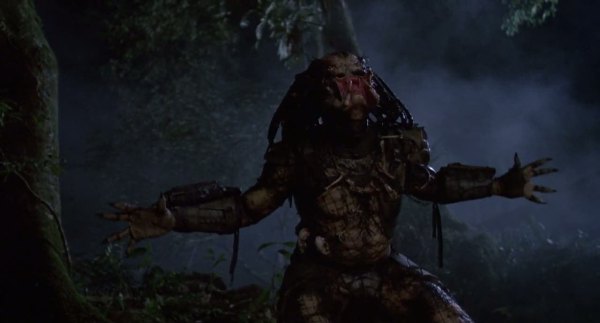
It’s subtle, and a lot of people watching would end up missing it, but the film shifts in these subtle ways with the intention of putting the audience on the back foot, to challenge their expectations and put them at a disadvantage, much like the characters. Whilst the humans in the film are a pleasure to watch, and perform their roles admirably, the real star of the film is the Predator himself. With a design from the legendary Stan Winston (and apparently inspired by a suggestion from James Cameron), the Predator has gone on to become one of the most iconic movie monsters in the world.

Originally a more insect like creature that was going to be played by Jean Claude Van Damme, director John McTiernan realised that the monster was such an integral part of the film and made the decision to alter it midway through production. This change was definitely for the better (the original creature looked absolutely awful!) and helped make both the creature and the film a success. Despite being so alien, and not having any lines that weren’t just mimics of other characters, the rivalry between Schwartzenegger and the Predator is one of the best parts of the film, with the final act of the two hunting each other still being incredibly tense to watch, even after thirty years and literally hundreds of rewatches.


With no dialogue and no other human on the screen, Schwartzenegger’s fight with the Predator is still one of the best moments from any of his films, managing to put Arnie in one of his most vulnerable and dangerous positions. Whilst we know that there’s never a chance that he’ll die, the audience still end up fearing for him.

Predator was never intended to be anything more than a schlocky action film, but thanks to some great over the top acting, brilliant directing, and a monster design that still stands head and shoulders above other movie monsters after all these decades it becomes more than the sum of its parts and one of the best Schwartzenegger films ever made.


Go to Amy's Blog

Kid Lobotomy #2 - Comic Review


Originally Published on Set The Tape

Kid Lobotomy issue two continues our introduction to the world of Black Crown, and adds some new characters to The Suites. Picking up where the previous issue left off, we discovers that Kid Lobotomy was not, in fact, killed by the deranged hotel guest. Instead, it was Ottla, the shape shifting staff member in Kid Lobotomy’s form that had her throat slashed.

Thankfully, such an injury isn’t life threatening for someone that can change their form. However, because of the trauma of the event Ottla is unable to immediately change out of Kid Lobotomy and back to herself. To help her break out of her half shifted form Kid Lobotomy has to perform a psychic lobotomy on himself.

Whilst this does work, it results in Kid Lobotomy accessing a repressed memory of a cockroach, which seems to result in him starting to transform into one. I say seems, because it’s never completely clear if this is actually happening, or if this is part of Kid Lobotomy’s madness. None of the other characters make reference to it, or seem particularly freaked out whenever they seem him mid transformation, but then this is a very bizarre world with some strange characters in it, so it wouldn’t surprise me that this could be happening and them not reference it.

Kid Lobotomy’s story reaches a peak this episode as his sister arrives in the hotel, intent at taking over and finally getting rid of her younger brother. The issue also introduces two new characters, Brigit Spooner, the hotel’s new artist in residence, and Adam Mee, a washed up writer that’s been living on the streets.

Mee is, so far, a rather unlikable character, one that’s become the victim of his won success and self belief. Having written a book that won awards and made him famous around the world his life soon fell apart, leading him to a dead end, and The Suites. Having found Brigit’s lost room key Adam Mee enters the hotel in order to get some time off the streets and ends up meeting Brigit, praising her artistic work.

It’s still not clear what kind of person Mee is, or where his story is going, but it does look like it will be connected to Brigit’s in some way. Brigit herself seems like one of the more positive characters in the book, having come into the hotel with a sense of happiness and eagerness to get to work and ‘art things up’ in the gloomy rooms.

Kid Lobotomy continues to be a strange book, one that blurs the lines between reality and madness. It’s not clear what is and isn’t happening to characters, whether things are part of their world or in Kid Lobotomy’s broken mind. Hopefully things will start to come together in coming issues, with more answers and a larger story becoming apparent, as if the book continues on like this for too much longer it will move from intriguing to boring.


Go to Amy's Blog

Arrow ‘Reversal’ Review


Originally Published on Set The Tape

We finally know who saved Laurel (Katie Cassidy) from the island at the beginning of the season, it’s Ben Linus, sorry, I mean Cayden James (Michael Emerson). Emerson is, as always terrific in this episode, and I can see why people were excited to be having the Lost star join the cast, he brings a level of quite, detached menace and gravity to a role that the series has often failed at in the past.

With his character having been introduced late the last season through Felicity (Emily Bett Rickards) and her dealings with Helix I was genuinely surprised to see him return. Arrow has name dropped villains before their appearances in the past, such as Ra’s al Ghul and Damien Darhk, but whenever they’ve done it in the past it’s felt like set up, here it’s more of a natural continuation of a story that we were led to believe had already been resolved.

The return of the Felicity/Helix story fits in really well at this point in the season, and goes to help develop the return of her relationship with Oliver (Steven Amell). In the past I didn’t really like the relationship between the two of them, but this season it’s been progressing and developing at a very different rate, and has definitely benefited from Oliver no longer being the Green Arrow.

It’s nice to see Oliver be the one left behind when Felicity has to rush out of the restaurant to go and help the team, and for Oliver to be the one at the bunker directing the team over the comms whilst Felicity is in the field in the last act of the episode. It shows the level of growth that both of them have been through, taking on roles and responsibilities that neither one of them would have felt particularly comfortable in only a few seasons ago.


This episode also saw Black Siren show up yet again, this time working alongside Cayden James, killing what appears to be random citizens across Star City. Using the same bad guy twice within the first four episodes of a season may have felt like overkill in the past, but there’s something great about the way that Katie Cassidy plays a villain that makes it always entertaining. Her rivalry with Black Canary (Juliana Harkavy) gets put on the back burner this week, instead choosing to give her a moment with Diggle (David Ramsey) as the new Green Arrow.

Whilst at this stage it’s hard to see Cayden James going on to be the big villain for the whole season, Laurel’s Black Siren can definitely last the whole year as long as the writers keep using her in these interesting ways. Sadly, some of the episode didn’t work as well as it should, and it all revolved around the tech/hacking side of the episode. Whilst this is a universe where you have to suspend your disbelief a little (it has speedsters and giant shark men after all), one of the most unbelievable aspects is the almost magical way that people use computers.

Our heroes are presented with a problem where the whole internet is about to be destroyed, with a predicted casualty rate in the hundreds of millions, and Felicity stops it in about ten seconds on keyboard. The biggest issue she had in stopping the bad guy was getting to the computer she needed, not the actual tech side of things.

And whilst we’re on the subject of tech, I really don’t think that the entire Internet is housed in one giant warehouse in America that can only be accessed by three people, none of whom have any kind of bodyguards or security; this is possibly one of the silliest things the show has asked me to believe in, and that includes the man with the magical rag suit that contained a nuclear explosion.

Despite these silly mistakes, the episode managed to remain fun and entertaining throughout, offering great character moments and superb action sequences.


Go to Amy's Blog

Judge Dredd: The Blessed Earth #7 - Comic Review


Originally Published on Set The Tape

‘Judge Dredd awoke a thousand years in his future to find Mega-City One in ruins and its 800 million citizens gone without a trace. After a long, strange journey, Dredd manages to locate and free them. And now, ten years later, society continues to pick up the pieces.

‘A robot Armageddon arrives as Dredd closes in on a last desperate attempt at retrieving his missing bones.’

As the final issue of Judge Dress: The Blessed Earth draws near the series has started to finally bring all of its plot points to a close, having many of the elements seeded throughout the series come together. The last issue saw the revelation that the Biosim Isaac was still alive, and that Biosims have been spreading throughout the world.

Here, we see the conflict between the robots and humans finally coming to a head, with the Neon Knights stepping up their attacks on any artificial life that they come across, even going so far as to declare war on the Judges, believing them to be artificial.

Judge Quill finds herself trapped in the middle of this conflict, having already turned on her former comrades and killed Chief Judge Anderson. You can almost understand her motivations throughout this issue, that she wants justice and feels betrayed by her former comrades, but it’s hard to completely condone her actions and her methods.

This is one of the things that Judge Dredd books does well, it always have the hero be dirty. It presents a more real world outlook, though one through an extreme sci-fi filter, that even people with the best intentions and the right motivations don’t always get to be ‘good’ people.

There is a moment in the book where Judge Lolo ends up being killed, and you can see that Quill blames herself for this. And I can’t really disagree with her. Lolo probably wouldn’t have died if Quill hadn’t had made the choices she has, so I can’t feel any kind of sympathy for her.

At the end of the book we learn that Isaac is in fact the Grand Master of the Neon Knights, which I honestly didn’t see coming; though that’s mainly because the Neon Knights hate all machines. Whilst the Neon Knights are being portrayed as crazy fundamentalists, I’m not entirely sure why they’re following Isaac after finding out who and what he is, but perhaps this is something that will be resolved in the final issue.

Judge Dredd: The Blessed Earth continues to weave it’s bizarre tale as it races towards its conclusion. How it will end, whether Quill will survive, or if Dredd will manage to get his skeleton back are unclear, but I am hoping that the final issues will help to explain some of the stranger aspects of the story and deliver a satisfying conclusion.


Go to Amy's Blog

Teenage Mutant Ninja Turtles / Ghostbusters 2 #2 - Comic Review


Originally Published on Set The Tape

‘Darius Dun, the crime lord assassinated on the order of Splinter, is now a ghost in an interdimensional limbo. He learns about The Collectors, demons who can traverse dimensions at will and exist solely to capture and contain living beings – and as a torturous revenge, Dun summons The Collectos and sends them after Splinters family – the Teenage Mutant Ninja Turtles.

‘But all is not lost! Before Donatello is captured he makes his way to the home dimension  of the Ghostbusters, looking for help. The boys in gray can free the Turtles, but The Collectors will chase the Turtles forever unless they’re stopped permanently.

‘And so, Ray Stantz concocts a happily complicated plan; he, Peter Venkman, and Winston Zedmore will take Raphael, Michelangelo, and Leonardo and lead The Collectors on a wild goose chase through the dimensions – allowing Egon Spengler and Donatello to work up the gear needed to trap the demons permanently.’

Whilst the first issue of the new crossover event, Teenage Mutant Ninja Turtles/Ghostbusters 2, was all about set up, the second issue manages to not only pack in some great action, but spends a lot of time developing its characters and exploring their mental state.

The pairings actually work really well too, even when you think they probably wouldn’t. Egon and Donatello is a no brainer, put the two scientists together and it works great. Ray and Raphael is a pairing that surprised me, mainly because they’re a pair that are very different from each other. However, this does mean that Raph gets to be Ray’s straight man, which leads to some really fun moments.

A lot of the time we tend to see Raphael as the angry member of the Turtles, but here he’s shown in a different light, especially when Ray compares him to his nephew; ‘Heart on his sleeve, but so worried about so much that he just sounds angry all the time’. This is the kind of insight that can shift a lot of people’s thoughts on the character, but one we rarely get in the Turtles’ ongoing book, as his brothers would never talk to him like that.

Whist the pairing that surprised me worked, the obviously fun one of Venkman and Michelangelo actually threw me too when the characters shared a very sweet, emotional moment. Together in a world filled with anthropomorphic animal people, the two of them bump into (literally) a rat-man that reminds Michelangelo of Splinter. Instead of taking it in his stride, Michelangelo breaks down, crying on Venkmans shoulder.

Instead of the usual Venkman crap, he takes the time to listen to the hurting teenager, lets him cry and get it out of his system, then gives him some very well thought out advice as a psychologist. Much like Raphael, this is something that we needed for the character, but something that he could never do around the others, plus, it shows that Venkman isn’t just a complete jerk (which is sometimes hard to remember).

The last pairing of Leonardo and Winston packs in the most action, with the two of them arriving in a world that very much resembles the robot controlled apocalypse of Terminator (they even allude to the film in their dialogue). As with the others, we see another side of Leo here, one where he doubts his role as a leader, and his inability to stop Splinter from going down a darker road. Drawing on his past as a Marine, Winston gives the young man the support he needs, reassuring him that not only is it not his fault, but that he’s one of the greatest warriors that Winston has ever fought beside.

All of these interactions are hugely important for the Turtles, as they’d never have the chance to open up like this in their own ongoing book. This is one of the beauties of the crossover with Ghostbusters, not just because it combines two brilliant franchises, and gives us moments like this, but because these characters have a history together and can have these much more personal moments.

The book ends on an exciting note with The Collectors closing in on our heroes, and the promise of a ‘proton-powered ninja arsenal’ the book ends with a promise of exciting things to come. With a set up for more action to come, and some genuinely great character moments, the second issue of this crossover has turned out to be better than I was expecting.


Go to Amy's Blog