Wednesday, 1 November 2017

Stranger Things: The Story So Far


Originally published on Set The Tape

Set in the winter of 1983, the first season of Stranger Things follows the disappearance of a young boy, a girl with mysterious powers, and monsters from another world. The story begins at the Department of Energy laboratory in the small town of Hawkins, where an experiment gone wrong has unleashed a monster. Whilst riding his bike home after playing with his friends Mike, Dustin, and Lucas, 12-year-old Will Buyers encounters the creature and vanishes. Discovering her son is missing, Joyce Buyers appeals to the local police chief Jim Hopper to find her son.

Searching the woods for their friend Mike, Dustin, and Lucas stumble across a young girl in a hospital gown. Bringing the girl back to Mike’s home the three of them find out that the girl, called Eleven, not only recognises a photo of the missing Will, but possesses telekinetic powers.

Meanwhile, Will’s older brother Jonathan is searching for signs of his missing brother when he stumbles across Mike’s older sister Nancy and her friend Barb partying at a friends house. When on her own Barb vanishes in the same way that Will did, only to awaken in a strange dark and decaying version of our world, where she is attacked by the creature.

Whilst searching the Energy lab for signs of Will, Hopper discovers that the security tape he has been shown is fake and begins to suspect a cover-up. Meanwhile, Joyce has begun to make contact with Will using Christmas lights, which Will can turn on and off to send messages to his mother.


Realising that Barb is missing, Nancy searches for her friend, but catches sight of the mysterious creature. At the same time the body of Will is discovered drowned in a quarry. After viewing the body Joyce refuses to believe that her son is dead and continues to use Christmas lights to speak to him. Shortly after a strange tear appears in her wall, where she can see Will on the other side before the creature appears.

Eleven uses a walkie-talkie to contact Mike to prove to the boys that their friend is still alive, spurring them on to continue their search for him. Discovering that Jonathan took photographs of her and Barb the night she vanished Nancy discovers a mysterious figure in one of the photos that matches the description of the creature that Joyce saw chasing Will.

Hopper breaks his way into the local morgue, where he discovers that Will’s body is a fake, one that he suspects was placed in the quarry by the same people hiding evidence at the Energy lab. Breaking into the lab Hopper discovers a strange portal before being knocked out and returned home.

Eleven reveals to the boys that Will is stuck in a parallel world called the Upside Down and agrees to help the three of them find a way to save him. Realising that the government are after Eleven the boys tell Joyce and Hopper everything they know about the mystery. Together, the two of them return to the Energy lab and enter the Upside Down to Search for Will.

When the creature returns to the real world Eleven attacks the monster with her powers to save her friends, vanishing with the creature as she sends it back to the Upside Down. In the other dimension Joyce and Hopper manage to find will and rescue him.

Back in the real world, Will recovers in hospital. However, it appears that his experience in the Upside Down has affected him as he can still see the other world, and has begun vomiting strange slug like creatures.


Go to Amy's Blog

The Flash ‘Mixed Signals’ Review


Originally published on Set The Tape

Season four of The Flash continues in its efforts to try and reassure audiences that it has returned to the lighter tone of the first season after being criticised for being too dark in season three (for the record, I had no problem with the shows third season’s tone). We get some genuinely touching character moments, some laugh out loud gags, all mixed with a villain of the week that feels very season one.

The episode picks up a number of the narrative threads left over from last week, and puts to bed most of the remaining issues of Barry (Grant Gustin) suddenly returning from the Speed Force. Barry returns to work at the CCPD (six months and five minutes late), fitting back into his old role like he was never gone, even getting moaned at by Captain Singh (Patrick Sabongui) in a way that shows he’s actually missed having Barry around.

It’s nice to get to see Barry visiting a crime scene again, as it feels like it’s been a long while since we got to see him solving a murder alongside Joe (Jesse L. Martin). The lack of Julian Albert (Tom Felton) working alongside Barry definitely makes the scene feel like one of the older seasons, but as someone who came to really like Julain by the end of season three I hope that we will get to see the character again at some point.


The main villain of the episode, Kilgore (Dominic Burgess) feels a lot like the early season one metahumans, someone with an axe to grind against people who have wronged them in the past and is using their new powers to do so.

Where Kilgore differs from past villains of the week, however, is the fact that he’s not one of the particle accelerator metahumans. How he gained his powers, who the others like him are, and why the Thinker (Neil Sandilands) wants them are sure to be questions that will play out over the course of the season.

The episode also manages to show off a lot of character development as well as setting up this season long mystery, with Barry and Iris (Candice Patton), as well as Cisco (Carlos  Valdes) and Gypsy (Jessica Camacho) getting the chance to have some relationship developments.

With Barry back from the Speed Force and trying to catch up on everything that he’s missed out on, he begins to push Iris too far with his cancellation of plans and cutting her out of the decision making for their wedding. Understandably this frustrates Iris, leading them to couples counselling.

The idea of putting the two of them into couples therapy, with Iris pretending everything is fine and Barry denying the need for counselling, plays to a lot of television tropes and is pretty unoriginal, however, it does lead to one of the best scenes in the episode. Getting to see Iris lash out at Barry for leaving her, for going into the Speed Force and leaving her to pick up the pieces is incredibly shocking.


These are things that we didn’t get to see because it happened between seasons, and the last episode she was happy to have Barry back, but he almost destroyed her life by leaving. Yes, he had to do it to save the city, possibly the world, but he left her shattered and alone, and it’s nice to see the episode acknowledge that this would have had a big effect on her. Whilst this could have been played out for a lot longer, across multiple episodes, it’s good that they’ve addressed it and will be moving on.

Getting to see the developments between Cisco and Gypsy play as a good counterpoint to Barry and Iris, we have a long time couple experiencing troubles whilst we get to see a new couple learn how much they mean to each other, and watch them figuring out their relationship. It’s also fun to learn a little more about Earth-19, such as the fact that they don’t have Christmas, but do have 1-1-1 Day and St Shaquille O’Neal Day, the latter of which had me coughing with laughter.

The show has definitely brought back the humour that fans loved, not just with moments like St Shaquille O’Neal Day, but with the ridiculousness of Barry’s new suit malfunctioning. Seeing him inflate whilst Cisco’s soothing voice talks to him is the kind of silly that works for The Flash, but could never be done on a show like Arrow.

With some great action sequences, such as Barry disassembling a speeding car, and some genuine character moments and ridiculous comedy, The Flash feels like it’s gotten back to its roots in a good way. If the fourth season maintains this kind of tone and quality throughout it may go on to be the best season yet.


Go to Amy's Blog

Looking Back At Wolfenstein


Originally published on Set The Tape

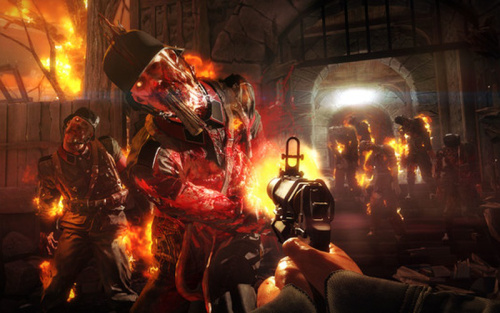
The Wolfenstein franchise returns once again with Wolfenstein II: The New Colossus, but the Wolfenstein series has a long, and at times bizarre, history. We look back on the weird and the wonderful from this World War II based video game series. Starting with…


Castle Wolfenstein (Atari 8-bit, Commodore 64)

Castle Wolfenstein is a stealth-based action game where players control an American operative during World War Two, who must infiltrate the titular castle in order to steal secret Nazi plans. The game is played in a top down perspective and requires the player to use stealth and cunning to reach their objective.


Beyond Castle Wolfenstein (Atari 8-bit, Apple II, Commodore 64, MS-DOS)

In Beyond Castle Wolfenstein the player once again takes on the role of an American spy, who this time must infiltrate a secret Nazi bunker where Hitler is in meetings with his senior staff. The player must retrieve a bomb, and place it outside the room that Hitler is in.


Wolfenstein 3D (MS-DOS)

The first game in the series to make the jump to first person shooter, Wolfenstein 3D sees the player take on the role of B.J. Blazcowicz for the first time, as he escapes from the Nazi prison Castle Wolfenstein. Wolfenstein 3D is widely considered to having helped birth the first person shooter genre as we know it.


Wolfenstein: Spear of Destiny (MS-DOS)

An expansion to Wolfenstein 3D, Wolfenstein: Spear of Destiny once again plays as B.J. Blazkowicz, though this time before the events of the previous game. This time B.J. must retrieve the mythical Spear of Destiny from the Nazis after its theft from Versailles.


Return to Castle Wolfenstein (PS2, Xbox, Microsoft Windows, Mac OS)

A loose reboot of the series, Return to Castle Wolfenstein is the first game in the series to introduce a supernatural element to the franchise. After being captured by Nazis, B.J. and another allied spy, Agent One, are imprisoned in Castle Wolfenstein, which is being used by the SS Paranormal Division to conduct experiments. Escaping from the castle, B.J. discovers that the Nazis are experimenting to resurrect their dead, and must find a way to stop them.


Wolfenstein: Enemy Territory (Linux, Mac Universal, Windows, Morph OS)

Wolfenstein: Enemy Territory is a standalone multiplayer expansion set within the Wolfenstein universe. Without a storyline or single player campaign the game purely focuses on player vs player combat.


Wolfenstein RPG (Java ME, BREW, iOS)

Wolfenstein RPG is a first person turn-based role-play game that takes on a lighter and more comical tone, replacing Nazis with mutant chickens. Once again playing as B.J. Blazkowicz, the player must escape his captors at Castle Wolfenstein and destroy the Paranormal Division before they can destroy the world.


Wolfenstein (PS3, Xbox 360, Windows)

Another reboot of the franchise, Wolfenstein sees Office of Secret Actions agent B.J. Blazkowicz discovering a piece of an ancient medallion containing supernatural powers. With the Nazis searching for more pieces of the medallion in order to access the Black Sun Dimension in order to gain powers that will give them the upper hand in the war, B.J. must find a way to stop their plans.


Wolfenstein: The New Order (PS3, PS4, Xbox 360, Xbox One, Windows)

A sequel to Wolfenstein, with the Nazis using the powers gained from the Black Sun Dimension to shift the war in their favour, B.J. Blazkowicz is sent on a mission to eliminate General Deathshead. When the mission fails B.J. is sent into a coma for 14 years, waking to find the Nazis in control of the world. Joining forces with the resistance B.J. fights to find a way to being down the Nazi regime.


Wolfenstein: The Old Blood (PS4, Xbox One, Windows)

A prequel to Wolfenstein: The New Order, Wolfenstein: The Old Blood is a loose remake of Return to Castle Wolfenstein, which sees B.J. Blazkowicz and Agent One infiltrating Castle Wolfenstein in order to retrieve a top secret folder that contains the location of General Deathshead. The mission goes wrong and Agent One is killed, though B.J. is able to escape. Joining up with a local resistance he must track down a Nazi scientist in order to find the information that will lead him to Deathshead.


Go to Amy's Blog

Tuesday, 31 October 2017

The Walking Dead ‘Mercy’ Review


Originally published on Set The Tape

The Walking Dead returns for its eighth season with the promise of ‘all out war’, and jumps straight into proceedings. Whilst the series is known for taking it’s time to reach certain decisions, or to develop storylines (some viewers also call this time wasting), the first episodes of seasons go out of their way to give the audience something big, and whilst this episode does lack some of the energy and ferocity of the previous seasons finale, it does at least deliver the start of the promised war.

The episode spends a lot of time jumping around within events, to the point where it becomes almost impossible to tell what order things actually happened. We have Rick (Andrew Lincoln) giving a rousing speech to the assembled masses of Alexandria, Hilltop, and the Kingdom, a speech that is delivered in pieces throughout the episode, even right up to the end. This is intercut with Rick’s daydreams of his future, as well as closeup shots of his teary eyes and sweaty forehead.

Whilst some may feel that this adds something to the episode, I can’t help but feel that it detracts from the overall momentum of the proceedings. Surely a rousing speech from Rick before they go into battle would be more effective than a speech delivered disjointed over 40 minutes? It would be like getting the Independence Day or Braveheart speeches split over half an hour, it wouldn’t have helped those films, and it doesn’t help this episode.

The Walking Dead has tried a lot in the past to be more than just a horror series, and sometimes it does manage to do this, but other times it feels like the show is trying to force itself to be better than it is. Decisions about how a story is edited seem to be made because the creators feel that it will make the series appear deeper and classier than it is, and often lead to duller episodes because of this.


There are some good aspects of the episode, however, this review isn’t just going to be me bad mouthing it. There are some good character moments that are subtly weaved throughout the narrative, such as Michonne (Danai Gurira) telling Carl (Chandler Riggs) that he’s in charge of protecting Alexandria, Rick telling Maggie (Lauren Cohen) that he’ll be looking to her as a leader once they’ve beaten Negan (Jeffery Dean Morgan), and the subtle look that Ezekiel (Khary Payton) given to Carol (Melissa McBride) when they’re reunited.

The episode manages to convey a lot about these characters, where they are in these moments and how they see the future, with very little dialogue, and it actually manages to be subtle and meaningful without trying too hard.

The plan that Rick and the others have is still not clear (why not just shoot Negan straight away instead of luring a horde of walkers?), but it becomes clear by the end of the episode that the assault on the Sanctuary is just the beginning stages of a larger plan, with the group having split up to attack other Saviour outposts and facilities in the final moments. It will be at least a week, possibly longer, before we see the full scope of their plan, which actually starts to pay into the promise of all out war.

The choice to pad out the episode with Rick’s daydreams about his future feel slightly off, and add to the pacing issues the episode experiences. Rick appears to have aged about twenty years, all gray hair, bussy bearded and walking with a stick, whilst Michonne looks no different, and Judith appears to have only aged about six years. Hopefully this is something that will only appear in the first episode and won’t be repeated throughout the season.

Despite some pacing issues at the start of the episode ‘Mercy’ manages to deliver an entertaining piece of television before the end credits role, and creates enough mystery and intrigue going into the second episode to keep audiences engaged.


Go to Amy's Blog

Supergirl ‘Triggers’ Review


Originally published on Set The Tape

The second episode of the latest season of Supergirl continues a lot of the themes from the first episode, continuing to explore the effect of losing Mon-El (Chris Wood) has had on Kara (Melissa Benoist). Whilst the first episode explored her loss through her anger, this week we get to see the fear and guilt that Kara feels, and how this ties into past trauma in her life.

Thanks to the villain of the week, the psychic bank robber Psi (Yael Grobglas), drawing Kara’s fear to the surface we get to see our hero more vulnerable and hurt that we have in the past. Whilst this begins as simple moments of claustrophobia, growing to her reliving the destruction of Krypton and the death of her family, before culminating in her literally on her knees weeping because she’s convinced Mon-El is dead because she sent him away, these moments have a huge impact, driving home that despite getting past her anger in the last episode she’s still nowhere near back to being okay.

Whilst Psi is an incredibly forgettable villain, with very two-dimensional motivations and an almost non-existent backstory, she acts more as a plot device to get Kara to the point where she acknowledges her fears and her trauma.

Being the only CW DC Universe show with a central female lead (sadly Legends of Tomorrow doesn’t count even though Sara is the leader because it’s a team show) it’s always been important that the show portrays its hero in a strong way. Whilst initially it may seem counter productive to have your hero on her knees crying with grief, doing so to then have her sister remind her just how strong a person she is so that she can overcome these fears to stop the bad guy is possible one of the most heroic moments the CW has given us. It may not have the flash and spectacle of her doing something spectacular (it lacks the awe of her lifting a submarine into the air like in last week’s episode) but it makes her stronger in a much more important way.


This episode also continued to explore the character of Samantha Arias (Odette Annable) and, most importantly, ties her into Kara’s world by the end of the episode. Whilst I was initially wondering if we’d simply be following her life completely separately from the main cast until her eventual transformation into Reign, it was a pleasant surprise that the final moments of the episode made her a part of Kara’s world.

With Maggie Sawyer (Floriana Lima) no longer being a series regular for the third season I’ve been waiting for something bad to happen to her to ruin her marriage to Alex (Chyler Leigh), and it may be possible that we see the beginning of that this episode. When Maggie reveals to Alex that she doesn’t want to have children you can see a definite moment of worry on Alex’s face. Will this lead to more? Is this the start of the end for the couple? I hope not, but with Lima no longer a regular cast member I can’t help but worry.

Despite only being in the episode for a small amount, ‘Triggers’ also sets an exciting new direction for J’onn (David Harewood) as he received a psychic message from M’gann M’orrz (Sharon Leal), calling him back to Mars. After having J’onn taking a back seat to run the D.E.O., and some fun character moments such as this week’s argument of band vs DJ, it’s exciting to know that the show will be giving J’onn some big and emotionally heavy stories very soon into the season.

Despite having a very throw away villain, and perhaps making the Samantha segments too dull, the episode manages to show a weakness that Kara has been hiding since day one, and a level of strength that makes her incredibly powerful. Simply for the moments where she faces her own past trauma and the loss of Mon-El alone, this is an unmissable episode.


Go to Amy's Blog

Power Rangers Ninja Steel ‘The Adventures of Redbot’ Review


Originally published on Set The Tape

After giving us one good episode last week, Power Rangers Ninja Steel is back to its usual fare of awful episodes, this week focusing on Redbot (Byron Coll). With so little characterisation having actually been given over to the Power Rangers, the heroes of the show, it makes no sense at all to give the spotlight to a side character.

This is the modern equivalent of having an episode of Mighty Morphin Power Rangers focus purely on Alpha-5, something that even then they knew wouldn’t work. The original seasons were very flawed, but they knew that if you wanted to give the robot sidekick some room to grow you had to do it as the B-plot of the episode whilst the Rangers took the spotlight. Here, however, Redbot barges his way to the forefront of the episode, and it’s much weaker for it.

During the course of the episode we learn that Redbot has his own blog, where he has been telling stories of the Power Rangers’ adventures, but putting himself in the role of the hero. When publisher comes to town wanting to turn his stories into a book Redbot becomes something of a celebrity.

The main conflict comes when the Rangers, and eventually the public, learn that Redbot has been lying about his stories, turning his fans against him. Meanwhile, the villains have hatched a plan to put a spell on Redbot’s books, freezing anyone holding one. This is accomplished by the monster of the week, Cat O’Clock (Charlie McDermott).


One of the things that Power Rangers Ninja Steel has going for it is some great monster designs, from the visually imposing such as Galvanax (Richard Simpson), to the ridiculous like last episode’s Phonepanzee (Simon McKinney). Cat O’Clock definitely falls into the same category as Phonepanzee, of being so ridiculous to be great. Unfortunately, the character isn’t given a great deal to do, and the gimmick of him freezing people with his clock powers feels like a missed opportunity.

As with many of the Power Rangers Ninja Steel episodes, I’m left wondering just how much better the monsters would have been in Shuriken Sentai Ninninger; the Sentai series the Ranger footage was taken from. Sadly, much of the monster is wasted in this episode, with a very standard and boring fight scene and Mega-Zord sequence that does little to stand out against other monsters of the season.

The episode even fails to land a consistent moral message for the child audience. Instead of sticking to the idea that telling lies, even small ones, will catch you out in the end and that you shouldn’t do it, the episode tells children that one good deed can erase dozens of lies and make people love you and want your autograph. It’s bad even for this season of Power Rangers.

Power Rangers can do better than this, the previous version of the show, Power Rangers Dino Charge, was excellent, and the monthly comic printed through BOOM! is still easily the best Mighty Morphin Power Rangers story ever told. Unfortunately, Power Rangers Ninja Steel continues to let its audience down with flat, boring characters, missed opportunities, and dull, dull writing.


Go to Amy's Blog

Should Star Wars Rebels Be Coming To An End?


Originally published on Set The Tape

Short answer to the question in the header: No.

Okay, in all seriousness, let’s have a proper discussion about Star Wars Rebels and if it should be ending with its fourth season.

At Star Wars Celebration 2017 the creator and producer of Star Wars Rebels, Dave Filoni, announced that the series would be coming to an end with season four. While I’m sad to see a show that I love come to an end, there are some reasons why bringing it to a close is a good thing.

With the show being set before the events of Star War: A New Hope and charting the creation of the rebellion as we know it, it always felt like there would be some kind of definitive ending to the series. Now that the end has officially been announced it means that the series has a definitive ending, something that the Star Wars: The Clone Wars never had.

Ending the show on their own terms means that Star Wars Rebels will be able to bring the story of the Ghost crew to the end that they want.


Many fans have speculated that the series would have something of a bleak ending, suspecting that both Kanan and Ezra would be unlikely to make it out of the show alive as Luke is referred to as the ‘last of the Jedi’ by a number of characters who would have been aware of Kanan and Ezra.

We know that Hera and Chopper survive the end of the series due to Chopper appearing in both Rogue One and the second season of The Freemaker Adventures, and Hera being mentioned in Rogue One and also appearing in Freemakers. Despite this reassurance that at least two of our characters will survive the events of the final season, there are still characters that fans are desperate to know their fate.

By bringing the show to a conclusion at least fans will finally have these questions answered.

Dave Filoni has already said that the final season will have a darker tone than the rest of Rebels. Considering some of the darker storylines that the show has had in the past, such as the reunion between Ahsoka Tano and Darth Vader/Anakin Skywalker at the end of the second season, and how bleak an ending Disney managed to produce with Rogue One’s 12A age rating, there could be a number of deaths coming at the end of season four.


As much as I love the characters and the story of Star Wars Rebels, having the show end will finally answer the questions that have been awaiting an answer since the series began.

The end of Rebels would not necessarily mean the end of the characters or their stories. We know that Hera will go on to be an important general in the rebel alliance, and that Chopper will still be with her. The end of the series doesn’t have to be the end of Rebels. The characters can go on to appear in other series (such as some have done in both Forces of Destiny and Freemaker Adventures), they can have novels focusing on them, or they could even go on to appear in the upcoming films.

Yes, it will be sad to see a show I love come to an end, but ending on a high note, bringing their story to the end that they want, it means that the series can end in a satisfying way; one that will maintain the quality that we’ve come to expect from them. The end of Rebels will be sad, but I’m sure it’ll be satisfying too.


Go to Amy's Blog

Star Trek: Discovery ‘Lethe’ Review


Originally published on Set The Tape

Star Trek: Discovery continues to build its own interesting interpretation of the Star Trek universe as it adds character backstory, as well as hinting a more familiar aspects of the franchise.

The opening moments of the episode embody a lot of what the series is about, and the things that are dividing fans over how they feel about the show. Michael Burnham (Sonequa Martin-Green) not only mentions the Constitution Class starship but the most famous one of all time, the Enterprise. Captain Lorca (Jason Isaacs) and Lt. Tyler (Shazad Latif) get to shoot Klingons on a holodeck. Sarek (James Frain) gets his shuttle bombed by a Vulcan Logical Extremist terrorist.

The Enterprise namedrop is fan service, pure and simple, though it does add to the idea that Discovery is part of the larger Star Trek franchise, not just it’s own separate entity. The appearance of a holodeck will annoy some, as this technology isn’t supposed to be around yet; however, the Discovery is a super advanced science/warship, so if any ship is going to have one it’s the Discovery.

The introduction of Vulcan terrorists is something that doesn’t seem to fit with the original version of the Vulcans, especially with the hopeful original series outlook on the future, but feels very much at home in a series that plays on a lot of modern fears of terrorism, war, and racial purity.

Whilst some may dislike Star Trek: Discovery for these kinds of decisions, I can’t help but feel that it helps make this new depiction of the Star Trek universe feel like a more layered and interesting place. Star Trek can’t just be an adventure of the week show exploring new planets anymore, it needs to tell stories that the audience can identify with and relate to, and this episode does that in spades.

The war with the Klingons is pushed to the backburner as we spend some time learning more about our characters, Burnham and Lorca in particular, seeing that they’re both quite tragic and damaged people. Through her connection to Sarek, Burnham learns that her adoptive father was put in a horrible position in the past, forced to choose only one of this not quite Vulcan children, Burnham and Spock, to go through into the Vulcan Expeditionary Group.


Whilst James Frain played a very stereotypical Vulcan in the first two episodes of the series we get to see him bring so much more to Sarek here. The subtle, barely controlled anger, shame, and guilt that he feels for essentially betraying his adoptive daughter by choosing to favour his biological son, the refusal to talk about the matter afterwards; it gives an incredibly nuanced performance in what would have been very cold and robotic with another actor.

These scenes not only give us a closer look into Burnham’s past, showing how much more emotional and human she has become since living on Vulcan, but also give her the opportunity to grow as a character, with a clear difference between her at the start of the episode and by the end.

We also learn throughout the episode that Captain Lorca is a lot more damaged than we were already led to believe. We learnt in the last episode that he killed his former crew rather than let them fall into Klingon hands, and that he’s refusing to fix his eyes as punishment for this, but here we see that he’s suffering on a much deeper level.

When his friend, Admiral Cornwell (Jayne Brook) visits him on the Destiny to tell him off for launching his rescue mission for Sarek we discover that she’s also there to find out if Lorca is really fit for duty, using her past as his friend, and as a psychologist, to see if he’s suffering from PTSD following the events of the last episode. Whilst initially able to allay her fears, even getting the Admiral into bed with him, we see that Lorca is far from fine, pinning Cornwell to the bed and shoving a phaser into her face when she wakes him.

We’ve had damaged captains on Star Trek in the past, Jean-Luc Picard and his trauma with the Borg, Benjamin Sisko and the loss of his wife, but we’ve never seen a leader so broken and psychologically traumatised as Lorca. The scene where he pins Cornwell down and holds a weapon to her is shocking, and a genuine surprise, and Cornwell makes us realise that perhaps he only slept with her to try to make her think he was okay, and perhaps the same when he assures her he would get help.

This idea that Lorca is a manipulator isn’t something new, and is compounded further when he suggests that Cornwell take Sarek’s place on his mission to hold peace talks with the Klingons. Did Lorca guide Cornwell into a scenario he believed could lead to her capture or death to save his command?

‘Lethe’ manages to deliver some of the best character development the series has given so far, and continues to set the series apart from other Star Trek shows of the past. With so much back story still to be explored, and now the added possibility of having to save Admiral Cornwell, Star Trek: Discovery continues to allow itself room to grow whilst delivering high quality television.


Go to Amy's Blog

Stranger Things: Season 1 Review


Leave a Comment on Stranger Things: Season 1 Review
I didn’t watch Stranger Things when it first came out. In fact, I only watched it a few weeks ago, after months of people praising the series and raving about how good it was. This meant that by the time that I actually got to watch the show there was so much expectation that it needed to deliver on.

Stranger Things follows the story of several members of the town of Hawkins following the disappearance of a young boy called Will. When investigations into his disappearance reveal a government conspiracy, a child with psychic abilities, and monsters from another world, the story quickly embraces the horror and sci-fi stylings of the decade that featured in so many beloved 80’s films.

From the look of the locations and costumes, to the way scenes are shot and the score reminiscent of John Carpenter, the series very much feels like a product of the decade it’s set in (though obviously with much more impressive visual effects).

Whilst many of the people I knew who were heaping praise upon the series were doing so for being ‘scary’ or for being ‘so 80’s’, I found that it was the emotional story at the centre of the show and the characters that made Stranger Things enjoyable to watch. The story was good, and unfolded at a relatively fine pace, but the first few episodes were definitely the weakest, and if it wasn’t for the characters themselves I may not have stuck around for the rest of the show.


The main adult cast of Winona Ryder and David Harbour are brilliant, with Ryder playing a very real and at times heartbreaking depiction of a mother being torn apart after the loss of her son. As the season progresses it’s nice to see how her initially slightly antagonistic relationship with Harbour’s police chief Hopper changes to one where they feel like a great team. Hopper may be one of the most interesting characters on the show; one who goes from being unlikable, to one that you feel a deep sadness for, before ending as someone that you’re desperate to know more about.

The stand-outs amongst the cast have to be the children, however, who managed to wow on more than one occasion. Whilst not being in the show a great deal, Noah Schnapp played Will with a sense of innocence and sweetness in the few scenes that he did have. Caleb McLaughlin was great as the sceptic of the group, whilst Gaten Matarazzo was laugh out loud funny as the ever enthusiastic Dustin.

Despite the whole cast being great, Finn Wolfhard and Millie Bobby Brown were amazing as Mike and Eleven respectively. A great deal of the series very much centred on the relationship between the two of them, and seeing the relationship that developed between them was incredibly heartwarming, despite being heartbreaking by the end of the final episode.


Even though Eleven had hardly any dialogue, she was played to perfection by Millie Bobby Brown, who conveyed more emotion and character development with body language and her eyes than actors many years her senior.

One of the other things that benefitted Stranger Things was the shorter season length. Whilst other shows rely on 10, 13, or even 22 episode seasons Stranger things had the sense to know that it didn’t need to stretch out its story. It told its story and was happy to do so within a shorter time. Not only did this mean that the story moved at a fairly brisk pace, but it didn’t overstay its welcome.

Stranger Things is a competent and well made series with great performances and an engaging story that continues to have its fan base grow as more people recommend the series to others. I am intrigued, however, to see how the series will progress into a second season. Will the story and characters continue to grow in a natural and interesting way, or will it overstay its welcome?


Go to Amy's Blog

Monday, 30 October 2017

Gotham Recasts Poison Ivy For Season Four


The Fox superhero series Gotham has recast Poison Ivy for the second time for it's fourth season. The iconic Batman character was originally played by Clare Foley before the decision was made to age the character to adulthood, recasting her with Maggie Geha. It has today been announced that the part has been recast with Flash actor Peyton List in the role.

After falling out of favour with both Penguin and Selina Kyle in recent events, Ivy finds herself in a florist's with some chemical compounds designed to give her more powers and abilities.

A statement from Gotham's producers accompanying the recasting announcement confirms that the change in actor is related to this alteration in Ivy's powers.

'In the continuing evolution of Poison Ivy's origin story, Ivy Pepper has been transformed once again taking another step towards becoming the Ivy we know from the comics. Dangerous. A live wire of energy. She'll set her sights on Gotham, intent on making the city her own green paradise.'


Go to Amy's Blog