Tuesday, 12 April 2016

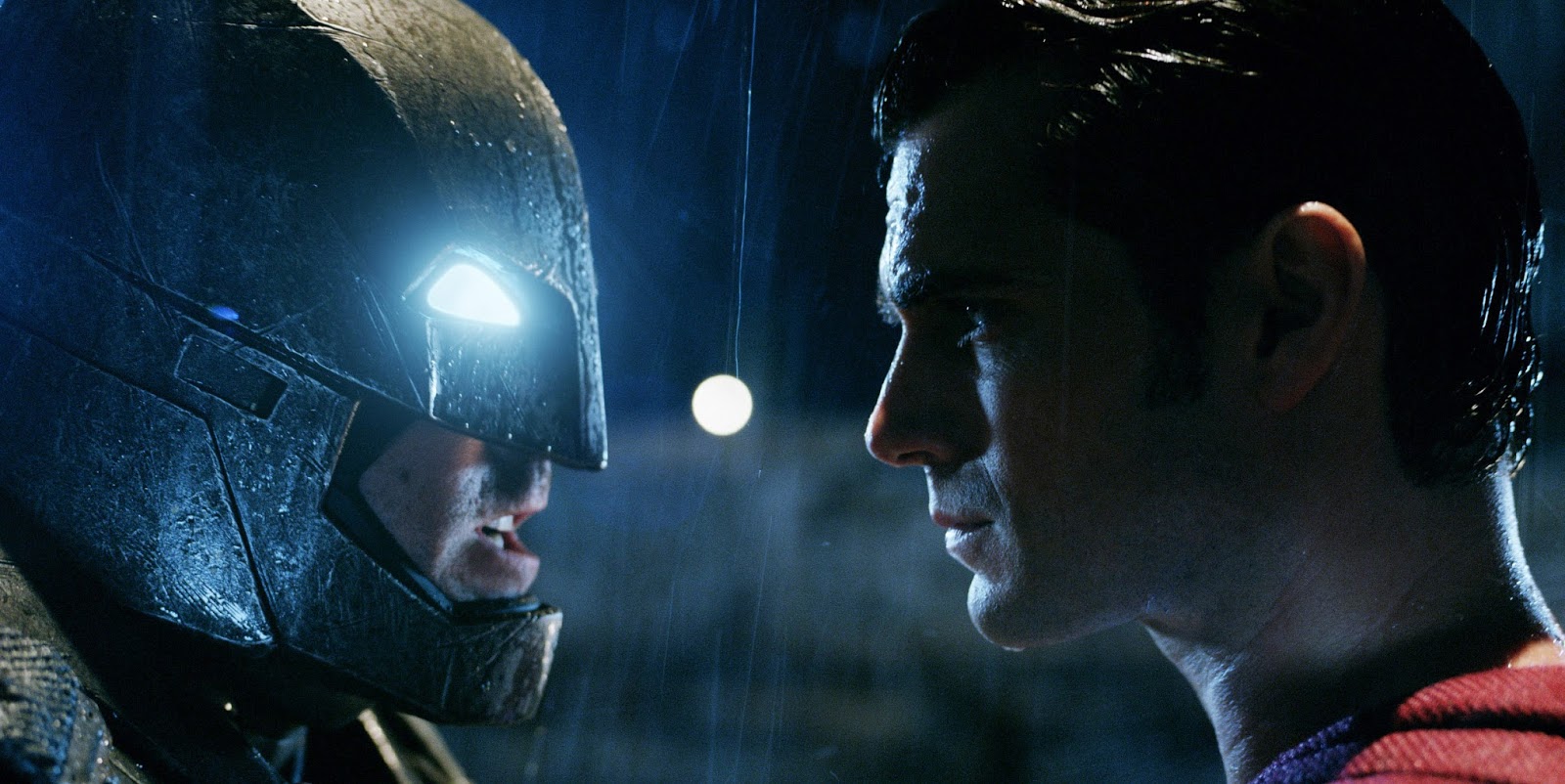
'Batman V Superman: Dawn of Justice' Review


This review WILL CONTAIN SPOILERS for the film to be discussed, if you do not want certain plot points or story spoilt, please do not read further.


What can be said about this film that hasn't been said a dozen times over by other reviewers, critics and audience members?  'Batman V Superman: Dawn of Justice' is a terrible movie.  It's plot is dull and unimaginative, with moments that make no sense either individually or as part of a whole.  The characters have little to no development and make bizarre choices.  The action is dull and the effects that accompany them are bland at best.

I like the DC universe, it's got some of my favourite characters and stories, but this film fails to capture any of the things that make the comics great in exchange for a shallow film that is more concerned with establishing its own universe before it's ready.  

If this film was just a focus on Batman and Superman then perhaps it would have been a lot better than it was, but with the plot being focused around establishing the Justice League and giving hints of the franchise's villains it's overly bloated and without focus.

The basic idea of Batman feeling threatened by the power that Superman has and could one day use against people makes sense, though the degree at which he pursues his vendetta against Superman makes very little sense.  We know that this is a Batman long into his career, who has lost at least one Robin, but to see a depiction of Batman that is so ready and eagre to commit murder is still jarring to watch, despite previous versions of the character having done so in film before.

On the reverse side, we're given a Superman even more grim and unfriendly than in Man of Steel.  Superman is one of those heroes who isn't human, but has so much humanity and caring inside of him that he's the best of all of us.  In this film we're given an aloof, standoffish god who seems only mildly interested in saving people, who's happy to float in the sky and watch people calling for help or allows people to flood around him in worship.


This version of Superman fails to capture any of the essence of the character in any way that even the Clark Kent scenes (all of about three of them) give nothing extra to the character.  The scenes with Lois have no chemistry between the two of them and feel awkward more than anything else, and it's impossible to tell anything about his role at the Daily Planet.  Is he a good reporter?  Does he get the freedom to explore his own stories like Lois?  Is he well thought of?

There's no character development for the man at all, he's reduced to being a plot device.  His role is to be the target of Batman and Lex's anger throughout the film, and the thing that drives Batman to assemble the Justice League.  He's not a player in this story, he's just a pawn being moved around the board to be sacrificed for the greater goal.

The most meaningful thing that Superman does in this film is to get himself killed just to motivate Batman, and even that comes from a stupid decision.  He knows that Kryptonite weapons weaken him, but chooses to use to go up against Doomsday rather than give the weapon to Wonder Woman, someone who had already proven she was more than competent to take on the monster.  But that just highlights my point, Superman is allowed to make a poor choice because it allows for his death, which allows for the next part of the studios plan to build their own movie universe.

The plan that Warner Brothers seems to have makes no real sense either though, rather than imitating the Marvel method of introducing each team member in their own films, to build up their characters before bringing them all together they're doing it the other way around.  I can't see this working, it means that rather than just bringing together characters we already know and setting up a big villain before the climax, they have to do all of that plus introduce at least three characters with very distinct and separate characters to the audience.  I can't see it working at all.

The scenes with the flash forward or premonition to a world destroyed by Superman and Darkseid might be visually interesting, but they feel out of place here, especially in the middle of the film.  It's like they accidentally put the post credits scene in the wrong place.  The Parademons look great, but other than that these scenes did nothing to excite me, and the Flash looked so terrible that at first I didn't even realise it was supposed to be him.  It says a lot about a film when the tv version of a character looks better than a big budget counterpart.

The film had some issues with it's villain too, namely the fact that Lex Luthor is absolutely terrible.  The casting of Jesse Eisenberg is just stupid, he plays the character as annoying and at times downright idiotic.  The scenes at the library benefit and the speech he gave were so cringeworthy and off-putting it made me hate a character I usually love.  Seriously, what the hell was the point of the jar of piss?  A jar of piss!

The whole film was just a terrible experience from start to finish, with no redeeming qualities.  It tried to shoehorn in as many different characters and ideas to the point that the film feels cluttered and bloated but with no actual substance or real story.

I find it hard to understand how some people are giving this film positive reviews as I have failed to find any redeeming feature in it what would make me want to give it a second viewing, let alone a positive review.  Warner Brothers have made a very serious mistake with this film, and it's one I'm expecting them to keep making as they make more DC movies.


Amy.
xx

Powerpuff Girls Transgender Unicorn Episode Not A Good Thing


The following article is purely my opinion, based on how I felt watching the episode, it may differ from your own opinions.  What I am presenting here are my own thoughts only, and as such it should be viewed not as 100% universal, but just one view amongst many.

One of the new episodes of The Powerpuff Girls features a 'transgender' unicorn character called Donny, who is a horse that believes he is a unicorn and has the girls help him attain his goal.  Whilst the show is trying to send a message about transgender people, I found that it went and did the opposite.

The series executive producer Nick Jennings spoke about the episode and said, 'Basically when we start out, he's a pony, but he wants to be a unicorn.  He has to go through a transformation to become a unicorn so it's a whole, 'What are you on the inside?  What are you on the outside?  How do you identify yourself?  How do people see you?'  There's a lot of subtext to that.'

'I don't think you can be too young to start talking about those issues and those things and just presenting an attitude, a voice that is going to resonate with people.'

For first main issue is this, why go through the whole scenario of a horse who believes he's a unicorn?  I get that it's a metaphor, but why not just have a trans character instead?  Clearly the creators don't think that their audience are too young to be learning about and thinking about gender, so just talk about it rather than using a metaphor.  Trans people exist, we're not metaphors.

I found the actual content of the episode itself to be contradictory to the idea of expressing a pro-trans message that the creators say they were trying to convey.  When we first see Donny he's wearing a horn to be a unicorn and Buttercup immediately rips off the horn, says he's not a real unicorn and reduces him to tears.

So, essentially what we have here is one of the heroes confronting our trans character and saying that they are fake, that despite trying to make himself look like a unicorn he's not.  To me, seeing her rip off his horn and call him out is no different than seeing someone pulling off a trans woman's wig and calling her a man.

Does this mean that Buttercup is taking the place of a transphobe or someone that abuses trans people?  It certainly looks that way, and she's the hero!  What kind of message is that telling children about accepting someone's gender identity?

When Bubbles tries to get the Professor to help Donnie there's a whole big scene about the multiple dangerous side effects of undergoing such a transformation, at which point Donnie ignores all of these dangers and immediately signs under a big red 'Forever'.

When I saw this part of the episode it looked like the writers were trying to say that trans people are so desperate to sign up for medical procedures that 'last forever' that we ignore dangers to do it.  Whilst there can be some dangers in medical transition it's wrong and misleading to portray it like this.  There's no real greater danger in changing gender than there is in many other medical procedures, don't go and make out that trans people rush into unsafe medical procedures because that's just plain not true.

When Donnie goes through with his transformation things go wrong and he transforms into a monster, a literal monster and goes on a rampage.  What exactly is the message here, that if you try to change your body you will become a monster?  Are they trying to say that trans people are somehow monsters?

Add into this the fact that characters, including members of the Powerpuff Girls themselves, call Donnie a freak more than once at this point and I can't see it as anything positive.  The message they're conveying is, if you change your body to try and match who you are inside you will be seen as a 'freak' and a monster.

Add onto this the fact that at the end of the episode it turns out Donnie was a unicorn all along and gets changed back into his true self, what's the point of this episode.  Donnie isn't a horse who wants to be a unicorn, he's already a unicorn.  The message at the end is 'be who you were born as'.

The episode might have been made to comment on gender, but I really don't think it was trying to make a good point.  Donnie is mocked for trying to be who he feels he is, he signs up for dangerous medical procedures without a car, he becomes a monster and gets called a freak, and the end message is 'don't try to change yourself'.

Like I said at the start, this is only my personal opinion, but I do not see this as a positive message about trans people hidden behind a metaphor, I think it's an incredibly negative message about trans people.  I'm extremely disappointed in this episode, but it just seems to add to a history of the show mocking trans characters and queer coding villains.


Amy.
xx

Germaine Greer Thinks It's Unfair For Trans Women To Marry Women


Speaking on the Australian debate show 'Q and A' well known trans-exclusionary feminist Germaine Greer made yet more controversial comments about the existence of transgender women, and made claims that it is wrong for lesbian relationships with trans women to exist.

One of the members of the audience, Steph D'Souza, asked Greer why she believed that transgender women are not 'real women', stating that she had previously drawn strength from the writer's work but has found her opinions of trans women to be troubling.  She pointed out to Greer that her belief in a 'real woman' is the same kind of essentialism that she once spoke out against.

When she responded it at first looked like she might be reversing her opinions on the transgender community.

'When I first was thinking about what is a woman, I fell for the usual view that women were people with two Xs and men were people with an X and a Y, which made life nice and easy for me.  I now realise that I was wrong.'

Rather than saying that she believes that transgender people exist, she went on to talk about intersex people.  Highlighting the existence of people who are intersex and understanding the struggles that they face is important, and Greer seems to understand that.  However, it was not long before she turned the conversation towards trans bashing once again.

'If you decide that you are uncomfortable in a masculine system which turns boys into men, often at great cost to themselves, if you are unhappy with that it doesn't mean that you belong at the other end of the spectrum,'

When asked about the fact that transgender people knowing that they have been born the wrong sex Greer replied, 'But you can't know that.  You don't know what the other sex is.'

One of her fellow panelists responded to her comment, saying that trans people know and feel that they were born into the wrong body, which was met with Greer pulling faces and rolling her eyes.

Greer went on to say that belief in an idea is not the same as knowing something, before adding, 'Women are constantly being told that they are not satisfactory as women, that other people make better women than they do.  The woman of the year may be Caitlyn Jenner, which makes the rest of the female population of the world feel slightly wry.'

'I don't believe that a man who has lived for forty years as a man, and has had children with a woman, and has enjoyed the unpaid services of a wife that most women will never know, then decides that the whole time he's been a woman and at that point I'd like to say hang on a minute, you believed you were a woman but you married another woman and that wasn't fair was it?'

Whilst it is unsurprising that Greer is once again openly bashing transgender women, from questioning our very existence by saying you cannot know if you are the wrong sex, to saying she would openly disbelieve someone saying their trans there is one thing about her comments that did take me by surprise.  Her feeling it's not fair for trans women to marry cis women.

One of the arguments I often see between members of the transgender community and trans-exclusionary feminists is the idea that trans lesbians do not exist, and cis women in relationships with trans women should not call themselves lesbians either.  It would appear that Greer feels the same way too, or perhaps has a problem with lesbian marriage as a whole.

It's interesting that throughout all of this though, that she never once commented on the question of whether she was acting in the same way as people who once dictated what women should be.  The fact that she continually demands women conform to some kind of biology that not all women do, or that they should behave or act certain ways indicates that she believes she has some kind of right to tell women what 'real women' are.

At one time Germaine Greer might have been a good feminist force working towards the betterment of all women, but it is becoming clearer that those days have passed her by, that her views and opinions are outdated and unpopular, and that even those who once saw her in high regard are starting to see her in a less than favourable light.  Perhaps it's time that Ms Greer shut up about trans women and went away before she loses what little respect some people still have for her.


Amy.
xx

Monday, 11 April 2016

Arrow '11:59' Review


This review WILL CONTAIN SPOILERS for the episode to be discussed, if you do not want certain plot points or story spoilt, please do not read further.


Okay, I'm going to get this off my chest straight off the bat, I do not like this episode.  It started well, had some great character moments and some cool action sequences, but the end ruined this episode.  It has ruined this season for me.  And judging from reactions on the Internet I'm not the only one who feels this way.  The reason for this anger?

This is the point where I say spoiler alert just to make sure you really want to know.  Still here?  Okay then.  This episode is bad because it kills off one of the best characters in the series in a completely pointless and terrible way just to service the story of the main character.

Laurel Lance, aka Black Canary, is killed by series villain Damien Darhk, who once again has his magic powers back.  After getting to play through some extremely complex character arcs and show some of the best growth of any of the characters on the show (possibly the only character to have this kind of growth) she's killed in order for Darhk to hurt her father and Oliver.

As a review of the episode this isn't really the place to go into details about just how bad a problem Arrow has with writing women, and how often they seem to 'fridge women', I actually gave a whole separate piece to that here, but it's impossible to talk about this episode without talking about the problem with killing off Laurel.

Aside from the fact that it is yet another instance of a female character suffering for the benefit of Oliver Queen, Laurel has been one of the most interesting characters in the whole life of the show, and her role as Black Canary has not only been one of the best facets of her character, but also one with an almost 70 year history in the comics.  To add insult to injury, her television death happened on the same week as the characters birthday in the comics.


Other than the killing of Laurel, the episode follows events as Darhk hatches a plan in prison to get his magic back, by getting Merlyn to steal it from Oliver and the team.

Part of the plan involves Diggle's brother, who we saw meeting with Merlyn at the end of the last episode.  When this episode picks up Andy confides in Diggle that Malcolm approached him and gets the team to help him to 'disrupt' Merlyn's plans.

As Oliver, Diggle and Andy prevent as group of assassins from stealing several missiles from a military convoy Merlyn and some of of the members of the League of Assassins still loyal to him infiltrate the bunker and confront Thea and Laurel before making off with Darhk's idol.

Despite Andy taking an arrow to protect Oliver, Oliver is distrustful of him and is convinced that he's working with Merlyn and Darhk, an accusation that drives a wedge between Oliver and Diggle.  The confrontation between the two of them is one of the more interesting parts of the episode, and really puts a strain on the two two men who have more than once called each other brothers.

It's a dynamic that would have been worth spending some time exploring over more than one episode, but when the heroes go to prevent Darhk from breaking out of prison it turns out that Andy was indeed working for the bad guys and gives Darhk the missing piece of the idol he needed to get his magic back.  Whilst the double cross is something of a surprise, and creates an interesting situation for Diggle going forwards, but it stops the drama of Oliver and him being at odds with each other.

The final moments of the episode are spent between Oliver and Laurel in the hospital moments before she dies, where she tells Oliver that she loves him, but is happy that he has Felicity in his life (servicing the Olicity fans over the comic book fans perhaps?) and asks Oliver to do her a favour, though we don't get to hear what that favour is.

Some people are speculating that Laurel is still going to be alive, and that she asked Oliver to help fake her death.  But why would she do that, to what end would faking her death help anyone?  She's seen her father go through the pain of losing Sarah more than once, and would never do that to Quentin.  I might have been wrong about who was in the coffin, but at this point I really doubt that it's a fake out and think that Laurel is gone for good.

'11:59' is the worst episode of this season, and makes a terrible mistake of killing off one of the best characters in the series for no good reason other than the writers not knowing what to do with her.  Arrow has angered a lot of fans with this move, and I am one of them.


Amy.
xx

Sunday, 10 April 2016

Legends of Tomorrow 'Progeny' Review


This review WILL CONTAIN SPOILERS for the episode to be discussed, if you do not want certain plot points or story spoilt, please do not read further.


After two weeks in the past Legends of Tomorrow takes us further into the future than we've ever been before, to the year 2147, just a few years before Savage launches his bid to take over the world.  Instead of targeting Savage, the team has come to stop Per Degaton, a teenage boy who will grow up to become a dictator that will kill millions and set the stage for Savage's rise to power.

The episode essentially has a go at the classic time travel question, 'if you could kill Hitler as a baby, would you?'.  

Whilst this dilemma may in theory introduce some degree of drama, it hinges upon the idea that any of our group of heroes would willingly kill a child, even if they are destined to become a murderer.  The thing is, our team are all decent people, even Captain Cold has proven that he's moved beyond the point of willingly killing anymore, having already let Mick live when he was intending to kill him.

Even when the team kidnap Per Degaton and Rip takes him out into the middle of nowhere to execute him there was never a doubt that he would back down.  It was briefly mentioned, but I think Rip coming to terms with the idea that there's a line he won't cross in his mission to get his family back rather than whether or not he'd actually kill a child.

For a man who has made it his mission to change history to save the lives of the people that he loves the most, and has done so pretty questionable things in the mission, to suddenly realise that there's some things he won't do to that end is a big moment for him.


It's not just Rip who's facing personal crisis in the future, however, as Ray discovers that his technology has gone on to be used by his descendants to create Atom robots that are used as autonomous law enforcement, and will go on to be used by Savage in his bids to take over the world.

Rather than being worried that his technology is being used by a genocidal maniac, Ray seems to focus on the fact that it would appear that he has a child that he doesn't know about back in 2016.  It's a bit of a relief that by the end of the episode we find out that Ray isn't actually a father, but that it's his brother's descendants who have gone on to produce the Atom robots.  Yes, it's a giant steal from the amazing Futurama episode 'The Luck of The Fryish', but at least it prevents Ray from moping around thinking that he might be an absent father.

Whilst Ray is dealing with these issues Kendra is having vivid flashbacks to her former life, particularly the time when she and Carter had a son, Aldus Boardman from earlier in the season.  It's nice to see Falk Hentschel back playing Carter again, but Kendra feeling like she is cheating on Carter with Ray would make more sense if he was still alive, and if her and Ray hadn't been in a relationship for two years at this point. 

The big fight towards the end of the episode is perhaps one of the shows most ambitious and best, especially as the team aren't just fighting soldiers but flying robots too.  The visual effects are on top form and show off just what television super heroics are capable of when given the chance.

As is becoming quite common with Legends, the best scenes in the episode fall to Captain Cold and Heatwave.  With Mick still locked up aboard the Waverider wanting revenge against Cold the rest of the team try to encourage Snart to go talk to his former friend.


Rather than trying to talk Mick around to being his old self again Cold just makes a deal with him, he opens up the cell and the two of them fight.  Having nearly beaten each other to a pulp Mick gets the upper hand but doesn't kill Cold, having lost his desire for revenge.  With Mick seemingly given up on wanting to kill his former teammates it looks like he might be back on the team again, plus he goes on to warn the others that because he's failed as Chronos the Time Masters will be sending more people to hunt them all down.

The realisation that the team try to change things for the better, but ends up bringing about Per Degaton's rise to power several years sooner is a sad moment, and you can see the events weighing heavily on Rip.

So far the team has struggled to stop Savage, and their latest attempt has even gone on to help him.  It's an episode that highlights the dangers of time travel and how things can go horribly wrong when altering history.


Amy.
xx

Saturday, 9 April 2016

Supernatural 'Hell's Angel' Review


This review WILL CONTAIN SPOILERS for the episode to be discussed, if you do not want certain plot points or story spoilt, please do not read further.


Supernatural finally gets back to the main season arc this week as the Winchesters team up with Crowley and Rowena (yes, Rowena's back!) to take on Lucifer.

What's kind of surprising about this episode is that after ten seasons with no mention of the Hand of God weapons we get the third one already in the form of the Horn of Joshua.  It makes sense that the series has created mystical WMD's in order to take on an enemy like the Darkness, but for these things to be so rare yet pop up again so quickly kind of goes against the notion of them being almost unheard of.

That being said, Crowley manages to track down another of the Hand of God weapons and makes a deal to team up with the Winchesters in order to use it on Lucifer.  A lot of the episode is given over to the three of them as they argue over the plan, with Sam and Dean wanting to exorcise Lucifer after he beats the Darkness, and Crowley wanting him dead immediately.  When the three of them are contacted by Rowena they realise that they will be able to use her and the codex to remove Lucifer from Castiel and agree to attempt a rescue.  

It turns out that despite having her neck broken by Lucifer Rowena is still alive, having used her magical know how to place an artifact inside her body that will repair her body in the event of her death.  Guess it's a really good thing for her that Lucifer only snapped her neck rather than exploding her like everyone else.

Getting Rowena back is a fairly unexpected but welcome development.  The show has a terrible history as far as killing off side characters goes, and Rowena was such an enjoyable addition to the series that killing her off when they did would have been another mistake on the part of the writers.

Working together, Sam, Dean, Crowley and Rowena summon Lucifer and trap him inside a ring of angel fire, trying to cast Lucifer out of Castiel's body.  When things don't work Crowley tries to give Castiel a hand, by going inside Castiel too.


The inside of Castiel's mind and the confrontation that follows is an interesting idea, I love the fact that Cas is just hanging out in the Winchester's kitchen, but Cas just sitting around trying to watch tv whilst Lucifer does whatever he wants feels a little odd.  I'd have rather of seen Castiel in more of a prisoner role fighting to get out rather than as someone who seems to have lost all interest in the outside world.

Maybe Lucifer is causing this disconnect in Castiel, maybe he's keeping him in this strange stupor, but if that's the case it's not been explained at all.  As it is Castiel seems much weaker as a character now as ht's been portrayed as someone who just doesn't care, which is really not who he is, especially considering the only reason he let Lucifer in was because he cared about beating Amara.

Unfortunately for the Winchesters, the attempt to get Cas back fails, just in time for Amara to arrive.  Putting their differences aside for the moment the group gives Lucifer the Horn of Joshua to use on Amara, but the weapon has no effect on her. 

Amara captures Lucifer and leaves the Winchesters and Crowley trying to figure out just how they might be able to defeat her.

Despite not a lot happening in the episode (seriously, most of it is Crowley arguing with Sam and Dean) a surprising amount actually happens.  Rowena comes back, Lucifer takes over heaven, Castiel is stuck inside Lucifer, Amara withstands a Hand of God and Lucifer is taken captive.  With so much happening in one episode and so little time left until the end of the season it's starting to look a little doubtful that the Winchesters are going to find a way of defeating Amara this season.  With season twelve coming up, is Amara going to carry across into the next season?


Amy.
xx

Friday, 8 April 2016

Agents of S.H.I.E.L.D. 'Spacetime' Review


This review WILL CONTAIN SPOILERS for the episode to be discussed, if you do not want certain plot points or story spoilt, please do not read further.


Last week Agents of S.H.I.E.L.D. tried to give us a personal story between Mack and his brother and fell slightly short of what they were hoping to achieve, in 'Spacetime' the series delivers a real personal story that not only has great action and intrigue, but delivers one of the series most poignant stories.

When a homeless Inhuman man with the ability to show people visions of the future is captured by Hydra it's up to the team to try and mount a rescue attempt, but things are complicated by the fact that Daisy has seen a vision of the future where the rescue mission goes horribly wrong and Coulson shoots her.

The whole vision of the future thing has been done before on other shows, a lot, but it really, really works well on S.H.I.E.L.D..  At lot of that's down to some excellent writing that relied on the reactions of the characters to drive the story forward rather than time high jinks.

I particularly enjoyed watching how Fitz continually butted heads with the other members of the team when trying to make them realise that the future is set once it's been seen and can't be changed.  the best thing about it was that throughout it all he was right.  Everything Daisy saw in her vision of the future actually happened, even if it wasn't what she thought it was when she first saw it.

The team might not have been able to change the future, but it didn't stop them from trying.  The scenes where they practised storming the security room over and over again were a lot more fun than you would first think, especially with bad arse Melinda May doing half hearted kicks at Simmons because she didn't want to accidentally hurt her.

As Fitzz predicted, the future can't be avoided and when May was ready to go on the mission something happens to prevent her going, the return of Andrew.  To be honest, I wasn't expecting his return to the series so quickly, I thought we'd have May and the team trying to hunt down and capture Lash again, so Andrew suddenly walking into the base came as a shock.

But it worked, it was the one thing that would conceivably keep her from going on the mission, and the scenes between the two of them were well written and well acted as May saw her husband for what could very well be the last time.  It's nice when Ming Na gets given these kind of scenes, as it can become very easy for the writers to fall into the trap of just having her as the stoic warrior, rather than giving her range and emotional scenes.


The Hydra developments this week are particularly interesting as we see Hive taking a much more active role now that he has rejuvenated his host body.  Decked out in a swanky matrix outfit he's started to lead Malick down an interesting path, encouraging the Hydra leader to get his hands dirty and kill for himself.

The scenes with Malick in the power armour add a neat twist as we get to see him actually do something other than make plans and act menacingly, and whilst there was no real danger of her actually dying his rooftop fight with Daisy was certainly eventful.  Also, the moment where he crushes a mans head was particularly gruesome.

The biggest development from the whole episode has to be the fact that the team are aware that Ward is back, and it's nice to see that Fitzz and Coulson immediately made the right assumption that he's a host for Hive, rather than playing a 'how could he be alive' type of plot.

'Spacetime' does the trying to change the future plot with a lot of style, humour and some genuinely tense moments that manages to deliver one of the best episode of S.H.I.E.L.D. in a long time.


Amy.
xx

Arrow, Stop Fridging Your Women


The idea of putting women in danger simply as a way of progressing a male character or furthering their story isn't something that's new, it's been around for thousands of years, but you would hope that as we move into a more progressive world that recognises that more than just cis white men can be heroes and strong characters that this trope would start to die out.

As it is it's so prevalent in our culture that more often than not it happens in almost every film, television, book or game franchise at one point or another.  This has been a particular problem in the comic book industry, and is where the term 'women in fridges' comes from.

For those not in the know, 'women in fridges' is a term that was coined by the popular and talented comic book writer Gail Simone, and references #54 of the third volume of the DC title Green Lantern.  In this issue, the new Green Lantern Kyle Rayner returns home to find his girlfriend Alex dead, her body mutilated and twisted into a fridge.

This use of death or injury to female characters in the comics industry was a big problem at the time, and Simone and her supporters compiled a frankly embarrassing list that showed just how many female characters were victims of this mindset.  Thankfully some of these attitudes have started to change in comics, and we are even seeing more and more female driven books as well.

Unfortunately it would seem that the writers and creators of the comic book television show Arrow are still stuck in this mindset that requires their female characters to suffer in order to progress the story of their male lead.

This problem is not a new one, and has been happening over the shows previous seasons, but reached a head this week in the episode '11:59', where long running character Laurel Lance, Black Canary, was killed off.

Whilst a lot of fans were angry with this new development because it has taken away a fan favourite character, and a character with a long and popular comic book history, her death highlights a serious problem within the show, one that is making it increasingly difficult to watch.  Namely, that the writers seem to only be able to give Oliver character development by hurting and killing the women around him.

This might take a little while to go over, because the list is very long, but please bear with me as I try to look back over some of the fridging Arrow has done over the last four seasons.

Laurel Lance - Okay, let's get this one out of the way first as it's the most recent and the most important to this piece.  Killing Laurel has been only the latest in a long line of bad things that have happened to the character.  She's believed her sister dead, her boyfriend died in her arms, she became an alcoholic, then her sister died for real, despite all of these developments, though, Laurel became an incredibly strong character.

Laurel took all of the pain that she lived through over these early season and channeled it into becoming Black Canary.  Yes, a lot of the things that she went through were personal to her, but some of them were also plots to further Oliver's character, such as the death of Sara.

After four seasons of watching Laurel go from jaded girlfriend to grief stricken alcoholic to strong career woman and hero to lose her in such a pointless way that we have is not only an insult to her character but to the viewers too.

Felicity Smoak - Whilst Felicity has been used as a fairly classic 'damsel in distress' more than once, with Oliver having to literally save her from a villain, her character was recently crippled.  Being attacked and shot by a number of the villain's henchmen as a way of getting back at Oliver for standing up to him her injury was used as a way to hurt the main character and drive him forward.

Felicity's injury has apparently been 'cured' with a macguffin that lets her walk again, so the events have hardly had an affect on her and her character's story.  She was only wheelchair bound for a few weeks, so in the grand scheme of things her 'paralysis' was more a minor inconvenience rather than a story that gave her any real depth or development.

Her injury was purely a way of punishing the lead character, by hurting 'his woman', something that like death is a major part of the problem with women in fridges and the tropes that surround it.

Thea Queen - Last season Thea was murdered by the season's villain Ra's al Ghul in a plot to force Oliver to join the League of Assassins.  She was attacked, beaten and stabbed through the chest with a sword simply to further the story of Oliver joining the bad guys.

Yes, Thea's death was temporary and she's alive again, but that doesn't take away from the fact that her very violent death still happened, and that it was done, yet again, in service of a man's story.  Since then the character has suffered with a 'bloodlust' and almost dying a second time, all in the name of giving Oliver something for him to blame himself over.

Moira Queen - Over the course of the first two seasons Oliver's mother Moira proved to be one of the more interesting characters in the series.  In season one she appeared to be one of the villains, but had a more complex story than first appeared, and in season two she went through a lengthy trial and eventual run to become mayor.

Towards the end of the season Moira reveals to Oliver that she's aware that he's the Green Arrow, which opens up the show to move into new and interesting territory as it moves to make Oliver's mother the mayor.  No sooner have the characters had this conversation when Moira is stabbed and killed by Deathstroke in front of Oliver to punish him for his past deeds.

Just as the show was giving the character new and interesting development she was killed purely as a way of hurting Oliver and driving his motivations in the final fight with Deathstroke.

Sara Lance - Initially being just a minor character in flashbacks, the reveal that Sara Lance was alive and was the Black Canary was exciting for fans, and season two established her as a strong, competent and powerful warrior that was easily an equal to Oliver.

In the third season she had barely returned to the series when she was shot with several arrows and thrown off a rooftop and killed.  Over the course of the season we find out that her death was orchestrated by a villain who did it in order to engineer a plot that would pit Oliver against the League of Assassins.

Whilst the death of Sarah led to Laurel becoming her own version of the Black Canary, and Sarah's death was later undone, her actual murder was done purely as a way of putting Oliver into a dangerous situation and drive his story forward, not that of Laurel or her father.

Shado - Introduced in the flashbacks in season one she became romantically involved with Oliver on the island during the course of the second season, before she was shot in the head and killed by Dr Ivo in an attempt to get at Oliver.  Shado's death would also go on to be a catalyst for the conflict between Oliver and Deathstroke.

Over the course of the season there have been other acts of violence towards female characters that whilst they may not be directly influencing Oliver's story, come across as either needlessly violent or wholly unnecessary, such as the death of Tatsu Yamashiro (Katana) husband and son, as well as the sudden death of Amanda Waller and the long term imprisonment of Nyssa al Ghul.

Like I said before, the idea of violence against women and the death of female characters as a way of furthering the story or the development of male characters is not a new thing, and is certainly not a problem wholly with Arrow itself, but the basic fact remains that this show has a horrible history when it comes to putting it's female characters in these kind of roles.

The series executive producer Marc Guggenheim spoke about the choice to kill off Laurel and had this to say, 'We recognise that it upsets a lot of fans, particularly the comic book fans.  In the comics, Dinah Lance and Oliver Queen are in a romance together in various iterations.  To some people, that is considered canonical and iconic.  We respect that, but at the same time we've always made no bones about the fact that we are telling our own version of the Green Arrow mythos....  But it made the most creative sense for us going forward despite the fact that we love Katie.  Every time we've killed off a character on the show, it's really been  for the effect on all the characters left behind.'

From the flash forwards we've already had this season to Laurel's funeral we know that one affect of her death comes in the form of Felicity telling Oliver to kill Damien Darhk in response to him killing Laurel.  After years of Oliver making a point not to kill people anymore this seems to be a lazy way of pushing the character into a situation where he has to examine his own rules and face the idea of becoming a killer again.

So once again it would appear that Laurel's death is here as a plot device to tell a story about Oliver at the expense of a strong female characters life.

I'm sure some people will be scratching their heads and asking what the problem is here, they'll look at the show and say that it's a show about violence and death and suffering are to be expected for these characters, and whilst that is true, to simply dismiss the argument that Arrow has been poorly treating its female characters overlooks an underlying problem with the series, and outdated storytelling tropes on a whole.

Oliver Queen can be an interesting character without watching the women in his life being hurt and killed.  He can have growth and development without blaming himself for the injury and deaths of the women in his life.  To simply fall back on these tropes to tell your story you're not only creating a weak version of Green Arrow, you're alienating a large number of fans as well as perpetuating outdated misogynistic approaches to storytelling.


Amy.
xx

Thursday, 7 April 2016

Female Star Wars Lead Angers Anti-Feminists


Today the amazing new trailer for the next Star Wars film 'Rogue One: A Star Wars Story' was released and was met with both positive and negative reactions.

For those that are happy about the film 'Rogue One' is something to be excited for.  Set before the events of 'A New Hope' the film follows a group of rebel soldiers as they try to steal the plans for the original Death Star.  It will be telling a smaller story than 'The Force Awakens' that focuses on the soldiers of the rebellion rather than the generals and the Jedi's.  It will be recreating the visual aesthetic of the original trilogy.  And Darth Vader will be returning to the big screen.

However, some people have an issue with what they've already seen, namely the fact that the lead character is a woman, and that the supporting cast includes people of colour.

Many took to social media to complain about the fact that the series is embracing a female lead for a second time and wanting to promote diversity in it's cast and characters.


As a fan of the Star Wars series, and not just limited to the films, I think that the new film looks amazing and the cast look fantastic.  The Star Wars universe has been full of amazing female character for years, whether it's Leia, Mara Jade, Bastilla Shan or Ahsoka Tano the series has always had strong women involved.

But apparently having two Star Wars films in a row that have a woman at the centre of the cast is too much for some 'fans'.

Well, then you're not really fans are you?  You might think lightsabers are cool, or think that a Wookie would be great to hang out with, but if you're against diversity then why are you into Star Wars?

Whether it's the Rebel Alliance in the original trilogy or the Senate and the Jedi Order in the prequel trilogy the heroes of these films have been about different genders, races and species coming together and overcoming adversity.

The Empire is about putting humans on top.  They make aliens second class citizens, they have slavery.  They're the ones who don't want diversity and equality.  And that's you.

If you feel that a cast that has a female lead and people of colour in the cast has 'ruined' Star Wars for you, good, because it means Star Wars isn't for you.  You're the Empire, and like the Rebels, us Star Wars fans don't want you around anymore.


Amy.
xx

Baldur's Gate Studio Responds To Trans Character Harassment


Beamdog, development studio behind the widely popular Baldur's Gate game series, have today released a statement following the online criticism around the game's new expansion 'Siege of Dragonspear' and its inclusion of a transgender character.

CEO Trent Oster has hit back at those criticising the game and condemned those who have harassed and insulted members of the development staff, particularly writer Amber Scott.

'While we appreciate all feedback we receive from our fans, both positive as well as negative, some of the negative feedback has focused not on Siege of Dragonspear but on individual developers at Beamdog, to the point of online threats and harassment.

'I just want to make myself crystal clear that Beamdog does not condone this behaviour, and moreover that it will not have the desired effect as we stand behind all of our developers 100%.  We created the game as a group, and going forward we will be working on the game's issues as a group, which I believe is exactly as it should be.

'We've received feedback around Mizhena, a supporting character who reveals she is transgender.  In retrospect, it would have been better served if we had introduced a transgender character with more development.  This is a lesson we will be carrying forward in our development as creators and we will be improving this character in a future update.'

Some of the feedback that he is referring to relates to a number of people who have complained that the introduction of a trans character is a bad thing because the character is 'badly written', though complaining about one small conversation about choosing their own name because they're trans has less to do with being badly written and more to do with people not wanting a trans character in the game to begin with.

To say that characters from certain groups or minorities should not be present unless they are 'well written' or 'have a point' is a poor argument as so many characters in every medium would suddenly disappear because, well not every character is well written.  Whilst it would have been good to have a trans character with a ton of backstory and a great narrative that really gives them the time to shine it doesn't mean that one side character who is trans is a bad thing.

There is such a broad mix of people in the world, all from different backgrounds with different stories that to only display this kind of range in central characters who are given this kind of depth and attention to detail would paint a very untrue picture of the world, even a fictional world.  People are varied, characters in games should be varied too, big and small characters.

Ed Greenwood, an author who has worked on many D&D games, took to Facebook to support Beamdog's inclusion of a transgender character and point out the ridiculouness of the arguments people have made against it.  'D&D has half-orcs, and half-dragons, and half-elves, and has magic items that specifically change gender, right there in the rules.  Surely, if you can handle the basic notion of cross-species sex, having a full variety of gender roles should be something that doesn't blow your mind.'


Amy.
xx