Wednesday, 19 July 2023

The Comic Cave - Batman: Prey


The Comic Cave is a regular feature where we spin the Wheel of Comics and see what graphic novel story it brings up for us to deep dive into! This week we take a look at Batman: Prey, a story set in the early days of Batman's career that reintroduced Hugo Strange following the events of Crisis on Infinite Earths.


It's not bold or innovative of me to say that Batman: Year One changed Batman forever (I'd be a hack and a liar if I tried to claim I'm the first to say that). When the Frank Miller penned origin story was released it reinvented the character in a big way. Miller had already shocked readers with The Dark Knight Returns the year before, and it had given a new darker, grittier take on Batman, but Batman: Year One firmly cemented that type of Batman story into the main DC timeline. 

People loved this take on the character, and wanted more stories like that. But, DC wasn't prepared to regress Batman back in time, erasing characters like Nightwing and Robin, and removing his relationships with other heroes. Instead, they launched Batman: Legends of the Dark Knight, a series that would explore Batman's early career, stripping him down to basics and showing new origin stories for some of his rogues. The series, with its rotating writers and artists, would become a showcase for talent, and would become so popular that it would run for more than two hundred issues. 

The third story to be released was Batman: Prey, and was the best of the series at that point. Batman: Shaman had kicked things off, and was an interesting if flawed dive into a story set in part around the same time as Batman: Year One, and Batman: Gothic would see Batman going up against an undying man hundreds of years old who made a deal with the devil in a book that's very Grant Morrison. And whilst these stories were very good, and would go on to become cult favourites, Batman: Prey felt like something very different, a story that wasn't trying to cash in on Batman: Year One, and wasn't incorporating the fantastical. Instead, it was a straight forward Batman story.

As the story begins several members of the GCPD are in the middle of a drugs bust when their target tries to run. Unfortunately for him, Batman is also on the scene, and the masked vigilante grabs him, takes him onto a nearby cinema marquee, and interrogates him before throwing him back to the police. This scene makes it clear to readers that this is a Batman who does not get on with the cops. The officers are pissed that he's questioning a suspect, seem as intent to arrest him as the other guy, and Batman even tosses the criminal to them with a dismissive 'Here, I'm done with him.'. This is very much a city that still distrusts the idea of a Batman, where a lot of people aren't even sure if he's real or not, and his only real ally is Captain James Gordon.

Batman witnesses this mistrust play out in the court of public opinion as the mayor, Gordon, and famed psychologist Hugo Strange appear on a late night talk show where they're asked to talk about the Batman. It's here that we meet Hugo Strange for the first time since Crisis on Infinite Earths and get to see what the character is like in this new timeline. Strange first appeared in 1940, in Detective Comics issue 36, where he was a criminal scientist who used his knowledge to help his gang perform robberies. After that, he appeared in the very first issue of Batman, later that same year, where he escapes prison and turns his henchmen into hulking monsters to take on Batman. He would appear several times over the years, and would go through some changes in the 70's, but would always be presented as a mad scientist who uses his knowledge to change and mutate people into creatures.

Batman: Prey ignores everything that came before, and reinvents Strange for a then modern reader. The mad scientist working in his lab was replaced with a doctor of the mind. Strange begins the story as a media personality, coming onto TV to give an armchair diagnosis of Gotham's vigilante; an analysis that is a bit hit and miss, but does nail a few things. He deduces that Batman is obsessive, that he has a mistrust of other people, is obsessed with darkness, the night, and vengeance. He even figures out that he's been driven by the loss of a loved one in a violent crime in the dark. Of course, all of this gets to Bruce, who ends up crushing the glass he's holding as he watches the show. 

These theories lead to Strange being recruited as an adviser for a new police task force with the express mission of taking Batman into custody; a task force that Gordon is placed in charge of live on TV. This puts Gordon into a difficult position, as he genuinely believes that Batman is doing good in the city, is helping the people of Gotham; his feelings are further muddied by the fact that Batman saved his son during the events of Batman: Year One. To this end Gordon tries to fill the task force with officers that he thinks won't be good enough to actually bring Batman down, and his first pick is Sergeant Cort. Cort hates Batman, but is a by the book officer who won't go against the law; someone that Gordon thinks he can control.

As the story progresses, however, Cort begins to become more and more enraged with the hunt for Batman, and his rage leads him to Hugo Strange, who sees the burning passion within Cort and realises that he can use it to his own ends. Strange has become determined to bring Batman in so that he can study him and eventually publish a book on the man; a book that Strange believes will make him famous. He's become so obsessed by the idea that he's made his own Batman costume, one with a cowl that looks like a modified bondage mask. He parades around his apartment in the costume, talking about how he's going to bring Batman down, bragging to his sex doll that he's got sitting in his living room like a real person. Yep, turns out this new Hugo Strange is a bit unhinged. 

One thing that I'll give the book a lot of credit for, it doesn't have Strange try to fight Batman whilst wearing the suit. They'll eventually have a confrontation whilst he's wearing it, but it isn't a physical one. Doug Moench knows that Strange needs to be a character that uses his mind, not his physicality, and the story works all the better for that. And he does use his mind against Batman. He uses his theories to investigate into previous crimes in Gotham, and with a drug induced clue from Batman, manages to figure out that he's actually Bruce Wayne. He then breaks into Wayne Manor and sets up a series of dummies dressed like Thomas and Martha that play recorded messages when Bruce comes home, messages where they tell him that it's his fault they're dead, and that they're ashamed of him.

This tactic actually shakes Batman quite badly, and in his mania he even ends up hitting Alfred. It's perhaps one of the first times in Batman's career that he's been hurt like this by one of his enemies, and it's an event that is sure to change Batman going forward, making him even more closed off against such things. Unfortunately for him, it's not just his mind that's under attack, as Strange is using Cort to break Batman down in other ways. Having used hypnosis on him, Cort is convinced to become Night-Scourge, a masked vigilante hunting and killing criminals. The media uses these incidents to turn Gotham against Batman, blaming him for the violence, and for inspiring other vigilantes. Strange uses Cort to break support for Batman and to damage his already shaky reputation. Plus, Cort gets to become a physical challenge for Batman to have to overcome.

This dual attack on Batman's mind and his body would be a trope that readers will see many times over the coming decades, and has become a firmly established trope for the character; and whilst Batman: Prey wasn't the first to do this it might be the first one to do it this well. The story established this firmly in readers minds, and the way that these attacks come very close to breaking Batman means that it has become one of the go-to plots for villains.

But this isn't the only thing that Batman: Prey establishes for the new universe. This story also introduces two very important elements for the character, the Batsignal and the Batmobile. As Gotham is turning against Batman he's left with one person he can go to, one man who might be able to help him, Captain Gordon. With Gordon willing to help Batman he needs a way of contacting him, at which Batman suggests a signal. Later in the book Gordon heads up to the roof of the GCPD, where he drapes a fabric bat on one of the spotlights, creating a proto-Batsignal. I really enjoyed the idea of Gordon creating a signal that he can quickly remove and hide whilst he's still a captain and can't give the go-ahead for a permanent signal. During the book Bruce spends time in the cave working on 'the car', and we see this engine inside a rough frame sitting in the background. Throughout the book he keeps mentioning how he needs better ways of getting around rather than using gliders, or just running home, but it's not until after his breakdown at the Manor that the finish vehicle is revealed in all it's glory; Bruce having finished it during his self imposed lock down in the cave. It's a cool moment, and one that makes for a decent origin for the Batmobile.

The book's art, by Paul Gulacy, Terry Austin, and Steve Oliff (who provided the pencils, inks, and colours respectively) is very much art of the era. If you've read late 80's Batman you've seen this kind of art before. But, it's also a really great example of this kind of style. It's perhaps the best that Batman: Legends of the Dark Knight has offered up to this point, and is packed with some fantastic moments. The art team do a wonderful job with the expressions and emotions of the characters, and the times when Strange begins to go mad during a rant, Cort turns into a violent thug, and Batman begins to spiral into madness when he returns home to find Strange's present are all very well done. The book has some great action moments too, and some of these scenes really stand out as being very well put together. One of the more inventive is one where Batman fights a criminal in his home bar, which sees the two of them smashing chairs into each other, using broken bottles as weapons, and a shotgun being brought out. There's not really a single moment in the book that looks bad, and that's very impressive.

Batman: Prey is a brilliant example of an early Batman story, a book that strips Batman back to the most basic, and challenges him in interesting ways. It brings back a classic villain and reinvents him in such a way that this is how people think of Hugo Strange now (he even keeps putting the Batman costume on because of this story). I'd also believe that this story is in part responsible for the early success of Batman: Legends of the Dark Knight, and helped to show people that it was a series worth reading. If you're a fan of Batman but don't always enjoy masses of continuity, or an extended Bat Family, Batman: Prey is something that you should definitely pick up.


Batman: Prey was originally published in Batman: Legends of the Dark Knight from September 1990 - February 1991.


Support Amy on Patreon

Buy Amy A Coffee

Go to Amy's Blog

Tuesday, 18 July 2023

The Flash: The Official Movie Companion - Book Review


'Take an action-packed journey into the cinematic world of The Flash with this comprehensive collection of stunning images, behind-the-scenes stories, and interviews from the upcoming, highly anticipated film and its comic origins.

'Keep pace with the Fastest Man Alive with this compendium of facts and incredible images from the Super Hero's landmark film debut! The Flash Visual Companion satisfies your need for cinematic speed on every page, with making-of details and behind-the-scenes profiles of the characters, locations, and artefacts seen on screen, as well as an exploration of the Scarlet Speedster in comics, television, and beyond.

'Interviews with key cast and crew members, including Ben Affleck, Michael Keaton, Ezra Miller, and more offer a one-of-a-kind look at the creation of the new film as well as the character's history on the page. The perfect gift for every fan who's been waiting for DC's iconic Scarlet Speedster to take the lead in a film of his own.'

I'm a fan of DC comics, and both Wally West and Barry Allen are in my top ten read comic book characters, 5th and 6th place respectively. Having read close to eight hundred comics with them in (and more than 1,300 if you include other speedsters like Jay Garrick and Bart Allen) I've been a fan of The Flash for a while, and was excited to see the character up on the big screen. I'm sure it's going to upset some 'passionate' fans to say this, but I was somewhat disappointed by what we got in both versions of The Justice League, and my excitement for the solo Flash movie fell; something that would only worsen when we started to see and hear more about the film before its release. But, as a fan of the characters in all of their other incarnations I was still willing to give The Flash: The Official Movie Companion a fair shot.

Having read through various movie companion books in the past I was excited to see some behind the scenes details, to read about how the story was plotted out, to look at all of the design sketches, behind the scenes construction photos, and post production work that went into the movie. Virtually none of this is in this book. Nor is it really about the movie, despite the title saying that. 

The front cover gives this away somewhat, as even though Miller is front and centre in the image there are several other versions of the Flash behind them, including the Injustice game version, the comic counterpart, and the CW television series Flash. The CW Flash, played by Grant Gustin, will appear in this book a lot; as does the series. The back cover of the book, the contents page, and the introduction all show off images of the Flash speeding through Central City, taken from the series. The CW show is featured a fair bit in the first sections of the book, alongside the comics in order to fill out the background for the character and his world.

Topics like Barry getting his powers, the death of his mother, his relationship with Iris, Central City,his allies, and his Rogues all heavily pull from the comics. These sections of the book give those who might be unfamiliar with the character beyond the screen a chance to see what the source material is like; how else are they going to learn about characters like Abra Kadabra and The Turtle? However, this does lead to a pretty big revelation, that the film itself barely covers these things, and that the book needs to draw from other sources in order to fill in and flesh out the world of The Flash, because the movie doesn't.

These sections also end up being quite light on details, with perhaps a paragraph or two on each topic, such as the first Flash, the multiverse, the Flash Museum, and enemies like Grodd getting two of three sentences. Several of his most iconic villains like Captain Cold, Heatwave, Mirror Master, and Captain Boomerang are all thrown into one paragraph and barely get more than a name drop. The books promise of being filled with amazing facts proves to be an empty one for the early stages.

The second and third chapters, titles 'Super-Speed' and 'Flashback!' do at least begin to incorporate more of the film, and start showing some behind-the-scenes stuff. There's a paragraph about how the running scenes were filmed, accompanied by a page of images from the film, three paragraphs about the 'baby shower' scene that comes with some concept art (some of the first in the book), and largest section, with half a page of text, goes to how the Batcycle was made. The third chapter takes more time to talk about the film, chiefly discussing how Barry ends up in the Flashpoint-style timeline, and how they made certain choices for how the two Barry's will interact. Whilst this section puts more emphasis on the film it's information that's very light on real details, and pretty much just tells the reader stuff they saw on the big screen.

The final chapter 'Heroes and Villains' has the most time given over to the movie, but also demonstrates some of the worst aspects of the film; chiefly the reliance on Michael Keaton's Batman for nostalgia purposes and attention. The title page for this chapter is a full page image of Batman, and from here it becomes about Batman, Wayne Manor, the Batcave,the suit and gadgets, the vehicles. It's the most the book seems to have given over to actual behind-the-scenes stuff like concept art and set photos, and it's not even of the Flash. The rest of this chapter is rounded out with Supergirl and the Kryptonians.  

The back of the book boasts interviews, including key cast members such as Keaton, Aflex, and Miller. What are these like? Almost non-existent. There are no segments of the book where you get to read an actual interview, there's no page given over to Miller talking about playing the Flash. Instead, the text incorporates a few word quotes from some of the cast and crew at times. These quotes are spread throughout the book, used to emphasise a point the writer was making, and barely add much. I honestly can't really remember the huge majority of them, and flicking through the book whilst writing this I can't even find any from Miller, or the two Batman actors (though I just might be missing them).

Is The Flash: The Official Movie Companion a good in depth dive into the movie? No. Not at all. Much of the book's contents cover things that aren't even a part of the film, and the bits that do feel more like half page snippets taken from promotional magazine articles. Even as a Flash fan I was struggling to find anything interesting or insightful in the book. The book served to highlight a lot of the issues the film had, whilst providing nothing new or interesting. And with a cover price of £29.99 it feels like a ridiculous price for what it is. I hate to talk badly about books, but this is a book that I'd honestly struggle to recommend to anyone. You can get more info from movie websites and social media, or by going to The Flash on Wikipedia. If you're absolutely desperate to read the book I'd suggest looking for a library copy over the cost of an actual purchase.


Support Amy on Patreon

Buy Amy A Coffee

Go to Amy's Blog

Saturday, 15 July 2023

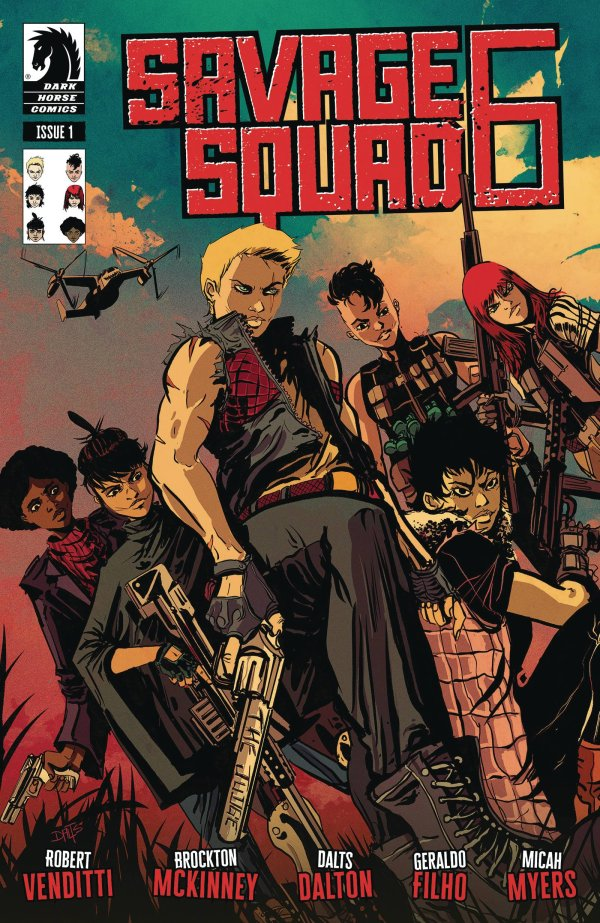
Savage Squad 6 #1 – Comic Review


Originally published on Set The Tape


Savage Squad 6 is the latest comic release from Dark Horse that takes readers to a dark future following a new world war. Set in the year 2037, the world is recovering from World War Three, which has ground society to a halt. A brutal army known as The Scourge rules what’s left of the world, and hunts down the small pockets of civilisation left behind. Every man of fighting age found by The Scourge has been killed, leaving what remains as little threat – or so The Scourge believes.

The Savage Squad are a group of six young women trained to be soldiers sent out to extremely dangerous locations to try to help bring down The Scourge in any way possible. Their latest mission takes them deep into the irradiated countryside around Pripyat, the location of the Chernobyl reactor meltdown some fifty years before. Tasked with finding a special weapon that could help turn the tide against The Scourge, the Savage Squad are ready for anything. Or so they think. Something sinister awaits them in the darkness of Pripyat, something that will push the team to their limits.

The first issue of Savage Squad 6 opens with a group of soldiers in Pripyat being picked off by unseen foes, ripped apart and torn to pieces by something lurking in the shadows. From here we join our central group of characters, six young soldiers unaware that they’re heading into the nightmare that us the reader has just been shown. It’s hard to gauge the age of the group, and the book’s cover makes them look to be in their early twenties, but the interior art has them much more in the mid teens range. With the book’s introduction informing the reader that all men of fighting age have been killed it does raise the question of if the Savage Squad are supposed to be teen soldiers, or if it’s just the artist’s style that makes them look younger.

Speaking of the Squad, we spend much of this first issue getting to know them and seeing bits of their personalities. Nat is the team’s new medic, and is our stand in. She doesn’t know the team, she doesn’t have a handle on their personalities yet, and we get to learn this alongside her as she goes. Cap is the leader of the group, and seems to be the most level headed and reasonable one of them. She seems to have a hard job of keeping some of the extreme personalities in the team working together, but seems to know how to keep things running as smooth as possible.

Shells is the team’s sniper and the one most openly kind towards Nat. She takes the time to bond with her, teaches her a few things about the team, and seems to be one of the first to try to get the others to go easier on Nat. Rosie is the demolitions expert, and fits into the big, muscly, and a bit dumb stereotype that comes with the tank character. She loves to blow things up, and brings it up as much as she can. Hauser is the dick of the team. She’s confrontational towards Nat, acts like a bit of a jerk, but is also one of the toughest of the group being the first to leap into action. Mags seems to be the techy of the team, equipped with some fancy holographic gear, but seems to be the least defined when it comes to personality.

Much of this first issue feels like groundwork, setting up the world and the characters. Because of that, and because the book is trying to set up six main characters, there are some parts that feel light on solid details, and left to fill in the blanks on your own. This isn’t a terrible idea. The is clearly a world with a history, and one that’s directly informing the events of this story. But rather than giving huge infodumps to lay out every single detail and piece of lore, the writers, Robert Venditti, and Brockton McKinney, give you the bullet points and allow you to imagine the rest. It means that the story can still progress at a decent rate, and the reader is somewhat included in the process, with their own imagination doing things like picturing what The Scourge is like.

The art, by newcomer Dalts Dalton, is pretty solid, and has a rough quality to it that works well for the setting. Things have a tough, almost jagged edge to them that fits the scourged planet and the rough and ready soldier women. Each of the women has their own distinct look and design that makes them stand out on the page straight away, which certainly helps the reader to remember who’s who and what their jobs are. Dalton also gets to expand beyond the expected towards the end of the issue when some unusual stuff happens, and the small hints that we see here make you excited to see what kind of art Dalton is going to treat us to in future issues.

Savage Squad 6 has been billed as wanting to bring ‘all the fun and abandon of ’80s-’90s action films to comics’, and this first issue seems to be on its way to doing so. It has a group of rough and tough soldiers for us to follow, and something sinister for them to fight in a remote and hostile environment. With the creator’s quote in mind it’s easy to begin to see where they might have drawn some inspiration from and what they’re giving little winks to, but time will tell if it’s able to fully capture that feeling.


Support Amy on Patreon

Buy Amy A Coffee

Go to Amy's Blog

Friday, 14 July 2023

The Comic Cave – Secret Invasion


Originally published on Set The Tape


The Comic Cave is a bi-weekly feature where we spin the Wheel of Comics and see what graphic novel story it brings up for us to deep dive into! This week we take a look at the Marvel Comics cross-over event Secret Invasion, a story that ushered in The Dark Reign.


There was a time when Marvel Comics used to be light on company wide cross-over events. There was Secret Wars in the mid 80s, along with its sequel, the Infinity Trilogy in the early 90s, and that was about it for the earlier decades of Marvel’s time. However, the early 2000s saw a gradual shift in direction. It began with House of M in 2005, then we had Civil War and World War Hulk a year later (they liked wars that year), and Secret Invasion in 2008.

We then had a years gap as Marvel built up towards Siege, but from there things come thick and fast in the 2010s as we get an event each year with Fear Itself, Avengers vs X-Men, Infinity, AXIS, Secret Wars, Civil War II, Inhumans vs X-Men, Secret Empire, War of the Realms, Empyre, King in Black, Devils Reign, and so on. It’s fair to say that Marvel got event fever, and whilst they’d saturate their universe with such events (the ones named are just the big ones and there are more that happened) one that’s fondly remembered by readers is Secret Invasion by Brian Michael Bendis, Leinil Yu, Laura Martin, Emily Warren, and Christina Strain.

Compared to a lot of the big named events, which tend to get a month or two of build-up before hitting shelves, Secret Invasion is a book that seems to have been laying the groundwork for a long while before. In 2005 Bendis launched an Avengers book called The New Avengers that brought together  new team of heroes including Avengers mainstays like Captain America, Iron-Man, and Spider-Woman, but also introduced characters that have never served on an Avengers team, such as Spider-Man, Wolverine, and Luke Cage. During the early issues of the series there are hints that there’s something weird going on in the background of the Marvel universe, that there’s some kind of conspiracy afoot, and it looks like Spider-Woman is a part of it.

Over time these early hints would shift and change, and when going back to re-read these parts after the events of Secret Invasion it doesn’t completely add up or make sense. For example. Spider-Woman is the Skrull Queen, but during the first story arc of The New Avengers is taking orders from Madame Viper, who is a Skrull, Now, we don’t know that about Spider-Woman at this point, and it’s possible that they’re sticking to their cover stories about her being a Hydra agent working for Viper, but it’s pretty clear that the shifty stuff going on here is in reference to Skrulls, and they’re not playing pretend for an audience (except if they know we’re there), so it’s more likely that Bendis hadn’t yet finalised his ideas and figured out at this point that Jessica Drew is the most important Skrull around.

Despite some jankiness like this in the early parts of Bendis’ plans, you can see that he’s moving pieces around the board, and is getting things in place for his big plan. Sadly, it does seem like some of his plans were disrupted by Civil War which forced the creation of two different Avengers teams, as well as removing Steve Rogers from the board fully. But comics are nothing if not an ever evolving medium, and so with a few tweaks Bendis was able to continue with his plans, and was even better able to justify certain things in the build-up to Secret Invasion.

As with the Disney+ television series of the same name, Secret Invasion deals with the alien shape-shifting race the Skrulls, who have been secretly planting their people in key positions around the world in order to facilitate a take over of the planet. Other than that, however, the two couldn’t seem to be more different if they tried (only one episode has aired at this point, but it’s already a thousand miles apart from the book). Whilst the show is treating the story as an espionage tale, where you can never be sure who to trust, the comic forgoes almost every aspect of that very quickly.

The main title, the eight issue series, follows the two Avengers teams, the wanted criminals of the New Avengers, and the government sanctioned Mighty Avengers, as they receive word that a Skrull transport ship is headed towards the Savage Land. Having already learned that the Skrulls have found new ways to mimic humanity, having discovered that the ninja assassin Elektra was replaced, the two teams are convinced that there are more Skrulls out there in hiding, and head to the crashing ship to learn more. At this point we’re not too far out from the events of Civil War, and the two teams absolutely hate each other because of this.

The New Avengers, consisting of Spider-Man, Wolverine, Luke Cage, Iron Fist, Ronin, and Echo are convinced that the government team has been infiltrated by Skrulls, and don’t trust Tony Stark, whilst the Mighty Avengers, Iron-Man, Ms Marvel, The Sentry, Ares, Black Widow, Power Man, and Spider-Woman, hate their former friends for being criminal heroes who won’t register with the government and seem determined to send them to prison.

The events of the Civil War comic were not like the film, and there is a very clear line in the book between right and wrong, and Stark not only crossed it but danced on that line as he performed awful crimes such as building gulags for his enemies. As such, it’s easy to see why tensions are super high at the start of Secret Invasion, but the unfortunate result is a group of people who are supposed to be heroes acting like they want to kill each other constantly, and it starts the book on a really crappy tone.

Upon finding the crashed ship, the Skrull attack begins. Iron-Man and his systems are incapacitated with a virus, which leads to S.H.I.E.L.D. falling apart and the crash of the helicarrier (it wouldn’t be a Bendis event without that thing crashing), The Fantastic Four’s building is destroyed and half the team lost in the Negative Zone, supervillain prisons are broken open, S.W.O.R.D.’s space station is blown apart, and the Thunderbolts facility comes under attack. And then the Skrull ship opens and a bunch of heroes from the 70s come out, including the previous style of Beast, first appearance Wolverine, under-arm webbing Spider-Man, and Steve Rogers’ Captain America.

The reveal of who’s inside the Skrull ship is a great ending to the first issue, as it implies that not only have more people that we suspect may have been replaced, but that it may have happened a lot longer ago than we think. It also raises the possibility for Marvel to do some ret-cons. Don’t like cat Beast? Fine, the real one is back and the cat guy was a Skrull the whole time. Wish that Jean Grey or Steve Rogers was back from the dead? We can do that. Think that Tony Stark has been a massive dick the last few years? No problem, he was a Skrull the whole time. It also offers the chance to add some ‘which is the real one?’ mystery as the two groups come face to face and there are some doubles in each. However, not only does this not happen, but there’s not even an attempt to create tension or mystery.

Once the two groups in the Savage Land start fighting it almost doesn’t stop for the next seven issues. Whilst the Avengers teams are dealing with the fake heroes in the Savage Land until the end of issue five, New York City comes under attack from a Skrull armada that releases hundreds of Super Skrulls that exist to make combos of existing heroes. There are Skrulls that combine Black Bolt and Doctor Strange, one that’s Wolverine, Collosus, and Cyclops in one, and another that’s giant. Every hero or villain that you can come up with is incorporated into these Super Skrulls in some way, and we then spend several issues seeing heroes like the Young Avengers trying to beat them. Eventually there’s a small lull in the constant fighting at issue six that allows the heroes to regroup and launch a final assault against the Skrull army in Central Park.

And then you get the conclusion to the book, a huge fight featuring as many heroes as possible that results in a founding Avenger dead with little fanfare, Norman Osborne getting put in charge of the world’s heroes because he got the kill shot on the Skrull Queen, and the hero community even more fractured than ever before.

Now if you’ve read through that and thought ‘you forgot to mention where in the book everything is explained’, I didn’t, because Secret Invasion doesn’t really bother doing that. The book is essentially an issue of build up, seven issues of crowded, boring fight scenes, and an issue of wrap-up, all of which fail to address how the Skrulls have been doing what they’re doing and why. If you want to know any of that you need to read the tie-ins.

And that’s perhaps the biggest problem that I have with Secret Invasion: the book itself is boring. The story is incredibly thin on the ground, and at times feels like a five issue series stretched out to eight. The pages where the heroes aren’t being dicks to each other are so jam packed with stuff going on that it’s hard to follow at times; there’s no moment that feels like a stand-out action beat because so many panels are so crammed that it puts you off wanting to give them much attention. The really interesting parts of the story happen in other books. So if you’ve heard what the plot is and thought ‘that sounds interesting, I’ll check it out’ you won’t actually get much from the main title. And, something that might not bother everyone but felt pretty bad to me, the heroes kill. Heroes who normally have a no kill rule brutally murder Skrulls because I guess murder doesn’t count when those sentient beings are green. Good job you’re only half Skrull Hulking, otherwise Iron-Man would blow your head to pieces too.

To learn why the Skrulls are doing what they’re doing, and how they’ve managed to better replicate humans you need to read the tie in books for both The Mighty Avengers and The New Avengers, each title having two tie-in books (so four volumes in total). But these aren’t the only tie-ins. There are mini-series for titles such as Inhumans, X-Men, and Spider-Man, though these vary wildly in quality, and tend to tie in to the main event very lightly. Even most of the ongoing books at the time that had to give over several issues to connect to Secret Invasion in some way seem to do so grudgingly. In total there are twenty nine separate graphic novels that cover the entirety of Secret Invasion, yet none of them rank any more than just ‘fine’.

Whilst the writing on Secret Invasion is somewhat ‘questionable’, the art is absolutely a big selling point for the series. The book looks gorgeous. Leinil Yu does a superb job on the art, whilst Laura Martin, Emily Warren, and Christina Strain’s colours make the book dynamic and engaging. Whilst I complained earlier about how messy some of the action scenes are in execution, that is in no way down to the art. Every single panel in the book looks good, and those action scenes are full of characters who are all doing something; the problem arises when there is so much that you have no idea where to look.

Yu seems to be doing the best that he’s able with the script that he’s given, and when you’re told that the big splash page needs to have fifty characters in it you can’t do a whole lot to not make it look messy; as such, it’s the smaller moments in the book that tend to stand out, such as the scene where Spider-Woman is trying to mess with Tony Stark’s head whilst he’s attempting to fix his armour, or the moment when the Baxter building is sucked into the Negative Zone and we get to see it from a distance.

There has been some discourse on social media since the airing of the first episode of Secret Invasion, where it was revealed that the cast and crew were discouraged from reading the book. People asked why you wouldn’t choose to read the story you’re adapting and taking inspiration from. But everything that the show is trying to push to the forefront – the mystery of who could be a Skrull, of the tension of never being sure who you can trust or if you’re actually in danger of betrayal – just isn’t in the book. The original book was built upon the concept of ‘anyone could be a Skrull’, and just did nothing with it, and instead chose to make a story that if it was adapted faithfully would take the final fight from Avengers: End Game and make that last for five of the six hour run time.

Secret Invasion has a cool concept, but fails to execute it. It also feels like the final nail in the coffin for the build-up to big, bombastic Marvel events that have little substance to them and come along almost every year. Whilst there is some interesting stuff to be found here, it’s hard to pick out in the thirty books that make up this complete story. But, if you love big super hero fights and get bored by the character drama and story this book might just appeal, so go give it a try.


Secret Invasion was published April – December 2008 by Marvel Comics.


Support Amy on Patreon

Buy Amy A Coffee

Go to Amy's Blog

Thursday, 13 July 2023

Godzilla: The Best of Rodan – Comic Review


Originally published on Set The Tape


Whilst most people will instantly think of Godzilla when you mention Kaiju, the Kaiju genre has been one that has spawned dozens of giant monsters over the decades (thousands if you count all of the giant monsters from tokusatsu shows like Super Sentai). And whilst Godzilla might be the king, there are a number of monsters that are almost as famous as him, and deserve a moment or two in the spotlight. Godzilla: The Best of Rodan gathers together four issues from across IDW‘s back catalogue that give the fire demon the chance to shine.

The first up in this collection is Godzilla: History’s Greatest Monster #4, written by Duane Swierczynski, which drops the reader into the middle of a story featuring a group of monster hunters who have been paid to capture as many Kaiju as possible. The story sees Titanosaurus smashing his way through a city whilst the monster hunters figure out a way to take him down whilst flying above in their helicopter transport. Unfortunately, Rodan comes onto the scene, forcing them to fight a monster on two fronts.

Compared to some of the stories in this collection, this one is clearly part of a bigger tale. Some of the Godzilla series have told self contained stories each issue, but this is clearly not the case here, with the characters referencing other events, and the story ending on a note that feels very unfinished. That being said, it does showcase Rodan well, and his arrival in the story feels brutal and epic as the huge winged creature fights against its ground-based adversary. The art, by Simon Gane and Ronda Pattison, is packed full of strong line work, and is filled with detail. Whilst this can sometimes feel a bit much on the human characters, the detailing is great on the monsters and the city destruction scenes.

The second story comes from Godzilla: Legends #2, by Jonathan Vankin, and feels like the most self contained and complete tale in the entire book. It begins a number of years before the main events, where a soldier stationed at a military base goes hiking up to the mountains and brings back a giant egg he finds as a souvenir. Unfortunately, its parent is attracted, and Rodan attacks the base. Several years later, and the egg is still in military custody, and under examination by a scientist becoming increasingly obsessed by it.

This story is easily my favourite in the book, because it feels like it’s doing everything that it needs to in this one issue. The story manages to be incredibly engaging and interesting considering its short number of pages in which to do everything, and whilst Rodan doesn’t feature much on the page its presence is there throughout and drives everything. The art for this story is the same as the previous issue, yet manages to look different thanks to less focus on heavy shading lines and less extraneous detail being added in the line work.

The third story comes from Godzilla: Oblivion #3, and whilst it’s part of a larger narrative it comes across as a solo story in its own right. Written by Joshua Fialkov, it tells the story of a brilliant scientist who’s been hired to build a portal device to allow travel to other worlds. Made to activate the device before proper testing can be done, the scientist, their employer, and a group of bodyguards cross over into a world ruined by the Kaiju.

Even though this issue ends on a cliffhanger, and is clearly being used as the set up for its own story, it works nicely as its own short story, and the ‘oh no what happens next?!’ type end does feel like the kind of shocking conclusion that many short stories tend to have. That being said, Rodan features very little in this story. Young Rodan babies appear once the team cross into the other universe, but so do a number of other monsters, and Rodan ends up being the first in a line of creatures that cause trouble, and don’t even end up being the main ones. So in a way it does feel kind of odd to see this in a Best of Rodan book when he’s a bit player. The art for the story, by Brian Churilla and Jay Fotos is really nice, and the two of them create some very cool moments once things go over to the other universe and you get to see multiple Kaiju interacting with each other.

The final story comes from the pages of Godzilla: Rulers of Earth #5, by Chris Mowry and Matt Frank, and much like the first story is clearly a part of a longer narrative. The story begins with a scientist and his students being chased by Varan, who eventually ends up fighting Rodan as they’re ushered into a military bunker for safety. However, when it’s revealed that the bunker houses a captured Kaiju, it becomes obvious that their safe haven is far from the sanctuary that the students were hoping for.

With this story seeming to be a middle part of a longer tale it means that there’s little to this to follow other than the monster fights, which are actually a very small part of the book. Who are these students, why are they at this bunker, where are they going next, why is anything happening? All questions that this issue does not address in any real way. As such I found it very difficult to connect with any of this story. Plus, Rodan is a background monster for much of this tale, and it’s inclusion here feels like it’s simply to make up numbers. The art on this story, by Chris Mowry and Jeff Zornow, is perhaps the best in the book, with the cleanest and neatest work, and the best monster visuals, which makes the fact that it feels so out of place all the sadder.

Whilst this collection does bring together four issues that feature Rodan, I cannot say that it brings readers four Rodan stories. The lack of a focus on Rodan in much of a meaningful way in most of them, and the inclusion of snippets of larger narratives makes it feel like this collection was thrown together as a purely moneymaking exercise. If you’re a completionist who has to have every issue then this book might be worth while to you, but for everyone else it’s a costly book without much to show for that cost.


Support Amy on Patreon

Buy Amy A Coffee

Go to Amy's Blog

Wednesday, 12 July 2023

Chester 5000 (Jess Fink) – Graphic Novel Review


Originally published on Set The Tape


IDW Publishing‘s imprint Top Shelf Productions has produced a variety of titles designed to deal with more adult material; it advertises itself as producing work of ‘literary sophistication, visionary artistry, and personal resonance’. Some of these titles are things such as memoirs from politicians, crime dramas, and books that deal with relationships and loss. Top Shelf’s latest release, Chester 5000, is something you don’t often see being produced by big comic publishers: a Victorian era erotic romance.

Set in the year 1885, readers are taken to a world of industrial innovation, where leaps in technology are being made the likes of which our own history did not see. Robert is an inventor and engineer, and spends a lot of his time supporting himself and his wife, Priscilla. This means that Robert often comes home tired and run down, and as such struggles to satisfy his wife sexually. Robert turns to the one area which he knows best in order to try and solve the problem: engineering.

The 1880s was the era in which the first vibrator was invented, known at the time as the ‘percuteur’, though much like the modern day magic wands, was first invented to stimulate and massage painful muscles and nerves rather than certain parts of the anatomy. But the device was soon used by doctors to relieve ‘hysterical’ women, and would go on to be not only one of the most widespread and used medical devices, but would be sold to regular people too (with little to no stigma about owning them and even having them out on display). With this being the era of the vibrator’s birth, and Robert trying to find an engineering solution to his wife’s needs, you might think that he builds her a sex toy of some kind – and you’re mostly right.

Robert presents Priscilla with Chester 5000, a robot. Designed to be able to satisfy Priscilla’s sexual urges whenever Robert is unable to, or not there, Chester is fully equipped with anything that could be needed to bring sexual satisfaction. And whilst Priscilla does start off just using Chester to get off, she and the robot man soon begin to develop deeper feelings for each other, feelings that could forever alter her marriage with Robert.

Chester 5000 is kind of a romantic comedy story, wrapped up in a steampunk package, and presented with a huge side order of hardcore pornography. The erotic in the erotic romance in the book’s description is doing a lot of heavy lifting, as a single page into the book the reader is presented with images of Robert and Priscilla having sex. Nothing in this title is censored, and the book will go on to show a variety of sexual acts between men and women, and women and robots. For those perhaps unaware that this book is pornographic it’s worth being made aware of this going in (there was a bit of a surprise at the Set The Tape offices when we discovered how graphic the book was). But, the book isn’t porn for the sake of porn.

Writer and artist of Chester 5000, Jess Fink, seems to want to tell a story that’s more than just sex, and if you look beyond the obvious pornographic images there’s actually a really lovely story in this book. I won’t go into much detail as to what the book is about, as it’s best to discover the story yourself as it goes, but it’s fair to say that the narrative has its ups and downs, and that the central characters go through a lot, and come out the other side as different people. And all of this presented without a word of dialogue!

Perhaps one of the boldest moves in the entire book is presenting it as silent. That, coupled with the lack of colour, gives the book a feel of old silent films, and the story has to present itself in some arch ways at times in order to convey everything that’s happening. Characters can’t have reasonable conversations about their feelings because that’s hard to make work in this medium, so Fink makes everything big, the emotions more extreme, and the scenes subtly simple in their execution, and it works incredibly well.

If you’re looking for a graphic novel that is something very different to what you’d expect to find on the shelf at your local comic book shop, Chester 5000 is certainly that. If you’re after something a bit funny and silly this will have you covered. And, if you’re a fan of erotic comics than this book certainly delivers on that front too.


Support Amy on Patreon

Buy Amy A Coffee

Go to Amy's Blog

Tuesday, 11 July 2023

Godzilla: Here There Be Dragons #1 – Comic Review


Originally published on Set The Tape


‘Here there be dragons’ is a phrase that will conjure very specific images, of old maps and charts with monsters drawn in the corner, with the phrase written below to indicate unknown dangers and threats. Whilst this phrase is something of an anachronism, it has been around for centuries, and has been used throughout fiction. And it seems that now it’s the turn for one of the greatest monsters ever made to appear on such a map: Godzilla.

Godzilla: Here There Be Dragons is a historic set story, taking readers back hundreds of years to the British controlled Caribbean of the 1500s, where pirate Mr Hull is awaiting execution for a list of crimes. However, in a bid to delay his death, and possibly prevent it, be offers his captors a tale that can lead to a hoard of fabled treasure, and the hidden mission of English sailor Sir Francis Drake. Thus, we’re treated to flashbacks of pirates, navies, and the fabled Monster Island, as Hull tries to buy his life with his story.

The premise of Godzilla: Here There Be Dragons is one that I’m surprised isn’t used more. Godzilla and his fellow Kaiju are a staple of the times that their films were made, with stories set between the 1950s and the modern day, and it’s not unusual to see stories set in the future (usually some monster-created post-apocalypse future). But you rarely see these iconic monsters in the past. Perhaps it’s the idea that Godzilla was an unknown quantity when he debuted in the ’50s that puts people off setting stories earlier than that but it seems like a big missed opportunity. This book seems to be trying to cash in on that.

And for the most part it really works well. A good portion of the book plays out the way any kind of historical pirate story would, and it’s not until we see the image of a ship’s course being shown on an old map that has monsters such as Mothra, King Ghidorah, and Rodan dotted around it that you’re reminded that this is a Godzilla story. And I liked that. I liked that the story didn’t feel the need to throw monsters onto the page as soon as possible and instead relied on making a decent story to keep the reader interested. And it is an engaging and interesting narrative that ends in such a way that you want to be able to pick up the next issue straight away.

The book’s art, by Inaki Miranda and Eva de la Cruz, fits this setting very well. The characters and the environments have a realism that’s needed for these settings, and if you ignored the pages with monsters on them it could easily be a story about pirates in the real world. Everything feels perfectly normal and sane, which makes the inclusions of the abnormal all the more jarring and outstanding.

Whilst the scenes of Hull being interrogated in his cell, or images of ships fighting through rough seas look fantastic, it’s the pages where the art team are able to get a bit more creative that really stand out. There’s a page early on where the image has a brave sailor at the top, has Godzilla’s curling tail breaking the page in half, with a shackled pirate sitting in front of the shape of a compass over Monster Island beneath, and the bottom of the page is filled with treasure that looks absolutely fantastic, and sells the concept of the book perfectly. Plus, the design of the Godzilla-stamped gold doubloon is top tier stuff, and something I want in real life.

Whilst the art team has gone above and beyond on this book there is one tiny thing that does let it down a tiny bit (though I’m not letting it affect my scoring). The book is set in 1556, and Hull is telling a story about Sir Francis Drake leading his circumnavigation of the globe, and how it’s a cover for him going to Monster Island. But that doesn’t fit the timeline for Drake’s life at all. Drake was born in 1540, making him 16 at the time of this story, and he didn’t do his first circumnavigation until 1577, and wasn’t knighted until 1588. It’s a small detail, but one that history buffs will pick up on, and does take you out of the story somewhat. A simple change to the date where Mr Hull is telling his story to something like 1596 would eliminate this issue, and I did end up checking and rechecking the date given to make sure I’d not misread it.

Despite the issue with where this story could fit in history, Godzilla: Here There Be Dragons is an incredibly fun and inventive book with a solid first issue. I was instantly intrigued by the concept, and found the execution to be very well done. I’m looking forward to seeing where the next part of the story takes things.


Support Amy on Patreon

Buy Amy A Coffee

Go to Amy's Blog

Saturday, 8 July 2023

Hailstone by Rafael Scavone - Graphic Novel Review


Originally published on Set The Tape


Hailstone, written by Rafael Scavone, with art by Rafael de Latorre and Wesllei Manoel, takes readers back in time to a small Montana town in the 1860s, where a long winter has set in, making life hard for the residents. Not only do the people of Hailstone have to deal with a lack of food, they also have to look on as the soldiers in the nearby munitions and equipment factory set up just outside town are well taken care of. Added to this, a rash of disappearances has begun. Some in the town suspect that the nearby Niitsitapi people (members of the Blackfoot Nation) are responsible for the lost townsfolk, and tensions are mounting.

When a young woman vanishes when out foraging for food, the sheriff, Denton Ross, and his half Niitsitapi deputy Tobias head out into the frozen woods to try to find signs of the missing girl. However, when something mysterious appears and saves them from a pack of wolves attacking the search party, Denton begins to suspect that something unusual is going on around Hailstone. Haunted by the disappearance of his own son, Denton is determined to seek out the truth, no matter what.

As soon as you pick it up it’s clear that Hailstone is a book wreathed in atmosphere. The eerie yet beautiful cover image of Denton Ross on horseback in the desolate, snow covered forest, his face obscured in shadow as his breath fogs in front of him, is stunning, and beautifully establishes the look and feel of the book. This is a book that’s dark in tone, yet bright in how it looks. The pages are filled with the snow covered Montana backdrop, and white is used frequently throughout; yet despite this the book feels oppressive and tense the entire time.

Rafael Scavone sets this tone well early on, with the opening scene of the book depicting a young woman, barely more than a girl, out in the frozen forest searching for anything that can provide enough sustenance to keep her and her family alive during the cold months. The sense of isolation, the desperation of having to scavenge for pine cones because there’s nothing else left to eat, makes the scene feel dour despite the smiles on the character’s faces. This is the only real moment of joy in the book, and from here on out the sense of despair and tension will only mount as Denton and Tobias search for answers. The fact that the soldiers just outside of town refuse to help, and their commanding officer doesn’t even seem to care, adds to this feeling of hopelessness, like Denton is raging against the inevitable.

This is where the horror of the book comes in, the feeling of being unable to do anything. It’s clear that Denton and Tobias are men used to helping their community, who try to do the best they can for the people they’re sworn to protect, and that being unable to solve this issue causes them deep distress. It’s a feeling that I think most readers will be familiar with, that sense that no matter what you do you can’t win, and seeing it here, worming its way through this mystery, makes this an uneasy read at times.

Hailstone also does a decent job at subverting expectations. The book felt like it was telling me a story I’d seen before, and I started to anticipate the eventual conclusion and revelations. But I think it knew that it was hitting a lot of horror conventions, and did so as a way of surprising me when the story went off in an unexpected direction. It’s not impossible to figure out the answers before they’re revealed, but Hailstone at least tries to get you to guess wrong a time or two, and it makes the eventual conclusion that much more surprising and satisfying.


Support Amy on Patreon

Buy Amy A Coffee

Go to Amy's Blog

Friday, 7 July 2023

Dead Mall by Adam Cesare - Graphic Novel Review


Originally published on Set The Tape


Dead Mall, written by Adam Cesare, feels like the kind of story that a group of friends would tell each other whilst gathered around a fire at night in a place that they shouldn’t be in – out in a creepy woods, or exploring some long abandoned building. It’s the kind of twisted tale made to get you looking over your shoulder to make sure that there’s nothing creeping up behind you.

Our story begins as a group of teenage friends break their way into the Penn Mills Galleria, an old shopping mall that’s been left abandoned and alone. Once a thriving heart of the community, it stands quiet and empty – or at least it appears to. As the group of five teens make their way into the old building and begin their night of drinking and fun, an invisible narrator follows their actions, providing a commentary and trying to gain insight onto their personalities. At first you think that it’s someone inside the building watching them, that it’s one of the shadowy figures lurking in the backgrounds of panels, but after a while it becomes clear that the narrator is the mall itself.

It turns out that Dead Mall isn’t a story about something or someone awful lurking inside an old building, but of a building come to life, twisted by bizarre, cosmic powers into a nightmare location. And the teens soon learn this themselves as the building shifts around them, trying to separate them, trying to herd them where it wants. Unfortunately for the teens, the mall is also home to twisted, monstrous creatures that were once lured in like them, now hunting them through the halls and abandoned stores. Now the group will have to try to find a way out before they’re killed, or before they become more of the mall’s residents.

One of the best ways that I can perhaps describe Dead Mall would be the sifting changing reality of a nightmare, mixed with Hellraiser. Instead of a puzzle box, however, the mall itself is the conduit, the thing that summons nightmarish beings, and transforms those it captures. The creatures that inhabit Penn Mills Galleria are very twisted, and some of them could easily be lifted from the page and dropped into a Hellraiser movie with little to no changes to their designs and fit right in. And these similarities mean that the weirdness of the story is easy to digest, because it’s a concept that’s familiar. Getting on board with the concept is done quickly, and you’re then able to delve into the details that make the story its own unique entity.

David Stoll’s artwork for Dead Mall is really superb stuff. For the most part the book feels very normal. The characters have nice clear styles and personalities presented through their looks, the environments feel familiar to anyone who’s ever been to a shopping mall, and everything is neat and tidy. It’s when the building begins to shift and change, moving through the decades, that things begin to feel unsettling, and the first time you see one of the twisted creatures that lives there is a truly shocking moment. The creature designs are a stand out part of the book, with some of them having a very twisted kind of beauty to them.

Dead Mall was a surprisingly fun and twisted read, with a story that wasn’t afraid to take a familiar concept and take it in some interesting new directions and just have a blast doing it. If you’re a fan of bizarre, almost disturbing cosmic style horror there’s going to be a lot to this book that will appeal to you.


Support Amy on Patreon

Buy Amy A Coffee

Go to Amy's Blog