The first of the new Marvel Predator stories comes to an end with issue six, with a new issue one on the way to start a new story (why not keep the numbering? Or at least add a subtitle?). And after five issues of build up, of hyping up the fight that is to come between Theta and the Yautja that killed her family, the issue fails to live up to expectation.
The last issue saw the alien hunter board the ship that Theta is being held prisoner on, stalking the halls and killing the crew one by one. After some convincing this issue Theta gets freed and is given her gear back, organising a counteroffensive against the monster. Unfortunately, the hunter is smart enough to not walk into a large room filled with gun toting soldiers, and blows a massive hole in the side of the ship instead, killing almost everyone.
This leaves Theta to fight the monster on the snowy planet herself. And this is where things go from okay to kind of dull. The two of them are fighting in a snowy expanse, with nothing around them. There's no visual flair to the environment, nothing that makes the place look particularly interesting or dynamic. The fight itself is fairly simple too, and there's not really any moment that makes you think 'wow'. The fact that Theta doesn't beat the monster on her own either, and that another character shoots its several times and blows one of its limbs off takes some of the victory from her too and lessens the moment.
There have been times when this story has had the makings of something really good, the idea of someone who's grown up hunting Yautja, picking them off one by one, searching for their specific target is a great one. But the execution never really felt like it did that idea justice. I think part of that is down to Marvel seeming set on making their Alien and Predator stories six issues long and that's it. Theta and her story could have been a much bigger thing, she could have had several other adventures whilst building towards the final confrontation as part of a longer series (one that would have given more time for her character to be given the spotlight too), but instead we get a pretty quick, shallow, and kind of dull affair.
The artwork on the issue feels very similar too. There are times where the comic should look great, with some moments of action that could stand out as something a bit special; but it never really goes above okay. There are also a couple of times where characters look a little off, where their features or expressions don't quite fit.
I'm fairly disappointed in this first outing for the Predator franchise under Marvel. I was hoping for it to impress, but instead it is one where I'm glad that it's come to an end as quickly as it has, so that hopefully the next #1 they have set to release can try to do a better job.
This article, and many others, can be read a month early on my Patreon for as little as $3 a month!
Werewolves have existed in myth and legend in one form or another for hundreds of years, stalking the shadows and hunting humans in stories designed to instil terror. But over the years, especially in the last several decades, werewolves have changed a lot, becoming less of a monstrous curse and more into something that can often be depicted as little more than a super power. Depending on the story, werewolves have even become heroes and figures of romance in some very specific kinds of erotica (no judgement here). But the new Sam Ellis film, Eight For Silver, takes werewolves back to their roots, and creates one of the more unique and interesting takes on the genre for decades.
Eight For Silver, also called The Cursed in some parts of the world, begins in the trenches of World War I, where a group of soldiers come under gas attack before charging into battle. One of these soldiers manages to survive, but is badly wounded. Carried into a hospital tent the doctors remove the bullets from his chest, but find another inside him; one that isn’t a German round. A large, silver bullet. From here the story jumps backwards in time thirty five years, where we travel to a small estate in rural France, the home of the Laurent family. The head of the family, Seamus (Alistair Petrie) owns a piece of land that is being contested by a group of gypsies, who say that they have a claim to it themselves. When it looks like they do have a legal right to it, Seamus orders mercenaries to wipe them out.
It is here that the real horror of the film truly lies, where we get an unflinching look at the kinds of torment and torture that happened to the Roma and Sinti people across Europe at the time. The scenes are hard to watch, and more than justify why one of the gypsies places a curse on the people doing this to her and her people; a curse tied to a set of silver teeth shaped like fangs. Following the destruction of the gypsies, the population of the area begins to have the same nightmares, the same dark dreams about the site of the massacre. When one of the village boys digs up the silver teeth it sets into motion a series of events that will unleash a monster upon the local population. A monster with the Laurent family as its target.
One of the things that immediately jumps out at you when watching Eight For Silver is that this doesn’t feel like most other werewolf movies. Most werewolf films have certain rules to them, such as the moon being a key part of the transformation, and that we will often follow the infected person as they learn what has happened to them and try to fight against it. In this film the curse that afflicts the victims is less kind. Once infected you change after a few hours, no moon necessary, and once changed you don’t get to come back. The result is a threat to the other characters that is constantly there, one that isn’t just relegated to three nights a month, but can come striking even in the light of day. And the film makes good use of that.
There are a number of scenes in the film that heavily subvert expectation because the rules of these monsters are so different. Instead of dark scenes set at night with only the light of a full moon, people are left to run for their lives in the bright sun of the day. There seem to be rules around monsters that we learn when we’re children, that they come out at night, that the day is safe. The creatures here didn’t get that memo, however, and their sudden appearances in the light of day lead to some of the more frightening moments in the film.
Even though they appear in the light of day, the film does a wonderful job at keeping the wolves hidden for much of the film, only giving slight teases of what they actually look like. Ellis does a wonderful job at just giving you enough of a look at them to realise that they’re not what you’d normally expect from the genre, where you can see that they’re not huge dogs or hairy men, but something wholly unique. The small teases and glimpses builds up a picture in your head, yet when we get the full reveal the film still manages to be incredibly surprising in its creativity, giving you one of the most alien and monstrous designs for a werewolf I think I’ve ever seen. These changes make it one of the more frightening and interesting takes on the classic monster on film, and anyone in doubt of that will surely be on board following the autopsy scene; a sequence I expect to see held up as an example of why you need to watch this film on future horror lists and videos.
The visual fare isn’t just relegated to the creatures though, as the film has an eerie, almost ethereal quality throughout, in part due to the location in which it was made. Shot in the Charente region of Western France, the landscape is at times beautiful, and at others frightening. Thanks to the amount of fog and mist in the movie (whether natural to that region or not), many of the scenes and locations take on an almost dream-like quality. It becomes harder to see what’s out in the world around the characters, it feels like the vast openness is closing in around you, and it makes things oppressive. Many of the moments in the film that take place in the day only work as well as they do because of the way the landscape is presented and shot, and some of the scenes set in the brightness of day in this film are more eerie and frightening because they’re being given to us in ways that most other horror films would avoid.
Boyd Holbrook, probably better known for his roles in things like Narcos and The Sandman, takes centre stage in Eight For Silver as John McBride, a pathologist who travels to the besieged community to help find the Laurents’ missing son. Holbrook does a super job in the film playing a grieving father and husband who’s come into contact with these kinds of creatures before. Introduced as a fairly normal man to begin with, his past and his true emotions are slowly revealed across the movie in ways that feel earned. Bucking expectations for werewolf movies, where the werewolf is usually the protagonist, Holbrook gets to take centre stage as the emotionally scarred wolf hunter, and breathes more humanity and empathy into the role than any other depiction has done. Rather than the crazed, obsessive who wants nothing more than to kill monsters, he is a decent, caring, and kind man who turns the grizzled monster hunter trope on its head in delightful ways.
Eight For Silver is a film that was so much better than I expected. Recent werewolf movies have been a mixed bag in terms of quality, and there haven’t been any for many years that I’d class as truly great. But thanks to the uniqueness of the setting, the one of a kind monster design, and some superb acting, this film has easily earned its place as one of my favourite werewolf movies. The only complaint that I have about the new release is that there aren’t enough extras included. The film comes with a trailer, and a four minute behind the scenes look, but that’s all. Having enjoyed the film so much I’d have loved to have spent time delving into it with interviews, making-of features, and a commentary or two. Sadly, I guess I will have to wait for a future collectors or special edition for those things. Despite that, thanks to the quality of the film itself I still have to give it top marks.
Who cares about the new film or the final season of the TV series, the real Flash event of the year is here! One Minute War begins this month in an issue that reminds folks that The Flash is more than just one hero, as every member of the Flash Family makes an appearance as a new threat comes towards Earth, promising death and destruction on a huge scale.
Most of the issue spends its time checking in on the various speedsters scattered around the world, reminding folks who these characters are. Wally and his family are having a barbecue with friends, Barry and Iris are out for dinner, Jay is having a drink, Jesse Quick is working with her husband to fight villains, Wallace and Bart are taking out criminals and getting on each other's nerves, and Max Murcury is preparing to run off into the speedforce.
But then they all sense something that no one else seems able to, some kind of sound that feels off. The whole world seems to freeze around them, and a huge spaceship crashes down into the middle of central city, seemingly killing thousands. And possibly including a beloved member of the family.
So, Jeremy Adams opened this event with a bang. For an issue where not a lot happens, where it's building the tension slowly, getting all of the pieces in position, it's an issue that's probably going to be remembered for those final pages. Spoiler warnings ahead, so if you haven't read it avoid....Iris is dead. Probably. The final page shows Barry holding the lifeless body of Iris, screaming. And whilst she's probably dead there could be the possibility that because time seems to be paused for everyone but the speedsters, or they're moving fast enough that it seems to be, that maybe she's still alive and he's not feeling her pulse because he's going that fast (or she's that slow) that it can't be felt.
I guess I'm just hoping she's okay. But until we hear otherwise, yeah, she's dead. I hate that the final image of the issue reminds me of the moment when Ralph Dibney found Sue dead in Identity Crisis, that it's recreating that kind of moment. And if this is really it for Iris I guess that's part of the reason why that choice was made; to make it similar to the loss of another important supporting character.
There's no hints in this issue as to who these invaders are or what they want beyond the enslavement of Earth. They talk about the mysterious power they use to do so, that they're connected to; and it would be interesting to see if that turns out to be the Speedforce and if that's why the weird shenanigans are happening.
The art on the book, by Roger Cruz, and Luis Guerrero, looks great, and the sense of scale and destruction when the huge, arrow shaped ship crashes down in the middle of the city is the highlight of the book. It feels huge, and the effect it has seems like more than the average super villain fight. It feels like this thing has fucked the city up, and killed a lot of people; and that's down to the art.
The Flash was one of my favourite books of 2022, and a large part of that was because it took the time to focus on stuff outside of the super heroics. We got to see Wally with his family, got to experience them as regular people. And now we're seeing that family and their happiness threatened in one of the biggest ways possible. And they've already lost a member of it. I've always loved The Flash, and the other speedsters that are around him are some of my favourite characters in DC, so getting so many of them in a big event that's purely for them is seriously exciting stuff. One of the things that I'm worried about though, you don't start off a big story with a death if it's going to be the only one that happens. I hope Iris is the only person we're going to lose, but it feels quite unlikely.
This article, and many others, can be read a month early on my Patreon for as little as $3 a month!
Biopic movies have always been a popular genre. There’s something about learning that a story that seems so unreal is actually based in reality that can leave an audience feeling awed or inspired. And films about celebrities and their lives tend to do well for these kind of stories. But there are so many amazing stories out there, of people you’ve probably never heard of before. Here is a list of people from across history whose stories are so wild that they need to be put on screen.
Leo Major
Leo Major was born in the 1920s in Canada, and had a fairly normal life for much of his childhood until he went to join the army in his late teens. Having joined the military in time for World War II, he soon found himself taking part in D-Day, where he single-handedly captured an enemy vehicle filled with important codes. He would lose an eye to an SS patrol, but kept on fighting, claiming he only needed the one to spot his enemies, and that he got to look like a pirate.
Major went on to achieve fame when he single-handedly captured 100 German soldiers (at the same time), and when he captured a German-held town on his own, driving the enemy forces out with attacks that made it look like an entire army was there. He would also be injured in a grenade attack that left him crossing enemy territory on broken legs. All of that is impressive enough, and would make for a hell of a story, but he also took part in several heroic deeds during the Korean War that would turn the tide of a number of battles. Leo Major’s story is at times ridiculous, he does things that no real human should be able to, but his bravery and abilities make him a figure that would appear larger than life.
Boston Corbett
We’ve all heard of Abraham Lincoln and how he was assassinated, but chances are you’ve not heard about the man who killed the assassin. Boston Corbett’s early life was spent working as a hatter, around the highly dangerous chemical mercury nitrate (which will explain much of the rest of his life). After the death of his wife and child drove him to drink, Corbett was found by a street preacher who helped him discover God. This would be a huge point in his life, and alter his actions going forward. He would run around the city, trying to preach at people, and even castrated himself to ‘please’ God.
When the US Civil War broke out he joined the Union Army, but was thrown out for constantly arguing with his superiors for their ‘ungodly’ behaviour and language. He later rejoined a different regiment. His new regiment were sent to capture John Wilkes Booth for the assassination of Lincoln, and Corbett ended up shooting him in a fiery barn shootout, killing him. He was court-martialled for this, but received some fame because of his actions. After an incident in which he chased people with guns he was sent to an institution, which he promptly escaped from. The last known sighting of Boston Corbett was of him fleeing the institute on the back of a horse.
Jacqueline Cochrane
Born in 1906 in the US, Jacqueline Cochrane had a fairly normal life to begin with. After her first marriage ended she worked as a hairdresser for a number of years before going on to start her own cosmetics company. After a friend of hers took her flying in a plane she decided that she wanted to learn how to fly, and got her pilot’s license in three weeks. She used her flying to help promote her business, called the Wings of Beauty, by flying around the country. Her lipstick line would be endorsed by Marilyn Monroe. But it’s not her cosmetics that make her notable, but her flying.
She was one of only three women to complete the MacRobinson Air Race in 1934, and from there would enter several others, as well as work alongside Amelia Earhart to help women pilots. When World War II began, Cochrane was instrumental in getting women pilots involved, and would play a major part in women pilots’ roles during the war. She would receive a distinguished service medal for this. She was present for the surrender of Japanese General Tomoyuki Yamashita, was the first non-Japanese woman to enter Japan after the war, and was at the Nuremberg trials. She then entered the Air Force, where she achieved the rank of Colonel.
After the her Air Force service she continued to fly, and was the first woman to fly a jet craft and go ‘supersonic’. She became the first woman to break the sound barrier, the first woman to take off and land on an aircraft carrier, the first woman to fly a bomber over the Atlantic, the first woman to perform a blind landing, amongst many other firsts. At the time of her death she held more speed, altitude, and distance flying records than any other pilot, regardless of gender.
Bass Reeves
Bass Reeves was born into slavery in Arkansas in 1838, but was moved to Texas when he was just eight years old when his owner moved. When the US Civil War began, Reeves, along with many other slaves, was forced to enter the Confederate Army by his owner. Luckily, Reeves was able to escape during the war, and fled into the nearby Indian Territory, where he lived amongst the Cherokee, Creek, and Seminoles people, learning their languages, until slavery was abolished years later.
When there was a push to hire 200 deputy US Marshals in the Indian Territory, Reeves was approached thanks to his knowledge of the area and people. Reeves would serve as a Marshal for 32 years, and became one of the most respected. He had the highest arrest record, and brought in some of the most dangerous fugitives of the time. Despite being shot at numerous times, he was never wounded. He was known for his detective skills and ability to track down wanted men, and arrested more than 3,000 felons; he was forced to shoot and kill 14 in order to defend himself. He even captured his own son for murder, insisting that it was his responsibility to bring his son to justice. A number of historians consider Reeves to be the lead inspiration for the hero The Lone Ranger.
Robin Friday
Sports movies are popular, and the life of Robin Friday would make for a hell of a sports movie. Born in London in the 1950s, Friday grew up loving football, and was a skilled player from a very young age. He was recruited to a number of teams during his teens, but thanks to his attitude would often find himself being moved from team to team. He had a number of odd jobs in his early twenties, but continued to work on his football skills, and was eventually hired on a professional team.
Over the coming years Friday would receive acclaim for his abilities on the pitch, but thanks to his wild drinking, drugs use, womanising, frequent fights, refusal to listen to authority, and him often injuring his own teammates, he became something of a loose cannon. He would have feuds with other players, and one time took a shit in another players kit bag whilst the match was still going on. His exploits on the pitch made him one of the best players in British football at the time, and his exploits off the pitch were pretty wild. A biopic about Friday could easily showcase the skills and ability he had, whilst also being an incredibly funny and ridiculous film.
The fourth issue of Batman Incorporated sees our group of heroes inspired by Batman taking on a group of heroes inspired by Batman. So that's not complex at all.
Ghostmaker's team, having split up to try and save his remaining mentors from whoever is going around killing them off, find themselves under attack by people who were turned into vigilante heroes by Lex Luthor in his failed Batman Inc enterprise; similar to Grey Wolf. Whilst the team do their best, each of them it eventually taken down by their opponents, and taken prisoner.
Meanwhile, Ghostmaker returns to the Batman Incorporated HQ when Clown Hunter's tracking chip says he's there. But upon arriving he finds it's a trick, and is turned upon by Black Mist, who reveals that she's not only working with Orphan 1, but is the reason he's still alive.
The theme of Batman Incorporated since it started seems to be 'Ghostmaker is not a good person', and this issue continues to build upon that. As his team is being taken down across the world he seems to only care about the parts that interest him, in tracking down his new student and finding his old sidekick. He's not trying to help the others, nor does he give them encouragement. He simply makes demands. We also learn more about what happened to Orphan 1 after Ghostmaker turned his back on him, and it only just reinforces the idea that Ghostmaker is an uncaring dick.
Now, I can see this being done for one of two possible outcomes. One is that he's being taken down a few pegs, and that he's going to learn that he needs to be a better person. Even if he doesn't actually change who he is, he might at least pretend to be better and nicer. Or, we're setting up for someone else to take over as leader of the group. This feels like the less likely scenario. But if it does happen I can see it being Knight, as she seems the most capable of the bunch.
But I think we're going to be going with the first scenario, and I think Clownhunter is going to be key. He's poised to help take some revenge on Ghostmaker, to hurt his mentor and possibly kill him, but I think that he's going to turn on Orphan 1 and help his teacher. And I think that this is what's going to help Ghostmaker start becoming a better person. He's going to have someone with no real reason to help him, who's seen that he's betrayed and hurt people in the past, step up and help him out. At least, that's where I think things are going.
The series has been pretty interesting so far, though it hasn't had any moments that have wowed me yet. Hopefully with the end of this arc seemingly getting closer we'll get that soon; possibly with a big fight between the two teams all together.
This article, and many others, can be read a month early on my Patreon for as little as $3 a month!
There are few events in the world that are as well known as the Holocaust, especially considering most people who were there for it have since passed away. It is a word that will most likely instantly bring certain terrible images to mind: images of the Nazis, of people herded like cattle, of huge camps, and of graves of thousands of victims. Despite the infamy of the Holocaust, and the importance of it, it’s something that has been rarely covered in education over the decades, leading to most people knowing relatively little about it, and even those monstrous enough to deny it even happened.
One of the things that is perhaps most shocking about the Holocaust is the fact that the vast majority of those who performed it, those who have the blood of tens, if not hundreds of thousands of people on their hands, simply walked away from those horrors as free people. They never faced trial, they were never punished, and they got to live a life of peace, comfort, and occasionally wealth; all things that they denied those whose lives they took.
Most people will know the name Josef Mengele, a man known as the Angel of Death. In the concentration camps he performed experiments on living people that were little more than torture. He beat them, shot them, killed them with lethal injections, and performed painful procedures on them. These crimes were well documented, and there is no doubt that he did these horrific things. But did he face justice? No. He lived free after the war. He visited his family, celebrated with other former Nazis, and died on the beach of a stroke in his sixties, some thirty years after the end of the war. He was one of the most well known, well documented criminals of the Holocaust, and he was never punished.
The new documentary film Getting Away With Murder(s) takes a look at the Nazis, who like Mengele, never received punishment for their actions. The film, which clocks in at nearly three hours, makes a point early on to tell the audience that such a tiny fraction of those who performed some of the worst acts of human history, for which the charge of Crimes Against Humanity was first used, never faced justice. If you’re reading that and find yourself wondering how, how the Nazis, who documented everything they did, couldn’t be held to account for more than six million deaths, this film will be an eye opening experience. Though one that will leave you shaken.
The film begins with the writer and director David Wilkinson travelling to one of the most well known sites of the Holocaust, Auschwitz. The audience are taken through the process of what would happen to those first arriving there, how those deemed useful such as men and older boys were taken to one side, whilst the old, the infirm, the very young, were taken to a series of small buildings. They were told that these buildings were showers, that they were going to be cleaned up before going into the camp. They were told this by other prisoners, those whose job it was to take their possessions and organise through them; prisoners who were forced to lie as their captors watched over them, ready to kill them if they didn’t. Those that were ushered into these underground showers were then killed, the showers in fact being a gas chamber. Crowded in, like animals, they died in agony. Their bodies were then taken to the next series of buildings, furnaces, where they were destroyed.
We’re told this by one of the historians at Auschwitz, who shows us the spot where people were separated, he walks us down the long road to the showers, shows us the remains of that building, and then the small, unassuming pond where the ashes of hundreds of thousands of murdered innocents were dumped. We also hear from two people who were there, who were just children when they were forced into the camps. One woman whose job it was to go through the possessions taken from those murdered people, forced to organise them out so that they could be used for the good of the Nazis. The other is a man, who, just a child when at Auschwitz, worked on the camp farms, where he was made to scatter pieces of bone from the ovens by hand as fertiliser. This is the first fifteen minutes of the film, simply our introduction to the topic, and it’s already a harrowing and haunting experience.
David Wilkinson doesn’t shy away from the horrors of the Holocaust over the course of the film. Early on he makes sure that the audience are more aware of the events than they’ve probably been before. My school education told me that it happened, that people died there in gas chambers, but it never went into the process. It never humanised those victims. And I assume that that is possibly the same for most people. By taking the viewers to that place, and having two of the survivors appear very early on, it makes this less of an abstract thing, less some horror of the past, and it puts a real human voice onto it.
It makes you think less of the overall numbers (something that is so overwhelming that you almost stop thinking of them as people), and makes you see the individuals who died. The film features several moments throughout where it uses footage from the camps, where we see the mass graves, to keep that reminder going. Watching this film you will see victims of the Holocaust, you will see dead bodies dumped out on the ground, you will see bodies being driven into a ditch with machinery because there are too many to move by hand, you will see men and women starved, beaten, and broken, you will see babies so withered that they barely look human any more.
I’m sure that there will be some who will say that this is too much, that the film doesn’t need to put those images on the screen, that the descriptions alone will be enough. But that’s not true. The descriptions aren’t enough. You need to see the victims. You need to be reminded that these are people who suffered and died in a hell on Earth, so that when the film starts to talk about the people who did this you’re sufficiently angry enough to want to see that justice holds them to account. You need that little bit of fire in you so that when you see over and over and over again those responsible for so much suffering walk free, it makes you want to rage.
There have been dozens of trials over the years following the Holocaust that have attempted to hold those responsible to account. The most famous of these, one that a lot of people will have heard about, is the Nuremberg trials. Despite the well known status of the trials, I wasn’t aware before this film that it only saw action being taken against 21 people. The name evokes images of mass trials against hundreds of Nazis, but in reality it was a small trial that saw 21 evil men try to get away with genocide.
Not only does the film go into this trial in detail, but it talks to the only living person who was there, American lawyer Benjamin Ferencz. Aged 102, Ferencz talks about Nuremberg with a fire and passion. You can see how important it was to him, how much it mattered, and how much it has affected his life since. He offers a doorway into an event that is often so mythologised that it doesn’t seem real, but Ferencz puts a human face onto things once again, reminding audiences that this wasn’t some big, dramatic Hollywood movie-like trial, and that getting the sentences they did was an uphill struggle that almost never came to be.
But these were just 21 people. More than 21 people took part in the Holocaust. And so the film starts to look at those who got away, those who never received any real justice, and the reasons why. Scattered throughout the film are moments when we cut to photographs of high ranking Nazi officials, and those with important positions within the death camps. We’re told about what they did, the kind of crimes they committed, and the little to no justice that their victims received.
There are those who were tried in absentia, who were never made to serve their sentences. Those who killed tens of thousands and receive a death penalty, which was then commuted to a few decades, then again to a handful of years. We hear of a woman who experimented on children in the death camps, who cut them to pieces and infected their wounds just to see what would happen; not only is there the injustice of her receiving a sentence of just four years for this, but the fact that she lived out her life after as a family doctor before dying in comfort. There’s another who was documented as beating babies to death, of throwing them out of buildings multiple floors up, who was acquitted because she was simply ‘following orders’.
The film makes it clear that these kinds of results aren’t isolated incidents because of incompetent legal systems, but that those in charge just didn’t care. Other nations, such as the UK and the US, didn’t want to pursue the Nazis in court for fear that those same kinds of trials and those same charges of Crimes Against Humanity could one day be used against them. Countries didn’t want Nazis sent to prison because they were useful in one way or another. The Cold War tensions led to Nazis being set free because the imagined enemy of the future was more important than holding to account the very real crimes of the past. After all, it was ‘only’ Jews that were killed, and most of those nations didn’t care about the Jewish people.
Getting Away With Murder(s) makes a point of letting the audience know that the Allied Nations, the ‘good guys’ as our history books would tell us, mostly didn’t care. They would say and do what they needed to to make themselves look good, and to look like the problems had been solved, but would do little more. The film looks at how many war criminals ended up settling in England, finding jobs here, building homes, and living their lives consequence free. I was appalled to see that my home town was one of those listed. Appalled, but by that point in the film, not surprised.
My biggest take away from this film is that the education on the Holocaust is woefully inadequate. We’re told the barest minimum about it, and in most cases it’s been romanticised. We’re given the story through the lens of the Allied Nations being heroes who came in, liberated the camps, and punished those responsible. But the truth of the matter is that most of those in power just didn’t care. We may have liberated the camps, but we didn’t do much to help the victims, and even went on to put some in prison ourselves. And we did nothing to punish those responsible. The barest minimum was done, to make the public think that the matter had been closed and that the guilty had been punished when the reality was so far from that.
The Holocaust is a mark of shame on humanity, not just because of what the Nazis and their collaborators did, but because of how little was done after. Justice wasn’t done. The guilty walked free. The victims were forgotten. And now we live in a world where the same rhetoric that led to those events are being echoed in the news in multiple countries.
We live in a world where we’ve continued to have genocides, and where they’re happening right now. We live in a world where fiction like The Boy In The Striped Pyjamas (a book that has quite literally been condemned by multiple Holocaust groups) is given more weight and attention and taught in schools over actual history, all whilst giving sympathy to the Nazis. We live in a world where people deny the Holocaust even happened, and where Nazis are bold enough to walk down the street when they should be afraid of getting their teeth kicked in.
We failed. We didn’t learn enough, we didn’t do enough. Getting Away With Murder(s) makes that clear, and because of that it will make audiences uncomfortable. But sometimes you need to face up to that discomfort and learn from the past in order to do better.
The Lazarus Planet events are spinning directly out of the events of Batman vs Robin, which were building upon the first story arc in Batman/Superman: World's Finest so it's fair to say that this is perhaps something that writer Mark Waid has been working towards for a long while.
With many of the worlds magic users and artefacts having been stripped of their power, the magics have ended up becoming part of a huge explosion involving a volcano filled with Lazarus resin. The result is a magic fuelled global event where the powered resin is causing massive storms, huge damage, and has altered the way both magic and technology are working.
Knowing that the Demon Nezha and his son, King Fire Bull, are behind it, Damian Wayne gathers together what heroes he can find at the Hall of Justice, and heads up a mission to try and put things right. With Batman heavily wounded, all eyes fall to his so to lead the heroes to victory.
One of the things that I instantly love about this book is Damian having to take on the role of leader. This isn't the first time that he's done this over the years, but it's one of the first times where he's giving orders to members of the Justice League and Justice Society, people more powerful and experienced than him, and they're listening to him with respect. There's no arguing, griping, or people refusing to listen to a child or ordering him to prove himself. Batman says to listen to him, and people do.
Because there's no drama around Damian taking on this role it feels like one that actually works really well for him. He instantly understands the strengths and weaknesses of his assembled heroes (except for Monkey Prince) and knows how best to use them. His tactical mind and his eye for strategy come through here, and it's a role that I hope we see more of in the future. Damian in charge of a team would be a nice step in his evolution.
Speaking of his team, it's a pretty weird mix of characters; but again, I kind of love it. Supergirl and Power Girl bring some much needed Kryptonian muscle to the mix, whilst Blue Devil, Shazam, and Zatana are the magic users, and Cyborg and Blue Beetle cover the tech side of things. Talia al Ghul and Batman are in the mix too, though Bruce is heavily wounded, and Black Alice and Monky Prince are held in reserve. It's a mixture of heroes that don't normally work together, and their inclusion in the book makes this feel like something a bit different because it's not the normal roster you'd expect to see as the leads in a big event.
The issue spends much of its time establishing the scale of the problem facing the Earth, and how much trouble the heroes seem to be in. Heroes are missing, magic attacks are happening all over, the dead have risen, and people's powers are going haywire. By the end of the issue it's clear that the bizarre nature of the magic event, and the alteration of peoples powers, is making this something where the normal rules and expectations don't really apply. And that's kind of exciting to see.
The books art is really nice, and the different style of the more hand drawn quality, with more lines and shading done by hand rather than just with colour, gives the book a bit of a grittier feel to it. This helps the tone a lot, and it feels like a dark, stormy, and frightening time for most of the comic. The characters all look really good, and whilst there are times Robin looks a bit older than he did in Batman vs Robin the book doesn't fall into the trap of drawing him like a muscled 20 year old (some of the art on Dark Crisis: Dark Army was terrible for this!).
The back-up story for the issue sees Monkey Prince talking to a tiny clone of Pigsy, who fills him in on the history between the Monkey King, Nezha, and Fire Bull. More in the style of the Monkey Prince comic than the rest of the issue, the tone and feel are very different to everything else; but it does add some context to stuff that we're seeing now. And for those who've been reading Monkey Prince it's a nice addition to that mythology.
This seems like a really interesting start to an event that looks to be trying to do something a bit different. With this being the culmination of things that have happened across multiple titles, with big changes for established heroes, and new characters on the way, this is a great way for DC to start 2023.
This article, and many others, can be read a month early on my Patreon for as little as $3 a month!
What is January? I’ve watched the film through, I’ve read other people’s views on it, and I’ve waited twenty four hours before writing this because that simple question seems to be eluding me. How can I begin to explain just what this film is in order to write about it? I don’t think that this is down to me being unable to grasp what January is, but down to the film itself being almost unknowable.
January, which is based upon the play by Yordan Radichkov, begins by introducing audiences to The Porter (Samuel Finzi), a man living in a small shack beside an old, abandoned soviet era school in the middle of nowhere. He, and his companion The Old Man (Iossif Surchadzhiev), fill their time cracking walnuts, doing the crossword, and giving alcohol to a caged raven they have. Their friend, Petar Motorov, is left in the horse sleigh in the early hours, and the heavy snow has covered his tracks, leading to them to suspect he may have headed into the forest (something they say is best avoided in January).
As the film slowly (and I do mean slowly) unfolds, the two of them are visited by various people. First there’s a pair of twins whose plough has broken down. When the sleigh comes back, pulled by the horse, but missing its driver, the group discovers a frozen wolf tied to the back. One of the visitors heads out into the forest, heading towards the city, and the sleigh returns again, with another frozen wolf on the back. Later a priest arrives, looking for Motorov, then a group of costumed men who chase off bad spirits. As each one leaves on the sleigh, it eventually returns without a driver, and with a frozen wolf on the back.
The characters in the film raise questions about what might be going on, with some implication that there might be otherworldly forces at work. The name ‘tenetz’ is given, with the talk about how this force infects people, puts them into a strange dream-like state that will slowly move on to others, bringing more and more people into a dream too until the whole world is dreaming. Other characters talk about believing that they’re already dead, or that they’re stuck in some kind of nether existence. But these are only theories, brought up briefly, and soon forgotten by the narrative as it moves on to the next bizarre event.
The sad truth of January is that if you like being able to figure things out, if you want to go away with answers and know what happened, then this is not the film for you, because it doesn’t seem to really care about those things itself. The film doesn’t focus on trying to figure things out, and instead enters this strange space where it does almost feel like you’re in a dream. Strange characters come and go, they talk about odd things that barely make sense, and there’s no reason for any of it. Whilst this will work for some, it will leave others frustrated.
It’s a disappointment that the film goes this way, as the acting feels much better than the story (or lack thereof) deserves. Each of the characters, all unnamed, feels wholly unique, each one bringing something new and interesting to things. The Porter feels like a tired and weary man who just wants to get through his day the best he can. The Old Man seems to have a hidden weight to him, he’s haunted by his years, and the times when he speaks about things deeper than the crossword feel like the few moments of the movie that begin to shed light on what’s happening. Of The Twins, only one ever reveals his face and speaks, and he brings a level of threat to the film that tempers over time as the mystery deepens. He delivers one of the better monologues of the film, in a shot that goes on and on, forcing the actor to do it in a single take. The actors manage to do something impressive with a script that barely feels there, and I feel that some great performances will end up overlooked because of the overall quality of the story.
The film is shot in black and white, and this does add to its visual flair. The dull and drab environments of the run down soviet school and the old shack end up having a stark beauty to them, and the exterior locations of the snow-covered landscape are so white that they’re almost oppressive, driving the characters back inside whenever they dare to venture out. The camera likes to make the most of the scenes too, and there are more lingering shots and slow movement in January than in most other movies. This, along with the slower pace of the story and the almost tired quality of the acting leads to a movie that feels incredibly slow. Things take their time, shots linger, scenes drag on past where you’d expect them to end. The result are moments that begin as strangely beautiful, but end up going on so long that they begin to have a very different quality to them.
January is a film that will divide audiences. It’s taking a medium that works very differently to film and translating it as best it can, focusing on a small group of people in one location. And whilst that has worked in other stories, the lack of any real explanations, of a coherent plot or characters that make sense leads to January feeling like a disjointed, almost pointless mess of a movie. It’s visually impressive, and it does have a sense of unease to it that saves it from being a complete write off, but I suspect that only a small selection of those into odd arthouse films will come away satisfied.
Neil Gaiman is a name that will instantly bring certain stories to mind, even if he’s not a writer whose work you’ve read. Thanks to the popularity of titles like Neverwhere, American Gods, and Good Omens, and their multiple adaptations over the years, he’s a writer whose work has seeped into the public consciousness.
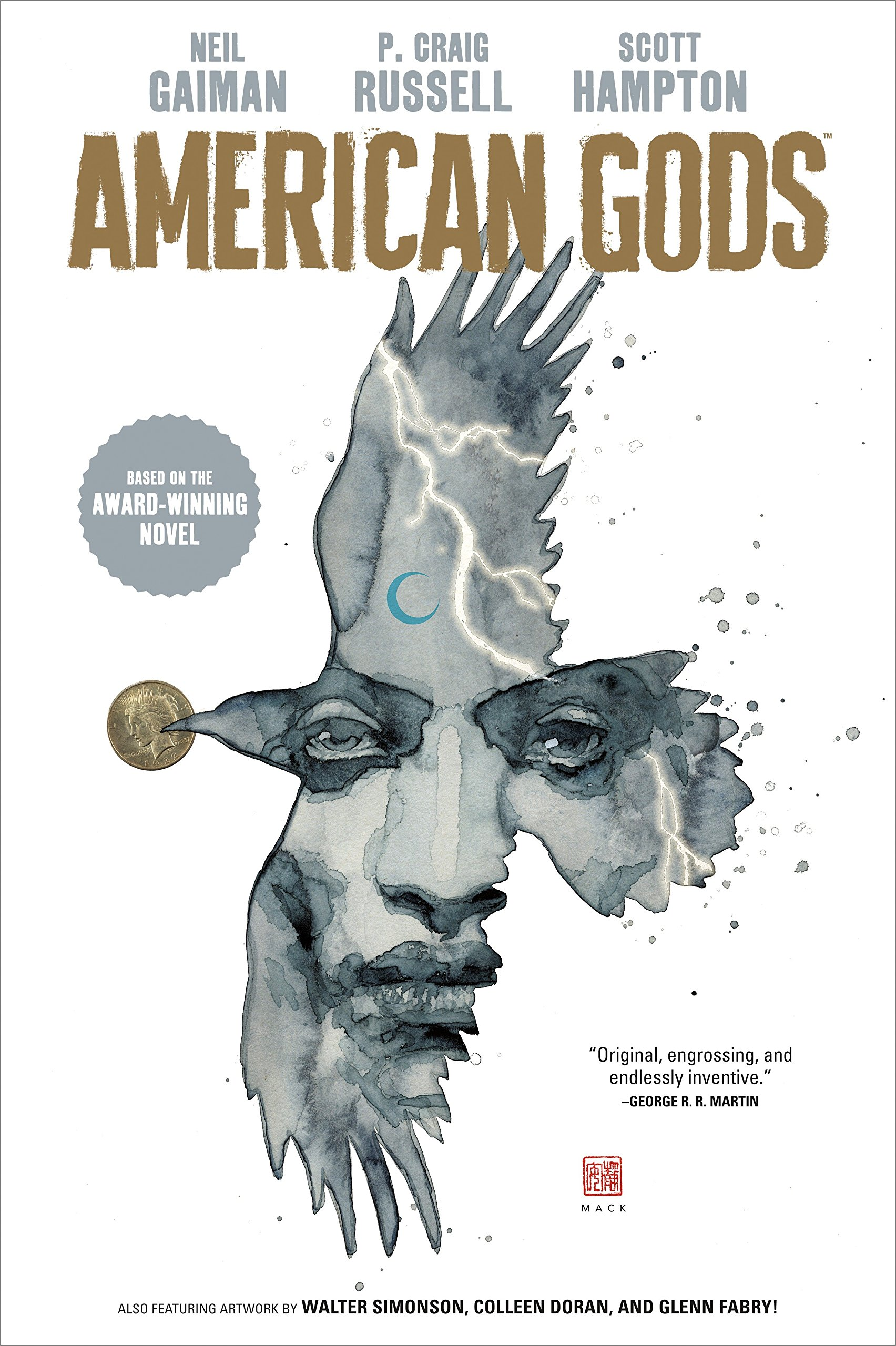
He’s a writer that I’ve always intended to actually read at some point, having experienced his work through other mediums, such as his episodes of Doctor Who, or the TV adaptation and graphic novel of Neverwhere, but I’ve not actually picked up one of his books and read it yet. When I saw that a new adaptation of his book, American Gods was being produced by Dark Horse, I was interested in trying it out in the hopes that it might push me more towards his prose work.
American Gods, which received a television adaptation in 2017, tells the story of Shadow Moon, a man who has been in jail for the past three years. Building towards the end of his sentence, he’s a quiet and well mannered prisoner, keeping out of trouble and trying to just survive as best he can. His release is coming up at the end of the week, his wife Laura is waiting for him, and his best friend has a job lined up for him. He looks set to get his life back on track. However, when he’s called into the warden’s office a few days early he gets told that he’s being released there and then – because his wife has died.
Leaving prison, alone, confused, and grieving, Shadow starts his journey back home where he can attend Laura’s funeral. Along the way, however, he meets the mysterious Mr Wednesday, who wants to offer Shadow a job. At first he refuses, but when he learns that his best friend died in the same car crash that killed Laura, and that there is no job waiting for him, he agrees to help the odd man. And thus Shadow finds himself being dragged into a strange and unusual world, where ancient gods still exist, and a war between the old and the new is on the horizon.
People tend to look at comics and books and think that they’re very similar things. They’re both things you read in order to obtain the story, so people assume that a lot of books can easily be translated into comic form. And whilst this can work, it does take a certain level of care and skill. Things that work in prose form, long conversations, moments of deep character introspection, and tangents onto other subjects that help build up the world, can flow quite naturally in prose form, and most people wouldn’t even really notice or care that the moment that should have been a five minute conversation takes dozens of pages to make. But when those moments come into comics it can leave things feeling slightly off. And this is one of the issues I had with this adaptation.
American Gods doesn’t seem to be a very visual story, at least none of the things that are collected in this volume are anyway. Much of the book is people talking, people travelling from place to palace, people sitting around and eating, drinking, and playing games. There’s not a huge amount here that grabs at you, and as such the moments of deep description and slow introspection that work in pure text form feel drawn out, dull, and fairly lacklustre when put into comic form. There were multiple times when reading the book where I felt my attention begin to wander, where I started to not really care about what was happening, and I began to wish I could start skipping through things or skimming the book.
Part of this is also down to the fact that because of the way Gaiman’s stories have entered the public consciousness I knew Mr Wednesday’s identity, and that Shadow was entering a world of gods and magic when the character didn’t. I was waiting for that revelation to happen, I was hoping it was coming soon so that I didn’t have to listen to Shadow questioning who this man was or what was happening for the tenth time. The story felt too slowly paced for the now well known revelation to matter, as the book began to drag. And whilst the artwork is nice enough, the fairly muted colours, the soft lines, and the depictions of the normal meant that there were few moments that make you stand back in awe of what’s on the page.
There were several times whilst reading the graphic novel where I felt like I’d enjoy what I was reading more if it was the prose version. I could see what these moments would be like in the original novel, and it felt like a much better fit. This is a decent and entertaining story, but one that feels slightly misplaced in this form. Perhaps for those that are familiar with the book the experience would be different, that they’d see how these characters and this story have been transplanted to this new medium and appreciate the work done on it; but perhaps they’d be left wondering why it has been done when the original book is there instead. I don’t know how this reads to a fan, but as someone coming to it brand new, it was not the experience that I was hoping for.
I've been singing the praises of this series since it began, having become quite interested in the mystery it's been building, and enjoying some of the character interactions. Sadly, this is the weakest issue yet, and it feels like a bit of a dip in quality; even though it's still a very good issue.
The entirety of this issue takes place in the hospital where the last one left off, with the Joker having had the bullet removed from his brain and having been stitched back up. Unfortunately for him, the hospital is surrounded by cops, and Red Hood is on the scene looking to get some revenge.
This issue sees the Joker running round the hospital, hiding out in various rooms, and trying to escape. And it's fine. And fine is about all I can say really. This issue doesn't feel like it really adds a whole lot.
The scenes where the Joker is trapped in a room with dying children feels a bit off, though it does give an apparent explanation for the back up features in the series (they're in universe comics that are made about the Joker and other heroes and villains). This issue also explains why when given the opportunity to kill Jason Todd over the years why he doesn't (he doesn't like telling the same joke twice). Again, it doesn't feel like a huge amount happens here, and I guess time will tell if his exploits in the hospital will have any baring on events, or if this was an issue that could have been skipped.
The backup feature, which we now know exists in universe as fiction, seems to follow the same pattern as the previous ones; weird stories that might be giving hints and clues and possible explanations for things. This one sees Joker trying it on with Zatana, offering to start a baby with her. She uses her magic to tell him that no one else will ever have his baby. The next day Joker wakes up heavily pregnant. He eventually vomits up living clay, which transforms into a tiny version of him. This, along with the cover that depicts Clayface, could be hinting that the shape changing villain might be involved in the two Jokers. Or it's another red herring and it doesn't actually mean anything.
This issue might not be the best of the series, but it's still an entertaining read with some interesting moments. The artwork is pretty solid, and there are some decent visual moments scattered throughout. People seem to be getting angry online about the pregnant Joker bit, most of them not having read the actual book; but people need to get over it, see it as the throwaway joke it was, and go along with it.
This article, and many others, can be read a month early on my Patreon for as little as $3 a month!


.jpg)