Monday, 15 August 2022

Dark Crisis: World Without The Justice League - Superman #1 - Comic Review


Originally published on Patreon


The Dark Crisis kicked off with a shocking, if somewhat misleading, moment with 'Death of the Justice League'. To outside observers it did indeed look like the members of the League, minus Black Adam, were destroyed. But, if you'd been reading the build-up to this you were aware that the League were more likely put in their own pocket worlds filled with their dreams brought to life; just like what had happened to Barry Allen.

Well, Dark Crisis: World Without A Justice League - Superman confirms this as we get an insight into two of the realities of the League as we catch-up with Superman and Aquaman.

The first story in this issue deals with Superman, and is written by Tom King, with art by Chris Burnham and Adriano Lucas. Despite being about Clark, the story focuses on Jonathan; which is great because Tom King is brilliant at writing Jonathan.

In this world Jon isn't lost, doesn't grow up without his parents, and Clark gets to be there for his son through his childhood and teen years. We see him and Jon and their relationship at a few points over the years, skipping from point to point as their relationship goes through some changes. Clark also seems to have considered the fact that he recently left Earth to help free alien worlds in the real world, and in this reality Darkseid wages war on the galaxy, but has agreed to leave Earth alone if Superman doesn't interfere.

Whilst this doesn't sound like the kind of deal Clark would make in the real world it does prevent him from leaving his family, keeping their unit together. However, even in paradise isn't perfect, and he and Jon clash a few times; mostly because Jon can't ignore the sounds of screaming from space. Clarke agrees to let his son head out into the galaxy as he reaches adulthood, set to make his own future; and even though he knows it's dangerous for him he thinks that he would't change this for anything.

It's strange to see this version of Superman, one who is willing to let others suffer if it means it keeps him and his family safe. Yes, he still protects Earth, but he allows other planets to be conquered by forces of evil, for children to die. This goes a long way to show how twisted these 'perfect' worlds that Pariah has created for the League really are, because they're not just designed to keep the heroes contained, they're twisting them too. Clark would never stand by and let others suffer. The recent run on Action Comics shows us that.

The Aquaman story takes a slightly different approach, though has some similar themes. In this story, written by Brandon Thomas with art by Fico Ossio and Sebastian Cheng, Aquaman and his family are attending the vow renewal of his parents. Everyone has gathered to take part, including a number of villains who's seemingly put their evil ways behind them.

Much like the Superman story, this takes Arthur years into the future, where his daughter has grown into a young woman, Jackson has been Aquaman for years, and things have become peaceful for their family. Despite this, there is some trouble at the ceremony when one of Andy's villains tries to blow them up, but Jess Chambers is able to stop it.

The story draws upon some of the things from the Future State books, such as Andy being Aquawoman, and Jess from Earth 11 being her partner, which makes things interesting. And I honestly did find this one to be more interesting than the Superman story; especially as Arthur seemed more aware of things being fake, and literally breaks free of the illusion at the end. Free of the fake reality, Arthur threatens to take revenge against the person who trapped him there.

Getting to see the inner workings of the Leagues pocket realities is a great addition to the Dark Crisis narrative, and it's good that it's happening in these books, rather than only getting small glimpses of them in the main title where less time can be given over to it. I'm looking forward to seeing what the other members of the League have going on in their worlds.


Support Amy on Patreon

Buy Amy A Coffee

Go to Amy's Blog

Flatliners – 4K UHD Review


Originally published on Set The Tape


1990 was a big year for films that dealt with the afterlife, with Flatliners, Ghost, and Jacobs Ladder all coming out around the same time. Whilst all three films deal with the notion of the afterlife, and how people deal with the weight of their sins and actions in this world, all three take a very different approach to it. Flatliners is perhaps the most grounded, and most scientific of the three, presenting a scenario that feels quite plausible.

The story follows five medical students in Chicago who come together when one of their number, Nelson Wright (Kiefer Sutherland) proposes an experiment to look into what happens after you die. He’s come up with a procedure to slowly lower the body’s key functions, resulting in medically induced death. After one minute dead, the person would be revived, and be able to tell them if there is indeed anything after you die.

Nelson convinces four of his peers, David (Kevin Bacon), Rachel (Julia Roberts), Joe (William Baldwin), and Randy (Oliver Platt), to be there as he flatlines, and to bring him back. Whilst they’re at first unsure whether it’s a good idea, they eventually come around, all of them interested in learning if there is anything after death. When the procedure goes well, and Nelson is brought back from the dead, he tells them of a strange vision he saw, and the others begin to vie to be the next ones to go through it. However, when those who have flatlined begin to see strange, almost disturbing visions of those they have wronged in their lives they start to question if they did see the afterlife, or if they’re being haunted by the actions of their own past and the guilt they carry with them.


Flatliners is a very Gothic looking film. From the opening moments where the camera passes slowly across statues to the secretive experiments taking place inside huge, cathedral-like buildings, there’s a sense of the classic horror about a film that’s relatively light on horror, and that I’d personally struggle to put in the category of horror. I’d heard about the film for years, how it was a spooky, psychological horror film, but upon finally seeing it I think perhaps I’ve been mis-sold on the concept. This isn’t a horror film, the characters in this movie aren’t haunted by spirits from the beyond, instead, it’s a character driven examination of human nature and the complexity of guilt.

The characters of Flatliners are looking to find answers to one of the ultimate questions, to the unanswerable question: is there life after death? For many, this is something they feel the need to believe in, and there’s a huge desire to believe in an afterlife, in something beyond this existence, even if they don’t subscribe to any particular religion. The fear of death being the end, of your consciousness simply ceasing to be, is one that I think near everyone has, and if you were able to provide a definitive answer to that question it would change the world forever. The character even acknowledge this in the film, stating that it’s the last great frontier of discovery left for humanity.

But this film sidesteps giving us a definitive answer, and works all the better for it. It allows the events you see to be interpreted as confirmation that there is indeed something after death, but also posits the possibility that it’s simply the last moments of electrical activity in your brain bringing up memories, making you think about your regrets and pains in your last moments. Because of this it’s hard to know what the characters are going through, whether they’re being haunted by literal shades from the afterlife, or if they’re going through extreme PTSD from the trauma of literally dying. I wasn’t expecting this level of complexity and ambiguity from the film, and it made for a pleasant surprise to what I was expecting.


The central cast are a great group of actors, and whilst most of them have headlined their own films before and since, they work really well in an ensemble, and complement each other well. Some of them are more likeable than others; William Baldwin plays a literal sex offender in the film, so it can sometimes be hard to root for him, and I was actually happy to see him get his eventual comeuppance. Their chemistry is good though, and as the film goes on you really believe that these are five people that become intrinsically linked through the traumatic events of the movie.

The new 4K release from Arrow Video gives audiences a great new version of the film, with a great visual presentation that really pops on the screen thanks to the cinematography. There’s also a full length audio commentary from critics Bryan Reesman and Max Evry, as well as a series of new interviews with key members of the crew. Whilst the extras are interesting there’s not a huge amount here beyond interviews to give you much of an insight into the film, although the interviews we do have are pretty informative.

If you’re looking to add Flatliners to your collection this is a decent release, and one that presents the movie in a beautiful way. But if you’re not a huge fan and have only a passing interest it may not have enough on offer for you.


Support Amy on Patreon

Buy Amy A Coffee

Go to Amy's Blog

Sunday, 14 August 2022

Batgirls #8 - Comic Review


Originally published on Patreon


It looks like the final threads for the first story arc of Batgirls has come to an end with issue eight (despite the first volume of the graphic novel collecting together the first six issues), as Barbara and Dick infiltrate the Iceberg Lounge to free the captive Seer, and capture the Saints.

The first arc for this book has been interesting, and has had it's ups and downs. For me the villains have been kind of the weakest part, and it's been the group dynamic and the small character moments that have really kept it enjoyable.

And this is something that I found to be a big part of this issue. The team, plus Nightwing, infiltrating a swanky party, fighting their way through trained killers, and saving the kid at the end  of it all felt pretty standard fare, and it was the fun moments between this that kept it enjoyable. I think perhaps this was the issue that pushed this split the most for me because of how much it pushed the character moments. There was a lot of banter, and I mean a LOT.

Almost every interaction between Dick and Babs was flirty and over the top in how much they joked around with each other. I get that they're a couple again, and that they have great chemistry, but it did feel like they were performing for an audience a lot of the time. In contrast, their relationship in Nightwing feels a lot more natural, and they have similar kinds of moments, but they feel less like a performance. It's hard to really convey what it was about it that felt off, just that it didn't sit quite right for me.

The other girls, Steph and Cassie, were fun as usual, and they do work very well together. They seem to be a great pairing, and bring out the best in each other. Them mishearing what Babs is saying and ending up getting involved when they're not needed and increasing the amount of danger everyone's in feels about right for them; it's the kind of shenanigans I've come to expect from them in this series.

With Seer seemingly done now, and the Saints pretty much wrapped up I'm looking forward to seeing what comes next for this series; especially if it means that they'll finally be addressing the serial killer in their neighbourhood (something they absolutely should have been looking into before now).


This article, and many others, can be read a month early on my Patreon for as little as $3 a month!


Support Amy on Patreon

Buy Amy A Coffee

Go to Amy's Blog

Saturday, 13 August 2022

The Joker #15 - Comic Review


Originally published on Patreon


I've really enjoyed this series. When it was first announced, before I read what it was about, I had little interest in it. Why would I want to read a book about the Joker, a character who always works better in small doses? Well, that's not what this series was about. If you've not actually caught this book yet and don't know about it, The Joker follows former police commissioner Jim Gordon as he's hired to try and track down and kill the Joker by a rich, shady individual.

The series saw Jim on the trail of the man who had tortured him, paralysed his daughter, turned his son into a killer, and countless other crimes. Along the way he discovered shady organisations, illegal cloning experiments, and even teamed up with a new version of Bane, Vengeance; Bane's clone 'daughter'.

The series put Gordon into a grey area. He was no longer the staunchly good cop who always does the right thing. He'd become an individual who was quite justifiably out for revenge against a monster. And the entire series I honestly couldn't tell you if he'd go through with killing the Joker or not.

So when this final issue came down to him being confronted by Batman, who wanted to know what happened to the Joker, it became a bit of a tense moment. The issue wrapped up the events in flashback, with Gordon telling Batman how things ended. But the reveal of what happened to the Joker was held back, was something kept close to the chest until the end.

This may seem like a cheap tactic to some, but as the central thread of the entire fifteen issue run, the whole journey that Gordon went on, it made perfect sense to keep it back until it couldn't be a secret anymore. And whilst Gordon didn't kill the Joker, and it felt right and true to his character, I think I'd be saying the same if he had have pulled the trigger. This series did a wonderful job of walking the fine line between good and bad, and in a lot of ways it made this story of an old cop chasing a weird clown around the world whilst cannibals tried to catch them deeper and more layered than it had any real right being.

If you've not read this series I'd highly recommend it. It may only be fifteen issues long, but it's easily one of my favourite stories for both Jim Gordon, and the Joker.


This article, and many others, can be read a month early on my Patreon for as little as $3 a month!


Support Amy on Patreon

Buy Amy A Coffee

Go to Amy's Blog

Drama by Raina Telgemeier - Book Review


'Callie loves theatre. And while she would totally try out for her middle school's production of Moon Over Mississippi, she can't really sing. Instead she's the set designer for the drama department stage crew, and this year she's determined to create a set worthy of Broadway on a middle-school budget. But how can she, when she doesn't know much about carpentry, ticket sales are down, and the crew members are having trouble working together? Not to mention the onstage AND offstage drama that occurs once the actors are chosen. And when two cute brothers enter the picture, things get even crazier!'

I recently won a copy of Drama in a Pride book giveaway, and it was one of the few books in the set that I'd not actually heard of before, even though it was first published almost a decade ago. Still, I like reading queer stories, and the artwork inside it was really nice, so I was happy to give it a go. But, it wasn't quite what I was expecting.

Drama is not a queer story. There are gay characters in the book, yes, but the story isn't really about that as a lot of other books that get labelled as LGBTQ+ in content so often are. This is a book about theatre, and about pursing your passions. Drama centres on Callie, a young student who has been obsessed with the theatre ever since she got taken to see Les Miserables as a young girl. She's set her sights not on being on stage, but in working behind the scenes, with a focus on set design.

As such, Callie has been a part of the school theatre team for years now, and is looking forward to the latest school production, Moon Over Mississippi, a fictional play set in the south during the Civil War. Callie wants to make this the best show they've ever put on, and invests a lot of time and effort into making the stage effects bigger and better than ever; complete with a working canon. When two new students, twins Jesse and Justin, show an interest in being involved in the show Callie soon forms a friendship with them. She also begins to realise that she has feelings for Jesse.

I was expecting queer identities to be at the centre of this story, and was surprised when, for the majority of the issue, Justin was the only visibly queer character, and that his gayness was only a minor, background thing that few knew about. Yes, it turns out that there are a few more gay and bisexual characters by the end of the story, and that their queer identities have an effect on Callie, but this is still very much a story of a cisgender, heterosexual girl and her time working on a school play.

After looking into the book I was surprised to learn that it was challenged by homophobic parents and schools over the last decade, considering there's virtually no gay content in this book. Drama has been called 'sexually explicit' (for one panel that features two boys kissing I guess, unless there a version with hardcore sex in it or something), and has been in the top ten banned books for several years in the US. All for a book where queer identities are hardly a thing. If I can speak frankly, it's absolutely fucking ridiculous. 

Drama is not a gay story. It's a story where gay people exist. That's it. And for that it has been banned and branded as explicit. It honestly boggles the mind. how closed-minded and backwards some people are to believe a story where gay kids happen to just be there is considered the worst thing in the world.

The book itself is fine, it's a decent enough story about a group of kids putting on a school play and the trials and tribulations that happen over the course of it. So if you're looking for a book about that kind of topic this is one that I think you'll enjoy. It capture the love of theatre, the way theatre kids geek out and swoon over tiny set details, and how they'll watch the same shows again and again because they're musicals. And it revels in that niche kind of joy. 

But if you're looking for a book about the queer experience, about discovering your sexuality or gender and coming to terms with that this is probably not going to do much for you. It's a stepping stone, it's a book that you give to a younger reader who probably doesn't even know what gay people are as a sneaky introduction. But I'd not say this is a queer book by any stretch.


Support Amy on Patreon

Buy Amy A Coffee

Go to Amy's Blog

Friday, 12 August 2022

Poison Ivy #2 - Comic Review


Originally published on Patreon


The second issue of Poison Ivy sees our central character continuing her quest across the US, hoping to spread her deadly new spores to as many people as possible. 

The bulk of this issue takes a small break from her journey as Ivy stops off at a roadside diner. She gets to know a few of the people that she meets, including a beautiful female thief who reminds her of Harley a little, as well as a kindly cook who seems full of joy.

Whilst this all seems lovely, it has a very sinister edge, as Ivy intentionally infects everyone in the diner with spores that will eventually cause horrific deaths for everyone there. She even makes note of the fact that she infects a family with what seem like cute, well behaved kids. It's kind of one of the more disturbing things I've read in a while from DC.

I'd mentioned in my previous Poison Ivy review that the book has a horror vibe to it, and that felt very present here too, though in a more subtle and insidious way. In our modern world it's hard to see Ivy as a villain, she makes some great points about how fucked the world is and how humans are to blame. how can you see someone wanting to stop mass global destruction as evil? Getting her to cause the awful deaths of lovely people who haven't done anything wrong is a good way I suppose.

Though, we don't see these deaths. They're not confirmed. So there could be room to this to be stopped, for Icy to change her mind or to be prevented from activating her spores within these people. But honestly, I'm not sure if the book is going to go that way or not. and I love that ambiguity, that we don't know yet is Ivy is going to become a merciless child killer or not.

I really enjoyed getting into her head in this issue, and seeing the way that she sees the world. I particularly liked it when she went into if she was vegetarian or not, and explained some of how mass farming for vegetarians and vegans actually cause more environmental damage than eating meat; a lesson I think a lot of veggies and vegans refuse to learn because they, like Ivy says, get off on feeling like they're doing good by not eating chicken.

This was a great issue for getting to know this character, for seeing how her mind works, and for getting some big stakes put on the table. It's not always a comfortable read, but this book remains a fascinating one for sure.


This article, and many others, can be read a month early on my Patreon for as little as $3 a month!


Support Amy on Patreon

Buy Amy A Coffee

Go to Amy's Blog

Goosebumps: Monster Blood by R.L. Stine – Throwback 30


Originally published on Set The Tape


As we’ve already discussed with our look backs at the first two volumes in the Goosebumps series, Goosebumps: Welcome to Dead House and Goosebumps: Stay Out of the Basement, the children’s horror series was a success from the first day it went on sale, with children across the world clamouring for each new release.

The 90s was an era where children’s and middle grade publishing pushed the big series releases, things like The Babys-Sitters Club, Animorphs, and Sweet Valley High. I vividly remember going to libraries and book fairs, and seeing shelves dedicated to titles that spanned dozens of volumes. And whilst most of these were designed to be picked up and read at any point (except perhaps Animorphs) they still felt a bit inaccessible. But Goosebumps stood out. It gave readers a new story every volume, and you didn’t have to rely on having read any others before to understand them. But the third release in the series ended up being one of the few Goosebumps stories that would continue for more than one volume.

Goosebumps: Monster Blood follows twelve-year-old Evan Ross, who is sent to stay with his deaf, elderly great-aunt Kathryn whilst his parents look for a new home for them on the other side of the country. Kathryn is set up to be a figure that frightens Evan, wandering around the house with a knife, laughing at her own weird jokes, and arguing with her cat like it’s a real person. Luckily, Evan has his dog, Trigger, with him to keep him company.

Playing out in the neighbourhood one day, Evan meets and befriends Andrea, and the two of them end up becoming close. When checking out an old toy store, Evan finds a tub of strange slime called Monster Blood. Despite the shop keeper initially not wanting to sell it to him, Evan purchases the stuff and brings it home. When he shows it to his great-aunt she mutters something over the tub, before handing it back to Evan with the warning to ‘be careful’.

As Evan plays with the Monster Blood, it begins to act strangely, getting warmer over time, and growing in size each day. When Trigger accidentally eats some of the Monster Blood he too begins to grow in size, doubling each day. As the Monster Blood grows out of control it seems to come to life, trying to consume Evan and his friend. It’s here that we get a pretty wild twist, something that would go on to become a big part of the Goosebumps formula. It turns out that aunt Kathryn put a curse on the Monster Blood, making it come to life. But she didn’t so it by choice, but at the command of her cat, who is actually a witch who has put Kathryn under her control.

The Goosebumps books have become known for their twists, and whilst the first two books in the series did have a moment at the end that made it seem like things might not quite be as neatly wrapped up as it appears, this was the first time that the twist ending makes you ask ‘what the fuck?’. The ending for the book is delightfully wild, but absolutely comes out of nowhere. The cat has been an evil witch the entire time? Okay, why not.

This is something that comes up more as the series goes on, where you suddenly find out that the hero is actually an alien preparing to invade Earth, that the whole story was written by the monster and they’re sharing it with their monster friends, or that the kids turn out to have been robots all along. Stine would go on to become a writer whose endings you could never predict, because whilst you think you’ve figured out the ending there was nothing stopping him from revealing the main character to be a hundred hamsters in a trenchcoat at the end (that one isn’t a Goosebumps twist as far as I’m aware!), and Goosebumps: Monster Blood was the first of his stories that really did this.

And this book was also the first one in the series where the story would come back again in other volumes.  Monster Blood would make a return in three direct sequels, all of which featured Evan as he continued his fight against the monstrous slime. There would also be two additional Monster Blood books that were part of the Goosebumps Horrorland and Goosebumps SlappyWorld series, which didn’t include Evan. Whilst it might not be one of the most famous titles in the series, it did go on to be one of the longest running.

Goosebumps: Monster Blood was the first really ‘weird’ entry in the series, and it taught the readers to never get complacent, to never think that you’ve figured things out or know how it’s going to wrap up. And I think this is part of the reason why it’s so well remembered, and why it inspired multiple stories – because it was the first time that Stine got to really surprise his readers.


Support Amy on Patreon

Buy Amy A Coffee

Go to Amy's Blog

Thursday, 11 August 2022

Multiversity: Teen Justice #2 - Comic Review


Originally published on Patreon


The second issue of Multiversity: Teen Justice continues on the investigation into the Church of Blood that was begun in the first issue, but doesn't do a whole lot to move the plot forward in any great ways.

This issue follows two main groups. The first sees Troy and Raven trying to infiltrate the church itself, whilst the rest of the teen team investigate strange happenings on the island of Zandia, where the children have been turned into old people, and every adult has been reduced to skeletal remains.

Both of these plot-lines don't really add a whole lot to the story. The stuff on Zandia gives hints at what the villains might be doing, that their plan will be to drain the life out of people; but this is never said in the text, and is just a guess based upon what we've been given. It does lead the Teen Justice team to learn that the leaders of the Church of Blood have been killed; which clues them in on the fact that the Church is being run by impostors.

The other story, of the two boys trying to sneak into the Church sees Raven being caught snooping around and having to leave, whilst Troy seems to ingratiate himself with the group. By the end of the comic he, and the church, seem to have vanished. 

That's about it really. This issue seems to be there just to set up for the next part of the story, and to make sure that our heroes get certain info. But for the reader it's mostly stuff we already know; and as such this issue didn't really raise above average for me.

There are some nice character moments scattered throughout the book, and the artwork is really good, but other than that there's not a whole lot to this issue. Hopefully now that more of the groundwork has been sorted out we'll get more exciting developments next issue.


This article, and many others, can be read a month early on my Patreon for as little as $3 a month!


Support Amy on Patreon

Buy Amy A Coffee

Go to Amy's Blog

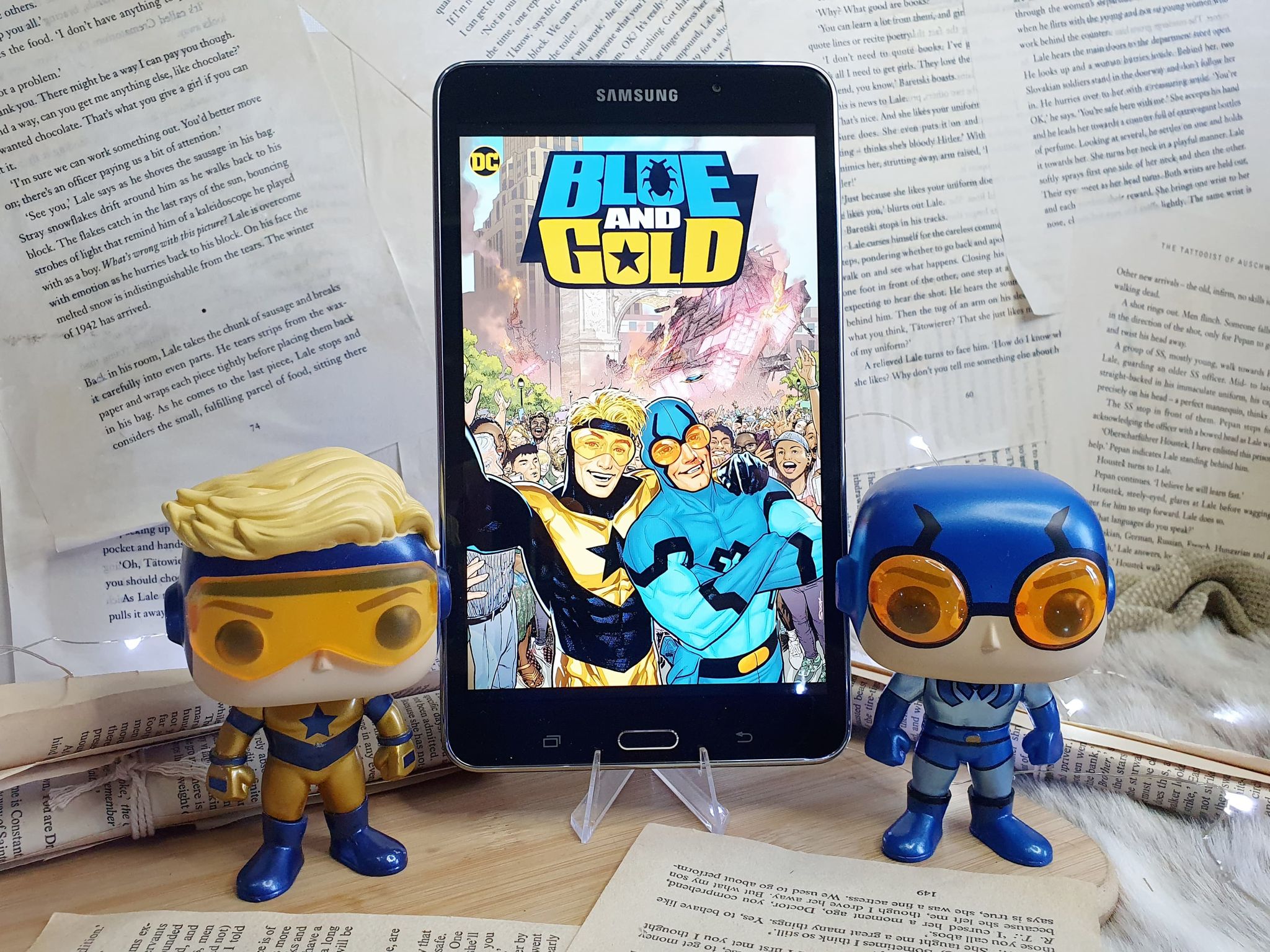
Blue and Gold by Dan Jurgens - Book Review


'Who needs the Justice League? DC’s fan-favourite duo, Blue Beetle and Booster Gold, are on their own—and online, as these underdogs embrace social media and start a superhero business! Desperate to regain the spotlight, Booster Gold looks to attract the public’s (and Justice League’s) attention the same way any washed-up, second-rate hero would—social media.

'The not-so-tech-savvy hero from the 25th century enlists the help of his best friend, Blue Beetle, who possesses both the money and the brains to help his old pal navigate the scary world of internet influencers. Watch out, evildoers, our heroes are live and online! But little do they know, an alien assassin seeking revenge places Blue and Gold in her cross-hairs, and The Omnizon never misses!'

I really like Booster Gold, he's become one of my favourite heroes over the years thanks to books such as 52 and his own solo series; but I often feel like DC doesn't quite know what to do with the character from book to book. Sometimes you get him being the stereotypical show-boating fame seeker from the future who only puts his brand first, and other times he's 'the greatest hero you've never heard of' protecting the timeline from threats that could destroy the entire universe and is going through awful trials that forge him into a true hero. And there just never feels like there's any consistency. Booster has become a hero you just have to take as he comes, and hope that he lines up with your preferred version of him.

Blue and Gold falls into the fist category, with Booster being a fame hungry dick looking to make a name for himself. Using social media, and streaming his adventures online using Skeets, Booster is trying to get big and famous enough to get invited back onto the Justice League (something that does happen for him and Ted in Dark Crisis). The book opens with him trying to come to the rescue of the League, who've been taken captive inside a spaceship that's about to leave Earth.

Despite his valiant efforts, Booster just isn't good enough to get inside the ship and save his fellow heroes. Luckily, Skeets recognises this and flies off for help in the form of Ted Kord, the Blue Beetle. Bringing Blue and Gold back together, the two heroes manage to break the League free and actually save the day. And they even impress the League in the process. Well, one of them does. When the League extends an offer to join to Ted, but not Booster, Ted turns them down, and instead sticks with his best friend.

Now the two of them set off to try and build their hero brand, appealing to the public to help fund their new hero enterprise. Whilst they do get some eager backers who want to help them focus on the smaller, weirder cases that the big heroes don't deal with, their public brand and finances become the least of their problems as they become targeted by the alien princess whose plans their spoilt when they saved the League; and a shadowy figure from Boosters past begins to pull strings from behind the scenes.

Blue and Gold is a book that has a much lighter tone that a lot of the other books in DC's catalogue, and doesn't ever really seem to take itself too seriously. And whilst this is enjoyable to a certain extent, and does bring to mind a lot of the older books that the two characters appeared in, it does prevent the book from feeling like more than just fluff for the most part. My favourite Booster stories have been the ones where they incorporated darker elements, where the character was challenged as a person and not just as a hero, where he had to grow. This book doesn't really have anything like that, and whilst the characters do end up in a different place to where they started it doesn't really feel like they change much as people.

But I guess that's the kind of story that Dan Jurgens is trying to tell here. Instead of telling a story where Booster and Ted change, or become 'better' people it's everyone else who changes. People begin by seeing the two of them, and Booster especially, as a bit of a joke, and it's this that changes. Booster and Ted stay the same, but they prove that they can still be decent people and good heroes even if they're a bit different from what most people would expect a hero to be; and by the end they've earned the respect of those who looked down on them at the beginning.

I think that if you're a fan of the old Justice League International days you'll find a lot here to enjoy, as it captures a lot of the same fun energy that that book had in spades. It has some silliness, some tough moments, some big challenges, and the sense that it's all one big fun adventure rather than a life or death struggle. 


Support Amy on Patreon

Buy Amy A Coffee

Go to Amy's Blog

Wednesday, 10 August 2022

Nubia: Queen of the Amazons #2 - Comic Review


Originally published on Patreon


The Amazon books have been one of the better parts of the DC universe since Infinite Frontier, and Nubia taking over as Queen has been a big part of why it's been great. Whilst she'd been acting queen for a while, since the death of Hippolyta, she's now officially become queen and has set out to do some good in the world. However, she's been having visions of her life before the Amazons too.

The second issue of this mini-series picks up where the last one left off, with Nubia having been caught in a landslide whilst protesting deforestation in Brazil, caused by a shadowy group of warriors who have targeted her because of the broken amulet she's wearing.

Whilst in hospital, Nubia has more visions of her past life, as a princess in Madagascar, and how even then she was a wise and caring leader, but also one who was more than capable of handling herself in a fight. When she wakes up from her injuries, she finds her Amazon entourage, and Hawkgirl, waiting for her.

Unfortunately, her recovery is cut short when the hospital comes under attack from the same warriors, equipped with mech-suits and robots this time. Clashing with the mysterious fighters, Nubia is shocked when one of the women removes her mask and sees the adult version of a young girl she knew thousands of years ago in her past life.

This series has gone in a very interesting direction, and I've been super fascinated by what it's doing. Nubia has been one of the more interesting and layered characters in DC the last year, and getting to learn about her history before she passed through the Well of Souls is something I've been interested in for a while. 

I like that it's something that isn't just being learnt for the sake of knowing it, however, but that it's having an impact in the present; even if it's not clear what that means yet. There are a few possibilities that would explain what is going on, but it also feels like we've been given so little information that it'd be wild speculation to guess anything at this point.

I do also like how Nubia is trying to make the world a better place, and to do something meaningful with her position and power; rather than just staying behind on Paradise Island and allowing the outside world to do its own thing. She seems interested in helping those in need, of thinking about the people who can't defend themselves and wanting to do what she can to help. This seems to be something that ties into the kind of person that she was before her rebirth, and also fits nicely into the conversation that she had with Martian Manhunter in the coronation special.

With only two issues left it feels like this series still has a lot to cover, and it's going to be interesting to see just what answers we get given.


This article, and many others, can be read a month early on my Patreon for as little as $3 a month!


Support Amy on Patreon

Buy Amy A Coffee

Go to Amy's Blog