Thursday, 12 May 2022

Godzilla vs Mighty Morphin Power Rangers #2 – Comic Review


Originally published on Set The Tape


The second issue of IDW Publishing‘s Godzilla vs Mighty Morphin Power Rangers picks up where the last issue left off, with the Power Rangers having been transported to a world in ruins where giant monsters reign supreme, forced to fight for their lives against powerful foes as their enemy, the moon witch Rita Repulsa, makes plans from the shadows.

As with the first issue of the series, the second issue starts in the middle of the action and doesn’t really slow down; even the brief moments of dialogue and exposition that occur seem to be sandwiched between big moments, or take place in the middle of fights themselves. This is leading me to the conclusion that perhaps this isn’t going to be a series that really slows down at all, and that writer Cullen Bunn is going to cram as much as possible into every issue.

The second issue opens with the core five Power Rangers having just entered this new dimension, having witnessed the Green Ranger and the Dragon Zord lose a fight to Godzilla. Never being ones to stop and think much before jumping into a fight, the Rangers deploy their zords to take on the titanic monster. When that doesn’t work they have to form the Megazord, giving fans a fight they’ve been waiting for since the series was announced.

Unfortunately, all this is playing into Rita’s hands as we learn that Godzilla is the only thing protecting Earth from the Xilian invasion and the monsters that they’re deploying against humanity. Sadly, the Power Rangers have pretty much been trained to see a monster and immediately kill it. Child soldiers, what are you going to do eh? Over the course of the rest of the issue we get to learn a little more about the invasion of this version of Earth, witness some more fights, and get some surprising monster reveals setting up for an even bigger third issue to come.

Due to how fast the issue moves, and how much of it is centred around fighting, there’s not a huge amount of stuff that I can say about the plot that doesn’t give away too much. What we do get goes pretty quickly, and we get some brief snippets of information about this other version of Earth, but a lot of those details are things that we’re left to fill the blanks on ourselves. That being said, Bunn seems to know what the reader will enjoy, and sets out to deliver some pretty dynamic fights across the issue, and adds in some firm favourite monsters from both franchises.

The art on the issue is provided by Freddie Williams II and Andrew Dalhouse, who worked on the first issue too. As with the first issue, the art feels different to the other various Power Rangers comics on the market at the moment, setting it apart on the shelves. The two of them really shine in the moments where we have giant robots fighting huge Kaiju, and whilst there’s nothing wrong with the regular humans it’s these titanic battles that are the highlight for sure.

With this series set to be only five issues long I knew that it would have to move at a quick pace, but with two issues down and the story never slowing down for a second I’m starting to hope that this pace doesn’t continue forever. It just feels a bit too fast and hectic to the point where it doesn’t seem like the heroes, or the reader, really gets a moment to breath and take in what’s happening. Perhaps a moment like this will come over the next three issues, as I’m sure a calm moment will help to make whatever big conclusion is to come feel all the bigger; but if the pace continues like this it’s going to make for a very overwhelming story when collected all together.


Support Amy on Patreon

Buy Amy A Coffee

Go to Amy's Blog

Wednesday, 11 May 2022

Alien: Colony War by David Barnett - Book Review


'Political tensions boil over on Earth, spreading to the outer fringes of known space as the UK colony of New Albion breaks with the Three World Empire. When an oil-drilling facility on nearby LV-187 is destroyed, its French colonists slaughtered, the British are blamed. Military forces arrive from the Independent Core Systems and combat erupts.

'Trapped in the middle are Cher Hunt and Chad Mclaren. Cher is trying to find out who was responsible for the death of her sister, Shy Hunt (of McAllen Integrations from Alien: Into Charybdis). At the same time Mclaren, accompanied by the synthetic known as Davis, follows in the footsteps of his late wife, Amanda Ripley, seeking to stop the weaponization of Xenomorphs. When a horde of the deadly aliens overwhelms both groups, however, their only hope may lie with Royal Marine Corps unit known as "God's Hammer."'

The Alien series has always done social commentary, whether it's looking at the corruption of large companies and the way they treat those who work for them as expendable resources, the over confident military system that thinks it can solve every problem with superior technology being beaten by 'primitive' foes, or incarceration and the way prisoners are treated. This is a series that has always had something to say, even if some folks miss those themes and focus on the killer aliens and the horror. Alien: Colony War is possibly one of the more overt books in this regard, and because it's taking a look at politics rather than corporations (though the two are so often linked) it seems to have thrown a few people and garnered some mixed reviews. However, thanks to some interesting political commentary, some good characters, and set-up for bigger things in the future, I think this is one of the more interesting entries in the series to date.

Alien: Colony War ties into several other novels, such as Alien: Isolation, and Alien: Prototype, as well as a few of the comic series that have explored characters such as Amanda Ripley, Zula Hendricks, and Davis. As such, if you're not completely up to date with everything there will be some sections of the book where you'll be having to play catch-up (I was in this category), but David Barnett does give the reader all of the important information that you need as the story unfolds; meaning that you're not going to come out of the book without understanding what happened.

The story begins on a private towing and salvage ship, the Clara, which is secretly transporting a cache of Xenomorph eggs they found on a salvage mission. They wake up in the Weyland Isles System, a part of space that has been colonised by the British. They learn that whilst they were asleep in cryo someone snuck onto the ship and stole the eggs. Unfortunately for them, they don't have long to ponder this issue as the ship was also sabotaged, and they crash onto the planet below, New Albion.

At the same time we're introduced to Merrilyn Hambelton and her daughter Therese on the French controlled world of LV-187, a small colony set up to mine the vast quantities of oil beneath the planet's surface. The colony came under attack by Xenomorphs a few weeks before, the creatures killing or capturing most of the colonists. Merrilyn and Therese have manged to survive by hiding and sneaking around, but their odds of survival are going down.

We're also introduced to Cher Hunt, a journalist who is looking into the death of her sister. After receiving cryptic messages about the incident she travels to New Albion hoping to find answers. It's here that she meets her contact, Chad McLaren, husband of Amanda Ripley, and the rogue AI Davis, who's inhabiting the body of a synthetic dog. Chad and Davis outline the details of Cher's sister's death and the existence of the Xenomorphs. The three of them decide to head to LV-187 to try and find proof of their existence, and evidence that can be used against those trying to weaponize the creatures. Little do they know, they've just entered a web of political double-dealing and plots that could plunge this part of the galaxy into war.

There are a lot of threads in Alien: Colony War, a lot of things going on in the background and characters to keep track of. If you're looking for a simple story of a group of characters fighting the Xenos to stay alive you do get that here, but of that's all you're after this book might be giving you more than you were expecting. In a lot of ways this feels like a middle part of a series, a stepping stone in a larger story; and that might put some casual readers off. We have the history of returning characters like Chad and Davis, and their history with the Xenos and other important figures to deal with. There's also the feeling like this book is setting up a lot of stuff that's going to be important going forward, with an ending that seems like it's going to reverberate into the rest of the Alien universe for a long while to go.

But how does it read if you're not abreast of everything? Well, it's still a good book, and you shouldn't be put off reading it just because you don't know everything. The stuff that happens on LV-187 is good, scary Xnomorph stuff, with a small group of survivors trying to stay alive long enough to escape the ever growing hive. There are some great tense moments as the characters are sneaking through the dark halls of the facility, trying to get to the next place they hope can provide shelter, and when the Xenos come they're fast, brutal, and frightening; which is everything you need from this kind of story.

Barnett also does a decent job of getting you invested in the characters quickly, thanks in part to Merrilyn and Therese. This mother daughter relationship gets you attached fairly fast, and it's a common type of relationship to the series. It hearkens back to Ripley and Newt in Aliens, and I like those kind of themes coming back from time to time, as motherhood and family are important parts of the franchise. There are some less savoury characters that make appearances on the colony too, and whilst at first you don't like them they do begin to grow on you over time and win you over because they're not outright evil, and you end up sighing with disappointment when they invariably meet an awful end because you actually find yourself wanting them to stick around more.

The characters and the sections of the book that I've seen receive the most discussion is the politicians on New Albion and the themes of British patriotism and imperialism. It's pretty obvious from the book that David Barnett is not a fan of 'Britain', and I say that in the sense of the kind of people who voted to leave the EU, who trash the streets when their teams lose at football, who vote Tory, and who we in the UK like to describe as 'flag-shaggers'. The book has a very negative view of this new upsurge in isolationism that Britain has, and transcribes it to the narrative here. Instead of breaking away from the EU, New Albion is declaring itself independent, trying to recapture the 'glory' of the British Empire. I guess they'll be doing some genocides then.

These sections of the book are very on the nose, and the leader of New Albion, Maurice Pepper, was instantly Boris Johnson in my head. In the few scenes he was in Barnett managed to inject him with the same kind of mannerisms and jumped up sense of self importance that Johnson has. It was surprisingly well done, and did make me instantly hate this man. So if that was the goal, it was achieved brilliantly. The political parts of the book aren't the main focus, and there's definitely much more of the book given over to Xenomorphs and the traditional elements of the series; but these sections are important and seem to be setting up larger changes to come.

There is something else in this book that I've seen people talk about, and it is a pretty big spoiler for the ever unfolding lore, so if you don't want spoilers jump ahead to the next paragraph. Some folks learnt in this book that the death of Amanda Ripley as we were told in Aliens is in fact a lie. I don't know how much of this was known before this point as I'm not fully up to date on all the comic releases, but we get told here that Amanda Ripley didn't die as an old woman a few years before Ripley came back, and is instead in cryo to stop cancer from killing her after spending years fighting Weyland-Yutani and the Xenomorphs. I've seen some people disliking this, and I can understand this reaction, but I kind of like it. I like it because this series is always expanding and changing, so having characters like Amanda out there that can be used is always a good thing. I also like it because it makes the second film so much more tragic. Ripley was suffering because she thought her daughter had died. She went to LV-426 in large part because of that loss. And all of that happened whilst her daughter was still alive, and walking a similar path to her. It makes it feel all the more tragic because she could have had that reunion she wanted so badly, but missed out on it. I also don't agree that is messes up continuity, as Amanda's death was faked for her protection, and we got told of her death bu Weyland-Yutani, who we know are not to be trusted. It changes things, yes, but I don't think it breaks things. And I think it adds some interesting developments to the series and the Ripley family.

I've seen some criticism of this book online, some folks who didn't like some of the new developments as mentioned in the above paragraph, and some people who weren't as fond of the political stuff. But these elements mixed in with the more traditional fight for survival story made this more interesting for me. I found that it tried some new things and did stuff differently, and because of that I think this is an enjoyable read that Alien fans will want to try out.


Support Amy on Patreon

Buy Amy A Coffee

Go to Amy's Blog

Tuesday, 10 May 2022

Nettle and Bone by T. Kingfisher – Book Review


Originally published on Set The Tape


'After years of seeing her sisters suffer at the hands of an abusive prince, Marra—the shy, convent-raised, third-born daughter—has finally realized that no one is coming to their rescue. No one, except for Marra herself.

'Seeking help from a powerful gravewitch, Marra is offered the tools to kill a prince—if she can complete three impossible tasks. But, as is the way in tales of princes, witches, and daughters, the impossible is only the beginning.

'On her quest, Marra is joined by the gravewitch, a reluctant fairy godmother, a strapping former knight, and a chicken possessed by a demon. Together, the five of them intend to be the hand that closes around the throat of the prince and frees Marra's family and their kingdom from its tyrannous ruler at last.'

T. Kingfisher has quickly become one of my favourite authors with her recent horror releases The Twisted Ones, and The Hollow Places; two books that I found absolutely chilling and read very quickly. Something about her writing is incredibly compulsive, making you want to read on long after you should have put the book down, and her new fantasy novel Nettle and Bone is no exception to this rule.

Set in a small harbour kingdom, nestled between a Southern Kingdom and Northern Kingdom, our story follows the daughters of the royal family. We meet Marra, the youngest of the three daughters, who watches as her older sister goes off to marry the prince of the Northern Kingdom to ensure the safety of their people. However, when her sister meets an untimely end, the middle daughter is sent off to marry in her place. Knowing that she might have to marry the prince if another tragic accident happens, Marra is sent off to live in a small convent, keeping her out of harm’s way, in case she’s ever needed.

Marra settles into her new life of not-quite a nun, finding purpose in the convent, finally free of the shackles of royal life. However, when she travels to the Northern Kingdom to attend the birth of niece she begins to suspect that not everything is going well for her sister. On a later visit, she learns that her sister is being abused by the cruel prince, and that the abuse and the constant pregnancies are taking their toll on her. Marra becomes determined to do something about this before the strain takes another sister from her. She makes a vow to kill the prince. Setting out with a dog made from bones and wires, she begins to recruit a strange assortment of people to help her in her quest, including a witch who can talk to the dead, a fairy godmother, a former night, and a demon possessed chicken.

Nettle and Bone is a wonderfully dark, yet strangely funny book, that manages to include some absolutely wild things like a chicken possessed by a demon, yet manages to make them feel not only real, but one of the least strange things that happens. Whilst I was at first surprised to see that this book was fantasy, given Kingfisher’s previous horror books, this is very much a dark fantasy story, and walks a very fine line between fantasy and horror much of the time. When the book first begins we’re introduced to Marra as she crafts her Bone Dog from scavenged pieces found in a bone pit, deep in a land where disease and darkness has spread, leaving many of the inhabitants roving, cursed cannibals. This sets the kind of tone for the book early on, and from here it never really feels like it gets much brighter.

The world of Nettle and Bone feels like a grim place to live, a world where the evils of the universe are just out of sight, both supernatural and human. The book has a lot of darkness, a lot of evil, and yet there’s always a sense of hope and happiness that manages to weave its way through, due in no small part to who Marra is. Marra is a wonderful protagonist for this story. She’s grown up as a princess, pampered and living in luxury, yet never once wants that. Once she’s been shipped off to live in a convent she finds herself enjoying life more, given more freedom than she’s ever had before. She enjoys getting to do the manual work she was always denied, and finds a passion as a healer and midwife. She understands that being born into positions of wealth and power don’t make you better than others, and that simple lives can be full of love and happiness, and that makes her a wonderfully unique princess.

The other characters in the book, especially those that come to join Marra on her journey, are utterly delightful. Her small band is definitely one of the more unusual groups of heroes, featuring a pair of magical old women who always bicker and jab at each other, a fairy godmother who doesn’t seem to have much power but holds a secret, a witch who can commune with and command the un-dead, a former knight running from his past as a killer but with a heart of gold, and the demon chicken. All of these characters seem like people who shouldn’t get on, who wouldn’t normally gel well together, yet they make for a truly delightful group of heroes. Even the dog made of bones becomes a firm favourite.

Nettle and Bone is a book that feels like the perfect blend of horror and fantasy, where the darkness of the universe feels baked into every element, creating a truly dark and disturbing universe. It has a wonderful group of protagonists who you’ll come away from the book wanting to see more of. And the plot, whilst simple in its end goal of ‘kill the prince’, is so full of twists and turns and amazing bumps along the way that it’s an absolute delight to read. Whilst this book was not what I’d come to expect from T. Kingfisher, it’s so obviously her work, her blend of darkness, creativity, and wonderful characters, that it easily joins her other books as one of my favourites.


Support Amy on Patreon

Buy Amy A Coffee

Go to Amy's Blog

Monday, 9 May 2022

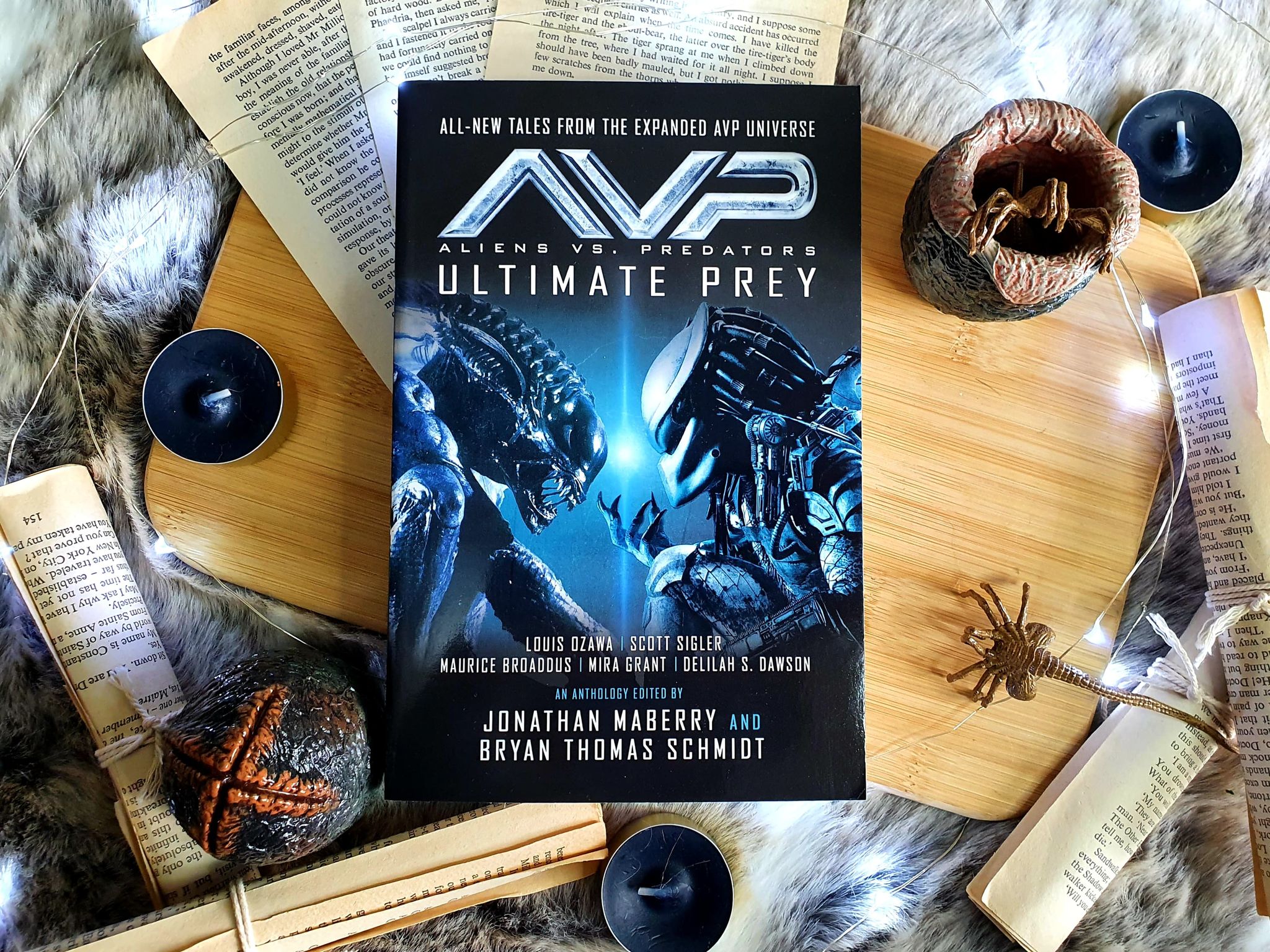
Aliens vs Predator: Ultimate Prey - Book Review


'Fifteen new and original stories for a first-of-its-kind anthology , set in the expanded Aliens vs. Predator universe.

'Here the ultimate hunters, the Predators, pitted against their ultimate prey, the Xenomorphs from Alien, with humans caught in the middle! Taking place on Earth and in distant space, these tales have been crafted by a who's who of today's most talented authors of the fantastic.

'Inspired by the events of the original Aliens vs. Predator movies, graphic novels, and novels, these are the ultimate life and death struggles.'

I've been a lifelong fan of both the Alien and Predator franchises since my uncle lent me VHS's of Aliens and Predator when I way, way too young to be watching them. Five is an appropriate age for those films, right? Ever since watching them I fell in love with those creatures and their universes, so the combined Alien vs Predator media was an absolute must for me. Whether it was graphic novels, books, video games, or movies, I engrossed myself in whatever I could get. When it was announced that Titan Books would be producing stories teaming up these two creatures I was especially excited, not least because their two separate anthology books, Aliens: Bug Hunt and Predator: If It Bleeds, were excellent.

The first story in this novel is 'Below The Secret' by Chris Ryall, and acts as a nice entry point into the book. This story follows April, a young woman who wanting to do something a bit different and wild agreed to take part in a storming of Area 51. Joining up with a group of people she meets online she thinks it will be a bit of silly fun that won't go anywhere, that will enable her to get some cool pictures for social media, and won't really amount to much. However, as the group enters the grounds she and Brockton split off from the others and head to a non-descript building where Brockton claims the real secrets are held. The two of them get inside using information Brockton bought, and discover an elevator that takes them deep underground, and brings them face to face with the deadly secrets hidden inside the facility. 

This story takes place in our world as we know it now, a world with people looking for ways to boost their social media following, doing silly Internet challenges, and looking for thrills to distract them from the boredom of regular life. As such, it feels like a shock when the characters come face to face with the titular creatures, even though we obviously know its coming. In some ways this story feels like it could be part of the same universe as the films, where these creatures have been using Earth as a hunting ground and various governments and private companies have taken notice. With some surprising moments and great tension, its a brilliant start to this collection.

The second story, 'Isla Maranzas' by Steven L. Sears, is a historical piece, one told in the form of what seems to be a written account of a man stranded on an island somewhere in the Caribbean in the 1770's. This narrator, whose name we don't learn, was shipwrecked on the island two years ago, and has been surviving the best he can, avoiding the deadly creatures that call it home. He has come to believe that this island is a home to a war between demons and angels as he has seen monstrous Malvados, creatures that burst from the chest and grow into monstrosities, fighting against Nephilim, giant warriors in armour who came down from the heavens. When another ship arrives off the coast the narrator must warn the sailors not to come ashore, for fear that they fall victim to these deadly demons.

I adored this story. The historical setting was wonderful, and something that I always enjoy seeing the Predators dropped into. Seeing it through the eyes of a man who has no context for the reality of things, and has come to the conclusion that he's seeing angels and demons is delightful in its ingenuity. The story also showcases some amazing Black women warriors, who were made slaves but come into their own in this setting and prove themselves to be worthy of the respect of the Yautja; and its absolutely delightful.

'Homestead' by Delilah S. Dawson is another historical piece, though no definitive time is given for when it takes place. Set somewhere during the expansion into Wild West, the story follows Lucy, the heavily pregnant wife of a farmer. Lucy is alone at her homestead as her husband, Robert is in town. Lucy begins to experience strange things around the land, seeing odd shapes moving out in the fields, and feeling like she's being watched. When something starts happening to her cattle, when monsters rip out of their bellies, Lucy is forced to flee to the next farm for help. But with the creatures everywhere, and her labour starting, safe haven might be hard for Lucy to find.

In all of the stories collected in this book the reader knows more than the characters involved. We know how bad the Xenomorphs are, we understand the rules for not getting killed by a Yautja, but I don't think the tension of knowing all this ever felt as high as in this story. As soon as Lucy is finding odd things around the farm I was begging for her to get away, to run, and the fact that she didn't was such a source of tension. The fact that Lucy goes into labour during the story, has to contend with her child coming into the world whilst surviving against these monsters, just made it so much more frightening too. Delilah S. Dawson does such an amazing job here, and I want to see her do more in this universe.

Have you ever thought 'what if we combine Aliens and Predator with a haunted house story?' Chances are you haven't, but this is exactly what David Barnett does with 'The Hotel Mariposa', and its so wonderfully weird and unique because of it. This story tells the tale of a trio of reality TV stars, hosts of American Spook-Chasers, who've come to an abandoned and haunted hotel to try and get some proof of the paranormal, boost their ratings, and keep their show in production. The hotel has stories of ghostly figures, shifting hallways, and every few decades people found dead inside with holes in their chests. They've come to capture ghosts on camera, but little do they know that an alien hunter is watching them from the shadows, waiting for its prey to make an appearance.

'The Hotel Mariposa' is basically what would happen if a TV ghost hunting show ever got caught in the middle of an Alien vs Predator story. The three people who get caught up in the middle are pretty open minded, but never considered aliens to be a thing. Unfortunately for them, not only are they real, but the hotel really does seem to shift and warp reality whilst they're inside it. This isn't the paranormal, and there's a very clever sci-fi explanation for this, but the changing interior and ghostly visions add some extra spooky wrinkles to this story.

'Planting and Harvest' by Mira Grant is set on a deep space research station named Philomelus, a place where scientists have come together to work on new food strains, new proteins, and fast growing foods that could help change the landscape of space travel, colonisation, and the military. Whilst most of this research is fairly benign, it's done in the remoteness of space so that if anything does go wrong it can be easily contained, and so that the secrets they develop can remain in the hands of their company. Unfortunately, this remoteness becomes a serious problem when a shuttle filled with Xenomorphs docks on the Philomelus. In less than a day the creatures have spread throughout the station, killing all but a single scientist who was able to lock herself away in her lab. Desperate, and knowing that she won't survive without help, she sends out a distress signal into the deep reaches of space; a signal that is picked up by a passing Yautja hunting party.

The initial set-up for 'Planting and Harvest' seemed like a fairly standard Alien vs Predator story, a place becomes overrun with Xenos, the Yautja come in to hunt them. Whilst Mira Grant doesn't do anything with the set up that sets it apart from others the rest of the story really do feel quite different for a few reasons. The first is that Grant expands a part of the universe that most folks would never really think about, the huge demand for food stuffs and crops in this future. The details that Grant give are interesting and adds new layers to things. Some of the odd stories of the difficulties that come from this and the results when things go wrong were strangely delightful, and something that I very much enjoyed. The other thing that I really liked about this was that the lone human helped the Yautja to hunt down and kill the aliens, but not in the normal way we see. She didn't pick up a weapon and fight beside them to earn their honour, but instead used her brains to help save the day.

Susanne L. Lambdin's 'Blood and Honor' sees a human and a Yautja teaming up in slightly different ways when Kai Kentarus finds herself stranded and alone on a remote world where Yautja are hunting not just Xenomorphs, but a pair of queens too. Having been betrayed by her lover, poisoned and left to die, Kai is forced to struggle through this hellish landscape, avoiding deadly creatures as she goes. Someone who has gone up against the deadly hunters and barely survived in the past, Kai is astonished to find herself helping a captured female Yautja to escape from one of her own kind. It appears that a male hunter has gone rogue, turning on the female Yautja whilst also hunting the two queens that are at war. With threats from every side, Kai and her new ally, Blood Venom, must work together to survive.

In comparison to the previous story, this is much more of what I expect when a human and a Yautja end up working together; though there are some new twists on this formula. The most obvious thing is that there's a kind of civil war going on in both alien groups. For the Xenomorphs this is an ancient, infertile queen battling for dominance with a new, younger queen, and for the Yautja it's a rogue male that has begin hunting and torturing the females. There's no real reason given for this male hunter's turn, it's possible that he's a bad blood, or from a rival clan, but it kind of doesn't matter in this story, and instead it's a nice reflection of what Kai is going through as her former lover has tried to kill her. Males enacting violence against women isn't just limited to humans it seems. I also loved the fact that Kai is a trans woman. It's not a major part of the story, and it's not something that needed to be included, but as a lifelong fan of these franchises who's herself trans, it's amazing to see someone like myself included in this way. 

'Carbon Rites' by Jess Landry is a story with something of a mystery. It begins by introducing us to Blake, a young woman who lives in the quiet town of Morden. Blake has never left the town, has lived there since she was born, yet dreams of one day getting to go off and explore the world. Little does she know that there's a huge secret hidden beneath Morden, one that she's going to have to face if she's going to make it through the night. When a trio of armed strangers enter her diner as she's getting ready to close one night Blake discovers that a strange creatures is hunting her from the shadows.

There's a huge mystery element to 'Carbon Rites', one that makes me reluctant to talk too much about the story through fear of giving some of the answers away. The story has a very strange feel to it the moment it begins, and things don't feel quite right the more that we get t learn. As Blake fights to make it through the night these mysteries deepen, and you find yourself getting really dragged in to this story in ways you're not expecting.


'First Hunt' by Bryan Thomas Schmidt makes the human characters a secondary focus, as we begin this tale by being introduced to a group of Yautja out on the hunt. Bo'kui is an older hunter, one who has trained many young warriors and presided over their first hunts, their passage to adulthood. He now watches on as a trio of young warriors stalk their ultimate prey across a world that has recently become home to a new human colony. As the hunt descends upon the humans homes Bo'kui must make sure that his three charges don't do anything to bring dishonour to themselves as they battle the deadly Xenomorphs.

I really liked the fact that 'First Hunt' took a different approach to some of the other stories in the book and gave the Yautja a good deal of the focus. Other stories in this collection have at times followed the alien hunters, getting in their heads and showing us how they tick, but none to the degree that this story does; where half of it is told from their point of view. This gives us a lot of insight into how the Yautja think, how they feel during a hunt, and a look at the cultural significance their hunts and the way they comport themselves has. When the story shifts back to the humans we get a good sense of the horror that they're facing, coming into contact with both species for the first time, and trying desperately to survive in increasingly desperate odds. There are some genuinely frightening moments here, and it makes you glad you're not stuck on that world with them.

Yvonne Navarro delivers a surprisingly thought provoking and moving story in 'Abuse, Interrupted' as we see what happens when Jazz, a woman being abused by her partner, decides that she's finally going to try and escape her situation; only to find herself getting caught in the middle of an alien battle. This is the only story in this collection where the Xenomorphs and the Yautja aren't the real horrors, where they're not the thing that makes your skin crawl or leads you to feel afraid.

Navarro spends a good portion of the story letting readers get to know Jazz, and to understand her situation before anything happens that fits with the themes of this collection. It's done so well that I actually forgot that I was reading an Alien vs Predator story for a while, as I'd become invested in Jazz and her story. Navarro is able to get you to feel for Jazz incredibly quickly, and whilst seeing her facing off against alien monsters leads to some moments where you feel in awe of her strength and bravery, its when she comes face to face with the man who's been abusing her that you really begin to see the strength of her character. This might be an uncomfortable read for some, especially if you've been the victim of domestic abuse yourself, but it's well worth the read.

'Better Luck To Borrow' by Curtis C. Chen follows Lily Shóu, an incredibly gifted young teen who's trying to make a shady deal with a Weyland Yutani employee to sell them secret specimens whilst on a school trip. Lily found several strange alien creatures in stasis in her late parent's lab and has made a deal to sell them, but when the stasis fails the creatures, facehuggers, are released onto the boat they're on, infecting several large rat creatures. With Xenomorphs now loose on the boat and killing students things get even worse when a strange ship approaches and unleashes a deadly hunter.

This story felt like an odd one tonally, because it was very clearly a story that didn't hold anything back in terms of horror and gore, with folks getting ripped apart or teens having limbs burnt off by acid blood, but at the same time it felt like a YA story thanks to the young cast of characters and the competent female teen lead. It was a strange combo, but it really worked, and I definitely want to see more stories in this universe play in this kind of territory. I also really liked Lily, and found her to be an engaging and well developed lead for such a short story. It was also great to have a lead character with a disability getting to be a hero.

'Film School' by Roshni 'Rush' Bhatia tells its story mostly through flashback as woman is detained by security forces, being questioned about how she and her colleagues broke quarantine to land on the planet Tenebris. The woman was part of a documentary film crew, who decided to sneak onto the planet in order to find out what happened to the colony there, and why it's since been quarantined. After being dropped off by their ship they discover that the colony is deserted. Searching the surrounding area they find an infestation of Xenomorphs, and a group of Yautja hunting them for sport. Stuck with no way off world, the group have to try to survive until their ship comes back for them.

This was a really good story because even though I knew what was coming it still felt incredibly tense as the documentary crew made their way around Tenebris looking for answers. It's one of those situations where you know something awful is coming, and you're just waiting to see how it happens. The interpersonal relationships within the group, and the breakdown of the team as things go wrong were particularly interesting, and even though you knew the narrator was going to get out alive it never felt like she was particularly safe; which was an impressive feat.

'Night Doctors' by Maurice Broaddus centres on Nyota and Miles, a pair of siblings who live on the Weyland-Yutani colony of New Allensworth. Miles is sick with a cough and Nyota takes him to the medical facilities in order to receive treatment, something that she's a nervous about doing thanks to her knowledge of how Black people have been treated my the medical establishment throughout history.  Nyota has heard of the stories of white doctors experimenting on Black people, of testing vaccines, and intentionally infecting them without permission or knowledge, and has a distrust around doctors. Unfortunately for Nyota and Miles, this is a part of history that doesn't seem to have died out, and the siblings find themselves learning about awful experiments.

I loved the fact that Maurice Broaddus drew inspiration from real world atrocities for this story, that he took a look at the things that the Black community have had to deal with for generations and thought about what might still happen in the future. The Alien universe has always been grim, and it's taken a dark approach to capitalist greed and how little faceless companies value human life; so it felt like no surprise that a company like Weyland-Yutani would experiment on people in order to get what they want. This is one of the few stories in the book where the alien creatures are far from the real monsters, and it's humanity that's the real force to fear.

E.C. Myers contributes 'Scylla and Charybdis', a story that has a slightly different take on the Yautja. When the colony ship Ketumani end up dead in space the crew are awoken to try and fix things. However, not long into the emergency a strange ship docks with them, and a large alien hunter boards them. Equipped with stealth technology and a strange projectile weapon, the creature stalks the crew through the ship, taking them out one by one. When the last of the crew is shot by the creature the story doesn't end, as this Yautja has been taking prisoners for a strange purpose.

I really liked this story. I enjoyed how the first half of the tale was a chilling story of a Yautja hunting this crew through their ship. There are some really tense and scary moments, and the captain becoming the last survivor and using trickery and clever tactics to try and take the hunter down is a real highlight here. However, this is only half the story. I won't spoil what comes after, because it's very intriguing, but there's some interesting human drama mixed in here too, as some neat developments and insights into Yautja society too.

'Another Mother' by Scott Sigler is the story in this collection I was most excited to read. A sequel to the phenomenal Aliens: Phalanx, still one of my favourite books and one of the most creative takes on the franchise, this story picks up a number of years later with two of the leads of that novel. We return to the remote world from that novel, where humanity has been living in isolation for generations as a feudal society barely entering the steam age. Thanks to having lived with the Xenomorphs for centuries, the people of that planet weren't able to expand and grow; but thanks to a group of brave warriors and some amazing discoveries, they were able to wipe out the colony and destroy the queen. Now, decades later it appears that some of these demons may have survived, and a new queen is around. There's also a lone Yautja on the planet, scouting the world as a potential hunting ground for her people. When she learns that some of these primitive humans have killed a queen she wants to do the same, proving herself worthy to her people. And to do that, she'll have to work with some of the humans.

I was so happy to return to this planet and these characters, especially with there having been a decent time jump so that readers could get a sense of the kind of lives the heroes got to live after the events of Aliens: Phalanx. This also proved to be a bit of a problem for me though, as it meant I was absolutely terrified for the returning characters. These were survivors from my favourite Alien novel, and I was so scared that something awful would happen to them here. I'm not going to say what happens, but I will say that the introduction of the Predators to this world felt so seamless and perfect that it felt like the natural continuation of this story. If you enjoyed Aliens: Phalanx I'm absolutely certain that you're going to get a lot out of this story.

The final story in the book is 'Kyódai' by Jonathan Maberry and Louis Ozawa, and is another sequel story. This time, it's a sequel to the film Predators. Louis Ozawa is a name that might be familiar to Predator fans, as he played Hanzo in the movie. With his character having dies to the hands of the Falconer predator in a swordfight, this story doesn't follow him, but his younger brother, Eiji. Captured in a similar way to his brother, Eiji finds himself falling through the air to a large jungle. When he lands he begins to search for answers and finds soldiers being hunted by Yautja, who are now using Xenomorphs as hunting dogs thanks to implants in their skulls that shock them. When Eiji discovers a shrine in the jungle he learns that this was the fate of his older brother, and makes a vow to survive the hunt no matter the cost.

'Kyódai' is a really great story for fans of Predators, not just because it continues that story and shows what comes next, but because it gives us a lot of insight into Hano, one of the best characters in the film. Through flashbacks and Eiji's inner thoughts we learn a lot about the brothers pasts, and the kind of people they are. We also see that despite falling in battle to the Falconer the other Yuatja looked at Hanzo with great honour, respecting his abilities to defeat his opponent in one on one combat. This adds some interesting detail to the Super Predators, and shows a more honourable side to them that the film didn't really explore. A great companion piece to one of the best Predator movies, this story is sure to make a lot of fans happy.

Overall, I loved all of the stories on offer in Alien vs Predator: Ultimate Prey. It really felt like a love letter to this join franchise, with both sets of creatures given great moments to shine and show off what makes them such great creations. There wasn't a single dull moment to be had here, there was great action, tense moments, lots of horror, and plenty of representation as we got amazing female characters, Black characters, disabled characters, and trans character to name but a few. This book expanded the franchise in some great ways, and I hope that we get more like this in the future.


Support Amy on Patreon

Buy Amy A Coffee

Go to Amy's Blog

Friday, 6 May 2022

Limit Break Comics: New Releases – Comic Review


Originally published on Set The Tape


Dublin-based comic collective and independent publisher Limit Break Comics recently launched five brand new titles at last month’s Dublin Comic Con. We’ve taken a look at what’s on offer!


Old Game Plus #1

Old Game Plus #1 is a short anthology book that takes inspiration from video games. The issue manages to include six short stories from a number of different creators, presented with varying art styles.

The first story, ‘A Warrior’s Journey’, is a take on Street Fighter, following a guy who looks suspiciously like Ken as he discusses his recent loss with his partner and he reflects on the journey he’s taken around the world fighting folks.

The second story, ‘It’s Just Another Saturday’, draws inspiration from skater games, and sees a young woman skating around an empty building, doing tricks, and grabbing collectables. It’s a story with no dialogue or narration, and has a nice art style that looks like a rough sketch. The third story, ‘Speedrun’, seems to be set inside the Resident Evil mansion as the protagonist rushes from room to room to get to their goal, trying to speed run the game. This was a fun look at this unique area of gaming.

The fourth story, ‘Brake, Brake, Accelerate’, looks to have drawn inspiration from futuristic racing games like F-Zero, and is another story told without any dialogue. The art looks really nice here, with some lovely crisp drawings and a nice muted colour palette. ‘Weapon of Choice’ is the one story where I couldn’t pick out one specific game that it might have drawn inspiration from, and instead seems to be a nod to fantasy games in general. It’s a neat little story that will have you guessing what might come next, with some great art.

The final entry is ‘For The Love of the Game’, which sees an adventurer doing a run through a lost jungle temple, doing their best to avoid traps. Once again, this story was delivered without dialogue, and relies on the really pretty art to tell the story. Old Game Plus is a nice mix of different stories, all of which will seem familiar to gamers, and felt like a great intro to the new wave of Limit Break books.


LENS

LENS is the biggest book on offer from this new wave of releases, and brings together a number of comic shorts that were originally published in other titles, to create one cohesive narrative.

The story follows the contract killer Lens, a woman who uses her position as a photo journalist to gain access to her targets. When Lens is hired to kill the CEO of a major corporation she finds herself being pushed to her limits and having to rely on all of her skills just to stay alive.

Written by Garry Moloney, LENS moves at a pretty fast pace, especially as it was originally broken down into small parts. Because of how it was originally published the story doesn’t hang around, and has some short scenes. Despite this, it manages to flow really well and you get a good sense of who Lens and the other characters are without being able to spend a whole lot of time with them.

The artwork, provided by Raquel Kusiak, certainly looks unique, with very thin, angular looking people with bold facial features. Kusiak also uses a very limited colour palette depending on the scene, with one colour dominating each scene. It gives the book a very bold look, one that has its own sense of style.


Plexus #2

Plexus #2 is the second issue in another Limit Break Comics anthology series, this time focusing on science fiction themes and technology.

The first story in the issue, ‘Ghosts’, follows Tommy, a guy whose apartment building seems to be haunted by some kind of ghost that inhabits technology. Whilst at first Tommy and the entity come into conflict, as the story progresses we learn more about what this creature is and where it came from, and see the relationship between the two of them change. This story is interesting, and pretty bold in a few ways, and boasts a cool art style that really works for this story.

The second story, ‘Run’, centres on a scientist who’s forced to run for his life through a ruined world, where pieces of earth hang in a white void of destruction, floating in a nothingness of annihilation. The man is desperate to get to one particular building, where he believes the means to his escape lies.

There are a lot of small nods and winks to other sci-fi stories in this tale, particularly thanks to small details in the art where you’re able to pick out stuff like the TARDIS console, and the Stargate amongst others. This is definitely the shortest feeling story of the three, but has an enjoyable twist ending that makes it worth reading.

The final story, ‘Oneira’, sees a man being haunted by nightmare-like people he can’t understand. This story is probably the hardest to follow, due in large part to the very strange art style used. It feels twisted and disjointed, like visualising a nightmare, and because of this I honestly couldn’t tell you what this story was about.

Overall the quality of Plexus #2 was good, with longer stories than the other anthology books on offer. However, with one of the stories making little to no sense I can’t say I enjoyed it as much as Old Game Plus.


Meouch  #2

Meouch #2 is the second issue in a series that began back in 2019, which follows the adventures of a cat assassin as he tries to deal with some rival killers, and a deal that goes horribly wrong when he’s double crossed.

This issue picks up where the first left off, as Frankie returns to his employers’ building looking to get answers about why he was double crossed. This leads him into conflict with rival cat killers and he’s forced to run for his life. With no other options open to him, Frankie plans an assault on the home base of the man responsible for the whole thing, Doggo Shady.

Written by Paul Carroll, with art by Gareth Luby and Rebecca Nalty, Meouch is a very silly book, one that is trying to combine the brutal horror of murder and the cliches of action movies with small furry animals.

On occasion it works, but more often than not it feels like the book is going too far into the silliness, and doesn’t feel particularly entertaining, especially with all of the cat puns. Another thing that doesn’t help this title at all is that it’s been three years since the first issue was released. With the fact that this is an ongoing story it seems like a tough thing to recommend a series where you have to wait years between chapters.


Limit Break Presents #1

Another anthology title, Limit Break Presents is the first issue of a new anthology series that brings together three groups of creators to tell stories tied together by a central theme. The theme of this issue isn’t hugely obvious, though may be something like ‘being yourself’ or ‘overcoming your insecurities’, but this isn’t hugely obvious. Whatever the theme, this book’s stories are pretty entertaining.

The first, ‘How Do I Look?’ sees a couple getting ready for an evening at a gala event. Presented in black and white, the story follows a man and woman as they prepare for an evening out, with the man having some misgivings and thoughts about whether what they’re doing is right.

The second story, ‘Shine’, is a huge contrast to the first. Presented in bright, bold colours, and with a very animated and stylised art, this story follows a couple of super-powered school teens as one of them has a meltdown in the bathroom. Unable to control her power, and worrying about what people are saying about her, it’s only when her friend comes to reassure her that she can learn to just let it all go and be herself. The story is pretty nice, has a lovely look to it, and a great message about being true to yourself.

The final story, ‘Tomb of the Unworthy’, sees a young internet influencer trying to break her way into an ancient temple in order to take a selfie with an artefact everyone is trying to get to. This is an interesting story, with some good art, and feels much more like a self contained narrative than the others. It makes its points well, and doesn’t feel like there’s much more to tell than’s already presented here. Despite the theme of this issue not being hugely obvious Limit Break Presents proved to be a great anthology collection, with some interesting stories with some bold and different styles that all stand out from each other and look great on the page.


Limit Break Comics seems to be the best when working in the anthology format, with four of the five new releases doing so. The only book that is part of an ongoing narrative is Meouch, and this was definitely the weakest of the set. If you’re looking for some interesting short stories and aren’t wanting anything big to read, these titles might just be perfect for you.


Support Amy on Patreon

Buy Amy A Coffee

Go to Amy's Blog

Thursday, 5 May 2022

The Hound of the Baskervilles by Arthur Conan Doyle – Throwback 120


Originally published on Set The Tape


If you were asked to name the most famous mystery stories of all time, the greatest mysteries that have ever been told, chances are pretty good that The Hound of the Baskervilles would be on that list, and would be placing pretty high. Having been called one of the greatest mystery novels ever written, the most famous Sherlock Holmes book is celebrating the 120th anniversary of its publication.

After killing the character of Sherlock Holmes in the 1893 story ‘The Final Problem’, Sir Arthur Conan Doyle spent almost a decade being sent letters from fans asking, or downright demanding, that he bring the character back. Holmes was such a popular character that the public couldn’t take his passing, and thanks to this level of harassment Doyle gave in and wrote a new novel telling a ‘lost’ story from Holmes’ past. Thus The Hound of the Baskervilles was born, and I’ve never been more grateful for obsessive fans hounding a creator!

The story of The Hound of the Baskervilles begins when Dr James Mortimer visits the home of Sherlock Holmes and John Watson in London, asking for their help. His friend, Sir Charles Baskerville, was recently found dead on his estate in Dartmoor, apparently having died of a heart attack. However, Mortimer tells the detectives that Baskerville had a look of pure terror on his face, and believes that his death is related to the legend of the Hound, a large, spectral dog that has haunted the family for generations, and taken the lives of many of its members. He backs up his claims by saying that large paw prints were found nearby.

Despite dismissing the claim of the monstrous dog, Holmes agrees to meet with Henry Baskerville, the next in line in the family, and to look into the mystery. Sending Watson to Dartmoor to look into things for him, the mystery seems to deepen when Watson, Henry, and Dr Mortimer experience strange, unsettling events in the night. Things seem even more dire when the trio learn that an escaped murderer is loose in the surrounding moors. Thus begins a case that will go on to be one of the most popular in the entire Sherlock Holmes catalogue.

It would seem like the inspiration for The Hound of the Baskervilles came from the legend of Squire Richard Campbell, a figure that has been described as ‘monstrously evil’ by historical accounts. Inspiring the story of the Baskerville ancestor, Campbell was said to have sold his soul to the devil, as well as murdering his own wife. Upon his death a pack of spectral hounds were said to be seen around his tomb, and that ever since, on the anniversary of his death, his ghost could be seen leading the hounds across the moors. Having an interest in the supernatural, despite it being an area that Holmes never put much stock in, Doyle was drawn to this story and took a number of the elements for the creation of his own tale, and would even go on to explore Dartmoor in person in order to capture the correct look and feel of the place for his first Holmes story in almost a decade.

Despite The Hound of the Baskervilles being a Sherlock Holmes story, and the first one since the character’s death, and following a several year gap, the story doesn’t feature Holmes a great deal. Instead, Watson is very much the lead character for this story. Watson has always been a huge part of the Sherlock Holmes world, especially as the stories are written from his perspective, but Holmes is still largely the key figure in the stories, with his absences being small when they happen. But for The Hound of the Baskervilles Watson carries much of the story, especially when Holmes sends him off to Dartmoor alone to investigate for him.

I don’t know if Doyle’s decision to sideline Holmes in this story came from a desire to showcase Watson as a capable lead, able to head up an investigation himself on the chance that he might want to continue the stories without Holmes’ return, or if perhaps he felt out of practice writing the character after so long and didn’t want to feature him much, or maybe even it could have simply been him messing with his fans by releasing a new Holmes story that hardly featured the character. Whatever the reason for Doyle’s decision, it actually worked out rather well, and gave the often overlooked Dr a chance to shine on his own without Holmes there.

The Hound of the Baskervilles became a huge success after its release, and this is probably a large part of why Doyle would bring Holmes back to life for real a few years later. The story has only grown in popularity over the years, and has become one of the most adapted books of all time, with more than twenty film and television versions of the story, as well as audio books, audio plays, stage plays, and even appearances in comics, anime, manga, and video games. With the huge popularity of the story, the fact that fans were demanding it for years, and that it helped to bring the world’s greatest detective back from the dead, it has well earned its place as one of the greatest mystery stories of all time.


Support Amy on Patreon

Buy Amy A Coffee

Go to Amy's Blog

Wednesday, 4 May 2022

Heart of Darkness by Joseph Conrad – Throwback 120


Originally published on Set The Tape


There are certain books that even if you’ve never read you’ll have heard about. They’ll be brought up as some of the ‘greatest books ever written’, studied in schools and higher education, they’ll inspire adaptations, and they often go on to last forever. Heart of Darkness is one of these books. It’s a book that I’d heard of many times in my life, but it wasn’t until just a year ago that I ever actually picked up a copy.

This short novella, barely more than a hundred pages in many editions, was first released in three parts in Blackwood’s Magazine across 1899, and it wasn’t util three years later that it would finally be published in novel form. To celebrate the 120th anniversary of this hugely influential and well known novel, I decided to take a look at it.

Partly inspired by the life of author Joseph Conrad, Heart of Darkness tells the story of Charles Marlow, who narrates a story about how as a younger man he travelled to Africa to discover some of the ‘blank spaces’ on the map. In his flashbacks, Marlow travels to Africa and gets work as part of a Belgian trading company who are colonising the area. After several incidents, Marlow is eventually put in charge of a steamer ship and tasked with sailing it up river to find one of the company’s camps, run by a man named Kurtz.

There have been rumours of terrible things happening in the area, of people becoming ill, and Marlow is tasked with finding Kurtz and bringing him back. During the journey the steam ship is attacked, shot with arrows out of the early morning fog, and members of the crew are injured and killed. When Marlow comes across a wandering Russian man he learns some troubling news: that Kurtz has apparently gone mad, and is being worshipped by the native people. Arriving at the camp these suspicions seem to be proven when they find severed heads on stakes, and Kurtz seems to command the natives like a small army.

Eventually Marlow is able to get Kurtz onto his ship and begins the journey back, bringing the sick Kurtz with him. Along the way Kurtz’ health worsens. Kurtz provided Marlow with secret documents that he begs to be kept out of the hands of the trading company managers, before dying of his sickness. Upon returning, Marlow sends the papers to the press.

Despite how popular a story Heart of Darkness is today, the book wasn’t a success within Conrad’s life, and when it was first published in 1902 it received little attention from critics at the time. According to some literary historians, even Conrad himself thought little of the book. However, despite this, the book began to find more and more of an audience as the years went by, with people gravitating towards its heavy use of metaphor and symbolism in order to leave a sense of mystery; as well as its commentary on colonialism in Africa.

By the 1970s, Heart of Darkness became a popular text for study in senior schools and universities, and has sparked a number of debates over the years. One of the areas in which the book has been discussed a lot, and is even often criticised is in postcolonial studies. Nigerian novelist Chinua Achebe gave a lecture at the University of Massachusetts in 1975 titled ‘An Image of Africa’, in which he condemned the racism of the novel and stated that whilst Conrad wasn’t responsible for the xenophobic image of Africa in the novel, it does continue to perpetuate the damaging stereotypes. The essay sparked a great deal of debate around the book, and is still a huge touchstone to this day when discussing the merits of the text, and the racist elements within it.

Heart of Darkness isn’t just a popular feature in the classroom and lecture halls though, and has been adapted a number of times over the decades since it was published. One of the first adaptations was a radio drama written by and starring Orson Welles, who changed the story to focus on the rise of a fascist dictator. The story also appeared on film, with its first adaptation for the screen being the television play Heart of Darkness (Playhouse 90), produced by CBS as part of an anthology television series of filmed plays. This version saw screen legend Boris Karloff in the role of Kurtz.

The story would also inspire a number of loose adaptations too, stories that didn’t directly recreate the source material, but instead used it as an influence. It was used in video games a number of times, with it being a heavy inspiration for Far Cry 2, which was set in Africa and saw the player trying to stop an arms dealer, and featured a final area called ‘The Heart of Darkness’. The much acclaimed game Spec Ops: The Line also borrowed heavily from the book, and featured the character John Konrad in a role much like Kurtz. Perhaps the most well known story inspired by Heart of Darkness however, is Apocalypse Now. The 1979 film shifted the setting from Africa to the Vietnam War, but still kept much of the central plot ideas, and themes, and had Marlon Brando in the role of a Colonel Kurtz.

Heart of Darkness is not an easy book, despite its short length. It can be a hard read at times, and it’s easy to see why some people have come to dislike it over the years. Whatever you think of it though, it has clearly become one of the best received, more important works of fiction in many, many years. The story has lasted for a hundred and twenty years so far, and it’s anyone’s guess how many more decades it will remain relevant and popular.


Support Amy on Patreon

Buy Amy A Coffee

Go to Amy's Blog

Tuesday, 3 May 2022

Virus: 32 – Film Review


Originally published on Set The Tape


New Uruguayan horror Virus: 32 has been marketed as a zombie movie, and whilst it does share some similarities with the zombie genre it’s very much its own animal. Following a mother and daughter with a tough relationship as a deadly virus sweeps through the city, Virus: 32 is a tense and creative survival horror story.

The film begins innocently enough, introducing viewers to the inhabitants of an apartment building where our lead, Iris (Paula Silva), lives with her flatmate. Whilst nothing obviously awful happens we do get a hint that something terrible is stirring just beneath the surface, when one of her elderly neighbours attacks and kills their pet bird. We learn that Iris is separated from her partner, and has temporary custody of her daughter Miriam (Sofía González).

Iris is introduced as a young woman who likes to party, whose apartment is filled with empty bottles and drugs. She doesn’t seem to take her life seriously, and has managed to mess up her plans to take care of her daughter by agreeing to work the night shift at the local community centre where she’s a security guard. She’s pretty far from being the mother that Miriam needs in her life. Despite her flaws, she tries to do her best, and sneaks Miriam into the community centre to spend the night with her. Whilst the two of them are inside the building something begins to spread throughout the city: a virus that drives those infected into a murderous rage. With their exit blocked off, the two of them must try to find a way to survive the night and make it to safety.


Virus: 32 is less of a zombie film, and is more in line with 28 Days Later, and I think people who enjoyed this British horror film (which is now 20 years old!) will find a lot to like with this movie. If you watched 28 Days Later and wanted to know what happened during the initial outbreak, to see the chaos of the virus tearing through society and causing havoc, this film pretty much does that, though on a small scale. Due to the budget of the movie being pretty low we never really leave the confines of the community centre. Anything that’s happening beyond those walls we see in the distance, we hear as faint screams and sirens.

Rather than being a negative, I thought that this actually helped the film in a lot of ways. It made the film have to focus on this very personal story, of this one woman trying her best to be a good mother and to protect her daughter whilst the world goes to hell around her. We know that awful things are happening everywhere else because we can see it in the distance, but we don’t need to focus on that. It doesn’t matter where this virus came from, if the government are doing anything about it, and how many other survivors there are because those things don’t matter to Iris in this moment. The only thing that matters is her and Miriam’s immediate survival, and the film does a great job on pushing that to the fore.


The lead actress, Paula Silva, does brilliantly in the role of Iris. When first introduced there’s no indication that she’s a mother. She acts like a woman barely out of her teens, more focused on the next time she can go out partying than she is on her daughter. Obviously there are parents like this in the world, and not acting in a traditional motherly role doesn’t take away her parenthood, but it’s rare to see a parent depicted this way in film. This is a big part of her story, however, and over the course of the film Iris is forced to step up and be a better mother, facing her own issues and the reason why she’s the way she is in order to do so. Considering how short the runtime of the film is and how much gets focused on the horror of surviving against the infected, we get a surprising amount of time given over to her characterisation and her backstory – something that proved to be one of the more interesting parts of the movie.

The film also tries to do something a little different with the infected, and adds a unique spin on things. Whilst they’re most similar to the rage infected in 28 Days Later, these infected don’t seem to be angry all the time, and when not actively hunting people they will wander around places, performing small tasks. This makes them pretty creepy at times, and we get some very tense moments where Iris has to try and sneak past them as they do their thing. But there’s also another added twist. Whenever the infected perform a violent act, whenever they kill anything, the rush of having killed seems to send them into a trance-like state where they shut down. This allows survivors a few moments, 32 seconds to be precise, to try and get away, sneak past, or kill them, whilst they do nothing. This is something that I’ve never seen in a zombie infection style movie before, and adds a whole new element; though one that I don’t think was utilised nearly enough.

Virus: 32 is an interesting film that’s trying to add some new twists to a pretty well worn formula. Rather than taking a big, grand approach to an end of society story it focuses on the human element, and thanks to some great performances it manages to deliver an engaging, personal story of a mother and daughter and their strained relationship. Fans of zombie infection movies will find a lot of familiar stuff here, but will also discover some new twists on the formula that are pretty unique.


Support Amy on Patreon

Buy Amy A Coffee

Go to Amy's Blog
Monday, 2 May 2022

Call Me Nathan by Catherine Castro – Graphic Novel Review


Originally published on Set The Tape


''All I want is a proper body . . . ' Born as biologically female, Nathan spends his formative years facing questions without answers, social ostracism from his peers, and incomprehension from his family—because from as early as he can remember, he knows he has been born in the wrong body. But, as his family comes to recognize, a physical identity is harder to change than a piece of clothing or a haircut. So from the moment he is at last supplied with a professional term for his self-diagnosis—“gender dysphoria”—he is able to leave behind his complicated psychological history, the challenges of his self-harming, and his struggles with sexual identity, and begin the difficult process of claiming his true self. Based on a true story, at first hand, Call Me Nathan issues a moving call for understanding, a powerful denunciation of prejudice, and a celebration of everything it means to love.'

SelfMadeHero have produced a number of graphic novels over the years that touch on important issues, moments from history, and real stories. A lot of the time when the publisher creates stories about real people it’s famous figures like George Orwell, Harry Haft, and Diego Rivera; figures that have a place in history and have done things of note. Call Me Nathan is slightly different though, as whilst it’s based upon the life of a real person, it’s a very normal person. This isn’t the story of someone who has done something world changing, it’s not a story that is well known or in the history books. This is a simple story of one man’s fight to simply exist as himself.

Call Me Nathan follows the life of Nathan Molina, a young man living in France. The story begins with Nathan in his teens, during the time in his life where those around him still saw him as a girl. You see, Nathan was born female, and all his life he’s known that something wasn’t right with him, that he wasn’t happy being a girl, and never felt like he really fitted in. As Nathan enters his teens these feelings intensify, especially when puberty begins, and his body starts to change.

Nathan begins to become withdrawn, spiralling into a depression. He lashes out at others. He had nightmares about the changes that are happening to him. He even begins to self harm. Nathan is unsure what’s happening to him, he only knows that there’s something different about him to those around him. After doing some research Nathan learns of the term transgender, and realises that it describes him, knowing that he really is a boy, and that he can change his outsides to match who he is on the inside. Now all he has to do is convince his family that this is the right thing for him.

There is a lot of stuff in Call Me Nathan that is shockingly familiar to me. Despite having a very different experience of transition than Nathan there’s a lot of his journey here that felt like it had been taken from my own life. The desperate longing to be who you’re meant to be, the sense that you’re losing out on your real life, the pain and depression that never seems like its going to end. I think that Catherine Castro does an amazing job of capturing those feelings and experiences, especially the strange miasma that hangs over your life when you know that something is wrong but can’t quite figure it out. So many trans stories seem to have characters who have always known they were trans, and to see an experience that echoed my own, where figuring that out was a huge step of the journey, felt so wonderful to see.


Thanks to the sheer amount of awful stereotypes and misinformation in the world about trans people right now it would have been really easy for this book to have gone wrong, to have perpetuated harmful lies, but you can tell that Castro took the time to actually look into this, that she spent time with the young trans man in her life, Lucas, and tried to create a real story. Nathan isn’t a real person, his story isn’t completely true, but it is based on a real story, on real experiences, and I think that sometimes that can matter just as much as any one true story. Nathan is a stand-in for one of thousands of trans men in the world whose life echoes this, who can see themselves in this book and feel represented well.

And that kind of representation does really matter. Especially now. The trans community is not in a good place right now. We’ve never been more under attack than we are now. States in the US have passed laws to ban trans-affirming healthcare for anyone under 19, whilst other states have begun to treat parents of trans children who support them as child abusers, even taking legal action against them. Here in the UK there are transphobic pieces in the media every single day. The same week that I read and reviewed this book it was announced that trans people would not be part of the conversion therapy ban, effectively giving the green light to torture trans people, and the Prime Minister spouted transphobic talking points on television. Trans people are in literal danger, our lives are at risk, and all because a hateful, vocal minority spread lies and misinformation about us as loudly as they can. And books like this go a long way to help challenge that.

Call Me Nathan doesn’t glamorise the trans experience, but shows it in a very real light. It shows the pain that trans people go through when their identities are denied. It shows the harm that going through the wrong puberty can do to us. It shows how hard it is to fight just to be seen as yourself. But just as importantly, it shows how wonderful and affirming it is when you get that. This book dispels so many myths and lies, it tells an honest story, and at times like this, when trans people are called sexual predators and child groomers just for existing, we need these kind of honest narratives.

I can’t talk about the book without mentioning the art, provided by Quentin Zutton. The art for the book doesn’t look like what most people would think of when they hear the word comic. There are no panels or hard boxes for the artwork to sit inside of, and much of the book looks more like a sketchbook, where the art has simply been drawn onto the page in a way that feels less rigid and more free-flowing. This really helps the story I think, and it gives things more of a stream of consciousness feel at times, especially when we’re left in Nathan’s head space. The lack of rigid form and the simple artwork complements the story, and it looks really beautiful at times too, with some pages that really sell the horror of Nathan’s experience, as well as his massive joy.

I don’t think the term SelfMadeHero has ever felt more apt for this company than this book, because Nathan, like all trans folk, are self made heroes. Trans people have to fight every single day to be who they are, and that makes them heroes in my book. Like Nathan himself says, when looking at the scars on his chest from his top surgery – they’re his “war wounds. I won this fucking war”.


Support Amy on Patreon

Buy Amy A Coffee

Go to Amy's Blog