Friday, 8 April 2022

Godzilla vs Mighty Morphin Power Rangers #1 – Comic Review


Originally published on Set The Tape


As someone who has loved tokusatsu ever since I first saw Godzilla as a child, marvelling at this huge lizard monster, and being a fan of the Power Rangers franchise since it burst onto screens back in 1993, it’s astonishing that the two franchises have taken this long to meet. The Power Rangers routinely fight giant monsters to the point where it becomes noteworthy when an episode doesn’t include it, and when you consider that the original Dragon Zord was essentially a Mecha Godzilla style robot, it feels like the two were made to come together. Well, after close to three decades the two finally do meet in the new IDW comic series Godzilla vs Mighty Morphin Power Rangers.

Taking place somewhere during the first season of the original Mighty Morphin Power Rangers series (context clues make that pretty apparent), the story begins with Tommy, the Green Ranger, having been sent on a recon mission to a remote tomb. The place seems to be some kind of ancient temple, guarded by monks, who’ve been dispatched by Rita Repulsa and her team of Goldar, Scorpina, and Finster. When Rita retrieves the item the monks were guarding, the Multiversal Focus, she works her magic and transports herself, her minions, and Tommy into a parallel world where the Power Rangers don’t exist.

Whilst Rita celebrates the idea of being in a world without Rangers to stop her conquest, the celebrations are interrupted by two giant monster fighting in the ruins of Angel Grove: Godzilla and Megalon. Seeing that this world has no heroes, yet has such wonderful monsters, the ancient witch begins to make plans to use the kaiju to her own advantage; but little does she know that Tommy followed her to this world, and that the other Rangers are on their way to help.

Godzilla vs Mighty Morphin Power Rangers is a book that is absolutely packed to the gills. The breakdown I gave above for the premise of the story sounds like I’ve given step-by-step of the entire first issue, but is only the first half a dozen pages. A lot happens in this first issue. The benefit of this is that there’s not a moment of this book where it’s not being used well. The plot is always moving forward, the characters are always doing something, and there’s not long to wait for the next action scene.


Whilst this is great, those who’ve been reading the Power Rangers comics from Boom! Studios, and have been enjoying the quieter scenes where we get a chance to delve into the Rangers’ minds and see how this kind of life affects them as human beings, might find this issue to be a bit lacking. The heroes don’t get a moment to breathe here, we don’t get to see what they think about going to another world, about the existence of kaiju, or even how seeing innocent monks murdered by monsters affects Tommy. I don’t know if this is something that is going to continue for the rest of the series, and if we do get moments where we can slow down and spend time with the Rangers as characters that’d be great; but even if that doesn’t happen it still feels entertaining enough to be good. After all, we never got characterisation in the original show.

Outside of the Rangers, the comic is full of awesome stuff for fans of Godzilla. As mentioned, the titular King of the Monsters makes his appearance fairly early on, along with another classic creature for him to fight. But he gets more to do other than just bash on another giant monster. I won’t say what that is, but let’s just say you don’t have to wait until the finale to get some amazing stuff. There are also some other characters and ideas from the existing Godzilla canon that make their way into this story, and the fact that we get some silly 1960’s style designs alongside the Power Rangers and their villains is wonderful. Cullen Bunn clearly knows a lot about both franchises, and doesn’t just want to rely on the titular monster as the only thing for Godzilla fans to find in the book.

The art on the book is provided by Freddie Williams II and Andrew Dalhouse, who provide the drawing and colours respectively. The art is very nice, and feels very different to other Power Rangers comics on the market right now. The Rangers and their villains are all clearly recognisable, but they seem to have a stylised twist to them that makes them really pop; such as Goldar, who feels so much bigger and more hulking than normal. The art team also do the giant monsters justice, and the creatures look just goofy enough to not be totally frightening, yet feel wonderfully realistic too.

A far as first issues go, this is a fast paced one, packed full of story and action that don’t give you a chance to slow down too much. With how much gets packed into this first issue it does leave me wondering just what else might be coming, and what other surprises Cullen Bunn has in store for readers. As a fan of both franchises I had a blast with this one, and can’t wait to see what happens next.


Buy Amy A Coffee

Go to Amy's Blog

Thursday, 7 April 2022

Godzilla: Monsters & Protectors – Graphic Novel Review


Originally published on Set The Tape


Godzilla is a franchise that has had many different identities over the years, and whilst it might have began as a horror film abut the awful reality of the nuclear attacks made against Japan, it’s become something that has appealed to audiences of all ages over the decades since its creation. Whether it’s the inclusion and focus on children in the films, animated series for kids, or Godzilla himself advertising things like the Game Boy, he’s become something that kids love. As such, it’s lovely to see some of the comics being produced by IDW Publishing focusing on younger readers.

Godzilla: Monsters & Protectors tells the story of Cedric Nishimura, a tween geek who hosts his own MeToob channel where he wants to tell the tale of how he helped to save the world from Godzilla. These internet video segments act as bookends to each of the issues collected in the book, provide us with extra context, and allow the reader to get to know Cedric in more detail. Between these segments, however, we get the real meat of the story.

It all begins when the Linival corporation tries to make history. Out in the middle of the ocean, on their floating island, the company switches on a new kind of reactor, one that they promise will provide the world with limitless clean energy. Whilst the reactor works fine, and the launch goes well, there is one unknown side effect. The energy hurts krill. Now, this might not seem like much, but this upsets the important ecological balance, threatening thousands of species, and the planet itself. And this is something that pisses Godzilla off. And so the giant lizard begins a campaign of destruction to stop Linival. However, when it looks like he may carry on his destruction, fed up with humanity as a whole, Cedric finds himself being drawn into a plan to prevent total destruction, thanks to two tiny fairies from Infant island.

I first started reading this series when it was released monthly, and stopped after the first issue. The first issue of the story isn’t hugely exciting, and is just Godzilla stomping around on this floating island, wrecking stuff. However, collected together into one volume, where I didn’t have to wait for the next issue and could read the story in one sitting, made this a much more enjoyable story. The first issue is very much stage setting, and once the second begins the story really fills out and expands into some interesting directions.


Fans of the Godzilla franchise will find a lot of stuff to enjoy here, not just down to the titular creature. There are other places, characters, and creatures taken from around the Godzilla franchise, mixed in and reworked into this story. For the most part there’s not much that happens here that feels out of place or contradictory, although there is a monster that appears later on in the book who has their origins slightly tweaked in order to provide something of a surprise inclusion, but it still feels true to the creature, and made for a delightful appearance.

As said earlier, this book is designed for younger readers, and is definitely in the middle grade category. The main characters are young, barely into their teens, and other than one or two adults, they’re the only people in the story. Whilst this works well and I had no problem with kids getting to save the day and be the focus, there were a few things that felt slightly weird or silly. There are times where the writer, Eric Burnham, seemingly wanted to include certain things but had to change the name. That’s why we get MeToob instead of YouTube, Nottendo instead of Nintendo, and Super Smash Sisters in place of Super Smash Brothers. I don’t know how this kind of thing would read for kids, whether it’d be funny or entertaining for them, but these references always felt weird and jarring as an adult reader.

The art on the book, by Dan Schoening and Luis Antonio Delgado, is really nice. The drawings are bold and simple, and filled with bright colours. Being designed for a younger audience the book has a somewhat stylised look to it, with characters feeling less focused on being realistic or anatomically correct, and more geared towards being bold and easily identifiable. It looks really nice throughout, and works well for the human characters. The monsters look really good too, and have a more Saturday morning cartoon vibe to them over a more frightening, realistic approach. The whole thing just pops..

Whilst I’m sure that there could be some readers who find the book too simple, and the story too child-friendly to be entertaining, I really enjoyed Godzilla: Monsters & Protectors. It showcased how this is a broad franchise, one that can appeal to a wide range of audiences, and can be approached in a number of different ways. Yes, it was simple, easy to read, and had lower stakes than some Godzilla stories, but sometimes that’s just the kind of thing you want to read.


Support Amy on Patreon

Buy Amy A Coffee

Go to Amy's Blog

Wednesday, 6 April 2022

In a Garden Burning Gold by Rory Power - Book Review


'Rhea and her twin brother, Lexos, have spent an eternity helping their father rule their small, unstable country, using their control over the seasons, tides, and stars to keep the people in line. For a hundred years, they've been each other's only ally, defending each other and their younger siblings against their father's increasingly unpredictable anger.

'Now, with an independence movement gaining ground and their father's rule weakening, the twins must take matters into their own hands to keep their family—and their entire world—from crashing down around them. But other nations are jockeying for power, ready to cross and double cross, and if Rhea and Lexos aren't careful, they'll end up facing each other across the battlefield.'

In a Garden Burning Gold tells the story of a family that rules a troubled nation, of a fierce and abusive man who has held power for more than a century thanks to the magical powers that he controls, and his twin children who come to try to challenge his rule.

The story takes place in Thyzakos, one of several nations that have come together to form a federation of countries ruled by un-ageing, magical leaders called Stratagiozi. The Argyros family has ruled Thyzakos for more than a century, ever since patriarch Vasilis Argyros killed the former Stratagiozi and claimed his title and powers for himself. As with other Stratagiozi, Vasilis has shared some of his power and responsibilities with his children, tasking them with controlling the tides, creating the constellations in the night sky, and changing the season.

His eldest daughter, Rhea, is tasked with ushering in each new season, and her powers are tied to her consorts. At the start of each season Rhea picks a suitor to marry, spends the season with them and their family, and come the end she kills them to end the season and usher in the new. She's had hundreds of consorts over the years, and has become numb to the killing, believing it's part of her duty to her father and her nation. However, when she returns home at the end of autumn, having delayed the changing of the season when she didn't kill her latest husband on time, she finds an angry father, and a nation on the brink.

Rhea's twin brother, Alexandros, who is also their father's right hand, tells Rhea that the nation is on the brink of war. Some of the lords and nobility have begun to tire of their fathers rule and are unhappy, and open rebellion has begun to form in the distant north where separatist groups have started to form in secret. When new suitors arrive at their home for Rhea to pick out for the new season her father tells her quite flatly which man to choose, wishing to strengthen their relationship with one of the noble houses. However, Alexandros has plans of his own to try and get to the bottom of the separatist issue, and has invited one of the northern heirs to present themselves to Rhea. 

Despite fearing her fathers wrath, Rhea chooses Michalia, the northern heir, as her consort. Heading out into the cold north, Rhea prepares to try to learn the secrets her brother needs to solve the Separatist issue; whilst back at home Alexandros must try to keep everything from falling apart whilst avoiding his fathers punishment.

In a Garden Burning Gold is a dense book. Just picking this novel up you can feel it's a thick, heavy thing; and the content inside mirrors this in some ways. The first thing that you'll notice when you open the book is that there's a big list of people and places before you've even gotten to the story. This is probably something that you're going to want to just skip right past. I would not recommend reading this first as I got three or four names into this and was immediately lost. For example, the list begins with several location names, titles, and characters both living and dead with no context to them at all. I didn't know what Thyzakos was, where Ksigora is or how it relates to the story, why it was telling me about a dead saint, what a Startagiozi was. I felt my eyes beginning to glaze within the first minutes of starting the book.

Skip this. Just skip these pages and use it as reference later if you need it, because everything important that you need to know, all of the places, people, titles, and how they all relate to each other get explained in easy to understand ways as the story unfolds. It was much better to discover it as it went, and I honestly never found myself going back to the list at the front of the book because Rory Power made all of these new complex systems and people easy to track over close to six hundred pages; no easy feat. I can only think that perhaps the publisher wanted to include a list of characters to help readers out, but probably should have put it in the back of the book rather than the front.

After this somewhat odd start, however, In a Garden Burning Gold quickly became a book filled with political intrigue and complex schemes. Whilst the book is very much a fantasy novel, set within its own world with certain people possessing magical abilities, it's not a traditional fantasy story, and instead plays out like a political thriller. Very little of the book deals with the regular folk of this world, other than a handful of times when we get to meet the ordinary, everyday citizens through the eyes of their rulers, this book deals almost exclusively with people in positions of power, wealth, and privilege. More specifically, the book deals with the Argyros family.

The Argyros' are a strange mix to say the least. Vasilis, the head of the family, is frankly a bit of a bastard. It's clear very quickly that he's a man who runs his family through fear. His children, people who are more than a century old themselves, are treated like children who don't know better, and are afraid to set foot out of line for fear of his punishments. In a Garden Burning Gold isn't afraid to show Vasilis punishing his children, and has some pretty graphic depictions of abuse throughout the book. Having seen novels where fathers seem to rule with fear, yet never go into how, it makes for a decent change to see how these kinds of situations come about. It highlights what abusive behaviour is like, and doesn't shy away from its depictions.

The two youngest children in the family, Chrysanthi and Nitsos, are the least developed of the group, and we don't really get much chance to know them. This is in large parts due to how they're treated by Vasilis, given even less responsibility or trust than their older siblings. Despite being decades old they act like kids, not really having much to do, being kept out of important discussions, and spending most of their time doing whatever activity they want. They've been initialised by their father so much that it seems to have affected who they are as people.

Rounding out the family are Rhea and Alexandros, our two point of view characters. As discussed in the breakdown of the plot, these two characters actually have responsibility, and play important parts in the running of the nation. Despite this, they are both also prisoners of Vasilis in a lot of ways. Alexandros is desperate to be seen as a man, to be listened to when he comes to his father with advice and suggestions. He's a smart man who is capable of doing more than he's given, yet never gets a chance to shine. This is a big driving force behind everything he does in the book, as he desperately tries to prove himself by 'saving' the family. Rhea begins the book quite dissimilar to her brother, and simply wants to perform her duties as her father lays out  so as not to incur his anger. She isn't looking to prove herself beyond simply keeping Vasilis happy, and it's only through what she experiences in the north that we see her actually begin to grow and thrive as a character.

Speaking of the north, we get to visit a number of interesting locations throughout In a Garden Burning Gold, and Rory Power manages to make a lot of these locations feel different and unique, whilst also having it feel like one cohesive whole. The Argyros family home, Stratathoma, feels like a wonderful Mediterranean estate, surrounded by beautiful blue waters and open, airy architecture. Ksigora in the north feels cold and hard, a place where it's more difficult to live; yet always feels like a beautiful, mountainous place. Trefazio is almost wild and exciting, with strange customs, oppressive heat, and huge, expansive buildings. Each of the places that the reader visits in the book feels so incredibly clear in your head, with wonderful descriptions that leap off the page. 

One of the things that Power does best though is the political intrigue and shady dealings. There are multiple times where our characters find themselves in dark rooms, plotting out schemes and making deals. These moments are done incredibly well, and I got bought into a lot of the trickery that takes place in this book, trusting characters I shouldn't have whilst being suspicious of the wrong ones. It was wonderfully crafted so that I never felt like I had all of the information, and was always thirsting to learn more, but seemed to think I knew enough to have most of it figured out. Much like the characters, I bought into the lies and the half truths and was totally taken in by it; leading to a wonderfully surprising series of conclusions.

Sadly, the story doesn't really end with this book, with it instead being the first part of a continuing story. That being said, it still felt like a book that stands on its own, that you can read and be happy with and not need to return to this series if you don't want to. I think that people will want to, however, and that this is a series that will get a lot of notice thanks to how clever and complex it is, without being exclusionary. I think In a Garden Burning Gold is a book that people who don't normally read this kind of genre will be able to pick up and really enjoy.


Support Amy on Patreon

Buy Amy A Coffee

Go to Amy's Blog

Tuesday, 5 April 2022

Resident Evil: Operation Raccoon City – Throwback 10


Originally published on Set The Tape


The Resident Evil games have often been held up as the gold standard of survival horror games, with a series that has evolved over the years to try and reach new audiences and meet new gaming expectations. Sometimes this works well and the game is universally loved, such as the remake of Resident Evil 2, but other times the game ends up a bit of a mess that the majority of fans dislike (we’re looking at you, Resident Evil 6). But one game that I’ve seen consistently getting mixed reception, either being loved or hated, is 2012’s Resident Evil: Operation Raccoon City.

As the title suggests, the game is set during the events of Resident Evil 2 and Resident Evil 3, in the fictional town of Raccoon City, as a deadly zombie virus runs rampant. The game puts you in control of one of the members of Delta Team from the Umbrella Security Services, a team of specially trained soldiers who are sent to the secret lab beneath Raccoon City to assist Alpha Team in stopping scientist William Birkin from selling his research to the US military. Teaming up with Hunk, a USS character from Resident Evil 2, the team is able to stop the sale from going through; however, Birkin is able to infect himself with the G-Virus, mutating into a rampaging monster that causes the full-scale outbreak across the city.

From here Delta Team are tasked with moving through the city and removing evidence of Umbrella’s involvement in the disaster. This will see the team visiting locations that fans of the series will recognise, including the Raccoon City Police Department, the cemetery, and Raccoon City Hospital. Along the way Delta Team will have to fight through hordes of zombies, bio-weapons, and tyrants before their mission comes to an end, and a few familiar faces will make appearances along the way too.


Developed by Slant Six Games, the studio behind the SOCOM U.S. Navy SEALs game series, in partnership with Capcom, the game began life after the popularity of the cooperative game Resident Evil Outbreak, which saw four players taking on the roles of survivors during the disaster in Raccoon City. With following instalments in the series taking a more action-oriented approach, and the popularity of the two player co-op in Resident Evil 5, Capcom chose to develop a team based cooperative shooter.

Slant Six Games spent two years developing the game, using their experience on the SOCOM U.S. Navy SEALs games to create the four player squad-based game. They also filled the game with a number of locations and enemies from previous entries in the series. Long time fans were pleased to be able to find that Resident Evil: Operation Raccoon City allowed them to return to some locations in interesting new ways, such as the Raccoon City Hospital that appeared briefly in Resident Evil 3

The game also involved a lot of street sequences, where players would find themselves in the middle of huge pitched battles between military forces and hordes of monsters. Players had the option to use the skills and equipment of the USS team to their advantage in these large battles, taking momentary control of some creatures such as Hunters, sending them towards enemy squads in order to take them out.


The game featured a large variety of creatures too, one of the bigger rosters of monsters in a Resident Evil game. There were the regular zombies and infected dogs that have become a staple of the series, but also some of the more iconic creatures, like Hunters and Lickers, and even Crimson Heads (specially mutated zombies that appeared in the Resident Evil Remake). Most excitingly, the game featured some big boss monsters, and there would be times where you would find yourself having to fight against Nemesis, or being pursued by multiple Tyrants at the same time.

Despite all of these good things, the game was far from perfect. The level design relied on nostalgia a lot of the time, taking you to locations that you were already familiar with, and having them as the reward for traversing ruined streets or underground tunnels for long periods of time. Whilst the combat was fun, and made a big change from the regular Resident Evil formula, it wasn’t completely polished, and there would be times where you’d find yourself glitching into cover, missing your enemy wildly, or having issues with the AI-controlled squad members if you were playing offline.

Despite these issues, the game did receive some positive reviews upon release, and sold more than two million copies within the first two months of release, and is still within Capcom’s top twenty selling titles. Some people didn’t like this weird ‘What if?’ game, where you were able to mess with the Resident Evil story and play as the villains, but I had a ton of fun with this title when it came out, and still think that this is one of the better spin-off titles in the Resident Evil catalogue, and is still a lot of fun to play.


Support Amy on Patreon

Buy Amy A Coffee

Go to Amy's Blog

Monday, 4 April 2022

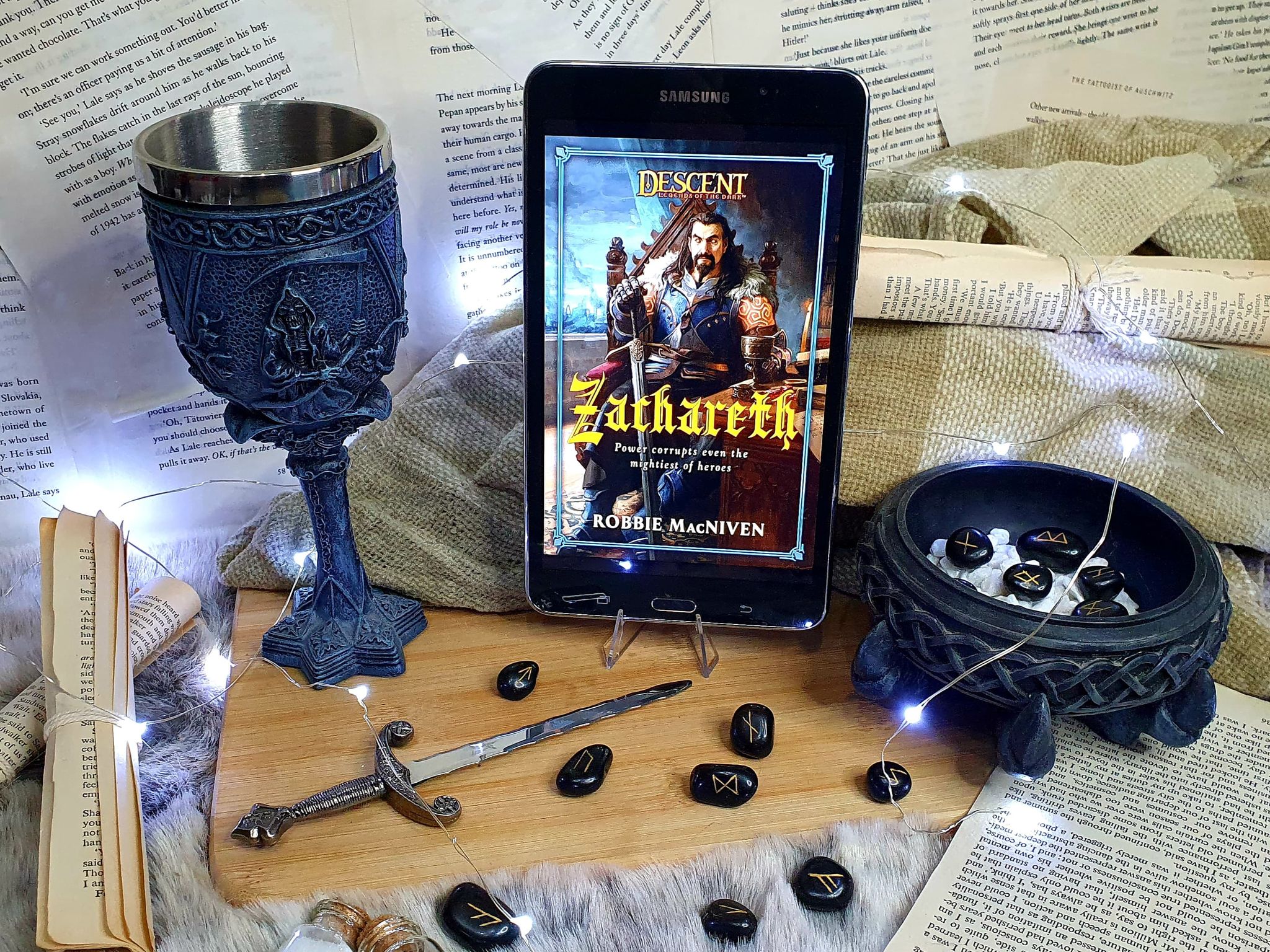
Zachareth: A Descent: Legends of the Dark Novel by Robbie MacNiven - Book Review


'The first in an exciting new series of heroic fantasy novels, Zachareth, explores the past of one of Descent: Legends of the Dark’s most notorious villains.

'Zachareth, Baron of Carthridge, is a driven, ruthless and obsessive man – a man who could be a hero, but he wants so much more. Having watched his father fall under the sway of a sorceress, Zachareth grows up craving knowledge and power. When his tutor at Greyhaven introduces him to forbidden magics, Zachareth discovers there is more to power than meets the eye. As he returns home to a barony on the verge of rebellion and beset by necromantic foes, Zachareth must choose his true path – the path of virtue and heroism, or that of darkness and villainy; the line between the two is finer than most imagine.'

One of the things that I love the most about the books being produced by Aconyte is that its introducing me to worlds that I've never experienced before, producing stories about games that I've only ever heard about, but have never had the chance to play. Descent: Legends of the Dark is one of these worlds, a game that I'd only heard whispers of in gaming shops. As such, I went into Zachareth a complete novice, with no knowledge or expectations; but I soon found myself wanting to experience more of this amazing fantasy setting.

The story follows the life of Zachareth Carth, a figure that will probably be familiar to fans of the series as he's one of the main antagonists of the game. Zachareth is described as being something of a figure that divides peoples opinions on whether he's a villain, or simply a dark hero; and the book very much explores this idea by showing a descent down a path that leads to some dangerous places, making deals with some dark folk, but always doing so from a place of wanting to do the right thing.

The novel begins years before Zachareth has become the figure from the game, when he's a young boy living in his fathers keep, Castle Talon. Barely into his teens, Zachareth hates his studies, doesn't get on with his ageing and angry father, and distrusts Leanna, his fathers elven adviser. His anger and frustration gets pushed to a breaking point during the Silver Tourney, an event that sees several of the surrounding baronies travelling to his home to compete with each other, when he comes to blows with the son of a rival. Zachareth is an angry teen, one who wants to simply lash out at the world, to find the easiest solution and take it as quickly as he can. Over the course of these chapters we get to see Zachareth getting taught his first important lessons in life; that sometimes there are better way to achieve his goals that simple force.

From here the book jumps forward several years as Zachareth prepares to become a man, ready to take his oath. The years have been good to Zachareth, and he's become an attentive student to his teacher, seeking out knowledge wherever he can find it. Whilst this has broadened his horizons considerably, and make him into a much more even headed man, his relationship with his father is still strained. At his banner hold ceremony Zachareth announces to the assembled nobles that he intends to leave Carthridge to study at Greyhaven, a prestigious university, where he plans to try to learn the secrets of rune magic to help him protect his future barony. His father is appalled at this idea, yet Zachareth leaves his home and sets out to learn what he can. With murmurs of undead at his home's borders, and his father growing more and more resentful of his son each day, Zachareth becomes determined to learn every magical secret that he can to protect his home; but this begins a journey that will lead Zachareth to some truly dark places.

I know that the book described this as an origin story for one of the game's 'most notorious villains', but I didn't come away from this book with that impression. Zachareth is not a villain. Or at least he's not a simple villain by the end of this book. He is, if anything, a man with a desire to do good who makes a few mistakes, and finds himself walking down the wrong path.

With so many villains in media wanting to conquer other lands, to wipe out certain peoples, or to amass power simply for the sake of having it I think it's fair to say that we've all had swathes of fairly simple villains in the past. We might often be able to see where those villains started from, yet end up condemning their means. There's a certain point where killing innocents means you've gone too far. Zachareth never has any moments like this in this book. He doesn't weight up one life versus many, he doesn't consider certain sacrifices to be worth it. He constantly wants to do what is best for his people. That's all.

Because of this, and because of the place where MacNiven has to have the character end up, there was never a time when the character felt dull or uninteresting. Knowing that this person is destined to end up a villain meant that I was constantly weighing up everything that they were going through, and all of the choices they were making. I was considering whether the choices they were making were right, if the actions they were taking could be considered justified, and if they'd made that turn into the villainous. I ended up engaging with the text a lot more than I thought, and I found that I came to care for Zachareth more than I was expecting because I felt this kind of odd sympathy for him. I could see that he was trying to be a good, decent protector for his home; but I was also aware that this would not have the outcome that he was hoping for.

Over the course of his journey Zachareth takes the readers to some interesting locations. As I've said, I'm not familiar with this setting, so I don't know how many of these are locations that will be familiar to players and how many are newly created by MacNiven, but there is a wonderful and varied mix. Zachareth's home of Castle Talon feels like a very traditional fantasy style lords home. It's a castle in a more norther, remote location that means the people are hardier and used to war, especially with the shared border to a land where the undead walk. You could make the comparison to the North in A Song of Ice and Fire, and that wouldn't be a completely wrong comparison as I did get those kind of vibes from it.

There's also Greyhaven, a city built around the school that sits at its heart. Everything in the city seems geared around this seat of learning, from the school itself to the shops that sell supplies to students, bars for people to relax, and import for the many needed supplies. It felt like a bustling, ancient city where people were always rushing around getting from one class to another, and it really did feel like the fantasy equivalent of a bustling university campus. We also visit another city that seems to have a much darker kind of feel to it, a creepy remote island, mist shrouded bog-lands, and we even get a traditional fantasy tavern thrown into the mix too. Despite only seeming to take place in one small corner of this hugely fleshed-out world there's a sense of scale to things here, and it feels like a bustling, lived in world.

MacNiven also includes a number of action scenes throughout the book, adding a nice break to the wonderful world building and character development. It's clear that MacNiven knows his stuff, and the fights feel like they leap off the page and are wonderfully clear and easy to follow. He gives plenty of detail, enough that you can clearly picture everything that's happening, and you'll soon find yourself getting swept up by the grandeur of it. Despite knowing that Zachareth must come out of every combat alright due to this being his origin story, MacNiven makes it always feel like there's a large degree of risk during these moments, and you never quite feel safe for the characters; especially towards the final chapters.

Zachareth: A Descent: Legends of the Dark Novel was a book that I found to be intriguing from the first time I saw the gorgeous cover and read the blurb, but I never expected it to grab me the way this did. I ended up devouring the book, desperate to keep reading to find out what happened next. This became a world that I went from knowing nothing about to being really invested in, with some of the best morally complex characters I've read in a long time. Part of me is angry that this is a first volume, because it means that I have to wait to get more of this character; but on the other hand, as someone who absolutely loved this book I'm extremely happy to know that I'm going to be getting more of this in the future.


Support Amy on Patreon

Buy Amy A Coffee

Go to Amy's Blog

Sunday, 3 April 2022

Planet Havoc: A Zombicide Invader Novel by Tim Waggoner - Book Review


'Scoundrels and soldiers band together to survive the onslaught of alien-zombies spreading across the galaxy in this riotous adventure from the bestselling game, Zombicide: Invader

'A deserted R&D facility tempts the hungry new Guild, Leviathan, into sending a team to plunder its valuable research. The base was abandoned after a neighboring planet was devastated by an outbreak of Xenos – alien zombies – but that was a whole planet away... When the Guild ship is attacked by a quarantine patrol, both ships crash onto the deserted world. Only it isn’t as deserted as they hope: a murderous new Xeno threat awakens, desperate to escape the planet. Can the crews cooperate to destroy this new foe? Or will they be forced to sacrifice their ships and lives to protect the galaxy?'

The first of the Zombicide books by Aconyte, Last Resort, was a somewhat traditional zombie story. It was set in a modern setting, in a world much like our own where the living dead have spread across the globe, infecting folks and eating the living. It was a pretty safe introduction to the world of the Zombicide games. However, the games don't just follow this formula, and have some pretty interesting takes on the zombie genre; and we get to explore one of these variations in the new novel Planet Havoc.

Planet Havoc is set in the distant future, where humanity has taken to the stars, meeting alien races and colonising new worlds. We join the mercenary crew of a ship that has been hired by the Leviathan corporation to sneak into a quarantined star system, getting past the military blockades set to capture any trespassers. The crew have been hired to travel to one of the remote planets in the system, Penumbra, and acquire samples of a rare mineral that could revolutionise power generation. As the ship is sneaking into the system they're discovered by a small patrol vessel, and a chase ensues between the two ships that results in both crews crashing on Penumbra.

On the barren planet, the two separate groups discover that Penumbra is home to more than just this rare mineral, but also contains a deadly race of alien beings. These creatures, the Neo-Xenos, are highly dangerous, and want off the planet. Controlled by a terrible hive mind intelligence, the Neo-Xenos set out to use the crashed ships to escape their prison, killing or infecting any human who dares to get in their way. Now the two opposing crews have to come together to try and survive, and to stop a terrible plague from being unleashed upon the galaxy.

If Last Resort is The Walking Dead, Planet Havoc is Aliens. This is probably the easiest comparison to make to try and describe the tone and feel of the story; and as a life-long fan of the Alien franchise I absolutely loved it.

There are some easy comparisons to make between the two, the duplicitous mega-corporations that want a deadly alien species to make into profit, androids, and bug-like aliens, but Tim Waggoner hasn't just made an Alien clone with this novel, and has drawn inspiration from a number of other great science fiction and horror titles such as Starship Troopers and The Thing to create something that will make genre fans feel at home, yet manages to do a lot of new things.

Whilst I normally wouldn't expect to have to explain the monsters in a book with zombie in the title, the creatures of Planet Havoc do need something of an explanation. Grown from a huge organism that has some kind of connection to a mysterious blue mould, the Neo-Xenos don't require other lifeforms in order to create themselves, literally growing new members of their race out of each other. This lack of hosts needed to create new foes makes them an incredibly unpredictable foe, as the heroes are never really going to manage to kill them all; as long as at least one survives there's always the risk that more will come.

The Neo-Xenos also come in a few different varieties, ranging from fast and agile creatures that seem designed to swarm and overwhelm their prey, to large, hulking brutes with immense strength and the ability to fire spikes at people. Perhaps the most frightening part of the Neo-Xeno, however, is their ability to infect others. Whilst they don't need hosts to create new members of the race they can infect and transform humans, making them into either huge, monstrous creatures, or intelligent sleeper agents that look no different from normal.

This twist certainly brings the creatures more into line with what we think about with zombies, of the infection that can spread within a group, but also makes them all the more frightening. Much like The Thing there's a sense of never being sure who you can trust, and not knowing exactly who might be infected that makes the Neo-Xeno truly terrifying. 

But it's not just about the monsters, as there's a large cast of humans fighting to stay alive across the course of the book; although that cast does keep getting smaller as things go on. There are essentially two groups when the book begins, one who are trying to sneak onto Penumbra, and the other who are trying to stop them. These two groups have a decent mix of people, though they definitely have a more central cast, with a few other characters that don't get as much of a focus who you kind of suspect are just there to get killed off at some point. Those that do get focus, however, are a lot of fun.

The mercenary crew make for the more colourful group of characters, and thanks to the inclusion of some evil corporate lackeys amongst them, makes for an interesting mixture. The team is led by Luis Gonzales, a former soldier who seems to be a decent man, taking on jobs that don't hurt innocent people and is fighting to do something good with his life. He's competent, has the respect of his crew, and doesn't seem afraid to talk back to the Leviathan representative. That representative, Jena Woodruff falls nicely into the Burke from Aliens role. She never really does anything bad or evil, but she's absolutely a bit of a bitch and you want to hit her half the time. She cares about herself, about profit and advancing her career. She's a cold and calculating person who doesn't seem to care about putting other people at risk to get what she wants.

In addition to various other soldiers and miners, the crew has a few stand out members. Oren is a cyborg, a human brain that's been placed within a mechanical body, that's been sent on the mission by Leviathan to record everything that happens. At first he seems to be a pretty simple kind of person, barely more than a walking camera who doesn't really say much. However, as the book progresses we learn that Oren has some pretty extreme views on the universe, views that put him at odds with many of the others around him. We also learn more about what it means to be a cyborg, as well as his personal history, and it makes for some truly fascinating reading. There's also doctor Sidney Cheung, a biologist that has been brought along on the mission to help with any native lifeforms found on Penumbra. Whilst Sidney gets more than she bargained for thanks to the Neo-Xeno, much like Oren she has some secrets beneath her exterior that make her to be one of the more complex members of the crew, and some surprises that readers won't be expecting.

The members of the Coalition Command military trapped on the planet with the mercs also get the chance to shine, and make for some interesting characters too. The stand-outs include Aisha Barakat, the captain of their small vessel, transferred to the patrol the remote system following a terrible event in her past; and Jason, the ship's android. In a lot of ways Aisha is very similar to Luis, and the two commanders get a lot of scenes together and the chance to form a real bond as the book progresses. We get a sense that despite being a part of a military who will execute prisoners, Aisha isn't a bad person, and we see a lot of her views on the universe and what it means to be a good person get challenged over the course of the story. Possibly the biggest surprise on that crew, however, is Jason. Entirely mechanical, Jason should be the kind of character who is completely loyal to the Coalition, programmed to follow orders and the letter of the law; but he's actually incredibly human and very much has a mind of his own. It's fascinating seeing they way his character unfolds across the book, and he quickly made for one of my favourite characters.

Planet Havoc is an action packed survival story that managed to feel incredibly familiar and comfortable for me as a fan of this kind of genre; yet it always managed to entertain, surprise, and never felt like it was being cheap or lazy. Waggonner seems to have written a love letter to some of the truly great sci-fi horror stories with this book, and fans of the genre are going to find a lot to enjoy here. Going into this novel knowing nothing about this particular branch of the Zombicide games I left eager to read more, and hoping that this ends up being the first of many such books.


Support Amy on Patreon

Buy Amy A Coffee

Go to Amy's Blog

Saturday, 2 April 2022

To Sleep So As To Dream – Blu-ray Review


Originally published on Set The Tape


There are certain genres and styles of film that seem to go in cycles: western movies were a big thing in the 1950s and 60s, horror and slasher movies were all the rage in the 80s, and today the comic book movie rules supreme in the cinema. Even after the heyday of certain movies seems to have passed you’ll still get a few throwbacks to these films released – well-received gangster films or buddy cop movies coming out long after the trend has finished. But one type of film whose day seems to be done is the silent movie.

This is kind of understandable, as silent movies weren’t made as a stylistic choice, but due to limits in technology when cinema was first created. As such, most people would dismiss this as a forgotten and useless form of the medium; you wouldn’t go back to using the phonograph when MP3s exist, right? One modern movie – though modern in relative terms, as this was first released in 1986 – that does take this leap back in time is To Sleep So As To Dream.

To Sleep So As To Dream tells the story of two detectives, Uotsuk (Shiro Sano) and Kobayashi (Koji Otake), who get hired to help investigate the disappearance of Bellflower (Moe Kamura), the daughter of ageing silent movie star Madame Cherry-blossom (Fujiko Fukamizu). The two detectives, and Madame Cherry-blossom’s elderly butler, engage on an investigation that sees them solving riddles, paying out large bundles of cash in ransoms, and getting into fights in their quest to reunite this broken family.


Despite being filmed in 1986, To Sleep So As To Dream takes many of its cues from much older films. The movie is shot in black and white, and for the most part it’s a completely silent film. There are times where we do have sound in the film, select noises – such as the ringing of a phone – that are used to highlight certain things in a scene, to build tension, or sometimes as parts of jokes. Other than that, all of the dialogue in the movie is presented through text cards that appear on the screen, giving the audience brief snippets of larger conversations. There are two moments in the movie where actual voices do appear, and much like the select sound effects these are used for specific purposes.

Because of the lack of dialogue, To Sleep So As To Dream tells much of its story visually, allowing the audience to follow along simply by watching what the lead characters do. Because of this, it’s pretty streamlined, and feels simple in places; yet director Kaizo Hayashi manages to make it a lot more layered than you might at first think. It soon becomes apparent that you can look at this film on a much deeper level, with Madame Cherry-blossom trying to get her daughter back, as a woman chasing her lost youth as she watches her old silent movies over and over again. There are moments where the film feels pretty unreal, where you’re not sure if you should be taking what’s happening at face value, and this can make for a strange viewing experience.


To Sleep So As To Dream is one of the strangest films I’ve seen in a while. It doesn’t quite feel like a silent movie, it does things that go against the conventions of the films of the silent era, because it’s simply using the aesthetic of those films. The film feels incredibly busy, despite being stripped down in a lot of ways, with odd stuff happening the the backgrounds of scenes and in set dressings. It’s got a strange sense of humour to it too, such as the ‘hard boiled detective’ eating so many hard boiled eggs across the course of the film. It’s the kind of movie that is so utterly unique that nothing else is really like it. It does its own thing in its own way, and even if its not to your taste it’s something that fans of cinema and the history of film should seek out, because this is certainly the kind of movie that will leave an impression.

In addition to this newly restored version of the film there are some interesting extras on the new release. There’s a short presentation that shows how the film was restored from the original negative, which features director Kaizo Hayashi getting to visit the lab and watch it being done. There are also some interviews with star Shiro Sano, and an interview regarding Japanese film culture and silent film by Benshi Midori Sawato. There’s also a pair of audio commentaries for the film: one with director Kaizo Hayashi and actor Shiro Sano, and the other with film experts Tom Mes and Jasper Sharp.

To Sleep So As To Dream is not going to be a film that everyone likes, but as a unique piece of cinema that’s been presented in high quality for the first time this is a set that film fanatics will want to take notice of.


Support Amy on Patreon

Buy Amy A Coffee

Go to Amy's Blog

Friday, 1 April 2022

Silent Hill: Downpour – Throwback 10


Originally published on Set The Tape


Silent Hill is a series that gaming fans look on fondly. It’s often spoken of in the same conversations as things like the Resident Evil series, and it’s easy to see why people might compare the two. But whilst Resident Evil has continued to produce great games, moving from strength to strength (most of the time anyway), Silent Hill has struggled to recapture the glory days of their first few games. Yes, Silent Hill 2 might be a superb game, but the offerings since then have very much divided players. Silent Hill: Downpour, the eighth game in the franchise, is a prime example of this.

Developed by Czech based publisher Vatra Games, Silent Hill: Downpour was announced two years before its release with relatively few details, although promised that it would offer something different for players. Whilst fans would argue about how good the game actually was upon release, Vatra seem to have been true to their word, and gave players something that at least felt pretty different.

The game puts you in control of Murphy Pendleton (David Boyd Konrad), a convicted criminal. This immediately gave players something different, as previous instalments of the series would put players in the role of ‘ordinary’ people who have a hidden dark past that comes out in Silent Hill; but here we have a character that will instantly have players questioning the type of person he is, and if they’re even comfortable playing such a character. The game doubled down on this by having its very first moments being a combat tutorial in which Murphy stabs and kills another inmate in the showers.


From here the game sees Murphy being transferred to another prison, but along the way the bus crashes into a ravine. Murphy awakens and is able to make his escape into the surrounding forest. After travelling through an old mine he finds himself in the deserted town of Silent Hill, a place filled with monsters out to harm him. On the run from the corrections officer pursuing him, and contending with the strange denizens of Silent Hill, Murphy must find a way to survive.

Another of the ways in which Silent Hill: Downpour stood out from the previous games is that after a pretty brief linear segment, where Murphy makes his way into the town, the game opens up quite a bit. It’s not a true open world by any means, but players were suddenly able to explore Silent Hill in ways they weren’t before. The player could walk around the town, taking on side missions that ranged from simple collection quests, to investigating a murder scene. You were also able to interact with the environment, pulling down fire escapes and breaking doors in order to open up new areas or alternate routes.

As the title suggests, rain plays a large part in the game, and instead of going for the series’ signature fog, Silent Hill: Downpour used rainfall to alter the game-play. When the rain rolls in players will have to be more careful, as it not only makes it harder to see, but it also increases the number of monsters in the area, as well as making them more aggressive to you. Whilst only slightly different from the series staple of fog in what it does, the change did at least set this game apart as being visually different from predecessors.

Another big change is the combat, which plays a heavier role than in previous games. Murphy gets to arm himself with whatever he can find in the abandoned town, with makeshift weapons ranging from hammers, bottles, broken chairs, and even simple rocks. These weapons would quickly degrade, breaking after several uses, prompting the player to constantly be on the lookout for more things to add to their arsenal. Unfortunately, the combat isn’t quite perfect, and you’d often find yourself taking a swing at a monster only to miss hitting it. This, along with the monsters being more aggressive and more numerous when it rains, leads players having to consider if combat is the best approach, or if they should run instead.


Silent Hill: Downpour also tried to offer players a more branching narrative, allowing your choices to affect what kind of person Murphy is. There would be a few times throughout the game where you’d be given the choice of saving someone or not, and this would help towards one of several endings for the game. You’d also be left to collect things across the game that gave you more of Murphy’s backstory, leaving it down to player exploration to determine how fleshed out he ended up being.

When it was released, Silent Hill: Downpour received mixed reviews. Some outlets liked some of the new elements that Vatra Games brought to the project, praising the design choices and its creativity. However, the sluggish combat mechanics and lacklustre puzzles left some people feeling that the game wasn’t as polished as it could have been.

With the Silent Hill franchise remaining a series of mixed parts, of games that vary wildly in style and quality, and with relatively small commercial success for later releases, it’s entirely possible that you missed Silent Hill: Downpour upon first release a decade ago. And whilst I’d definitely advise picking it up and playing if you’re able, just to see what you think of it, the price of even a pre-owned version can be ridiculously high; as such, if you do happen across a copy for cheap, grab it whilst you can, because you may just grab yourself an absolute bargain.


Support Amy on Patreon

Buy Amy A Coffee

Go to Amy's Blog

Thursday, 31 March 2022

The Carnival of Ash by Tom Beckerlegge – Book Review


Originally published on Set The Tape


The Carnival of Ash is marketed as a fantasy book; a story set within an alternate history in a fictional city where the crafted word rules supreme. Cadenza is a city filled with giant libraries, where hundreds of printing presses work around the clock, churning out work, and where poets and creators control the life of the citizens. However, the book seems to have been woefully miss-sold, leading to a jarring reading experience.

The Carnival of Ash begins following Carlo Mazzoni, a young poet who has travelled to Cadenza in order to show off his epic poem and to find fame. Unfortunately, he came to the city at the worst possible time, as the leader, Artifex Tommaso Cellini, has died suddenly. Now the city is in turmoil, and Carlo discovers secrets about his family history that not only disturb him, but makes it look like he may be involved in Cellini’s death.

From here, the book shifts perspectives across each of the twelve cantos, featuring an ink maid who writes pornographic letters to paying clients so that they can live out their sexual fantasies, and a pair of poets who are fighting over a woman they both desire, to name but a few of the early ones. Unfortunately, as the focus of the book shifts to a new person with each segment, it means that the main plot of the novel, the special political ramification of the appointment of a bureaucrat as the replacement for Cellini, rather than a poet, feel incredibly lost in the background.

As mentioned earlier, the book has been marketed as a fantasy novel, thanks to the descriptions of giant libraries, and a city dedicated to poetry and works of fiction. As such, I came to it expecting a focus on those aspects, to get to explore these huge libraries; and with it being a fantasy book I was hoping for some kind of magic to be involved with them, whether that be stories that can come to life, the power of the written word, or having to bind books with power to keep dark things from escaping the pages. This book has none of that. It seems like it’s been marketed as fantasy because it’s set in a city that doesn’t exist in the real world, but other than that this is a lengthy, ponderous, historical novel.

This isn’t in itself a bad thing: there’s a big market for historical fiction, and alternate history is a popular genre. However, if you come to this book expecting something very different, as I did, this revelation that you’re reading a completely different genre is a huge disappointment. I spent so long reading the book waiting for something to happen, something unusual or out of the ordinary that justified its labelling as fantasy, something that would make me actually enjoy it – but nothing came.

It wasn’t just the surprise change in genre that I found troubling whilst reading the book, however, as there were a number of things with the content that I ended up not enjoying. One of the biggest things that I need to talk about is the fact that this book doesn’t come with any content or trigger warnings, and the content really does need some. There is constant sexual objectification of women throughout the book. Women are treated incredibly poorly, often being reduced to sexual objects, and there are even moments of sexual violence. With this being a fantasy or alternate history, these kinds of things didn’t need to be included for ‘historical accuracy’, and they serve no real purpose towards moving the plot forward. As such, the book felt like it was very much not geared towards female readers, and the lack of warning about some of the graphic content could put a lot of people off. There are also moments of extreme torture, abuse, fatphobia, and ableism scattered throughout, to further dampen any enjoyment of the book.

I came into The Carnival of Ash expecting certain things thanks to how the book was advertised, and when the book turned out to be something completely different I found it hard to find much to grab my attention, thanks to a plodding and almost aimless-seeming narrative, and content that often threw me out thanks to its shocking or disturbing nature. I went into this book hoping to find a lot to enjoy, but spent the majority of my time reading it forcing myself to get through it. If you’re a fan of dour and lengthy historical fiction you might enjoy this, but just be warned before picking it up.


Support Amy on Patreon

Buy Amy A Coffee

Go to Amy's Blog

Wednesday, 30 March 2022

Gorath – Throwback 60


Originally published on Set The Tape


The 1960s were a big decade for Japanese film. The big budget disaster movies were doing well, and giant monsters were becoming more and more popular, as the Godzilla franchise began to hit its stride and new creatures emerged onto screens. Toho was at the heart of this boom, producing some of the biggest films of the decade, and as such wanted to continue to ride this wave of success with new, creative endeavours. 1962’s Gorath was an attempt to make a big budget science fiction film that would stun audiences and showcase some of the best special effects work around; and for the most part, it did just that.

Directed by Ishiro Honda, the acclaimed filmmaker behind such hits as Godzilla, Rodan, and Mothra, the film begins with the crew of the JX-1 Hawk, a new exploratory space vessel, competing its months long mission on the outskirts of the solar system. With the crew preparing to return home, they receive a message from Earth asking them to investigate a strange gravitational anomaly near Saturn. Upon going to investigate, the crew are shocked to discover that a rogue star has entered the solar system, and is making its way towards Earth. The star is putting out immense gravitational forces, and it destroys the JX-1.


Back on Earth, scientists gather to discuss the information the lost crew were able to send back, and work out that in two years time the rogue star, named Gorath, will pass close enough to Earth to tear the planet apart. A plan is devised, and the world’s governments come together in Antarctica to create a giant engine that they will be able to use to push Earth out of Gorath’s path, moving the planet back to its regular orbit once the danger has passed. When Gorath reaches Earth, having already stripped Saturn of its rings and grown in mass, the engines fire and move the planet out of the way; unfortunately, the intense gravity does cause huge damage, creating giant floods and huge earthquakes across the planet, including one that completely destroys Tokyo. Fortunately, the plan succeeds, and the Earth is saved.

Hot off the success of 1960’s big budget disaster movie The Final War, which saw the Earth completely destroyed, Toho wanted to create another big budget disaster movie, though one with a more hopeful ending. Feeling confident that the film would do well following the success of their previous films, Toho gave Gorath a bigger budget, and an almost year long production time to create the movie. And it really does show on screen. The miniature work on Gorath is wonderful, and rivals some of the best stuff seen at the time. The increase in budget and production time meant that Honda was able to take his time, to allow the special effects team to create more intricate, detailed models and sets.

One thing that perhaps harms Gorath, or at least interrupts the flow of the movie, is the inclusion of a giant walrus Kaiju named Maguma. Thanks to the success of Toho’s film Mothra, studio executives wanted to include a giant monster, believing that by marrying together The Final War and Mothra they would be able to capitalise on the success of both films. Whilst this might work on paper, in execution it really fails to be anything other than odd. Maguma appears towards the end of the film, when heat generated by the giant engines melts the surrounding ice in Antarctica and awakens the giant monster that was sleeping beneath the surface. With the creature threatening to destroy the engine, the only thing that can save the Earth, the military are forced to engage the monster and kill it.


These sequences add very little to the film, and were even cut in the American release of the movie with no real damage being done to the story. If anything the cuts actually helped to keep the plot focused on the rogue star, and to keep tensions high. It also doesn’t help that Maguma is possibly the cheapest looking thing in the film. It’s unclear whether the creature was a late stage addition, if Honda had less focus on the monster, or if it’s just down to the design, but the monster looks rubbery and fake in ways that you don’t come to expect from a Toho creation, and looks like a cheap imitation.

The odd inclusion of the giant walrus monster aside, Gorath proves to be a great movie. Its plot is interesting, especially in comparison to Toho’s The Final War, and acts like a good companion to that film, showcasing humanity coming together to create a hopeful future, rather than humanity destroying itself. The special effects look great, with some good wire-work being used to create zero gravity space scenes, and the miniature and model work is top notch. If you’re looking for a big budget Japanese Tokusatsu film that isn’t just big monsters, Gorath is one worth watching.


Support Amy on Patreon

Buy Amy A Coffee

Go to Amy's Blog