Tuesday, 22 February 2022

The Haunting of Las Lágrimas by W.M. Cleese - Book Review


'Argentina, winter 1913. Ursula Kelp, a young English gardener, travels to Buenos Aires to take up the role of head gardener at a long-abandoned estate in the Pampas. The current owner wishes to return to the estate with his family and restore the once-famous gardens to their former glory. 

'Travelling deep into the Pampas, the vast grasslands of South America, Ursula arrives to warnings from the locals that the estate is haunted, cursed to bring tragedy to the founding family of Las Lágrimas. And soon Ursula believes that her loneliness is making her imagine things – the sound of footsteps outside her bedroom door, the touch of hands on her shoulders when there’s no one there. Most strangely of all, she keeps hearing the frenzied sound of a man chopping down trees in the nearby forest with an axe, when all her staff are in sight. 

'As the strange occurrences intensify – with tragic consequences – Ursula questions if there’s truth in the rumours about the cursed estate. The family’s return is imminent – are they in danger? And the longer Ursula stays at the estate, the more she realises that she too is in mortal danger.'

I love a good Gothic ghost story, tales with spooky, remote locations, creepy old houses, and buried history that the hero needs to uncover. These kinds of elements are great even on their own, but when a book has all of these things they just feel extra special. And The Haunting of Las Lágrimas has all of this in spades.

Our story begins after the events of Las Lágrimas, with our protagonist, Ursula, writing about her experiences from the safety of The Hotel Bristol in Mar del Plata. Straight away we know that something terrible is to come in this book. Yes, Ursula herself might be alive, she may get in the end, but we meet her as a woman plagued by nightmares, afraid of leaving her hotel room, and dealing with the trauma of what she went through. This instantly builds tension, before we've even begun to get into the true heart of the book; and is a perfect way to start this kind of slow burn horror novel.

Writing down her experiences, in order to put her thought in order and expel some of her demons, Ursula begins to outline her story. We begin with Ursula, a gardener from England who has travelled across the world to Argentina in order to escape her oppressive family and connect more with her lost grandfather, working as one of the staff for the wealthy Houghton family, and whilst the family treats her well, more like a peer than a member of staff, she wants something more challenging. As such, when she overhears a visitor talking to the head gardener about a job opening she approaches him about it.

The man, named Moyano, turns out to be the estate manager for the distant Las Lágrimas, a home built in the wilderness of the pampas, that is in the process of being restored and rebuilt before the owner, Don Paquito Agramonte, and his family move in. He tells Ursula that the estate is extremely remote, and the garden in huge disrepair. It's a task that no other gardener will take on, and that will test her skills and resolve to the limit. Desperate for a chance to prove herself, Ursula jumps at the offer and immediately sets out for Las Lágrimas.

After a two day journey via train and horseback ride, Usrula finally arrives at the remote estate. Moyano, it seems, was underselling the enormity of the work, and Usula finds herself in charge of two young workers, facing a huge walled garden that is full of weeds and brambles. Knowing that clearing the garden alone could take weeks, but that she has to have something worthy of showing Don Agramonte when he arrives, she sets out to do what she can.

However, as the days begin to go by Urusla starts to experience strange things at Las Lágrimas. The old house feels strange and oppressive, and the nights alone in her room are long and frightening. The few staff that are there whisper stories about hauntings, and refuse to divulge their secrets. She feels like she's constantly being watched, and starts to hear the sound of someone chopping down trees in the surrounding woodland. But strangest of all, parts of the garden seem to change on their own, reverting back to their original, restored state overnight, without anyone having done the work.

Despite being determined to make the garden ready, and knowing that it will take all of her tie, Ursula begins to find herself being drawn deeper into the mystery of Las Lágrimas, searching for an explanation for the strange events. But will her efforts stir up further trouble for her from both her living employers, and the spirits that make Las Lágrimas their home?

One of the ways in which The Haunting of Las Lágrimas really excels is in atmosphere. As soon as Ursula sets out for Las Lágrimas things start to take a turn, and you find yourself on edge. On her journey to the estate we learn some of the history of the place, the rumours of the hauntings, and we begin to understand the remoteness of the location. The estate itself seems to sit in the middle of nowhere, days journey from the nearest settlement, surrounded by endless grassland, dark forest, and ominous skies. The way Ursula describes it in her journal really does transport you there, and you can begin to see why it soon starts to prey upon her mind.

The estate itself is as much a character as any of the principal players in this story too, and its dark and draughty halls and overgrown gardens feel both vast and lonely, and overwhelmingly oppressive at the same time. Ursula often finds herself walking through the halls of the estate alone, listening to the silence around her, feeling the cold creeping in. Her one place of solace, her bedroom, often seems to be the focus of a strange, unseen visitor too, with strange noises just outside her door, and a horrible chill trying to get inside. It feels like there's nowhere for Ursula to get away from the dark forces always lying just out of sight.

Even the garden, a place where she can pour all of her focus and energy, a place that should make her feel at peace shifts and changes over time. It seems to slowly turn upon her, with unseen eyes on her back, strange sounds coming from round the corner, and even in the middle of the day it can feel like one of the most frightening places on earth. 

W.M. Cleese seems to know how to build this tension throughout the book, and does so masterfully. Las Lágrimas is unsettling at first, but only because its an old building, a place in disrepair and in a remote location. But as the story progresses it starts to change, to become sinister in its own right. Cleese is able to increase the unease at such a slow rate that you don't even realise that it's being done, until both Ursula and the reader reach such a point that you never feel like you can let your guard down, and that nowhere in Las Lágrimas can provide safe shelter.

The fact that Las Lágrimas is so remote, and that Ursula doesn't know the way back to civilisation, means that this is one of those kinds of stories where you're not left shouting 'why don't you just leave?' at the protagonist. Usula has no choice but to stay and face the haunting. As such, she's forced to call upon wells of personal strength that she doesn't even know she has, forging ahead even when she wants to do the exact opposite. Because of this she comes across as a very strong and capable woman, doubly so due to the time the book's set. This is a time and place where women aren't treated with respect or given positions of authority, and Ursula is used to having to prove herself to others. She has a level of inner strength and confidence that not many others in the book possess.

I had a lot of fun reading The Haunting of Las Lágrimas, times where I couldn't put the book down because I was desperate to find out what would happen next, what piece of the mystery that Urusla was going to uncover; but there were also times where I found myself drawing my blanket in close and casting nervous glances towards the darkened corners of the room because the sense of horror was getting to me so much. I'm sure that there will be some people who will say that the book is a little slow, that there isn't enough 'in-your-face' horror going on to be scary, but the constant building dread, the sense of unease and fear that just went on and on were so much more frightening than I was expecting. If you enjoy scary mysteries, strong female protagonists, remote, Gothic locations, and spooky happenings, this is a book you're definitely going to want to read.


Support Amy on Patreon

Buy Amy A Coffee

Go to Amy's Blog

Monday, 21 February 2022

The Young Woman and the Sea by Catherine Meurisse - Book Review


'Catherine Meurisse once again draws upon her memories. Her stay in a far-off, strange-yet-familiar land, at the Japanese villa Kujoyama in 2018, provides the artist another opportunity to pursue her creative quest, this time where the West and Far East meet. In the manner of Lewis Carroll, the young artist lets characters out of legend lead her through pictorial landscapes. Imagination and dialogue are key to penetrating the secrets of this strange territory and discovering why the young explorer finds it so fascinating. This Alice daydreams and wonders, returning every now and then to reality and nature, that dynamic dictator of events and situations. After The Great Outdoors, Catherine Meurisse continues her pursuit of beauty in an unknown land, between mountain and sea, illustrating landscapes that reflect the seasons and the artist's progress. Truly splendid!'

The Young Woman and the Sea tells the story of artist Catherine Meurisse as she journeys to an artists retreat in Japan, and the extraordinary things she saw whilst exploring the Japanese countryside.

The book begins with Catherine arriving at the remote coastal retreat, a beautiful building that sits surrounded by woodland, nestled between the sea and a mountain. There to try and capture the beauty of the land around her, Catherine is unsure where to begin; and being jet-lagged she decides to take take a nap. Upon awaking she sees a tanuki outside her window and decides to follow it.

Climbing up the hill behind the retreat Catherine comes face to face with the animal, who immediately starts talking to her. Listening to her talk about her desire to recapture the beauty of Japan's nature, the tanuki gives her a paintbrush made from its own fur, and teaches her to write something on a piece of paper in Japanese. When she looks away from the creature for but a moment, however, it vanishes. Left alone and unsure where to go to Catherine starts to try to find her way back to the retreat, getting lost in the process.


From here the artist begins to explore the world around her, wandering the countryside, and befriending a local artist who is searching for the perfect woman to paint. Together, the two of them make their way to a bathhouse, where they are able to stay the night and meet the owner, a beautiful woman who the artist wishes to paint as a drowned lady. The next day Catherine is able to explore more of the surrounding land, discovering the beauty in the everyday, as well as small special places tucked out of sight. Throughout it all, she keeps meeting up with the Tanuki, who keeps challenging her as to why she has yet to find her inspiration.

The story of The Young Woman and the Sea is a little odd, and you can very much tell that its semi-autobiographical, as not a huge amount really happens here. For much of the book we follow Charlotte as she walks from place to place, discovering more of the beauty of Japan, and learning about various people's connection to it. She's looking to be inspired by what she finds, yet isn't sure how that will work for her yet. This is where the tanuki seems to come in.

Now, I would be extremely surprised if the real Catherine met a magical talking tanuki, and this is either creative license or a surprise revelation that magic animals are real. However, the creature seems to be trying to coax Charlotte into coming to the realisations she needs in order to make the most of her time in Japan, and begin to create the art she really wants to. But when the book comes to a close there is a question left hanging over whether any of it was even real. The final pages seem to imply that much of what we've just read, and perhaps everything from the moment Charlotte fell asleep, could in fact be a dream; her mind coming up with a scenario by which she's exploring the world.


Alongside the somewhat vague story, the characters feel a little strange too, and I failed to really get a sense of who anyone was really supposed to be. Charlotte spends the entire book lost, unable to find the thing that will kick-start her art, the old artist she meets is strangely obsessed with drowned women and poetry, the hostess they talk to seems to be implied to be ghostly and ancient, though perhaps not; and then there's the magical talking animal who's doing all this for its own amusement I guess. The characters seem to only be there to move events from one location to another, not really having much to do, but simply there to get the reader to new places.

These places are, in fact, the highlight of the book, as Meurisse has done some wonderful landscape art for the book, managing to craft some truly beautiful moments as the characters journey around the Japanese countryside. It really does feel like the artist went and spent some time in the place, and that it became a sauce of inspiration for her. The only thing that lets the art down is that the characters are very simple and cartoonish in comparison. The landscapes are stunning, but the people look like they come out of a newspaper strip comic and the two don't mesh at all. I often found myself being drawn out of things by these two conflicting styles; and that definitely hurt my enjoyment of the book.

Overall, The Young Woman and the Sea was a fairly enjoyable book, though one where I was enjoying looking at the art more than I was reading the story or getting to know any of the characters. It's a shame that I was unable to connect with any of the characters in any real way, but hopefully others will be able to do so. The book is a beautiful examination of the wonder of Japanese landscapes and countryside, yet contains little else to go with it.


Support Amy on Patreon

Buy Amy A Coffee

Go to Amy's Blog

Sunday, 20 February 2022

The Locker Room by Timothé Le Boucher - Book Review


'It is a place where savagery knows no bounds. A place where foggy glass windows house a ruthless social hierarchy. A place where no one is truly safe. They call this place...the locker room.

'As teen boys discover a renovated locker room at their school, it becomes the nexus of genuinely life-altering events. Body shaming, bullying, and the cruelty of prying eyes are only the tip of the iceberg inside this cauldron of hormones and developing adolescent minds.

'Akin to the horrors of Lord of the Flies, The Locker Room explores a micro-society without boundaries in which only the strongest survive.'

Oh boy, locker rooms. Does any place within school conjure more awful memories? I know that my own experiences were not the best in them, despite nothing truly awful happening there; but that still didn't preclude people from bullying anyone who was overweight, odd, without the right fashion, or just anyone that the bullies decided to go for that day. And don't get me started about all the internalised trauma of having to spend years in the boys locker room as a trans girl who still hadn't figured her shit out yet. Nightmare fuel.

A story that decides to take a look at this weird microcosm of school life, of this place where tensions are always high, and where there a pretty much never school staff to keep things safe, is definitely a bold move. Within just opening the book the author and artist Timothé Le Boucher lets the reader know that the events in the book are inspired by things that he witnessed and lived through; that the depictions of bullying and abuse he's crafted here aren't too far removed from his own past, as well as the lived reality for many others.

The story begins with a group of school boys being let into their newly renovated locker room for the first time. The walls have been repainted, they've got nice new benches, and the showers have been revamped. Whilst they're initially impressed by what they find they do encounter one glaring issue, their old individual showers have been replaced by a communal one. These young, adolescent boys are terrified by the idea that they'll have to get naked around each other and shower. In fact, they outright refuse to use the showers, and spend the next few weeks going without.

However, as time passes the students are sick of feeling dirty and sweaty after their sports, and when the girls start telling them they all stink someone makes the plunge and uses the showers. After this more of the students begin to, and some lines begin to be drawn between those that shower and those that don't. This isn't the only divide we see in this book, and there are some very clear groups that form inside the locker room, each vying not to be the ones that get picked on by those deemed to be 'above' them.

One kid who falls prey to the bullies more than once is Corentin, a boy who doesn't really have any friends, and whose weight makes him a target of ridicule and abuse more than once. One of his chief bullies is the exchange student Gauthier, who makes it his mission to shame the kid. However, when Corentin discovers something 'odd' that Gauthier is doing in one of the toilet stalls and takes a photo the focus of the bullying changes. Now Gauthier is the one being abused and made fun of, whilst Corentin manages to get in with one of the groups when he suggests new ways in which to harass the boy who once bullied him.


The Locker Room is an odd book in that it wants to take a look at bullying in schools, but doesn't do it in a broader context; instead focusing squarely on what happens in this one room once a week. We don't get to see if Corentin gets picked on during lunch, nor do we see if snide comments are made about people during class. Our only context for things is in this one isolated room. This really works in some regards, and I liked how whenever the story showed us anything from outside we were looking out through the frosted windows of the locker room at these indistinct, distorted shapes. However, it often felt like I was only getting small snippets of the whole, and that whilst the important events might be happening in this one location I was still missing details that would have made things make sense.

For example, we see a pretty sharp change in how the students are acting towards Corenti and Gauthier from one week to the next, as Guthier becomes the target for the bullies and Corentin becomes one of them. There are hints in the dialogue as to what's been going on, but you're very much left to try and fill in the gaps yourself and add your own context. A big example of this is what Gauthier was doing in the toilet that got him so hated by the other students. Before this he seemed incredibly self conscious about showering with the other boys, and kept himself covered as much as he could, that coupled with the photo of him in the stall labelling him as 'revolting' leads the reader to make certain conclusions without actually saying they itself.

I don't know if this is being done from a perspective of some kind of plausible deniability, such as if someone comes to the conclusion that Gauthier was caught masturbating in the toilet and that's why he was made fun of the writer can say 'I never said that, that's your own conclusion' if they ever got called out for having that content in the book. It might also be because to a certain degree it doesn't matter what Gauthier was doing. Having lived through school I can say, and I'm sure you'll all agree, that it often didn't matter what someone decided to make the reason for bullying you; if it was going to happen it was going to happen, and reasons why didn't matter.

I think this is the approach the author is going for, and if so, I think it's the better way of doing this. Readers are able to project their own thought and feelings onto this, possibly drawing from their own experiences; which makes the book feel a lot more personal in some way and will help the reader relate it to their own life.

Though the book is good in a lot of ways there are some areas in which I felt it let itself down, or could cause upset to some readers. The first is that this is a book that focuses on teenage boys, and as such features the boys using horrible language. There are the uses of abelist and homophobic slurs more than once across the book, and whilst this might be accurate for how teens talk it was jarring to see, and did lessen my enjoyment of the book. 

The second thing is that whilst there is no male nudity in the book, or at least no full frontal male nudity as most often the boys would be covering their genitals self-consciously, there are repeated scenes where the boys spy into the girls locker room and everything is openly on show. I know that the book is being written from a teen male perspective, and that for most teen males seeing a guys junk is the last thing they want, whilst seeing a girl naked is probably the first, it did feel a little one-sided that naked girls were fine whilst naked boys weren't. The author could have easily conveyed the boys being perverts without showing female nudity.

Overall, I thought that The Locker Room was a well crafted book, one that isn't necessarily heavy on the details, but certainly captures the feel of what its like to experience bullying, and how bullying can sometimes go too far. Bullying is still one of those things that all too often gets brushed aside as not being serious, or is chalked up to 'kids just being kids'. But the simple truth is that bullying is awful, it has long-lasting effects that can stay with a person for decades. It needs to be challenged and called out whenever it happens, and if books like this can help highlight these issues, or encourage people to act differently when it happens, that can only be a good thing.


Support Amy on Patreon

Buy Amy A Coffee

Go to Amy's Blog

Saturday, 19 February 2022

Dead and Unburied Vol 1 by Jocelyn Boisvert - Book Review


'Yan is on top of the world. School's almost out for summer, he's about to have a new baby sister, and he's going to be spending his vacation making a zombie movie with his best friend Nico. But on his way home from school, he finds himself in the wrong place at the wrong time, and before he knows it, his life is slipping away... Things are no longer smelling rosy now that Yan's pushing up daisies. But for some reason, Yan's soul isn't going anywhere: his body may be rotting, but his mind is clear, and once out of his grave, Yan is determined to be reunited with his family. He may be falling apart, but he isn't about to let that happen to them!'

Death doesn't tend to be where many stories start, not least when its the lead character dying; but the new teen zombie story Dead and Unburied does just this, introducing readers to our lead character, Yan, before killing him less than dozen pages in.

Yan Faucher is your average teenage guy. He has a decent home with his mother and father, his older sister, and his younger brother; as well as a baby sister about to be born any day. His best friend Nico and he love movies, and the two of them dream of making a zombie movie together over the summer holidays and making a break into the film industry. Life is good, and Yan is having fun enjoying his teenage years. However, when Yan is walking home from school, heading to the hospital to see his newly born sister for the first time, he comes across a local thug threatening someone. When he sees the thug pull out a knife Yan rushes in to help, but gets stabbed in the stomach.

Despite being found by one of his classmates, Alice, who attempts to perform CPR on him whilst help comes, Yan is beyond saving, and passes away. Except, his spirit doesn't seem to want to leave his body. Yan gets to witness his family saying goodbye to him at his funeral, before he's buried. After what feels like forever Yan discovers that he can move his body again, and discovers that he's somehow come back from the dead. With no way out of his coffin, and nothing better to do, Yan decides to occupy himself with his beloved trumpet, which was buried with him.

On the anniversary of Yan's death Nico visits his friends grave, and hears the sound of a trumpet coming from beneath the soil. Knowing that this means his friends must somehow be alive , Nico sneaks out at night and returns to the cemetery, determined to dig Yan up and be reunited with his friend. Unfortunately, things doesn't quite go as planned.

One of the things that I really enjoyed about Dead and Unburied is how it's not trying to be your typical zombie story. Zombies seem to have gone through a huge boom over the last decade and a half, appearing in all kinds of genres and all manner of situations, and whilst some projects try new things they all seem to be variations of 'zombie plague wiping out humanity'. There's none of this here. There's nothing in the book that hints of awful things to come, or even that there's any other zombie in the world other than Yan. This isn't about how humanity adapts to an extinction event, or how the apocalypse brings out the worst in humans. It's about the loss of a kid, and how that ripples out into the rest of the world.


The book is ore of a study about how much an impact a single person can have on dozens of other lives; even if that person was a completely ordinary and average kid. After he's died and he's laying in his coffin Yan imagines the world without him, how his family adapt and move on, and how the world will be without him. And for the most part he seems to hope for the best. He doesn't wallow in self pity at having died, but hopes that the loss of him can spur his family on to do good things and live a better life. So when he visits his home and finds a father barely holding things together and drinking, a sister who's gone off the rails and involved with criminals, a brother who seems to have regressed and doesn't speak, and a mother barely keeping it together it hurts him. He also learns that in the year since he died Nico went through a mental breakdown and was hospitalised.

Yan wasn't anything special, he was a normal, average kid who had a few close friends and a family. He hadn't changed the world, or created art that would entertain and inspire thousands. He was just a kid; yet still the loss of him from the world had such a huge effect on those left behind. I think this is one of the more accurate depictions of loss that I've seen, though possibly pushed for effect. No one in the world means nothing, everyone touches other lives in some way, often important ways; and the loss of anyone changes the world. 

Outside of the family issues Yan gets into a few scrapes across the town, including getting to frighten the man who killed him, and getting chased by police. He's struggling to adapt to being out of his coffin, and it makes for some fun moments across the book. He's not just back from the dead, he's the living dead, so he looks and smells like a corpse and has to deal with that.

Whilst there's a lot that happens around Yan and his family there's little explanation as to how this has all happened, how he's back from the dead; and I assume that this is something that will be explored in the next volume. Normally such a glaring omission of information, or at least a lack of hints as to a solution, would annoy me in some way; as I'd want something here that I could look at for a possible solution. But I honestly didn't mind it at all. This was mainly due to the rest of the book being so engaging and entertaining that I didn't even notice that there was no solution offered for Yan becoming a zombie; which I think speaks to how well written the book was that this hugely important thing didn't even register to me.

The art for the book is supplied by Pascal Colpron, who does a really good job. The book has this really nice look to it, where everything feels bright and colourful without feeling overly cartoonish. It's a comic where everything feels alive and vibrant, even if the lead himself is not. And this really works. They also do a good job at making Yan not feel too disgusting as a zombie too. It's clear that he's not a regular human, thanks to his dry, sunken face and exaggerated features, but he's not a disgusting, rotting mess. The choice to make him green and wizened looking, rather than having huge chunks of flesh hanging off means that he still feels enough like a real person for you to be able to connect to him. He can still emote with his face, and you can see him as a person rather than just a walking corpse.

Dead and Unburied is a fun zombie story that doesn't focus on the horror of the living dead, but instead takes a look at the impact that people have on the lives of others, how important people can be, and how death can change lives. With so much more left to cover, this feels like the perfect set up for more interesting things to come in future volumes.


Support Amy on Patreon

Buy Amy A Coffee

Go to Amy's Blog

Friday, 18 February 2022

Don’t Go In The House (1979) – Blu-ray Review


Originally published on Set The Tape


There are certain things that we’ve come to expect from slasher movies over the years: masked or costumed killers, the final girl, elaborate kills, chase sequences, and teens being punished for breaking the rules. But before some of the bigger hits in the genre, particularly Friday the 13th in 1980, which was a massive financial success and changed slasher films forever, things were done a bit differently. Don’t Go In The House is a prime example.

The film doesn’t follow a victim. It doesn’t have a final girl. Instead, we begin with Donny Kohler (Dan Grimaldi), a man in his mid thirties who works at the local incinerator facility, burning trash. Straight away we see that Donny’s isn’t your typical guy; when an accident results in a coworker being engulfed in fire Donny watches on, mesmerised rather than helping.

When he returns home from work that night to help take care of his sick mother, whom he shares a large run down house with, he finds that she has died whilst he was away. At first this devastates him, but his pain soon turns into a revelation; without his overbearing mother around he can do whatever he wants. Donny begins to enjoy his new freedom, playing his music loud and jumping on the furniture, but the disembodied voice of his mother begins to haunt him, trying to punish him for his happiness.


This voice stirs up trauma in Donny, of the times where his mother would punish him as a child by burning the evil out of him. Sure that he can overcome the voices in his head and break away from his mother’s ghost with fire, Donny converts one of the rooms into a fireproof chamber, and starts looking for victims that he can burn alive.

I’d heard of Don’t Go In The House due to it being one of the 72 banned ‘video nasties’ in the UK, and was expecting a gory slasher style movie of Donny going around in his fire-proof suit killing poor unsuspecting women. Instead, I was surprised to find the film that this has most in common with is actually Psycho .

The victims don’t really matter in this film, and whilst we spend a good portion of time seeing Donny select his first victim, and working himself up to perform the act of kidnapping and killing her, the later victims get very little screen time, and I don’t think any but the first is named. Instead, it’s Donny that is the focus, his journey from abused son to fire-obsessed killer. The most obvious comparisons to Psycho would be the relationship between Donny and his mother, and how he keeps hearing her voice after she dies, and how her past actions are driving him to now harm young women. Thankfully the film doesn’t go into the disgusting trope of the cross-dressing villain, and because of that I think it actually makes a lot more sense than Psycho, and works better.

The house of the title also stirs up images of the Hitchcock movie, thanks to it being a large Gothic building standing alone on a hill. It might not be as imposing as the Bates home, but it’s more interesting due to the fact that it’s not a fake, but is actually a real house. The house is itself as much a character as Donny, and the well kept rooms at the entrance to the house that put forward an image of normality, soon give way to a decaying and ill-kept building, reflecting how Donny’s normal appearance is only surface level.

It being not just a killer running around hunting victims, but an actual study of a person’s descent into evil actions, particularly with the themes of how abuse can beget abuse, make this film an interesting watch. It’s hard to see why the film was ever banned, as it is clearly more than some gore-filled horror cash grab like many slasher films of the era.


The new Blu-ray release offers audiences a few different ways of watching the movie. It comes with a 2K restoration of the film from the original negative as either the Theatrical Cut, or the Television Version of the movie, as well as a new cut that combines the two versions together into a longer Extended Cut. There are commentaries for each of the versions of the film, with cast, crew, and film authors offering their insight and expertise to expand the viewing experience. There’s also a Cinema Mode, which presents the film as it would have appeared in theatres in 1979, complete with trailers for other horror films, and cinema adverts; it even has an ad for a local Indian restaurant, and is a good bit of silly fun.

In addition to all these versions of the film there are a number of extras including interviews with cast and crew members, trailers, featurettes about the house where it was filmed, archival interviews, video essays, and documentaries about the film and its place in horror cinema.

Don’t Go In The House is a horror film that was banned in the UK for decades, that received a harsh reputation because of this, and could be thought of as nothing more than gross, slasher gore; but is actually a lot more interesting than that. And this new release offers horror fans the ultimate way to experience this piece of cinematic history. 


Support Amy on Patreon

Buy Amy A Coffee

Go to Amy's Blog

Thursday, 17 February 2022

The Woman In Black – Throwback 10


Originally published on Set The Tape


The Woman In Black began life as a short Gothic horror novel written by Susan Hill, first published in 1983. The book tells the story of a retired lawyer, who one Christmas Eve is listening to ghost stories around the fire with his second wife and his four step-children. Unwilling to tell them a story of his own, he instead writes down an account of when he was a young man who had to travel to a remote house for work; a house that is home to a dark spirit.

The book was an instant success, and was adapted into a television film six years later for ITV, as well as being produced into a stage play in 1987; a play that would go on to become the second longest running play in West End history. Despite the success, the story existed in this space of doing nothing until it was announced in 2009 that it would become part of the new revival of Hammer Horror, a beloved series of British made horror films.

This new adaptation differs from the book a great deal, and stars Daniel Radcliffe as Arthur Kipps, a young, widowed lawyer who’s sent to the remote Eel Marsh House, the home of a wealthy client locate in a remote marshland. Leaving his young son behind in London, Kipps travels to the small town nearby, where some of the locals try to encourage him to stay away from the place. Arriving at the isolated home, Kipps hears odd noises, finds strange, locked doors, and even sees a spectral figure dressed in black standing in the grounds outside the house.


When he arrives back in the village one of the young children in town dies after drinking lye. The villagers blame Kipps for this, and he learns that the strange woman in black he saw is a local legend, an entity that if seen means a child will die soon after. Determined to get to the bottom of things, Kipps returns to Eel Marsh House to find answers, and confront the dark spirit.

Up to this point the newly released Hammer films, films like Beyond The Rave, Let Me In, and Wake Wood, were more modern horror movies. They were set in contemporary periods, they had more modern concepts, and they often felt very similar to other film studio output. The Woman In Black, in contrast, instantly felt like Hammer Horror returning to its classic roots. Despite being a modern made story, the book is set in the Victorian Era; a time period where many of the biggest Hammer Horror movies were set.

The film leaned into the setting, using it to help with the horror. Kipps couldn’t just illuminate the remote, Gothic mansion by flicking a switch, nor could he grab a torch and explore the darkness. He has to move from room to room holding candles and oil lamps, or sometimes even just a single match. It felt like the darkness was much more oppressive, always closing in around him, and that the small piece of light he had could go out at any moment. The lack of technology also helped with the sense of isolation, as he couldn’t call for help, and no one would be speeding to his rescue in a boat or car equipped to make it through dangerous marshland.


Director James Watkins definitely seems to have tried to make a film that recaptures the glory of Hammer’s older work, and chose to make a film where the atmosphere was as much a character as any of the actors. He had long, slow shots that would linger uncomfortably. You’d find yourself constantly watching the backgrounds of scenes trying to spot where the woman might appear, or other shadowed figures might be moving. The film did have a handful of jump scares scattered throughout, and whilst these were effective at getting a scream or two out of the viewer, it was the ever building tension of watching Arthur alone in this dark and dilapidated house that was the real horror of the film.

And Daniel Radcliffe did a great job at playing against this ever building sense of dread. There were times where he would be the only living character on screen for long periods, and the film was being carried on his ability to make you believe that he was alone and terrified. And for the most part he did it really well, although at just twenty three at the time he seemed quite young for the role. The average age for married men in the 1890s was twenty six, so it’s not impossible that the character could have been married, widowed, and had a four year old son at twenty three, but it does occasionally feel like he’s slightly too young for the part.

The Woman In Black is a film that helped to put Hammer back on the map, that showed that it could still produce dark, brooding Gothic horror that doesn’t rely on gore or big scares to frighten the audience. It showed that its star was more than just a child actor capable of only one role. And it ended up being one of the better book to film adaptations around.


Support Amy on Patreon

Buy Amy A Coffee

Go to Amy's Blog

Wednesday, 16 February 2022

Blood Omen 2 – Throwback 20


Originally published on Set The Tape


The Legacy of Kain series is not an easy one to get into. For example, despite being called Blood Omen 2 this is not the second game in the series, it’s the fourth. Just explaining where this game sits in the timeline and why takes a little doing, so hold onto your hats.

In the original game, Blood Omen: Legacy of Kain, players follow Kain, a nobleman turned into a vampire who seeks revenge against his killers and a cure for his vampirism. The next game in the series, Legacy of Kain: Soul Reaver, takes players into the a future where Kain rules over a ruined and nightmarish world with his vampire legions. Kain has become the villain, and you play as a wraith-like vampire out to stop him. This led into Soul Reaver 2, a direct sequel, which sees the protagonist travelling through history and messing with time. This leads us to Blood Omen 2, which takes place in a new alternate timeline caused by the events of Soul Reaver 2, but taking place between Blood Omen: Legacy of Kain and Legacy of Kain: Soul Reaver. See, not too hard to understand.

The game once again puts players in the role of Kain, who begins awakening from a two hundred year sleep in the city of Meridian, and remembers little of his past. He remembers that before his long sleep he was engaged in a campaign of conquest of the world, and that a group known as the Sarafan Order opposed him. Kain learns that the Sarafan Order have destroyed his armies, and have taken over the world. Lacking most of his former power, Kain heads out into this new, industrial world in an attempt to take revenge on those who toppled his armies, and to reclaim as much as his former power as he can by fighting his former, traitorous lieutenants and absorbing their abilities.


Despite being a part of the same series as the Soul Reaver games, Blood Omen 2 was not produced by the same crew, and had little involvement with the team from Soul Reaver. This actually worked to the game’s advantage, as the team were able to create a game that fits into the world (in its own strange way) but feels very different to the previous games. The game-play is immediately familiar to anyone who played Soul Reaver, yet lacks some of the more unusual aspects of those games, choosing to take a more traditional action approach.

The game is mainly a hack-and-slash experience, where players are allowed to explore and traverse around the city of Meridian, collecting new powers that enable them to progress from one area to another, working their way through the game’s collection of bosses. You can equip yourself with a variety of weapons to fight your way through the denizens of Meridian, and thanks to the ability to grab your foe and perform some evil attacks Kain dispatches his enemies in some wicked and gruesome ways. But, you’re also a vampire, and you don’t want to waste all of that precious blood, and as such you’re able to telekinetically suck the blood out of your victims, having it fly out of your foe and into Kain’s mouth. Not only does this heal you, but it also gives you experience points that can be used to upgrade and unlock abilities throughout the game.


The game makes no allusions to Kain being any kind of hero, or even anti-hero. You’re a bad guy, and your actions reflect this. You stalk the streets of Meridian, killing anyone you come across. Whilst your quest to fight the leader of the Sarafan Order might end up stopping an invasion of the demonic Hylden it’s not being done out of the goodness of Kain’s heart and is simply part of his plan to usher in the nightmarish future players have already seen in Soul Reaver.

With this being the fourth game in the series it had a lot lore to draw upon, and added some of its own into the series; but where it really excelled was in its expansion of what came before, particularly giving Kain more screen time than other entries in the series. This marked Simon Templeman’s fourth outing in the role of Kain, and he’s an absolute delight to listen to. Having played the character for so long he knows when to ham it up, and when to go all out, and his performance is wonderfully over-the-top, and makes proceedings incredibly enjoyable.

Blood Omen 2 didn’t set the world on fire when it came out, and whilst it received favourable reviews it didn’t top any charts, or receive mass acclaim; but fans of the series found a lot to enjoy, not least getting to spend more time with Kain. Whilst the game might not introduce many new game-play innovations, and builds upon what has come before, its dedication to simply having fun as the bad guy, and of wanting to expand the lore of its setting makes this an enjoyable entry in the Legacy of Kain franchise, and a game that I find myself returning to time and time again.


Support Amy on Patreon

Buy Amy A Coffee

Go to Amy's Blog

Tuesday, 15 February 2022

One Flew Over The Cuckoo’s Nest by Ken Kesey - Throwback 60


Originally published on Set The Tape


The 1960s were a time of big change in the United States. The Civil Rights movement was in full force as Black communities fought for equality, the Cold War had been ongoing for years, the space race was happening, and tensions were high. One of the fights that is often overlooked is Deinstitutionalisation: the fight to change mental health practices, and replace long-stay mental health facilities that basically tortured those staying there. One piece of art from the time that really focused on this is the novel One Flew Over The Cuckoo’s Nest by Ken Kesey.

Published in 1962, the book is told by ‘Chief’ Bromden, a Native American man who has been a patient at a psychiatric hospital since World War Two, who staff believe to be deaf and mute. The story begins with the admission of a new patent, Randall Patrick Murphy, who pretends to have mental health issues in order to serve out his criminal sentence in the hospital rather than a prison work farm.

Randall is instantly a force for disruption in the hospital, and regularly clashes with the head nurse, Nurse Ratched, who rules the facility with absolute authority and manipulative practices. Randall regularly breaks the rules, and begins to try to encourage the other patients to stand up to Ratched. When one of Randall’s plans to have a party goes wrong, one of the young patients, Billy, finally stands up for himself. Unfortunately, thanks to the cruelty of Ratched, Billy ends up spiralling into despair and takes his own life.

This event spurs Randall into a violent outburst, where he attacks Ratched and tries to choke her. The attack is stopped, though Ratched is left unable to talk. In reprisal for the event, Ratched has Randall lobotomised, leaving him in an unresponsive, vegetative state. The book ends with The Chief – who it was revealed could talk, and made a connection with Randall – releasing his friend from his suffering by suffocating him to death with a pillow, before breaking his way through a window and escaping the facility.

Ken Kesey wrote the book a few years before it was published, in the 1950s, and did so in part to show the brutality of the US mental health system. Kesey had spent time working as a night shift orderly in a mental health facility in California, and had seen these horrors first hand. He spent time talking with patients, learning their stories, and discovered some of the things that were being done to them. As well as this, Kesey took part in experiments into psychoactive drugs as part of the notorious MKUltra programme. Kesey believed, as did many members of the Deinstitutionalisation movement, that psychiatric drugs were a much better way of helping patients, and his own experiences with this would go on to help form parts of his book.

Kesey also used the book to talk about the nature of institutions, and not just the mental health system. The character of The Chief talks to Randall about The Combine, his name for the authorities that manipulate people. Throughout the book The Combine is represented by Nurse Ratched, and her ways of controlling and manipulating the ward through her subtle system of shaming people and rewarding actions that she deems desirable. The patients fail to see that Ratched is controlling them, shaping their actions, and forcing them to conform to her way of thinking; something that many have seen as a stand-in for the American government over the decades since the book was published.

The book received mixed reactions when it was released, with some praising it for its themes and its approach to the mental health system, holding it up as an important piece of work that deserved to be on lists of ‘must read’ titles, but others thought less fondly of it. Some places claimed that the book was promoting criminal activity and sexual acts via Randall’s actions, and that the themes would try to convince young readers to rebel against authority figures. The book was removed from classroom reading lists across a number of states during the 1970s, and one school in Idaho outright banned it, firing the teacher who tried to use it in their classroom.

Despite these outcries, the book sold well, and soon found itself on bestseller lists across the world. It was also quickly adapted into a play starring Kirk Douglas and Gene Wilder, which premiered only a year after the book was released. The novel was also adapted into a film in 1975 starring Jack Nicholson, which would go on to be a major hit and win numerous Oscars, BAFTAs, and Golden Globes, amongst other awards.

One Flew Over The Cuckoo’s Nest is often included on lists of all time great novels, of books that everyone should read at least once. When it first came out it helped to get people thinking about the awful conditions in the mental health system, and now that those have thankfully changed it can help to remind us of what things used to be like, so that we can make sure it doesn’t happen again.


Support Amy on Patreon

Buy Amy A Coffee

Go to Amy's Blog

Monday, 14 February 2022

John Buscema’s Marvel Heroes Artist’s Edition – Graphic Novel Review


Originally published on Set The Tape


Comics, especially superhero comics, are a big business. Superhero comics have inspired some of the biggest, highest grossing films of all times; there are children's cartoons, live action television series, video games, toys, merchandise of all sorts filling shops. It’s hard to imagine a time when comics weren’t the juggernaut that they are today. And whilst today companies like Marvel and DC put out dozens of titles every single week, employing a host of amazing writers and artists, that wasn’t always the case, and during the 1960s and 70s there were fewer books on the shelves, and fewer people involved in putting them out.

Whilst today it might be surprising to see an artist working on more than one title at a time, in the Silver Age it wasn’t unusual to see the same artist popping up all across a company’s output. And one artist whose work seemed to be everywhere, and who helped to really define how comics should look, was John Buscema. If asked to name famous comic artists people will probably give you names like Jack Kirby, Steve Ditko, and John Romita Sr. It can be easy to forget artists like Buscema, who worked on some of the biggest titles Marvel Comics had to offer, and whose work you’ll have absolutely have seen even if you’re not aware of it.

John Buscema’s Marvel Heroes Artist’s Edition aims to remind readers of some of the fantastic work Buscema did during this period; work that many have called some of the ‘best looking of that period’. This new hardcover collection brings together several issues from the series that Buscema worked on, including various covers, and presents them to you in the rawest form it can; in black and white, where the art stands out on the page in all its glory.

Featured in this new collection are three complete issues: Avengers #51, Sub-Mariner #24, and Thor #197. These three issues, of three of Buscema’s more well known titles, allow the reader to see how he put together a full issue, how he translated the story across the pages and built dynamic action that would flow from scene to scene. These issues are a lot of fun to read, and really demonstrate what comics of this era were like. The writing really packs the story in, cramming a lot into the pages to the point where they feel twice as long as modern comics at times.

The book also brings together a selection of iconic covers from across his body of work, featuring characters such as the Fantastic Four, Vision, Black Panther, Thor, and Hulk. As well as this we get a selection of interior pages from a myriad of issues of Avengers, Fantastic Four, Sub-Mariner, and Thor. These pages are selected pretty much at random, though probably displaying some of the best work in these issues, and whilst they’re great for getting a look at Buscema’s art you can forget about following any kind of story with them.

John Buscema’s Marvel Heroes Artist’s Edition is a great way of taking an in-depth look at the work of one of the bigger contributors to Marvel Comics. And if you’re looking to spend time poring over artwork of this era to immerse yourself in it this is a good book to do so with. However, if you’re looking to read the stories of the Silver Age, to see some of these big events given the space to play out for you to experience over again, this book is not what you’re looking for, as this is less a collection of stories, and more of a historical reference piece. Whilst this book may not be for everyone, and it’s probably not going to have mass market appeal, to those who love comic history this will be a fine addition to any collection.


Support Amy on Patreon

Buy Amy A Coffee

Go to Amy's Blog

Sunday, 13 February 2022

In Shadows Volume 1 by Hubert - Book Review


'Arzhur, a disgraced knight, has taken on a new mission to restore his honor: save Princess Islen from the Black Castle. The only problem is, the mysterious Islen doesn't want to be saved...The reluctant pair must nonetheless cross the kingdom—pursued by a trio of sinister witches—in hopes of finding refuge with Islen's father, the king. But will their secrets catch up with them first?'

Fantasy is a genre that you don't often see in comics; of course super heroes are the big tradition, and there's a lot of science fiction and horror, but fantasy seems to be a genre that comes few and far between to the medium. As such, when I saw that Europe Comics were releasing a new fantasy book I was immediately interested in seeing what it was like.

In Shadows begins by introducing readers to Arzhur, a former knight who is down on his luck and seems to be wallowing in his misery. We don't know what's happened to him to get him to this point, but we see him as a man drowning his sorrows, and being looked down upon by other knights. Soon after he and his squire are approached by a trio of strange old women who want to hire him for a job.

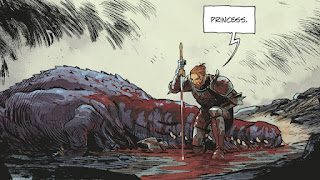
With little to keep him in town, and with the promise of gold and a way of regaining respect amongst his peers, Arzhur agrees to travel to the Black Castle to rescue princess Islen, who is being held within by monsters. Equipped with a new sword, Arzhur travels with the old women and his squire to the castle. Fighting his way past a horde of strange creatures, Arzhur eventually comes face to face with the princess, and the huge monster guarding her. After slaying the creature Arzhur is shocked when the princess tells him that it was her friend. Even worse, the old women begin to try and drag Islen away to her mother, not her father as they had previously told; something that Islen seems terrified about.

Seeing that the old women have lied to him, and that Islen is in genuine fear for her life, Arzhur turns on the women, freeing Islen from their grasp. The old women, now revealed to be evil hag like creatures flee into the forest. Now Arzhur makes a promise to Islen, that he will take her to her fathers castle, keeping her safe along the way. Unfortunately, the hags have other ideas.


The set-up for In Shadows is probably one of the most iconic of fantasy tropes; off to save the princess from the castle. What I really enjoyed about this story, however, is how quickly this gets turned on its head and thrown out the window. Within a few pages of being hired to save the princess Arzhur was already at the castle, ready to go in sword swinging. At first I was left thinking that this seemed a bit too quick, that the story had skipped over a lot of stuff to get straight to the action; but the fact that this was still very much set-up for the real story was a delightful twist.

The real story here is of Islen and her family, of the fight between her parents, and her trying to figure out what kind of person she wants to end up being. In a lot of ways, this is very much Islen's story, rather than Arzhurs, and of the two of them she's the one we get to know the most as events unfold. We find out how her parents met, what their relationship was like, how she ended up in the Black Castle. In contrast, we learn that Arzhur is looked down upon by his fellow knights and feels guilt, but we never know why. The story is clearly holding back on this for a while, and it will be something that will be covered in later volumes, but for now it comes across like he's the supporting character to Islen; which is a nice twist on expectations.

The story we do get this volume is actually really good, and has some great twists and turns, and some really dark moments in it too. Come the end I was actually really disappointed that it was over already, and that I was going to have to wait to find out what happens next as I was fully invested in the characters and their story.

The artwork, provided by Vincent Mallié, is absolutely gorgeous. Mallie is able to bring this world to life in wonderful, detailed ways. The villages and towns feel dirty and run down, like they're lived in. The countryside can feel vast and empty one moment, or like lush, thick forest the next. And the characters all look distinct and clear, with all of them being instantly recognisable and having a physical look all their own. Some of the best stuff, however, are the creatures, the twisted animals and strange magical beings that make appearances throughout. Seeing these unusual things suddenly appear alongside the more mundane makes them stand out instantly, and the level of detail they have means that you'll spend ages just looking through everything, trying to take it all in.

In Shadows was an engaging and engrossing first volume, one that very quickly had me wanting to know more and delving deeper into things. This is going to be one of those books where I'm going to be eagerly waiting for the next volume, and will be reading it as soon as I can.


Support Amy on Patreon

Buy Amy A Coffee

Go to Amy's Blog