Sunday, 14 November 2021

Witches Unleashed: A Marvel Untold Novel by Carrie Harris - Book Review


'Three extraordinary supernatural heroes join forces with Ghost Rider to capture Lucifer himself and return him to Hell, in this staggering Super Hero adventure from Marvel: Untold

'Johnny Blaze, aka the Ghost Rider, has accidentally released Lucifer from Hell, and that’s a serious problem. While hunting the 666 fragments of Lucifer’s soul now loose on Earth, Johnny enlists the aid of witches Jennifer Kale, Satana Hellstrom and Topaz to track down a sliver of the demon which is possessing the body of Jennifer’s cousin, Magda. Lucifer is looking for the Tome of Zhered-Na, aiming to release the demon within its pages and unleash hell upon the world. But the witches are the Tome’s protectors, and they aren’t going down without a fight. Now the witches must work together, trust the Ghost Rider, and put their personal demons aside to stop the King of Hell in his tracks.'

Before picking up Witches Unleashed the only character that stars in this book that I'd heard of before was Ghost Rider. I'd read several books with him in it before, and watched the wonderfully terrible Nic Cage movies, and was excited to see more of him in the Marvel Untold range, but I'd never heard of the witches before. Thanks to Carrie Harris providing a wonderful breakdown of who the three of them were and how they'd come to work together in a twitter thread I was hooked on learning more about them. A Charlies Angels of supernatural, magic powered women? That's something I definitely need in my life.

Whilst I haven't had the chance to track down their comic book team-up yet, and I will because I need more of these characters, Carrie Harris manages to make this book completely accessible to people like myself who've not had that prior experience. I'd say you could come to this book with no idea who any of them, even Ghost Rider, are and still find an engaging and enjoyable story here.

The book begins some time after Johnny Blaze, the Ghost Rider, has escaped from Hell. You'd think that escaping from Hell would be a good thing, and that Johnny would be trying to enjoy his time back on Earth, but sadly in escaping Hell Johnny allowed Lucifer to break out too. To make matters worse, Johnny isn't only dealing with one Lucifer, as upon escaping Hell his soul split into 666 fragments, each of which has inhabited its own host. We find Johnny towards the end of his mission to track down and eliminate all of the parts of Lucifer's soul.

Unfortunately, each time a fragment of Lucifer is destroyed the rest get stronger, and now Johnny has discovered that one of these remaining fragments is in the body of a mystic; and a member of the Kale family. The Kale's are guardians of the Tome of Zhered-Na, a powerful spell book that also contains the demonic entity, the Hellphyr. Fortunately, only a Kale can unleash the demon from the book, meaning that only Lucifer's new host will be a problem. 

It's also fortunate for Johnny that there's a Kale guarding the book, his cousin Jennifer. And Jennifer isn't alone either. Having been brought together by Doctor Strange years before, Jennifer has her own coven with the half demon succubus Satana Hellstrom, and the powerful empath Topaz. When Johnny comes into their lives to warn them that Lucifer is on his way the three witches will have to put their new life together at risk and decide how far they're willing to go to protect what they have.

This book isn't like a lot of the other books in the Marvel Untold range, it's focused less on super heroics, and more on the people in the story. Even the magic and the supernatural is kind of just set dressing, there to help the story progress and for the action to take place. What's at the real heart of this tale is the characters.

The story begins by introducing us to Johnny, a man who has been the Ghost Rider for so long that it's kind of become routine for him. He's no longer battling against the idea that he's sharing his body with the spirit of vengeance, and he's even begun to form a decent working relationship with Zarathos, the demonic entity inside of him. However, it's the more recent traumas that Johnny has had to live through that still haunt him, namely the deaths of his wife and children. As such, Johnny begins the book a pretty closed off man, and it's only through his coming to work with the witches that we see that there's more to him, and that he's actually quite desperately lonely and in the need of connection.

This kind of connection is something that the witches already have, thanks to having formed their own little family after being brought together as a team several years before. Over the years they've not only come to like each other, but love each other like sisters, and have developed some strong bonds. The three of them come from vastly different backgrounds, their magics are different, and their personalities sometimes clash, but by being together they all help each other. They know how to pick each other up when they're down. They know when another in the group is about to lose their temper and needs to be challenged or given a shoulder to cry on. They know how each other works, and because of their connections and the life they've made together they've all never been happier.

Obviously, this is disrupted when Johnny arrives on the scene, not just because he's telling them that Lucifer is on his way to town to wreck their shit, but because it changes their dynamic. Their comfortable life is thrown out of balance, and they're having to face long buried fears and anxieties that they've been trying to avoid processing. This brings about some of the more important conflicts in the book, not the fight with Lucifer, but having to confront the issues that threaten to break their family apart.

Thankfully, the characters in Witches Unleashed aren't afraid to open up to each other, to talk and to help each other; and this even translates across to Johnny too. Just by being around these three women his life is made a lot better, and you get the sense that he's made very real connections that will exist long after this story has come to an end. There are some genuinely touching moments across the course of the book, particularly one where Johnny opens up about the loss of his children that were really quite moving.

For those that have come to this super hero story for some action, there's plenty here that will keep you entertained too. Whether it's the opening chapters where Johnny is hunting down a Lucifer shard that is running amok with a tank, or the final confrontation with the King of Hell in a Halloween themed circus, there's plenty of action packed moments throughout the book. Carrie Harris shows that she's not just great at writing interesting interpersonal moments, but can craft exciting and engaging action sequences as Ghost Rider and the witches take on some powerful foes across the book.

Witches Unleashed: A Marvel Untold Novel is a lot of fun, it introduced me to some characters I knew nothing about, and gave a lot more depth to one I had only a passing familiarity with. I really enjoyed this focus on the dark, more mystical side of the Marvel universe, and hope that we get to see more of this kind of content in the future.


Buy Amy A Coffee

Go to Amy's Blog

Saturday, 13 November 2021

Horror is Good For Kids!


Originally published on Set The Tape


I’m sure that there will be some of you who read the title and will immediately jump to saying that I’m wrong, that ‘of course horror isn’t good for kids, they’re just children after all’. You’ll make a snap decision that sitting four-year-olds down for a viewing of The Texas Chainsaw Massacre or The Human Centipede is not just wrong, but immoral; and I’d have to agree with you on that one, because that’s not what I’m going to advocate here.

Yes, I myself grew up having seen some horror films that I was way too young for, having snuck the odd video off my uncle’s shelf to watch surreptitiously, or having crept into the back of the room whilst they has a film on that I was not allowed to see. Whilst I can’t remember it myself, my mother is quick to remind me that when I was three I wouldn’t go near windows at night for several months because I was convinced Freddy Monster was going to get me because I’d snuck in to watch A Nightmare On Elm Street. But despite that I don’t think these experiences did me too much harm.

If anything, discovering horror at such a young age really pushed my love for stories, and I found myself ever seeking out more thrills and scares. Having been born in the late ’80s there were plenty of children’s films that whilst not designed to be horror had some pretty dark elements that made them damn scary in places. Things like Labyrinth and Return To Oz are still films that freak me out a little to this day. And yes, whilst I might have seen the odd thing a little too early (thank you Tim Curry’s Pennywise for my lifelong fear of clowns) for the most part I think horror did me a lot of good.


Being a kid is scary. I think as adults we can sometimes forget that because we look back at our childhood wistfully, longing to go back to a time where we didn’t have to worry about bills, and jobs, and looming global threats, because as children we were unaware of all that and were taken care of by our parents. But being a child isn’t all fun and games, even if that’s how our memories paint it. It’s hard being a child.

Everything is big and out of proportion to you, leaving you to feel tiny and isolated in a world not designed for you. Parents tell you what to do, where to go, what to wear, and can suddenly change the rules on you just ‘because I say so’, leaving you to feel like you have little to no agency. It’s a world where everything you think you know can suddenly shift, where the happy routine you’ve got can be thrown out of whack by forces more powerful than you that you can’t fight against without fear of reprisal. That sounds a lot like a horror scenario to me.

A lot of the stories that you’ll be exposed to as a kid won’t reflect these themes and feelings, as most stories written for children have happy endings where things are wrapped up with a neat bow, and the most drama tends to be things like a missing toy or having to go visit grandma. But horror shows kids that their feelings of helplessness, of being powerless in the face of stronger forces, of sometimes being alone with no one to turn to happen to other too. And in most cases, shows kids that there can be happy resolutions to these situations.


There’s a lot of horror designed for children, any of us reading this who grew up in the ’80s and ’90s will remember books like Goosebumps and Point Horror, and I’m sure even if you’ve never read one there’ll be a cover or two that stick out in your memories. Books like these were great introductions to horror for kids. They followed the normal conventions of the genre, showing characters living a good, normal life before something terrible happens, forcing them to have to confront their fears in order to reach what is normally a happy conclusion that gives them some sense of a happy ending.

The horror of these stories wouldn’t be anywhere as extreme as that in media designed for adults, but would draw upon some of the fears that children would experience. Moving into a new house, spending time away from your family, having to go into a spooky cellar, finding creepy looking objects. They took the things that kids were scared of and showed them that even if their worst fears were realised and something horrific happened it didn’t mean that you couldn’t get a happy ending.

Children’s television is also a good place for horror, and some of the best loved children’s shows from the past are either horror shows, or shows with a very dark edge to them. Things like Goosebumps and Are You Afraid of the Dark? often make lists of some of the best kids shows, whilst less obviously frightening things like The Demon Headmaster and Round The Twist still get mentioned when talking about things that frightened us as kids. Sadly, it seems like a lot of children’s shows have toned down the more frightening elements over the years, as many of the lists of scary kids shows tend to feature things from the ’90s over modern shows.


Does this mean that parents have become more protective of their children and are more worried about exposing them to horror at a young age? Possibly. I’m not a parent, and few of my friends are, so I can’t speak to that with any great authority. But as an outsider looking in I do sometimes feel that parents are more aware of what their kids are watching now, are more worried about them seeing things that might be ‘too old’ for them.

To that I’d have to say, don’t be afraid of letting your kids see things that might frighten them or scare them a bit. I’m not saying you have to sit them down and expose them to the most extreme ends of the genre, but showing them media that acknowledges their fears and concerns in a good way, that shows them that fear isn’t something to be ashamed of, but something that we all feel, could be a very healthy way to show them that they aren’t alone in the universe, that they don’t need to be overwhelmed by fear.

Who knows, they could even discover a genre they love, one that inspires to them to seek out more and even one day create themselves. Horror is good. It’s good for everyone, but it’s especially good for kids.


Buy Amy A Coffee

Go to Amy's Blog

Friday, 12 November 2021

Shepherd – Film Review


Originally published on Set The Tape


With the way things have been the last couple of years, I’m sure that a lot of us would see an advertisement looking for a shepherd to take a job as the sole inhabitant of a remote island and seriously consider taking it. The idea of getting away from other people during a pandemic, and losing access to social media and all the highlights of social issues and injustices sounds pretty nice all things considered. Sadly for Eric Black (Tom Hughes) he’s trying to escape something altogether worse.

The film begins with Eric having recently buried his wife, Rachel, although  not really, as there was no body in the coffin; just a collection of personal objects placed there by Eric and the other mourners. Left to try and figure out what might have happened to Rachel, we get small clues as to the tragedy Eric is living through. We also get hints that he may not just be figuratively haunted by these events when a drawer in his home opens by itself with the sound of a baby crying, and a small infant arm emerges from withing. Finding a baby scan picture inside the drawer it seems like Eric may have lost more than his wife. Deciding to get away from these ghosts he takes a remote shepherding job in the paper, leading him to a small island off the coast of Britain.


With only his dog for company Eric finds his new home to be a brutal, yet beautiful place. An old lighthouse that no longer works dominates the beach, it’s fog bell letting off a loud ring throughout the day and night. The cottage that’s to be his home is the only other structure on the island, and standing against the elements, looking close to falling down. The rest of the island is rolling hills, foggy fields, and hundreds of sheep. It could be the ideal place to get away from all your worries; except that strange things soon start happening to Eric on the island.

Strange noises fill the house at night; someone or something begins to move around the few possessions he’s brought with him; the sheep start acting strange; and a ghostly cloaked figure appears in the dark and the fog. The events that Eric experiences feels like a haunting in the most classic sense of the word. Strange little things happen, things that could easily be explained away yet come across as frightening. A lot of the time when the more overt things happen, such as the wraith-like figure that seems to stalk Eric, they happen in his dreams, and as such the audience can be forgiven for questioning if what we’re seeing is real, or is these are perhaps the delusions of a mind broken through grief.

As the film progresses we start to learn more about Eric and his marriage to Rachel, and that there might be more to her mysterious death than we’re first led to believe. This begins to raise the question as to whether it might be her ghost that has followed him to the island, or if perhaps he’s somehow being punished for terrible things he may have done.


One of the key ways in which Shepherd tells its story is through its visuals. As Eric is often the only person on screen for the majority of the film, the environments of the movie have to do some of the work too, essentially becoming characters in their own right. Thanks to choosing to film in some remote locations across Scotland and Wales, with the Isle of Mull being one of the chief filming locations, the film takes on a wonderfully brutal beauty. The desolate landscapes are frightening and lonely places to be, yet look stunning in their presentation here. Director Russell Owen, who also wrote the film, seems to know perfectly how to take these beautiful locations and make them feel eerily sinister, and shoots some truly chilling scenes where the island itself feels like a malevolent entity.

With other ghostly horror films seemingly unable to play things subtle for their complete run time, Shepherd definitely feels like something a little different. It feels like an older way of crafting a ghost tale, one where you’re not relying on the jumps and loud noises to frighten the audience, and you allow them to think for themselves. You should definitely check it out for this reason, and for its strong performance from lead actor Tom Hughes, and some absolutely stunning visuals.


Buy Amy A Coffee

Go to Amy's Blog

Thursday, 11 November 2021

Doctor Who: War of the Sontarans - TV Review


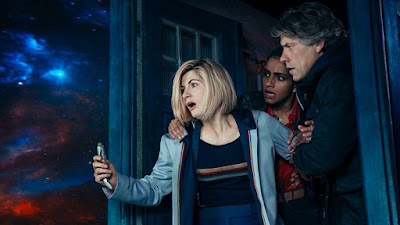
Well, after a first episode that was enjoyable enough but felt confusing and bloated at times it's nice to get an episode that felt like it did a lot with the story without being overwhelming; delivering a good monster of the week style story that still played a part in the bigger story.

The story pretty much picks up where the last one left off, with the Tardis coming under attack from the mysterious Flux, some kind of energy wave/cloud thing that's destroying all of reality itself. After a brief dream-like sequence where the Doctor stares up a strange broken and twisted house floating in the air (this has to be Lungbarrow right?) our three companions wake up outside the Tardis on a fog covered battlefield surrounded by dead British soldiers. 

The three of them are quickly found by Mary Seacole, confirming that they must be in the middle of the Crimean War; however, when they learn that the British aren't fighting Russian forces, but an army of Sontarans it indicates that history may have gone awry. Unfortunately, the Doctor is barely able to begin processing this before Dan and Yaz are swept away somewhere and somewhen into the timestream. With the Tardis refusing to let her back inside the Doctor has to find a way to stop the Sontaran invasion before she can go after her friends. 

Meanwhile, Dan finds himself back in present day Liverpool, where the Sontarans have taken over, whilst Yaz is taken to the planet Time along with Vinder, where they discover the Mouri, strange almost religious figures that have a connection to time itself. Unfortunately, Swarm and Azure are also heading to Time.


So, a lot does happen this episode, but thanks to the main focus being on the Sontaran invasion of Earth, even across two time periods, it feels a lot more manageable than the previous episode. It had a briskness of pace that felt good, as it needed to wrap certain things up before the end of this episode, whilst still keeping the main plot going. If this is how the rest of the series is going to play out I'm much more excited now to see the rest than I was at the end of the first episode.

Another thing that this episode really gets right is the Sontarans. I was never completely happy with the Sontarans during modern Doctor Who, their designs felt a little too smooth and neat, their costumes were too bright and colourful, and they were often too comical for me to really see them as any kind of threat. All that seems to have been addressed here. I mentioned in my previous episode review that I liked that their design was a more modern version of their classic look, and we get to see a lot more of that this episode. Their armour actually looks like armour now, rather than purple and blue rubber it looks like heavy weave cloth and thick metallic plates; it looks like something a warrior would have to wear.

Their faces are also a big improvement, having gotten rid of the smoothness and almost sanitised look they had, instead looking rougher, uglier, and meaner. Their faces don't look like they're fresh out of the cloning tanks, but that these are creatures that live on the battlefield, have taken hits and have scars and look like they could really hurt you. This is also reflected in the way they act, with these being the scariest and most aggressive Sontarans we've seen in the modern era. Yes, they still have moments of humour, such as Commander Skack admitting that they'd invaded this era because he wanted to ride a horse; but they were much more threatening, mercilessly killing prisoners, and even executing their own soldier for the disgrace of being caught.

Speaking of that particular Sontaran, I thought we were going to get a reveal that that particular warrior was going to be Strax from a point before we'd met him previously. He was played by Dan Starkey, seemed to have medical knowledge because he fixed himself up, and when he admitted that he had been captured and taken to heal by the enemy he asked for a fitting punishment; and I thought this was going to be the point where his commander would make his punishment healing the sick, as a kind of joke upon how he brought dishonour to himself. I think it would have fitted really well, and would have been a neat connection to previous seasons. But sadly my hopeful fan theorising wasn't to be.


The modern Sontaran stuff was probably the weakest of the episode, with Dan's ability to sneak right into the heart of their top secret and supposedly heavily guarded time ship construction yards being very easy and convenient. With how much the rest of the episode did to build up the threat of the Sontarans they felt a lot less of a bother in the modern sections. Thankfully, the fun that John Bishop is continuing to bring to the role made these scenes fairly enjoyable, and his moments did elicit some genuine laughs from me. I'd never really seen much of John Bishop in things before, so had no real opinion on his casting, but having had two episodes with him now I'm really enjoying the energy he's bringing to the show.

Aside from the Sontaran plot the most intriguing parts of the episode are those that took place on Time. Not only did we get to see a bit more of Vinder and learn a tiny bit of him, but we also get another appearance from Joseph Williamson, who has also somehow ended up inside the temple briefly. With this being two episodes in a row with him and his tunnels making an appearance I'm very interested to see what kind of explanation we're eventually going to get. These sections also allowed Yaz to take the lead for a while, working under the mantra 'what would the Doctor do?'. Along with her moments helping to pilot the Tardis last episode it's clear that she's had the chance to learn more from the Doctor since Ryan and Graham left last season, and is beginning to act more like the Doctor. Whilst this isn't necessarily a bad thing, the last companion who tried acting like the Doctor and got a bit too cocky ended up getting them self killed; so it does make me worry about Yaz a bit.

The best part of the scenes on Time, however, are those that involved the villains Swarm and Azure, along with their new companion the Passenger. Passenger has to be Di inside some kind of robotic prison suit or something right? Azure took her last episode and Passenger did nothing but stand around so I'm guessing she's locked inside it. Whilst Swarm did some creepy things last episode I didn't really get much of a sense about the kind of character he was, but episode two really gives him a chance to shine, despite only being in the episode for a short amount of time. The level of confidence he has, the bravado and subtle threat he exudes really sells that he's going to be a big villain, and Sam Spruell plays him wonderfully. It's still pretty early days yet, and I'm sure we're going to get more of him as the series progresses, but I genuinely loved every scene he was in and can't wait to see more.

With an entertaining plot that gets resolved in this episode, more mysteries being revealed, and a cliffhanger that feels a lot more of a threat than the first episode (we all knew the Flux wasn't going to kill our three leads in the first episode, but who knows what Swarms plan is going to do) this feels like the episode that has settled into a good pace for the rest of the series to emulate. I was worried how a series long arc was going to play out, and if everything would work out by the end, and whilst things could still go wrong if the landing doesn't stick, I'm certainly more hopeful for the rest of the story now, and think that this is going to be Chibnall's best work as show runner.


Buy Amy A Coffee

Go to Amy's Blog

Wednesday, 10 November 2021

Beyond: The Founding of Valdemar by Mercedes Lackey - Book Review


'The long-awaited founding of Valdemar comes to life in this new series from a New York Times bestselling author and beloved fantasist.

'Within the Eastern Empire, Duke Kordas Valdemar rules a tiny, bucolic Duchy that focuses mostly on horse breeding. Anticipating the day when the Empire’s exploitative and militant leaders would not be content to leave them alone, Korda’s father set out to gather magicians in the hopes of one day finding a way to escape and protect the people of the Duchy from tyranny.

'Kordas has lived his life looking over his shoulder. The signs in the Empire are increasingly dire. Under the direction of the Emperor, mages have begun to harness the power of dark magics, including blood magic, the powers of the Abyssal Planes, and the binding and "milking" of Elemental creatures.

'But then one of the Duchy’s mages has a breakthrough. There is a way to place a Gate at a distance so far from the Empire that it is unlikely the Emperor can find or follow them as they evacuate everyone that is willing to leave. But time is running out, and Kordas has been summoned to the Emperor's Court.

'Can his reputation as a country bumpkin and his acting skills buy him and his people the time they need to flee? Or will the Emperor lose patience, invade to strip Valdemar of everything of worth, and send its conscripted people into the front lines of the Imperial wars?'

My only experience of Mercedes Lackey's work have been a few of the entries in the Elemental Masters series, books that I really enjoyed as I love the way that she's able to mi interesting character development with intricate and accessible world-building. As such, when I saw Beyond: The Founding of Valdemar I was very excited to read more of her work, especially one in a purely fantasy setting, as I knew it would be something that she'd excel at. When I realised that this book was part of a much larger series, the 52nd story set in this particular world, I was a bit worried that I might not understand everything, that there would be some previous part of her work that I'd need to have read to understand and enjoy this. However, this being a prequel novel to much of those stories, and thanks to the accessible way Lackey writes, it was a brilliant experience to delve into this world.

The story begins in 'the Empire', an unnamed place where a cruel dictator rules over a vast empire where those who live there are constantly under the threat of their tyrannical leader coming in and taking everything away from them at a mere whim. With a war raging on the frontier, and magical beings and supplies being taken to the distant capital, those who have anything good are constantly afraid that they could lose whatever they have. It's in this world that we meet Kordas Valdemar, the Duke of a small region of the Empire, good for not much than the breeding of horses.

Thanks to the high quality of the horses that Valdemar produces the duchy has been left to do its own thing by the Empire, which has allowed Kordas to continue the daring plan put in place by his family before him. Having gathered as many mages and innovators as he can, hiding them away in secret chambers inside his manor, he's been trying to find a way to transport his people far away from the Empire, giving them the chance to live a life without fear. When one of the mages finds a way to open a teleportation gate to a distant land, one far beyond the reach of the Empire, Kordas believes the time has finally come to lead his people to freedom.

Unfortunately, this plan is suddenly put at risk when the Emperor summons Kordas to the capital shortly before the upcoming vast celebration that the people of Valdemar are planning to use as cover to escape. Forced to attend the Emperor, Kordas has to leave his people to tend to the plan without him, to establish a beachhead in their new home, and begin secretly transporting the population; but what he discovers in the capital will further complicate his plans, and he finds himself having to play the most dangerous game of his life.

I have to admit, I absolutely adored this book. Very quickly I found myself drawn into this story, of a persecuted and threatened population trying desperately to get out from under the heel of a despotic leader so that they could live in peace (I'm sure that there's nothing in the real world I can relate to this). Before I knew it the plight of Kordas and his people had hooked me, and for the first half of the book I was intrigued as to how the plan was going to unfold.

Mercedes Lackey did an amazing job at outlining the rules of the world, the way the society worked and how magic was a part of it, without it feeling like she was getting bogged down in the history or the details. As such, when the mages were discussing the science behind their magic, and how it was going to be used to escape the Empire it was something that made sense, that I was able to keep up with; and something that I found absolutely fascinating. The way that the plan was slowly revealed to the reader, seeing the people of Valdemar preparing to leave, keeping their movements and preparations secret, were great, and the exploration of their new home once they were able to establish a gateway was parts of the book that I'd have loved to have seen more of and gone into more detail.

The most engaging part of the book, however, was everything that happened once Kordas was to the capital. Suddenly those hints at how bad the Empire was, and how evil their leader is seemed to not be enough to describe what the reality was actually like. Kordas was thrust into a nest of vipers, having to play a very specific part, doing his best not just to survive, but to ensure that his people had the chance to play out the plan. To say it was tense would be an understatement. There were times I was expecting Kordas to be caught out, to be suddenly taken away to a prison cell. It was an engrossing read.

But we also got to discover so much once we reached the capital. It was a place that even Kordas was unfamiliar with, thanks to the changes that had taken place over the years, and we got to discover a lot of its wonder, and horrors, alongside him. The Capital also introduced what was, for myself, some of the best characters. The dolls. I won't go into detail about them so as not to spoil the book, but these magical servants created to run the Capital were so wonderfully intriguing, and developed so much over the course of the book that they're probably the thing I'm most excited to see more of in the book. I can't wait to see how they play out in what Lackey has set up for the next entry in the series, and how they'll further develop.

I really liked how Kordas was essentially a hero who doesn't think of himself as one. he doesn't see himself as standing up and doing the heroic deeds because he feels that doing so is simply his duty. It's not something brave to put the needs of his people first, it's simply the only decent and moral thing for him. He might be an outlier in regards to the other members of the leadership in the Empire, but to him, he's being the way everyone should be, the ideal that we should all strive towards. He doesn't look down on the people working the fields, he goes and talks to them to find out if there's anything that can be done to make things better for them; he doesn't expect others to do the dirty work for him, he goes and rolls his sleeves up and steps in to do it himself; and he doesn't persecute people for who they love, but tries to create a world where they're free and open to be themselves. He's a decent human being, and because of that he was a perfect lead character for this story; for this story of hope fighting against the worst of human nature.

This might have been my first experience reading a Valdemar novel, but it's definitely not going to be my last. After this one book I'm very much on board as a fan now. I'm going to be grabbing the next book as soon as i can, and I'll be going back to read the ones that came before. Mercedes Lackey created a world and characters that drew me in and enraptured me when I wasn't expecting it to. A perfect fantasy novel in every way.


Buy Amy A Coffee

Go to Amy's Blog

Tuesday, 9 November 2021

A Hole In The World by Weston Ochse – Book Review


Originally published on Set The Tape


'The town of Iron Hat, South Dakota, has disappeared and only one eccentric local remembers it ever existed. Investigators hear him out, but decide he's just gone crazy.

'When Graves Hill, a town near Leicester, also disappears with only the MP complaining he's missing some constituents, the Black Dragoons—a clandestine military unit dedicated to protecting Great Britain from supernatural threats—investigate.

'Soon, the Black Dragoons and their American counterparts are working together. Preacher's Daughter is on the case, but Great Britain may never be the same again...' 

Before reading A Hole In The World my only experience of Weston Ochse was his work on an Alien novel that tied into the recently released Aliens: Fire Team video game. He’d managed to craft an interesting story with engaging characters and interesting world building. And throughout it all he managed to create a creepy and atmospheric read. As such, when I read the description for A Hole In The World it sounded like an intriguing idea, one that could be very scary too.

The plot begins with the town of Iron Hat, in South Dakota, suddenly vanishing one day. Not only is the town itself gone, but no one can remember it even being there. People who head to the town turn their cars around and go home, people who work there don’t remember having a job, and records of it start to slowly vanish from databases across the world. Except one man seems to remember it, and appears to be the only one who does. This get the attention of a special branch of the military whose job it is to investigate strange events, and if needs be, kill monsters.

When they discover that another town also seems to have vanished, with only the one person remembering it, one of their operatives, Preacher’s Daughter, is sent across to the UK to assist their British counterparts in their investigation. As Preacher’s Daughter settles into this new team they begin to uncover evidence that something powerful is behind the disappearing towns, something that could lead to a lot of death and destruction.

When I first read the description of this book I thought that this was going to be a spooky mystery story, one where the reader gets to try and figure out what’s happening alongside our lead characters, and scary, spooky things happen. Whilst there are elements of this in the book it’s actually more of a military combat book, where more time is given over to focusing on soldiers being soldiers than the more interesting supernatural aspects of the world. Rather than focusing on monsters, fey spirits, and other creatures that exist we spend a lot of time reading descriptions of guns and equipment, complete with technical specs and names that mean very little to anyone who’s not a big gun fan, and needed to Google a lot.

Ochse does give a lot of time over to the characters as well, however, come the end of the book I still felt like I didn’t know much about these people; and in a lot of cases found that I didn’t really like them. Preacher’s Daughter, the lead of the book, felt very underdeveloped, despite the majority of the book following her, and that we spent as much time watching her hanging out with people and chatting shit with them as we do seeing her in action. I think one of the biggest reasons for this is the fact that despite nothing saying that this book is part of any of Ochse’s other series, such as Seal Team 666, and as such I came to believe that this was its own stand alone thing.

Perhaps this is my fault, maybe I didn’t think it through enough; but the end result was me being dropped into a story and a world that seemed to have expected me to be familiar with a lot of things. There were times where Preacher’s Daughter would be thinking about her old team, and we’d get long paragraphs about people and places from her past where she’d outline how important this was to her before it suddenly going ‘but they’re long dead now so it doesn’t really matter’.

I’m sure for someone who had read the previous books this would have been moments of great callback, or added insight into beloved characters, but for someone coming into it fresh it felt tangential and often frustrating. This would also be the case when Preachers Daughter would start talking about things like the time she fought an ancient god in a strange spirit plane, and drop a chunk of technobabble explaining it. Again, for anyone who’d already read her adventures in killing a god this must have been great, but for me it ended up pulling me out of the book.

Overall, A Hole In The World is a perfectly fine supernatural military shooter book. It has some interesting ideas and moments in it, but with it being part of a bigger universe it often felt inaccessible to a new reader, and there were times where I felt like I was lacking a lot of information. For anyone who’s already read Ochse’s series and enjoyed it I’m sure you’ll get a lot out of this one, but for anyone thinking of trying this out without that background it might not be the best place to start with Ochse’s work.


Buy Amy A Coffee

Go to Amy's Blog

Saturday, 6 November 2021

Air & Darkness: Tides of Darkness Book 2 by Sarah L. Blair - Book Review


'Darkness is coming for the city that never sleeps. A vicious vampire attack at New York City’s most popular nightclub puts the world’s biggest rock star in a body bag, and paranormal investigator Sidney Lake is on the case: at the top of the NYPD’s suspect list. Inconvenient, as Sidney is miles from Manhattan, hiding from the memories that haunt her. Too bad distance won’t stop the Darkness from chasing her down. . . Now she has no choice but to return and find out who—or what—has been wearing her face.

'Two millennia ago, Dimitrius Roman made a sacred oath, one he has battled and bled to uphold ever since. However, his faith is put to the ultimate test when a long forgotten foe emerges, threatening to destroy the sacred bloodline of the Goddess. With Sidney on the verge of coming into her true power, Dimitrius must face the unforgivable mistakes of his past in order to fulfil his vow and help Sidney as she confronts the ancient evil determined to end them both.

'With the long-held promise of the Goddess finally within reach, Dimitrius and Sidney must dig deeper than ever before to overcome their own demons, and rise above Darkness once and for all.'

Air & Darkness is the second book in the Tides of Darkness series, following on from 2016's Darkness Shifting, as well as last year's prequel novel Darkness Loves Company. Whilst this book is a direct sequel to the first, taking place only a few weeks after the closing moments of the first book, it incorporates a number of elements introduced in the prequel novel.

The story begins with our heroine, Sydney Lake, having hidden herself away from the world in her remote cabin, using her time away from New York and the various monsters and dark forces that make it their home, to try and get to grips with the loss of her lover, Mitch. However, those same dark forces refuse to give her the time she needs to grieve as her new home comes under attack from vampires.

At the same time Dimitrius, the two thousand year old immortal pledged to protect and follow Sydney, is playing host to one of the worlds biggest pop stars in his club. When she's found dead amidst a power cut the club becomes a crime scene, and Dimitrius a suspect; along with Sydney, who witnesses saw at the club. Dimitrius realises that the same force that killed the singer impersonated Sydney in an attempt to implicate her, making the both of them targets.

With Sydney having to return to New York following the attack she, Dimitrius, and their allies will need to try and figure out who this mysterious foes is, and how to stop them before the police decide that one of them is responsible for the murder.

Air and Darkness feels very different to the other two books in this series. Whilst the first book and its prequel featured a lot of the supernatural world, and small parts about Dimitrius and his history it was largely focused on Sydney and the cases that she was working on as a paranormal investigator. These other elements, especially the connection she and Dimitrius share were often secondary to the main thrust of the story. Here, however, it very much becomes one of the central themes of the book, and doesn't just dictate how Sydney interacts with Dimitrius, but how they respond to the threat that has set its sights on them both.

Whilst I enjoyed that a lot of these elements were left something of a mystery in the other books I was great to actually begin to learn more, to see how these characters all interact with each other, as well as learning small snippets about their long lives. Some of the best scenes in this book were the moments where we saw tiny peaks at stuff that adds flavour to their lives but isn't necessarily important; moments like getting to see the old photographs in Dimitrius' room that shows him and his group across the decades, or the hints of his affiliations with old mob families from a century ago.

That being said, thanks to the fast pace of the story Sydney never really gets a chance to slow down and ask any of her immortal friends what it's like living so long, and whilst we do get the occasional heavily embelished drunken story these moments are fleeting as the main antagonist of the book takes up a lot of their attention. Hopefully in future books Sydney will get the chance to delve more into this past when things are less dangerous for her; especially as I really want to know this myself.

A lot of the humour that was present in the previous books makes a return here too, and even though there's a constant sense of dread as the heroes are beset by the villain it feels like there's a lot more joviality here than in previous books. Perhaps this ties into the fact that there's also a lot more trauma being dealt with in this book too, and humour is often used to help deal with pain. Sydney has to face the loss of Mitch head on this book, alongside having to try and figure out how her feelings for Dimitrus work; but it's not all Sydney's story. Dimitrius himself gets a good deal of focus this time around, and probably gets the most development across the entire series to Sydney just in this book alone. Whilst he began the book a somewhat enigmatic figure with motivations I'm not sure I entirely trusted, come the end I felt like I knew him well, as well as cared for him.

Air & Darkness does a lot with its characters over a relatively short time, and whilst this is the second book in the series (third if you include the sequel) it also feels like a first in some ways. It feels like this is a starting point to new, bigger things to come. There's a new family forged by the end of this book, a group of heroes who look set to go off and challenge the world and do great things. And I hope that the tease we get in the final pages is stuff that we're going to get to read about in the next one.


Buy Amy A Coffee

Go to Amy's Blog

Friday, 5 November 2021

Star Wars Adventures: Tales of Villainy #11 – Comic Review


Originally published on Set The Tape


The latest issue of Star Wars Adventures: Tales of Villainy features two stories that couldn’t feel further apart if they tried.

The first story in the issue, ‘Squad Goals, Part One’ is written by Cavan Scott, and features artwork by Manuele Bracchi and Bracardi Curry, and follows the adventures of the famed Rebel Alliance pilots Rogue Squadron. Rogue Squadron was a name that has been around for many years, and the team has been the focus of a number of novels and video games, and whilst much of that was made into ‘Legends’ by the Disney acquisition of the franchise it’s good to see that Rogue Squadron have started to make more canon appearances ahead of the upcoming movie.

This story follows the five members of the team: Luke Skywalker, Wedge Antilles, Lyle Kullan, Ibti Myrak, and Isla Mantara, as they engage with Imperial forces whilst on a mission to destroy an Imperial shipyard. There to support and protect some B-Wings, things don’t go well for the team when their newest member, Ibti, decides that her ways are better, and doesn’t follow orders. Over the course of the story we see Ibti and the other members of Rogue Squadron knock heads more than once.

Making a space battle feel fun and exciting is easy when it’s in a medium where you can see the action. With ships flying around and shooting at each other, making near misses and pulling off wild manoeuvres, it’s not hard to get the audience feeling pumped; but when it’s just static images on a page like in a comic it’s a lot harder. Luckily, Cavan Scott seems to understand that another way to make these moments feel exciting an engaging is to inject character drama into it.

As such, this feels like one of the better comic book space battles that I’ve read in a long while. Thanks to the interpersonal issues, to Ibti showboating and going rogue (no pun intended), it makes things feel tense because you’re waiting for her decision to come back to haunt, either leading to a mission failure or an avoidable death. Despite only knowing two of these characters before coming to this issue I found myself quickly becoming absorbed in the drama, and wanting to see more of this team.

The art on this story is some of the best I’ve seen in a Star Wars Adventures story too. The line work by Manuel Bracchi is very nice, and he’s able to put a load of detail into the panels. It really brings the ships and the characters to life, and it feels like a lot of care and attention to detail has been given to making this look as crisp and accurate as possible. Isla Mantara’s colours are very well done too, and feel very natural and depict more what you’d expect to see on the screen, rather than being overly stylised or cartoonish.

The second story is ‘Done Dirty’, written by Anne Toole, with art by Nick Brokenshire, and it feels very different to the first. Instead of being focused on the battle between right and wrong, and spending time in the vastness of space we come down to the more rundown parts of the Star Wars universe as we head to Tattooine to follow a lowly Gran working for Jabba the Hutt, tasked with looking after Jabba’s pet, Bubo. However, Bubo has gone missing somewhere on Jabba’s Sail Barge and Jabba is prepared to quite literally throw the poor man off for losing track of Bubo. Luckily, the Gran is able to convince Jabba that a better punishment would be to clean the entire ship, which would also allow him to search everywhere for the little critter. Thus begins a journey through the parts of this well known vessel that we’ve never seen before as the man tries his best to find the missing animal before his last chance runs out.

Whilst the first story is focused on the large fight for the galaxy, this feels about as down to earth as you can get in Star Wars. It’s simply about one guy doing whatever he can to not get killed, even if it means crawling through the filth on Jabba’s ship. It’s an entertaining enough story, and whilst it offers a fun insight into a place we only see briefly in the films, and gives more depth to Jabba’s character (I was shocked to learn he would be concerned for a tiny creature) it doesn’t feel like the story does a great deal. It’s a throwaway story yes, but at least it’s an enjoyable one.

The art on the story is provided by Nick Brokenshire, who does both the line work and the colours, and it looks very different to the first story in this issue.The colours are much more muted, and even in the darker parts of the ship everything feels pretty light. There are no hard shadows or thick lines, and the end result is an art style that feels quite delicate and even fragile at times. A strange style to go for for a story set around Jabba the Hutt, but one that works really well.

Thanks to a great first part story with a genuinely good cliffhanger, and some good silly fun on Tattooine, the latest issue of Star Wars Adventures: Tales of Villainy has a lot to enjoy.


Buy Amy A Coffee

Go to Amy's Blog

Thursday, 4 November 2021

Grand Theft Auto III – Throwback 20


Originally published on Set The Tape


Today if you were to say the name Grand Theft Auto you’d be conjuring images of detailed cities, fast cars, crime and destruction, all rendered in 3D that your character is able to run around in to your heart’s content. But that’s not how the series started. When it first came out, Grand Theft Auto was a simple two dimensional top down game that saw the payer driving around town causing havoc. Whilst the spirit of the series was there, the things people think of now were still absent.

This all changed in 2001, however, when Grand Theft Auto III arrived on the Playstation 2. To say that the game is a game changer is something of an understatement. The innovations introduced in this title would not only change the Grand Theft Auto franchise forever, but would influence other open world games to do similar things. It is perhaps not too much hyperbole to claim that Grand Theft Auto III quickly became one of the most influential video games ever made.

Set in the fictional location of Liberty City, loosely based upon New York, players take control of Claude, a career criminal who is betrayed by his girlfriend and left for dead during a robbery. After being arrested, Claude is able to escape police custody during a prison transfer; releasing him onto the streets of Liberty City to try and rebuild his life. By befriending and working with different criminals across the city the player is able to transform Claude from a nobody into one of the biggest criminals in the city.


Thanks in part to the new freedoms allowed by the technical improvements of the Playstiation 2, the development team were able to push the game further than any previous entry in the series. Not only were they able to create large, interactive environments for the players to engage with, but they were able to incorporate thousands of lines of dialogue,, not just in pre-animated cut scenes, but across the game world where pedestrians would wander freely and interact with the player. Whilst pretty basic by today’s standards it was groundbreaking at the time, and the game soon won critical and public acclaim for the level of detail and care that developers had given it.

Unfortunately, the game wasn’t loved by all, and thanks to the player freedoms to go wherever they wanted and to do whatever they wanted, the game was criticised for promoting violence and criminal tendencies. Even before the game hit shelves there were media outlets condemning its existence. Game Spy reportedly gave the game an award for being the ‘Most Offensive Game of the Year’, and claimed that it was not only ‘reprehensible’, but questioned if it deserved a place within the games industry. They weren’t the only ones, as complaints about the game found their way into several publications, including The Boston Globe, and The New York Times.


The outcry against the game didn’t hurt the sales of the game largely, and if anything it brought more attention to it and helped with sales. However, after initially being released in Australia the game was soon banned after being reevaluated, and Rockstar were forced to remove all copies from the continent. A more sanitised version was released there the following year, with the ability to sleep with sex workers being one of the key features removed. The original and unaltered game wouldn’t be released in Australia again until 2019.

Despite all of these issues the game sold well upon release, and quickly became the highest selling game of 2001, and the second highest selling game of the next year, losing out to Grand Theft Auto: Vice City. Within a year of its release it had sold more than six million copies and made over $250 million. Grand Theft Auto was firmly established as a series to watch, and Grand Theft Auto III received numerous game of the year awards.

Two decades on it’s easy to see the influence the game went on to have on other open world games, and to find a lot of the criticism against it laughable, but when it first came out it was still a huge gamble for the developers; but a gamble that paid off. Now the game sits firmly on many lists of greatest games of all time, and recently it was announced that it was getting yet another re-release, this time as part of a remastered celebration of it’s 20th anniversary. Despite being an older game now, Grand Theft Auto III is one that’s going to be with us for many more years to come.


Buy Amy A Coffee

Go to Amy's Blog

Wednesday, 3 November 2021

Doctor Who: The Halloween Apocalypse - TV Review


After almost two years away, and with very little advertisement or fanfare Doctor Who finally returns to the screens with the first of a six part series long story that, despite seeming to really try to do a lot, feels like a rushed, jumbled mess of parts with no clear connections so far.

This isn't the first time that there have been bigger stories in the Doctor Who universe. Even if you discounted the fact that every story before the revamp in 2005 was a multi-part story, there were things like 'The Key To Time', and more recently the third and fourth series of Torchwood were longer form storytelling. Of these mentioned examples the one that's easily my favourite is Torchwood: Children of Earth, a five part series that I think is still some of the most emotional and affecting things in the entire shared universe of Doctor Who

One of the ways that series worked so well is that it didn't rush with it's storytelling, yet managed to cram a lot into its five episodes. By the end of the first episode there was indications that big things were coming, that there was a threat on the horizon, there were new characters added, developments made with existing ones, a few mystery threads left hanging, and an explosive cliffhanger. The first episode of Doctor Who: Flux is very much not this, however. There are some similarities between the two, there's a threat established, a new character added, and a cliffhanger ending, but despite that this new episode feels very messy and confusing in comparison.


Now, I'm sure there are already going to be people yelling that this is only a first part, and that a lot, if not all of this, can get resolved in future episodes; and I very much hope that that's the case. I want this to be looked at as the set-up of a great series long story that is not only well received but lets Jodie end her tenure with a huge bang. But as something that I've watched without those other episodes yet, as something that I've experienced on it's own and have had to watch as a single episode I feel kind of dejected by the whole thing.

For starters, The Doctor didn't seem particularly good in this episode. There were times where there is clearly, obviously something bothering her, yet she never allows herself to open up to Yaz about it. There's the moment when the Tardis seems to be breaking down, leaking some kind of fluid and she just goes 'It's nothing, it's fine', or the few times where she experiences a psychic connection with one of the many villains of the piece yet won't talk about it even when prompted. Now, I understand that The Doctor doesn't always tell their companion everything, that sometimes they hide things so as not to seem like things are hopeless, or that they occasionally don't know answers, but it happened so often this episode that it felt like The Doctor either dislikes Yaz or didn't trust her. Even a simple 'I'm not sure' would have sufficed in response rather than acting like Yaz was some kind of child asking stupid questions.

Dan, the new companion for the series, was definitely the one cast member of the main three who actually felt like he got any kind of care or attention given over to him. His introduction was nice, and the scenes where he's helping out at the food bank and giving out sweets to trick or treaters were great because they showed he's a deeply kind and warm sort of person. He has a kindness to him that shows he's a decent and caring person, one that might be needed if The Doctor and Yaz continue to have this semi-antagonistic relationship develop over the course of the series.

Outside of Dan there are a number of other characters introduced. There's Claire, a woman who appears seemingly at random to tell The Doctor that they're going to meet in the past, then goes off and gets sent back in time by a Weeping Angel. The scene where the Angel appears is pretty good, but like much of the episode it feels like this inclusion is a scene where we're going to be waiting for it to mean anything. There's also another woman from Earth who's supposed to be meeting Dan for a date and gets grabbed by one of the villains for the series.


As for the villains, there's the already mentioned Weeping Angel, who appears for one scene, some Sontarans who make a few appearances setting up their inclusion in the next episode, a strange being who appears to have been  prisoner of 'the division' of millennia but escapes and causes havoc, as well as his sister who was posing as a human woman living in a house in the Arctic circle with a human man; she may have been under some kind of chameloen circuit, but no answer to that has been given yet. And there's a kind of but not really villain in the form of a dog alien who kidnaps Dan. All of this on top of the giant energy wave thingy that's tearing the universe apart that may or may not be connected to some of the other villains in the show. 

It's  lot of stuff, most of which isn't explained in the episode, and adds to the sense that things feel bloated and crammed in. Surely some of it could have been saved for later; like the Sontarans. Did we need to see them in episode one for their appearance in episode two to make sense? The flashback towards the beginning of the episode that shows construction in 1820's Liverpool will probably be important at a later time, but again, did we need that established here for it to work later?

I'm really hoping that the series goes well, and there's a lot of promise here, there are small parts that I found genuinely enjoyable and intriguing; but I'm just not completely sold on it yet. Let's hope that episode two helps to improve things. Though I will say, the line 'You look nothing like four bears' might be one of the best things in the Chibnall era.


Buy Amy A Coffee

Go to Amy's Blog