Tuesday, 3 August 2021

Jurassic Park III – Throwback 20


Originally published on Set The Tape


At one point the Jurassic Park franchise was a series that was always based off books, always adapted by Steven Spielberg, and pretty much always seen as being great films. But then Jurassic Park III came out and people began to look at the franchise a little differently. It wasn’t just books being made into films by a respected director, now it had become a monster movie franchise. And whilst the third film would be the last entry in the series for a decade and a half, it would be a film that forever changed how the franchise was seen.

Originally announced for a 2000 release date in 1998 (before a script had even been made) the project went through a number of directors and plots, including concepts where teenagers would become trapped on the dinosaur infested island, and where pteranodons terrorise Costa Rica. The story was only locked into place a month before filming was scheduled to begin.
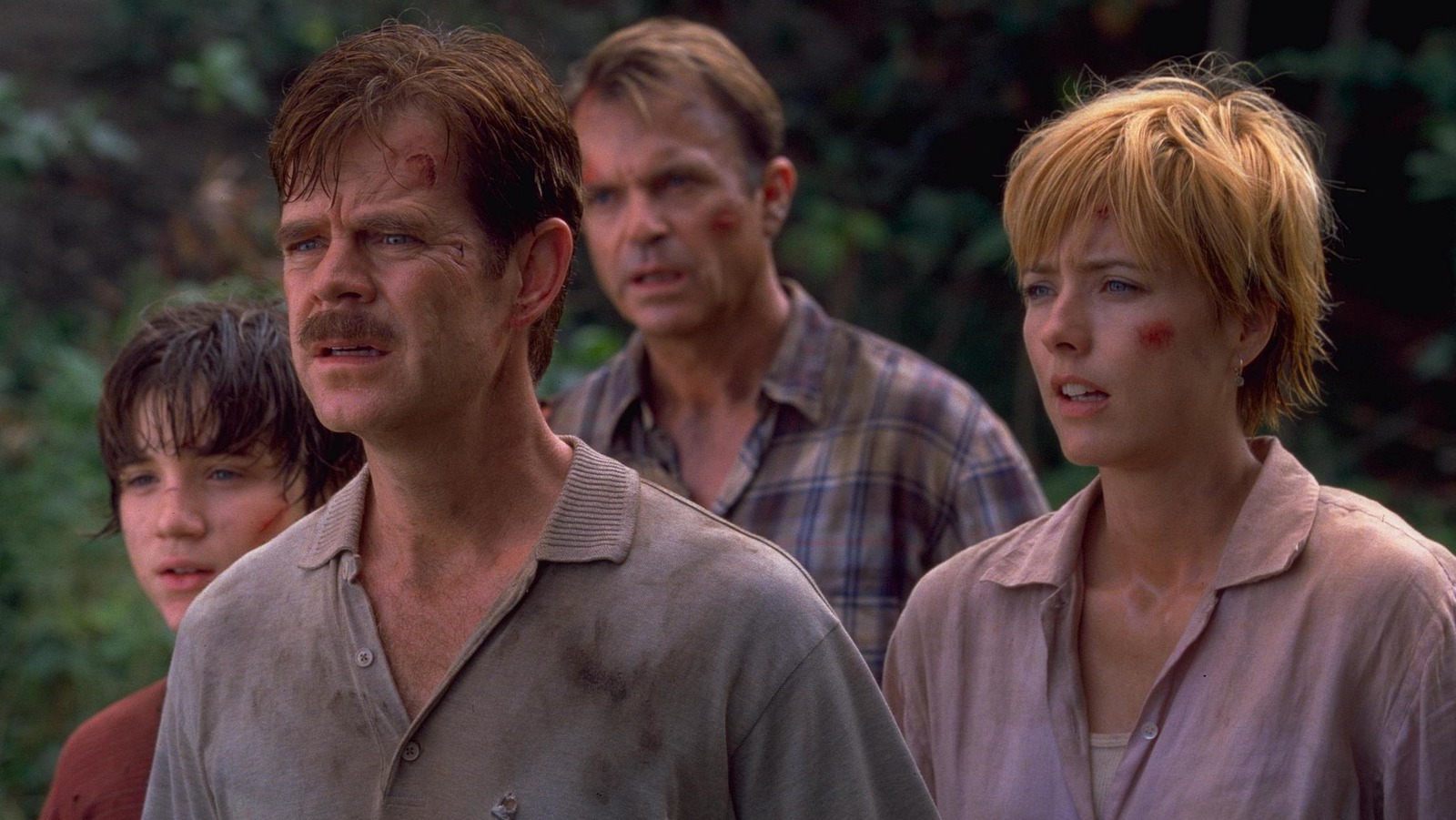


The final plot revolves around a divorced couple, Paul (William H. Macy) and Amanda (Tea Leoni), whose son goes missing when parasailing over the ocean near Isla Sorna, the Jurassic Park Site B. The two of them approach famous palaeontologist Alan Grant (Sam Neill) to give them an aerial tour of the island and the dinosaurs, posing as wealthy adventurers. Despite being reluctant, Grant agrees to do it to secure funding for his latest research.

When they arrive at the island, however, Grant discovers that he’s been lied to when they attempt to land their plane. After being knocked out he wakes up on the island as the search for the missing boy begins; a search that’s cut short when a massive predator attacks and destroys the plane. Separated on the dangerous island, the survivors have to find a way to escape, and find the missing kid before one of the island’s deadly predators gets them first.

Despite the troubled pre-production, Jurassic Park III ended up being a pretty decent and entertaining movie. It may not have had as complex or engaging a plot as the first two films, but it managed to recapture a lot of what audiences enjoyed about the series: people running away from dinosaurs. One of the things they did that helped with this was the inclusion of the deadly new predator, the spinosaurus. Bigger, faster, and more cunning than the iconic t-rex, this new threat would become the iconic creature of this entry in the series.


Whilst some people complained that the film lacked the narrative depth and engagement of the previous entries, many enjoyed the faster paced story, where the characters were quickly moved from one dangerous set piece to another. As well as having the human protagonists having to deal with returning favourites such as the velociraptor (now featuring feathers) the audience were treated to some long awaited moments; such as the inclusion of the pteranodons and their giant aviary.

For a lot of people Jurassic Park III has become the black sheep of the franchise, a film that you’re told isn’t good because it’s not as clever as the first two, because the cast isn’t as impressive, because it’s not based on the books, and because Spielberg isn’t directing. However, the film has some of the most impressive set pieces of the original trilogy, like the aforementioned aviary sequence, is able to balance the terror and gore with some genuinely funny moments, and never really lets the viewer have enough time to get bored with proceedings as it makes sure that the real stars of the film, the dinosaurs, are always the focus of the drama. It’s easy to overlook this entry in the franchise, but it still remains a film that will always bring a smile to my face when I watch it.


Buy Amy A Coffee

Go to Amy's Blog

Monday, 2 August 2021

Wild Search – Blu-ray Review


Originally published on Set The Tape


Wild Search is the latest Hong Kong 80’s action flick to get a beautiful new Blu-ray release courtesy of Eureka Entertainment, and it sees Chow Yun-Fat playing a police officer who ends up having to protect a little girl after her mother is killed when a gun smuggling deal goes wrong.

On the surface, Wild Search seemed like it was going to be a gritty cop drama. The synopsis made it sound like Chow Yun-Fat was going to be putting his life on the line to defend this little girl against killers and criminals, and the trailer featured a lot of violence and bloody moments. But once I actually started watching the film I was surprised by how much comedy was in the mix, and how the real story seemed to be a romance between Chow Yun-Fat’s character and the aunt of the girl he was protecting.

The story opens with an arms deal being made in a small Hong Kong flat. When the police arrive on the scene the deal goes wrong and the seller is killed, leaving her four year old daughter Ka Ka (Cheuk Yan Chan) as the only witness. Detective Lau Chung Pong (Chow Yun-Fat) tries to learn more about her and her family, which leads him to a rural family home in the countryside, where he meets Cher (Cherie Chung), Ka Ka’s aunt.


Lau and Cher become close over the course of his investigation, and working together they discover that a rich and powerful businessman named Mr. Hung (Paul Chun) was involved in the gun smuggling, and is also Ka Ka’s father. After confronting Hung, Lau and Cher become targets, and he sends deadly killers after them to make sure that his involvement in the illegal activities never comes to light.

Wild Search is a loose remake of the 1985 Peter Weir film Witness, and puts the focus squarely on the human drama rather than the action. The relationship between Lau and Cher is the focus of the film, and it’s never forced, instead building slowly over the course of the movie, helped in no small part by the clear chemistry that the two leads have. The small moments where the two of them are lightly teasing each other, or when Cher is trying to take care of Lau after he gets hurt, are some of the sweeter moments in the movie.

That being said, there are a good few action moments spread out across the film, though these do feel slightly forced at times. There’s a moment where Lau engages into a high speed chase after a suspect without knowing which car he’s after, or what direction he’s supposed to be going in, leading to a high speed drive around the city with no real purpose. The moments where the action serves the story are the best though, and the climactic fight at Cher’s rural family home is probably the best one the film has to offer, and features a rather spectacular end kill that had me laughing out loud.


The new Blu-ray release offers a couple of different versions of the film: the original Cantonese dub and the original English dub. Whilst the Cantonese version is the closest to the original vision of the director, I have to admit I had a lot more fun with the English dub, and it resulted in quite a few more laughs. This was mainly due to how Ka Ka was played in the English version, where it was quite clear that they’d gotten an adult to do the child’s voice. This rather creepy, slightly posh voice coming out of a four year old was unintentionally hilarious, and ended up making the child feel quite creepy at times too. Obviously, this is not what the film was aiming for, but if you’re already familiar with the film and are looking for something slightly different that’ll be fun to watch I’d definitely advise giving that version a go.

The disc also comes with a few extras, including a brand new feature length audio commentary by Asian film expert Frank Djeng, who offers a lot of insight into both the production and making of the film, as well as the impact the film had, and Asian cinema at the time. There’s also an archival interview with Roy Cheung, who plays the villainous killer Bullet in the movie, as well as a brand new interview with voice actor Simon Broad, who dubbed all of Chow Yun-Fat’s English language roles. The Limited Edition also comes with a great little booklet with writing by NEO Magazine’s David West, who provides insight into the movie.

Wild Search might not have been the film that I was expecting, but it turned out to be a very enjoyable film nonetheless, with some quirky comedy, some decent action, and a nice romance story at the heart of it.


Buy Amy A Coffee

Go to Amy's Blog

Friday, 30 July 2021

Werewolves Within – Film Review


Originally published on Set The Tape


Opening a film about werewolves with a quote from Mister Rogers about being kind and neighbourly is certainly a bold move, and it definitely sets the tone for Werewolves Within, the new horror-comedy from Josh Ruben, that adapts the PlayStation VR game of the same name.

Straight off it’s worth making it clear that whilst this film is technically a video game adaptation, it has very little in common with the source material. One of the things that other film adaptations do, and that can often lead to films that fall flat, is that they try to bring all of the characters and story of the games to the big screen, attempting to take what made those games successful in the first place and putting them in a new medium. Whilst this can be done well, it more often isn’t, and has led to video game movies being considered something of a bad genre.

Werewolves Within, however, takes a different approach. The original game sees you sitting around a camp fire in a medieval village,trying to figure out which of the people in the group is secretly a werewolf. Instead of adapting this, Ruben takes the basic seed of the concept and transplants it entirely, bringing it up to date.


The film sees Finn Wheeleer (Sam Richardson) travelling to the town of Beaverfield, where he’s set to be the new Park Ranger. Upon arriving Finn finds a small town that’s somewhat divided, as some residents want to sell up their land to a developer who wants to build an oil pipeline, whilst others refuse to give up their homes. He meets Cecily (Milana Vayntrub), another recent addition to the town, who gives him a small tour, introducing him to the various odd inhabitants.

It doesn’t take long for things in Beaverfield to go wrong, however, and the various members of the town soon find themselves trapped inside the local inn as a huge snowstorm rages outside. With the power out they think that their problems will soon pass, until they discover a viciously destroyed body under the inn; a body that’s been mauled by some strange animal. When more odd things start happening, the townsfolk come to the only logical conclusion: that it’s definitely a werewolf who did this, and it must be one of them. Now they’ve got to find a way of surviving the storm and this vicious killer; but who can they trust when one of them might be the monster?

Werewolves Within feels a lot like Clue with a dash of horror thrown in, and whilst the film deals with monsters and murders it’s the comedy that takes centre stage. Ruben focuses on the people of Beaverfield, and gets a lot of fun out of pitting this odd group against each other. There’s the pipeline industrialist, the environmentalist, the odd redneck couple, the staunch republicans, the womaniser, the gay couple; all kinds of arch, over the top stereotypes are thrown into the mix just to add more drama and weirdness. And for the most part it works pretty well.


With the film leaning more into the comedy aspect there are certain moments that feel a little bit too ridiculous, that lean into farce more than anything else, and even though the plot is dealing with a potential monster in their midst you kind of forget that this is even supposed to have any horror involved. And you can be forgiven for forgetting that there’s even a werewolf in the film, as we’re so focused on the people that you even begin to question if there is an actual monster in the movie or not.

There are some good performances in the film, especially from Sam Richardson and Milana Vayntrub, who just click really well together. The pair form a very quick bond, and there are sparks of romance between the two of them that are just delightful. I’d love to see them get to play against each other in a romantic comedy one day, as they really show a ton of chemistry and charm that makes their scenes together some of the highlights of the movie.

Werewolves Within might not be your standard video game movie, nor your average dark comedy, but it has a lot of charm and you get the sense that everyone involved in making it had a lot of fun doing it. If you’re looking for a good, fun movie to fill a couple of hours it’s definitely worth a watch.


Buy Amy A Coffee

Go to Amy's Blog

Thursday, 29 July 2021

Final Fantasy X – Throwback 20


Originally published on Set The Tape


Straight off the bat I’m going to say that I’m a little shocked and appalled that 20 years have gone by since the release of Final Fantasy X, a game I remember being hyped to play long before it came out, and one that felt like a huge leap forward for the classic Japanese RPG series. Now it’s older than the entire franchise was when it was released. Time, why must you punish us by continually progressing?

Final Fantasy X was the first entry in the beloved Square series to come to PlayStation 2, and was the first game in the series to break away from pre-rendered backdrops to fully three-dimensional backgrounds. It was also the first game in the franchise to use voice acting; something that many fans were unsure of when it was first announced. Until this point the series was well known for a particular style, and many were worried that this new, modern entry wouldn’t feel like a Final Fantasy game. Luckily, upon release it became a huge success.

The story takes players to the world of Spira, a place inspired by Japan, Thailand, and the South Pacific. These influences would inspire both the look and feel of the game, which along with the leap in technology made the game stand out amongst its brethren. We play as Tidus, a star Blitzball player who is transported to Spira from his home of Zanarkand following an attack from the monstrous entity known as Sin. Shortly after arriving in Spira, Tidus becomes the bodyguard to Yuna, a young woman who’s set out to defeat Sin.


The game still followed many of the main gameplay elements of previous entries in the series, presenting players with a large world to explore through a third-person perspective as they take control of Tidus. Most importantly for fans, the game retained the core combat element of the series, whereby the player is able to assemble a team of three characters to use in turn based fights. The game also retained the random combat encounters that was a staple of the franchise.

Final Fantasy X did, however, add some new features, including a Blitzball mini-game, where the player is able to compete in the fast paced underwater sport. Whilst being an optional part of the game in the later stages, Blitzball is an important part of the story early on, and thanks to this it encouraged players to go out of their way to seek out these mini-games, where they were sometimes completely forgotten in previous series entries.


Upon release Final Fantasy X was showered with critical acclaim, with many gaming publications giving it near perfect scores. The game was praised for the bold new innovations to the series, including its voice cast, and was seen as an improvement to a formula that, whilst popular, had become somewhat unchanged over the previous entries. The game still retains a high score on Metacritic today, with a score of 92 out of 100.

Due in large part to its success it’s also one of the few Final Fantasy games to get a direct sequel and was the first to do so, with Final Fantasy X-2 released on PlayStation 2 just two years later. This sequel shifted players into the shoes of Yuna, who along with two returning squad mates from the first game search for Tidus across Spira, whilst also trying to prevent the country from falling into politically motivated war. Both Final Fantasy X and Final Fantasy X-2 have received HD remakes over the years, first on the PlayStation 3, and most recently on the Nintendo Switch.

Final Fantasy X was something of a gamble for Square when it first came out, as they introduced a lot of new elements to the game, and took a very different approach to the type of story they wanted to tell. It not only worked out well for this game, but has gone on to become one of the most important entries in the franchise as the games that have come after it have taken many of these elements into their own structure. Final Fantasy X is one of the most important entries in the series, and one that will hold a special place for many fans.


Buy Amy A Coffee

Go to Amy's Blog

Wednesday, 28 July 2021

Gamera vs. Zigra – Throwback 50


Originally published on Set The Tape

Whilst most people outside of Japan will think of the Godzilla franchise whenever you talk about giant monster movies, a franchise that deserves recognition is Gamera. First appearing in 1965, the titular Kaiju has gone on to become an icon in his own right, and one that has been incredibly popular with children, making him the monster that’s ‘friend to all children’.

Because of his popularity with younger viewers, and the massive success of Kaiju Eiga during the 60s and 70s, several Gamera films were produced over a short period. Unfortunately, this also led to some entries in the series being a bit flawed in quality. Sadly, 1971’s Gamera vs. Zigra is one of these films.

When an alien spaceship, piloted by the creature called Zigra, attacks a base on the moon and kidnaps a female astronaut, the aliens take control of her, using her as an emissary to the people of Earth. Abducting two marine biologists, and two children, the woman displays her newfound abilities under the control of Zigra, using them to create massive earthquakes that destroy parts of Japan. When the children escape and head back to the mainland the woman goes after them, whilst the giant turtle Gamera attacks the UFO, releasing Zigra into the ocean.


Freed from his ship and exposed to Earth’s forces, Zigra grows to massive size, and begins attacking Gamera. The two giant creatures clash and Gamera is sent into a coma at the bottom of the ocean. With the help of the two children, Gamera is eventually awakened from his stasis and fights Zigra a second time, and manages to completely destroy the monster and save the people of Earth.

Whilst Gamera vs. Zigra begins well enough, with a good sequence showing the Zigran spaceship attacking the moonbase, once things head to Earth the film definitely slows down, with much of the plot centring around the Sea World Amusement Park in Kanagawa, which film company Daiei was in a cross-promotional agreement with. The film is so focused on showcasing the Park that much of the interesting parts of the story, such as the magnitude 18 earthquake, and the Zigran attack on the military, all happen off-screen.

The focus of the Gamera series has always been children, but it feels even more blatant in this film, with several important problems being solved by a pair of seven-year-olds. Whilst it’s important that children’s films put children in prominent roles, Gamera vs. Zigra goes a little too far, and it makes every adult in the film look like a bumbling idiot. The scenes where the kids are getting the best of a powered alien controlled woman are pretty painful, and I think even kids would look at them and feel embarrassed.


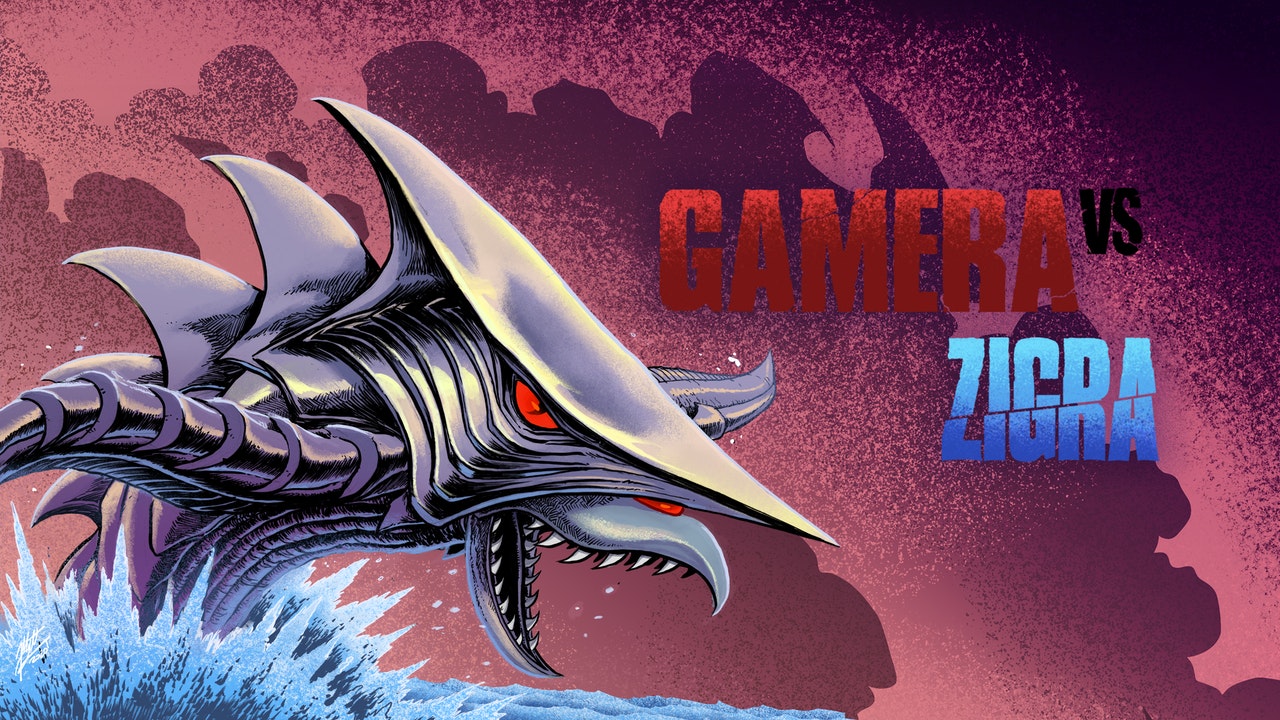
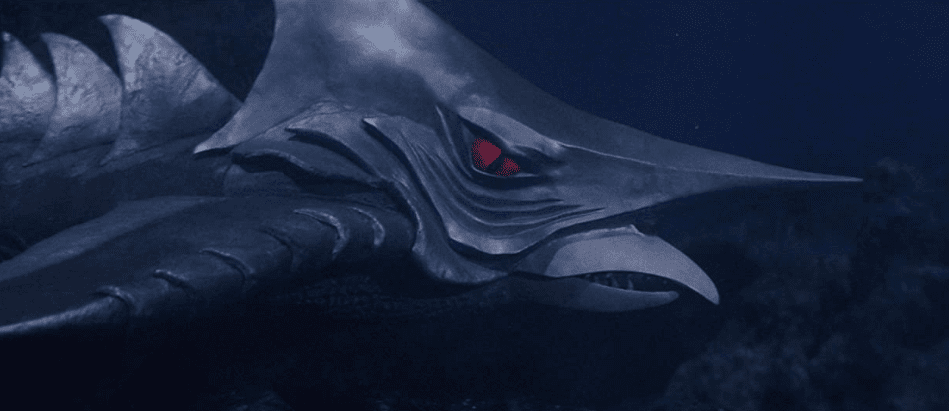
Zigra himself has a pretty interesting design, taking the form of a giant goblin shark. The suit looks pretty good, both on land and in the water, where he and Gamera fight. Some of the best moments for the monster are definitely when he’s on land, where he walks around on his tail, giving the creature an interesting look compared to a lot of other Kaiju. There’s one scene in particular where the shark design is utilised well as Zigra slices a ship in half; one of the few stand out parts of the piece.

Sadly, due to the relatively low budget of the film, neither Gamera nor Zigra get to really show off their stuff, and most of the fights happen either underwater or in sparsely populated areas. The large scale city destruction that has become a staple of the genre is missing, and its absence is definitely felt. But it’s not all bad. There are a few interesting moments, and a few fairly ridiculous ones too. At one point Gamera even plays part of his theme on Zigra’s fins whilst the monster is knocked down. It’s a bit too ridiculous, but you can’t help but be won over by it.

Whilst Gamera vs. Zigra isn’t technically the final film in the Showa era for Gamera, it’s the last entry in the original Gamera series, and is a poor note to leave on. The film was so unsuccessful that it didn’t reach the US until 1987 –  sixteen years later!


Buy Amy A Coffee

Go to Amy's Blog

Tuesday, 27 July 2021

Plurality – Film Review


Originally published on Set The Tape


A series of child kidnappings and murders has the people of Taiwan on edge. Someone is stealing children off the street, children with birth defects and disabilities, and killing them in horrific ways. When the latest victim of this killer is the young son of a congressmen, a daring new plan to catch them is put into place.

However, things take a turn when a bus with several key witnesses and suspects crashes, killing everyone on board. A scientist working on an advanced new technique manages to scan the brain patterns of the people on the bus and loads their minds into the body of a coma patient in a vegetative state. Now the police are able to question the suspects as they take control of the new body they find themselves in.

Whilst most of the minds are uncooperative, one of the suspects seems to be able to see flashes of memories from the others, and believes that he’s onto the trail of the killer. Making a deal with the detectives, to get the body to himself as well as getting the chance to see his daughter, he agrees to help with the case. But with the killer inside the same body, and making things difficult for everyone, it’s not going to be easy finding the answers that everyone needs.


Plurality is a film with a pretty bold premise, and one that wasn’t particularly clear to begin with. We see the police interrogating several people, before the surprise revelation that they’re in the same body. This shock moment comes only a few minutes into the movie, and sets out early that this is going to be a film that plays with expectations.

I’ve seen the film being described as Taiwan’s version of Split, but this seems to be a very surface level comparison. Whilst yes, there are multiple people inside one body, and one of them is a killer, this film does some stuff very differently. This isn’t using the real world issue of dissociative identity disorder (previously called multiple personality disorder), but invents a reasoning for things that sits squarely in the bounds of science fiction. These aren’t different personalities, but distinct people, all of whom led separate lives in their own bodies before their death. Not only does this open up the story and the investigation into the child killings, but is also avoids an exploitative depiction of a very serious mental health condition.

Tony Yang plays Case 193, the body into which the different minds are loaded. Yang does a very good job at portraying these different people, who we do occasionally see depicted by other actors. There are scenes where he switches from one person to another, sometimes multiple times, and after a while it becomes pretty clear which person he is even before he opens his mouth. Yes, some of the mannerisms and actions are exaggerated for effect, but it does mean that with a slight tilt of the head or a shift in movement we know that Yang is suddenly a different person.


The other leads, Detective Wang (Frederick Lee) and Dr Shen (Sandrine Pinna), who play the grizzled detective and sympathetic scientist respectively, are enjoyable to watch too. Okay, both of them make some rather silly decisions at times in order to move the plot along in a certain direction, decisions that mean you wouldn’t really trust either with responsibilities like this after this movie, but they get some great scenes between the two of them that really give them a chance to show off their acting abilities.

Some of the best moments though would have to be the ones that take place inside the shared mind of Case 193, where the rooms and hallways of the institute take on a sinister turn. The moody lighting and odd effects that get used during these moments are pretty simple, but thanks to how different they are to the rest of the film you’re never at doubt that you’re inside this strange mindscape where anything can happen. These scenes tend to be some of the creepier parts of the film, especially when the killer begins stalking the other personalities, coming out of the darkness to eliminate them.

Plurality is, on the whole, a lot of fun. It has some interesting ideas and a narrative that’s got more than a few twists and turns that’ll keep you wondering and trying to figure out answers. Add onto this a cast of really good actors and some short but intense action sequences and you’ve got a film that’s well worth a watch.


Buy Amy A Coffee

Go to Amy's Blog

Monday, 26 July 2021

Star Wars Adventures: Tales of Villainy #6 – Comic Review


Originally published on Set The Tape


The latest issue of Star Wars Adventures: Tales of Villainy picks up where the last issue left off, with Padme Amidala and Anakin Skywalker trapped in a theatre that’s been taken over by criminals during a swanky party; and any illusion that Katie Cook wasn’t just writing a Star Wars version of Die Hard goes out the window as the first lines of the entire issue are near quoting the movie.

Padme muttering to herself “Come back to Naboo early, Senator, we’ll get together for the festival of light, have some canapes” as she sneaks around the building might be one of the best parts of her story, though I think she should have been doing it whilst wearing a vest and crawling through an air vent just to get the full experience.

The rest of this story sees Padme finally finding Anakin, and the two of them trying to come up with a plan to stop the hostage takers, as the lead criminal tries to convince Tomarian to hand over his stash of Beskar by blowing up key parts of the building. The resolution comes pretty quickly, with Anakin and Padme doing very little to actually stop the villains. A few quick swings of the lightsaber and a few well places blaster shots ends the entire thing without much fanfare.

The second story in the issue is written by Daniel Jose Older, who writes the Star Wars: High Republic Adventures series, and actually takes readers back to a time just before that series began. We get some key insight into the inner workings of the villainous Nihil, and if anything this issue raises more questions for the main book to answer.

We go on board the Gaze Electric, the huge flagship for the Nihil fleet under the command of The Eye. It appears that the Nihil have a Hyperspace Savant named Mari San Tekka prisoner, who they’re using to predict the emergence of debris from the Great Disaster from hyperspace. Mari San Tekka predicts a debris emerging in the Trymant system, and as such the Nihil change their plans and head to Trymant 4, the planet where we meet our main characters in the very first issue of Star Wars: The High Republic Adventures.

Whilst the main bulk of this story focuses on a handful of the Nihil racing each other through the expanse of the Gaze Electric in order to board their Spider ship in time to head to Trymant 4 (a ship we see a lot of in the other title), it’s the small pieces of background information that really make the story interesting. We get to see some of the inner workings of the Nihil, and get another allusion to them searching for something specific. I’m interested for this to get expanded upon more in the other title, and to find out more about Mira San Tekka, who I’m assuming has to be related to Lor San Tekka from The Force Awakens in some way.

The first story in this issue was a fairly by-the-book affair, one that never really excited too much, and didn’t really showcase the characters of Anakin or Padme too much. On the other hand, the second story had a lot of interesting elements to it, ones that have made me more intrigued for answers in Star Wars: The High Republic Adventures.


Buy Amy A Coffee

Go to Amy's Blog

Sunday, 25 July 2021

Pokemon 3: The Movie – Spell of the Unown – Throwback 20


Originally published on Set The Tape


After the massive success of Pokemon: The First Movie, and the ever increasing popularity of the franchise overall, Toho continued to produce more Pokemon films, though these would see limited release outside of Japanese theatres. Pokemon 3: The Movie – Spell of the Unown, was the last Pokemon movie to get a theatrical release outside of Japan until Detective Pikachu, but also received a hugely popular theatre release in Japan, coming in third that year to The Green Mile and Mission: Impossible 2, but only came to the UK via video a year later.

The film is set during the events of the third season of Pokemon: The Johto Journey’s, which focuses on the monsters and region from the second generation of games. The story sees series lead Ash (Veronica Taylor), Misty (Rachael Ellis), and Brock (Eric Stuart) travel to the town of Greenfield, where scientist Professor Spencer Hale has created a device to study the elusive Pokemon Unown.


After discovering a series of ruins connected to the Unown, Professor Hale is sucked into a portal to their realm, which leaves his young daughter Molly alone. Searching for clues to her father’s whereabouts Molly accidentally summons the Unown, who use their powers to make her wishes come true, transforming her home into a giant crystal palace, and summoning the legendary Pokemon Entei to become her companion and protector. Investigating into the Professor’s disappearance, and the arrival of Entei, Ash and his friends end up being sucked into a series of illusions and warped versions of reality as the Unown and Entei try to protect Molly from outside interference.

Pokemon 3: The Movie- Spell of the Unown is definitely one of the strangest entries in the Pokemon movie series; a franchise that’s always been a little odd. Much of the marketing for the film was based around the inclusion of Entei, one of the three legendary beasts from the second generation of games, but when it comes to actually watching the film viewers get the odd twist that this creature isn’t really Entei, and that it, along with most of what we see happen in the film, are all illusions and constructs created by the Unown. Because of this the film has a very disjointed and dream-like quality to it; though it still proved to be hugely popular with fans, who actually praised it for having a more complex plot than the previous two films.


The film also came with an animated short, that aired before the movie, called Pikachu & Pichu, which saw the series’ mascot being left alone in the big city whilst Ash and his friends go off to organise a surprise. Pikachu, and the other Pokemon, meet the Pichu Brothers, a pair of Pichu, and end up getting into a series of misadventures across the city, before ending up back at their hotel in time for a surprise party Ash and the others arranged for them. This short proved popular amongst the fans, and the Pichu Brothers would make other feature film appearances further down the line, as well as getting their own mini-series, Pichu Bros. in Party Panic, on the Pokemon Channel; which was only viewable via the Nintendo GameCube.

Whilst only hardcore fans of the franchise would continue on to watch future Pokemon film releases Pokemon 3: The Movie – Spell of the Unown proved to be the final time the feature films would get much notice outside of Japan until the release of the live action Detective Pikachu, and as such has stuck around in the memories of many fans as the last time they got to see Pokemon in the cinema.


Buy Amy A Coffee

Go to Amy's Blog

Saturday, 24 July 2021

Son – Film Review


Originally published on Set The Tape


The new horror film Son keeps viewers on their toes as we watch a young mother fighting to be believed after her son falls ill with a mysterious sickness, in the latest film from writer/director Ivan Kavanagh.

Son opens in the past, showing a young woman fleeing into the night before giving birth in the seat of her car, repeating to herself ‘I don’t want it’ over and over again. After this the action jumps forwards several years as we see Laura (Andi Matichak) now living a peaceful life with her son David (Luke David Blumm). When Laura hears strange noises coming from her son’s room one night she investigates to find a crowd of people in the room with him.

However, when the police arrive they find no evidence of anyone having been in the room other than her and David, and the only person who seems to believe his is one lone detective, Paul (Emile Hirsch). Not long after the incident David falls violently ill, throwing up huge quantities of blood, becoming covered in bruises and open wounds, and falling into a coma. The doctors are unable to explain any of it, but Laura is convinced that she knows what’s happening. She reveals to Paul that she ran away from a cult years ago, and thinks that they’ve come for her son. Now Laura is determined to get away with David before the cult return to finish what they started with him.


Son has a pretty interesting concept behind it, particularly because for much of the film we’re being kept guessing as to what’s really happening. There are certain things that we cannot deny, such as David falling ill with a mystery sickness, and the bodies that begin to stack up across the course of the story, but everything else is left something of a mystery. We get to go along with Laura and see what she sees, this cult stalking them, and possible connections to demonic entities, but, we’re also presented with the possibility that this is all a delusion in her mind, and that we’re seeing only what she believes is real and not what is actually real.

This heightens the tension of the movie, as you’re left wondering if anything you’ve seen is real or not. Some may argue that it takes some of the fear factor away, that there might not be an evil cult hunting this mother and her son, but if anything I think it keeps you more on edge as you begin to question if the hero of the film might actually be the villain; especially when she begins to perform some morally questionable actions to help her son.


You get the sense throughout Son that it’s been in part inspired by some of the classic demon child films in horror, such as The Omen and Rosemary’s Baby, though instead of focusing on the horror of having a child being host to dark forces it instead makes the unconditional love that a mother has for her child the main theme. And Andi Matichak is superb at this, and gives an incredibly strong performance. She manages to walk the fine line between fierce strength and crippling terror, making her incredibly believable as a mother desperately trying to hold her family together.

Luke David Blumm also gives an incredibly strong performance, one that’s impressive for such a young actor, especially because of some of the physical demands of the role as he’s writhing and contorting during scenes where the sickness is tearing him apart inside. These moments are augmented by both make-up effects and frankly disgusting sounds, but his performance very much sells these moments too.

Son is a violent, gory, film filled with twists and turns that will keep you interested and engaged, and will leave you feeling pretty satisfied come the ending. Yes, much of it is a mystery throughout, but once those final credits roll I think you’ll be left with something of a grin on your face as everything clicks into place. Whilst it does feel more like a psychological drama than overt horror at times, it’s still a thoroughly entertaining movie.


Buy Amy A Coffee

Go to Amy's Blog

Friday, 23 July 2021

The Follower by Nicholas Bowling - Book Review


'When her twin brother goes missing in Northern California, Vivian Owens follows his trail to the town of Mount Hookey, home to the followers of Telos: a mountain-worshipping cult that offers spiritual fulfilment to those who seek it.

'While trying to navigate the town’s bizarre inhabitants and the seductive preaching of the initiates of Telos, Vivian will have to confront questions about herself, her family, and everything she thinks she knows about the world. She quickly realises that her search is about far more than her missing brother – it is a quest for the secret of happiness itself.

'To that end, there is only one question she needs to answer: what is really at the top of Mount Hookey?'

The Follower is billed as Welcome to Night Vale meets Twin Peaks, a bizarre tale of a young woman from the UK who travels to the strange little town of Mount Hookey in California to try and find her missing twin brother, who joined one of the odd cults that seem to run the town.

The story follows Vivian, a woman in her early twenties who's travelled to the other side of the world searching for her flaky twin, Jesse. The family had recently faced some personal tragedy when their father died, and as their mother seems to barely have a grasp on reality it's up to Vivian to go searching when her brother disappears after joining the followers of Telos.

Things begin with Vivian arriving in Mount Hookey after being assaulted in a nearby town, where she was knocked unconscious and left with to black eyes. Left without any money, credit cards, her phone, or her passport Vivian has very few options open to her, but chooses to keep on searching for her brother. She discovers that rather than there being one unified Telos cult in the town there are several different factions, who are often at odds with each other, and that Jesse could have been connected to any of them.

Trying to find answers, Vivian gets the cryptic clue that her brother 'went up the mountain', searching for the crystal city of Telos. Travelling up after him she ends up receiving another head injury, and in her muddled haze sees a strange glowing figure. When she manages to return to town she learns that there might be an even bigger mystery going on when she's approached by another family searching for their own missing relative.

The Follower sounded like a book that should have been perfect for me. The creepy and weird franchises it was being compared to are the kind of thing that I really like; and I've always found that a good cult story tends to be a lot of fun for writers to come up with some seriously odd ideas. But despite being compared to some very weird stories The Follower felt pretty mundane for the most part. Perhaps this was my own fault, that I was hoping for something really weird where you're left wondering what the hell it is you've just read; but the book read much more like your standard missing person thriller for the majority of it.

Most of the book focuses on Vivian as she searches around the town, speaking to various members of the Telosians, occasionally chatting to people who're nothing to do with the religion. She hangs up missing posters, and generally looks down at the inhabitants of Mount Hookey as she judges them for their odd beliefs. For the most part this seems to be Vivian's only character trait, and despite following her for the entirety of the narrative I felt that I never really got to know her. There was little to her character other than wanting to find her brother, and we never got to know anything about her; about her personal life, friends, partners, hopes for the future. If anything she seemed like an empty vessel just moving the plot forwards.

The book is written from the third person, and as such we rarely got a glimpse into Vivian's thought and feelings. This lead to me feeling pretty detached from her; which didn't help when she made what I thought were some odd decisions. For example, she begins the book having just been mugged and has none of her money or important personal items with her. She literally has the clothes on her back and a stack of fliers. Instead of getting in contact with her bank of her embassy she just carries on; even though she has no money for food. It's also odd that she's putting up posters with her contact detail on it when her phone's been stolen.

Perhaps some of this is down to the number of head injuries she sustains over the course of the book, being hit in the head or knocked out at least half a dozen times over just a few days. Once of twice would have been one thing, but by the end of the book it was becoming something of a running gag. Sadly, it also leads to what I felt was a pretty disappointing moment when all seems lost, when she's fighting to save her brother and she gets knocked out, only to wake up being told not to worry about it as other people sorted it all out no bother. I ended up feeling a little disappointed that the tension was undermined so quickly afterwards, and Vivian made to seem to helpless.

Like I mentioned earlier, the book was billed on being weird, but never really lived up to this. There are moments as the story progresses when it looks like there is going to be something unusual happening, and there's definitely something otherworldly or explainable that takes place. But the book never tries to explain this, and it becomes a background element that seems unimportant after a short while, despite it being the thing that instigated the entire plot. The characters and the author seem happy enough to walk away from the mystery, from the most exciting part of the narrative, without any real worry; and this led to me feeling incredibly disappointed by the ending.

I'm sorry that this isn't my usual kind of review, that I'm not singing the praises of the book like I normally like to, but I just couldn't connect to the story or the characters. I'll admit that this is probably a me thing, and that other people could find a lot to like in this book. It has some interesting ideas, and whilst the book didn't set my world on fire others might really like it. So if there is anything in what I've said about this book that you think sounds a little interesting, or that you might like you should definitely give it a read to see for yourself. This is, after all, just my opinion, and this could be a book that you absolutely adore.


Buy Amy A Coffee

Go to Amy's Blog