Wednesday, 20 May 2020

Space Precinct Episode 01 'Protect and Survive' - TV Review


Space Precinct, for those not in the know, was a British science fiction police procedural television series produced from 1994 to 1995, and was created by Gerry Anderson. Anderson was responsible for a number of sucessful television series, including Thunderbirds, Space: 1999, and Captain Scarlet and the Mysterons. The series followed a human police officer, Patrick Brogan, who has transferred from New York City to Demeter City, a police precinct on the distant planet of Altor.

The first episode drops viewers straight into the action, as Brogan and his partner, Jack Haldane, are on a stakeout, waiting for an alien they suspect is smuggling illegal Xyronite immigrants. When the smuggler is killed in the ensuing encounter, Brogan ends up having to rely on his informant, Slick Ostrasky, to help find the man in charge. However, when Slick is killed Brogan and Haldane get put on protection detail so that the only witness to the killing, a Melazoid businessman called Armand Loyster, can identify the murderer.

I can vaguely remember the Space Precinct series when it first aired in the UK in the mid 90's, and had a few of the action figures. However, my recollections of the series are only really vague memories, and as such I wasn't sure what to really expect sitting down to watch the show again. Whilst there were times that the episode felt a little cheesey, with some effects and sets that looked thrown together, and there was a little humour thrown in too, I was shocked at how grim and gritty it was at times too.


The episode opens with a stakeout that goes wrong, leading to Brogan getting into a gunfight with an alien inside a slaughterhouse. Gutted alien carcasses hang from the ceiling, and the almost demonic looking alien that he's chasing tries to kill him. Brogan ends up having to shoot the alien in order to protect himself, and just murders the guy.

This darker tone ended up carrying across much of the episode. When Slick Ostrasky, played by Pink Panther's Burt Kwouk, is killed he's tied into a car that is made to crash, resulting in a massive explosion; all whilst he's begging the murderer to let him go.

The episode seemed to be made the same way any adult police procedural show would be, albeit with a futuristic layer pasted on top. Instead of regular beat cops you've got exotic aliens. Instead of car chases people are in flying cars. But at its heart this is a story about an evil man that will murder to get away with his crimes, and police officers who want to bring him to justice.

I remember the show being on television in the early evening, almost as if it were designed for a family audience in the way that Star Trek was. I even think the BBC showed it around the same time as Star Trek. But after watching it now, with fresh eyes, I'm not so sure if it was designed for a family audience. If you took out the fantastical and it was a modern, real world setting this would not be a show that you'd want your kids to seem. A number of people die quite brutally, one of whom gets shot in front of a video monitor so that Brogans kids see it.


Space Precinct has genuinely surprised me by the tone of the content. I was expecting something a bit lighter, and more adventure focused like Anderson's other works. Instead there's a show that whilst not the most visually impressive things around has some very adult and engaging content at its core. The story in this episode would work just as well in a modern day setting, and I think that's why the episode held up so well. I'm excited to see if the rest of the series continues like this, or if it leans more into the science fiction side of things. If it does, I think it may lead to some weaker moments, as the police procedural aspect worked so well.

Whilst some of the effects, such as laser beams and an alien's frog-like tongue looked very dated the model work on display was absolutely brilliant. By this point Anderson had been producing shows made using models for decades, and that experience shows. The flying car chases look great, and the model ships break through terrain in spectacular fashion. The explosion that kills Slick is on screen for only a few seconds, but you can see where they spent a lot of time, effort, and money building the models before the blow them to pieces.

'Protect and Survive' is an interesting first step into the Space Precinct universe. It seems to not quite know what kind of tone it wants to have, but it certainly manages to impress.


Tuesday, 19 May 2020

Hagazussa: A Heathen's Curse - Film Review and Analysis


This article is the expanded version of my review that appeared on Set The Tape


Hagazussa: A Heathen's Curse was the directorial debut of Lucas Feigelfield, who also wrote the film. Initially released in 2018 in Germany, it's now receiving a wider home release.

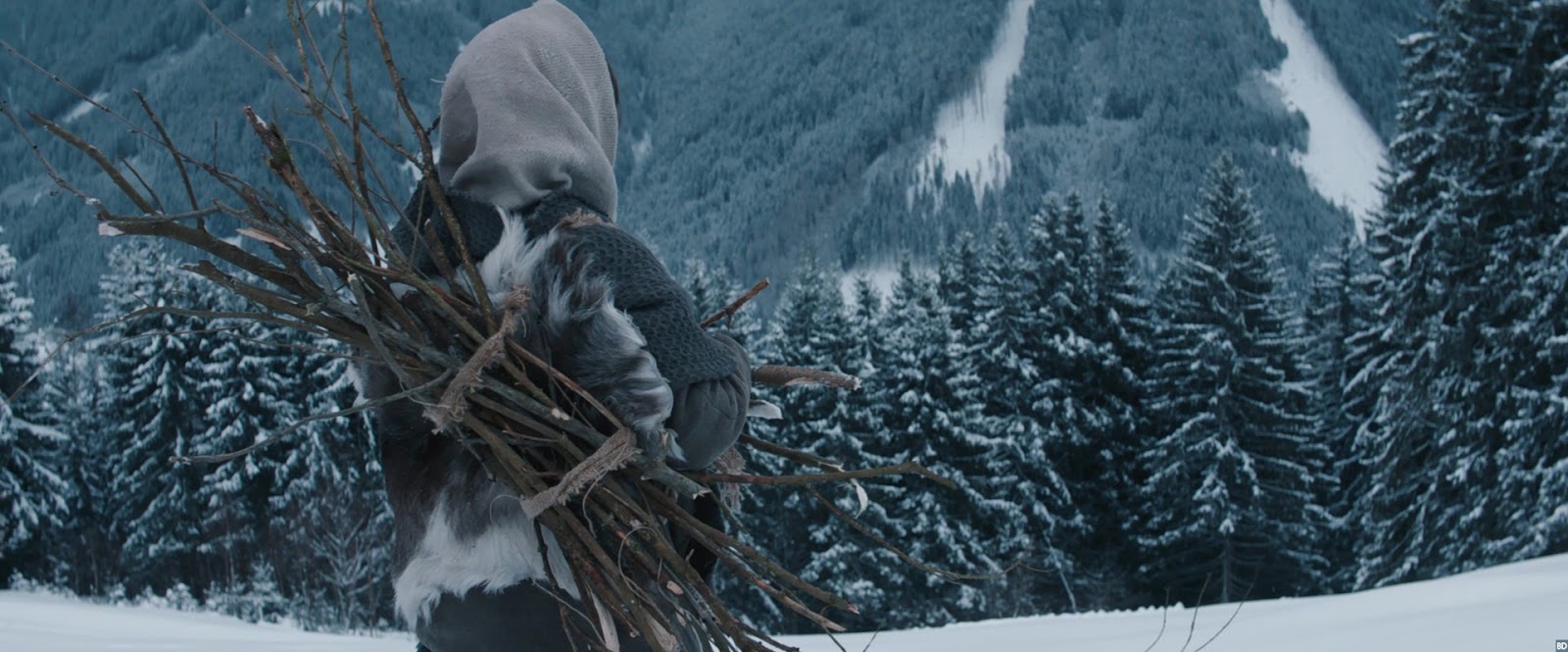
Hagazussa follows the life of Albrun, a girl living in a remote cabin with her mother. The two of them are outcasts from the local community, and shunned as witches. When Albrun's mother gets sick she eventually passes away, leaving the child alone to fend for herself. The film then jumps forward to Albrun as a young woman, with a baby of her own. Still living in her mothers remote cabin, she begins to experience increasingly strange and disturbing events.

In all honesty, I don't really know how to start talking about Hagazussa. I'd heard a little about the film before I had the chance to see it, and one of those things was that a lot of people felt it was similar in many regards to The Witch by Robert Egger. I can see why this parallel is made; both films centre on people in very isolated, wooded locations in times past who are struggling with supposed supernatural forces. Both films are slow burns that rely as much on lingering camera shots and the sounds to build tension as anything else in the story. They're also both open to interpretation as to what actually happens, whether events are influenced by the paranormal, or if they're stories of young women abused to breaking point.

Whilst I enjoyed The Witch and found it to be an interesting film, it didn't engage me or disturb me in the same way that Hagazussa did. I say engage, but that's not really accurate. I found it a little hard to stay with the film at times. The story is very slow, and one could argue that a good portion of the movie could be cut down and tightened to give it a better pace, but then I think it would lose a lot of what makes it a creepy experience. The fact that I had to work to stay in the movie, that I had to make myself stay invested did, in retrospect, add something to the experience.


Hagazussa is a story that you don't want to experience. It's designed to be off putting and disturbing. You want to turn it off and leave it alone because it gets under your skin. And whilst you have the power to do that, you can just stop, Albrun can't run away from what's happening to her. She's stuck in these experiences, and you feel like you have to stay there with her. The film made me want to run away from it, yet I also wanted to see what would happen to its lead next, a kind of morbid curiosity. I'm not even sure if this could be down to feeling sorry for the character and wanting to see it through to the end to see if things went well for her, because the film never gave the sense that there would be a happy ending.

The very first scenes in the film show Albrun's childhood, her isolated upbringing with her mother. These scenes are probably the most easily understood and interpreted part of the film, as events seem to play out how they appear. We learn through these scenes that the two women are pretty much hated by others in the local community, and we see the impact this has on Albrun. After her mother's death things become worse for Albrun, and could be considered one of the leading events in her awful adulthood.

When we next see Albrun as an adult she's still at her mothers cabin, having carried on alone from her childhood. She doesn't interact well with the people in town, and is openly mocked and ridiculed by the local children. You begin to get a sense that Albrun has never really learned to talk to people, and that she's as sheltered and naive as when she herself was a child. You begin to question how she has a child because of this, how she could have had a romantic relationship if she's so hated by those around her and appears incapable of even talking to people. A possible explanation for this is given by one of the local women, who makes a comment about heathens who attack lone women in the mountains, raping them and making them pregnant. A possible rape would add to Albrun's difficulties with people, and explain why she refuses to answer questions about her child's father.

Over the course of the film we see Albrun try to make strives towards making an actual friendship with one of the local women, Swinda, but this attempt ends in a brutal scene where Swinda holds Albrun down to be raped by one of the local men. Following this moment Albrun finds that her goats have all been stolen, save one who's left as a slaughtered warning. Enraged by these events Albrun takes revenge on the town by throwing a dead rat in their water supply, and peeing in it; which results in a disease sweeping through them.

After seeing that she's caused the deaths of innocents, Albrun goes deep into the woods and eats a mushroom that sends her on a hallucinogenic trip that results in her drowning her baby. When she comes out of her trip she sees what she has done puts her baby's body into her cooking pot, where she stews and eventually eats it.

This is without a doubt one of the most disturbing and affecting moments of the film. The events themselves are enough to make you feel uncomfortable, but the long lingering takes on Albrun as she's overwhelmed by her actions are awful enough, but the shots of what she does afterwards are even worse. It could have been shot in a way that implied what she did, or even begin to show the audience before cutting away, but instead the camera lingers as she brings the meat to her mouth and begins to eat her own daughter. Following this, she leaves her home and waits for the dawn on top the mountain, where the sunlight causes her to burst into flames.

The reason that I've gone into the story so deeply here, that I've spoken openly about spoilers, is because you need to know what happens in order for me to talk about how open to interpretation the events are.

Taken literally, Albrun poisoned the town with her waste and a dead rat, causing disease, before she went on a trip and accidentally killed her baby. Then she tries to dispose of the evidence by eating her. This makes some kind of sense, and is probably what some people would take from the film, but fails to explain the final scenes of her bursting into flames.


Another possibility is that Albrun actually used magic to curse the town. This comes more into play thanks to what happens afterwards, as the consumption of hallucinogenic mushrooms and eating of babies are heavily connected to witchcraft lore. Mushrooms such as the redcap Fly Agaric appear in many old drawings and pictures of witches, and some believed their hallucinogenic properties were used to create experiences such as flying, or changing into other creatures. The presence of some hallucinogens are also used to explain why some areas broke out into witch hysteria, such as the possibility of ergot being baked into bread being behind the Salem witch trials. The eating of babies was also said to be one of their practices, and baby fat was said to be used in potions and ointments.

By eating the mushrooms and the cooking and devouring of her own baby Albrun is giving in to her witch heritage, performing the practices that her mother taught her as a child. This could explain why she bursts into flames at the end. Perhaps it's because she is now a witch and the suns light physically harms her, or it could be symbolic of her own self and her old life burning away as she embraces who she really is and becomes a witch.

There's also a possibility that Albrun is being haunted by the spirit of her mother, who she keeps hearing during the course of the film, before finally seeing in the climactic moments. If her mother was a witch, or even if not and the supernatural exists within this world there's a possibility that this spirit has been with her for her years alone on the mountain, slowly poisoning her daughters mind and twisting her into something else. Albrun's mother was left to die by the village, after years of being tormented by them, so why not use her daughter to get revenge against them from beyond the grave.

Another, and very real interpretation, and one that immediately jumped out at me, was that Albrun was just a women broken by years of loneliness and abuse, that all of the awful things she's done have slowly worn her down and led to the awful events that she experiences. She had to grow up isolated with her mother, who the locals scorned and hated. She was sexually assaulted by her sick mother, who then died and left her to grow up alone. She is raped at least once as we see in the film, but could have been raped before this. She is betrayed by the one friend she thinks she has. She causes the deaths of innocent people in a moment of rage. Her livelihood is stolen away from her. She accidentally kills her own child. All of this would be more than enough to cause a psychological break within the poor woman, and her burning on the mountain top could easily represent the destruction of her sanity.

I've also seen the possibility floated online that her baby may already be dead before the scene where Albrun appears to drown her, and that her discovering the body is really her coming to the realisation that her daughter was already long dead. This does fit too, as there are a few times where scenes make a different kind of sense see through this lens, such as her daughter refusing to drink from her breast. It could also explain why Albrun seems to leave her daughter alone for long stretches, and why she doesn't let anyone see her. Her child even seems smaller and more decomposed than she should when Albrun discovers her body, hinting that she's been dead for a long time.

I honestly don't know which of these ideas I like the most, or even which one fits with the film I saw. I don't know if there were dark forces at work. I don't know if Albrun was a witch, or just a woman with a broken mind. I'm not even sure if everything that I saw was real or figments of her mind. I find myself questioning so much of the film beyond just the ending. Part of me wants to go back and watch it again, to try and see if I can make a decision or find more hints that could help me reach a conclusion, but I also feel like I don't ever want to watch the film again.


The events depicted in Hagasuzza are disturbing and unsettling. The director uses shots and music that adds to those feelings and compounds them. The result is one of the most unsettling pieces of film I think I've ever seen.

I don't think I could watch the film again, and I'm not even sure if I could recommend it to others; and if I did it would only be because I know this is the kind of film that they would like. It's not for everyone, and probably not even for every horror fan, but it is a film worth seeing if you can stand it.

I was originally thinking this would be a film I'd probably give a three out of five. It was good, but I struggled with it, and wasn't sure how to take it. But then I started to think about the film more, and realised that just in talking about those feelings and thoughts I'd written more than two thousand words on it. Surely that means the film has had an impact on me. It might not have been an experience that I loved, or one that I'll ever want to have again, but it's one that's had an effect. And isn't that the real goal of horror, to get under your skin, to make you feel awful? If so, then Hagazussa has more than done what it's set out to do, and is a film I'm sure I'll think about for a long while to come.


Buy Amy A Coffee

Go to Amy's Blog

Monday, 18 May 2020

Associates of Sherlock Holmes - Book Review


'A brand new Sherlock Holmes anthology to sit alongside George Mann's successful Encounters of Sherlock Holmes anthologies, and Titan's Further Adventures and New Adventures series.

'A brand-new collection of Sherlock Holmes stories from a variety of exciting voices in modern horror and steampunk, edited by respected anthologist George Mann. Stories are told from the point of view of famous associates of the great detective, including Lestrade, Mrs Hudson, Sherlock himself, Irene Adler, Langdale Pike, and of course, Professor Moriarty...'

Associates of Sherlock Holmes is a book designed for fans of Sherlock Holmes fiction. I now that that could be said about any new Sherlock Holmes book, but this book really appeals to those who've read the original works, with each of the stories being presented here being about, or told by, characters who have appeared in the stories before. Some of these are better known characters such as Inspector Lestrade or Mycroft Holmes, but they also include those smaller one-off characters like Violet Hunter. Thankfully, each of the stories comes with a small introduction from the individual authors, so that readers get a little understanding about the character being featured, and why they've been picked.

George Mann brings together a number of well known Sherlock Holmes writers together to tell a variety of stories, some that vary quite a bit in tone and genre. There are stories that feel like they'd fit easily into the original works, whilst others take on a much darker, even horror feel.

'Heavy Game of the Pacific Northwest' by Tim Pratt tells one of the more unusual stories in the collection, following Professor Moriarty's right hand man, Colonel Sebastian Moran, all the way to the United States. Set after the death of Moriarty, and before the return of Holmes, Moran has travelled to the Pacific Northwest at the invitation of a friend in order to hunt. An avid hunter, and a man known for going after big game, Moran is somewhat surprised to learn that his firend has summoned him to help track down and kill a mysterious ape-man said to inhabit the forests of Washington State.

The story certainly plays with your expectations, giving the reader an explanation for the mysterious ape-man; before pulling the rug out and leaving a lingering question of whether or not Moran does in fact encounter a Bigfoot. The story plays out well, slowly teasing the reader in as Moran enters the dense woodland, and has a very creepy air as he spends his time in the forests as both the hunter and the hunted.

'A Dormitory Haunting' by Jaine Fenn is a story that catches up with Violet Hunter, one of the main characters from the Conan Doyle story The Adventure of the Copper Beeches. Having only recently watched the Jeremy Brett adaptation of this particular story days before reading this book it was a pleasant surprise to see Violet return. Despite being something of a pawn in that story, being used by a vile man in his plots, she was a very clever young woman. She had the knowledge to seek out Sherlock's help even before realising how bad things were, and was quite active in that initial story at finding the truth.

Here we see her as the head of a private school in Walsall, something that Holmes mentions in the original story. We see a slightly older and more confident Violet, one who when confronted with a mystery makes a decision to get to the bottom of it and protect the girls under her care. We get to see how her experiences in the original story have shaped her, and made her a great amateur detective in her own rights.

Cavan Scott's 'Nor Hell A Fury' features one of the most memorable and prominent female characters from the world of Holmes, Irene Adler. Often celebrated as a woman who was able to best Sherlock Holmes, and earning his respect in doing so, we get to see what happened next for her in this story set in France.

One of the most interesting things that Scott does here, however, is allude to the idea that Watson has had to alter some of his stories for publication so as not to embarrass certain public figures. In this case, it appears that Irene Adler is not even her real name, and was a name that Watson gave her in the story, and that it was not the King of Bohemia who was involved in that particular scandal but a member of the Russian royals. It makes complete sense that Watson would need to alter certain facts and events in order for them to be published, but it's an idea that doesn't often come up in Holmes stories. It was also enjoyable to see that whilst Irene didn't win like she wanted here, she was still smart enough to end up with an insurance measure at the end, proving that even if she doesn't win she's smart enough not to lose.

'The Vanishing Snake' by Jefferey Thomas tackles one of the better known Sherlock Holmes stories, The Speckled Band, and takes the opportunity to correct a few things that were factually incorrect with the original story. Thomas points out that there's no such snake as a Swamp Adder, and that snakes don't drink milk, but instead of using these inconsistencies to damage the original story, uses them to take it in a new and interesting direction. The explanation for these mistakes skirts on the supernatural, yet works incredibly well, and offers readers an unusual alternative theory.

My favourite story in the collection, however, would have to be 'peeler' by Nick Kyme. The story centres on Holmes' best known ally, other than Watson of course, Inspector Lestrade. In this story Lestrade begins to investigate a number of attacks across London, where the victims are left killed and large portions of their skin removed.

The story has a very Jack The Ripper feel to it, and cashes in on the creepy horror of Victorian era London well. The plot advances at a pace quick enough to remain exciting throughout, yet also gives you time to slow down and see how the police investigate the kind of crimes that Sherlock and Watson ultimately get called in on. It's great to see how Lestrade teams up with the consulting detective from the opposite side, and how he feels about Holmes. The story is so well done that it's one that I could easily see expanded upon into a much bigger story, one that could easily be a book in itself.

These are just some of the stories on offer in the book, however, and there are a lot of others too. There are stories that feature Billy the Page, Shinwell Jones, Mycroft Holmes, Inspector Barnes, and many others. Each of the writers manages to take these small characters, some even having a single appearance in the original work, and manages to craft engaging and engrossing tales. The stories highlight how interesting and diverse the supporting cast were in Conan Doyle's original stories, and shows how great writers like those on offer here can take these characters and make them leads in their own tales.

Whether you're a fan who knows all of the original stories and can name all the side characters, or someone with only a passing knowledge of the Sherlock Holmes cannon, this book is sure to offer you something. Even if for some reason you don't enjoy every story (which I would be hard pressed to believe as they're all amazing) there will definitely be something here that will entertain.


Buy Amy A Coffee

Go to Amy's Blog

Wednesday, 13 May 2020

A Nightmare On Elm Street (2010) – 10 Years On


Originally published on Set The Tape

Horror films, and more specifically their villains, have the ability to become some of the most iconic things in not just film but pop culture in general. Even if they’ve never seen the films, most people would be able to identify Jason Vorhees or Leatherface because of their distinctive looks.

Even where there are different killers in each film, like Ghostface from the Scream movies, people know it’s the scream killer. The beauty of these iconic masks is that not only are they instantly recognisable, but that anyone can play that role, and quite often several actors and stunt performers will play these bad guys over the course of a franchise. The biggest exception to this for horror films has to be Freddy Krueger.

Freddy is as iconic as his mask-wearing brethren, with his green and red striped jumper, hat, razor glove, and burnt face. But it’s not just his clothing and appearance that makes him stand out, but the performance of Robert Englund. Englund played Krueger a staggering eight times across different films, and it’s the energy, mannerisms, and voice of Englund that helped to make Freddy an icon that came back time and time again.

Getting over this, and recapturing that magic, would prove to be the biggest hurdle for the 2010 remake of A Nightmare On Elm Street. The decision to remake the film came about in part thanks to the success of the Friday the 13th remake the year before, a film that was a critical and commercial success. Platinum Dunes, the production company that owned both franchises, thought that they could bring the same level of success to A Nightmare On Elm Street.


The new film looked good, with great cinematography from Jeff Cutter, the script was true to the spirit of the original yet managed to do enough of its own thing thanks to good writing from Wesley Strick and Eric Heisserer, and director Samuel Bayer executed a slick and entertaining film. Despite this, the remake is never given the amount of respect and love by Elm Street fans as the original film. Unfortunately, this is down to the performance of Jackie Earle Haley as Freddy.

Fresh off the success of playing Rorschach in the 2009 Watchmen adaptation, Haley was something of a hot commodity, with filmmakers wanting to get him into one of their projects as soon as possible. And that’s a fair thing: he’s a very good actor, and his performance as a deranged and unstable lunatic was probably the best thing from Watchmen,was so why not get him to play another deranged lunatic? It should have worked.

What seems to have happened, however, was that for whatever reason Haley was still playing Rorschach. His Freddy was slow, he hid in the shadows, and he grumble mumbled his way through most of his dialogue. Whilst not inherently bad creative decisions when you compare them to Englund, which moviegoers were always going to do, it comes across as a flat and dull version of the character. The energy and fun that Freddy adopted over the course of the franchise was gone. Instead we had a gloomy and nasty killer who didn’t actually seem to be having much fun in what he was doing.

Freddy was always a killer that loved killing. He revelled in not just the kill, but the hunt too. He liked that he was able to mess with his victims in their dreams, and would often perform elaborate torture and means of death in large part because he found it funny. Many of the films in the franchise could probably be classed as somewhat comedic at times because of this. Taking out these moments of dark comedy might sound like the right decision – after all, you’re making a horror. But it turns out that doing so leaves a film that feels like a pale imitation of the original, one that fails to please fans, and is often forgotten.


Buy Now On Amazon


Buy Amy A Coffee

Go to Amy's Blog
Monday, 11 May 2020

Trans Woman Helle Jae O'Regan Killed


Transgender woman Helle Jae O'Regan has been identified as the victim of a workplace rampage that claimed her life and injured two others in San Antonio on 6th May.

20-year-old Helle was employed at Diesel Barbershop in San Antonio, Texas, where the incident took place.

According to police statements and media reports, 42-year-old Damion Campbell entered the barbershop to book an appointment whilst staff were preparing the premises to re-open, but when asked to provide payment he left the store, before returning with weapons. He was seen in surveillance video holding both a knife and a gun, and threatened the three members of staff present.

Two of Helle's fellow employees were able to escape, one without injuries whilst the other received several stab wounds. According to the police, Campbell choked Helle unconscious before stabbing her to death. Police have said that they do not believe Helle's gender played a role in her death.

 Helle has been described as a proud trans woman, who embraced her identity. On the Trans Day of Visibility she posted to her Instagram account where she shared pictures of her transition. 'I wasn't going to post anything but it's #transdayofvisibility so I decided I will. I was looking at the pictures I used to take before I transitioned versus now and it made me realize I'm way happier than I used to be. I love myself now. Thank you to everyone who's ever supported me and to anyone who hasn't I hope you come around. I'm happy and proud to be myself.' The post said.


Management of Diesel Barbershop chose to release a statement on their Facebook page in order to provide members of the public with more information, and to correct some reports that had provided incorrect information on the incident.

The Diesel family is devasted over the loss of life and acts of violence committed against the employees of our Bandera Oaks location on May 6th. This senseless act of violence has shaken us to our core and is affecting us all in ways we could have never imagined. Thank you all for your kind words, thoughts, and prayers as we try to comprehend what just happened and move forward through the rough days ahead.
Because of this tragic event on May 6th, the re-opening of all of the Diesel Barbershops in San Antonio and New Braunfels is being temporarily delayed until Friday May 15th.
To help dispel the false reports from the various media outlets, here are the basic facts of the events of May 6th, 2020 as best as I can relay them. Out of respect and privacy for the families and employees involved in this horrible tragedy, I have intentionally chosen to not identify the 3 of them by name.
3 Diesel Barbershop employees were at Bandera Oaks the morning of May 6th answering phones to book appointments and deep cleaning the shop for our re-opening on May 8th. An individual came to the front door (which was locked) and attempted to enter. We unlocked and opened the door to let him know we were closed and getting the shop ready to reopen on Friday. The man then asked about making an appointment for when we reopen. As we would have likely done for any of our clients, we let the man in to the shop to book his appointment. We gathered the necessary information but when it came time to secure his appointment by placing a credit card on file, he said he needed to step outside to grab a form of payment. When the man stepped back into the shop, the staff realized that along with the backpack he was now carrying, he also had a handgun and a knife. Attempts were made to give the man whatever he wanted…cash, equipment, or whatever it took to get him out of the shop. The man made it clear that he wasn’t there for money. He then began asking the employees: “What have you done wrong? What have you done wrong? God sent me here to kill you because you have done something wrong! What have you done wrong?” over and over again while forcing them to the back of the shop. Details beyond this are sketchy at best. In the end, one employee managed to escape and call 911. One employee was stabbed 5 times in the back, but she also managed to escape. Tragically, one employee lost their life in this senseless act of violence. Even as I type it, I still cannot believe it. It’s a nightmare of the most epic proportions.
From the beginning, there has been a great deal of incorrect information reported in the media. For example:
1. Chief McManus stated publicly in an interview that we were open, and the man was receiving a service. This is patently false. We were not open for business nor doing illegal haircuts. We were cleaning the shop to prepare it to open on Friday May the 8th and the front door was locked. We let the man in because he said he said wanted to book an appointment for when we reopen.
2. There was not an altercation in front of the shop. Everything occurred inside the shop. The employees who ran out of the shop ran to Pei Wei and Monarch Dental to call 911. Neither business is involved in this tragedy beyond that.
Here is what I know to be true and what I know I need to focus on to help me and my Diesel family process this senseless tragedy. A man attempted to kill 3 of my amazing employees. 3 wonderful, kindhearted, give you the shirt off of their backs, loyal employees for no reason at all. None. In fact, detectives tell us this appears to be a completely random act of violence. And because of that random act of violence, one life has been ended and a family is forever changed, two employees will be forever scarred and changed by this, and the entire Diesel Family is reeling in shock. We’re all just numb now. Numb.
Make no mistake about it. This tragedy will forever be a part of who we are, but it will not define us, what we do and how we take care of our clients. I kindly and respectfully ask that you all rally around the staff at the Bandera Oaks location and that you throw all of the love and support you can to the families of the employees who were directly involved in this horrible horrible tragedy. They need you. We need you.
Thank you for your support and love all of these years. It means more to me and to my staff than you will ever know.
We will be back and we will get through this. One. Day. At. A. Time.

Emmett Schelling, the Executive Director of the Transgender Education Network of Texas (TENT) spoke out on the incident. 'We are saddened to hear of the news about Helle O’Regan’s death. Trans and non-binary Texans, unfortunately, lays claim to being the state with the highest number of reported murders of transgender people than any other state these past five years. The stigma that exists and is continued to be perpetuated from the highest held offices in our state only feeds into this. We mourn for Helle’s life being cut so prematurely, but take comfort in hearing how much joy she brought to those who knew, loved and accepted her fully as her authentic self.'

Tori Cooper, of the Human Rights Campaign posted on the organisation's website saying, 'The Human Rights Campaign is standing with Helle’s family and friends in mourning today. Her death further underscores the dire and urgent need to end violence and discrimination against transgender people - and especially against transgender women - now.'

One of Helle's friends, Luke Tyler, spoke to local news networks about Helle, saying 'Every time I saw her, she smiled. She’d do anything for you. She was a caring person. I never saw her in a bad mood. Being trans is so hard, and her life was hard, but she lived like it was the best day of her life every day.'


Buy Amy A Coffee

Go to Amy's Blog

Aliens: Phalanx by Scott Sigler - Book Review


'It's Medieval carnage meets Alien as a pre-industrial society fights against extinction brought about by a massive infestation of Xenomorphs.

'Ataegina was an isolated world of medieval castles, varied cultures, and conquests, vibrant until the demons rose and spread relentless destruction. Swarms of lethal creatures with black husks, murderous claws, barbed tails and dreaded "tooth-tongues" raged through the lowlands, killing ninety percent of the planet's population. Terrified survivors fled to hidden mountain keeps where they eke out a meager existence. When a trio of young warriors discovers a new weapon, they see a chance to end this curse. To save humanity, the trio must fight their way to the tunnels of Black Smoke Mountain--the lair of the mythical Demon Mother.'

Titan Books have been publishing some really good Alien books recently. They've provided adaptations of existing entries in the series such as Alien Isolation, tie-in's to the comics like Alien: Prototype, and completely new stories like Alien: Cold Forge. Every book has brought something new to the table, whether it be a new type of Xenomorph, or a new insight to an existing story. But I don't think any of the Alien books are as different, or as bold as Alien: Phalanx.

The thing that immediately sets this book apart from the others is the fact that it's not really a science fiction story. Other than the presence of the Xenomorph, this is a fantasy story. It's set on another world, a world where nations have risen and fallen, where humans have their own societies that trade with each other, plot against each other, and distrust each other based on the gods they worship or the way they treat their women.

Much of the story of Alien: Phalanx is such a human, personal story, set within a world we've never seen before that at times I sometimes forgot that this was actually an Alien story. And I want to make it clear, that's not a bad thing at all. I was never waiting for the creatures to turn up, never found myself sitting through scenes I found dull or variations of things we've seen before waiting for the action to happen. It was a change I didn't know I wanted, but loved so much.

Most Alien stories will show you a group of people living their lives, whether they're colonists, or people on a ship, who end up in a situation where a Xenomorph either arrives or escapes from some kind of lab. Then it's a desperate fight to survive and escape. Not here. Here we had a world where the Xenomorphs have already been around for decades, where there are people who have no concept of a life or society that isn't built around surviving these creatures.

The humans of Ataegina are living underground, hidden away in ancient strongholds that have been repurposed into cities. In order for these cities to survive they need to trade for important things with other cities. This is where we find out lead characters for the book, runners who have to make the dangerous trek across the surface from place to place gathering supplies. Instead of the cramped hallways and tunnels that are usually the places to be afraid of, now it's the outside world. The people feel safe in their confined tunnels, whilst going for a stroll in the woods is an almost guaranteed death sentence.

The change that Sigler makes, to flip the expectations upon the readers is something so obvious, yet something I can't really remember having seen before. The Xenomorphs are things that live in the outside, that keep humans trapped away, living inside their own warren of tunnels. The fact that this is a pre-industrial world makes a huge difference too, as there is nothing for the humans to fight back with. No guns, no explosives, nothing.

Readers learn very early on that there are simple rules to survive in this world, stay quiet, stay hidden, and if one of them comes for you, you kill yourself. The fact that the people of this world have only one solution to a Xenomorph attack, kill yourself before they take you, is one of the most chilling things I think I've ever read in an Alien book. The moments where characters are forced to stand still as a Xenomorph comes past them, or sneak around knowing that the creatures are there somewhere, are some of the most tense and horrifying moments I've read in an Alien novel, and I loved every moment of it.

I won't go into too much detail about plot and characters, as I think this is a story best experienced with a little warning or knowledge as possible to get the most out of it, but I will say that the story did things that I was not expecting, went in fascinating new directions, and drew me in more than any other Alien story. These were characters that I spent a lot of time getting to know in the quieter moments, and a world I ended up really fascinated with. There were times I really struggled to put the book down because I just wanted to read more and more.

I hope that this is the start of a trend for the Titan Alien stories, where we get more unusual takes on the formula, and writers take bigger chances. I also hope that Scott Sigler gets to play with this universe again, as the imagination and energy he brought to it was absolutely amazing. I'd even love to read a follow-up book to this one, even if it doesn't have a single Xenomorph in it; because I would love to spend more time with the characters and their world.

Alien: Phalanx is an amazing combination of a traditional fantasy novel, mixed with the horror of the Alien franchise. It's a book that sent me on a roller-coaster of emotions, that had me wishing it was twice as long, and makes me eager to see what the author does next. Easily in my top ten books of the year.


Buy Amy A Coffee

Go to Amy's Blog

Sunday, 10 May 2020

YouTuber Arrested For Transphobic 'Prank'


YouTube content creator Ferdian Paleka has been arrested following a week long manhunt following outrage when he posted video where he performed a transphobic prank.

Paleka, who has more than 130,000 subscribers on his YouTube channel, was arrested on the morning of 8th May following a week long search. The YouTuber had been wanted for questioning following a video where he and his friends prepared food packages containing brick matter and rotten food, before they gave them out to trans women. They also referred to the women in the video as bencong, a pejorative term for trans women in Indonesia.

'We want to survey whether or not the bencong are on the streets in this fasting month.' He said in his video. 'If we encounter them, we'll give them the packages. But if they're not around that means the city is safe from them.'

Paleka and his friends handed the fake care packages over to several trans women, and were seen laughing at many of them whilst doing so.

The video received immediate backlash online, with many of his followers and members of the general public complaining about what he did. In response Palek released a fake apology video, where he stated that he would only release a real apology if he received 30,000 likes. 'I personally would like to apologise for what I've done. Not.' He mocked in his 'apology' video.

This was not the first time that Paleka has been accused of making a video that unfairly targets members of the LGBTQ+ community, and he has also been reported to have made videos that degrade women, and sex workers.

The video was made in Bandung, in Indonesia, and as such is subject to certain laws. Ferdian, and his two accomplices who appeared in the video with him, were charged with online defamation under the Information and Electronic Transactions Act. If found guilty he could face up to four years in prison. He has also been charged with deliberately breaking the law and bringing harm to other, which could be punishable by up to 12 years in prison.

In light of these charges, and facing a prison sentence, Paleka went on the run, before finally being arrested on the Jakarta-Merak toll road in the early hours of the morning. Paleka was found after the police monitored his family, who tried to help him flee. He had dyed his hair, and shaved off his moustache in an attempt to avoid detection.

One of the victims of Paleka's prank, 39 year old Sani, said that she and a number of the others chose to report Paleka and his friends to the police to 'create a deterrent effect for the perpetrator so that such things would not occur again in the future'.


Buy Amy A Coffee

Go to Amy's Blog

Friday, 8 May 2020

5 TV Shows Based On Books


Originally published on Set The Tape


Thanks to shows like Game of Thrones and The Witcher being super popular there’s a good chance that you’ve seen a television series or two that began life as a book. When film adaptations prove to be unable to capture the full scope of a novel sometimes it falls to TV to step in and show film how it’s done. Here are five TV shows that began life as books.


His Dark Materials (2019 – present, BBC)

After the disaster that was 2007’s The Golden Compass it was only a matter of time before another attempt to adapt the Phillip Pullman series was made. A joint venture between the BBC and HBO, His Dark Materials is the live action version that fans have been waiting for. Spread out over eight hour long episodes, and incorporating elements from later books in the series, the first season of the show proved to be very popular, having been renewed for a second season before it even premiered.

Set in another world where each human has a ‘demon’, an animal familiar that’s a manifestation of the soul, the series follows Lyra (Daphne Keen) as she searches for her missing friend. Along the way she discovers a conspiracy involving the sinister Magisterium, the secrets of her past, and the existence of other worlds.

The series mixes together great acting, some superb writing, and brilliant special effects that bring the demons, and giant armoured bears, to life.


The 100 (2014 – present, The CW)

Based upon the novel series of the same name by Kass Morgan, the post apocalyptic science-fiction series follows a group of survivors who return to Earth after a devastating nuclear apocalypse.

After nearly a century of living on an orbiting space station called The Ark, a group of 100 delinquent teens are sent down onto the surface of Earth to see if the planet has become habitable again, as well as reducing the increasing population on The Ark. On the surface they find that people have managed to survive the apocalypse, and have broken into warring factions.

Over the course of the seven seasons the survivors of the 100 are drawn into the conflict between these groups in an effort to survive, and those living on The Ark follow them back to the planet and try to establish a new settlement. The seventh and final season is set to air this year, so now’s a great opportunity to catch up before it ends.


The Strain (2014 – 2017, FX)

Based upon the trilogy of books by Chuck Hogan and Guillermo del Toro (yes, that Guillermo del Toro) The Strain follows a small group of inhabitants of New York as a deadly new virus sweeps through the city; one that turns the victims into monstrous vampires.

The series begins with a very down to earth premise as members of the CDC are called in to investigate an airliner that has fallen silent upon landing, with all aboard dead. Very quickly, however, the show begins to reveal that the one responsible is an ancient vampire who wants to spread his contagion and take over the world. Luckily the CDC doctors get joined by a group of capable survivors to try to stop him, including an ageing vampire hunter played by David Bradley.

The Strain embraces its horror roots, and doesn’t shy away from scares or gore. The vampires in the series are monsters, and one of the few in TV that really lean into it. They don’t talk, they act like animals, and they’re vicious. The series has some great production values and a brilliant cast of actors, and at just four seasons long doesn’t make the mistake of overstaying its welcome.


Bones (2005 – 2017, Fox)

Loosely based upon the life and novels of Kathy Reichs, a forensic anthropologist, Bones became a huge hit police procedural series that went on to last for twelve seasons.

Bones follows Dr Temperance ‘Bones’ Brennan (Emily Deschannel), a forensic anthropologist, and FBI agent Seeley Booth (David Boreanaz), as the two of them work together to solve crimes. To help it stand out from other police procedural shows on American television such as CSI and NCIS the show incorporated much more humour than similar series, and is often described as a dark comedy as well.

The series is as much based upon the real life Kathy Reichs as her books, and Reichs has said that the series serves as something of a prequel to her novels. In a funny little twist, just as Reichs writes books about Temperance Brennan in real life, Brennan writes books about a fictional anthropologist in the series, called Kathy Reichs, in a weird little bit of fourth wall breaking.


Dexter (2006 – 2013, Showtime)

Possibly one of the better known shows on this list, Dexter follows the life of the titular ‘hero’ Dexter Morgan (Michael C. Hall), who spends his days solving crimes as a blood analyst for the Miami Police, but at nights hunts down and kills criminals to state his serial killer urges.

Based upon the book series by Jeff Lindsay, the show followed the books for the first season before breaking away and doing its own thing. Whilst the series became extremely popular, thanks to its unique and dark take on the standard mystery/police procedural, it waned in popularity towards the end, and the final episode is often cited as one of the most polarising, as many fans outright hated it. Sadly, the series also has a somewhat dark legacy after media reports of real life murders supposedly ‘inspired by’ the show.

Despite these issues Dexter is still a popular series, and some of the early seasons really stand out as creative and engaging television.


Buy Amy A Coffee

Go to Amy's Blog

Wednesday, 6 May 2020

Scream 3 – 20 Years Later


Originally published on Set The Tape


It’s a pretty universal fact that horror franchises don’t do sequels well. There are certainly exceptions where sequels are genuinely good, like Aliens, or so bad they’re good like Jason X, but for the most part as a horror series goes on you tend to get diminishing returns. This is especially true with 2000’s Scream 3.

Whilst Scream and Scream 2 are both good films, thanks in large part to some clever writing by Kevin Williamson and great directing from legend Wes Craven, Scream 3 struggled to recapture a lot of that magic. This was in part due to the loss of Williamson, the original creator of the franchise; his outline for the third film was mostly thrown out by new writer Ehren Kruger. The film went from focusing on the lead Sidney Prescott (Neve Campbell) and her struggles against the ghostface killer, first in high-school then college, and instead made it about the latest fictional Stab movie, and put a bunch of new characters into the spotlight.

The change from identifiable and relatable locations and people to something far removed from what most know made a big difference. These were no longer teenagers who were like people we knew being stalked and killed, they were spoilt Hollywood starlets, and sleazy executives. No one really cared much about the characters. Whilst the film did bring back series staples such as Neve Campbell, Courtney Cox, and David Arquette, they had limited screen time and failed to bring back a lot of what made the first two films great.


The film tried to make use of its new Hollywood setting, however, by throwing in some celebrity cameos. Jason Mewes and Kevin Smith appear as Jay and Silent Bob touring the film studio, for some bizarre reason, and really throws you out of the movie for a moment thanks to how jarring it is. However, the best part of the movie might actually be the cameo from the late, great Carrie Fisher, who plays a records clerk who is mistaken for Carrie Fisher; the small scene where she laments missing out on getting to play Princess Leia because Carrie Fisher slept with George Lucas is so steeped in Carrie’s trademark humour that you can’t help but love this moment of genuine comedy in a film that has none of its own.

Scream 3 tried to be a good sequel. It tried to tie things back to the first film by introducing a long-lost half brother for Sydney out of nowhere, who apparently set off the chain of events that caused the entire franchise. But it comes off as feeling cheap, a last minute alteration to the mythology that could have happened, but just comes across as a lazy rewrite because they realised their killer didn’t really make much sense.

The Scream franchise isn’t as bad as some horror series. It has some great moments spread across the four films, and has a central cast of great actors. It’s a shame that the series failed to be consistently good across all instalments, but sadly it seems that the only one where Kevin Williamson didn’t write it is the one to let the franchise down.


Buy Amy A Coffee

Go to Amy's Blog

Tuesday, 5 May 2020

Britfield & The Lost Crown by C.R. Stewart - Book Review


'Tom has spent most of his life locked behind the cruel walls of Weatherly Orphanage, but when he learns that his parents might be still alive, Tom knows he must do what he can to find them. He can't leave Weatherly without his best friend Sarah, so armed with a single clue to his past, BRITFIELD, the two make a daring escape.'

The description for Britfield & The Lost Crown, along with the dramatic front cover, made it feel like this was going to be an exciting and vast adventure, filled with intrigue and danger. The book started that way, with the daring escape from Weatherly Orphanage being one of the best parts of the book, but once this part of the book was out of the way it did begin to slow down a little.

The lead character, Tom, has grown up in different orphanages his whole life, and only has vague memories of his life before and his parents. He's grown up in one abuse home after another, being treated like a prisoner, he and his fellow orphans used as free labour in sweatshop conditions. He's had to grow up fast, and has missed out on a lot of the things that most children get to have.

When he's suspected of being behind the theft of a book from the evil orphanage owners home (something that he admittedly did do), he's told that he has two days to give them information on every breaking of the rules that has ever happened. He's asked to betray every other child in Weatherly's, and his reward is information about his parents; whom he'd assumed died years before.

Tom, being a good person, knows that he can't betray his friends, even if it means that he can get his family back; so a plot is hatched to break him and his best friend Sarah out of the place. The planning of the escape, the pandemonium that ensues because of it, and the breaking out of Weatherly's were my favourite part. The kids were clever, they'd plotted out an elaborate and complex plan that sounded like it could really work; and of course, like any good plan there were things that went wrong along the way that threw obstacles in our heroes way. It was so much fun to read, and despite knowing that Tom and Sarah must escape, there was still a sense of tension.

Once Tom and Sarah manage to leave the orphanage they engage in a chase across England, being followed by a detective who's written to be the greatest police officer in the country, Gowerstone. Gowerstone is brought in to find the missing children by the orphanage owners, but then doesn't seem to be working for them. He is able to take charge of multiple forces across the country, in Cambridge, London, and Canterbury, and seems to be answerable only to the Prime Minister. He seems to know each step the kids are going to make before even the reader, and has access to all kinds of info that he's a walking supercomputer.

Gowerstone was the first part of the book that threw me. It seemed like C.R. Stewart wanted some kind of super special police officer/secret agent type tracking down the kids, but never really gives too much of an explanation for it. How were the orphanage owners able to get him on the case, yet he be working in an official capacity? I'd understand them calling him in if her were a private detective, but he's very clearly working for the police. It's also never explained how he's able to command so many different branches of the police, and has apparently unlimited resources, including firearms squads, to find two runaways.

The strangeness of Gowerstone made me begin to suspect that the author wasn't hugely familiar with the workings of British police forces, and this began to spill out into other parts of the book too. Every location that Tom and Sarah visit is almost overly described, but in a very clinical way. The author gives almost map-like directions when they travel around London, telling us which streets they take and in sequence, giving us historical facts about when certain buildings on those streets were built. Canterbury is broken down into which parts of the city were built in which century, but the smaller details about what the streets were like were glossed over.

There were a few other things, such as people describing travelling through London with 'blocks', and saying that London Underground tickets would cost £2.50 each really threw me out. It came as no surprise to learn at the end of the book that C.R. Stewart was not a British native, and lived in the US. They seemed to want to set their story in England and include these famous, historical location, and they clearly did a lot of research about these places; unfortunately it often came across as a little cold and distant. I wanted to see these places through the eyes of the two children, not with a breakdown of the historical info the author researched.

I wish I could say these were the only issues I found with the book, but once the kids left the orphanage I began to enjoy the story less and less. Okay, stealing the Hot Air Balloon was fun, and an interesting and unique form of cross-country escape, but the two of them didn't really feel in too much danger. This was largely because most of the people they came across helped them, gave them food, gave them clothing, helped them escape the police, did things for free for them. Either everyone in Britain are super nice people who help children (trust me, we're not) or Tom and Sarah have some kind of pheromones that makes everyone do things for them. It began to get a little ridiculous if I'm being honest.

I know I seem like I've criticised the book a lot, and that's just because it wasn't to my particular tastes; you might feel differently. As a book intended for kids I'm sure that a lot of the things that brought me out of the narrative or bugged me won't be an issue to children in the target audience. As it is, the book is a fun little adventure story, it has some mild peril that won't traumatise child readers, and has lots of nice people in it helping the heroes. If that's the kind of thing you're looking for for your own children, this book will definitely keep them entertained.


Buy Amy A Coffee

Go to Amy's Blog