Friday, 15 April 2016

Agents of S.H.I.E.L.D. 'Paradise Lost' Review


This review WILL CONTAIN SPOILERS for the episode to be discussed, if you do not want certain plot points or story spoilt, please do not read further.


'Paradise Lost' spends some time taking a look at the villains of the series and delivers some exciting and unexpected new developments as the Inhumans take centre stage.

When Gideon Malick returns to his home following the events of the last episode he discovers that Hive is already there and waiting for him, having summoned the council of Hydra heads to meet with him.  From this first moment the episode begins to build up the idea that this would be Malicks last episode, especially as his daughter Stephanie describes Hive as being 'handsome'.

This theme continued throughout the episode, where all of the scenes involving Malick suggesting that Hive would kill him by the end.  We even get flashbacks to Malick as a young man, where we discover that he had a brother who was sent through the obelisk to the planet where Hive was trapped after Malick betrayed his trust.

As we learn that Hive retains the memories of those he has possessed in the past Malicks paranoia that Hive wants to kill him begins to grow, so by the time the two of them have their dramatic confrontation the scene is tense and full of menage.

I have to admit, at one moment I found myself expecting Hive to kill Malick and that Stephanie would step up to become his partner.  So when Hive kills Stephanie I was genuinely shocked.  Everything about this episode was built the way most shows would go when killing off a character, giving them more screen time, giving them flashbacks, it was all textbook for Malicks death.  The fact that the writers chose to subvert this expectation is a pleasant surprise.


Whilst Malick was dealing with Hive, Coulson, May, Fitz and Simmons track down Giyera and try to take him captive.  Knowing that he can use his telekinesis to move no organic material the team devise a trap that will lock him in an empty room with their secret weapon, Melinda May.

The fight between May and Giyera, or if you're an older geek Chun-Li and Kung Lao, is really, really good, as the fight doesn't rely on anything but else but the combatants to make it engaging.  With no weapons, props or scenery to add to the fight the choreography had to be top notch here, and they succeeded in spades.  I'm not sure if Ming Na performs her own stunts and fights, and it's hard to tell if it's her the whole time here, but MarK Dacascos is definitely doing his own work and he's still as good as ever.  To be honest, I've been waiting to see Giyera actually get his hands dirty since seeing Dacascos in the role, and his first foray into physical action has been worth the wait.

Unfortunately for the team Giyera escapes from captivity aboard the S.H.I.E.L.D. jet and takes over the vehicle, incapacitating everyone on board as he does so.

During all of this Daisy and Lincoln have been tracking down a member of Afterlife, a potential Inhuman who never went through terrigenesis, who Lincoln believes may have information on Hive.  Despite some initial unwillingness to cooperate the two of them manage to find out that Hive was actually the first Inhuman created by the Kree thousands of years ago, and that he led the Inhuman uprising against them that drove them from Earth.


The two of them also manage to get their hands on a piece of Kree technology, a metal orb that Hive once had in his possession centuries before.  It's still not clear what's inside the orb, though it does bear a resemblance to the orb featured in Guardians of the Galaxy that contained an Infinity Stone.  Does this orb have an Infinity Stone inside it?  Probably not.  

Revealing another of the Infinity Stones on Agents of S.H.I.E.L.D. would definitely be a big moment for the series, and would help to make the show feel a little more important in the Marvel cinematic universe and could encourage more people to watch, but I doubt that they would leave something as important to the overall plan to the series.

The episode ends with Daisy and Lincoln finding out that Giyera has the rest of the team captured and the decision to bring together the Secret Warriors to mount a rescue mission.

'Paradise Lost' brings a lot of answers and background to the series and fleshes out more of the backgrounds and overall mythology of the MCU in an entertaining and engaging way.


Amy.
xx

Shrek Musical Changed After Using Transphobic Slur


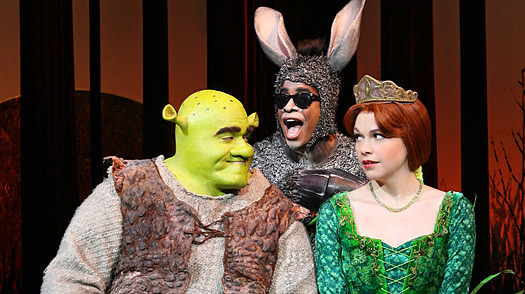
A Canadian production of the Shrek musical has chosen to change its script following a complaint over the repeated use of the word 'tranny'.

A transgender man, Ky Greyson, told news sources that he walked out of a showing of the production when the character of the Big Bad Wolf called out the word after he puts on a dress, to the laughter of the audience.  The play continued to use the word several more times.

'It was a really good production, but I remember hearing the word used and the entire crowd burst out laughing and my heart just dropped,' Greyson said, speaking about his experience with CBC News.  'There were very dehumanising jokes with regards to not conforming to gender roles and being a masculine person femininely.'

'If we're teaching kids in the audience that if this is okay to be mocked, this is to be ridiculed, we're perpetuating self-hate in people who may be trans women or trans feminine people at a young age and also continuing the myth and misunderstanding of what trans people are.'

Gay Star News claims to have contacted the PR team for the UK tour of Shrek The Musical and were told that the production has never received a complaint regarding the use of the word tranny.  They also said that there were 'no major script changes in the adaptation from the original Broadway production'.

Neptune Theatre, where the production in question was showing, have expressed their apologies for using the word and have released the following statement.

'We were upset to learn that one of our productions created feelings of distress amongst members of the LGBTQ community in Halifax and changes were made immediately to remove content once we became aware of the situation.  Neptune has spoken and met with those members of the LGBTQ community to express our apologies and to learn from this experience.'


Amy.
xx

'Rites of Spring' Review


This review WILL CONTAIN SPOILERS for the film to be discussed, if you do not want certain plot points or story spoilt, please do not read further.


'Rites of Spring' is a slasher monster movie that tries to mix horror and crime drama with little actual success.  

As the film starts we learn that each spring women in this part of rural America go missing and have never been found, and we get to watch as two young women, Rachel and Alyssa, being attacked and kidnapped by an old farmer.  When the two women wake up hanging from the ceiling in a rundown old barn they discover that their captor intends to offer them as a sacrifice to some kind of creature.

In the midst of all of this we are given a second story, of a group of criminals who kidnap the young daughter of a local businessman, and intend to hold her for ransom.  As the story progresses the criminals begin to double cross each other and their plan unravels at the same time that Rachel is able to escape from the barn and is chased by Wormface, the rag covered monster that Alyssa is sacrificed to.

The two stories intersect as Rachel stumbles across the criminals hideout when trying to get away from the monstrous killer, and the criminals now find themselves being hunted down as well.


'Rites of Spring' tries to mix two completely different and separate stories together, but fails to do so in any meaningful way.  The horror story and the crime story as both very generic and use so many cliches and tropes that it becomes laughably predictable as to what will happen.

We have a criminal double cross, there's mistrust in the gang, the 'good guy' who's turn to crime because he's desperate, the brother he wants to protect but gets involved in a kidnapping scheme.  The characters have no depth or characterisation, they're stock characters that have nothing to offer.  Horror films aren't best known for giving great characterisation or back story, but most will at least attempt to build something for you to be able to identify with, otherwise you don't care when people start dying.

Here we have a group of people who have no real clear motivations, no one stands out in any particular way and you can't even remember any names whilst the film is going on.  There are never any moments of tension or fear for the characters when Wormface begins to kill them because you're never given a moment to actually care about them.  If more time was given over to the characters then perhaps the film would have had a little more depth to it, and some of its other flaws could be easier to forgive.

Whilst films that mix genre's like this can be quite effective, such as 'From Dusk Till Dawn', one of the problems with this one is that there's never a moment when it goes from a crime film into a horror.  From the very start the two stories are intermixed, cutting from the scenes of the two women tied up in the barn to the kidnappers.  If the film had simply been following the kidnappers, and used the extra time to develop their characters, and Rachel suddenly comes running into their hideout covered in blood and being chased by a maniac with a weapon it would have backed a shocking punch.

It's like the first time you watch 'Predator' or 'From Dusk Till Dawn' not knowing what they're about, one shifts from a generic action movie set up to suddenly include an alien, and in the other George Clooney is drinking in a bar when vampires begin killing everyone.  These moments throw you because they're the last thing you expect.  This film could have done that, it could have had a slasher movie crash into their crime thriller and made the project stand out.  


Unfortunately, because you are aware of both stories from the outset there's no moment of surprise, if anything you're left waiting for the two stories to meet up and actually connect, and that takes out a lot of the fun from the experience.

Wormface is a strange monster too, as we're left to figure out what he is through watching events, rather than actually being told.  The man who takes Rachel and Alyssa clearly believes that some kind of bizarre ceremony has to be performed on the first day of spring in order to keep Wormface happy, and so it's kind of implied that he might be some kind of deity or nature monster.

However, Wormface himself doesn't appear to be anything other than a man covered in rags.  Yes, his face is messed up, but he's not monstrous in the traditional sense.  He moves like a human, he doesn't appear to have any supernatural abilities or powers, and uses a weapon to kill.  So reaches a point where you have to ask exactly what he is.  Is he some kind of supernatural being, or is he just a man?

'Rites of Spring' doesn't give us any answers to this, it leaves it down to the person watching it to make up their own mind about what they've just seen and to reach their own decision.  That I actually like.  I like that face that to some Wormface will be some kind of monster that needs to receive sacrifices, but to others he's some horrible human who just enjoys killing people.  It's a kind of decision that most films wouldn't take, most films would try to give you a definitive answer one way or the other.

Despite having some new ideas of it's own 'Rites of Spring' fails to impress thanks to a cliched and poorly written script, bad pacing, lifeless characters and shoddy monster design.  It might be worth the watch for hardcore horror fans who want to see as many films as they can, but don't expect anything of real note here.


Amy.
xx

Thursday, 14 April 2016

100,000 Visitors!


Wow!  100,000 visitors!  Today is a big day!  In the last hour the site has exceeded 100,000 hits and I wanted to take the opportunity to thank each and every person who has taken the time to visit the site and continues to come back time after time.

None of this would be possible without your continued support and your positive feedback.

I'm hoping to be able to continue to provide you all with more great content going forward and hope to be able to bring new and exciting announcements to celebrate this milestone very soon.

Thank you one and all for everything that you have done for me and this site.


Amy.
xx

'The Thaw' Review


This review WILL CONTAIN SPOILERS for the film to be discussed, if you do not want certain plot points or story spoilt, please do not read further.


'The Thaw' has a look and a feel that's very reminiscent of a classic X-Files episode, and tells a story that would have very much felt at home in the show, albeit with much more gore and brutality than would have been allowed.

'The Thaw' tells the story of a group of researchers in the Arctic, who are studying the effects of global warming on the surrounding countryside and ecosystem.  When the group tranquilise a polar bear they discover that the animal had unearthed part of a frozen woolly mammoth thanks to the receding ice levels and had been eating the ancient remains.  The team transport the polar bear to their facility for further study.

When a group of students and the lead scientist's daughter arrive at the facility a few days later they discover that the polar bear, along with some members of the research team, have become infected with an ancient parasite from inside the remains of the mammoth.

What follows next is a series of events as some members of the group try desperately to return to civilisation before they become infected, whilst other members of the party sabotage their escape to prevent the parasites from spreading.

With several members of the group infected with the creatures that are eating them from the inside out, they discover that the lead scientist has a plot to return to civilisation with the parasites and allow them to spread in an attempt to lower the human population in order to reduce the global warming that is destroying the planet.


'The Thaw' is a fairly competent body horror film, one that easily plays on the fears of infection and parasites and the notion of insects growing inside the human body.  We've all heard stories about bot fly larvae being found inside of people, or stories of fish that swim inside bodies through the urethra, and I doubt that there's a person who isn't at least a little disturbed by the thought of such an invasion.  This film thrives on that disgust and fear, and uses it to good effect.

The isolation of the surroundings adds to the fear of infection, with nowhere to go the people are stuck with those who are or may be infected.  Thankfully the locations have a look that is completely different to that of The Thing, which follows a similar theme.  Instead of being surrounded by the snow and ice there is a lot of vast greenery and wilderness, that gives the film a very different feel.

The film is shot well enough, with a nice clean look to it that can at times make the scenes feel fairly cold and clinical, but I think this adds to the general aesthetic of the piece, especially when inside the research station itself.

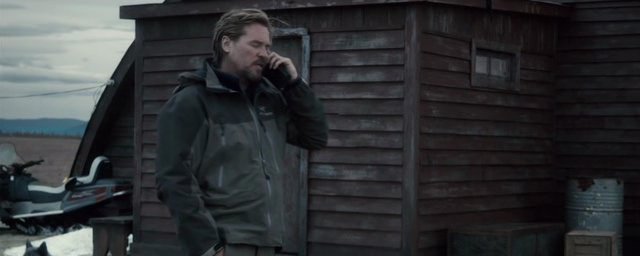
Val Kilmer headlines the cast, though only has limited scenes in the film, though with it being Val Kilmer that might not be such a bad thing.  The most notable cast member beside Kilmer is Aaron Ashmore, who's instantly recognisable, though I'm sure some of that will come from people mistaking him for his brother.  

The rest of the cast being relative unknowns actually works to the films benefit, as you don't expect certain people to survive simply because they're more well known than others, which in turn adds to the question of who is or isn't infected.


The films monsters, which never get given a name, are well executed and never too over the top.  Where some films would opt for larger and more visually creative creatures 'The Thaw' keeps things simple, and fairly realistic.  The parasites are more like Silverfish in their execution, and this closeness to something that many of us will be familiar with makes the parasites more frightening and believable.

The effects are well made and the visuals are gory and gross enough to convey the horror of creatures inside your own body without going too far into being a splatter fest.  The scenes where you can see the parasites crawling inside people's wounds before burrowing deeper inside the body are particularly unsettling and probably some of the more memorable moments.

The plot line of Val Kilmer's Dr. Kruipen wanting to infect the whole world in order to combat global warming is fairly ridiculous, and it's a huge jump to believe that a man of that kind of intellect would resort to genocide just in order to try and stop damage to the environment.

The idea of global warming leading to the discovery of ancient parasites is one that actually exists within the modern scientific community, especially with numerous ancient super vira having already been unearthed by scientists in the Siberian permafrost.  Whilst it's hard to believe that parasites such as the ones in the film could actually exist, the fact that it is in some way grounded in actual scientific reality does make the film slightly more disturbing.

'The Thaw' is not an amazing piece of cinema, it will never be remembered as an all time great and it probably won't stick around in people's memories for long after watching it, but it manages to stay entertaining and engaging enough through the run time to not overstay it's welcome.  It might not be the most original story in the world, but it's pulled off with competency and style.


Amy.
xx

Wednesday, 13 April 2016

Retro Review: Doctor Who 'Inferno'


Plot Summary:  Still stranded on Earth by the Time Lords, the Doctor is working with U.N.I.T. at a project nicknamed 'Inferno', where a group of scientists are working towards penetrating the Earth's crust in order to tap into pockets of Stahlman's Gas, which they believe can provide boundless cheap energy,

Whilst the Doctor is not an active participant on the project, partly due to his confrontational interactions with Professor Stahlman the project director, he is using the surplus power from the project's nuclear reactor to work on the Tardis console, trying to repair it and allow himself to travel through space and time once again.

Whilst repairing a part of the drilling equipment one of the workers comes into contact with a strange green ooze that goes on to mutate him into a subhuman primordial creature who attacks several other members of the project.  Unbeknownst to anyone else, Professor Stahlman is also infected.

Soon after they subdue the mutated workman the Doctor is working on the Tardis when a power surge activates the console and he vanishes in front of Liz and the Brigadier.  Instead of travelling through time or space the Doctor finds himself transported to a parallel universe.

The Doctor discovers that this new Earth is a much darker counterpart of the one he knows, where Great Britain is a Republic fascist regime, the Royal Family having been executed years before.  On this new Earth the Inferno project is still ongoing, though is much further along than the one on his Earth.

When he is captured by this universe's version of U.N.I.T., the British Republican Security Forces, he discovers the alternate versions of his friends.  In this universe the Brigadier is the vicious one eyed 'Brigade Leader', Liz Shaw is a member of the military and is a 'Section Leader' along with 'Platoon Under Leader' Benton.

The Doctor finds out that this universe, whilst very different from his own, has had several of the same events happen, including the mutated worker.  In this universe Professor Stahlman has also been infected and is beginning to act bizarrely as the effects begin to take hold.  Convinced that something bad will happen he breaks out of his cell and attempts to sabotage the drilling.  Unfortunately he is too late and the drill breaches the Earth's crust.

The whole facility is rocked by massive tremors and many of the scientists and staff flee.  Stahlman locks himself and several scientists in the drilling room and begins to expose them to the green slime.  Because of the intense heat he and all of the others mutate into Primords, bestial creatures that are more monster than man.

Discovering that the tremors are not just isolated to the facility, but are tearing the whole planet apart, the Doctor manages to convince the others to help him return to his world in order to prevent the same thing from happening there, promising to take them all with him.  The group fight their way across the facility to where the Tardis is located, keeping the Primords at bay with fire extinguishers, having discovered that the cold CO2 inside them makes the creatures vulnerable.


Massive explosions hit the facility as the Doctor is readying the Tardis to travel back to his own world and the Brigade Leader pulls a gun on the Doctor, demanding that he save them all.  The Doctor tries to tell him that despite his earlier promise he can't bring any of them to his dimension.  The Brigade Leader goes to shoot the Doctor, but is killed by Section Leader Shaw.  The Doctor activates the Tardis and disappears as a wall of lava envelops the building and the others.

Arriving back in his own dimension the Doctor falls into a coma.  Awakening hours later the Doctor rushes to the drill and begins to destroy equipment in an attempt to stop them from breaching the Earth's crust.  The Doctor is detained by U.N.I.T. soldier, who believe he has lost his mind.

Inside the drill Stahlman exposes himself to the green ooze and mutates fully into a Primord.  The Doctor manages to kill the Primord Stahlman with a fire extinguisher and shuts down the drill before they breach the Earth's crust and cause complete global destruction.


Analysis:  'Inferno' is the final episode of Jon Pertwee's first season as the Doctor, and the first year where the show was located purely on Earth.  Being limited to only telling stories in one place and time meant that the writers had to get increasingly creative when it came to coming up with new scenarios to put the Doctor in.  'Inferno' marks possibly the best attempt at this in one of the best episodes of the Classic Doctor Who era.

At the time 'Inferno' was one of the darkest episodes the series had produced, featuring a bleak story that allowed them to kill several of their main characters, albeit in the form of their parallel world counterparts.

The idea to create a story around a parallel Earth came from the series having ran out of budget at the latter half of the season, and as such the writers came up with the idea so that they could use the same sets and characters in more than one way.  It might have been a decision based purely on a production and cost level, but the writers managed to craft a story that worked incredibly well, and one that never felt cheap or easy.

Subtle differences to the second Earth, such as a slight difference in fashion and the Republic propaganda posters meant that very little effort was needed to create the new Earth, yet kept the two distinct and different enough in their looks that you're never confused as to which Earth we are watching.

One of the best things about the story, though, is getting to see some of our familiar and beloved characters playing 'evil' versions of themselves.  Despite being a military woman Liz is not too far removed from her other Earth self, and even saves the Doctor at the end knowing that she had no hope of living herself.  The Brigadier and Benton are a completely different matter though, as the two of them are just thoroughly nasty pieces of work.

Benton becomes a Primord, so we never get a chance to see how this version of his character would play out in the final scenario, but much like the Brigade Leader he seems completely set in his devotion to the Republic and even enjoys his role.


The evil counterpart to the Brigadier is by far the best of the three of them though, with the Doctor's best friend transformed into a fascist military leader who gives orders to murder people without a second thought a stark contrast to one of the series' most beloved characters.  He's visually stunning too, with the massive facial scar and eye patch means that he will certainly stick in the mind long after the episode has finished.  It's a shame that he didn't somehow manage to come across to the main universe as it would have been great to have him in more than one story.

Despite a heavy presence in the story the Primords are not really the main villains or even the biggest threat, but more of an obstacle for the characters to deal with.  Instead it's time that proves to be the biggest enemy here, with the countdown to the destruction of both Earths being the biggest threat.  This is another factor that gives the story a unique feel, as the big monster is reduced to a minor part of the story rather than being the main focus.

The only downside of the story is that it marked the final appearance of Caroline John as Liz Shaw, who left the show before it returned for season 8 to have her child.  As it is Liz never gets a goodbye scene with the Doctor, and despite only being in the show for one season she deserved more than that.  As someone who is closer to be an equal to the Doctor than many of his other companions over the years her departure is definitely something that should have been given some thought and screen time.

'Inferno' has a look and a feel totally unique to itself that makes it one of the more entertaining, effective and engaging stories in the classic era of Doctor Who and a story that is still fresh and enjoyable to watch 46 years later.


Amy.
xx

Tuesday, 12 April 2016

'Batman V Superman: Dawn of Justice' Review


This review WILL CONTAIN SPOILERS for the film to be discussed, if you do not want certain plot points or story spoilt, please do not read further.


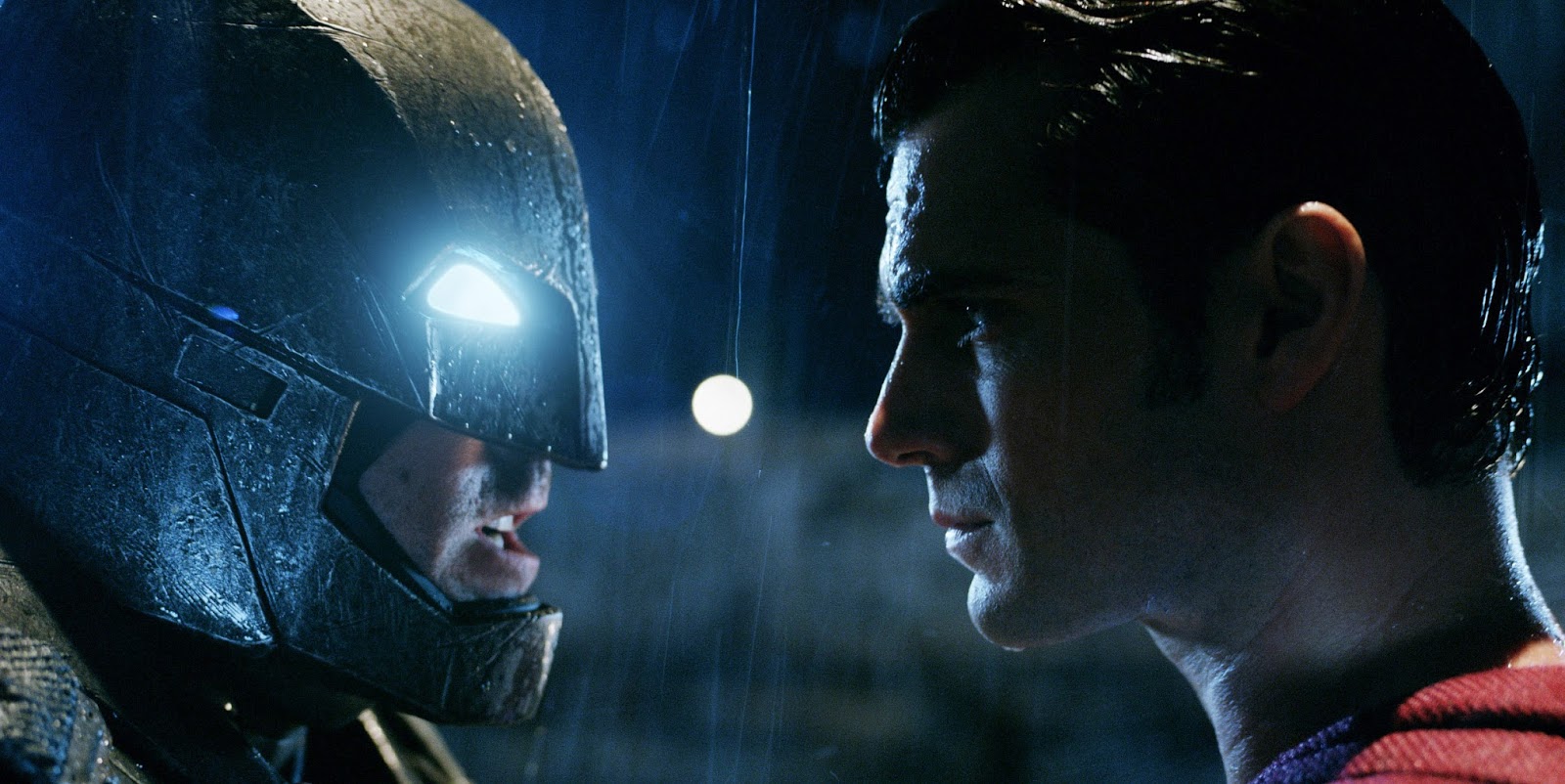
What can be said about this film that hasn't been said a dozen times over by other reviewers, critics and audience members?  'Batman V Superman: Dawn of Justice' is a terrible movie.  It's plot is dull and unimaginative, with moments that make no sense either individually or as part of a whole.  The characters have little to no development and make bizarre choices.  The action is dull and the effects that accompany them are bland at best.

I like the DC universe, it's got some of my favourite characters and stories, but this film fails to capture any of the things that make the comics great in exchange for a shallow film that is more concerned with establishing its own universe before it's ready.  

If this film was just a focus on Batman and Superman then perhaps it would have been a lot better than it was, but with the plot being focused around establishing the Justice League and giving hints of the franchise's villains it's overly bloated and without focus.

The basic idea of Batman feeling threatened by the power that Superman has and could one day use against people makes sense, though the degree at which he pursues his vendetta against Superman makes very little sense.  We know that this is a Batman long into his career, who has lost at least one Robin, but to see a depiction of Batman that is so ready and eagre to commit murder is still jarring to watch, despite previous versions of the character having done so in film before.

On the reverse side, we're given a Superman even more grim and unfriendly than in Man of Steel.  Superman is one of those heroes who isn't human, but has so much humanity and caring inside of him that he's the best of all of us.  In this film we're given an aloof, standoffish god who seems only mildly interested in saving people, who's happy to float in the sky and watch people calling for help or allows people to flood around him in worship.


This version of Superman fails to capture any of the essence of the character in any way that even the Clark Kent scenes (all of about three of them) give nothing extra to the character.  The scenes with Lois have no chemistry between the two of them and feel awkward more than anything else, and it's impossible to tell anything about his role at the Daily Planet.  Is he a good reporter?  Does he get the freedom to explore his own stories like Lois?  Is he well thought of?

There's no character development for the man at all, he's reduced to being a plot device.  His role is to be the target of Batman and Lex's anger throughout the film, and the thing that drives Batman to assemble the Justice League.  He's not a player in this story, he's just a pawn being moved around the board to be sacrificed for the greater goal.

The most meaningful thing that Superman does in this film is to get himself killed just to motivate Batman, and even that comes from a stupid decision.  He knows that Kryptonite weapons weaken him, but chooses to use to go up against Doomsday rather than give the weapon to Wonder Woman, someone who had already proven she was more than competent to take on the monster.  But that just highlights my point, Superman is allowed to make a poor choice because it allows for his death, which allows for the next part of the studios plan to build their own movie universe.

The plan that Warner Brothers seems to have makes no real sense either though, rather than imitating the Marvel method of introducing each team member in their own films, to build up their characters before bringing them all together they're doing it the other way around.  I can't see this working, it means that rather than just bringing together characters we already know and setting up a big villain before the climax, they have to do all of that plus introduce at least three characters with very distinct and separate characters to the audience.  I can't see it working at all.

The scenes with the flash forward or premonition to a world destroyed by Superman and Darkseid might be visually interesting, but they feel out of place here, especially in the middle of the film.  It's like they accidentally put the post credits scene in the wrong place.  The Parademons look great, but other than that these scenes did nothing to excite me, and the Flash looked so terrible that at first I didn't even realise it was supposed to be him.  It says a lot about a film when the tv version of a character looks better than a big budget counterpart.

The film had some issues with it's villain too, namely the fact that Lex Luthor is absolutely terrible.  The casting of Jesse Eisenberg is just stupid, he plays the character as annoying and at times downright idiotic.  The scenes at the library benefit and the speech he gave were so cringeworthy and off-putting it made me hate a character I usually love.  Seriously, what the hell was the point of the jar of piss?  A jar of piss!

The whole film was just a terrible experience from start to finish, with no redeeming qualities.  It tried to shoehorn in as many different characters and ideas to the point that the film feels cluttered and bloated but with no actual substance or real story.

I find it hard to understand how some people are giving this film positive reviews as I have failed to find any redeeming feature in it what would make me want to give it a second viewing, let alone a positive review.  Warner Brothers have made a very serious mistake with this film, and it's one I'm expecting them to keep making as they make more DC movies.


Amy.
xx

Powerpuff Girls Transgender Unicorn Episode Not A Good Thing


The following article is purely my opinion, based on how I felt watching the episode, it may differ from your own opinions.  What I am presenting here are my own thoughts only, and as such it should be viewed not as 100% universal, but just one view amongst many.

One of the new episodes of The Powerpuff Girls features a 'transgender' unicorn character called Donny, who is a horse that believes he is a unicorn and has the girls help him attain his goal.  Whilst the show is trying to send a message about transgender people, I found that it went and did the opposite.

The series executive producer Nick Jennings spoke about the episode and said, 'Basically when we start out, he's a pony, but he wants to be a unicorn.  He has to go through a transformation to become a unicorn so it's a whole, 'What are you on the inside?  What are you on the outside?  How do you identify yourself?  How do people see you?'  There's a lot of subtext to that.'

'I don't think you can be too young to start talking about those issues and those things and just presenting an attitude, a voice that is going to resonate with people.'

For first main issue is this, why go through the whole scenario of a horse who believes he's a unicorn?  I get that it's a metaphor, but why not just have a trans character instead?  Clearly the creators don't think that their audience are too young to be learning about and thinking about gender, so just talk about it rather than using a metaphor.  Trans people exist, we're not metaphors.

I found the actual content of the episode itself to be contradictory to the idea of expressing a pro-trans message that the creators say they were trying to convey.  When we first see Donny he's wearing a horn to be a unicorn and Buttercup immediately rips off the horn, says he's not a real unicorn and reduces him to tears.

So, essentially what we have here is one of the heroes confronting our trans character and saying that they are fake, that despite trying to make himself look like a unicorn he's not.  To me, seeing her rip off his horn and call him out is no different than seeing someone pulling off a trans woman's wig and calling her a man.

Does this mean that Buttercup is taking the place of a transphobe or someone that abuses trans people?  It certainly looks that way, and she's the hero!  What kind of message is that telling children about accepting someone's gender identity?

When Bubbles tries to get the Professor to help Donnie there's a whole big scene about the multiple dangerous side effects of undergoing such a transformation, at which point Donnie ignores all of these dangers and immediately signs under a big red 'Forever'.

When I saw this part of the episode it looked like the writers were trying to say that trans people are so desperate to sign up for medical procedures that 'last forever' that we ignore dangers to do it.  Whilst there can be some dangers in medical transition it's wrong and misleading to portray it like this.  There's no real greater danger in changing gender than there is in many other medical procedures, don't go and make out that trans people rush into unsafe medical procedures because that's just plain not true.

When Donnie goes through with his transformation things go wrong and he transforms into a monster, a literal monster and goes on a rampage.  What exactly is the message here, that if you try to change your body you will become a monster?  Are they trying to say that trans people are somehow monsters?

Add into this the fact that characters, including members of the Powerpuff Girls themselves, call Donnie a freak more than once at this point and I can't see it as anything positive.  The message they're conveying is, if you change your body to try and match who you are inside you will be seen as a 'freak' and a monster.

Add onto this the fact that at the end of the episode it turns out Donnie was a unicorn all along and gets changed back into his true self, what's the point of this episode.  Donnie isn't a horse who wants to be a unicorn, he's already a unicorn.  The message at the end is 'be who you were born as'.

The episode might have been made to comment on gender, but I really don't think it was trying to make a good point.  Donnie is mocked for trying to be who he feels he is, he signs up for dangerous medical procedures without a car, he becomes a monster and gets called a freak, and the end message is 'don't try to change yourself'.

Like I said at the start, this is only my personal opinion, but I do not see this as a positive message about trans people hidden behind a metaphor, I think it's an incredibly negative message about trans people.  I'm extremely disappointed in this episode, but it just seems to add to a history of the show mocking trans characters and queer coding villains.


Amy.
xx

Germaine Greer Thinks It's Unfair For Trans Women To Marry Women


Speaking on the Australian debate show 'Q and A' well known trans-exclusionary feminist Germaine Greer made yet more controversial comments about the existence of transgender women, and made claims that it is wrong for lesbian relationships with trans women to exist.

One of the members of the audience, Steph D'Souza, asked Greer why she believed that transgender women are not 'real women', stating that she had previously drawn strength from the writer's work but has found her opinions of trans women to be troubling.  She pointed out to Greer that her belief in a 'real woman' is the same kind of essentialism that she once spoke out against.

When she responded it at first looked like she might be reversing her opinions on the transgender community.

'When I first was thinking about what is a woman, I fell for the usual view that women were people with two Xs and men were people with an X and a Y, which made life nice and easy for me.  I now realise that I was wrong.'

Rather than saying that she believes that transgender people exist, she went on to talk about intersex people.  Highlighting the existence of people who are intersex and understanding the struggles that they face is important, and Greer seems to understand that.  However, it was not long before she turned the conversation towards trans bashing once again.

'If you decide that you are uncomfortable in a masculine system which turns boys into men, often at great cost to themselves, if you are unhappy with that it doesn't mean that you belong at the other end of the spectrum,'

When asked about the fact that transgender people knowing that they have been born the wrong sex Greer replied, 'But you can't know that.  You don't know what the other sex is.'

One of her fellow panelists responded to her comment, saying that trans people know and feel that they were born into the wrong body, which was met with Greer pulling faces and rolling her eyes.

Greer went on to say that belief in an idea is not the same as knowing something, before adding, 'Women are constantly being told that they are not satisfactory as women, that other people make better women than they do.  The woman of the year may be Caitlyn Jenner, which makes the rest of the female population of the world feel slightly wry.'

'I don't believe that a man who has lived for forty years as a man, and has had children with a woman, and has enjoyed the unpaid services of a wife that most women will never know, then decides that the whole time he's been a woman and at that point I'd like to say hang on a minute, you believed you were a woman but you married another woman and that wasn't fair was it?'

Whilst it is unsurprising that Greer is once again openly bashing transgender women, from questioning our very existence by saying you cannot know if you are the wrong sex, to saying she would openly disbelieve someone saying their trans there is one thing about her comments that did take me by surprise.  Her feeling it's not fair for trans women to marry cis women.

One of the arguments I often see between members of the transgender community and trans-exclusionary feminists is the idea that trans lesbians do not exist, and cis women in relationships with trans women should not call themselves lesbians either.  It would appear that Greer feels the same way too, or perhaps has a problem with lesbian marriage as a whole.

It's interesting that throughout all of this though, that she never once commented on the question of whether she was acting in the same way as people who once dictated what women should be.  The fact that she continually demands women conform to some kind of biology that not all women do, or that they should behave or act certain ways indicates that she believes she has some kind of right to tell women what 'real women' are.

At one time Germaine Greer might have been a good feminist force working towards the betterment of all women, but it is becoming clearer that those days have passed her by, that her views and opinions are outdated and unpopular, and that even those who once saw her in high regard are starting to see her in a less than favourable light.  Perhaps it's time that Ms Greer shut up about trans women and went away before she loses what little respect some people still have for her.


Amy.
xx

Monday, 11 April 2016

Arrow '11:59' Review


This review WILL CONTAIN SPOILERS for the episode to be discussed, if you do not want certain plot points or story spoilt, please do not read further.


Okay, I'm going to get this off my chest straight off the bat, I do not like this episode.  It started well, had some great character moments and some cool action sequences, but the end ruined this episode.  It has ruined this season for me.  And judging from reactions on the Internet I'm not the only one who feels this way.  The reason for this anger?

This is the point where I say spoiler alert just to make sure you really want to know.  Still here?  Okay then.  This episode is bad because it kills off one of the best characters in the series in a completely pointless and terrible way just to service the story of the main character.

Laurel Lance, aka Black Canary, is killed by series villain Damien Darhk, who once again has his magic powers back.  After getting to play through some extremely complex character arcs and show some of the best growth of any of the characters on the show (possibly the only character to have this kind of growth) she's killed in order for Darhk to hurt her father and Oliver.

As a review of the episode this isn't really the place to go into details about just how bad a problem Arrow has with writing women, and how often they seem to 'fridge women', I actually gave a whole separate piece to that here, but it's impossible to talk about this episode without talking about the problem with killing off Laurel.

Aside from the fact that it is yet another instance of a female character suffering for the benefit of Oliver Queen, Laurel has been one of the most interesting characters in the whole life of the show, and her role as Black Canary has not only been one of the best facets of her character, but also one with an almost 70 year history in the comics.  To add insult to injury, her television death happened on the same week as the characters birthday in the comics.


Other than the killing of Laurel, the episode follows events as Darhk hatches a plan in prison to get his magic back, by getting Merlyn to steal it from Oliver and the team.

Part of the plan involves Diggle's brother, who we saw meeting with Merlyn at the end of the last episode.  When this episode picks up Andy confides in Diggle that Malcolm approached him and gets the team to help him to 'disrupt' Merlyn's plans.

As Oliver, Diggle and Andy prevent as group of assassins from stealing several missiles from a military convoy Merlyn and some of of the members of the League of Assassins still loyal to him infiltrate the bunker and confront Thea and Laurel before making off with Darhk's idol.

Despite Andy taking an arrow to protect Oliver, Oliver is distrustful of him and is convinced that he's working with Merlyn and Darhk, an accusation that drives a wedge between Oliver and Diggle.  The confrontation between the two of them is one of the more interesting parts of the episode, and really puts a strain on the two two men who have more than once called each other brothers.

It's a dynamic that would have been worth spending some time exploring over more than one episode, but when the heroes go to prevent Darhk from breaking out of prison it turns out that Andy was indeed working for the bad guys and gives Darhk the missing piece of the idol he needed to get his magic back.  Whilst the double cross is something of a surprise, and creates an interesting situation for Diggle going forwards, but it stops the drama of Oliver and him being at odds with each other.

The final moments of the episode are spent between Oliver and Laurel in the hospital moments before she dies, where she tells Oliver that she loves him, but is happy that he has Felicity in his life (servicing the Olicity fans over the comic book fans perhaps?) and asks Oliver to do her a favour, though we don't get to hear what that favour is.

Some people are speculating that Laurel is still going to be alive, and that she asked Oliver to help fake her death.  But why would she do that, to what end would faking her death help anyone?  She's seen her father go through the pain of losing Sarah more than once, and would never do that to Quentin.  I might have been wrong about who was in the coffin, but at this point I really doubt that it's a fake out and think that Laurel is gone for good.

'11:59' is the worst episode of this season, and makes a terrible mistake of killing off one of the best characters in the series for no good reason other than the writers not knowing what to do with her.  Arrow has angered a lot of fans with this move, and I am one of them.


Amy.
xx