Thursday, 10 January 2013

Doctor Who 'Curse of the Fatal Death' Review

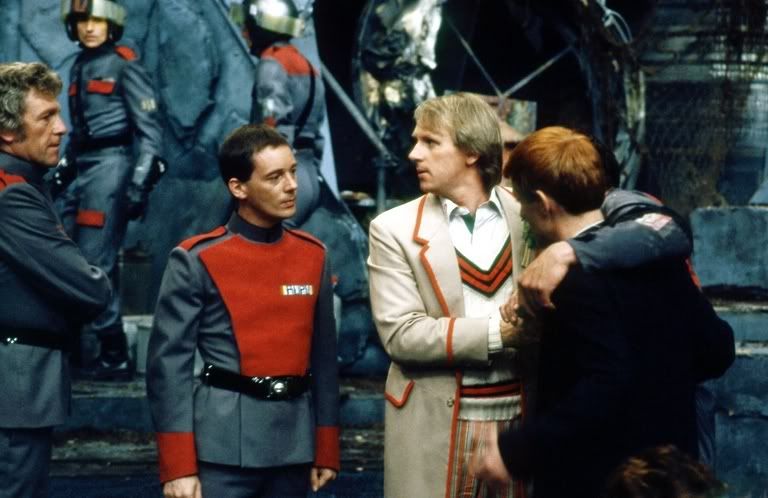
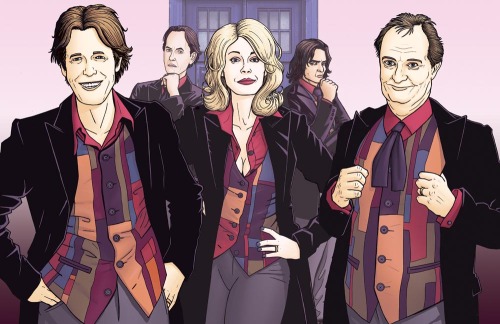
The five Doctors featured in 'Curse of the Fatal Death'.


‘Curse of the Fatal Death’ is a special comic relief episode of Doctor Who aired in 1999.  It is notable amongst other non-cannon comic relief specials as it features many of the crew that would later go on to work on the revived series of Doctor Who, including Stephen Moffat, special effects company The Mill and Richard Curtis.

The story begins with the Master pursuing the Doctor in his Tardis, gloating over his latest plot to kill the Doctor, unfortunately for him however he is accidentally transmitting to the Doctors Tardis, informing the Doctor of his plans.  The Doctor in returns asks the Master to meet him on the planet Tersurus as he has something important to tell him.

On Tersurus the Master attempts to kill the Doctor several times, though the Doctor easily manages to avoid these traps.  Once he manages to convince the Master to stop trying to kill him and let him talk he informs the Master of his intention to retire, instead opting for a quiet married life with his companion Emma.  The Master, finding such an idea disgusting, continues with his attempts to kill the Doctor and is in turn sent into the sewer system of Tersurus, which takes him over three hundred years to find his way out of.
Jonathan Pryce plays an excellent Master.
Using his Tardis to return to just after the point he fell into the trap an elderly Master returns with a group of Daleks, intent on destroying the Doctor.  Now a prisoner of the Daleks and the Master, the Doctor must stop the destruction of them all from an exploding Zektronic energy weapon.  The Doctor is injured and forced to regenerate, three times.

The Doctor finally manages to disable the machine but is hit by a burst of Zektronic energy that kills him, stopping him from using his twelfth and final regeneration.  Believing the Doctor dead the Master and the Daleks, whom he saved, renounce their evil ways and vow to honour his memory by protecting the universe in his place.
The Doctor plans to retire and marry his companion Emma.
Suddenly the Doctor begins to regenerate, his twelfth form being that of a beautiful woman.  Emma is stunned by the change and confesses that she can no longer marry the Doctor.  The Doctor and the Master however begin to feel a mutual attraction to each other and leave together, arm in arm.

‘Curse of the Fatal Death’ is a quick twenty minute skit that pokes fun at Doctor Who but is made by people that love the show.  This results in a nice little comedy episode that is respectful to the legacy of the show and fans will enjoy.
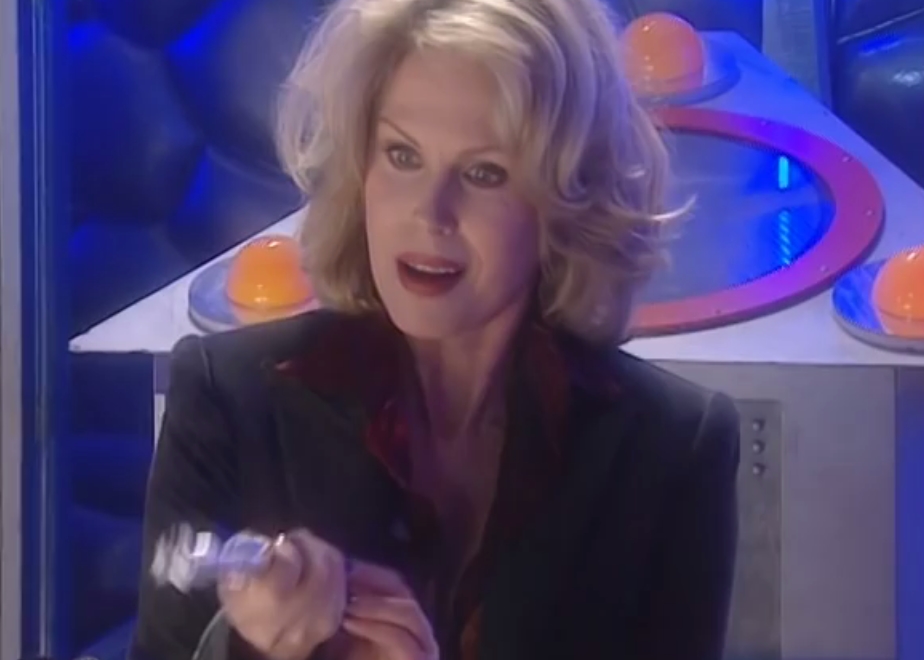
The twelfth Doctor discovers the vibrate function on the Sonic Screwdriver....
The five Doctors featured in the episode are great, each bringing something new to their own versions of the Doctor, even though most are only the Doctor for less than a minute.  Jonathan Pryce makes a wonderful Master, one that brilliantly carries on the legacy left by Rodger Delgado and Anthony Ainley and feels more like the Master than the later Jon Simm.  The part of Emma, the Doctors companion in this story, is played by Julia Sawalha, who was planned on being a cat-burglar like companion in the cancelled twenty seventh season of the show and would have replaced Ace alongside Sylvester McCoy.

A fun little episode that is made by people who love the show for people who love the show.  Respects the source material but isn’t afraid to point out some of its funnier faults.  An entertaining watch for any fans of Doctor Who.  7/10

Wednesday, 9 January 2013

Doctor Who 'Dalek' Review


The Doctor must come face to face with his oldest and deadliest foe.

The Tardis is drawn to an unidentified distress signal, landing in a massive underground facility near Salt Lake City in Utah, in the year 2012.  They find themselves inside a private collection of alien artefacts owned by the wealthy Henry van Statten, who has made his billions by secretly owning the internet and creating amazing new technology based on alien artefacts.

Impressed by the Doctor’s knowledge of the artefacts on display van Staten takes the Doctor to ‘the cage’, where he keeps his one living specimen.  Realising that this must be the source of the distress call the Doctor enters ‘the cage’ and tries to help the life form within.  However, the Doctor comes face to face with his greatest enemy, a Dalek.

The Dalek learns from the Doctor that they are both the last of their races, the other Daleks and Time Lords killed in the last days of the Time War.  The Dalek escapes from its confines and hunts for the Doctor through the facility, intent on killing the last of the Time Lords before escaping to the surface to continue with its default mission of exterminating all non-Dalek life.
The Dalek uses Rose to manipulate the Doctor.
‘Dalek’ is the sixth episode of series one of the revived show and features Christopher Eccleston and Billie Piper as the Doctor and Rose respectively.  It marked the first appearance of the Daleks in the new series and offered an insight into the events of the Time War, to this point only mentioned in brief. 

During the course of the episode we learn that the two factions in the Time War were the Time Lords and the Daleks, though other races were drawn into the fighting and suffered along side them.  We also discover that the Time War was ended by the Doctor himself when he destroyed both sides, killing not only his oldest enemies but his own people. 

These revelations let us see more of the damaged Doctor that had thus far only been hinted at, a man that has been through terrible physical and emotional damage.  We see the pain and anger that normally bubbles beneath he surface, allowing the Doctor in this story to embrace those emotions and show a new side of himself.  A Doctor that is full of rage and is more than willing to kill.

The Dalek in this episode is also a thing of beauty, a bronze death machine.  In the past the Daleks have often looked frail and unthreatening, but here the Dalek looks like a big, heavy and dangerous piece of machinery.  It is much easier to accept this version of the Dalek as one of the supreme races in the universe.  Especially as this one single Dalek goes on to kill over two hundred people by itself. 
The Dalek feels the pain of being the last of its kind.
Whilst the episode is initially set up as a chase/action oriented story we are given a great deal of emotion too, and not only from the Doctor.  Having used the DNA of Rose, due to her being a time traveller, to repair itself the Dalek begins to experience some negative side effects.  It begins to feel.

By the end of the episode the Dalek almost become a thing to pity, a sad and lonely creature left all alone in the universe.  We see it and the Doctor both recognise that they have lost their races, and the pain that it has caused them.  Unable to continue living with such emotions the Dalek chooses to kill itself rather than carry on, showing us a side to the Daleks that we have never seen before.

‘Dalek’ is a great episode, not only does it successfully establish the Daleks and their role within Doctor Who to new audience members, but it also gives long term fans something new and interesting.  An episode full of action and killings, as well as deep emotions that give Christopher Eccleston a great chance to show the deep emotions that he brings to his version of the Doctor.  One of the best episodes of his time on the show.  8/10

Amy.
xx

Amy Walker Facebook
Trans Girl Writer Facebook Fan Page
Amy Walker Twitter

Tuesday, 8 January 2013

Doctor Who 'Frontios' Review


The Doctor and the Tardis crew land on Frontios.

The Tardis arrives on the planet Frontios is the far future, where some of the last humans are struggling for survival.  Frontios is under constant meteor bombardment and during one such attack the Tardis and its crew are dragged to the surface of the planet by massive forces of gravity. 

The Doctor, Tegan and Turlough leave the Tardis and attempt to help the colonists wounded in the previous attack.  Unfortunately another meteor shower hits and the Tardis is destroyed stranding its crew on Frontios.  The crew investigate Frontios and discover vast tunnels beneath the surface, inhabited by the Tractators, giant insects with the ability to manipulate gravity fields.

Wanting to enslave the inhabitants of Frontios and use the planet to travel across space in order to pillage and destroy other worlds the Doctor must find a way to stop the Tractators and save some of the last of humanity.
The Doctor and a Tractator in the ruins of the Tardis.
When I first saw the trailer for Frontios on one of my other Doctor Who DVD’s I was initially very intrigued the destruction of the Tardis, people being sucked bellow the surface of the earth and the phrase ‘Frontios buries it’s own dead’ that popped up a number of times made it look like it could be a very interesting story.

Instead I found Frontios to be very boring.  The plot didn’t feel like it was enough to fill the four episodes given over to it, and just felt stretched and padded.  The human characters that inhabit Frontios are constantly arguing and changing their opinions on whether to trust the Doctor or not, almost to the point of it being too ridiculously boring to care.  By the time the Doctor learns of the Tractator threat you question why he would risk his life to save any of these people.

The Tractators themselves are initially very fun to look at, but after a while you really begin to notice the limitations of the costumes created.  Whilst they do indeed look very alien and insect like their slow and ungainly movements and tiny waving arms quickly make them something of a joke.  It is a good thing that they have powers to manipulate gravity otherwise they would pose no believable threat at all.

The story also sees Turlough experiencing ‘race memory’ of the Tractators, though it comes across as very unbelievable.  He produces so much information about the Tractators that it goes beyond race memory.  It also reduces him to a near catatonic state for almost half of the story, making him do a number of things that have no real explanation or reasoning behind them, one of which causes the death of a supporting cast member.
Quite possibly the worst parting gift ever.
Despite the fact that by the end of the story the Doctor gets the Tardis back for the vast majority of the story both he and the audience are led to believe that it is lost forever.  The Doctor seems to only consider this a slight irritation.  There is little to no emotion surrounding the loss of his wonderful machine and home, something that strikes me as very out of character for the Doctor.

All in all ‘Frontios’ is set up to be an interesting story but falls short at every hurdle.  The villains are boring, the human cast inconsistent and irritating, the story stretched out way too long and the regular cast act so unlike themselves.  ‘Frontios’ is not the longest Doctor Who story I have watched, but it certainly feels like it is.  The episodes are a chore to watch that I was glad when it was over.  5/10.

Amy.
xx

Amy Walker Facebook
Trans Girl Writer Facebook Fan Page
Amy Walker Twitter

Monday, 7 January 2013

Doctor Who 'The Eleventh Hour' Review


The Doctor and Amy Pond.

‘The Eleventh Hour’ is the first story of series five of the re-launched show and the first episode starring the eleventh Doctor Matt Smith.  The story begins with a newly regenerated Doctor crashing his Tardis in the small English town of Leadworth and meeting young Scottish girl Amelia Pond.  The Doctor and Amelia quickly form a connection with each other and she tells The Doctor of the scary crack in her bedroom wall.  The Doctor discovers that the crack is in fact a crack in time and space and that something may have passed through.

Unfortunately he is forced to leave as the Tardis begins to phase, but promises Amelia that he will be back in five minutes.  However, when The Doctor does return he’s run slightly astray and has arrived twelve years late, coming face to face with an adult Amelia, now going by the name Amy.  Having waited twelve years for The Doctor and been told by everyone else that he was simply a dream or imaginary friend Amy is initially very distrustful of The Doctor.

They quickly discover, however, that something had indeed passed through the crack in the wall all of those years ago and has since been hiding in Amy’s home.  Prisoner Zero, as it is called is a shape shifting alien on the run from the galactic police, the Atraxi.  Unfortunately the Atraxi have followed Prisoner Zero to earth and are threatening to burn the planet if it does not reveal itself. 

The Doctor and Amy work together to find a way of stopping Prisoner Zero and handing him over to the Atraxi before earth is destroyed.
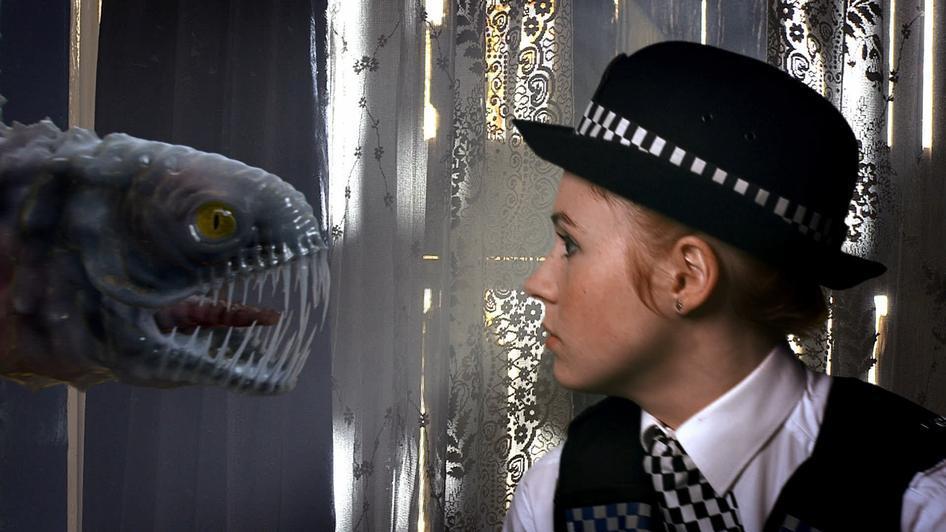
Amy comes face to face with Prisoner Zero.
‘The Eleventh Hour’ had the difficult job of not only introducing a new Doctor and a new companion, but also managed a number of changes behind the scenes too.  With a new executive producer and head writer, as well as two new producers, it could have been easy for the first show of the new era to stumble slightly, instead they managed to create a great episode that not only kept old fans happy, but helped to create a jumping on point for people new to the show.

The casting in the show is also particularly well done, with Matt Smith as the latest incarnation of The Doctor.  The youngest actor to ever receive the role there were questions surrounding how well Smith would perform in the role, but in this episode he proves to be a competent and worthy addition to the part. 

We are also introduced to new companion Amy Pond, performed by Karen Gillan, and Amy’s boyfriend and future companion Rory Williams, played by Arthur Darvill.  Amy and Rory are set up brilliantly well in this episode, neatly and efficiently establishing their relationship, something that would become massively important in the future.
The Doctor 'tells off' the Atraxi.
Despite having not one, but two new alien threats in the episode the aliens almost take a back seat role in the story, instead the main focus being the relationship between the newly regenerated Doctor and Amy.  Moffat creates a wonderfully sweet relationship between the two of them, where despite waiting for The Doctor for fourteen years you honestly believe Amy would run off with The Doctor without second thought.

Quite possibly the best series opener and best introduction to a new Doctor since the show returned to screens in 2005, as well as a fun establishment of new companions Amy and Rory.  8/10

Amy.
xx

Amy Walker Facebook
Trans Girl Writer Facebook Fan Page
Amy Walker Twitter

Sunday, 6 January 2013

Alan Wake Review


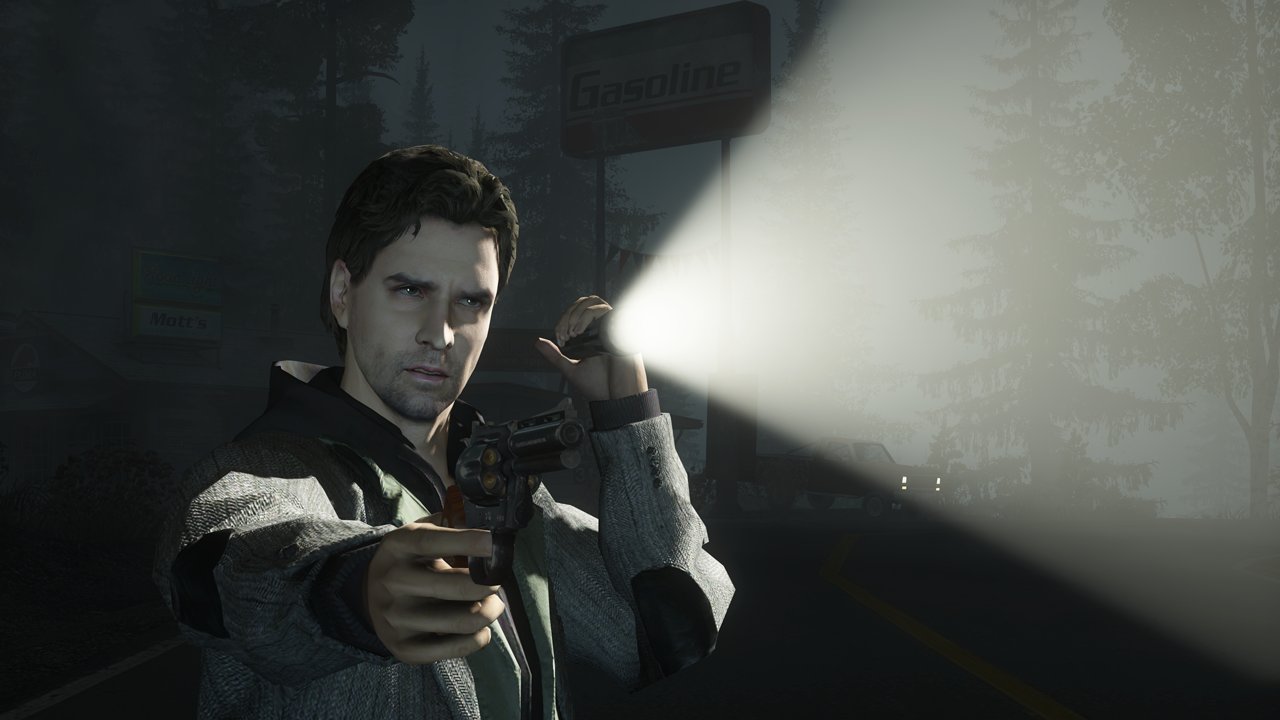
The titular character of the massively popular Alan Wake video game is not your usual action hero.  He begins the game as a popular mystery writer who has begun to have a number of problems writing his new book.  He and his wife travel to the small town of Bright Falls for a vacation so that he can escape these pressures.  Things take a dramatic turn for the worse when his wife goes missing and his search to find her shifts into the realm of the supernatural.  Alan is forced to arm himself and face some of his greatest fears if he wants to find his wife.

The game draws heavily from television shows such as the Twilight Zone, even having its own version in the game world.  It also takes a lot of inspiration for the literary works of Stephen King and H.P. Lovecraft, at several points referencing King directly.  With a story that takes inspiration from suck beloved examples of the genre the game presents a tale that it scary, funny and thrilling in equal measures.
The story is spaced across six episodes, each one written like and episode of a television min-series.  Each episode ends with a cliff hanger like moment that will have you excited for the next part.  Each episode is accompanied by a ‘previously on Alan Wake’ segment to bring you up to date, and their own title song from the games excellent soundtrack.  Although episodic game play has been done many times before to varying degrees of success Alan Wake does it perfectly, creating a game that feels like it came straight form television itself.

The game plays very well, with fairly linear levels that offer enough freedom to leave the beaten track and discover new things that will add little gems to the experience.  Manuscript pages that build on the characters and tell you parts of the story you would not normally see, as well as radio and television sets that show you more of the world around Bright Falls.
Bright Falls itself is stunningly beautiful, a stereotypical small town in the state of Maine, as seen many times in Stephen Kings work, and it offers the gamer something both familiar and frighteningly different.  The wooded environments around Bright Falls are well crafted and great fun to explore on your quest to find your wife, taking you from farmsteads, to lake side vistas, to wooded mountains and abandoned mines.  Each episode has its own unique locations that all feel completely natural to the surroundings of Bright Falls and craft a fully formed, very real location.

The main antagonist in the game is the dark presence, literally a shadowy figure that is using Alan to further its own ends.  Over the course of the game you learn that it is some kind of ancient evil power that is trying to escape its confines and spread over the face of the earth.  Possessing various inhabitants of Bright Falls the dark presence sends these shadow men against Alan.  Having to use both sources of light and fire arms to combat these shadow men gives the game something more than just a traditional action game.  You not only have to worry about the amount of ammunition you have, but how much power you have in your torch, or the distance between the safety of light sources.

Alan Wake is a game that is an almost perfect blend of story, characterisation and interesting game play.  The game will appeal to anyone that is a fan of survival horror or action games, as well as people who may never have played a game before in the past.  If you like horror, especially the writing of Stephen King, Alan Wake is the perfect game for you as you will feel right at home. 

Amy.
xx

Amy Walker Facebook
Trans Girl Writer Facebook Fan Page
Amy Walker Twitter

2000 Hits!

Wow!  Up to 2000 hits already!  Thank you to everyone for coming to  the blog and reading what I've done.  I've had some great feed back from a lot of you and are glad that people are enjoying it.

Thanks so much everyone!

Amy.
xx

Amy Walker Facebook
Trans Girl Writer Facebook Fan Page
Amy Walker Twitter

Saturday, 5 January 2013

Doctor Who 'Tooth and Claw' Review


The Doctor faces off against an alien werewolf.

The Doctor attempts to take Rose to see a music concert in 1979, but instead lands the Tardis in the Scottish moors in 1879.  They encounter a carriage carrying Queen Victoria, who is travelling to Balmoral Castle.  The Doctor and Rose join her on her trip and the group arrive at the Torchwood Estate where they plan to stay the night.

Unfortunately the estate has been taken over by a group of monks that have taken the estate’s inhabitants hostage and prepared a trap for the queen.  Having brought a man to the estate infected with a form of alien induced lycanthropy they plan to infect the queen and create an ‘Empire of the Wolf’.

The Doctor and Rose must defend the queen from the werewolf whilst trying to devise a way of defeating the creature.  Discovering that the queens late husband, Prince Albert, and the former lord of the Torchwood Estate knew of the presence of the werewolf and its plan for Queen Victoria, and as such set the Torchwood Estate as a trap for the wolf.

Using the trap provided for them The Doctor manages to defeat the wolf and save the queen, though it is left vague to the fact if she became infected from a cut form the wolf.  The net day the queen knights both Rose and The Doctor, then immediately banishes them from the British Empire.  The queen is appalled by the unholy lifestyle that Rose and The Doctor live.  She also orders the creation of the Torchwood Institute to help defend Britain from further alien attacks.
The werewolf stalks the halls of the Torchwood Estate.
‘Tooth and Claw’ is a great episode for fans of both the classic series and the new Doctor Who.  The tone of the episode is very reminiscent of some of the early Tom Baker serials that focused on gothic horror.  Whilst the episode begins at day on the Scottish moors the majority of the episode is set at night, in the dark and oppressive confines of the Torchwood Estate.  This helps to give the episode a great claustrophobic atmosphere and ramps up the tension.

The alien werewolf itself is an amazing piece of CGI work that is stunning to look at.  Where a great many television shows will have computer effects that don’t hold up well on screen and age very quickly the werewolf in this episode is a stand out of the series.  Its movements are smooth and fluidic and it interacts with the live action sets and characters very easily.

Both The Doctor and Rose work well in this episode, with their two separate stories within the Torchwood Estate playing out very naturally, unlike many of the ‘missing assistant’ ploys used in the show in the past.  The giddiness and excitement the two of them experience in the situation is something that seems to come very naturally to the both of them too, and goes to show how Rose has matured over her time in the show and how her relationship with the Doctor has changed since his regeneration.
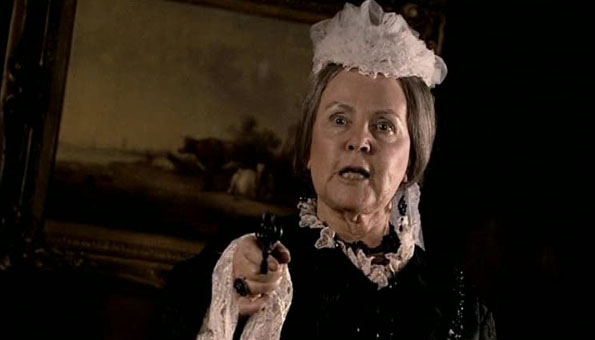
Queen Victoria played brilliantly by Pauline Collins.
Queen Victoria is played especially well by Pauline Collins, who brings a great deal of depth and emotion to the character.  It could have been very easy for the writers and actors to have her simply as a stereotype of what you would expect the character to be.  Instead they spend their time showing how the character thinks, how she has dealt with the loss of her husband and the effect it has had on her at an emotional level.  All of this helps not only to serve a better episode, but also makes sure that you care for her as a character and genuinely want to see her safe from the threat of the werewolf.

A great monster episode that uses its setting to perfection and gives us a cast of characters that have real life to them, that you actually care about.  It’s also fun to hear David Tennant use his natural accent, and the inclusion of Jamie McCrimmon’s name is a great shout out to old fans.  8/10

Amy.
xx

Amy Walker Facebook
Trans Girl Writer Facebook Fan Page
Amy Walker Twitter

Friday, 4 January 2013

'A Song of Ice and Fire: Game of Thrones' Review


I came to ‘A Song of Fire and Ice’ late, with books one to five already published and the first two seasons of the television adaptation having aired.  I’d heard nothing but good things about both, with people raving about the quality of the story and the characters.  I have to admit that at first this put me off.  I was worried that the product wouldn’t live up to the hype and I’d be left disappointed.

Eventually I relented and sat down to watch the first episode of the show and was immediately enthralled.  The world, the characters, the mystery.  I needed to know more, I needed to see what happened next.  Over the following two weeks I had watched every episode of the show and had bought the first book.

Going into the book I was pleased to find that everything that had made the show great was a product of the original source material and not something that had been added for television.  Not only that, but I was given so much more to enjoy.

George R. R. Martin is an amazing storyteller that crafts an entire world that feels real and full formed, filled with a cast of characters that are as multifaceted as you or I.  There are no real villains and no real heroes in ‘A Song of Ice and Fire’, everyone has their own reasons to do what they do, and can justify there actions.

Yes, there are some people who do some down right nasty things in the book, but through the back story that Martin provides we can see how they reached this point, and if not sympathise with them at least understand.

Instead of focusing solely on one character the author spreads the focus on several key figures in the world he created, dedicating a chapter to one of these before moving on to the next.  This allows the reader to see multiple viewpoints and builds us a bigger picture of the world of Westeros. 

We are also given more than one storyline, with events unfolding across the world, some that effect and are effected by others, some that are apparently separate yet will have some small connection to one or more of the other stories.  Just like the multiple character viewpoints this makes Westeros feel like a real world, where many different things are happening.  It also helps to build anticipation for the inevitable meeting of these storylines, where we will get to see these characters clash.

The first volume is a great introduction to the world and the characters, and sets up the stories for the following volumes incredibly well.  For anyone that has watched the television show and is interested in reading the book do so, everything that made you love the show will be even better.  And if you haven’t experienced either start here.  9/10

Amy.
xx

Amy Walker Facebook
Trans Girl Writer Facebook Fan Page
Amy Walker Twitter


Doctor Who 'The Five Doctors' Review

The five Doctors together on Bessie.


‘The Five Doctors’ is the Doctor Who’s 20th anniversary special, and they don’t hold anything back going into one of the best stories to unite multiple Doctors.

An unseen adversary uses a device called a Time Scoop to capture previous incarnations of The Doctor, a number of his companions and even his enemies, including Daleks and Cybermen, and places them into the Death Zone on Gallifrey.  Although they are able to capture the first three versions of The Doctor, the fourth Doctor and Romana become stuck within the time vortex.  The three Doctors and recognise the Death Zone and lead their companions towards the tower in the centre.
           
Meanwhile the fifth Doctor his hit with pain as he feels the removal of his former selves from the timeline, forcing the fifth Doctor to travel to the Death Zone in the Tardis. 

Discovering the reactivation of the Death Zone, and the resultant power drain that it has had on the Eye of Harmony, the Time Lord high council realise that multiple versions of The Doctor have been taken out of the time stream.  Reluctantly they decide to send The Master into the Death Zone to assist The Doctor, agreeing to give him a full pardon for his crimes and a new set of regenerations if he does so.
The fifth Doctor feels the loss of his other selves from the timeline.


Inside the Death Zone the various versions of The Doctor, his companions and The Master must fight there way past Daleks, Cybermen and other threats to reach the tower at the centre of the Death Zone and solve the mystery of why they have been taken out of time.

‘The Five Doctors’ is a great episode for fans of the classic series, bringing together three Doctors and a handful of his best companions.  Yes, only three Doctors are actually in the special.  Unfortunately William Hartnell passed away before the special and as such was replaced with Richard Hurdall.  Despite this he manages to portray the first Doctor well, and the inclusion of Susan as his companion helps to elevate him in that role. 

Tom Baker is also absent from the episode, due to the fact that he believed it would be a mistake to return after only being away for two years.  Baker would later go on to say that he regretted that decision.  Instead his brief appearance was created using footage from the unused serial Shada, before his Doctor become trapped in the time vortex, effectively removing him from the rest of the story.  Interestingly though a waxwork replica of Tom Baker was used in the publicity photos for the story, creating the perception that he would appear.

Seeing the return of both Patrick Troughton and Jon Pertwee is magnificent, and both appear to relish the return to the show and seem to have real fun in the story.  They also bring back a lot of the chemistry that the two of them had in ‘The Three Doctors’ which, once again, is a joy to watch.
The Master is forced to assist the Cybermen in their pursuit of the Doctors.

Alongside the returning Doctors is also a number of returning companions, Sarah Jane for the third Doctor, the Brigadier for the second Doctor and Susan for the first Doctor.  Sarah Jane is one of the all time greatest companions in the series and works so well with Pertwees Doctor, falling straight back into the relationship that the two of them had when she was his companion during Pertwee’s final series on the show.  The Brigadier and the second Doctor work so well together that it is easy to see why the Brigadier is the Doctors best friend, with more bickering going on between them than any of the other characters.  Finally we have the return of Carole Ann Ford as Susan Foreman, The Doctors granddaughter and original companion, not seen since 1964’s ‘Dalek Invasion of Earth’.  Fords return is probably the biggest treat as far as returning characters are concerned and detracts from the fact that the first Doctor she is with is not William Hartnell.  

Alongside these returning heroes are a number of the shows most iconic villains.  The Daleks make a brief appearance chasing the first Doctor and Susan whilst Cybermen prowl the vast plains of the Death Zone.  The story also has the return of the Master in a role where he has to work along side The Doctor’s.  As well as the return of these classic villains is the introduction of one of the shows most interesting and deadly creatures, on that is past due a return, The Raston Warrior.
The Raston Warrior 'the most perfect killing machine ever devised'.
 The Raston Warrior is a Time Lord created robot that can move faster than the speed of light and kills a whole squad of Cybermen with little effort.  Basic in design, just a man in a silver bodysuit, it is executed brilliantly in the way that it moves, leaping into the air before disappearing and reappearing elsewhere.  Firing spears and cutting disks from its hands it kills a dozen Cybermen within minutes, without taking a single wound itself.  Personally I would love to see more of this machine, I’d like to see what it would look like with today’s budget and technology, to find out if it was used as a weapon in the Time War.

With a story that contains almost a dozen central characters and introduces so many new things as well as re-using the old it is easy to imagine how ‘The Five Doctors’ could have gone wrong and felt clustered.  Instead it spaces the action and character moments beautifully, giving everyone there own time to shine.  The only real complaint that comes to mind, other than the fact that Tom Baker did not want to be included, is that the four Doctors spend the majority of their time apart, only appearing all together for the final ten minutes.  Other than that, the 20th anniversary special is one of the best stories in the show.  9/10

Amy.
xx

Amy Walker Facebook
Trans Girl Writer Facebook Fan Page
Amy Walker Twitter

Thursday, 3 January 2013

Doctor Who 'The Doctor's Wife' Review

The Doctor recieves a call for help.

‘The Doctors Wife’ is the first episode of Doctor Who written by acclaimed author Neil Gaiman, and guest stars Suranne Jones and Michael Sheen.  The story opens with The Doctor receiving a communication cube containing a distress call from a Time Lord.  The Doctor traces the origin of the cube to a rift in space leading outside of the known universe.  The Doctor pilots the Tardis through the rift and lands on an asteroid, the Tardis then shuts down and its matrix disappears.

The Doctor, Amy and Rory explore the asteroid and discover its strange inhabitants, Auntie, Uncle, a green eyed Ood named Nephew, and an excited young woman called Idris.  Idris fawns over the Doctor and bites him, forcing Uncle to lock her away.  The Doctor discovers that Auntie and Uncle are in fact made from the body parts of dead Time Lords and are controlled by the asteroid, called House, which is sentient and capable of possessing objects around it. 

Having lured The Doctor there and removing the matrix from the Tardis, placing it inside of Idris, House plans on taking control of the Tardis and escaping through the rift into the universe beyond. 


With Amy and Rory trapped inside the House controlled Tardis The Doctor and Idris must find a way of pursuing him and return the matrix back to the Tardis before her body breaks down and dies.
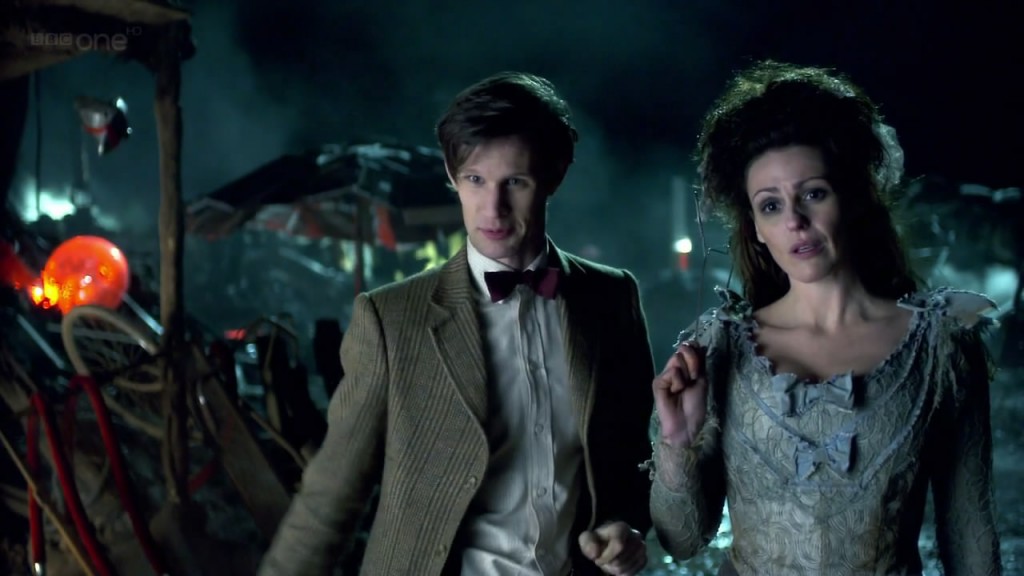
The Doctor and Idris search for a way to follow House.
‘The Doctors Wife’ is a great episode that explores the shows longest running relationship, that of The Doctor and the Tardis.  Whilst I was initially uncertain as to what direction Gaiman was going to take the episode in when we discovered that Idris was in fact the ‘soul’ of the Tardis, but any doubts I had were very quickly put to rest.  The instant on chemistry between Matt Smith and Suranne Jones was a pleasure to watch, and they explored aspects of the character that we’d rarely seen up to that point.

We begin to gain insight into The Doctors life on Gallifrey, discovering that the Tardis itself was actually a museum piece the first time The Doctor saw it, and instantly fell in love with it.  Idris even goes on to tell us that whilst The Doctor may believe he stole the Tardis, the Tardis considers it the other way round.  The flirting and the arguments that the two of them have are a real treat to watch, and come the end of the episode you find yourself wishing that The Doctor and the Tardis are always able to interact this way.
The Doctor in the old control room.


Amy and Rory also have an interesting time in this episode, with the two of them trapped inside the House controlled Tardis whilst being hunted by Nephew.  Through them we get to explore some more of the Tardis, getting to see more of it than ever before since the shows return in 2005.  It also takes the time to start to explore the relationship between Amy and Rory and the fears they both share, of loosing each other, of waiting and being forgotten, and yet again another death of Rory.

The final confrontation of the episode takes place inside the Tardis control room, but not the main one, instead we are treated to a brief re-visit to the Eccleston/Tennant control room that the Tardis keeps filed away.  Getting to see Matt Smiths Doctor in the older control room along side Amy and Rory is great, and doesn’t outstay its welcome at all.

The final goodbye between The Doctor and Idris is a teary eyed one, though not completely sad.  The Doctor may not be able to interact with the Tardis the way he did with Idris, but he did get a chance to speak to his wonderful machine, and we got a chance to see the love these two alien beings share for each other.  It is easy to just think of the Tardis as a machine, but this episode reminds us that it is alive, that it is The Doctors home and that it is the one who shows him the wonders of the universe.  A brilliant episode that had become an instant classic.  10/10

Amy.
xx

Amy Walker Facebook
Trans Girl Writer Facebook Fan Page
Amy Walker Twitter