Friday, 29 November 2024

Wolves, Pigs & Men - Blu-ray Review


Kinji Fukasaka is considered one of the masters of the yakuza genre, and his 1964 film Wolves, Pigs & Men is a stark, often brutal look at the violence within the yakuza, as well as the bonds of brotherhood that are found there.

The film follows three brothers, Kuroki (Rentarô Mikuni), Jirô (Ken Takakura), and Sabu (Kin'ya Kitaôji) , and charts their escape from their world of poverty into the the violent world of organised crime. Each of them grew up dreaming of escaping their world, of making more of themselves. The eldest of the siblings, Kuroki, is the first of them to escape the slums that they've called home, leaving behind his siblings and ailing mother to join the Iwasaki yakuza gang. A number of years later Jirô follows suit, leaving home and entering a life of petty crime. Jirô ends up working alongside another criminal named Mizuhara (Murota Hideo), and the two of them achieve some success. When Jirô catches the attention of the yakuza bosses, however, his operation is destroyed, and he finds himself in prison for several years. 

All of this happens in the films opening sequence, despite being enough for a film itself. Once the film begins in earnest, Jirô returns home from prison, where he learns of his mothers death. This brings him back into contact with his youngest brother, Sabu, who was left alone to care for her in her final years. Wanting to escape his home and start a new life Jirô plans a daring heist, knowing the time and location of an upcoming drugs shipment. He hires his brother Sabu and his friends to help him, an offer that he intends to go back on. However, the drugs belong to the Iwasaki yakuza, where their eldest brother Kuroki has become a leader, and the plan looks set to bring the three brothers on a collision course with disaster. 


Despite being recognised as a master of the genre, this particular release from Fukasaka was somewhat overlooked in its original release, thanks in part to its stark and brutal nature being in contrast with the image that Japan was pushing for itself in the build up to their first Olympic games. Despite this, the film has found something of a following over the years, and the new 60th anniversary release makes for a perfect opportunity for fans to rediscover it.

The film presents a stark, often bleak look at the world of Japanese organised crime, and where often a story about three brothers would have them working together within that world Fukasaka makes the bolder choice to have them all walk their separate paths, ones that end up crossing each other and bringing them into conflict instead. It at times feels more like the three lead characters are doomed, that perhaps they're cursed by the world of crime, drawn in against their will into these terrible circumstances. The film is brutal, and even nihilistic at times, and whilst it's an entertain watch it's far from a fun one. It shines a spotlight on the darker side of Japanese life, and human nature, in a way that would become a signature for the director.


The film has been restored from the original Toei prints, and looks great in HD. There are some elements that are weaker than others, such some parts of the film looking perhaps a little too dark, and some of the outdoor scenes lose a bit of quality over the interior shoots; but this is more due to the filming limitations and equipment at the time and isn't far removed from what you'd find from other film of the era.

Alongside the restoration there's a new audio commentary track by Jasper Sharp, an expert on Japanese cinema who goes into the life and careers of the cast and crew, as well as discusses the impact of the film both at the time and over the years. As with other Eureka releases, this kind of commentary track is incredibly interesting and informative, and is a wonderful accompaniment for the film. There are also interviews with screenwriter Satō Jun'ya, and producer Yoshida Toru, both sitting at around 20 minutes each. There's also a short interview with Fukasaku's biographer, Yamane Sadao.

As one of the important films in Fukasaku's career Wolves, Pigs & Men makes for a culturally interesting piece, as well as a damn good movie in its own right. It's a bleak, dark, and often violent affair, one that won't exactly have you coming away from it feeling particularly cheerful, but as a piece of Japanese film history it's not to be missed. 


Support Amy on Patreon

Buy Amy A Coffee

Go to Amy's Blog

Thursday, 28 November 2024

The Bog Wife by Kay Chronister - Book Review


'Since time immemorial, the Haddesley family has tended the cranberry bog. In exchange, the bog sustains them. The staunch seasons of their lives are governed by a strict covenant that is renewed each generation with the ritual sacrifice of their patriarch, and in return, the bog produces a “bog-wife.” Brought to life from vegetation, this woman is meant to carry on the family line. But when the bog fails—or refuses—to honour the bargain, the Haddesleys, a group of discordant siblings still grieving the mother who mysteriously disappeared years earlier, face an unknown future.

'Middle child Wenna, summoned back to the dilapidated family manor just as her marriage is collapsing, believes the Haddesleys must abandon their patrimony. Her siblings are not so easily persuaded. Eldest daughter Eda, de facto head of the household, seeks to salvage the compact by desecrating it. Younger son Percy retreats into the wilderness in a dangerous bid to summon his own bog-wife. And as youngest daughter Nora takes desperate measures to keep her warring siblings together, fledgling patriarch Charlie uncovers a disturbing secret that casts doubt over everything the family has ever believed about itself.'

The Appalachian mountains is an area of the United States that seems to come up in horror a lot. It's remote setting, the ancient feel of the land, and almost sinister beauty that it possesses makes it a great setting for the unsettling and horrific. Kay Chronister's The Bog Wife taps into this beautifully, but moves away from the more common forest setting that Appalachian horror tends to set itself in, and takes readers instead into an ancient bog.

The Haddesley family have lived on the bog for generations, tending to the cranberries there. But the Haddesley's aren't a normal family, and their lineage holds unique history. Generations ago, a member of the family was cast into the bog as punishment for a crime, rocks loaded into his pockets. He sank beneath the surface, and was gone forever; but it seems that he made a deal with the bog as he died. Emerging from the bog was a woman, made from peat, and sticks, and swamp waste. This bog wife married the eldest son, the next patriarch of the family, and together they created the next generation. When it was time for that patriarch to die his body was fed to the bog, and a new bog wife was created for the new heir.

This is how the Haddesley family has operated for as long as they can remember, isolated from the outside world, living in this ancient, mystical tradition. However, as the Haddesley children, Charlie, Wenna, Eda, Percy, and Nora, gather to feed their dying father to the bog their lives are changed forever when the bog fails to provide them with a new bog wife. Now, with their father gone and their future uncertain, the Haddesley siblings must try to find a new path.

The Bog Wife is an interesting type of horror story, in that a lot of it almost doesn't feel like it is one. When the bog fails to produce a new bog wife part of me questioned if perhaps the stories were untrue, that the siblings had been raised to believe a lie. None of them can remember their own mother that well, her having gone years before, so was she not a bog wife as told, but perhaps a normal human? The story continues this way for much of the book, with no overt signs of the supernatural or paranormal, leaving the reader to try to decide for themselves what might be happening. There are answers by the end, but the unsettling journey to them is what made me really enjoy this book.

Instead, a lot of the book is unsettling instead of outright horror, and much of that comes down to the characters. The Haddesley siblings have been raised in something of a cult-like setting, listening to stories from their father telling them how they're special, how they have a connection to the bog, and how the bog itself will provide for them. It's disturbing at times as I came to feel bad for them, and I could see the trauma that they'd been through even if them themselves were unaware of it.

Their isolated upbringing is also reflected somewhat in their characterisation. The siblings are all adults, with Wenna having moved away from the family and set up a life for herself in the normal world. But they all read as somewhat younger than they should be. They act more like teenagers or children at times, and whilst this at first felt a little odd to me I came to the realisation it was because of how they were raised. They'd been isolated, taught by a single father, brought up to believe some strange things, and as such their emotional maturity was somewhat stunted as they'd not had the kind of interactions and growth they'd need to become regular adults.

Each of the siblings also reacts to the sudden shift in their fortunes in different ways. Charlie, the eldest son kind of gives up, doesn't do much, and becomes disengaged from things. Eda, the eldest daughter, steps into the role of head of the family, and tries to keep things together as best she can. Percy intends to make sure the bog and the Haddesley's continue on as they always have, and retreats into the bog itself to try to find a solution. Each of them displays a very different reaction to their world view coming into heavy challenge, and with Chronister splitting the book into various point of views we're able to really get into their heads and see how they're handling it.

The Bog Wife is an eerie book, one filled with suspense and thought provoking characters. The setting also feels wonderfully unique, and Chronister brings the bog to life in ways that serve the story perfectly. For those looking for a slower burn horror story with a creeping sense of dread and lots of characters to get your teeth into The Bog Wife makes for a perfect read. 


Support Amy on Patreon

Buy Amy A Coffee

Go to Amy's Blog

Wednesday, 27 November 2024

Laurel & Hardy: The Silent Years (1927) - Blu-ray Review


It might be because I'm British, but Laurel and Hardy were two entertainers that I was aware of as far back as I could remember, but had never seen a single thing they'd been in. They were iconic, and even having not seen any of their films I knew them by sight enough to be able to identify them in some rather shoddy looking merchandise. They're giants of cinema, and I always wanted to try out something of theirs. The Eureka Masters of Cinema release, Laurel & Hardy: The Silent Years - 1927 presented me with my first opportunity to do so. 

The release brings together fifteen silent shorts, from their very first film together on to the 'official' birth of their partnership. As such, this is a perfect place for anyone like myself to start their Laurel and Hardy experience, as well as a great addition to collections for long time fans.

The first film in the set is The Lucky Dog, and sees Stan Laurel taking the centre stage as a young man down on his luck and facing a number of personal woes. Most of these are physical in nature, such as when he's almost hit by a pair of moving trams, or when his landlady swings her broom at his head. However, things begin to look up for him when he catches the eye of a young woman; but her jealous boyfriend and a mugger, played by Hardy, means it'll be anything but easy for him. I'd heard that silent movies were stunt filled and packed with spectacle, and this film demonstrates that, opening with Laurel taking a dive into the street. It also uses some on screen animation and extra graphics here and there that give things a bit of extra flair. It's a fun introduction to the genre, and the characters themselves. 


45 Minutes From Hollywood is the pair's second film together, and they're still not the headliners that they'd become, with both of them playing supporting parts here. The film is fun enough, but does stand out as something a little unexpected as the two men you've bought the set to see never even appear in the same frame together. It's hard to really say this is a Laurel and Hardy movie, and it's more a film they both happen to be in, but as a piece of their history it's decent to have along. The next film, Duck Soup, feels more like what I've come to understand their movies to be, as the two of them are actually paired on screen for the first time in a substantial way. The two of them are acting in the ways I expect, with Laurel displaying his iconic grin, whilst Hardy slips into the role of the more physical one of the two. It's early days still, and it's not quite there yet, but this really feels like the genesis of what they'll become known for.

As the films progress, we see this pattern, with the two of them briefly coming together before another movie has them doing other things. You can tell that the winning formula hasn't quite been seen yet, and the times when they're together in the earlier movies feel more coincidence than planned, but as you work your way through the films there's a definite shift to the iconic duo we know, and by the end it's a Laurel and Hardy that most people would recognise.

The films collected here showcase a decent range of what silent movies had to offer, and many of them are still as humorous and entertaining as they were back in the day, with the practical stunts and effects being incredibly charming despite how basic some are simply because this was the early days of filmmaking, and you can see the craftsmanship and experimentation on screen in front of you. Even separate from Laurel and Hardy themselves, this set offers an enjoyable look at what films of the 1920's were offering audiences. 


Considering that the films here are almost 100 years old they're presented really well. Most are in black and white, though a few have a slightly different tone to them depending on what filter was used at the time. Because of the age there are times when there are dips in visual quality, and some films can alter from scene to scene, but considering the age and technology from the time none of them are too bad, nor is anything here unwatchable. It's likely the best versions of a lot of these films that most people will have seen. The discs do include some new audio for the films, however, with the music having been newly created for this release; which considering most films of the time had live music in theatres rather than a soundtrack isn't too surprising an addition here.

Each of the films also comes with an audio commentary featuring experts on film of the era, as well as Laurel and Hardy in particular. These were informative and entertaining, and offered me a decent amount of insight into each of the films as well as their backgrounds. There's also a bunch of other features, including interviews with experts on silent movies, alongside archival interviews and recordings.

Having come to this set fresh, with no history with these entertainers I was unsure how much it would grab me or entertain, but the films are presented so well, with tons of extra context and information, that it made for an educational and enjoyable experience. But for fans of the actors it's likely going to be a must buy. Yes, you've probably already seen these movies before, but you'll not have seen them looking this good.


Support Amy on Patreon

Buy Amy A Coffee

Go to Amy's Blog

Monday, 25 November 2024

The Contestant - Film Review


I'm not sure when the first time was that I heard about Tomoaki Hamatsu and his remarkable claim to fame, but it was one of those schoolyard rumours that I'd heard people talking about; a man, stripped naked, and surviving off nothing but competition winnings inside a small apartment as part of a Japanese gameshow. I knew little else about it, and having seen some of the extreme things that happen on Japanese television I made some big assumptions about this, namely that Tomoaki had entered into this situation willingly. The new documentary film The Contestant, that charts this dramatic story, reveals a much darker truth, and presents a story that feels more like a horror film than I could have first imagined.

For those not in the know, the Japanese television show Susunu! Denpa Shōnen was looking for a new reality segment for their series. Having become well known for it's reality based challenges and travel segments, but television executive Toshio Tsuchiya came up with a new idea, to see how long it would take someone to reach a goal of  ¥1 million in magazine prizes with nothing else to live off. To this end he hosted an audition with a number of people, one of whom was picked for the role. This is how Tomoaki Hamatsu became involved in Life in Prizes. The documentary reveals, however, that Tomoaki did not know that he was going to be on television.

Taken straight from the audition, he was blindfolded and taken to an empty apartment where Tsuchiya ordered him to strip naked. He was told that he needed to win prizes to earn his freedom, and was left alone with a stack of magazines and postcards. Unknown to Tomoaki, his every move was being recorded, and broadcast on Susunu! Denpa Shōnen, becoming the shows most popular segment. 


Whilst this situation sounds incredible, it's relayed to viewers here with such mater of fact bluntness that you find yourself shocked and appalled by events. Tsuchiya talks about the idea behind his 'show' as if it's simply some kind of thought exercise and not the very real torture of another human being. He shows little regret or compassion throughout most of the movie, and that coupled with the decreasing health and sanity of Tomoaki, who the show mockingly named Nasubi, meaning Eggplant, because of the shape of his head, makes this a surprisingly chilling experience.

The Contestant charts Tomoaki's journey across 335 days, where he was naked and alone, trying to win his freedom. Whilst he was first given a few crackers each day so that he didn't starve to death, those were soon taken from him and Tomoaki was reduced to eating raw rice and dog food to survive. The film intercuts this footage of Tomoaki with details of the world outside, one where people are tuning in to watch his progress with a sense of glee, where people are laughing at him as he does his best to simply not die. We also hear from his family, who had no idea what had happened to him or where he'd gone, until they saw him naked, starving, and somewhat crazed on their televisions. 

It's somewhat amazing to see the two sides of this event, one where the public are being swept up into a fervour, where they see entertainment and comedy in the situation and they don't want it to end because it's part of their Friday night viewing for almost a year. On the flip side, there's a man who's going through some of the worst psychological torture imaginable. It's heart breaking to watch at times. Especially when you find out what comes next. 

Having finally reached his goal, Tomoaki is awoken in the middle of the night by Tsuchiya, who gives him his clothes back, now hanging off his thin frame, and takes him on a flight. Tomoaki is taken to Korea, where he's treated to a nice meal, and Tsuchiya buys him a gift. Tomoaki thinks this is part of his prize before he gets to go home, that is until Tsuchiya takes him to another apartment, forces him to strip, and makes him go through it all again; but this time in Korea, where Tomoaki doesn't read the language, so has to learn Korean whilst winning prizes. You might ask why he'd go along with this, why he'd not just leave, but by this point Tomoaki's spirit is completely broken, and you can see it. The footage of Tsuchiya convincing Tomoaki to go through this again is horrifying, because it shows how a man has been so broken and his will destroyed by what is frankly a sadistic and cruel TV executive who doesn't want to lose his cash cow. 


Thankfully, Tomoaki's torture couldn't last forever, and he eventually 'won' the show. But as you can imagine, fifteen months of this life had an extreme toll on Tomoaki's life. The documentary takes some tome to go into this, detailing his recovery from his ordeal. Whilst the show made him something of a household name in Japan, with more than 17 million viewers watching him real fame never really came from this. Instead, Tomoaki became a fierce advocate for this home of Fukashima, and would go on to do some incredible things for them. As a result, the film ends on something of a high note (literally), as we see Tomoaki achieve the incredible; but not because of Life in Prizes, in spite of it. 

Tomoaki Hamatsu's story is an incredible one, one that is shocking, horrific, sad, and in some ways inspiring too. He's a man who was exploited and abused for entertainment. He was put on television, naked and almost dying, without his knowledge, his diaries he wrote during this time that chronicled his declining mental state were published by the broadcasters and became best sellers. Everything about him became a product for almost a year and a half, he wasn't a man, but a thing to be used. He was worn down and destroyed, but he also came back with a strength that most people would fail to find.

The Contestant is a film that has to be seen to be believed. The story it tells is one of the most shocking in the modern era, one that shows how terrible the entertainment industry can be. But it's also one that will make you think about the things you watch, will make you question how many reality or documentary shows are actually simply just exploiting people, and how they might be appealing to the worst parts of your own nature. People seem quick to forget others humanity, especially if it benefits them. Tomoaki Hamatsu is one of the best examples of this we have.


The Contestant is released in UK cinemas on the 27th November 2024. 


Support Amy on Patreon

Buy Amy A Coffee

Go to Amy's Blog

Tuesday, 12 November 2024

2 Dumb Dinos - Graphic Novel Review


The newspaper-style comic strip has been around for a very long time, and it's a format that doesn't really seem to be going away even in an age where fewer and fewer people are actually engaging in print news; to the point where it looks like many publications may soon be as extinct as the pre-historic stars of this new graphic novel. Despite this, the format of silly, topical, and even bizarre comic strips continues in online spaces, often appearing on people's social media. And this is likely where most people will have met Scumbag and Dingus, the two titular dumb dinos.

Created by Nathan Hamill, son of the Star Wars mega star and talented creator in his own right, and Eric Filipkowski, who's worked on and off screen in a number of comedy shows including South Park and Drunk History, 2 Dumb Dinos collects together the first 36 strips into a small, hardcover volume. Partially inspired by the comic strips of old, the two creators make nods to current affairs, referencing elections and political figures, as well as having completely odd adventures that make little to no sense at times.


One of my biggest take aways from reading the book (a quick experience that took less than thirty minutes all told), was that I don't really know who this humour is for. Much of 2 Dumb Dinos is stuff happening for no real reason, and with no explanation, and it's perhaps more akin to the online comedy style of Gen Z. Now, this is where I'm going to sound old, and I kind of hate that, but because of this I just didn't really gel well with the book. There's a strip where Dingus convinces Scumbag to buy shoes for his hands, and Scumbag then can't get into a Pringles tube and assumes it's a plot by his friend to steal his new hand shoes. Another has one of the dinos dressing as different sub cultures each week, such as goth or as a Harry Potter fan, only for the last panel to reveal he'd been caught on To Catch a Predator, but don't worry, it's not a paedophile thing. If this is supposed to be comedy it didn't work for me as I failed to even crack a smile. 

Many of the strips are like this, with almost disconnected things happening, leading to a punchline that's either got nothing to do with the rest of the strip, or just kind of peters out into nothing. Yes, I know that this is essentially Gen Z humour, where things are either random and weird, or they're funny by not being funny, but I'm not Gen Z, I'm old and boring (I guess), and so there was very little about the writing of the book that I actually liked. One of the strips even succinctly summed up why I didn't really click with it, with one of the dinos saying 'I think the fans are happy just watching us talk in profile in this featureless room that could really just be anywhere…We’ll just stick with what works: jokes that don’t make any sense or even have a punchline.'


But, comics aren't just about writing, they're also art, and the art can be a hugely important part of the final product. So, what's the art on 2 Dumb Dinos like? Well, the front cover is about as colourful as it gets. The purple and green of Dingus and Scumbag on the cover of the book is the only time you're going to get the characters looking like that. The interior of the book is very, very brown. There are two colours, a light brown that's pretty much everything, and a darker brown that's used for shadows and highlights. As such, the book is very dull looking, and mixed with the flat comedy, it led to a reading experience that felt devoid of much enjoyment. If the book was coloured normally, with the lead characters being bright and colourful, and the items and costumes used for their gags having some character, then perhaps the book would have landed better for me; but as it is it's two dull looking characters in a dull brown void that was thoroughly visually unappealing. Hamill has colourist listed amongst his credits, but little of that seems to be on show here.

This seems like a pretty negative review, and I'm disappointed that it comes across that way because I wanted to like the book. I like this kind of format of short funny comics, but I think this boils down to me not being the target audience. There will absolutely be people out there who love this, who find it funny and will get the humour. I'm just not one of them. So I'm not going to say it's bad, I'm not going to say it's a book you shouldn't try out, because it could very well be a hit for you. If you like weird and random humour, if you're Gen Z and grew up on odd internet memes and shows like Spongebob Squarepants then you should definitely give 2 Dumb Dinos a look.


Support Amy on Patreon

Buy Amy A Coffee

Go to Amy's Blog

Monday, 11 November 2024

Marginal by Tom Carlisle - Book Review


'When Rob receives a call in the middle of the night, he knows it must be bad news. But he isn't quite prepared for what he hears; his brother, Marcus, has died on the Systematics compound in Scotland, where the two of them grew up. The place Rob managed to escape with his sanity barely intact, the place that hollowed out his parents and his brother.

'Rob is determined to go up north to the compound to see Marcus laid to rest, but more importantly, to get to the bottom of what killed him. Because Rob has been waiting for the Systematics to make a mistake, for their charismatic leader Bjorn Thrissell to show his true colours so that Rob can make their crimes public and bring them down for good.

'But when Rob arrives at the compound with his producer Lucy in tow, they discover a group of people coming apart at the seams and paranoia seeping through the community. Mutiny is in the air and worse still… there is something lurking under the surface, something monstrous and murderous, something that has been biding its time in the margins…

'Trapped and isolated, Rob and Lucy are going to have to put their trust in the community they have come to ruin if any of them are going to have any hope of survival.'

Cults are a ripe ground for horror stories. They're a very real horror that exists within our world, one where we can see how far people can be abused and broken by corrupt leaders, as well as showcasing the extremes that people are willing to go to for their beliefs. Some of the most frightening things people have done throughout history have been because of religion, and modern day cults are usually reflective of this. As such, Marginal is able to tap into some very dark ideas and horror that feels very grounded with its story set around a remote cult in remote Scotland. However, it's not afraid to dive into the realm of the fantastical too.

The story follows Rob, a man who was raised as a member of the Systematics cult, but who managed to escape from it a number of years earlier; an experience that still has a number of psychological scars that he's living with. When Rob is awoken in the middle of the night with a phone call telling him that his brother, Marcus, who remained in Systematics, has died, Rob knows that he's going to have to face the terrible events of his past.

Rob is determined to be there for his brother's funeral, being held within the Systematics compound in Scotland, and wants to find out exactly how and why his brother died so suddenly. Lucy, a young podcaster who wants to get a story about Systematics, accompanies him north, hoping to get the big scoop that will make her career. The two of them arrive at the compound and meet with the leader of the cult, the charismatic Bjorn Thrissell, hoping that they'll be able to learn the truth. Unfortunately, neither of them could ever expect what they find.

In some ways Marginal feels like a book of two halves, with half the book being very grounded in reality, dealing with the Systematics cult, and their affect on Rob and his brother. It's got some dark moments, as all stories about cults tend to do, but it's geared more towards character drama and mystery as to how Marcus died than anything else. 

Rob is something of an unlikeable protagonist in some regards. He's clearly a man with a lot of demons and a lot of trauma in his past, and this is all being dragged up to the fore thanks to the loss of his brother and having to return to the Systematics compound. But, because of this there are times where he's somewhat overly aggressive, he snaps at people, he's surly and withdrawn. His journey throughout Marginal, and the way it affects Rob emotionally is one of the main aspects of the book, and it's interesting to see the journey he goes through, but there are also times where I kind of wanted to yell at Rob. This isn't a bad thing, and having an imperfect lead character can be a lot of fun, but I can see how this might be challenging for some readers, and why not everyone might gel well with him.

The supporting characters are kind of similar too, thanks in no small part to most of them being cult members. A lot of people in the book are self serving, or liars, or simply untrustworthy, and it leads to a situation where as a reader I was never sure if I could trust what people were saying or doing, or if I should want to see them come out the other side. It created this somewhat grey narrative, one where I found myself challenged in a lot of ways.

Marginal is a story about a cult, but it's also more than that, as there's a shift in the narrative part of the way through that turns this from a grounded, realistic cult horror story, into something much, much more frightening. I will not say much about it, as going in knowing as little as possible about the book is definitely the best approach, but this shift introduces some wild new elements to the book, and comes with some extreme violence, gore, and body horror that is sure to shock the reader. 

Overall, I had a pretty decent time with Marginal, it had some cool ideas and some flawed characters that I think will likely challenge some readers. But it was also at times a hard read thanks to its darker tone and more depressing story. Marginal will appeal to a lot of horror fans, but it might not be to everyone's tastes.


Support Amy on Patreon

Buy Amy A Coffee

Go to Amy's Blog

Tuesday, 5 November 2024

Advent - Film Review


The Halloween season has just come to an end, and the Christmas season is just around the corner, so what should people be watching in the meantime? Well, why not bridge the gap with some Christmastime horror in the form of the new movie Advent?

Advent, told in a documentary/YouTube footage combination, tells the story of Hayley (Rasina Alexander), a young woman who's recently lost her mother to a tragic and gruesome suicide, and is trying her best to find some stability in life alongside her alcoholic father. Thanks to her love of urban legends and the paranormal, Hayley has been using her YouTube as an outlet, something where she can share her passions with other like-minded people. Unfortunately, she's somewhat obsessive, checking every comment instantly, tracking her views, and uploading more videos than she can likely manage.

As Christmas is approaching, Hayley tracks down something truly special via an internet seller, a Krampus Calendar. According to legend, this old wooden advent calendar is a way of access the world of the paranormal, and will allow the user to give their soul over to Krampus. Believing that this will help to make her internet famous, she buys the calendar and plans to use it; much to the dismay of her best friend, Charlie (Cian Lorcan). The calendar has some strict rules, each door must be opened at midnight, and the challenge within must be completed within twenty-four hours. Whilst some of the challenges seem simple and innocuous at first, such as circling your Christmas tree three times, or knocking on a window, they soon take on a darker tone, and it's clear that something is having a strange effect on Hayley.


Found footage movies are a common choice amongst low budget horror directors. You don't need much equipment, you don't need a big crew on set, if things look a little janky and unprofessional it adds to the amateur footage quality, and thanks to the advent of everyone having a camera on them it's incredibly believable that people would record strange events happening to them. Whilst there have been some truly great entries into the genre over the years there have been a lot that have left a lot to be desired thanks to how much easier they are to make, and people with little to no experience giving making a horror film a try. And whilst Advent will not be remembered amongst the ranks of films like The Blair Witch Project, Goniam Haunted Asylum, or Paranormal Activity, it manages to be entertaining enough that I never once felt truly bored; which is something I'd class as a big achievement in the found footage genre.

Writer and director Airell Anthony Hayles has managed to craft an interesting narrative in Advent, a film that blends together a sit down interview with Richard Hill (Nicholas Vince), someone who knew Hayley and has expertise on urban legends, and footage from Hayley's YouTube. The choice to blend together what's essentially the regular kind of found footage scenes with a more documentary style helps the movie quite a bit. It breaks up the scenes, allows a narrator to add context and background detail that would be hard to fit in naturally, such as the origin of the evil calendar and the fate of Hayley's mother, and it gives the movie an air of legitimacy. Many found footage films try set themselves up as evidence footage or lost tapes suddenly found, but Advent plays more like a low budget documentary show you might find on a small channel at 11pm, and it kind of really works that way.

Hayley's story, the main thrust of the film, is also very interesting as not a huge amount actually happens in terms of jump scares or frights. I had something of an expectation that as each door on the calendar opened we'd get mounting supernatural experiences, such as the ramping ghost activity in Paranormal Activity, but instead most of the film was a collection of videos where Hayley was showing each challenge and performing them with no apparent result. Instead, it's the overall event that generates the tension. Each challenge seems banal, even silly, but as they go on you start to see a physical and mental decline in Hayley that unnerves more than any shadow figures or loud bangs in the night would manage.


Hayley is a character that suffers, a lot. Her journey over the course of the film feels mostly normal at times, though there are enough weird things that happen that you question if there might be something supernatural at play. Because of this it feels eerily grounded, and the movie takes on this horrible voyeuristic feel where it's like we're watching someone have a terrible mental health crisis. You feel intrusive being there, that we shouldn't be seeing this, and the sense of realism that is brought to things gets under your skin.

Because of this, the film is a slow burn, and so may not be to everyone's tastes, but where most found footage films go for jumps and characters we're waiting to see killed off Advent feels like it's trying to be more of a character study, and so it offers something that will scratch a very different itch. That being said, there is a scene in the film that does a couple of supernatural switcheroo's that lead to a moment that I absolutely adored, and I feel was worth the price of admission alone.

Advent is an unusual film. It's sitting in a genre that has some very tried and true formulas but instead of going along with them is having a go at crafting something a little bit different. The performances from the cast are decent, with Rasina Alexander being of particular note thanks to how well she portrays her characters slow descent into horror. If you're not quite ready for the spooky season to be over and need something to get you ready for the incoming holiday season then Advent is definitely worth considering.


Advent is released on UK digital streaming platforms on 25th November.


Support Amy on Patreon

Buy Amy A Coffee

Go to Amy's Blog

Friday, 25 October 2024

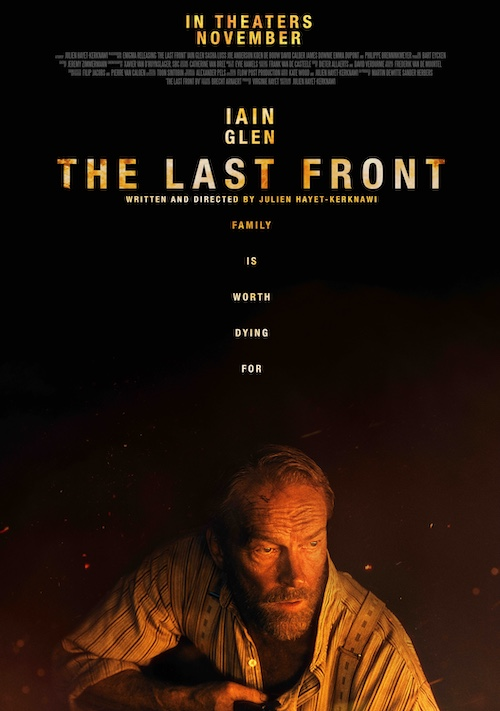
The Last Front - Film Review


World War I was hell, anyone who knows about it will agree with that, and the name will spark images of muddy battlefields, trenches, and conditions that were like hell on earth. But, the war was more than just those kinds of battles, and The Last Front, despite the name, takes a look at some of the earlier confrontations in that war through the eyes of a widowed farmer thrust into a position where he has to lead a resistance force against a cruel invader. 

Iain Glenn stars as Leonard Lambert, a Belgian farmer and father of two young adult children, daughter Johanna (Emma Dupont), and son Adrien (James Dowie). Leonard spends most of his time managing his small farmstead, and occasionally having to deal with the budding romance between his son and the daughter of a local doctor, and how their different social classes makes their young love forbidden to their parents. It's a simple life, one that is broken when a group of German soldiers arrive in the village, seeking to take whatever supplies they need, no matter what they must do to take them.

The Germans are led by Lt. Laurentz (Joe Anderson), a particularly twisted and cruel individual. The first time we meet Laurentz and his men they're travelling through a small town when a panicked inhabitants takes a shot at them. This results in every home being raided, and civilians being dragged out into the streets for execution, no matter who they are. Larentz is a villain, pure and simple, with no shades of grey to be found. As such, when he descends on Leonard's community the residents are faced with few choices, die, run, or fight. Despite not wanting to fight, and wanting to take a peaceful way through life, Leonard soon finds the leadership role of the fledgling resistance force thrust upon him. 


Iain Glenn has a great energy to him that really seems to suit the role he's playing in The Last Front. He has a weariness and quiet, gentle way of speaking that you feel like he's a man who's seen a lot of the world and has grown wise from it. He's kindly, and projects a lot of warmth, yet is also able to switch that off and become a fierce fighter. It's many of the qualities that he brought to his character across eight seasons of Game of Thrones, and so those that might be checking out The Last Front because they recognise Glenn from there will likely feel very comfortable with his performance here.

And Glenn isn't alone in delivering a great performance, as the film seems to go out of its way to put some great talent on the screen. Joe Anderson is superb as the monstrous Laurentz, a character who's so one dimensionally evil that in some ways he feels like a bit of a throwback to older movies where filmmakers didn't necessarily want much nuance to their antagonists. Despite this, he's still a great character, largely because he's so despicably nasty that you don't really care that he's a bit of a caricature and you just want to see him get what's coming to him. Anderson makes you hate his character, and keeps ramping up your disgust for him; which is exactly what you need in a film like this. 

The rest of the supporting cast do decent jobs too, and whilst none of them stand out on screen as much as the two leads they all deliver solid performances. The younger cast bring a lot of passion, especially the two young lovers desperate to defy their parents and the class system they're born into. It is very noticeable that a film about Belgium and German characters is populated by British actors, and there are some times when things feel very British, one character yelling 'oy!' like he's down the pub for example, but after a whilst you get lost in the characters and their stories and forget about the slightly off accents.


The Last Front is the first film from director Julien Hayet-Kerknawi, but it doesn't feel like he's stumbling around to find his style, or that he doesn't understand the filmmaking process as some early directors do from time to time. The film is very well shot, and the production values are very impressive for what is a fairly small production. The film looks great on the screen, and the night scenes, illuminated by the flaming torches the characters are carrying with them, really pop and impress.

Someone looking for a more nuanced film, one that presents the idea that people on both sides of World War I were humans, with complexities, motivations we can perhaps understand, and morals skewed by their governments will likely be a bit confused by the way that The Last Front does things, as it takes a much older approach to war movies by making the villains truly evil and the heroes morally good. It's a simple period action affair, but one that presents itself with great charm and care to deliver a decent product that you can't help but enjoy it.


The Last Front is available in UK cinemas from 1st November.


Support Amy on Patreon

Buy Amy A Coffee

Go to Amy's Blog

Friday, 18 October 2024

Studio One Forever - Film Review


Queer spaces have become a fairly common sight in modern times, with most large cities having at least one bar catering to the LGBTQ+ community. Of course, that's not always the case; I grew up in a town that has never had a queer space, but is also rampantly homophobic. Times are still hard, but they also feel like they've mostly gotten better. If you ask most queer people about the history of queer bars and clubs they'd name the Stonewall Inn, but there's another place that deserves to be spoken about, Studio One.

Opened in 1974 in Los Angeles, Studio One was a disco dance club, filled with drinks, drugs, and topless men, and a live music venue that would host some of the biggest names in Hollywood as both acts and patrons. Created during a period where homophobia was rife, where two men simply holding hands on the street would be enough to get them a beating from the police, and when raids on queer establishments was a regular occurrence, the opening of Studio One was an act of defiance in a world that punished the queer community. However, thanks to the desperate need for a space such as this, and the glamour of LA, Studio One not only survived, but thrived.

The new documentary film, Studio One Forever, delves into the history of the establishment, featuring first hand accounts from the people that called it home. The documentary was spurred on in large part by that fact that in 2019 a development plan proposed the destruction of the building where Studio One was once based, a building seen as a historic landmark by many. Thanks to the fact that two of the people on the council were once patrons of the bar during the 70's and 80's, attention was given to the situation, and the community was called to rally to save this piece of history.


The film charts this journey, but also goes into the origins of Studio One. We learn about the need of the space, hearing first hand accounts of how hostile LA was to queer people at the time, and how Studio One gave them a place where they could be themselves. Through interviews, and using footage and photographs from the time we're able to see how much Studio One meant to people, and are able to witness the open joy of young queer people able to be themselves, to dance, celebrate, and love openly. 

It's interesting to see the duality of Studio One as well. One side of the building was a heaving dance club, filled with shirtless, sweaty men dancing to loud music, an experience enhanced by both drink and drugs. The other side, however, is presented as a more 'high-class' establishment, with a stage where live performances would be held to a room of seated guests who were wined and dined across the evening. This latter part of Studio One, named the Backlot, would host names like Sammy Davis Jr, Joan Rivers, Tina Turner, and Paul Newman. The club was a creature of two halves that somehow worked together to create a unique space that was able to go beyond just the queer community, and became an icon of the city.

For those that we see campaigning the city to keep Studio One alive, these were the stories they shared, the successes, the celebrations. However, the film also shows us the darker side of this history as we move from the 70's into the late 80's and early 90's, to the height of the AIDs epidemic. Anyone who knows about the AIDs crisis knows how much it harmed the queer community, so much so that many have twisted the narrative of the disease's history into being a 'gay disease', despite it affecting anyone and everyone, no matter their sexuality or gender. But, because it was harming the queer community the most a response to AIDs was slow coming, and many, many lives were lost.


This is the most affecting part of the documentary, as the film covers this period. The people who were there at the time, who are speaking now list name after name of those who were lost. They describe how one week their friends would be alive, and the next they'd be dead. A treasure trove of rediscovered photos from Studio One became a slideshow of faces of the dead. The people who speak during the documentary, people like Lloyd Coleman, Gary Mortimer, Gary Steinberg, Ron Hamill, and John Duran reach a point where they're unable to keep speaking more than once. We get to watch them relive the deep trauma of this period as they tell stories about people who were left to die by an uncaring world. 

Studio One Forever isn't just a story about a nightclub, it's a story about the people who called it home, who had it as a refuge, people who very few of are still with us today. It's a documentary about a unique and often amusing venue that would be entertaining enough on its own, but it's also a monument to those we as the queer community have lost, and a lesson as to why preserving this history is a hugely important thing. I never knew about Studio One before watching this film, but I came away believing that it's an incredibly important story, one that deserves its time on the screen.


Support Amy on Patreon

Buy Amy A Coffee

Go to Amy's Blog

Tuesday, 15 October 2024

The Convert - Film Review


Colonialism has caused irreparable damage to the world, with numerous cultures having been completely erased by mostly European settlers who forced their way of life to convert those they could, and murder those they couldn't in truly terrible ways. Over the centuries since these cultures and nations have been damaged by colonial powers it's been hard for these people to even exist, let alone tell their stories. Thankfully, there has been more of a shift in the last few decades, with more and more people willing to not only listen, but to denounce the actions of their ancestors as horrific. I've enjoyed seeing this shift, and learning the more truthful history of these events and their impact has been hugely educational. As such, I was immediately intrigued by director Lee Tamahori's latest film, The Convert.

Set in the 1830's, the film follows the journey of Thomas Munro (Guy Pearce), a lay preacher who has agreed to travel across the world from his home in England to the new colony of Epworth on the coast of Aotearoa. Along the way the ship he's travelling on must stop to gather timber for repairs, and Munro leaves the ship to explore the new land he'll be calling home for the first time. Whilst exploring, he comes across a clash between two Māori tribes. The chief of one of the tribes, Akatarewa (Lawrence Makoare), is the father of a young Māori man serving on the ship he's travelling on, and so he's able to approach him and ask for mercy for two captured young Māori. Akatarewa agrees to let one live, in exchange for Monro's horse, and kills the others. Thus, Munro ends up becoming the guardian of Rangimai (Tioreore Ngatai-Melbourne), the daughter of another tribe's chief.


Continuing on his way to Epworth, with Rangimai at his side, Munro finds a tiny collection of cabins in a harsh and uncaring landscape. And those that call the town home are similar, showing little to no care for the young woman in Munro's care, refusing to give her much needed medical treatment. As Munro settles into his new home he sees the ugly side of the settlers, those that live on Māori land but show no deference to them or their culture. As Munro learns more about the indigenous people he tries to prevent a coming war between them; a decision that will forever change his life. 

For a film with a title like The Convert, about a preacher travelling to a land that we know used religion to try to erase the native people, and with a story that seems to try and place a white man into the middle of a situation where he could rise up to be the hero, I was worried about The Convert essentially being a white saviour story. Thankfully, the film subverts these tropes and expectations, instead telling a story about a man learning that he may be wrong about his place in the world, and that his faith and its applications might be incorrect. 

The Convert is told from the perspective of Pearce's Munro, and he's in almost every scene of the movie because of this, being our eyes and ears in this setting. Because of this, much of the film rests upon Pearce's shoulders, and how he plays Munro makes or breaks a lot of the film. From the very first scenes of the film he's shown to be a quiet man, one who's happier to watch and learn about others rather than taking the centre stage. He thinks before he acts, and seems to be guided by a strong sense of morality. This becomes even more evident when we reach Epworth, and he's faced with more outward corruption and hostility. You can see a quiet rage simmering away just beneath the surface, and the body language that Pearce has in some of these scenes feels like a man fighting not to explode into action. It's a wonderfully subtle performance, one that's paid off brilliantly later on in the film where we find out about the ghosts he's been carrying with him, and then with where the film leaves his character in the final scenes. 


But, this isn't just his story, it's a story about Aotearoa and its people, and as such the film populates itself with some fantastic characters and actors of Māori descent. Tioreore Ngatai-Melbourne has the most screen time as Rangimai, a young woman dealing with the murder of her husband right in front of her, whilst finding herself suddenly thrust into a strange new situation as she's taken to Epworth. Ngatai-Melbourne is cold to begin with, wanting little to nothing to do with the man who now essentially 'owns' her. However, as time passes and she heals, and learns that Munro is in fact a decent man there's a wonderful sense of adventure and hope that comes over her. She's eager to learn to speak 
English, and her joy at the idea of going to the Epworth town dance is incredibly sweet. It's through her that we also learn a lot about Māori culture, getting to follow her as she returns to her people.

A great deal of the culture and history of these people is given to us via the character of Charlotte (Jacqueline McKenzie), a settler who has been mostly shunned by her own people for having married a Māori man and having had a child with him. Charlotte is Munro's only translator to begin with, and the only person willing to help him with Rangimai when she's sick, and a decent friendship forms between the two of them. She's able to provide Munro, and us the audience, with important information. It would have been easy to make her character quite flat and one-dimensional, but McKenzie injects a lot of heart and pathos into her. 

One of the stand out's for the film is Lawrence Makoare as the cruel Akatarewa. We meet two Māori chiefs over the course of the film, and whilst one is fairly kindly, willing to listen to reason, and seemingly quite benevolent, Akatarewa is quick to anger and violence. Makoare creates a character that you not only absolutely hate, but feel incredibly justified in doing so. He's a man revelling in his cruelty, who mocks the people at his mercy, and who wants to be seen as the biggest, badest chief around no matter how many people he slaughters to get there. It feels like Makoare is having a lot of fun with the character, and is enjoying playing the villain, and it really adds to the sneering, cruel quality of the character. 


As well as a fantastic cast, the film looks fantastic. The landscape of Aotearoa is put on beautiful display, from lush and gorgeous forests that stretch on for miles, to the fierce coastline that ranges from beautiful coves to windswept expanses of sand. We don't explore the nation a great deal, focusing instead on one small area, but from what we do see the beauty and danger of the land is portrayed wonderfully, and it very much feels like Aotearoa is a land that both challenges and rewards those that call it home. Some of the best looking parts of the film come in the latter half, when we visit Rangimai's home, and get to see how her people live. The settlement is gorgeous, with stunning wooden carvings decorating the gateway inside, as well as the buildings. These are mostly background details, but I kept finding my eye drawn to them whenever they were on screen, hungrily absorbing as much of the beauty of Māori art as possible.

The Convert is a film that would have been very different a few decades ago, where it would have played into the white saviour historical trope that we saw in films like Dances with Wolves, a trope that still continues on today even in fictional settings, with recent movies like Dune, and Avatar playing into this. Instead, The Convert feels like the opposite, it's a white man who's trying to exert his views and his will onto these people because he thinks it'll help them, but in the end ultimately fails. Instead, he's the one who has to learn, who has to see things from a different perspective. The Convert is an apt title because of this, and a film that I think deserves a great deal of attention.


Support Amy on Patreon

Buy Amy A Coffee

Go to Amy's Blog