Monday, 25 September 2023

Godzilla: Here There Be Dragons #3 – Comic Review


Originally published by Set The Tape


With the last two issues of Godzilla: Here There Be Dragons we have been introduced to a time of pirates, swashbuckling adventure, and giant monsters, and it’s been an absolute delight to see these two worlds collide this way. But the third issue gives us something even better than this: a whole hidden history of Kaiju!

Things looked grim for Mr Hull, a condemned pirate, at the end of the last issue as he was led to the gallows for his long promised execution. How is the series going to go on without him there driving the narrative forward? Well, the book kind of did a fake out on us, as the very first panel of this issue reveals that Hull was spared from his fate at the last possible second thanks to the arrival of Sir Francis Walsingham, the principal secretary to Queen Elizabeth.

This new introduction changes things slightly for the story, but not to a huge amount. Walsingham has come to listen to Hull’s story, as part of his investigation into larger issues. This means that Hull will continue his story about his time on Monster Island, but he won’t be under constant threat from his captors, and we’ve done away with the back and forth with his jailers from the first two issues. Which isn’t a bad change. It doesn’t really alter much in how the story is being given to us, but manages to expand the world in interesting ways.

The most interesting thing that this third issue does is that it reveals that it’s not just the people of this time and this culture who have experienced Kaiju before the modern era. A wonderful splash page shows us Godzilla in Feudal Japan, King Ghidorah fighting Roman soldiers, Mothra worshipped in ancient Egypt, Rodan being offered sacrifices in Central America, and Hedorah alongside a Viking long-ship. It turns out that these creatures are known throughout the world and history, but that their existence is a closely guarded secret; one kept by a Kaiju worshipping secret society called The Sons of Giants.

These few pages, especially the one that showed robed cultists wearing amazing Kaiju masks, are perhaps my favourite images in the series so far. Words cannot express how much I want each of those cultist masks. This gives us the reason for Walsingham having arrived in the book, and why Hull is so important. His story may hint at a connection between The Sons of Giants and the Queen of England (please god have Queen Elizabeth be wearing the lobster mask!). A whole new dimension has been added to this story now, and it’s no longer just pirates and giant monsters, but conspiracies and cults.

The issue isn’t just focused on the present, however, as we continue Hull’s story of his time on Monster Island, introducing a human antagonist for the members of his crew to deal with, along with showcasing Ebirah, Horror of the Deep. For a story focusing on seafaring and pirates it feels right that the giant lobster monster makes an appearance here, and seeing him crash through the jungle was a genuine delight. Frank Tieri not only knows how to pace a story and when to throw something big and bombastic at the reader, but it also seems like he’s hitting my all time Kaiju wish list with this story too.

Art on this series has never been anything but wonderful, and Inaki Miranda and Eva de la Cruz continue to to impress each issue. The already mentioned pages where we see the Kaiju scattered across the globe interacting with different cultures is amazing, and the panel showing the secret cult was a jaw dropping moment thanks to the way that the art team execute the visuals. They manage to make it both wonderfully silly and goofy looking, but also so fantastic that you want to see it in real life, which is a hard line to walk on such things.

We’re over the halfway point in the series so far, and it is genuinely not just a delight to read, but a wonderful celebration of the entire Godzilla universe. The only complaint is that there are only two more issues to go, as this is a series that more than deserves to be an ongoing tale.


Support Amy on Patreon

Buy Amy A Coffee

Go to Amy's Blog

Sunday, 24 September 2023

Alligator Loki #1 - Comic Review


There were a lot of great moments in the Loki television series, with some surprisingly great guest stars thrown in too (Richard E. Grant as Classic Loki was fantastic), but something that just grabbed everyone's attention and became a fast favourite was the adorable Alligator Loki. Just a regular alligator with a cute set of golden Loki horns on his head, this reptile stood out the second he appeared on screen. As such, it was only a matter of time until he got his own solo series.

Written by Alyssa Wong, this one-shot issue is fun, simple to read, and enjoyable throughout. The book has no dialogue, and instead features short, silent stories focused on the tricky reptile as he gets into all kinds of hi-jinks and trouble. He breaks out of the zoo thanks to some help from the Young Avengers, goes to a theme park with Thor and rides the roller coaster, and even tries to help his brother take down Doctor Doom at one point.

The stories are quick and fun, and stand on their own, but there does feel like there's a longer interconnecting narrative here too, so that the entire book becomes one long story about the reptilian alternate version of Loki. And he is another version of Loki here, not just Loki changing his shape, as we get regular Loki and Alligator Loki together for a couple of the adventures.

With the book being silent, the art has to do a bit more heavy lifting than you'd normally expect. Thankfully, Bob Quinn, and Pete Pantazis do a fantastic job, and the book is super easy to read. The pages are bold and bright, with tons of small jokes and silly references hidden throughout. The art team manage to put a ton of personality into the tiny green troublemaker, and some of the best moments of the book are when Alligator Loki's initial plans fail, and you can see him plotting his next move with a shady look on his face. The book also recreates the woman yelling at cat meme with Thor and Alligator Loki, and its a genuine laugh out loud moment that delighted.

A simple, yet fun book, one that will appeal to readers of all ages and is super accessible. Hopefully, with the popularity of Alligator Loki this won't be the last time we get a book like this, as it was a lot of fun to read.


Support Amy on Patreon

Buy Amy A Coffee

Go to Amy's Blog

Schrader's Chord by Scott Leeds - Book Review


'I told you they were real. After his estranged father’s mysterious death, Charlie Remick returns to Seattle to help with the funeral. There, he discovers his father left him two parting the keys to the family record store and a strange black case containing four antique records that, according to legend, can open a gate to the land of the dead.

'When Charlie, his sister, and their two friends play the records, they unwittingly open a floodgate of unspeakable horror. As the darkness descends, they are stalked by a relentless, malevolent force and see the dead everywhere they turn.

'With time running out, the only person who can help them is Charlie’s resurrected father, who knows firsthand the awesome power the records have unleashed. But can they close the gate and silence Schrader’s Chord before it’s too late?'

Charlie Remick is living a quiet life, wells, as quiet as a life in the music industry gets at least. Dubbed 'the man with the magic ear' Charlie has been finding hit new musicians for the record company he's working for, and has signed success after success. He's a hot shot in the industry, and he's enjoying living and working in New York; even if he is living paycheck to paycheck. Things change for him, however, when he gets a message from his older sister, Susan, telling him that his father has died. Faced with the prospect of returning home after years away, Charlie is reluctant to go, but knows that he has to face the ghosts of his past.

Arriving in Seattle, he's reunited with Susan, and his twin sister Ellie. The three of them are left to deal with their father's estate after his grim death, a death by suicide. As they're trying to deal with everything that this tragedy brings, the employees at their fathers record store, Ana and Dale, worry about what Raymond's death might mean for them, and if they're out of a job. As the people in Raymond's life come together because of his death, strange things begin to happen. A crazed man dies in a horrific accident at the wake, and Charlie is left a case containing four mysterious records and the cryptic message 'I told you they were real'.

Charlie reveals that the records are part of a ghost story that their father would tell them growing up. Forged by the composer Ivan Schrader, the four records, when played together, would open a doorway to the world of the dead. Not quite believing in the myth, but curious to see what might happen, Charlie, Ellie, Ana, and Dale decide to play the records. What follows is a frightening experience, on that will see the four of them having to fight for their very survival as supernatural forces set their sights on them.

Schrader's Chord is a slow burn horror novel that puts character and story first before scares, one that ends up sucking you in and makes you forget that you're supposed to be reading a horror story. The first third of the book almost forgoes all horror, and instead focuses on the Remick family and the staff at Raymond's record store. It becomes a very real, very well crafted story about relationships, human nature, and the way that people intersect in ways that they don't expect. The main focus is on Charlie and Ana, who get the most time in the book split between the two of them, and explore the death of Raymond in different ways.

Despite being his son, Charlie isn't hugely affected by his fathers passing, due in large parts to how their relationship deteriorated over the last few years. He almost resents having to travel across the country to deal with his fathers death, and his initial reaction to inheriting the record store is one of dismissal, wanting to sell it immediately so as to be done with it, little thinking about what that might mean for those who work their and rely on the place. Ana, however, is the opposite to this. She's not related to Raymond, but has come to see him as a father figure and his presence had ended up changing her life for the better. She's mourning his passing, feeling like the world has lost a kind and caring individual. It's great to see these two almost opposing perspectives, in examining the different ways in which the same person can change peoples lives in completely different ways.

However, this isn't just a book about family relationships and mourning; though it would be fine if it were. This is a horror book, and as such things need to get scary. When Charlie and the others end up playing the cursed records things very much get scary, and from here on out the book becomes this delightfully creepy race against time to survive the horrors that the group unleash. Thanks to the records, the four of them are able to see the dead, to interact with the spirit world that exists around us, unseen by the living. This leads to some delightfully frightening and messed up moments when the group realises that they're in the presence of a ghost, and the dead people start doing some frankly fucked up stuff.

Even when the frights start the book still puts the human characters first. The focus is always on the people, how these events affect them, and how it brings them closer together; Charlie and Ana in particular. The ability to see the dead also leads to some interesting moments as Raymond, who lost his life at the family home, gets to make a reappearance, and he and Charlie are finally able to air their dirty laundry, and deal with the issues that kept them apart in life. It makes for an interesting thing to see a character dealing with the loss of an estranged parent, to have to recon with the issues they had never being resolved, for them to then have the chance to speak to that person again and get to put those demons to bed. As with everything in this book, it's the characters that come first.

Schrader's Chord is Scott Leeds debut novel, and it's astonishing how well crafted it is. A lot of the time with debut authors you tend to see the cracks as it were, the areas where they're not quite as strong, and the places where you know they're going to get better as their career continues. With this book, however, it feels like it's been written by someone who's been crafting books for decades. The character work is fantastic, the world feels full and lived in, the horror is chilling, and the creativity is wonderful. If this is the first book that Leeds has released I can't wait to see what they come up with in the future.

Whether you're into your music or not (if you are you're going to get a lot more out of the book!) there's something phenomenal to discover with Schrader's Chord. This is the kind of book that only comes along every once in a while, a debut that feels like a tour de force, that you hate having to put down because it's so engrossing, one that you can easily see being adapted into a horror film that would take the world by storm. Horror fans looking for something new and interesting need look no further than this.


Support Amy on Patreon

Buy Amy A Coffee

Go to Amy's Blog

Saturday, 23 September 2023

Werewolf By Night #1 - Comic Review


I'm going to be a bit honest before starting this review; I absolutely love the work of Derek Landy. His Skulduggery Pleasant series is one of my all time favourite book series, and when I got to meet him a few years ago it was one of the best author/celebrity experiences I've had. The guy is just lovely. That being said, I didn't pick the book because his name was attached to it. I didn't even see his name to begin with. No, I picked this book up because I loved last years Werewolf By Night TV special that was released, and wanted to see more of that.

In some ways this new one-shot does have some similarities with that show; namely the black and white art style that follows our titular protagonist, Jack Russell. Most of the book is presented in a beautiful, almost Gothic looking black and white art style with a few splashes of colour here and there. What tends to bring the colour, however, is his co-star, the ever wild and bombastic Elsa Bloodstone.

The book begins with Jack tracking down the evil Doctor Nekromantik, who has kidnapped a young woman from a village near his ancient castle. Jack has promised to find Nekromantik, stop him, and bring the girl home to her family. Unfortunately, there's a horde of undead between him and his goal, and Jack is forced to fight his way through them. Fortunately for him, he's not in this mission alone. High above the forest, inside a private plane, Elsa Bloodstone is making ready to launch her own assault upon Nekromatik.

Having stolen the plane from some vampires, who she gets to kill whilst in the air, Elsa blasts her way out of the plane and parachutes into the castle; making as flashy an entrance as she's able to. As the two monster hunters battle their way through Nekromatik's forces, they end up discovering each other, and team up; creating an unstoppable duo.

The first thing that needs saying about this book is that it's ridiculously fun. For those who've read Landy's Skulduggery Pleasant series a lot of the banter and jokey dialogue that's in the book will feel instantly familiar. There's a snappy quality to everything, and it moves at a wonderful pace. Elsa is, in a lot of ways, very similar to Valkyrie Cain here, and that absolutely suits her to a tee. It seems like Landy is at his best when writing snarky, bad-ass women and their sullen, monsterish partners.

The second thing that needs praising is the art. Fran Galan provides both the art and the colours on the book, and it's amazing to flip through and stare at. The book has this very gloomy, almost hand drawn and pencil shaded look to things, where the lack of colour and the simplicity of the art makes it feel like an old black and white monster movie of the 1930's and 40's. When Elsa turns up, however, she's bright and colourful, with gorgeous colouring work that pops on the page. Some of the best moments are when she's a splash of colour on an otherwise gloomy looking page, such as when she's falling through the sky towards the castle in the pouring rain.

Werewolf By Night is a fantastic comic. It has a simple, easy to follow narrative, yet manages to throw in some twists and surprises. The characters are fantastically written, and their interactions are great. And the art is just perfect for this. It's a shame that this is just a one-shot, as I can't help but feel an ongoing with this creative team and character pairing would do fantastically well; and would likely end up being one of my best comics of the year. As it stands, this is a near perfect one-shot that you're not going to want to miss out on.


Support Amy on Patreon

Buy Amy A Coffee

Go to Amy's Blog

Medusa's Sisters by Lauren J.A. Bear - Book Review


'The end of the story is only the beginning… Even before they were transformed into Gorgons, Medusa and her sisters, Stheno and Euryale, were unique among immortals. Curious about mortals and their lives, Medusa and her sisters entered the human world in search of a place to belong, yet quickly found themselves at the perilous centre of a dangerous Olympian rivalry and learned—too late—that a god's love is a violent one.

'Forgotten by history and diminished by poets, the other two Gorgons have never been more than horrifying hags, damned and doomed. But they were sisters first, and their journey from sea-born origins to the outskirts of the Parthenon is a journey that rests, hidden, underneath their scales.

'Monsters, but not monstrous, Stheno and Euryale will step into the light for the first time to tell the story of how all three sisters lived and were changed by each other, as they struggle against the inherent conflict between sisterhood and individuality, myth and truth, vengeance and peace.'

Chances are, even if you're not familiar with the myths, you'd have heard of Medusa. The character has become so famous over the generations that she has appeared in multiple retellings, stories that are only tangentially connected to her original myths, and in media that has no connection at all. The woman with snakes for hair that can kill a man just by being looked upon has grown beyond her origins into something that is likely to last forever in some form or another. And whilst that's true for her, her sisters have had a much more difficult journey. Before this book came along, I didn't even know Medusa had sisters.

Medusa's Sisters, as the title would suggest, is less about Medusa herself (though her story is central to the plot of the book), and instead focuses on those figures who are often left out of the stories, the women who have been left by the wayside over the generations since their inception; Stheno and Euryale. For myself, this was the first time I'd heard these names, and before picking up the book I was only passingly aware of the the origin story for the Gorgons. This is perhaps the best point of view to come into this story from. I came at it with no preconceptions, no expectations, ready to be taken on what would feel like a wholly new journey. And Lauren J.A. Bear did not disappoint in that regards.

The story begins with the birth of three sisters, Stheno, the eldest, Euryale, the middle child, and Medusa, the youngest. These triplet sisters are birthed to Ceto, the goddess of sea monsters. Whilst her other children have all been monstrous in some form or another, these three daughters are birthed beautiful, normal. Looking like humans, the three of them have nothing to them that sets them as special amongst their monstrous family. Except Medusa, who, unlike all others in her family, is born mortal. She will have a long, youthful life like the rest of her siblings, but Medusa is able to be killed, prompting her eldest sister Stheno to dote on her and spend her time protecting her mortal life.

As the three sisters grow, they soon begin to become bored with their existence under the sea. Having been exposed briefly to the world outside their home, and the world of the Olympian gods, the three sisters are determined to see more of the world. The three of them head to Thebes, the kingdom of the monster killer Cadmus, where they are welcomed into his palace with open arms, and soon make friends with his most beloved daughter, Semele. Their time in Thebes shows them much of the beauty of the human world, and the sisters begin to discover their own interests and passions. However, it also teaches them the dangers of the Olympians, as they see the tragedy that can befall young women who try to romance the gods.

Soon after leaving Thebes, the sisters travel to Athens, where they grow further apart. Stheno learns music, and discovers a create outlet for herself. Medusa becomes enraptured by the temples, and starts to spend more and more time there. And Euryale discovers a local brothel, and starts to learn about the pleasures of the flesh. All the while, each sister is drawing closer to the tragic event that will leave them cursed, unable to look upon mortal men, and with monstrous features that will lead to them being known as the Gorgons.

The Greek myths have received hundreds, if not thousands, of retellings over the years. Their stories have lasted so long, and influenced so many others, that it feels like there are too many versions of the same characters to keep up with them. One character that often gets painted very differently from her origins is Medusa. Medusa was punished by Athena, transformed into the snake-haired Gorgon that we think of when we hear that name. She is then killed by a travelling hero who needs her powers to transform those who look upon her, taking her head as a gruesome weapon to be wielded. And at this part of the story Medusa is often made into a villain. The most famous version of her, that from Clash of the Titans sees her as a dangerous killer that Perseus is right to kill. This book never once paints Medusa as anything but kind and gentle, and for that it deserves attention.

The characters of Medusa, Stheno, and Euryale are just that, they're characters. They're regular people for the most part. They're looking to find their place in the world, they're relationships evolve and change, they find things that they're passionate about, they're creative. They're people birthed from the goddess of monsters, but that doesn't make them monsters themselves. And this is the main focus of the book, to show the humanity in these characters. The first two thirds of the book is just that, an exploration of their lives before the tragedy that will befall them, and it's something that I wasn't sure that I'd normally enjoy; yet proved to be deeply absorbing.

Bear does a wonderful job at making the three sisters feel like regular people, with evolving and deeply emotional connections that shape their lives. It's interesting to see how they interact with each other, how their relationships change, and to watch them discover the world outside of the one they knew growing up. Them being almost unaware of how the surface world works becomes a great introduction to that world ourselves for the reader. We get to learn along with them, to discover what this time and place was like, and to learn of the dangers of the gods as they do.

The book also does something wonderfully interesting, it makes the curse that befalls the sisters make sense. In the original myth, Medusa had an affair with Poseidon, and when she learned of this Athena became so enraged that she cursed Medusa, transforming her and her sisters into the Gorgons. But why would Athena care this much? She's not Poseidon's wife, so why would yet another example of an Olympian not being able to keep it in his trousers (there were a lot!) enrage her so much? Bear gives us a reason for this, one that's incredibly tragic and heartbreaking, and so far the only one I've seen that makes perfect sense. I'm sure many will call this a 'twist' on the story, but I think of it more as a deepening of the myth, a correction that would make the myth make more sense, and would further the tragedy of Medusa's tale. It's also something that I think those who read the book will long remember, and will use as a reason to encourage others to pick the book up.

As mentioned earlier in the review, the book isn't just about Medusa, however, and it's real focus is on Stheno and Euryale. As such, the story continues on past the point where most people would expect it to end; the murder of Medusa. Bear makes some changes to established myths, alters some origins and plays around with characters in much more obvious ways in this segment of the book, but does so in a way that transforms the narrative into something else that you don't expect, and it almost feels like you're getting to read a whole second story. The ways in which Bear weaves these narratives together, and keeps taking you on these journeys is delightfully done, and makes me instantly willing to read any other mythological retelling that she writes. 

Medusa's Sisters is a wonderfully crafted and deeply engaging narrative, one that grabs you early on and doesn't let up. It takes stories that are thousands of years old and does something new and interesting with them, whilst also remaining true and faithful to what they were when they were first created. 


Support Amy on Patreon

Buy Amy A Coffee

Go to Amy's Blog


Friday, 22 September 2023

It Follows (2014) – 4K UHD Review


Originally published on Set The Tape


A large part of horror is the unknown; being at the mercy of forces that you can’t understand. As such, it’s always a little sad to see a horror film do well, and go on to spawn a series of sequels, side-stories and prequels that go on to explain almost everything, and take away a large portion of that magic. It’s very surprising then to find a horror film that was a critical and financial success, that’s beloved by audiences, that chose not to do that, and remained a singular piece that refuses to allow its audience those insights and answers. It Follows breaks a lot of horror moulds, and it’s now available in a gorgeous new 4K Ultra-HD release.

It Follows tells the story of Jay (Maika Monroe), a college girl from Michigan who lives with her mother and sister, Kelly (Lili Sepe), and spends her time hanging out with her friends, Paul (Keir Gilchrist) and Yara (Olivia Luccardi). Her quiet life goes through some changes when she starts dating Hugh (Jake Weary), a new guy in town. After a couple of dates Jay and Hugh sleep together, but shortly after having sex, Hugh drugs her. Jay wakes up tied to a chair in an abandoned building, with Hugh looking panicked whilst looking around the building.

Hugh tells Jay that he’s passed something onto her, that an invisible entity will now be coming for her. Only her, and the people infected before her, can see it, and it can take on any human form. The creature will be following her, always walking towards her, and that she needs to be on the lookout for anyone who’s following her. He explains that if it catches up with her it will kill her, and then come after him again. The only thing she can do is to sleep with someone else to pass it on. Shortly after explaining this, the entity appears, and Jay realises that Hugh was telling the truth.

Thus begins Jay’s fight for survival, as the entity begins its relentless pursuit of her. With Jay having seemed to have been sexually assaulted by Hugh after he leaves her at home in her underwear, and her in a state of fear and anxiety, her friends and family assume that she’s simply going through trauma. Now she has to convince those around her that she’s not crazy, and that her life is in danger.


It Follows is the creation of writer/director David Robert Mitchell, and it’s clear very early on that he has a very specific look and feel for the movie, one that will draw you in and interest you as much as the actual story and characters. The film exists in a time out of time, almost in its own world. There are scenes where you see modern cars and phones, and others where cars are from the 70s and 80s. Fashions are mixed, with people in the same room wearing clothing styles from varying decades. Most modern appliances and electronics are absent, with older TVs appearing throughout, showing movies from the 1950s. One of the characters has a e-reader/phone that’s inside a literal clamshell, a compact mirror having been repurposed for this use. The result is a film that is hard to pin down, one that at times feels like a period piece, and others a modern day tale.

Part of this was done due to the director wanting the film to feel timeless, but it was also done to give the narrative an almost dream-like quality, where the small details don’t quite make sense. This absolutely helps the movie, as the central story has a nightmarish quality to it. I’m sure most of us have had a nightmare where something is chasing us, at least once. The slow moving camera shots, the use of wide angle lenses, and the choice to often keep characters isolated in the middle of the frame, small and vulnerable in a wider world, add to this, and give the film a feel unique all to itself.

In some ways, the central antagonist of the film (the titular It) takes some ideas from other places. The themes of sex and horror have been used numerous times over the years, and being cursed because you have sex isn’t a new one. A monster that only you can see, that makes your claims that your life is in danger seem false, fits very much into the cliches of the Gothic, especially when a woman is placed at the centre of it. And the relentless pursuer that never stops, that seemingly can’t be killed, and that cannot be reasoned with, immediately conjures connections to The Terminator. Whilst the film seems to borrow from these other areas, the end result feels very original, and the concept of the creature and the way it works is a novel one.

The creature is also a big part of the enjoyment of the movie. Once you’ve been informed of the rules, the movie almost becomes like a game, albeit a tense one. Once you know that this thing is constantly coming you start to examine every scene, looking for someone in the background who could be the entity. You start to question every person walking towards Jay, trying to figure out if they’re real or not, and you begin to experience a little of the fear and horror that the characters are going through.

The cast sell this fear well, with Maika Monroe doing a wonderful job at showing this slow descent into desperation and fear. Her character goes through a lot in the film, feeling like her boyfriend assaulted her, not knowing if she’s going crazy or not, trying to show her friends that she’s not imagining things, and then dealing with the idea that she’s in danger for the rest of her life unless she places another person in danger. Monroe manages to convey this journey in a subtle way, never descending into screaming and shouting, with a more internalised journey going on. A lot of her scenes almost have a sense of defeat to them, of a young woman pushed so far to the edge that she has nowhere left to go, and is ready to give up. It’s a decent contrast to Weary’s performance, who injects Hugh with a manic desperation and frayed nerves that puts his own trauma on the surface.


The music is another aspect of the film that stands out, and the film’s composer, Disasterpeace, is as integral to the success of the film as the cast and director. Having previously worked on video game scores, this is the composer’s first film work, and it’s hard to believe as the score for It Follows is one of the best horror scores in decades. Like with the other aspects of the film, the score feels weirdly out of time, though its heavy use of synths gives the film a very 80’s feel, and reminds one of John Carpenter in the best ways. The music elevates the film thanks to the ominous moods that it brings to scenes that would otherwise feel normal and benign, and it’s often the shift in sound that will set you on edge. Disasterpeace enhances every moment of the film with his music, and the recurring motifs and themes end up getting stuck in your head.

There have been many essays and dissections of It Follows over the years, and a quick search online will bring up dozens of deep dives into the film’s themes, its meanings and interpretations. Modern horror tends to play things quite straight, with things being either easily understandable, or with explanations given in the narrative. It Follows bucked that trend, and because of that it grabbed viewers’ attention. Not knowing what the creature is, where it came from, or why it does what it does makes the movie get under your skin a little bit more. You end up thinking about it after it’s done, you create theories, you discuss it with others, and you end up going back and revisiting it hoping that you can glean some further insight. This is why the film made more than 20 times its budget, and often features on ‘best horror’ lists.

This new release not only comes with a new 4K master of the film that looks gorgeous, but also a host of interesting extra features that those who want to know more about the movie will enjoy. There are new interviews with several members of the cast and crew who recount their time working on the movie, a video essay about the film, and two audio commentaries that go in depth into the making of the movie. The Limited Edition version also comes with a 150-page hardback book filled with essays about the film. The review copy we received did not include the book, but it’s something that I’d love to read, and is sure to further satisfy those wanting to deep dive on the film.

It Follows has been described as an instant modern classic, and having revisited it again for the first time since its release it’s hard to disagree. The film feels different, and has a style all to itself, and it doesn’t talk down to the audience or feel the need to hold your hand. The fact that it didn’t spawn a slew of sequels, and that the creator knew it could stand on its own, only makes it stand out further, and once you watch it it’s sure to stick around in your brain for a long while after.


Support Amy on Patreon

Buy Amy A Coffee

Go to Amy's Blog

Thursday, 21 September 2023

Avengers Inc #1 - Comic Review


The Avengers have been many things over the years, a flagship hero team, a group of characters that can't sell their own books, street level heroes, warriors for cosmic scale battles, secret agent teams. They've been able to turn their hands at most things given to them, showing the versatility of some of Marvels bigger characters. Now Al Ewing is steering the Avengers in a wholly new direction with Avengers Inc, crime procedural.

The cover of the book gives hints at this new theme, with a discarded weapon, crime scene markers, and chalk outlines covering the page. It also puts our series leads in slick suits that are reminiscent of detectives and government agents. The cover does also seem to be taking a bit of a lead from The Human Target over at DC, but the story at least seems to be different enough to not just be trying to do the same.

Avengers Inc focuses on Janet Van Dyne, The Wasp. A founding member of the Avengers, and the person to give the team their name, Janet has been a mainstay of the Marvel Universe ever since, though doesn't always get given the chance to really shine. This book, however, seems to be giving her something new and different to try out.

The story begins with a series of murders taking place on The Raft, a high tech super villain prison. Six inmates have been shot in the head by a mysterious, unseen assailant. One of the victims is Whirlwind, a long time adversary of the Wasp. Mayor Cage comes to Janet and asks her to look into what's happened; though with one caveat, no costumes.

Heading to The Raft, Janet examines the six bodies, but is shocked when they all get up, seemingly back to life. They now sport diamond shaped crystals in their foreheads where they were shot. Unusually, whilst the others seem to be themselves, Whirlwind has a complete change of personality. Not only does he help Janet against the others, but he's using the name Victor Shade. Victor Shade, for those in the know, was once an alias used by Vision; and the diamond in the forehead is a bit Vision-like for sure.

Whilst the warden isn't quick to believe that Shade is on the up and up, Janet fully believes that he's another man completely, stating that he moves, acts, and talks differently to Whirlwind in every way. Getting him released into her custody, the two of them head out to further look into what's going on. The final pages of the book hint at what (or who) might be behind everything; though I won't be spoiling that twist here.

Avengers Inc is an okay book. That's about all I can say for it at this point. The story has some interesting pieces to it, the mystery feels like it could be quite fun, and the end page reveal definitely piques my interest. But there are large parts of the book that move at a very slow pace; to the point where I was checking how many pages were left of the book. This feels like a series that could get really interesting, and I have faith in Al Ewing to do that after reading all of Immortal Hulk in one week, but it also feels like it could go the complete opposite way and end up being a book I quickly drop.

The artwork on the book, by Leonard Kirk, and Alex Sinclair, is decent for the most part. The characters are all neat and clean looking, and the action scene is clear and easy to follow. However, the books lack of costumes and big spectacle does mean that there are times when it feels like the art hasn't been given enough room to wow me. It's people in smart, dull coloured suits having conversations in regular rooms for the most part. And whilst that isn't a bad thing and I'm not saying that I need bright colours or flashy things to keep me engaged, it does mean that I don't really feel like I've seen everything this art team can do yet. I want to see them wow me on the page, and that just hasn't happened yet. 

Avengers Inc is an interesting start to a series that's definitely doing its own thing. Whether or not it manages to be a book that people will talk about for a long while after the fact, or if it'll end up forgotten is yet to be seen, as it feels like either option is a possibility right now.


Support Amy on Patreon

Buy Amy A Coffee

Go to Amy's Blog

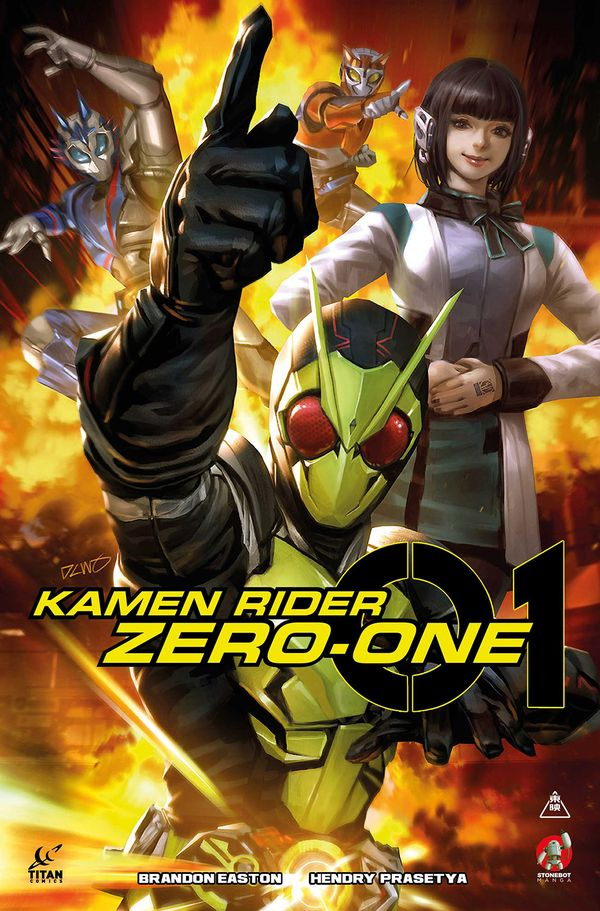
Kamen Rider Zero-One - Graphic Novel Review


I remember the very first time I was exposed to a tokusatsu show. Like many kids of my generation, it was Power Rangers. The US made series that took the Japanese footage from Super Sentai series and spliced in their own actors to create a new series that was so mismatched and broken at times that you had to see the delightfully weird and absurd side to the show. From then on, however, I was hooked on the format, and found myself watching anything Japanese made that I could, Kaiju movies, anime series, movies, whatever I could. And whilst my horizons for Japanese media were broadened, my love for tokusatsu was still at the core. As the years progressed I was able to get my hands on English translations for various Super Sentai shows, and some Ultraman, but one show that always seemed to elude me was Kamen Rider.

For some reason I've never been able to find English translations of the series, despite knowing that they are out there somewhere. As a result I've seen other people getting into the series but have never been able to do so myself. Every time I see a new, awesome looking Rider suit I know that it's something that I'm likely going to miss out on. But when Titan Comics announced that it was creating a brand new story set in the Kamen Rider Zero-One universe I was hugely excited, as it meant that I could finally get a taste of this beloved franchise.

Kamen Rider Zero-One focuses on Aruto Hiden, a failing stand-up comic who became the head of a mega corporation when his grandfather passed away and left it to him in his will. As the CEO of Hiden Intelligence, Aruto has been thrown into a world that he knows next to nothing about, and is trying to do the best he can. This isn't the only thing that he's been left by his grandfather, however, as he has also become the latest wearer of the Kamen Rider Zero-One armour, and has been trying to be a hero by fighting against rogue Humagears.

As the book begins Aruto is defending himself and his actions to A.I.M.S., a military organisation with a couple of their own Kamen Riders. Aruto feels like he's doing a poor job as a Rider, and that his comedy career isn't going so well either. He begins the book at rock bottom. Unfortunately, he doesn't get much of a chance to pick himself up before things get a little worse for him, and he comes under attack from a mysterious new Kamen Rider calling himself Ragnarok. Ragnarok arrives on the scene and quickly overpowers Aruto, proving to be more powerful, and more brutal in his approach. He's there to kill any Kamen Rider he finds, and Aruto is squarely in his sights.

Following the initial confrontation with Ragnarok the book becomes one long mission to stop the monstrous new foe, one that sees Aruto being put down more and more, even being threatened with arrest for his actions, and having to learn to become the hero that's hidden deep inside himself. As someone who's not seen the show, I don't know how this fits into the character arc of the series, if it contradicts anything, or if it works perfectly; but as a book on its own it's a decent arc for the lead character to have to go through, and feels like the kind of journey a hero would go through pretty early on in their career.

The fact that the book seems to sideline most of the ongoing series stories and creates its own antagonist for Aruto to have to deal with feels like a smart move too. Before the story begins we get a nice breakdown of the main characters and the world they're in so that new readers aren't completely lost, but then the book does its own stuff, letting those new readers learn as they go alongside longtime fans. 

I did also enjoy the character of Ragnarok. Once his true identity and origin were revealed the story suddenly made a lot more sense, and his relentless pursuit of Aruto suddenly felt more natural. For those who've read Chip Zdarsky's Batman: Failsafe there will be a sense of familiarity to this story.  The fact that both stories were originally published in individual issues within six months of each other makes for one of those amusing cases of writers having similar ideas around the same time. Luckily, the two are still very distinct from each other, but it's cool to see a tokusatsu spin on that kind of tale.

The art on the book is decent throughout, with some fantastic splash pages and big action panels that really showcase how cool these kinds of characters look. Tokusatsu heroes have a unique feel to them. Whilst these characters live on the screen and the people involved in the shows produce some amazing content there are times where it feels that the comics can push further and harder. You're not constrained by budget or safety concerns, so you're able to throw these characters into situations and fights that the series just couldn't do; and this book does that in spades with fights and gags that you know the show couldn't replicate.

Perhaps the only complaint with the art is that there are times where the action on the page feels a bit choppy, and things seem to be happening either between the panels, or in ways that are not always easy to understand. I don't know if this is down to a scripting issue, or how the artist put the script to page, but there were a few times where the action did feel a little disjointed.  But this wasn't a big enough issue to detract from the overall quality.

As someone who loves tokusatsu style stuff I had a lot of fun reading this book, it gave me a fun insight into the Kamen Rider Zero-One series, as well as being an enjoyable story that felt like it stood on its own feet. I can't judge it based on the feelings of a fan of the series, but I dare say those who love Kamen Rider will get a big kick out the book too,


Support Amy on Patreon

Buy Amy A Coffee

Go to Amy's Blog

Wednesday, 20 September 2023

Green Lantern #3 - Comic Review


Hal Jordan has a pretty unusual power ring. Not only did he previously charge the ring from Manhunter powered armour, but in this issue we learn, via flashback, that it has some powers and abilities that sets it apart from the standard Green Lantern weapon. After almost falling to his death when his loses power as he attempts to leave the Earth, Hal manages to create a burst of willpower that reignites the ring and saves his life. After this, he learns that he's able to create projections that can look realistic, losing the all green energy construct to become indistinguishable from the real thing. 

It very much feels like this series is both doing new things, but also regressing in other ways. The ring that seems to only work on Earth, tying Hal to the planet, is an interesting idea, and can make for a cool status quo as Hal becomes a GL purely for the planet (to the point where going up in space to the Watchtower would result in a loss of powers). However, the costume is very classic GL, and the ring being able to make full colour replicas of things also has a very Silver Age feel to it. In those early Green Lantern books the ring was basically able to do anything Hal wanted, with new powers and abilities added every issue. And making perfect, indistinguishable replicas of people and objects was one of these powers.

The fact that the supporting cast for the book also feels like it's taken from older comics, with a big focus on Hal and Carol and Ferris Air. So far, Carol has become the biggest co-star of the book, and she's become the main focus of Hal's life, with him wanting to get into a relationship with her again, and doing whatever he can to stay in her life; including getting a job as her personal pilot. This stuff, however, feels a bit gross in some ways. There's a moment in this issue where Carol calls him and needs to talk and the first thing that he thinks is that she's broken up with her partner and wants Hal back. He's become almost single minded in his desire to be with Carol, and it feels a bit creepy at times. Hal is close to just being a creepy stalker, and I don't want that. The relationship stuff between the two of them has always been the weaker parts of Green Lantern books, and if we're going to be stuck on Earth and watching Hal be a creepy stalker it's going to drag the quality down a lot.

Whilst Hal is trying to force his way back into Carol's life, however, Sinestro is plotting and scheming. He approaches a mysterious group of aliens hiding out on Earth, and makes a deal with them to gain access to tech and weapons that they have; even getting a few goons thrown in too. Together with his new crew of lackeys, Sinestro attacks Ferris Air and causes a ton of damage and kills several people. The security footage gets back to Carol, who immediately shares it with Hal. Hal retreats to a bar to formulate a plan to find Sinestro, when the villain just walks right up to him.

So, this issue finally feels like it's beginning to actually do something with the plot. The first two issues spent some time laying the groundwork, showing us Hal's new civilian life and his special ring, but it hadn't done much with an overarching narrative. With Sinestro stepping up and causing some shit, however, it feels like we're finally getting somewhere. Where is that? Honestly, I have no idea. So far Sinestro's motivations are not obvious. He could have some convoluted scheme, or he could just want to mess up Hal's life. The fact that it could be anything, and that he could be a big arch villain, or a petty bitch makes Sinestro a lot of fun in this series so far. Whatever way it goes, with their history it's sure to be an interesting scenario.

The art on the issue is really good, and the book looks fantastic. The art has been a big part of my enjoyment for the series so far. As mentioned, I found the first two issues somewhat slow, and the art kept my interest as the book spent its time setting things up. Here, however, we get to see some bigger moments, with Sinestro's assault on Ferris Air adding some much needed action to the story, and being presented in a way that felt genuinely frightening at times too. We've not really seen Sinestro operate this way before, attacking with a gun, getting up in people's faces, and he feels a lot more threatening this way than when he's just using a ring.

The back-up story continues to set the stage for the upcoming John Stewart title, focusing on this alternate universe version of John where he's a living power battery and leader of the corps. The other universe lacks anything that really stands out or feels interesting, mostly because we're dropped in the middle of things with no real explanation of who people are or what's going on. However, with their villain having been cast out into the multiverse (wonder which Earth she'll end up on) I'm sure we'll start getting things explained when out John ends up involved.

This issue does have a nice scene where John and Guy have a personal conversation with each other which reminded me of the older Green Lantern Corps series where the two of them were often put together and developed a really strong and interesting friendship. This is something that I hope the new series will give us more of, as their friendship was a big selling point in that series for me when it was coming out and I'd love to see it make a return.

Overall, this is perhaps the best issue of the series yet as it feels like stuff is finally happening. As a long time GL fan who has been somewhat disappointed in the books we've been given for the characters since 2018 (Far Sector not included as it was great) I've been hoping that this new wave of Lantern books are going to be great. So far, this series has been enjoyable, but it has also been a struggle at times. Hopefully from here on out it'll just continue to improve in quality.


Support Amy on Patreon

Buy Amy A Coffee

Go to Amy's Blog

The Comic Cave – Old Man Logan


Originally published on Set The Tape


The Comic Cave is a fortnightly feature where we spin the Wheel of Comics and see what graphic novel story it brings up for us to deep dive into! This week we take a look at Old Man Logan, a Wolverine story that’s often held up as one of the character’s best. But is it actually any good?


It’s hard to think of the X-Men and not imagine them as one of Marvel Comics’ biggest properties. 1991’s X-Men #1 is the highest selling comic of all time, when Marvel was in danger of going bankrupt in the 90s the various X books kept them going, they’ve had successful television shows and films. They’re big money for Marvel. That’s why people are often surprised to learn that the X-Men were originally cancelled, and it wasn’t until they were given a second chance with Giant Sized X-Men under the creative leadership of Len Wein that the franchise really took off. Part of this was down to the new roster of mutants in flashy costumes unique to each of them. And one that stood out immediately was Wolverine.

Originally introduced in an Incredible Hulk story, Wolverine made the jump to the X-Men and got a lot of his details smoothed out and improved, and soon became one of the most popular characters in Marvel. Over the years the character has had multiple mini-series, his own title, and his mysterious hidden past has been explored and revealed in depth. He’s even been allowed to join the Avengers, which – considering he routinely horribly murders people with knives that come out of his hands – is a bit of a surprise for sure. But, when a character is that popular there’s pretty much nothing the Marvel will say no to them doing. And this might be a large part of why we got Old Man Logan, a story originally published in the third volume of the solo Wolverine title.

Written by Mark Millar, with art by Steve McNiven, Old Man Logan transports readers 50 years into the future of the Marvel Universe, to a dark time where the heroes have fallen and the US is a wasteland of crime and corruption. We find Logan, older, with grey hair and a weathered face, living with his wife on a small pig farm in California, struggling to get by. They have got issues with sick pigs, and no one wants to buy from them, leading them to struggle to make their rent. His wife raises the idea of selling their kids’ toys to try and make some cash, which Logan instantly shoots down. Instead, he takes the beating given to him by his landlords, the Hulks.

Bruce Banner is the warlord who rules over California, and he does so thanks to his children, a group of inbred, disfigured rednecks that he created by raping his own cousin, and eventually then having sex with his own daughters. The result is a gang of cruel, even more monstrous Hulks who could easily fit into stories such as The Hills Have Eyes. Shortly after Logan takes his beating from the Hulks, an old friend arrives on his doorstep: the former Avenger Hawkeye. Hawkeye, now an old blind man, needs to transport a package across the US, and offers to pay Logan to help him get it there. Knowing that this is his best hope at raising money, and enough money to keep the Hulks happy for a long while, he agrees to go with Hawkeye. He has one condition, however: he will not fight.

Thus begins a cross-country road trip as the two old heroes jump into the spider-buggy, and head for New Babylon, the new US Capital. This gives Millar an excuse to show off the state of the rest of the country, as we spend several issues watching the two leads go from place to place, getting into awful situations. We get small insights into what happened when the heroes fell, learning that the key villains divided the country between them, and see all kind of odd things such as Ghost Rider gangs, roving dinosaurs, giant dead bodies, and natural disasters.

Along the way Hawkeye learns that his daughter from his third wife (and Spider-Man‘s daughter) Ashley, has decided to become a hero, taking inspiration from her grandfather, wearing a Spider-Man inspired costume and taking up the name Spider-Bitch. Spider-Bitch and a couple of other new heroes go after Kingpin, but get captured. When Hawkeye learns of this he and Logan go to help her get free, but learn that she didn’t go to take on the Kingpin to free people from his rule, but to take over. With her now in control of his criminal empire the two men are forced to flee as Ashley tries to kill her own father.

Later, Logan (who still hasn’t stepped into any of the fights) reveals why he’s a pacifist. It turns out that the big fall of the heroes happened because all of the villains banded together, swapped notes, switched up which heroes they fight, and all attacked at the same time. When the attack on the X-Mansion came, Logan was present as dozens of villains such as Omage-Red, Sabertooth, Bullseye, Mr Sinister, and Doctor Octopus broke in and tried to kill the children. Logan jumped into action and killed as many of them as he could, wondering desperately why he was the only X-Man protecting the school. After an hour of fighting he killed the last assailant, and it’s revealed that he was never fighting villains. Only one bad guy came to Xavier’s, Mysterio. Using his tech, he made the X-Men look and smell like the other villains, and tricked Logan into murdering all of his friends. This is why, 50 years later, Logan refuses to ever pop his claws again.

After several issues along the way, such as sink holes, and a Venom-infected T-Rex, the two make it to the capital, where it’s revealed to the reader that Red Skull rules over his territory from a swastika-emblazoned White House. Hawkeye reveals that he was transporting a case full of vials of super soldier serum for a fledgling resistance force hoping to create an army of Captain America-powered heroes, and take on the Red Skull. But it turns out the whole thing is a sting operation, and he and Logan are shot and murdered.
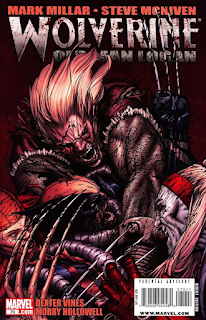
Their bodies are brought before the Red Skull in his trophy room, a room filled with pieces of the heroes he helped to kill, such as Iron Man‘s armour, a piece of the Silver Surfer board, one of the Thing’s arms, and Doctor Strange‘s cloak. Logan bursts out of the body bag he’s in, and attacks the Red Skull, decapitating him with Captain America’s broken shield. Grabbing the case full of cash from the bogus deal, he puts on Iron Man’s armour, and flies out of the building, heading home to California. Unfortunately, when he arrives he learns that the Hulks came back a few days after he left, and his wife and children have been murdered.

Wolverine pops his claws, and sets out for revenge. Over the final issue of the story Wolverine methodically makes his way through the Hulk clan, killing each and every one that he can find. Eventually he comes face to face with Bruce Banner, who’s become a tiny and pathetic man. Banner transforms into a giant, monstrous version of the Hulk, and eats Wolverine. Believing that Wolverine is dead, the Hulk relaxes, but is ripped apart from the inside as Wolverine claws his way out. Looking at the murdered and mutilated remains of the Hulk clan, Logan finds a tiny Hulk baby in the ruins, and takes it with him. The book ends with Logan burying his family, and setting out to try and make the world a better place whilst raising his new son.

Old Man Logan, as you’ve probably realised from the description, is not a nice book. It is filled with violence, gore, and general nastiness that feels very much at home in Mark Millar’s writing. Millar is perhaps one of my least liked writers in comics, and there are very few of his books that I find actually enjoyable. Civil War is perhaps the best of his work even if it runs out of steam at the end, ends horribly, and turns a number of heroes into horrible people. But crafting horrible people is a key feature in Millar’s work, and Old Man Logan exemplifies a lot of that in a number of ways.

The entire premise of the book hinges on something that feels slightly ridiculous: the idea that all it takes to destroy the world is for the villains to have a meeting and decide to work together. The book doesn’t reveal an amazing scheme, a piece of tech or magic that swung the war in their favour, instead it makes the heroes look ineffectual and weak by just having the villains all jump them at the same time. And this kind of sums up a lot of the book; stuff just happens with little to no explanation, purely because Millar thought it would be cool.

Things such as dinosaurs roaming through the US gets a hand-wave explanation. Venom goes on a T-Rex because it would look cool. Emma Frost and Black Bolt have a super special safe haven carved out for them and the last few mutants. Why? Millar doesn’t appear to care, and doesn’t fill us in on it. How does a biker gang have Ghost Rider bikes, when you have to be a Ghost Rider to have one, and they’re just regular people? Don’t worry about it, just look at the flaming motorcycles. It’s all spectacle and flash with nothing to it, that could be removed from the book and you’d lose nothing from it.

And it wouldn’t be a Millar book if rape wasn’t included somewhere in the story, this time with the Hulk raping his own cousin and his daughters. Rape is a subject that seems to pop up whenever Millar is able to get it into a book. In Nemesis, the story’s lead character kidnaps a girl, impregnates her with her own brother’s baby, and sets up her womb to collapse if she tries to have an abortion, rendering her infertile if she doesn’t have an incest baby. In Kick-Ass 2 the hero’s girlfriend is gang raped by the villains to get at him. In Wanted, the protagonist commits rape multiple times. In The Authority, a villain travels back in time and molests one of the heroes to mess with them in the future, a hospital victim gets raped, villains are punished with rape, and one of the series’ prominent gay heroes is raped by a villain. And, in the 90s, when DC killed Superman and broke Batman‘s back, Mark Millar pitched a similar story for Wonder Woman, ‘The Rape of Wonder Woman‘ which reportedly would have been a full issue sexual assault scene that ended with Wonder Woman raped in public.

When coupled with stories of his that have included depictions of domestic violence, racism, brutal violence, excessive swearing, and other ‘edgy’ content it’s hard for me to see Millar as nothing but a writer pandering to the teen boy demographic, or those readers who delight in the awful, who hate superhero comics as they normally exist, and who don’t see harm in the depictions of sexual violence against women. It’s made even worse that Millar has seemingly shown no care in how this constant depiction of rape has been used. In an interview with The New Republic, when asked about it, he said: “I don’t really think it matters. It’s the same as, like, a decapitation. It’s just a horrible act to show that somebody’s a bad guy.” With that kind of attitude it’s hard to really get on board with Millar.

The awful writing aside, the art in Old Man Logan is, at least, good art. The times where McNiven isn’t having to draw incest hillbillies or gruesome murders make for some decent parts of the book. The desolate landscapes looks eerily beautiful, the characters all have a sense of realism to them that you don’t always get, and some of the designs for the locations and characters the heroes meet along their journey are very interesting. It’s a shame that so much time is given over to the violence and gore, and we couldn’t have spent more time seeing more of this dark future, as McNiven seems to be doing his best to make the world work, and it would have been good to see more of that.

Old Man Logan took place within the pages of Wolverine, in the middle of another writer’s run on the character. This, along with the future setting, makes the story feel very out of place, and it’s odd that the series wasn’t released as a stand alone mini-series, as it had no effect on the main title. However, this wouldn’t be the last time this character and setting would be used. A younger looking version of this Logan, along with his now adult Hulk son, Bruce Jr, would appear in Fantastic Force, as part of a new superhero team setting the future world right. Old Man Logan would return years later as part of the Secret Wars crossover event, which would see the older version of Logan come into the main Marvel 616 universe, where he headed up his own 50-issue series, as well as appearing in other books.

Old Man Logan is a book that often gets brought up in discussions about great Marvel stories, and stand out Wolverine books. But with the story being both an alternate future and a different universe it bears little to no impact upon the Wolverine we know, or the main universe. As a standalone story it will either deeply appeal or deeply disgust. Millar is a divisive writer, and how you feel about him and the things that he puts into his stories will affect how you enjoy this book. If you have no issue with that, and love Old Man Logan, then it’s a great book, and if not, then perhaps it’s hard not to agree with Grant Morrison’s feelings on the man.


Old Man Logan was originally published in Wolverine from June 2008 to September 2009 by Marvel Comics .


Support Amy on Patreon

Buy Amy A Coffee

Go to Amy's Blog