Tuesday, 14 June 2022

Bloodborne: 1-3 Boxed Set – Graphic Novel Review


Originally published on Set The Tape


Fromsoftware produce some great video games. They craft beautiful worlds, expansive environments, and punishing game-play that has been known to test some players to their limits.

One area where they sometimes lack, or at least at first glance, is in the storytelling. Unless you sit and examine every item, reading their descriptions, or talk to every NPC at every opportunity, it’s possible that you can complete one of their games and not know much of what it’s about. As such, when comics set in these worlds come along that promise to expand the lore, fans are eager to give them a read. Now Titan Comics are collecting together the first three volumes of their Bloodborne series. But how do the books stack up?

Bloodborne Volume One: The Death of Sleep follows one of the Hunters, people who have pledged themselves to fight the monsters that plague the city of Yharnam in a cycle of death and rebirth. The Hunter here looks like the iconic image from the cover of the game, complete with blunderbuss, saw cleaver, and costume. The Hunter begins their journey in Yharnam, where they find a group of survivors in a chapel. Inside is a young child, a pale blood, who the Hunter will need in order to complete their quest. When a huge beast and their ravaging horde assaults the chapel the Hunter attempts to slay the creature, but is killed in the process.

The Hunter awakens in the Hunter’s Dream, before returning to Yharnam and repeating their quest to the chapel. Instead of fighting the huge beast, this time they take the child and flee the city. From here the two of them set out to reach the coast and find a boat in an attempt to escape the monsters. However, the beast is following in their wake, determined to kill them both.


The story of The Death of Sleep is an interesting one, though one that is fairly light on details and leaves the reader to have to fill in a lot of the blanks. It relies on the fact that readers know a lot about the game too. As someone who has played Bloodborne, but has not experienced the whole game, some elements were familiar to me, but not enough that I really knew everything that was happening. I liked that the first part of the story reflected the game, that the Hunter was aware that they were repeating actions, that they died and had to try again. I also like that it was never answered whether the Hunter was male or female, and had an androgynous appearance; allowing the reader to project their own player character onto the Hunter. However, after this it very quickly started to rely on elements that I didn’t know.

I don’t know why the Hunter was after the child. I don’t know why the child’s blood was white, or why that was important. I don’t know why the child could see things that the Hunter couldn’t, and what that meant. I’m sure these are elements that lore heavy fans will know, but it did make the story very inaccessible to new readers wanting to learn more. I was also quite disappointed that the story ends on a cliffhanger, yet does not continue on into the next volume, leaving it feeling vague and unfinished.

The art for the story, provided by Piotr Kowlaski and Brad Simpson, is good. The action sequences feel full of energy and motion, capturing the frantic combat of the game. They also manage to make the book look both ugly and horrifying but beautiful at the same time; something that the game did wonderfully. The environments look great, particularly when the characters leave Yharnam. If the book explained things more I would have found it a much more enjoyable experience. As it is, fans of the game will probably find stuff here to like, but how much they like it could depend on their knowledge of the Bloodborne universe.

Bloodborne Volume Two: The Healing Thirst takes a much different approach, taking readers back to a time before Yharnam becomes the monster infested hell hole it ends up in the game. The book takes a look at the Healing Church, a religious organisation in the city, as the ashen blood disease begins to sweep through Yharnam. People are dying, people are becoming monsters, and it looks like the hunters who are supposed to keep them safe, and the church who are supposed to heal them, might be at the centre of it all.


We follow two characters, Alfreidus, a doctor, and Clement, a priest. Both men can see that there’s something awful happening in the city, and both believe that the Church might be part of the issue. The two of them come at the problem from opposite sides, one relying on science whilst the other relies on faith, but eventually they end up meeting and forming an unlikely alliance. Working together, the two of them hope to be able to find a cure to the awful infection before it overtakes the city.

This is the kind of thing that I was hoping for from this series, as The Healing Thirst dives into the history of Yharnam, giving us something that we’ve not seen before. It’s really odd seeing the city as a working metropolis, with people going to their jobs, shopping, and tending to their gardens. Having seen the city in the game its easy to forget that this is a place that was once filled with life. There is a sense of sadness whilst reading it, however, as you know that this isn’t going to last. You know that these people are doomed, that the city is going to get worse, and you can’t help but feel a sense of hopelessness as Alfreidus searches desperately for a cure to help the person he cares for. I enjoyed watching the friendship form between him and Clement, and the fates of each of the characters was suitably grim.

The art team from the first volume return for this story, and I think the book looks better than the first one in a lot of ways. I don’t know if its because its all set in Yharnum, so we get more time to marvel at the grandeur of the architecture and the small nooks and crannies filled with details that you can spend time looking through. It’s the same creative team, yet the art in this volume feels so much better, more detailed, and more interesting. This is easily the most enjoyable volume of the collection, with a clear story, and characters with understandable goals. This was the kind of thing that I was hoping for from these books, and it’s a shame that I only got it for the one book.


I’m not exactly sure what I can say about Bloodborne Volume Three: A Song Of Crows. The story centres on Eileen the Crow, one of the more memorable NPCs from the game. In the game Eileen hunted your character, and other hunters, and is sworn to destroy those corrupted by their lust for blood. We see her burring those that she’s killed, dozens of bodies, but after that the story doesn’t really do anything. Eileen seems to be pursuing someone, but the story is broken, disjointed, and has fever dream logic to the point where I cannot tell you what happened even after reading it twice.

It doesn’t help that Eileen herself seems confused, with broken and disjointed narration. She wanders through strange places, where reality seems to shift around her and change at a moments notice, unsure what is happening or where she is. There’s an entire issue that has no narration or dialogue, relying on the images to tell the story; yet because of the weird and confusing story it adds nothing, makes things even more confusing, and feels like a waste.

The same art team return for this volume, and do some good work, even carrying an entire issue where the art is the only thing on offer. And whilst I can’t find anything about the art to fault for this volume, a story cannot survive on pretty images alone. Thanks to the meandering, weird, and seemingly pointless story I was left confused by what I’d read. It’ not often that I have bad things to say about a book, as I usually try to find something to be positive about, but this time I failed to find much to like and felt like I’d simply wasted my time reading it.

Bloodborne: 1-3 Boxed Set is something that’s going to appeal to fans of the series, but I think mainly to those fans who have invested a lot in the game. Casual readers might find that the stories on offer here lack the depth they want, that they leave too much unexplained, and that they rely on game knowledge to get more out of it. However, if you’ve spent time reading all the lore, poring over the wiki entries, and doing deep dives into the world FromSoftware created this might be a set you get a lot out of.


Support Amy on Patreon

Buy Amy A Coffee

Go to Amy's Blog

Monday, 13 June 2022

Godzilla vs Mighty Morphin Power Rangers #3 – Comic Review


Originally published on Set The Tape


The fight between the heroic Power Rangers and the monsters of another universe continues in the third issue of Godzilla vs Mighty Morphin Power Rangers as the brightly coloured heroes find themselves facing off against some familiar foes.

Last issue the Power Rangers managed to survive an encounter with Godzilla, King of the Monsters, after arriving in a different universe chasing after their team-mate Tommy and the evil sorceress Rita Repulsa. Having barely survived that battle the Rangers attempted to free Tommy from Rita’s imprisonment, but were forced back into battle when Rita, allied with the Xilian aliens, unleashed more monsters on the innocent civilians of this other Angel Grove.

This issue picks up where that left off, with the Rangers back in the Mega-Zord to take on Rhinoblaster and Eye Guy, two villains from their past who have been recreated, as well as their new foe, Gigan. As Rita tries to use her magic to turn Tommy back to evil, hoping to bring the Green Ranger under her control once more, the Rangers are forced to fight against three giant monsters; luckily, help arrives in an unlikely form when Godzilla re-enters the fight. But will Godzilla fight with the Rangers, or is he yet another threat for the heroes to deal with?

I was really excited by this series when it was first announced. I love both the Godzilla and Power Rangers franchises, and bringing the two of them together felt like a perfect fit, to the point where it was surprising it took close to thirty years to do. And whilst I have been enjoying this series this third issue really does seem to emphasise my biggest problem with the book – that not a great deal actually happens. A lot of the issue is given over to the big fight, and whilst that shouldn’t be a bad thing (who doesn’t want to see the Power Rangers fight Gigan?), this is the third big Zord fight in as many issues. It’s beginning to feel repetitive.

As a kid I remember the Zord fights being some of the best parts of an episode of Power Rangers, particularity in the early days when the show was a bit slap-dash and ill thought out (though in a charming way). But other seasons of the franchise, such as Power Rangers Lightspeed Rescue and Power Rangers Time Force, really tried to do something different, to tell stories. And the current BOOM! Studios comics is similarly showing that there can be some great, layered, and interesting Power Ranger stories. But it feels like Godzilla vs Mighty Morphin Power Rangers lacks any kind of story depth or complexity, and is just riding on the gimmick of the Rangers fighting iconic monsters.

The only times we see anything outside of the big fight it’s Rita and her goons torturing Tommy and going over their plan. And yes, we do learn a little more about what Rita is doing, that this is part of her conquest of her home dimension and not simply her skipping out, but we don’t get much else. She reveals this is part of her plan, but we kind of knew that from page one. She reveals she’s planning to betray her new allies, but anyone who knows the character knows that’s coming.

It doesn’t feel like any of the characters are characters beyond the simple, surface level cliches of what they are. None of the Rangers even really say anything that stands out as something that their character would really say, and most of their lines could be given to any other Ranger and it not feel weird. They’re not individuals with quirks or traits in this book, just folks in costumes controlling a big robot. The only characters who do feel like they have a personality are Rhinoblaster and Eye Guy.

As with previous issues, the art is good. Freddie Williams II and Andrew Dalhouse do a decent job and things look nice enough. There are a few moments in the big fight where the Mega-Zord looks a bit strange, due in part to being in positions a guy in a big suit wouldn’t be able to achieve. We’re seeing the thing at angles we don’t on TV, and it just feels kind of odd because of that.

I’m hoping that we get something with more substance in the next issue, something that isn’t just the Mega-Zord fighting giant monsters. However, with the way this issue ends it looks like that’s not what we’re going to be having, as yet more monsters have been thrown into the mix. And whilst it is great to see these universes interact, to see Power Rangers monsters side-by-side with Kaiju, it’s getting to the point where I really need something more.


Support Amy on Patreon

Buy Amy A Coffee

Go to Amy's Blog

Sunday, 12 June 2022

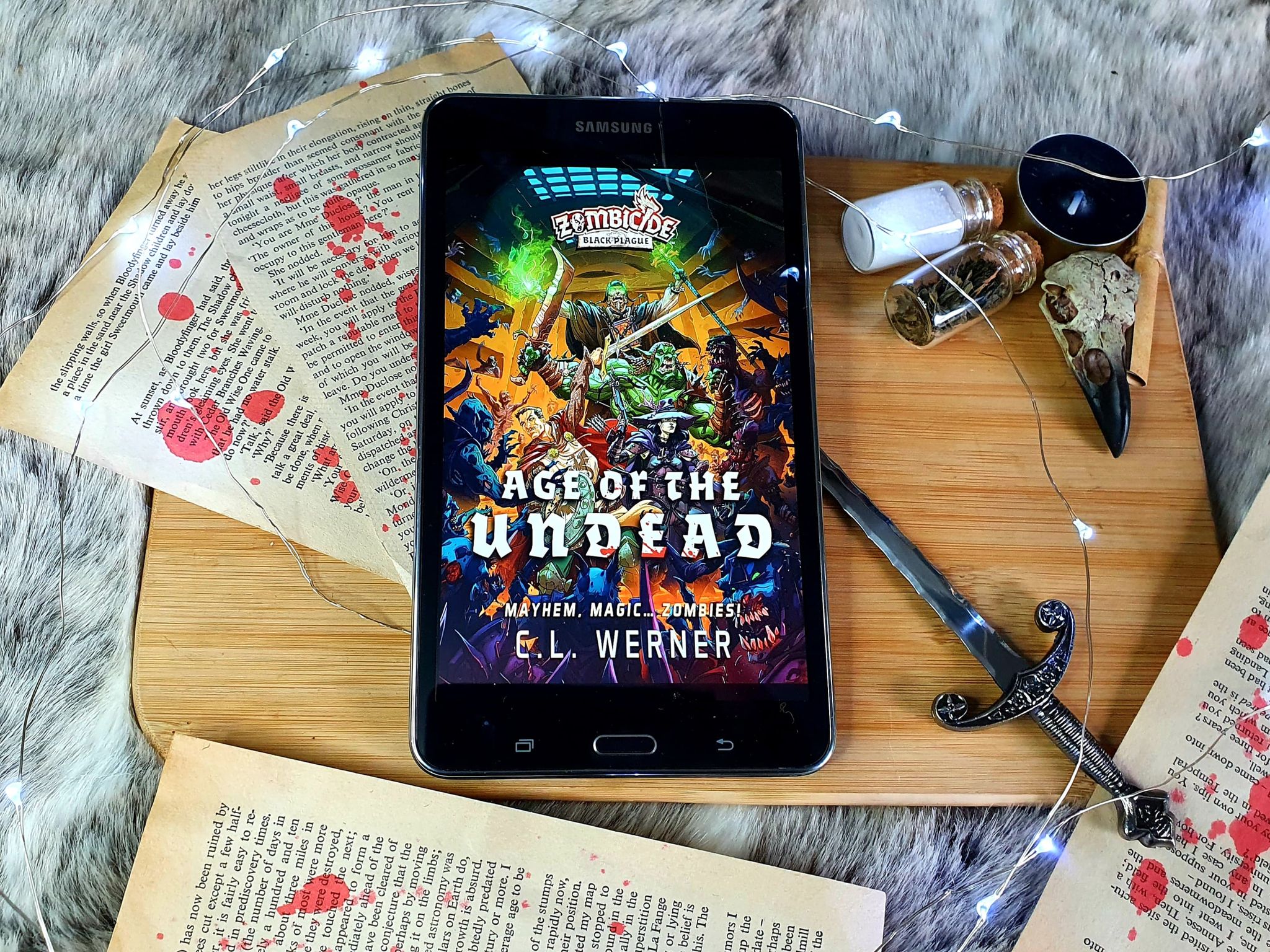
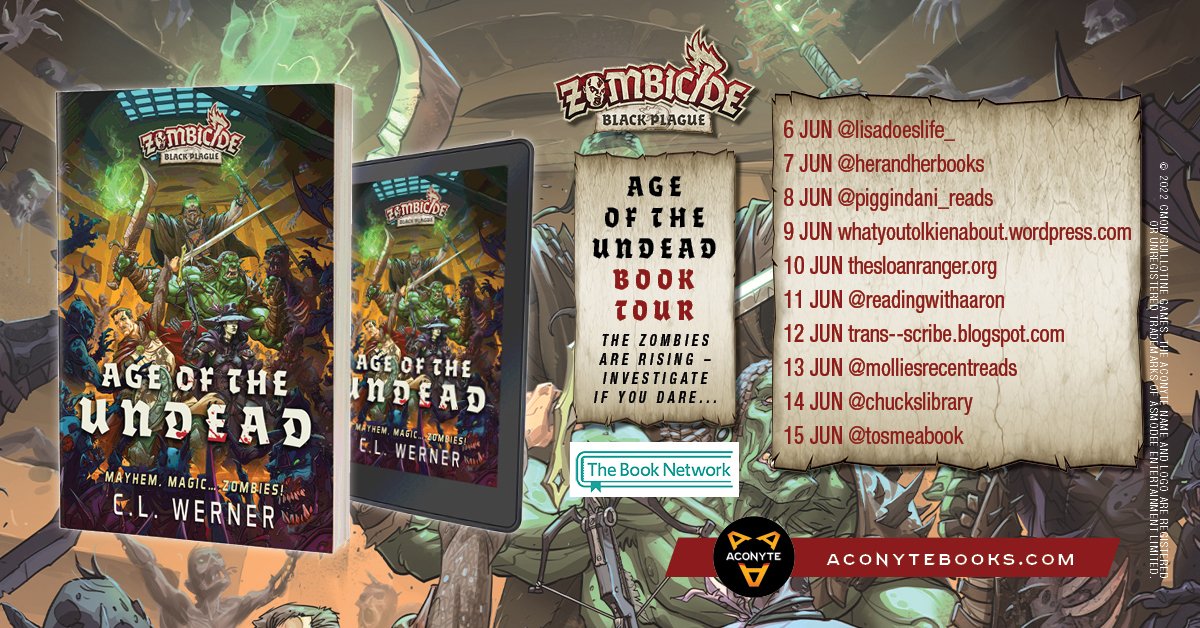
Age of the Undead: A Zombicide Black Death Novel by C.L. Werner - Blog Tour & Interview


'In a fantasy realm shattered by the zombie apocalypse, a bold Knight must enlist unlikely allies while discovering the source of undead corruption, in this darkly humorous adventure from the bestselling game range, Zombicide: Black Plague.

'When Knight Alaric von Mertz loses his family to a ravenous zombie horde, he swears revenge on the necromancer responsible. But a quest for vengeance is no easy matter in a world overrun by the walking dead. Joined by a sharp-tongued rogue, a witch hunter with secret knowledge, a novice wizard, and a dwarf demolition master, Alaric’s journey leads him from magical fire moats to the zombie-ridden catacombs of the witch hunters to uncover a spell book of insurmountable power. As zombies claw and bite, Alaric fears he will never avenge his family. For in this age of the undead, betrayal and magic lurk around every corner, spelling either doom or salvation for them all.'

Zombie stories aren't given the fantasy treatment enough. Yes, we have things like the undead in the occasional stories based off things like Dungeons and Dragons and Warhammer, but thanks to the prevalence of zombie viruses the stories of the undead have moved from the realm of the mystical into one more of science. And that's a big shame. Well, Zombicide is joining other illustrious fantasy stories by adding zombies into tales of swords and sorcery.

Age of the Undead takes readers to a kingdom already in the clutches of a plague of undeath that has been sweeping the lands. In the books prologue we see a practitioner of the dark arts watching on as events unfold, seeing the spread of the plague, the king and his armies marching out to face the monsters rising from the grave, and their ultimate defeat. Rather than leading us through the outbreak of this zombie menace we skip over a lot of the early days of the plague, catching up with things when the armies have fallen, the defences have failed, and only a handful of survivors are all that's left in a nation now ruled by the dead.

We meet Alaric von Mertz, a young knight who has travelled from the failed battle against the undead to his family castle in the small town of Mertz. By the time he has arrived the town has already fallen, the streets silent, the houses empty, and no sign of any survivors. Upon investigating the castle he grew up in he does manage to find a lone survivor, the thief Gaiseric, who was locked up in the castle dungeon when the undead swept through Mertz. Whilst Alaric is at first unsure whether or not to trust this rogue, when the two of them have to work together to overcome the undead a bond of trust begins to form between them.

Unfortunately for Alaric, Gasieric seems to be the only survivor that he's going to find, and he soon discovers that his family did not survive the zombies. Worse still, he learns that they're being controlled by a necromancer; a local wizard named Gogol, whom Alaric had convinced his father to save from execution. Feeling in part responsible for what has happened, and desperately wanting revenge, Alaric and Gaiseric decide to travel to Singerva, a walled city close to Mertz where they believe that they might be able to find safe haven, as well as help to return to Mertz to kill Gogol. 

Along the way the two of them find more survivors, a witch hunter named Helchen, and the wizard Hulmul. Despite having two members in their party who should hate each other, due to witch hunters often killing wizards they suspect could have anything to do with necromancy, the four of them head into the ruined Singerva hoping to find whatever help they can. Unfortunately for them, they will have to fight their way through hordes of monstrous undead before they can find any safe haven.

One of the things that I really liked about Age of the Undead is that despite being in an amazing fantasy world filled with other races, amazing creatures, and literal magic, it never felt too big or too fantastical. This isn't Game of Thrones by any means, it's not gritty fantasy that feels more like a historical, because there are so many high fantasy elements here, but it did feel like this was the kind of story that would be going on in the background whilst other heroes went out and saved the world. This isn't a quest to stop this zombie plague, or to kill the leader of the undead army, nothing here is going to save the world; it was was simply a group of survivors trying to stay alive as long as possible. And I loved that.

Werner is no stranger to fantasy world, having written books set within the Warhammer universe, and you can really see that experience coming through here. He knows how to make a world that feels lived in and real (even if it's currently in ruin), and is able to make the action jump off the page thanks to precise, descriptive language. There were times where it felt like I was creeping through the ruined streets of Singerva alongside out heroes, trying to find the next safe-haven as they fought their way from one desperate confrontation to the next. Werner was able to make it all feel real in a way that some fantasy stories lack.

A big part of this immersion comes from how tense the book is. It might be a fantasy story but it's also a horror, and Werner seems to excel at the horror elements. Because the characters of the book felt like skilled combatants, but never over-powered heroes, you were always a little worried for them, and any fight that they got into felt like it came with risk. Whether it's trying to make their way through tight, winding corridors, escaping from huge hulking monstrosities, or getting away from undead crows that could swarm from any direction, the action scenes always kept me on the edge of my seat.

Having not yet played Zombicide I was unfamiliar with what kind of creatures could appear in the book, other than having a vague idea from other novels in the range such as Last Resort or Planet Havoc. Werner seemed to stick to some of the more common types of zombies from the games, such as the regular zombies, faster runner zombies, and large brutes that cause more damage and are harder to take down. However, Werner was also able to throw in some other undead that I was not expecting, and managed to keep surprising me throughout the book whenever a new creature was introduced.

The real highlight, however, has to be the characters. The group of heroes of Age of the Undead aren't the kind of people that would go out saving the world, and some of them aren't even the kind of folks that you'd really want to be around if you had a choice. But, they proved to be an amazing cast of characters who I quickly came to care for and found that I wanted to read more from them. Alaric is the most stereotypical of the characters, a lordly knight who always tries to do the right thing. This was a good character to pick to lead the group, and to introduce readers to first, because he's the kind of archetype that you expect to find in this type of story. He's a stable, predictable character who feels like something of a comfort to have around.

Gaiseric, on the other hand, is the kind of character you wouldn't really trust to have around you. He's a thief, but seems to be a decent man. He's a great foil for Alaric, but also helps to temper the knight at times too. He's not a coward, but knows that sometimes it's better to run and live rather than make the big heroic sacrifice. He's also incredibly handy to have around, able to sneak his way in anywhere and to get past dangerous traps; something that proves to be surprisingly useful in this particular story. Helchen is the character I initially liked the least. She's a witch hunter, which means that its her job to find wizards who might be involved in the dark arts, and to stop them. She's close to what real world witch hunters were, and her organisation has a very Inquisition feel to it. She's hard, cold, and kind of untrustworthy to begin with. However, getting to see those qualities thaw over time, especially as she forms a friendship with a wizard, makes for some delightful characterisation. 

Speaking of wizards, Hulmul is probably one of the characters that most people would want to spend the most time with. He's a kind, and decent sort of man, who's willing to help others and put himself at risk even when he's out of his depth. He knows that people like him are met with mistrust and disdain, and seems to know how to get around that by showing folks that he's really just a very kind man. It makes him a rather delightful breath of fresh air at times. The fact that he also has a small dragon as a familiar is also a big selling point for him. There are some other characters that join the team along the way, who are some very delightful characters, but I won't say too much about them so as not to spoil some of surprises of the book. One thing that I will say, however, is that with this being a book about trying to survive against the undead, not every character makes it out alive. So be careful who you get attached to along the way.

I had a lot of fun with Age of the Undead, and found myself feeling a bit disappointed once it came to a close. I wanted to spend more time with these characters, to see what happens to them next and if they can keep surviving. Hopefully this won't be the end for them, and we can find out what adventures await the survivors in the future. But if this is the only volume we get with these folks it was a hell of a fun ride.


I got the chance to ask author C.L. Werner some questions about what it was like writing Age of the Undead, and what we can hope to see from him in the future.


How did you end up writing Age of the Undead, was this a project that you pursued, or were you approached to write it?

Age of the Undead is a project that was brought to me by Aconyte when the decision was made to release novels set in CMON's Zombicide worlds. Based upon my previous work with Warhammer Fantasy, and my penchant for delving into Gothic horror, it was felt that I'd be a sound choice to plot and produce a novel for Zombicide: Black Plague.


Were you a fan of Zombicide before writing the book, and if not did you have to emerse yourself in the game universe much before writing Age of the Undead?

I first encountered Zombicide at Adepticon in Illinois one year. However, it wasn't until the release of a fantasy version of the game several years later that my interest went beyond the merely casual and became quite a bit more. I missed out on the Kickstarter for Zombicide: Black Plague, but managed to secure a set second-hand. There followed a lengthy hunt for all the artist guest boxes with additional survivors and some expensive arrangements to get my hands on a few of the more obscure exclusives. By the time the sequel game, Zombicide: Green Horde came up, I'd learned my lesson and was ready for the Kickstarter. So, yes, I was quite inundated with Zombicide before writing Age of the Undead. At this point, I think I'm only missing the exclusive Willow survivor and the Dice Tower necromancer Erik Summoner from my trove of material for the game. I even have the crossover components from other CMON boardgames like B. Sieged and Massive Darkness.


The Zombicide games are pretty new, and don’t have a huge amount of lore to draw upon. How much of Age of the Undead was constrained to things already established, and how much freedom did you have to create new things?

There are several aspects of the setting that were already clearly defined, such as the different kinds of zombies and how they act (and what you need to do to destroy them). So in the sense of that subject, I already had a framework to build off. The world itself, however, needed some fleshing out as only a few things had been defined and even those were of a hazy nature. For instance, there's a king and the kingdom shares a frontier with a wild region inhabited by orcs, but the exact nature of what that kingdom is like and the fine details of mankind's hostile history with the orcs required some back and forth to create precisely what would be agreeable to CMON's vision of the game. 

I had quite a bit of freedom though, and was able to refine the concept of witch hunters in Zombicide, create several gods that are worshipped by the inhabitants of the kingdom, explore a bit of how that society functions (even if only by showing what happens to it as an undead cataclysm lays waste to its provinces). In the end, it was a very different feeling from writing Warhammer where I had decades of source material written by hundreds of different designers to go through in an effort to maintain coherency (which sometimes became impossible where contradictions couldn't be resolved).


You introduce a whole new group of characters for the book that don’t appear in the game, how did you go about choosing what type of characters would become the heroes of the book, and were there any that were favourites of yours?

From the start, I wanted to avoid using the survivors from the core set of Zombicide: Black Plague such as Ann and Baldric. Not because they're bad characters (far from it) but because of the narrative restriction using them would impose. It is a reason the cast in a Warhammer novel is largely not individuals represented on the tabletop as a miniature – when you use such characters, the reader knows they will enjoy an amount of plot armour and so it becomes difficult to provoke genuine concern for the welfare of such characters. By employing new characters like Alaric and Helchen, I was able to steer the story where I wanted without worrying about how I was going to keep readers from thinking 'well, they'll be alright because they're in the game'.

I did have several archetypes, as it were, in mind when choosing the sort of characters I wanted to use. Mostly these were the sorts of characters I most felt I'd like to see in the game as survivors. As a result I proposed a dwarf 'demolitionist', an orc renegade, a witch hunter, and a displaced samurai among the cast. The samurai didn't fit (which might be for the best as he might have ended up as a clone of my Shintaro Oba character I've used in many short stories over the years) but I was able to develop the rest into, what I hope, are interesting heroes.

As far as favourites go, it is a little hard to choose. I can say I was surprised by how much Gaiseric grew on me, and he seemed to keep getting more and more scenes from his perspective as a result. Hulmul and his reptilian familiar Malicious were also a lot of fun to write and the wizard provided a nice counter-point to Helchen's witch hunter training. 


Your book features a few different types of zombies and infected beyond the regular shambling zombie, did you find it difficult to make zombies feel new and interesting, or was it easy to do new things with the monsters?

I think with any type of monster, the best way to do new things with it is to show the emotional impact its presence makes on the people who encounter it. We've all grown up with these legends and folklore, all seen zombies and werewolves lurching their way through movies, but too often we let that familiarity dull our appreciation of how horrible such things would be if we were to meet up with them ourselves. Because reading is a more intimate experience between audience and creator than other forms of entertainment, the writer can drive directly at the reader's innermost mind and try to rekindle the buried horror that, perhaps, over-exposure has numbed. At least that's what I've tried to do.

Zombicide has a LOT of different zombies, and that's one of the things that makes the game so unpredictable (especially if some lunatic has decided to put every card in the deck to see what new zombies will show up). Pretty much all of the undead that appear in the novel are representations of those that show up in the game and its expansions. It was quite a bit of fun to figure out how to represent these monsters in the novel while also making sure they felt like the adversaries you meet in the game. Indeed, I kept finding excuses to introduce as many types of zombies as I could over the course of the novel. I'll admit, there's a bit of a cheat in one spot, but otherwise I resisted the temptation to create new monsters and instead tried my utmost to make those develop by CMON and Guillotine Games really shine. At least if anything steeped in black magic as the undead are can really be said to shine. Maybe 'un-shine' is an appropriate term.


You’ve written books in the Warhammer Fantasy universe in addition to Age of the Undead, is fantasy a genre that particularly appeals to you?

Fantasy is a genre that has been very dear to me from the first time I watched The Hobbit, which would have been the original broadcast back in 1977. It wasn't too long after that and I'd read the book, and soon after followed on with The Lord of the Rings. When I'd go to the library, it was always books of folklore that I'd check out, tomes crammed full of fairy-tales of giants and sorcerers, witches and dragons. Surprisingly, I didn't really get a proper introduction to Dungeons & Dragons or Warhammer until I was in high school (this was the era of the Satanic Panic, after all), but once I did get exposed to the hobby, it redoubled my passion and spurred all the connected hobbies like painting miniatures, collecting books, and creative writing (it is a small step from plotting RPG adventures to plotting stories). 

The thing that really spurred me to writing fantasy fiction was a much belated discover of Robert E. Howard and his Conan stories. While I knew of the character through things like the movie Conan the Barbarian and magazines like Savage Sword of Conan, it wasn't until I'd moved to Arizona after high school that I would read the real stories these works were based on. There's a deceptive ease about Howard's style that drew me in and made me think 'I can do that'. I say deceptive, because while Howard might not be so verbose as, say, JRR Tolkien or CL Moore, he shows an uncanny ability to know exactly the right words to use in that stingy economy of his. He might describe an entire city in just three sentences, but he knows precisely what needs to be done to make that city crackle in full-form through your imagination.

The appeal of fantasy? Well, aside from monsters (which I've always had an inordinate fondness for), I think it is the sheer freedom of such settings. These are places where, thanks to magic, anything truly can happen at any time. That has a very great allure to anyone who seeks escape from the perniciousness of the world around them. To slip, even for a few hours, into the great halls of Minas Tirith or to skulk about in a Stygian tomb seeking fabulous treasure, is a relief that I think goes unappreciated by those who lack the imagination to experience that solace. 


The book seems to end hinting that these characters could be facing future adventures. Would this be a series that you’d want to return to in the future to tell more stories with?

I'd most certainly love to return to these characters. There's quite a bit more in Zombicide that I'd love to explore and, perhaps, if enough readers enjoy Age of the Undead, I'll be allowed the opportunity to take them on another adventure. Probably with even more heinous varieties of zombie featured in the proceedings.


If you had to be protected from zombies by one of the heroes of Age of Undead which one would you want to have the job?

Gogol. Oh, wait, he's not an option is he?

Seriously, I think each of the heroes has their own specific skills that make them shine in particular situations. The brute force of Ratbag is going to be an immense benefit, but so too are Hulmul's spells and Gaiseric's cunning. Overall though, I'd say that Helchen has the best amalgamation of abilities to operate in a solo capacity. She might not have the strength of Alaric or the dead-eye accuracy of Drahoslav, but at the same time she has more knowledge about the nature of the enemy than either of them. Gaiseric might be a bit more slippery, but a witch hunter has a craftiness that is essential to the profession. Hulmul is wise in the ways of magic, but he's not so ready with sword, mace, or crossbow. Helchen's the one who provides the best balance to draw upon, in my opinion.

Actually, scratch all that. Ursola. If things get too bad, she can just blow the whole place up. If I have to lose, I'd prefer that the zombies lose too.


Can you give us any hints for future projects that you’re working on that fans of the book can look forward to?

At the moment I am writing another novel for Aconyte which, I suspect, will be of interest to fans of Age of the Undead. There are two stories with my demon-hunting samurai Shintaro Oba that are slated for upcoming issues of Tales from the Magician's Skull, the fantasy magazine published by Goodman Games. I am currently in negotiations with both the Black Library and Winged Hussar about new novels. There's also a story of Lovecraftian horror I penned for Shadows Over Avalon that may be close to being released by 18th Wall, featuring one of the most unlikely heroes to come from my usually cynical and pragmatic pen – Sir Galahad!


Support Amy on Patreon

Buy Amy A Coffee

Go to Amy's Blog

Friday, 10 June 2022

DC Pride 2022 - Comic Review


DC has made some big strides towards queer representation over the last few years, giving readers more and more LGBTQ+ characters from across the community. Now the company has come to a point where they have more queer characters than they can fit into a single Pride special; something I never thought I'd see as a young queer comic reader. This year the company has chosen several characters to showcase in DC Pride 2022.

The first story, 'Super Pride' is written by Devin Grayson and has art by Nick Robles and Tronia Farrell. The story begins with Damian Wayne tacking down a gang of criminals, but getting annoyed when his best friend, Jonathan Kent, arrives on the scene to help. But, Superman isn't just here to help out the boy wonder, as the two of them have plans; Damian is joining Jonathan for Pride. Honestly, seeing Damian preparing for Pride by making sure his has his riot gear was genuinely laugh out loud funny for me; especially when Damian points out that the first Pride was a fight for freedom, not just a celebration. Even when they do attend the celebration he's unable to completely switch off, and is worried about all the places where the parade could be attacked from; he's definitely his father's son.

What is the best about this story though is Jonathan, and how he worries about being at the event as Superman. He planned to attend with his boyfriend, Jay, but in his civilian identity. He worries about if him being there as Superman might send the wrong message to some people, and even says he's not sure how his dad would feel about it. To which Damian tells him he'd love it, because it would be him being true to himself. It's a touching moment, made even better when Jay gifts him a new cape lined with multiple pride flags. I know it would be a pain for artists to draw on a regular basis, but I really want Jonathan to keep that cape full time. This is a great story to start the issue out on, a celebration about being yourself, about showing the world who you are, and of having your friends and loved ones supporting you doing it.

The second story is 'Confessions', written by Stephanie Williams, with art by Meghan Hetrick and Marissa Louise. This story focuses on Nubia, queen of the Amazons. Here she's relaxing at home with her lover, Io, who is reminiscing about the first time the two of them kissed, after Io repaired Nubia's broken sword. Nubia makes a confession to Io though, that she didn't break her sword battling a monster, and instead reveals to her a story of how she ended up meeting Big Barda, and was roped into helping some women in need. Though she helped them by raising money as part of the Babes of Bodyslam charity wresting match.

It's kind of delightful to see a character like Nubia in a situation like this, completely out of her element, and doing things that you wouldn't expect her to be doing. The fact that she's just chilling with these other wrestlers, a mixture of female heroes and villains, is lovely to see too, and shows a side of the character that I've not really seen much of. The artwork for the flashback is great too, as it takes on the look of  much older comic, and feels like it could have been lifted from the 80's. Whilst this story doesn't touch upon queer themes too much, it's a lovely story of women coming together, supporting each other, and doing some good in a different way.

'Think of Me', written and drawn by Ro Stein and Ted Brandt might be the story that people are most excited for in this issue, because it's not just featuring a queer character, but it features their coming out. This story sees Connor Hawke foiling Music Meister's plan to steal a priceless chandelier from a new production of Phantom of the Opera. The story is narrated by a letter that Connor is writing to his mother, where he talks about his recent experiences in Robin, and his history with his father. One of the things that he brings up is how Ollie would always try to encourage him to bring dates to events that they were attending, and how Connor never felt completely comfortable with this. In his letter he admits to his mother that he's asexual, and that he's proud of who he is.

Connor's asexuality has been something that fans have been predicting for a while now, with it being a popular theory around the character. But this is the first time that it's ever been expressly confirmed on the page. This is Connor coming out. The story is written really well, and the way that he expresses himself in his letter to his mother, explaining how he feels, and how he's fine with his identity is lovely. With asexuality still often being so overlooked, and even mocked, even inside the LGBTQ+ community it's great to see an ace character being given a spotlight here, and that they're shown to be truly happy with who they are. As someone who's been reading Robin I'm looking forward to seeing more of Connor, and hope that we see more of him being happy in his life.


'Up At Bat', written by Jadzia Axelrod, with art by Lynne Yoshii and Tamra Bonvillian, features Alysia Yeoh, who's been attending a trans wellness convention in Gotham City. Leaving the conference, she's approached by a bleeding and wounded Batgril, who asks her for her help. Alysia helps Barbara back to the clock-tower, and helps to fix up her wounded leg, however, it appears that there was a tracker in the dart that was stuck inside Barbara, and it's led Killer Moth right to them. In order to protect herself, and the wounded hero, Alysia grabs her trans flag pained bat, dons a Batgirl jacket, and takes on the villain.

I honestly don't think that we get enough of Alysia in the DC books, and loved seeing her come back for this special. I also appreciated that Jadzia Axelrod doesn't shy away from certain aspects of the trans experience in this story, with Alysia telling the audience that states still don't recognise certain genders, that trans adoption is near impossible, and violence against trans people is on sharp rise. It would have been easy to ignore that, to just tell a fun story, but Axelrod injected some reality into the tale, which was very much appreciated. However, I absolutely loved getting to see Alysia getting to step into an action role, and with her getting to keep her Batgirl jacket I'm really hoping that this could be the start of something here. We've already got multiple Batgirls, so why not let Alysia be one too? A trans Batgirl would be amazing, would be incredibly inclusive towards trans women, and is something that I really, really want to happen.

'A World Kept Just For Me' by Alyssa Wong, with art by W. Scott Forbes, focuses on Aquaman Jackson Hyde as he goes on a date with Ha'wea. Ha'wea takes Jackson to meet his family, where they share a dinner with them and Jackson gets to see the home Ha'wea grew up in; and in return, Jackson agrees to show Ha'wea where he grew up. But instead of taking him to Amnesty Bay, the two of them drive out into the New Mexico desert, where Jackson shares some of his past.

This story was really sweet, and it was lovely to see these two characters finding their feet around each other. Neither seemed really comfortable, or sure about what to do, and it very much felt like two people in the early stages of a relationship trying to find the best ways to communicate and share with each other. The artwork on this story is also absolutely gorgeous, and the under water scenes look phenomenal.

The next story is 'A Gumshoe In Green', and sees the Green Lantern Jo Mullein returning to The City Enduring after some time away. The folks in the city, the three races, have recently gained emotion, and the place is something of a new city, where folks are learning things anew and finding their place in the world. Jo is approached by a woman who thinks that her husband has been cheating on her, and asks her to find out information. The case feels a little strange to Jo, and it doesn't quite fit the usual affair pattern. Upon confronting the two of them it appears it was all a game by them, and they're hoping to rope Jo into bed with them because they assume she'd be up for that because she's bisexual.

I'm sure pretty much every person who has ever come out has experienced some kind of comment where people express the opinion that you must want to sleep with them. If you come out as gay or lesbian there's a change one of your straight friends will make a comment along the lines of 'you better not come on to me' or something that implies you must find them attractive because you're gay. And being bisexual, or pansexual, seems to lead people to the conclusion that if you're able to be attracted to anyone, you must be attracted to everyone, and always wanting sex. I really don't blame Jo for getting as angry as she does in this issue, because I think we've all been there. It's a part of the queer experience that doesn't often get shared in media, so seeing it here was great. The story also just looked fantastic too thanks to the black and white art, with the only colour being green.

'Public Displays of Electromagnetism' by Greg Lockard, with art by Giulio Macaione uses the hero The Ray and his boyfriend to talk about a topic that again, doesn't come up much, public displays of affection in queer relationships. In the story Ray pulls away from Xenos, his partner, when he tries to be affectionate towards him in the Justice League headquarters. It takes Ray some time to figure out why he did that, why he pushed his partner away, and to come to terms with what they means, before the two of them eventually make up.

Being in a visibly queer relationship can be scary a lot of the time. You never know what could happen to you when you do something as simple and innocent as holding your partners hand. Will you get shouted at, will you get physically assaulted, will you get killed? Not being able to show your love to someone can be hard, it can get in your head, and it can lead you to feeling nervous about doing so even in a safe environment, just like in this story. It's easy to be made to feel that feeling love for someone is wrong, and to try and hide that part of yourself from the world. But this story shows that you shouldn't listen to those voices, and that queer love has as much a right to exist as straight love.


The next story, 'Bat's in the Cradle' by Stephanie Phillips, with art by Samantha Dodge and Marissa Louise, is one of the shortest in the book, but is incredibly sweet. It's narrated from the point of view of Batwoman's father, Jacob Caine, as he's kidnapped and tied up. Thankfully, his daughter isn't too far behind to help him out. As Kate rescues him, Jacob thinks about his life as her father, his role in her life, and how it's his job to be there for her, support her, and how that ultimately made him a better version of himself.

There's not a huge amount to this story thanks to the short length, but the sentiment it has is wonderful. The flashback to when Kate revealed to her father that she was thrown out of the military for being gay, but he stands by her and hugs her is a wonderful moment, one that shows what a parent is supposed to do in such a moment.

'Special Delivery', written by Travis G. Moore with art by Enrica Erin Angiolini, follows Tim Drake as he desperately tries to get across town to see his boyfriend, keeping a parcel safe from a duo of super villains along the way. As he goes we get narration of Tim talking to Bernard about how flaky he is, how he's always late and can never tell him why, yet has loved his time with him. He talks about finding his feet as someone newly coming to terms with his new sexuality, and how spending time with Bernard has helped him with that. 

It's very sweet to read this story. I've always had a soft spot for Tim, as he was the Robin I grew up reading, and seeing him finding some happiness with Bernard, and working through those nervous, scary stages of coming out where it's still new to you, is kind of delightful. Tim has had a lot of awful things happen to him over the years, so getting to see him finding small moments of happiness in simple things like going to the beach or the fun fair with his boyfriend is just delightful.

'The Hunt' by Dani Fernandez, with art by Zoe Thorogood and Jeremy Lawson, tells the story of Harley Quinn and Poison Ivy as they play a game for a date night, where they try and hunt each other through the woods using silly traps. Along the way, however, each of them encounters a strange, darker version of the other. This other version treats them coldly, going out of their way to hurt the other, to mock them and make them feel awful. It's when each of them, separate from the other, expresses their love for the other that they're able to overcome these entities. The power of their love saves the day.

This was a lovely story to read, and Harley and Ivy are probably the best known queer characters in this book, with their love story being one that even casual fans will be aware of. It's great to see them having fun together in ways only these two could, even if that does end up being hijacked by this strange entity. The artwork for this story also looks great, with a very muted and simple colour pallet and design that isn't too bold or in-your-face. The art really helps to tell the story too, and there are some creepy moments in there too.

The next story, 'Are You Read For This', written by Danny Lore and Ivan Cohen, with art by Brittney Williams and Enrica Erin Angiolini, introduces readers to not just some new queer heroes, but a whole new universe too. Set on Earth-11, this story introduces us to Kid Quick, the non-binary speedster who has to stop a gang of villains from stealing some important items from a Pride float. Luckily, Kid Quick has some help from Teen Justice, this world's group of young heroes.

This story is a fun introduction to these characters, and they get to return in their own comic that's also out this week. Multiverse stories are always a good bit of fun, giving us the opportunity to see weird versions of characters that we're already familiar with, and this story if no exception. It seems like a decent, entertaining group of characters, and this story definitely has me open to reading more about them.

The final story in the book doesn't deal with a DC character, but a real person who is a big part of the DC Universe. 'Finding Batman' is an autobiographical story written by Kevin Conroy, who is for many the definitive Batman. The story also features art by J.Bone. In this story Kevin gives readers an honest account of his experiences of being a young gay actor, of the abuse he received from people in the industry. He tells about the jobs he lost for being gay, he talks about seeing friends dying from Aids, he tell readers about watching his father in hospital, and dealing with his brothers deteriorating mental health issues.

All of these experiences played a part towards Kevin finding what he needed to play Batman. He understood living a double life, about hiding huge parts of yourself. He understood the pain of watching people you know suffering, dying. And he channelled that into being Batman. He used those experiences to find Batman. It's an incredibly touching and emotional tale, one that I think will surprise many people. I still see people even now discovering that Kevin is gay, having never known that about him, but I think even those who do know don't really understand that things that he went through because of that; and this story gives us some insight into that. 'Finding Batman' felt like a cold, hard slap in the face after the fun of the rest of the book, but it also felt like the perfect way to end things. Pride is a celebration of how far we've all come, but it also needs to be a reminder of what, and who, we've lost too, and how we still need to fight to keep what we have because the world can be a cold, awful place towards the queer community.

DC Pride 2022 is a book with a lot of different character, different identities, and different experiences. It tells a lot of different stories, all of them with something to say about the queer experience. With so many laws and legislation being passed to target the queer community, with hate crime and violence against queer folks on the rise, and with so much hate being spewed good, decent representation for your community is needed right now, and this book gives us that.


Support Amy on Patreon

Buy Amy A Coffee

Go to Amy's Blog

Thursday, 9 June 2022

Magic 7, Volume Five: Separation by Kid Toussaint - Book Review


'The group of seven has been fractured. Leo, the spiritualist, has given up his old friends in favor of his new girlfriend Ophelia, who won’t leave his side. After everything he learned from his father’s library, Leo is convinced that bringing together the seven mages would be disastrous for the world and must be avoided at all costs. But for now, Leo’s friends are the ones who are under threat: Milo, the telepath, has been shut away in a grain silo by his own parents to keep him from manipulating them, while Farah, the demonist, has been taken to an exorcist to remove the evil force within her, by whatever means necessary. The seven friends are at risk of losing each other, but that’s without counting on Alice, who always has a plan…'

The fifth volume of Magic 7 sees the fallout from the shocking revelations in the last book, and has the kids facing some of their toughest challenges yet when they're forced apart.

Having learnt some shocking truths about the original seven mages, and how they were responsible for creating the Beast, Leo has tried to distance himself from his new friends, but as school begins again after summer he's forced to spend time with people that he thinks could be a danger. To combat this Leo has tried to push them away, acting more selfish, ignoring them, and acting angry at them. He's so afraid of what the seven of them can do when they're together he's trying to do everything he can to make them hate him.

In addition to this, Fabrice is still trying to act like the bully he used to be now that schools back, pushing Hamelin around in the halls and being a jerk towards him. Hamelin is alone once again, being shunned by both Leo and Fabrice, and has turned to helping people's pets in order to feel better about himself. 

Whilst the boys try to deal with these new social issues, Farah seems to have gone missing, with no one having any idea where she is. Lupe, rebuffed by Leo, loses herself in her work on the Magic Train, shutting herself away in her warehouse. The only one who can see where all of these paths will lead them, and knowing that the seven of them must come back together, Alice sets out to orchestrate a scenario where the team will have to save each other; the only problem is, the danger is absolutely real. But where's Milo in all this? Well, Milo has been locked away in an underground facility by his parents and Nathaniel so that he can't use his powers on them. Not only that, but they're trying to convince him to turn on the others, so that he can one day use his abilities to control them all. Will the team manage to put aside their issues and come back together in time to save everyone?

This volume of Magic 7 felt really different to the others we've had before. It's less about the children's powers, their destiny together, or any of the big things like that, and is more of a look at how important they've all become to each other as friends, and how losing those friendships comes to effect them now. It's a personal drama with some action thrown in thanks to Alice's wild plan, but one that's ultimately about Leo coming to terms with what he's learnt and not letting it change his relationships with his friends.

It's amazing how quickly the group has come together and formed strong bonds, and how even a simple change like Fabrice pretending to be a bully at school can throw them all off. And Fabrice might be one of the more interesting characters here even though he isn't really a big focus. We see Leo dealing with his warring emotions, and Hamelin falling into loneliness and depression, but Fabrice goes through a much more complex journey, but in the background. he wants to be friends with the other members of the group, but feels he can't when he's in school, with a pressure to pretend to be the person he was before. 

He turns on Hamelin, embarrasses him, and pushes him around, but we can see that it doesn't bring him the glee it used to. He feels bad about it. When the information about their powers is also leaked online he pays the price for it when his father physically assaults him, leaving him with a black eye. He knows now that his drawings didn't kill his baby sister, but his father still blames him and harms him because of it. He carries this pain with him, the knowledge that his father is fine physically assaulting him, and you can see the harm that's causing this boy. I really hope that we get more of a focus on Fabrice in future volumes, because there's so much more to him than there first appears, and he seems to need a lot more help than the others in conquering his own trauma.

I hate that I was right about Nathaniel too, as this volume shows just how untrustworthy and manipulative the man is. He cages Milo in a secured prison, not allowing him any human contact, so that he can try and get Milo to join his side. We still don't know what Nathaniel is working towards, what his ultimate goal is, but it's so clear now that it can't be good, and that he doesn't have the children's safety as a concern at all. I don't know if Nathaniel is going to be the big villain, or if there are going to be worse threats for the seven, but as things stand right now he certainly seems to be a major threat for them, one who can cause some very serious issues for them all if he so wanted to.

The art for this volume is different, with a new team of Kenny Ruiz and Noiry working on art and colours respectively. The art style is similar enough to the other volumes that it doesn't feel out of place at all, and isn't a big visual change, yet it does stand out as different enough. Things are slightly more stylised, characters seem a big more angular in places, and the poses seem a lot more dynamic. I can't quite put my finger on what's different about it, but I do really like this new art team, and think that the book looks great. The action sequences in the casino/zoo in particular look really good.

Things have never seemed to desperate for the kids than they do in this volume, and come the end it's not clear just how safe any of them are. I don;t know if they're going to be able to go back to their normal lives, or if they're going to have to be on the run. They're facing threats from all sides, and their bonds may have been pushed too close to breaking for them to ever really be the same after this. I'm definitely excited to see what happens next.


Support Amy on Patreon

Buy Amy A Coffee

Go to Amy's Blog

Wednesday, 8 June 2022

The Curious Case of Benjamin Button by F. Scott Fitzgerald – Throwback 100


Originally published on Set The Tape


Chances are, if you heard the name Benjamin Button your mind would go to the 2008 film from director David Fincher, and would probably have images of a heavily made-up Brad Pitt looking like a strange old man. And whilst the film, and its success, made The Curious Case of Benjamin Button into more of a household name, many people are still unaware that it began life one hundred years ago as a short story. As the book is celebrating its first century of existence I thought I’d take a look back at this odd piece of literature.

Originally published in Collier’s magazine, before being printed as part of the anthology collection Tales of the Jazz Age, The Curious Case of Benjamin Button was written by acclaimed author F. Scott Fitzgerald in 1922. By the time of the story’s publication, Fitzgerald was already a household name in the US thanks to the success of his first novel, This Side of Paradise. Having married the well known socialite Zelda Sayre, Fitzgerald and his wife became big figures around New York, living in luxury hotels, attending fancy functions, and doing childish things like sliding down hotel banisters, spinning in revolving doors for half hour at a time, and even riding on the roofs of taxis. Having often been accused of being ‘wild’ or ‘childish’, it’s no surprise that Fitzgerald would explore the themes of age and behaviour in one of his stories.

The Curious Case of Benjamin Button begins in 1860 in Baltimore, where Benjamin Button is born. Despite being a newborn, Benjamin has the physical appearance and abilities of a 70-year-old man. When he’s taken home Benjamin is made to play with toys and neighbouring children by his father, Roger, and obeys to make his father happy; despite not wanting to do so himself. Benjamin eventually attends school, starting at kindergarten, but thanks to his elderly body, frequently falls asleep in class.

It soon becomes apparent that Benjamin isn’t staying old, but is ageing in reverse, becoming younger and healthier as the years progress. Benjamin tries to go to college, but is rejected as a ’50-year-old lunatic’. He eventually works with his father, and even starts to run the family business. He meets a young woman and marries her, though their marriage doesn’t last and they eventually split. Now in his middle ages, Benjamin goes off to serve in the Spanish-American War, and reaches the rank of lieutenant colonel for his exemplary service.

Entering his twenties, Benjamin gives control of the family business to his own son, Roscoe, so that he can go off and finally attend college. As Benjamin continues to age into his teens he struggles to keep up with the work load, and discovers he’s not strong enough to stay on the football team. After graduating, Benjamin, who is now in his young teens, is forced to move in with his son, who makes Benjamin call him uncle for appearances sake. As Benjamin turns into a child he becomes friends with his own grandson, and attends kindergarten with him. Eventually Benjamin reverts to a baby, his memories of his life begin to disappear, before everything eventually goes dark and the story ends.

The Curious Case of Benjamin Button is strange to pin down a lot of the time. It’s a farce to a certain degree, a wild satire that could never, ever happen. The story is absolutely ridiculous, but there are times where it feels kind of sad too. It seems like Fitzgerald wrote parts of the story as a kind of slap-back at those who criticised him and his wife for their outgoing personalities, making a point of how society tells people they should be acting at certain ages, and skewing it with the odd ageing of Button. Children are forced to act grown up sometimes, as Benjamin is in the book, and whilst society tells older people that they should be respectable and serious that’s their last chance to really have fun and enjoy themselves; especially if their own children have grown up and left home. The story asks the reader to consider how society treats age, the expectations that are put on people at different times in their lives.

The book looks at familial relationships in new and interesting ways too, turning things on their head. When he is but a newborn, barely in the world for a year Benjamin is the same age as his grandfather. He and his father are the same age at one point, as is he and his son, and he and his grandson. The book does something that I don’t think I’ve seen in many other stories: it allows the protagonist to interact with the various members of their family as peers. This completely changes how these relationships work. Any grandparent can play with their grandchild, but they’re not doing it in the same way that another child would, with the same sense of wonder and imagination, the same energy; but here Benjamin is able to. It also skews things further when his own son becomes older than him, and the father becomes a moody, emotional teenager that acts like a child to his own son.

There are a lot of layers to The Curious Case of Benjamin Button, a lot of ways that readers can experience the book. You can read it as an odd fantasy story, you can delve deep into the themes of family, you can look at what is has to say about roles in society and ageing. It’s a story that has more to it than first appears, and that’s a big part of why it has existed in public consciousness for so long.

However, much like Benjamin himself, the story gained greatest success as it got older. In 2008 a Hollywood adaptation was made starring Brad Pitt and Cate Blanchett. The film version differed quite a bit from the original story, seeing Benjamin being abandoned by his father and growing up in an old people’s home for example. But the concept of the story grabbed audience’s attention, and thanks to the special effects turning a recognisable actor into an old man, people took note. The film was well received by audiences and critics, and even went on to be nominated for several awards, winning three Oscars that year.

With the film adaptation being the most well known part of this story’s legacy it will be interesting to see how the story of The Curious Case of Benjamin Button will continue on as it goes into its second century. Will it have another resurgence in the future, or like Benjamin himself, will it eventually fade away?


Tuesday, 7 June 2022

Watch Dogs Legion: Daybreak Legacy by Stewart Hotston - Book Review


'The underground resistance movement from Day Zero returns to navigate the perils of emergent AI and an authoritarian state, in this gritty, high-tech thriller set in the world of Watch Dogs®: Legion

'London is still going to hell, even with Albion on the back foot, but Olly and Ro are hard at work finding allies for DedSec and taking down the bad guys. When a job goes awry, they end up doxxed, on the run, and in serious trouble. Bagley, the DedSec AI, gets involved and discovers someone new, someone just like him… another ghost in the machine. Frenemy hacktivist network, 404, tips them off that since terminating the ambitious plan to digitise human consciousness, Project Daybreak, DedSec has become the target for a new player in London. Looks like Project Daybreak isn’t as dead as they thought, and neither are those who died with it.'

I've enjoyed the Watch Dogs franchise, and have only recently delved further into the universe by reading Day Zero, which was released by Aconyte books in 2020. So I was delighted to learn that their latest addition to this ever expanding narrative would be continuing the story created in that novel, and would show us what happened next for those characters.

Set after the fall of Albion in London, Watch Dogs: Daybreak Legacy puts readers in a London where people are still kind of holding their breath, waiting to see what happens next. Albion, and their tyrannical rule, is gone, so what next? There's been a vacuum left behind by their destruction, and whilst some people are filling those voids, such as the Met Police coming back, there's still a lot of uncertainty. And this goes for our heroes in DedSec too. They've beaten the villains, they've achieved their goals, and now they're left floundering a bit.

At the start of the book we see some of the members of DedSec, Ro and Olly (who featured in the first novel), using their skills to take down a small group of scammers. They hack into their systems, return the money they stole, give them a bit of a kicking, and leave them to be picked up by the police or run out of London. The big fish are gone, so they've been left to tackle small crime. And whilst this is doing some good there are others who're waiting for DedSec to do something more. They're waiting for them to make real, lasting change that will help large parts of the population. They took down Albion, so they should do something to repair some of that collateral damage.

And it appears that perhaps someone in a position of power agrees with that sentiment, as Olly and Ro become targets. Their identities are altered, they're wanted by police, and they're turned into criminals and terrorists. Olly and Ro are forced to go on the run whilst Bagley, the DedSec AI looks into what's happening and reverse the changes. But Bagley learns something shocking, that they've been targeted by another AI.

It not only looks like this AI was created the same way as Bagley, and has similar abilities, but that the AI thinks that DedSec need to be taught a lesson. Gathering a group of supporters themselves, this new AI is set to take over London and make it its own domain. Teaming up with another group of hacker activists, Ro and Olly are forced back into action to prevent a disaster.

One of the things that I thought was really good about Watch Dogs Legion: Daybreak Legacy is that there's less action in this novel, and more of a focus on the characters. Olly and Ro had some big parts to play in the previous entry in the series, but they seemed to be reacting a lot of the time; forced into action because of events out of their control and never really having a chance to slow down. Here, in contrast, the two of them have plenty of time to consider their next moves, to discuss the issues that they're facing, and to come up with solutions beyond just hacking systems or destroying things. 

A large part of this is down to the type of threat that our heroes are facing. Albion was a huge organisation, it had people everywhere, but it was still people. They had troops on the street that you could fight in the physical world, they had systems that you could disrupt to slow their people down, and if you took out key figures the organisation would grind to a halt. But in facing an AI there's no people to fight against. Yes, it has followers, friends to help it out in the real world, but stopping them doesn't stop the AI. The AI can't be easily hacked, it doesn't have one place it exists that can be destroyed. Olly and Ro are having to abandon a lot of the tactics that they've relied on before and having to come up with whole new strategies.

It was really nice to see these characters who had gone on to become competent rebels, freedom fighters who knew what they were doing and how to be use their skill suddenly becoming fish out of water all over again. They stumble and panic, they question what they're doing, and they need to reach out to new allies to help them.

And the new new allies they make, the new characters introduced in this book, are absolutely delightful. Nowt is one of the leaders of 404, a rival hacker group, who absolutely hates AI's, and is one of the more confrontational characters in the book. She's against this new AI, believing that it is a threat to London if left unchecked, and that it's ability to create more AI's is close to being a crime against nature. She wants to destroy the new AI, and any others like it that might exist, and is even antagonistic towards Bagley. In contrast to Nowt, there's Barbara. Barbara is an elderly woman who's a mother and grandmother. When Olly and Ro meet her she cooks them food, tells them off, and acts more like a material figure than a hacker activist. She has a coolness about her that is hiding a warmth beneath that's really delightful, and it was lovely to see her getting to know Olly and Ro, figuring out if she could trust them or not.

There's a lot of time for group dynamics in this book, with chapters given over to the characters sitting around discussing their options, and as such new bonds are soon forged, and you come to really care about the characters in the book. Watch Dogs Legion had you jumping between members of DedSec, recruiting new people to come and work with you, picking the best folks for each mission, and occasionally losing them for good. I never really got attached to any of the player characters whilst playing the game, so it's a pleasant change of pace to actually spend some time with some characters and forming bonds with them. It was something that was a little lacking in the game, and it's an area where the books are really coming out strong.

But it can't all be peace and long character led drama, as there is a big threat to deal with in Watch Dogs Legion: Daybreak Legacy. There are some tense moments throughout the book where our heroes have to infiltrate facilities, try to get past security guards, or just avoid getting arrested. Hotston does a great job of keeping things tense in these parts of the book, and you really do start to worry that things are going to go badly for the characters. There are even a few spooky moments in there too where the book starts to go a bit horror too.

Watch Dogs Legion: Daybreak Legacy proved to be an engaging and interesting follow-up to the game, as well as a great sequel to Watch Dogs Legion: Day Zeo. It made me come to care about the returning characters a lot more, and left me wanting more from them. Hopefully this won't be the last we see of these characters, or this setting.


Support Amy on Patreon

Buy Amy A Coffee

Go to Amy's Blog

Monday, 6 June 2022

Candyman (1992) – Limited Edition 4K UHD Blu-ray Review


Originally published on Set The Tape


When people think of horror films there’s a good chance that they’ll be thinking of the 1980s, a decade where horror ruled supreme. Whether it’s slashers, supernatural entities, or creatures from beyond our world, the 80s had it all. In contrast, the 1990s wasn’t exactly a huge decade for the genre. By the latter half of 90s horror had some big hits with the like of Scream and Ringu, but the early 90s was devoid of many real hits in comparison. One early 90s horror film that absolutely stands out in that era, and remains one of the best examples of the genre, is 1992’s Candyman.

Based upon the short story ‘The Forbidden’, written by Clive Barker as part of his Books of Blood series, Candyman took the concept of folklore and urban legends being real and transported it from Liverpool to Chicago. The film follows Helen (Virginia Madsen), a graduate student studying urban legends at the University of Illinois. During her studies Helen comes across the story of the Candyman (Tony Todd), a figure said to appear and kill you if you say his name five times in front of a mirror. Looking into the legend, Helen learns that it has a connection to Cabrini-Green, a predominantly Black, poor neighbourhood.

Helen believes that the Candyman is nothing more than a myth, a figure created to scare children and to blame for some grizzly murders that happened at Cabrini-Green. As such she begins investigating the events. However, after being attacked by a local gang she begins experiencing strange events, seeing a figure claiming to be the Candyman. With Helen’s mental health deteriorating, she’s in even more danger when she’s accused of kidnapping a baby. Despite protesting her innocence the bodies begin mounting up around her. Is Helen losing her mind, or is the entity of the Candyman real?


Candyman is not the kind of horror film you’d expect to come out towards the end of the horror boom of the 80s. The Candyman isn’t a slasher killer, he’s not chasing down teens, he’s not stalking nightmares or breaking in the back door. You can watch the entire film and still not be completely sure if he’s even real. This is one of the great things about Candyman, the film presents you with a version of reality, the one that Helen is experiencing, yet never tells you outright whether it’s true. You can come away from the film believing in the Candyman, and blame him for the deaths and horrors, or you can see him as a manifestation of Helen’s broken psyche as she experiences trauma, with her being the killer.

In a time where horror films presented very clear and easy plots Candyman tried to do something a bit different, and this is in part largely due to the writing, both from director Bernard Rose who adapted the story, and from Clive Barker himself. Like much of Barker’s works, the story is saying something more, and is more than just a scary distraction for the audience. The original short story dealt with themes of class, and how the poor suffer at the hands of their oppressors, and the movie does this too, though having turned it into a story about race and oppression. The movie has subtle commentary that other genre pieces often lack, and it elevates the movie into being about more than blood and gore.

The film’s music also helps it to stand out amongst its peers, with a fantastic soundtrack from Philip Glass giving the story a dreamlike, and surreal tone much of the time. Candyman was the first horror film Glass scored, and he approached it not as a lowbrow genre piece as other composers might, resulting in a score that made the film feel special, different, and like it was more worthy of respect.

Over the years Candyman has had sequels, but none of them have really received the love that the first film has garnered over the three decades since it was first released. It came out at a time where horror was given little respect, and showed that the genre could have real substance. It made a star out of Tony Todd, lunching his career into new heights. And it remains to this day one of the best examples of how horror can get under your skin.


The new 4K Ultra HD release comes with two versions of the film, both having received 4K restorations from the original film negative. One is the original UK theatrical version, which most people will be familiar with, and the other is the extended R-rated US version, which adds more blood and gore into the movie. In addition to this, the new set comes with a host of extras. There are new interviews with stars Tony Todd and Virigina Madsen, an interview with Clive Barker where he discusses his work and how it drew influences from his life, and interviews with the production designer and make-up artists who talk about their work on the movie. There’s also an interview with writer Douglas E. Winter who discusses Barker’s writing, and a small featurette with writers Steve Barnes and Tananrive Due who discuss the impact and legacy of the movie, particularly with the Black community.

The new release also comes with two full length commentaries. The first has director Bernard Rose and star Tony Todd. The two of them discuss working on the film but also veer off into other subjects at times, making it feel more like a conversation rather than a discussion of the movie. It’s a very relaxed and informal commentary, and they talk about a range of topics (they even discuss the Avengers movies at one point), so if you came to that commentary hoping for in-depth analysis of the film you might be left wanting more. Luckily, the second commentary delivers that, as author Stephen Jones and critic Kim Newman discuss the film, the impact it had, and the history of Clive Barker and his impact on the genre. There are also a trio of short films by Bernard Rose and trailers to round out the extras, along with an illustrated booklet filled with storyboards, and a booklet with new writing on the film, as well as some art cards and reversible poster.

This new release is a good set for fans of Candyman, and if you don’t have a copy of the film already this is definitely the one that I’d recommend picking up. Some of the extras are interesting and engaging, but I do wish we’d had a little more on there at times as I kept finding myself wanting to learn more about this iconic movie.


Support Amy on Patreon

Buy Amy A Coffee

Go to Amy's Blog