Tuesday, 15 February 2022

One Flew Over The Cuckoo’s Nest by Ken Kesey - Throwback 60


Originally published on Set The Tape


The 1960s were a time of big change in the United States. The Civil Rights movement was in full force as Black communities fought for equality, the Cold War had been ongoing for years, the space race was happening, and tensions were high. One of the fights that is often overlooked is Deinstitutionalisation: the fight to change mental health practices, and replace long-stay mental health facilities that basically tortured those staying there. One piece of art from the time that really focused on this is the novel One Flew Over The Cuckoo’s Nest by Ken Kesey.

Published in 1962, the book is told by ‘Chief’ Bromden, a Native American man who has been a patient at a psychiatric hospital since World War Two, who staff believe to be deaf and mute. The story begins with the admission of a new patent, Randall Patrick Murphy, who pretends to have mental health issues in order to serve out his criminal sentence in the hospital rather than a prison work farm.

Randall is instantly a force for disruption in the hospital, and regularly clashes with the head nurse, Nurse Ratched, who rules the facility with absolute authority and manipulative practices. Randall regularly breaks the rules, and begins to try to encourage the other patients to stand up to Ratched. When one of Randall’s plans to have a party goes wrong, one of the young patients, Billy, finally stands up for himself. Unfortunately, thanks to the cruelty of Ratched, Billy ends up spiralling into despair and takes his own life.

This event spurs Randall into a violent outburst, where he attacks Ratched and tries to choke her. The attack is stopped, though Ratched is left unable to talk. In reprisal for the event, Ratched has Randall lobotomised, leaving him in an unresponsive, vegetative state. The book ends with The Chief – who it was revealed could talk, and made a connection with Randall – releasing his friend from his suffering by suffocating him to death with a pillow, before breaking his way through a window and escaping the facility.

Ken Kesey wrote the book a few years before it was published, in the 1950s, and did so in part to show the brutality of the US mental health system. Kesey had spent time working as a night shift orderly in a mental health facility in California, and had seen these horrors first hand. He spent time talking with patients, learning their stories, and discovered some of the things that were being done to them. As well as this, Kesey took part in experiments into psychoactive drugs as part of the notorious MKUltra programme. Kesey believed, as did many members of the Deinstitutionalisation movement, that psychiatric drugs were a much better way of helping patients, and his own experiences with this would go on to help form parts of his book.

Kesey also used the book to talk about the nature of institutions, and not just the mental health system. The character of The Chief talks to Randall about The Combine, his name for the authorities that manipulate people. Throughout the book The Combine is represented by Nurse Ratched, and her ways of controlling and manipulating the ward through her subtle system of shaming people and rewarding actions that she deems desirable. The patients fail to see that Ratched is controlling them, shaping their actions, and forcing them to conform to her way of thinking; something that many have seen as a stand-in for the American government over the decades since the book was published.

The book received mixed reactions when it was released, with some praising it for its themes and its approach to the mental health system, holding it up as an important piece of work that deserved to be on lists of ‘must read’ titles, but others thought less fondly of it. Some places claimed that the book was promoting criminal activity and sexual acts via Randall’s actions, and that the themes would try to convince young readers to rebel against authority figures. The book was removed from classroom reading lists across a number of states during the 1970s, and one school in Idaho outright banned it, firing the teacher who tried to use it in their classroom.

Despite these outcries, the book sold well, and soon found itself on bestseller lists across the world. It was also quickly adapted into a play starring Kirk Douglas and Gene Wilder, which premiered only a year after the book was released. The novel was also adapted into a film in 1975 starring Jack Nicholson, which would go on to be a major hit and win numerous Oscars, BAFTAs, and Golden Globes, amongst other awards.

One Flew Over The Cuckoo’s Nest is often included on lists of all time great novels, of books that everyone should read at least once. When it first came out it helped to get people thinking about the awful conditions in the mental health system, and now that those have thankfully changed it can help to remind us of what things used to be like, so that we can make sure it doesn’t happen again.


Support Amy on Patreon

Buy Amy A Coffee

Go to Amy's Blog

Monday, 14 February 2022

John Buscema’s Marvel Heroes Artist’s Edition – Graphic Novel Review


Originally published on Set The Tape


Comics, especially superhero comics, are a big business. Superhero comics have inspired some of the biggest, highest grossing films of all times; there are children's cartoons, live action television series, video games, toys, merchandise of all sorts filling shops. It’s hard to imagine a time when comics weren’t the juggernaut that they are today. And whilst today companies like Marvel and DC put out dozens of titles every single week, employing a host of amazing writers and artists, that wasn’t always the case, and during the 1960s and 70s there were fewer books on the shelves, and fewer people involved in putting them out.

Whilst today it might be surprising to see an artist working on more than one title at a time, in the Silver Age it wasn’t unusual to see the same artist popping up all across a company’s output. And one artist whose work seemed to be everywhere, and who helped to really define how comics should look, was John Buscema. If asked to name famous comic artists people will probably give you names like Jack Kirby, Steve Ditko, and John Romita Sr. It can be easy to forget artists like Buscema, who worked on some of the biggest titles Marvel Comics had to offer, and whose work you’ll have absolutely have seen even if you’re not aware of it.

John Buscema’s Marvel Heroes Artist’s Edition aims to remind readers of some of the fantastic work Buscema did during this period; work that many have called some of the ‘best looking of that period’. This new hardcover collection brings together several issues from the series that Buscema worked on, including various covers, and presents them to you in the rawest form it can; in black and white, where the art stands out on the page in all its glory.

Featured in this new collection are three complete issues: Avengers #51, Sub-Mariner #24, and Thor #197. These three issues, of three of Buscema’s more well known titles, allow the reader to see how he put together a full issue, how he translated the story across the pages and built dynamic action that would flow from scene to scene. These issues are a lot of fun to read, and really demonstrate what comics of this era were like. The writing really packs the story in, cramming a lot into the pages to the point where they feel twice as long as modern comics at times.

The book also brings together a selection of iconic covers from across his body of work, featuring characters such as the Fantastic Four, Vision, Black Panther, Thor, and Hulk. As well as this we get a selection of interior pages from a myriad of issues of Avengers, Fantastic Four, Sub-Mariner, and Thor. These pages are selected pretty much at random, though probably displaying some of the best work in these issues, and whilst they’re great for getting a look at Buscema’s art you can forget about following any kind of story with them.

John Buscema’s Marvel Heroes Artist’s Edition is a great way of taking an in-depth look at the work of one of the bigger contributors to Marvel Comics. And if you’re looking to spend time poring over artwork of this era to immerse yourself in it this is a good book to do so with. However, if you’re looking to read the stories of the Silver Age, to see some of these big events given the space to play out for you to experience over again, this book is not what you’re looking for, as this is less a collection of stories, and more of a historical reference piece. Whilst this book may not be for everyone, and it’s probably not going to have mass market appeal, to those who love comic history this will be a fine addition to any collection.


Support Amy on Patreon

Buy Amy A Coffee

Go to Amy's Blog

Sunday, 13 February 2022

In Shadows Volume 1 by Hubert - Book Review


'Arzhur, a disgraced knight, has taken on a new mission to restore his honor: save Princess Islen from the Black Castle. The only problem is, the mysterious Islen doesn't want to be saved...The reluctant pair must nonetheless cross the kingdom—pursued by a trio of sinister witches—in hopes of finding refuge with Islen's father, the king. But will their secrets catch up with them first?'

Fantasy is a genre that you don't often see in comics; of course super heroes are the big tradition, and there's a lot of science fiction and horror, but fantasy seems to be a genre that comes few and far between to the medium. As such, when I saw that Europe Comics were releasing a new fantasy book I was immediately interested in seeing what it was like.

In Shadows begins by introducing readers to Arzhur, a former knight who is down on his luck and seems to be wallowing in his misery. We don't know what's happened to him to get him to this point, but we see him as a man drowning his sorrows, and being looked down upon by other knights. Soon after he and his squire are approached by a trio of strange old women who want to hire him for a job.

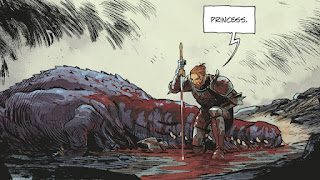
With little to keep him in town, and with the promise of gold and a way of regaining respect amongst his peers, Arzhur agrees to travel to the Black Castle to rescue princess Islen, who is being held within by monsters. Equipped with a new sword, Arzhur travels with the old women and his squire to the castle. Fighting his way past a horde of strange creatures, Arzhur eventually comes face to face with the princess, and the huge monster guarding her. After slaying the creature Arzhur is shocked when the princess tells him that it was her friend. Even worse, the old women begin to try and drag Islen away to her mother, not her father as they had previously told; something that Islen seems terrified about.

Seeing that the old women have lied to him, and that Islen is in genuine fear for her life, Arzhur turns on the women, freeing Islen from their grasp. The old women, now revealed to be evil hag like creatures flee into the forest. Now Arzhur makes a promise to Islen, that he will take her to her fathers castle, keeping her safe along the way. Unfortunately, the hags have other ideas.


The set-up for In Shadows is probably one of the most iconic of fantasy tropes; off to save the princess from the castle. What I really enjoyed about this story, however, is how quickly this gets turned on its head and thrown out the window. Within a few pages of being hired to save the princess Arzhur was already at the castle, ready to go in sword swinging. At first I was left thinking that this seemed a bit too quick, that the story had skipped over a lot of stuff to get straight to the action; but the fact that this was still very much set-up for the real story was a delightful twist.

The real story here is of Islen and her family, of the fight between her parents, and her trying to figure out what kind of person she wants to end up being. In a lot of ways, this is very much Islen's story, rather than Arzhurs, and of the two of them she's the one we get to know the most as events unfold. We find out how her parents met, what their relationship was like, how she ended up in the Black Castle. In contrast, we learn that Arzhur is looked down upon by his fellow knights and feels guilt, but we never know why. The story is clearly holding back on this for a while, and it will be something that will be covered in later volumes, but for now it comes across like he's the supporting character to Islen; which is a nice twist on expectations.

The story we do get this volume is actually really good, and has some great twists and turns, and some really dark moments in it too. Come the end I was actually really disappointed that it was over already, and that I was going to have to wait to find out what happens next as I was fully invested in the characters and their story.

The artwork, provided by Vincent MalliĆ©, is absolutely gorgeous. Mallie is able to bring this world to life in wonderful, detailed ways. The villages and towns feel dirty and run down, like they're lived in. The countryside can feel vast and empty one moment, or like lush, thick forest the next. And the characters all look distinct and clear, with all of them being instantly recognisable and having a physical look all their own. Some of the best stuff, however, are the creatures, the twisted animals and strange magical beings that make appearances throughout. Seeing these unusual things suddenly appear alongside the more mundane makes them stand out instantly, and the level of detail they have means that you'll spend ages just looking through everything, trying to take it all in.

In Shadows was an engaging and engrossing first volume, one that very quickly had me wanting to know more and delving deeper into things. This is going to be one of those books where I'm going to be eagerly waiting for the next volume, and will be reading it as soon as I can.


Support Amy on Patreon

Buy Amy A Coffee

Go to Amy's Blog

Saturday, 12 February 2022

Gotham City Impostors - Throwback 10


Does anyone remember how a Batman themed first person shooter multiplayer game, that didn't feature any of the characters from the comics, was released a decade ago? To be honest, I wouldn't blame you if you forgot that Gotham City Impostors existed, I owned the game and I didn't even remember it was a thing for most of the decade its been out.

Created by Monolith Productions, the company that gave us great games like Alien Versus Predator 2, the F.E.A.R. series, and Condemned, and who would go on to produce Middle-earth: Shadow of Mordor and its sequel, Gotham City Impostors seems like a really odd addition to its list of games. Looking back at it now, it seems like this was something that the team threw together in their spare time between big projects just so that they had something hit the market. 

There's no single player in Gotham City Impostors, there's no story, there's nothing that you can do with this game on your own; instead, the game is a six versus six online shooter, similar to many of the multi-player modes found in first person shooter games like Call of Duty. There are four different game modes open to players right from the start, Psych Warfare, Fumigation, Bounty Hunter, and Team Deathmatch. Despite some of the fancy names long time shooter players will be instantly familiar with the core game-play of these modes, with Psych Warfare being capture the flag for example.


Where Gotham City Impostors seems to at least be trying to make itself feel different from other shooters is in the inclusion of strange weapons and gadgets that allow you to navigate the stages in different ways. The game has some regular weapons in its arsenal, but also over the top, hand made contraptions that do things like firing grenades out of a jack-in-the-box. The gadgets are possibly the design highlight, however, as you're able to equip your Impostor with roller skates that let you zip around the arena, spring shoes that allow you to jump high, glider wings that let you fly over the action, and goggles that allow you to see through walls. These add an elements of fun the proceedings, and makes for a game that isn't just running and gunning; especially as you can be aiming at an enemy and they suddenly spring up into the air and land on a roof thanks to their bouncy shoes.

One part of the game that got a lot of attention at the time was the customisation of the characters. Whilst the game is in first person, and you won't really be seeing your own character much, there were  a lot of items to unlock and equip yourself with that would make you stand out to different players; plus you'd get to see your weird creations in the loading lobbies. These items would be, essentially, bits and pieces that your character seems to have found around the house to make their own Batman or Joker costume. Old shirts with badly sewn on logos, bin lids as armour, cardboard box cowls, and badly applied make-up were common place in this game; and actually helped to set the tone of camp silliness that the game needed.


The environments were similar in this regard, they never seemed to take themselves too seriously. This wasn't the dark and brooding Gotham of Tim Burton's Batman, nor was it the attempt to depict a more realistic caped crusader like The Dark Knight. Here the environments were bright and gaudy, splashed in neon lights and bright paint. It felt closer to rundown Gotham that began life as something from Batman & Robin or the Adam West series. Alongside the silly costumes, the weird gadgets, and the odd weapons, this led to a game that didn't seem to be taking itself too seriously, and actually felt pretty fun to play.

However, this was a Batman game that not only didn't feature the character, but put a focus on guns and shooting people, things that Batman hates. Whilst it was fun to play, it did feel like the definition of a soulless cash-in, a game that with a few tweaks could become a completely different property, and that perhaps simply slapped the Batman branding on at the eleventh hour and called it a licensed game.

Whilst Gotham City Impostors is a Batman game in name only, and barely has anything to do with the character, it was something that was fun to play when it first came out; a game that offered a lighthearted and silly approach to a fairly standard formula. Though with how quickly audiences move on to new multiplayer games, and the gaming having been removed from Steam in summer 2021, it's unlikely that this is a game that you'd be able to play again if the mood took you.


Support Amy on Patreon

Buy Amy A Coffee

Go to Amy's Blog

Friday, 11 February 2022

Elizabeth and the Box of Colours by Katherine Woodfine - Book Review


'Elisabeth loves to paint, just like her papa. She spends hours making her own pictures of everything she sees - and the more colourful, the better!

'But when she goes away to school, she finds herself in a world of grey: grey buildings, grey uniforms, grey rooms. She misses Papa and all the colours of home. And one winter morning, she gets some terrible news that makes her days darker than ever before. Will Elisabeth be able to find the colour and joy in her life again?

'A touching tale about friendship, family and finding joy in the darkest of times. Inspired by the childhood of French portrait artist Ɖlisabeth Louise VigĆ©e Le Brun.'

The Barrington Stoke line of short reads labelled Little Gems have been really great reads so far. Short, punchy, and filled with gorgeous illustrations, these young reader books have been a delight to read every time; and Elizabeth and the Box of Colours is no exception to this rule.

The story follows the real world figure of Elizaeth Louise VigĆ©e Le Brun in a fictionalised account of her childhood in France in the 1700's. Born to a loving family in a large home in Paris, Elizabeth is exposed to art from a young age thanks to her father, who is himself an artist. He allows the young Elizabeth to play in his studio, using his pencils, his pains, and anything she might wish, to practice her own drawing skills. Straight away it's clear that Elizabeth has a strong connection to art, not just because of her father, but because it's the best way she has to express herself.

One day, her life if forever changed when Elizabeth is sent away to school, far from her family home. This school, run by nuns, sees to be the exact opposite of what Elizabeth needs in order to survive. The buildings, the decor, and even the clothing, is drab and grey and without colour. When Elizabeth has her art supplies taken away from her she's left with no choice but to sneak and steal, practising her art in private, lest it be taken away by the nuns.

Her fellow students discover her artistic skill, and encourage her to make art for them all, helping to keep her hobby a secret. But when Elizabeth is given the terrible news that her father has died, she suddenly feels unable to make any more art. With the colour having gone out of her world, Elizabeth isn't sure how to go on.

Despite being slightly fictionalised, with notes in the back of the book informing readers how the real Elizabeth's story differed from this one, the central story of Elizabeth and the Box of Colours is still really important. You see, the book isn't just teaching young readers about one of France's greatest portrait artists, but is giving them a valuable lesson about always pursuing the things you love. Throughout the story Elizabeth is told that art is a wast of her time, that it isn't allowed, and that she should stop what she's doing. And each and every time Elizabeth refuses.

The book is showing children that sometimes you'll be told that the thing you're passionate about is a waste, that it's frivolous and unimportant, and that sometimes you need to tell those people 'no'. It's a lesson that I think we often forget to give our children, that when they've been told time and time again to always listen to adults, to obey authority, it can sometimes be the better thing to turn your back on those who would try to stop you living your dream, simply because it's something they don't quite understand.

Being a book about art, the nook is filled with wonderful illustrations by Rebecca Cobb. Cobb has a very simple style, one that feels like it could have been illustrated by a young artist, and as such it really fits the story being told here. It feels like Elizabeth could have been the one illustration her own story, and the bright, vibrant colours help the images to leap off the page.

Elizabeth and the Box of Colours is a wonderful short story, one that has a good message inside its pages, and one that I think a lot of children are going to enjoy.


Support Amy on Patreon

Buy Amy A Coffee

Go to Amy's Blog

Thursday, 10 February 2022

Resident Evil: Revelations – Throwback 10


Originally published on Set The Tape


Come 2012, Resident Evil was a franchise that had not only come to be the most successful survival horror series of all time, but was also firmly entrenched as part of the ‘family friendly’ Nintendo brand, thanks to it being the first place that games like the 2002 Resident Evil remake, Resident Evil 0, and Resident Evil 4 debuted. But in 2012 the series made its first real leap onto handheld consoles with the release of Resident Evil: Revelations.

Whilst the series had featured some handheld games in the past, with the completely original Resident Evil Gaiden on the Gameboy Color and a port of Resident Evil on the Nintendo DS, these had been either unsuccessful side games, or just re-releases of past games with a slightly new polish. However, thanks to the new technology of the Nintendo 3DS, Capcom finally felt that the time had come to make a completely original portable entry in the series that would be worth playing.

Recent entries in the series had begun to shift towards a more action approach, with Resident Evil 4 and Resident Evil 5 both receiving some praise for this; though the lacklustre Resident Evil 6 that would come out later that same year would receive critical panning for its focus on action over horror. Wanting to offer players something different, game director Koushi Nakanishi decided that Resident Evil: Revelations would have a much bigger focus on the horror roots that the series was known for.


To this end the story was crafted to take place on a huge, deserted cruise ship, essentially a floating mansion at sea. The players get put in control of series mainstay Jill Valentine, who has since left the iconic STARS group and joined the BSAA, a global organisation responsible for combating bio-weapons around the world. Having travelled to the Queen Zenobia after her former partner Chris Redfield goes missing, Jill begins to uncover a conspiracy that could see a deadly new virus spread through the oceans of the world unless she’s able to find a way to stop it.

The choice of setting for the game was actually a pretty good one, with the cruise ship feeling both familiar and completely new in many ways. Large sections of the ship felt like you were back in the Spencer Mansion or the Raccoon City Police building, with the fancy hallways and elegant bedrooms that would have been home to guest. But it was also able to incorporate areas that felt more industrial and mechanical without having to explain away secret labs hidden away (though the game does have those too). It was also a nice nod to the very first handheld Resident Evil game, Resident Evil Gaiden, which also took place on a cruise ship.


Alongside the new setting the game also brought a number of new creatures with it too, thanks to the T-Abyss Virus, a new strain of the Progenitor Virus that combined the T-Virus from the series past with a new virus found in deep-sea creatures. The result are monsters that look like horrible under-water creatures. They have fleshy, grey skin, mouths that open up and extend like eels and worms, and can squeeze through pipes and move through water with frightening speed. A lot of the monsters from this game have yet to actually make a return to the series too, making this the only place that players are able to confront some of the more interesting creatures in the series.

The game made good use of the 3DS technology, releasing a game that pushed a lot of the hardware and presented a gaming experience that felt like a console game in many ways. Added into this, the game incorporated the 3D effects of the console to create the first 3D entry in the series. The graphics were praised upon the game’s release, with many finding it to be one of the best looking games on the console, as well as one of the more exciting entries in the franchise in recent years.

Only a few years after its handheld release, where it received huge sales and positive reviews, a HD version of the game was brought out onto Xbox 360 and Playstation 3, where it spent a number of weeks at the top of the chart. Thanks to the added hardware specifications of the consoles, this edition was able to push the game-play and graphics of the game even further, with new game modes and updated graphics added. Though these versions didn’t prove to be as popular as the original 3DS release they still did well for the series, and a further re-release would come to the Nintendo Switch, keeping the game on the latest generation of Nintendo portable consoles.


Support Amy on Patreon

Buy Amy A Coffee

Go to Amy's Blog

Wednesday, 9 February 2022

Promethee 13:13 Volume One by John Diggle and Christophe Beck - Book Review


'What if you knew the world was about to end? What would you be willing to do, to save the people you love?

'Darla Clemenceau has been plagued by apocalyptic visions, ever since she was abducted by a UFO as a child. Now, she's ready to put it all behind her and move on with her life. But what if it's all true? A dangerous cult militia is prepping for the end of the world, and they see Darla as the key to their survival...

'Meanwhile, something alien is awakening on the dark side of the Moon, and the crew of the space shuttle Atlantis have a rendezvous with destiny...'

Promethee 13:13 begins by following alien abductee Darla Clemenceau as she prepares to go on stage at a UFO conference to talk to fellow believers about her experience, as well as the strange visions of a future apocalypse that her abduction left her with. However, whilst the audience are expecting her to tell that that aliens are real, she does the exact opposite, and tells the room full of believers that she was never taken by aliens, that her experience must have been a hallucination, and that she's been taking anti-psychotic medication ever since. The crowd reacts poorly, and Darla passes out from the stress.

Waking up some time later in the back of an ambulance, Darla is expecting to be able to go home, but when the man who invited her to speak at the event kills the two paramedics and takes Darla hostage at gunpoint things go off the rails. The man tells Darla that her experiences were real, and that the visions she has been having are connected to a very real threat that will soon come to pass. 

As Darla is being taken to meet with the man's fellow believers NASA is busy sending up a new space shuttle. The mission is officially heading up to restock the International Space Station, but the astronauts will be secretly deploying a satellite able to detect gravitational disturbances. As the crew prepare to deploy the satellite some unseen force takes hold of the shuttle and drags it across space to the dark side of the moon. Here, the crew are shocked to find a huge, alien structure awaiting them. Their shuttle is taken inside, and the crew begins to ponder what their best course of action is going to be.

Back on Earth, Darla is taken to a secret location where she meets a group who believe that her visions are not only real, but that they're connected to a vast conspiracy that could be leading to the end of the world. She's told that not only was she abducted by aliens, and altered in order to survive seeing them, but that the visions she is having are connected to a series of events where disasters will occur at 13:13 over the next few days, until an apocalypse takes place. With the end of the world looming on the horizon, the group wants Darla to use her visions to help find them a road to safety.


I'd been familiar with the name Andy Diggle for a few years, due in large part to being a fan of DC's Green Arrow, and the television adaptation series Arrow. Outside of his Green Arrow Year One book the only work of his that'd I've read was Judge Dread vs. Aliens, an absolutely brilliant read with some gorgeous artwork; and thanks to how well written and entertaining that book was I felt pretty confident that he'd deliver an engaging and interesting science fiction story. I'd no experience with Christophe Beck's work before this, but just looking at his back catalogue of titles, and the type of stories he's written, I was pretty sure that I was going to like what he does.

I liked how the story wasn't afraid to keep the reader in the dark for a good while, slowly unfolding the story over the course of the hundred pages. It would have been easy to lay a lot of things out early on, to provide the audience with big info dumps from the characters that were in the know, but instead Diggle and Beck teases things out, drip feeding the important information; and this makes for a much more entertaining mystery, as you're never really given any more information than the character on the page who has the least information. This leads to some great moments where we get shocking reveals, or the plot goes in a direction I wasn't expecting.

I also loved how this was a science fiction story where the person who holds the only hope to survival isn't a traditional hero. Darla is a middle-aged, large Black woman. She's not some pretty, young, white person who's able to pick up a weapon and beat the bad guys; she's an average every person, and this works so much better. She doesn't have all the answers, she doesn't have special training. She's unsure of herself. She felt like a very real person in over their heads and it made her so much more relatable because of this. All to often these kinds of stories make their leads into big, bolder than life heroes who are able to perform impossible deeds, and whilst it might be entertaining from a visual sense, it never really feels believable.

The artwork on the book is provided by Shawn Martinbrough, whose work suits the book well. For the most part, there's nothing really big or extraordinary in the pages of Promethee 13:13, it's not the kind of story with wild visuals; as such, the artist on the book needs to be someone who can take the mundane and ordinary and make them look interesting. It's one thing drawing super heroes flying through the air, this is always going to look striking, but drawing two regular looking people sitting in a room talking and still making it dynamic takes a lot of skill, and Martinbrough does this time and time again here. Not that there's not some great visual moments though, as when things get weird Martinbrough is able to bring a level of scope and dynamic flare to proceedings.

With this being the first of three volumes we don't get every answer that we might be hoping for here, there's still a ton of mysteries to unpack come the end; but I honestly found myself eager to jump straight into the very next book as soon as I was done. I wanted to know more about these alien visitors. I wanted to find out about the huge conspiracy. And I wanted to see what happens to Darla next. Diggle and Beck have done a great job of crafting a story that really managed to hook me and get me invested in the world and the characters in a relatively small amount of time. I'm very much looking forward to the next entry in this series.


Support Amy on Patreon

Buy Amy A Coffee

Go to Amy's Blog

Monday, 7 February 2022

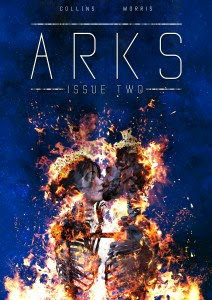
Arks #2 – Comic Review


Originally published on Set The Tape


The second issue of the independent, fan funded comic series Arks has arrived, and it begins to give readers a lot more insight into what’s happening on this strange new planet, as well as raising the stakes for our two protagonists.

The first issue of the series was one that spent most of its time shrouded in mystery, keeping the details of who this man we were following was, and what was happening, pretty close to its chest. It was only really at the end that where things began to get clear; in contrast, this issue gives readers a lot of information and begins to reveal a larger plot at play.

With the two leads, Joseph and Lilith, now reunited we start to learn more about them. Lilith spends a great deal of the issue quizzing Joseph about who he is, what he remembers, and what he’s been doing. This is down to Joseph clearly having some kind of trouble going on, some kind of trauma or medical issue that’s been causing him to act strange, and Lilith wanting to figure out how his mind is. It’s a neat little conceit to get the two characters talking about things that wouldn’t naturally come up in conversation.

We get to learn about where the two of them met, their favourite foods, their pets, bits and pieces about their childhoods. We discover things that begin to give us insight into who they are as people and how their relationship works that we wouldn’t otherwise know. After all, people who’ve been in a relationship for decades don’t tend to list off facts about their lives. Possibly the biggest surprise in these revelations is that Joseph and Lilith aren’t as young as they look, and that when their minds were uploaded into the device that recreated them on this new world they were in their eighties, revealing a further startling feature of this strange technology.


The issue isn’t all about getting to know only the humans, however, as the two of them explore their new world and discover dangers waiting for them. There’s a big sense of mystery as they find strange things, animal corpses in strange conditions that hint that there might be something wrong with this world.

Once all the drama of the issue is over, ending on a pretty scary cliff-hanger, we get some extra pages at the back of the book that give us some insight into the amazing technology that R.J. Collins has created for this story. We’re given information about the nano-technology that’s being used to transform this primordial alien world into a replica of Earth. We also get an explanation as to why some of the birds look weird and have extra eyes, because they’re cybernetic drones designed to search and scan areas to help with the terraforming. These pages are great, because they explain small details that have been scattered throughout the issues, and give a breakdown of things like the rapid synthesiser which we probably wouldn’t get in the story itself.

The art follows the same style that we had in the first issue, though it feels like perhaps it’s gotten better in some ways. I get the sense that the artist has become more comfortable and confident with the process, this odd combination of traditional looking and digital art, and has been trying new things. The pack of wolves that appear in the book in particular look really good, and they come across as particularly dynamic and menacing.

The second issue of Arks builds on the sense of strange mystery that the first issue had, introducing new, bizarre things for the readers and characters to discover, whilst also managing to bring us up to speed on things that were left something of a secret in the first issue. I feel like we’ve actually begun to understand who Joseph and Lilith are now, and now that we’ve begun to connect with them we can start delving into the bigger mystery at play.


Issues #1 and #2 of Arks are available now from Clicky Sprout Wife. Issue #3 will launch on Kickstarter on 24th February.


Support Amy on Patreon

Buy Amy A Coffee

Go to Amy's Blog

Saturday, 5 February 2022

Maneater - Game Review


The beauty of the Xbox Gamepass is that you can try out games that you think look good, but that you'd probably not pick up in a shop. There are some games where the very concept of them sounds cool, but thanks to lack of funds you just can't justify buying them. Maneater is one of these games for me. I'd seen it on the Xbox store, saw the trailer for it and thought 'I definitely need to try this one out'; and I am so glad that I had that opportunity to.

The game begins by putting you in control of a bull shark, whose life is being narrated by a voice over like you're on a nature documentary; a voice over that some folks may recognise as Chris Parnell, well known for his roles in Rick and Morty and Archer. This immediately sets the tone for the game, telling the player that this is not a game that you're going to be taking seriously, and where you should expect to have a lot of fun. 

From here players head into a small bay, where you're introduced to the various ways to control your fishy avatar, including how to attack and eat everything in the water (humans included), before going up against a shark hunter named Scaly Pete, who captures and kills the bull shark. Thus it is revealed that we're not going to be playing as this shark, but instead the one inside her. Our new shark is born, managing to chomp of Pete's hand in the process, before being dropped into the bayou. 


Now in control of our real character, a tiny baby shark, we begin the game in earnest, exploring our environment, chomping down other fishies to level up and get bigger, and trying to avoid larger predators. This early stage of the game is actually genuinely challenging, and I found myself having to run away from large predators a number of times as I swam into range of an alligator whilst scouting out the area. The first few hours were spent carefully exploring, ticking off objectives from my map, whilst trying to gain enough experience to level up to a point where the other nasties wouldn't mean an instant death sentence for me.

After a while you're able to collect enough experience, as well as the various elements that you will need to unlock and upgrade different abilities, and the game becomes a little less challenging, and a lot more fun. By completing missions and grabbing collectables more locations begin to open up, including a polluted bay, an island golf resort, a tourist filled beach, and the deep ocean. Each new area brings with it more stuff to find and unlock, as well as new prey and challenges. Despite being the same water, with every area connected, it feels surprisingly varied, and some of the final locations are starkly different from those at the beginning. 

Simply exploring these areas is a huge part of the fun of the  game. Swimming through shoals of fish, gliding through sunken ship and over coral reefs is actually quite relaxing, and if you keep on grabbing food as you go simply swimming around taking everything in will keep you in enough elements to keep unlocking upgrades at a steady pace. Exploring also allows you to find 'locations', points of interest around the maps that grab you experience. These are always worth checking out, not just for the upgrades and to fully tick off all your tasks, but because they're usually a lot of fun to see, and contain some decent jokes. One location took me to a sea sponge home which turned out to be a pineapple, another had me discovering giant doors on the bottom of the ocean kept closed with chains that had the narrator confirming the existence of kaiju, and a bag filled with hockey stick on the golf course seemed to imply that this game takes place in the same universe as Happy Gilmore.

The humour of the game is easily one of the biggest selling points, as it means that you're never left sitting there thinking 'this thing is too silly', because the game lives on being silly. The jokes scattered around the map do this, as do the ridiculous things your shark can do, like flopping up onto land and eating people in the street. If the game didn't embrace the silliness it wouldn't be half as enjoyable as it is.

As well as unlocking locations around the map your shark will be going up against some Apex Predators, mini-bosses that will range from no problem at all to ones where you'll be taking a few attempts to beat depending on how much you level up. Early game bosses like barracuda's and alligators won't be too much of an issue f your the same level or higher, but as the game caps your level at thirty, the later game bosses like level forty killer whale, or the level sixty sperm whale will present a genuine challenge where most other things won't. But, as I was comfortably eating great white sharks at this point suddenly having to play smart and use tactics was a pleasant surprise.


The game also has some great unlockables for your shark, with mutations that allow you to customise your play style. You'll be able to equip different base bodies, tails, teeth, heads, and fins that allow you to do different attacks, and alter your speeds and bonuses. Not only do these upgrades allow you to change the way you play, but it will mean your shark will take on some interesting attributes, and come away looking like a monster from myth.

I really enjoy games where I get to explore open worlds and grab collectables; even if there are no achievements or challenges connected to going everywhere and doing everything I'll often find myself doing it anyway as I need to tick off every item and remove every marker from my map. And in some cases a lot of those kinds of games can begin to feel generic, and samey. Maneater, however, felt so different and fresh. Getting to swim through these environments, rather than just running and climbing, added a whole new feel. It felt fresh and new and unique in ways I've not experienced for a while.

As someone who doesn't get to play nearly as many video games as I used to I had an absolute blast sinking a couple of days into this game. I had fun exploring and collecting, the combat was different, and it was packed full of humour. I think this is going to be one of those games that I'll be recommending to folks for a good while to come.


Support Amy on Patreon

Buy Amy A Coffee

Go to Amy's Blog

Friday, 4 February 2022

Star Wars: The High Republic Adventures: Galactic Bake-Off Spectacular – Comic Review


Originally published on Set The Tape


The Star Wars franchise is well known for its space battles, gunfights, and light sabre duels; it’s got Wars in the name for a reason. But sometimes it’s the quieter moments in the franchise that can really stand out. Whether it’s watching Boba Fett become part of a tribe of Tuskens in The Book of Boba Fett, or watching Omega bond with her siblings in The Bad Batch, the moments that aren’t about fighting and conflict can be some of the ones that not only bring a lot of joy, but shows people what’s worth fighting for in this universe. Star Wars: The High Republic Adventures: Galactic Bake-Off Spectacular is the second time we’ve got to see the Jedi of the High Republic take a break from all of the terrible things that are going on, and it’s a delight.

The last time we saw our heroes having some fun was in issue eleven, where the teens took part in the Great Jedi Rumble Race, a competition where they dashed through the halls of the Starlight Beacon having fun and competing against each other. This issue, which seems to take place slightly before those events, sees our characters having fun in a very different way.

The issue begins with Master ‘Buckets of Blood’ Buck announcing that it’s the ‘Great Jedi Baking Day of Baking Baked Things’ as he and several others burst their way into the kitchens of the Starlight Beacon. I swear, this man can’t do anything subtly and I absolutely love it. He’s like a big blue Brian Blessed Jedi. Buck has gathered together some of the other Jedi, and a handful of Padawans, to help him to make Yoda’s recipe for Special Baked Sweet Story Custard Cakes. The cakes, which everyone is desperate to get, has a special ingredient though: you have to tell a story about cooperation whilst making them.

This leads to Buck and Kantam telling the young students a story about how the two of them had to come together and cooperate in order to make it out of the Great Disaster alive. From here the book jumps backwards and forwards between the Great Disaster and the Jedi making their sweet treats, with more and more people arriving to help and listen to the story each time we cut back to the Starlight Beacon.

The issue is written by series regular writer Daniel Jose Older, but he’s also been joined by Vita Ayala, who has been doing some fantastic work writing Nubia and the Amazons over at DC Comics. As the story is skipping between two different times I wasn’t sure if Older and Ayala would be taking one section each, or sharing the writing across all parts, and after reading it I really can’t tell. The two of them write really well together, and this is very much a comic where the creative team seem to be on the same page and crafting a great story together. With how good Ayala’s work has been on other titles I hope that we get to see more of them in future Star Wars titles, as their character work and attention to important themes and narratives fits perfectly in this universe.

Whilst the writing is pretty seamless, there are two very distinct art styles on this issue, with two different teams working on the two time periods. Toni Bruno, who has worked on the High Republic books in the past, provides the artwork for the sections that deal with the Great Disaster. Bruno’s art style uses thick lines, and messy edges to give a more gritty, lived in feel, and this works really well for a flashback to a time where everything is falling apart and breaking around our heroes, and their lives are in danger.  Jo Geyong, in contrast, has a very light art style, with thin, neat lines, and lighter, brighter colours decorating their pages.

The result is that not only are the two times visually distinct, but that they build upon the feelings the authors are trying to get across. The Great Disaster is a dangerous, awful time, so it is darker, moodier, and messier in places to help convey this without even needing the words; in contrast, things are bright and airy when the Jedi are all gathered together making food. It’s a happier time where nothing bad is happening, and the artwork not only reflects that, but makes you feel it.

Whilst not a huge amount happens in this issue to move the story forwards it’s not really about that. This issue is about taking a breather, and showing our heroes in a happier time, one where they can relax and feel some joy. But, we do also get to learn more about Buck and Kantam, and where they were during the Great Disaster too, so it does fill in some blanks for us. We also get an actual recipe in the back to make Yoda’s cakes too, and I don’t know about you, but I’m definitely going to be making those at some point.


Support Amy on Patreon

Buy Amy A Coffee

Go to Amy's Blog