Monday, 10 August 2020

Marvel Action: Spider-Man #3 – Comic Review


Originally published on Set The Tape

So, the Shocker story-line has come to a close much in the way that I was anticipating. The villain was brought down, and revealed to be exactly who we all thought he was going to be, but despite this resolution being something that I was pretty sure about from the very first issue it was still a really entertaining read. Brandon Easton is really good at telling his superhero story, but he’s even better at telling a human story, and that’s what makes this final part of the story really work.

The stuff with Shocker is pretty standard fare. He’s upgraded his suit and is more powerful than ever, using his powered-up abilities to hold the city to ransom. His new suit is pretty cool, and is what you’d get if you mashed together Iron Man‘s hulk-buster armour and Shocker. Whilst this is a bit of a stark visual change, thanks to the standard Shocker suit having some vaguely Iron Man hints to the design it isn’t too big of a change to this version of the character.

It even proves to make more sense for Shocker to be in some kind of armour rather than his normal quilted jacket as the heroes make a point of him needing to be insulated from his vibrations. I know that that’s what the classic Shocker’s suit is supposed to do, but it always looked a little hokey and weird, but this big armour looks like something that would actually work and do that job.

The action scenes are pretty good once they get going, and the powered-up Shocker is actually one of the more impressive villains the heroes have had to take on. He’s not just a physical challenge for them, but is able to cause substantial property damage and a risk to civilians in ways that some of the other villains haven’t.

Now, to talk a bit more about the story and character elements I’ve got to go into spoilers, so if you don’t want to know stuff skip ahead to the next paragraph. So, it turns out that Shocker is actually Mr Schultz, Miles’ teacher. The revelation isn’t a complete surprise, but the effect it has on Miles is the important part. He spent so much of this issue thinking that his mentor was a victim, or being forced to help the Shocker in some way. He wanted to believe that Schultz was a good man, and refused to think he was the villain. Whilst this is a definite blow to Miles it does go to highlight that Miles has a good support network around him, that he’s able to rely on his friends and parents to support him. This definitely plays into one of the bigger themes of the entire Marvel Action: Spider-Man series, that friendship can help get you through.

This issue seems to put the Shocker story-line completely to bed, and it seems like Miles is relatively okay come the end, so I don’t know if this will have any lasting consequences for the book or the characters. If there are other things to come that tie into this I’m excited to see them, but if not this story still proves to be a great jumping on point for  the next volume. It shows how the characters work together, and how important their team is to keeping them being successful heroes.


Buy Amy A Coffee

Go to Amy's Blog

Friday, 7 August 2020

Theo Paxstone and the Dragon of Adyron by James Turner - Book Review


'Dragons and worse lurk in the forests of Adyron, and only the steam knights in their gleaming battle machines can keep the kingdom safe. Theo Paxstone dreams of being a knight himself, but instead finds himself stuck slaving away at a repair shop for a pitiless master.

'When a dragon swoops in and abducts the princess from the annual royal tournament, Theo escapes. He joins forces with a crippled knight and his squire, and together they pursue the dread beast, determined to rescue the princess from its clutches. Along the way they discover that not all enemies are what, or whom, they seem…'

Theo Paxstone and the Dragon of Adyron is a fun fantasy story designed for younger readers, but one that adults will enjoy too. Set in a post-apocalypse world, where the old world of technology and science has fallen into myth and legend, the story follows young orphan Theo. Theo is stuck working in the junkyard shop of Master Grimes, worked in sweatshop like conditions for long hours. Whilst there are many downsides of his life, this does mean that Theo has learnt to become a mechanical genius.

Having secretly worked on his own steam knight armour in a hidden corner of the junkyard, Theo dreams of one day getting to be a steam knight, piloting a huge suit of armour equipped with flaming lances and missiles. The steam knights are definitely one of the cooler parts of the book, and uses the post apocalypse fantasy element of the world to full effect, giving us massive mech armour that lumber into battle firing gatling guns and clashing with huge swords.

When the royal family comes to the city, complete with a huge following of steam knights, Theo thinks that he'll get the chance to sneak away from the junkyard and watch the knights in action during the tournament. Unfortunately, before the festivities can really get underway a massive dragon attacks, killing many knights and kidnapping the princess.

During the attack Theo finds a trapped knight, Sir Bertham, and helps to free him from the burning wreckage alongside Bertham's squire Riley. After helping the old knight Bertham buys Theo's freedom from Master Grimes, and gives Theo the opportunity to join him and Riley on their mission to rescue the princess from the giant dragon.

The quest that the three of them set out on, saving a princess from a dragon, is one of the most clichéd ones around, but James Turner manages to make it feel fresh and interesting. This is in large parts thanks to the setting, and the small events that beset the group along the way. The four of them have to contend with huge mutant wolves, monstrous lake creatures, and even evil knights on their journey. Along the way we also get to learn a little more about the characters, and we learn that Riley and Bertham have some secrets to them. 

The characters and story have enough twists and turns in them to keep events interesting, and prevents the plot from falling into any of the expected clichés. The setting and world is fairly interesting, and James Turner gives the sense that he's thought a lot about the world and the history, even if it doesn't always get the spotlight in the story itself. There's a lot of references to places and events that we never see, and often don't get explained in any real depth. This makes the world feel bigger than just what we're seeing, but there is a downside to this, the world feels big, but not hugely deep. We never learn what happened to the old world, why some people have powers, if those powers are magic or down to some technological advance or mutation. I can't help but feel that some more time could have been given over to these elements, but then it becomes a matter of having to fill the reader in on history without it feeling too dull or like a history text. It's a fine line to walk, and whilst it mostly works here, there were a fair few times I wanted more.

Theo Paxstone and the Dragon of Adyron is a book that will appeal to most age groups, and would be a great book for a parent to read with their kid.


Thursday, 6 August 2020

Total Recall – 30 Years On


Originally published on Set The Tape

If you asked people to list their favourite Arnie films I’m pretty confident that Total Recall would wind up high on most of those lists. There’s a point in his career where his films were definitely a bit dodgy, but Total Recall falls in that golden period between things like Predator, and Terminator 2, where he was definitely at his best. Despite the amazingness of the film we ended up with, the movie actually went through a bit of development hell.

Originally adapted from the Philip K. Dick story ‘We Can Remember It For You Wholesale’ by Dan O’Bannon and Ronald Shusett, the guys who created Alien, the film bounced around between directors and actors for decades before finally being made. David Cronenberg and Dino De Laurentis were set to direct at certain points, and the film had Richard Dreyfuss, William Hurt, and even Patrick Swayze set to star in the lead during the development. Eventually the film landed with Paul Verhoeven, who was still celebrating success from Robocop. Together he and Arnie would make a film that would become a classic.

Set in 2084, the film follows construction worker Douglas Quaid (Arnold Schwarzenegger), who really wants to get away from it all and have a vacation. He’s been dreaming of Mars and would love to visit, but his wife is set against it. Instead, he opts to get memories of this dream holiday implanted into his head. He decides to spruce things up, however, and opts for the spy package, where he’ll get memories of travelling to Mars to save the planet and beat the bad guys. When they go to implant these memories, however, they discover that Douglas Quaid is a false memory, and that he’s on the run from a mega corporation on Mars who wants him dead. With his cover blown Douglas has to travel to Mars to find out who he really is, and stop the bad guys from killing him.


The film is very much a fish out of water style story, with Doug being an average construction worker suddenly thrown into a world of corporate espionage, murder, and revolution. And the film really leans into the weirdness too, throwing alien ruins and psychic mutants into the mix. This, along with Quaid never being sure if his memories are real, or if he’s even stuck in a delusion, make it a bit of a trippy film at times. There’s even some discussion as to whether or not what we see happening is even real as the man selling Doug his memories basically outlines the plot, and we see the alien ruins and Melina (Rachel Ticotn) on one of their screens. I’ve seen this film dozens of times myself, and still don’t know where I stand on if it happened or not.

I think this is one of the reasons why Total Recall has endured as one of Arnie’s best movies. It has the cool action sequences and cheesy one-liners that fans come to expect, but it also gives you room think about the plot more, you get to discuss the story with people who have differing interpretations, and you can go through and analyse small images or snippets of dialogue from the start of the film and see how they play in to the whole.

The film might not be one of Arnie’s most memorable ones next to things like the Terminator franchise, but I think it’s definitely one of his most interesting films, one that can satisfy both the deeper thinkers and analysers, as well as those just coming for silly action.


Wednesday, 5 August 2020

Sherlock Series 1 – 10 Years Later


Originally published on Set The Tape


Sherlock Holmes is one of the most famous literary characters in existence, and considering that he’s just a regular man, is incredibly recognisable no matter who is playing him. You could stick a deerstalker hat and magnifying glass on a bare shelf and someone would look at it and say ‘oh, Sherlock Holmes’. With how iconic the character is it’s no surprise that a new adaptation comes around every decade or so, but none have quite taken the world by storm the same way that BBC’s Sherlock did back in the summer of 2010.

The series came about during a conversation between long time friends and creators Mark Gatiss and Steven Moffat, who were on a train together at the time. The two of them talked through their love of the books, and the different adaptations that had been made over the years, and thought that it could be fun to try and update the classic Victorian tales for a modern world.

They pitched their idea to some BBC executives, and were given the go ahead to make a 60 minute pilot episode. The series cast Martin Freeman as John Watson, who was probably best known for The Office at the time, and the relatively unknown Benedict Cumberbatch at Sherlock Holmes. Whilst we can now look at this casting as something good, at the time people couldn’t believe that the BBC were spending so much money on a series with two ‘nothing’ actors. But more on the actors later.

The Sherlock team produced an hour long pilot episode loosely based on the first Sherlock Holmes story, ‘A Study in Scarlet’. This episode is still available on the series one DVD, and is well worth the look because it’s probably the best version of Sherlock around. Based on the strength of this pilot the series was green-lit, but with some slight changes. The show was only going to get three episodes, but each would be 90 minutes long. This is where the series began to run into problems.


The first episode was entirely re-shot, both to account for the new run-time, and to make use of the bigger budget available. The episode was padded with some unnecessary scenes, like the introduction of Mark Gatiss’ Mycroft Holmes to try and make some mystery and potential conflict that went nowhere, and to shoehorn hints of Moriarty (Andrew Scott) into the episode. Despite these changes, the first episode of the series, ‘A Study in Pink’, is still probably the best episode of the entire show, because it’s the closest to what Sherlock Holmes is supposed to be.

The first episode shows Sherlock being given a mystery and actively trying to figure out who the killer is. He makes mistakes along the way, letting the killer go at one point because he’s operating under a false assumption, but ultimately we see a little of how he does things. He picks up on small clues and uses his vast intelligence to try and make deductions.

However, as the series goes on this begins to fall by the wayside, and Sherlock solves mysteries because he just knows everything. He gives us the answers, sometimes without telling the audience how he reached those conclusions, and at other times having used information that the audience were never given. Mysteries are supposed to be fun because they give the audience the chance to try and work things out, but Sherlock seemed to forget that as the first series went on, instead making it more about how amazingly smart the lead was. And boy was that an issue by the time they got to series four.

This isn’t the only major problem with this first series, however. There’s also Moriarty. Professor Moriarty is one of the greatest and best known literary villains of all time. This is despite him only ever appearing in two stories. Gatiss and Moffat try to force the character into every episode of series one, though, having him pulling the strings behind everything just to mess with Sherlock it seems. That’s despite him making a point of saying he doesn’t want Sherlock getting in his way. There’s a huge inconsistency to the character in the way he’s written. They’ve turned a calculating genius into a bit of an idiot. And dear god, talk about queer coding. I’m not bashing Andrew Scott here, as he’s a good actor who was only doing as he was told, but the sheer amount of camp in his performance is so over the top it becomes both distracting and insulting.

I’m sure this is the point where you’ve either switched off or are just grumbling at me for writing about a series I’m not a fan of. But I am a fan. I like this series, to a point, and adore Sherlock Holmes in general. My biggest issue is that the series was run by two people who just don’t seem to understand what makes the characters and stories great, and just wanted to show how clever they are.

The series isn’t completely bad though. They have some great production values and do some very clever things with presenting information to the viewer, such as having text messages flash on screen or displayed on a part of the set rather than cutting to a phone. Yes, the show got more extreme with this as time went on, but series one has a great balance and uses it well.

Sherlock also gave us Una Stubbs as Mrs Hudson, who is hands down the best version of the character ever put to film. Yes, she has moments where she gets a bit silly (looking at you again series four), but for the most part she’s a great mother figure to the two man-children that are Sherlock and John. She’s also the member of the cast who was best known when the show came out, and her casting definitely helped get the series some attention.

Despite some of the issue that I’ve covered here, series one of Sherlock took the public by storm, and made it one of the biggest hits the BBC has ever had, as well as making the series’ stars into hot commodities. I’m confident in saying that Benedict Cumberbatch wouldn’t be a household name without this series.

Yes, it’s flawed, and the flaws here become huge problems later on, but series one is still the best the show ever was, and has some genuinely good moments in it too. If you haven’t already seen it, I hope that this article doesn’t put you off, and that you’ll go give the show a go yourself.


Tuesday, 4 August 2020

Loveless by Alice Oseman - Book Review


'Georgia has never been in love, never kissed anyone, never even had a crush – but as a fanfic-obsessed romantic she’s sure she’ll find her person one day. As she starts university with her best friends, Pip and Jason, in a whole new town far from home, Georgia’s ready to find romance, and with her outgoing roommate on her side and a place in the Shakespeare Society, her ‘teenage dream’ is in sight.

'But when her romance plan wreaks havoc amongst her friends, Georgia ends up in her own comedy of errors, and she starts to question why love seems so easy for other people but not for her. With new terms thrown at her – asexual, aromantic – Georgia is more uncertain about her feelings than ever. Is she destined to remain loveless? Or has she been looking for the wrong thing all along?'

I'm not normally one for literary fiction, I normally like something a little fantastical to be a part of the books I read, and I don't really read much queer fiction, despite being quite gay myself. But there was something really special about Loveless that made it really hard for me to put down.

One of the biggest appeals of this book was the subject matter, not necessarily a young queer girl going to university and discovering their sexuality, because that's not too uncommon; instead, it's that the book gives representation to asexual and aromantic people. This is a part of the LGBTQ+ community that are often not given a voice, and in some cases are even denied their identity actually existing. My computer has even tried to get me to change aromantic to aromatic.

I know some people who fall into these categories, some of them are people that I love, and it's so good to get to read a book that gives this community a chance to take centre stage.

The story follows Georgia as she and two of her best friends, Pip and Jason, move to Durham University. Georgia has never kissed anyone, and is plagued by this. She thinks that there must be something wrong with her, and really thinks that she should be in a relationship or in love because shes a big fan of love stories, but nothing ever feels right to her. She tries to kiss her 'crush' on prom night and the result is pretty spectacularly disastrous to say the least.

With the help of her friends and her outgoing room mate Rooney, Georgia tries to explore her sexuality and discover if dating and relationships are really right for her. As these are teenagers, there is of course a lot of drama involved, and things don't always go well for the group, leading to misunderstandings, arguments, and break ups.

Despite this, Georgia makes a new friend, the head of the Uni's Pride Society, and learns more about asexuality, and more begins to make sense to her about her life. Now Georgia has to learn to come to terms with her sexuality and her worries about her future, whilst repairing her friendship circle.

Loveless is full of drama and teen angst yes, but it's way more than that. It's about love. And whilst there is a sapphic enemies-to-lovers romance in here, it's not about romantic love. The book makes a big, clear point that platonic love is a real, important thing. The love that you have for your friends is real, and it matters. It might not be the same as love for family, or love for a romantic partner, but it can be just as strong and just as meaningful. This is an important thing for aro-ace people, and it's a big part of Georgia's journey in the book, but it's something that applies to everyone.

The book shows the reader through Georgia how important love is in all of its forms, and that you should never feel ashamed or weird for saying that you love your friends. Friendships can be so powerful and important, and you should be able to tell your friends that you love them dearly. Loveless is about learning to discover your true self, but also learning to not be afraid of your future or trying to force your life to fit the shape that society says it should. It doesn't matter if your life and your love isn't what society demands it should be, what the boring straight cis people would call 'normal'. We're all amazing and wonderful, our lives all matter, and everyone deserves to finds happiness in whatever form that takes.

I'd never read Alie Oseman's work before, but am definitely planning to read more of her stuff now. I'm going to be recommending this book to so many of my friends, especially the queer ones. And I hope that this kind of story becomes more common, that aro-ace people aren't a rarity in fiction, and that their stories aren't about having to 'fit in' or being 'fixed', but them just getting to live their own lives. This is amazing queer content, and I absolutely adored every minute of reading it.


Monday, 3 August 2020

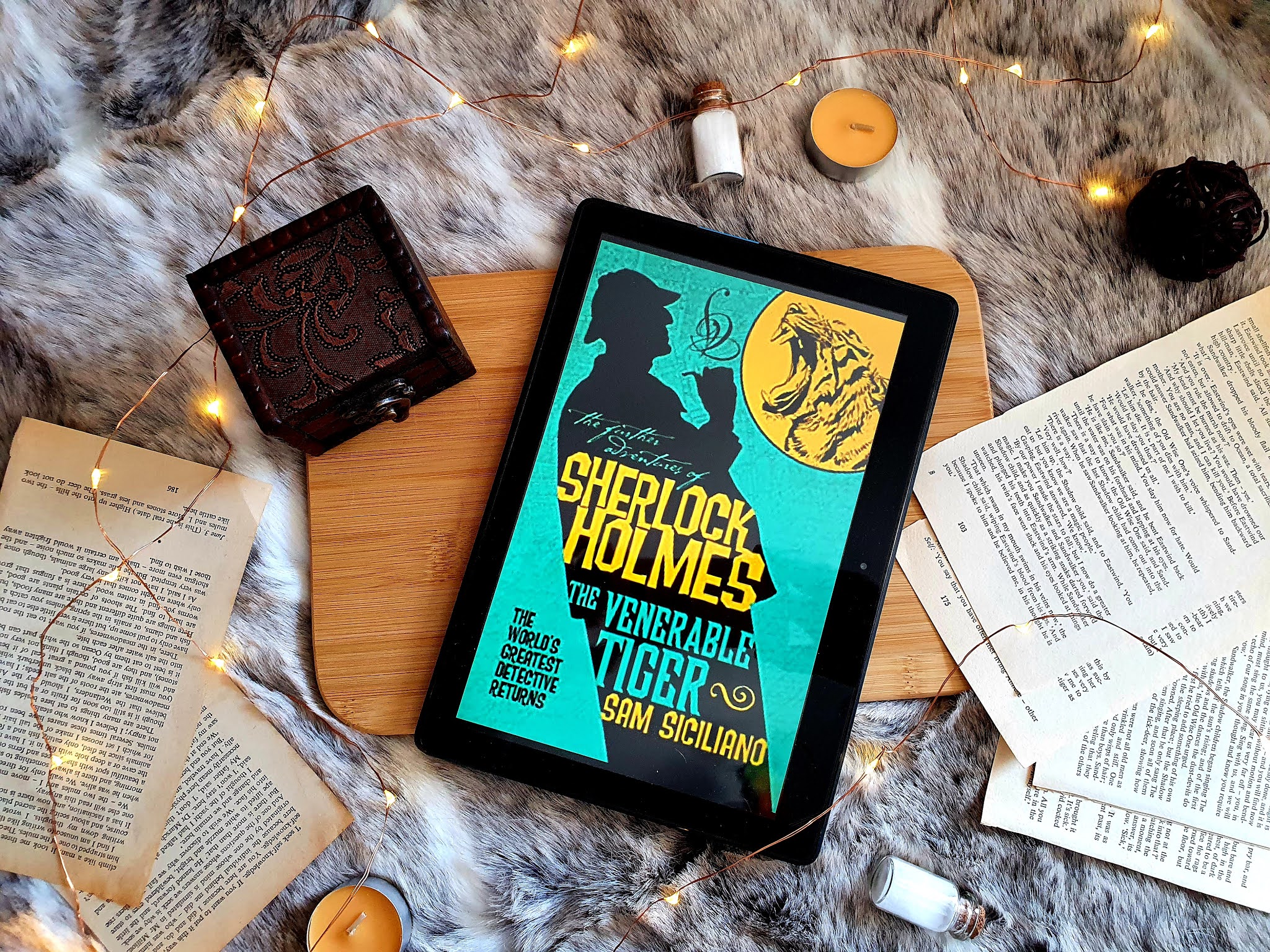
Sherlock Holmes: The Venerable Tiger by Sam Siciliano - Book Review


'Sherlock Holmes acquires a new client when a beautiful young woman, Isabel Stone, faints on the steps of his Baker Street rooms. She has come to beg his assistance in reclaiming some priceless jewels kept from her by her tyrannical stepfather, Captain Grimbold Pratt. But shortly after agreeing to take her case, Captain Pratt comes to Baker Street, not quite so tyrannical as Isabel would have them believe. Holmes and his cousin, Dr Henry Vernier, must unravel a tense family mystery dating back to the Indian Mutiny, where neither of them is sure who to believe… '

Quite often I find myself thinking about what makes a good Sherlock Holmes story. Obviously there's the need for a good central mystery, these stories are mystery books after-all, and Sherlock Holmes without a case to solve is often something that's best left alone. There's also the need for a good grasp of the character, you need to understand why Sherlock and Watson are iconic and popular figures and bring some of that to the work. And one that I personally like, is does it feel like it could be put on television? Any Sherlock Holmes story that captures the feel of the Jeremy Brett television series from the 1980's and 90's is always going to win me over very quickly, and this is what happened with Sherlock Holmes: The Venerable Tiger. I could really picture the iconic Holmes actor walking around this vast country estate, interacting with tigers, and the over the top host, and it made me really enjoy the book even more.

Sherlock Holmes and the Venerable Tiger sees Holmes and his cousin, Doctor Henry Vernier, being presented with a potential case when a delicate young woman Isabel Stone arrives at 221B Baker Street, literally fainting into Vernier's arms when she gets there. She informs the detective that she's lost her fortune, and needs his help to get it back. Her father was one of three men who returned from military duty in India with a cash of jewels worth a fortune. Her father passed away, leaving the riches to Isabel and her mother, who married a friend of her father, Captain Grimbold Pratt. Now her mother has died too, and Grimbold refuses to give Isabel her inheritance.

Whilst Holmes doesn't seem initially interested in the case, but when the huge and imposing Grimbold arrives and threatens Holmes and Vernier the case sparks something in the detective and he agrees to try to get to the bottom of things. He and Vernier travel to Grimbold's estate, where they find even more mystery, and a host of exotic animals waiting for them.

One of the best things about this book is the relaxed nature of it. This isn't a murder investigation, there's no rush to find a killer before they strike again, so there's no real haste to the events. Holmes and Vernier take their time in trying to figure out what's actually happening, which gives readers a lot of time to get to know the characters, especially Grimbold. Over the course of the book the grouchy old military man goes from a potential antagonist to a brusk but lovable figure. He warms to the investigators, and we see that despite his outward appearance he's actually quite a generous and kind host; and one with some hidden depths.

The characters make more than one visit to the estate, and it feels more like they're on holiday more than an active investigation. Which suited me absolutely fine. There were times where I'd become so engaged in seeing the characters just spending time together and getting to know each other that when something happened to move the case forward it would take me a little by surprise, having forgotten the real reason they were there.

That's not something bad though, it's not like the main plot takes a back seat, as when you look back at it it's pretty clear that Holmes is constantly picking up on things and digging for information. It's a very subtle way of investigating that not every Holmes writer is able to make work, but Sam Siciliano does so perfectly here. He has such a good grasp of Holmes and his methods that even as a reader you forget that Holmes is constantly digging and solving the case, being fooled by Holmes just like the characters.

Speaking of the characters, even though Grimbold is the stand out character there's a lot of great characters that come in and out of the narrative, all of them first appearing to be one thing, but turning out to be something more. None of the characters are two dimensional, they've all got layers to them that a lot of side characters in Holmes fiction don't get. Each of them is interesting, and I always found myself wanting to be spending more time with them. If I had to find any fault with the book it was that it wasn't longer, because I'd wanted more time all of these people.

The central mystery has a pretty satisfying conclusion, and there are enough hints laid throughout that you can figure out much of what's happening if you put your mind to it, which is a good thing. There are times where Holmes will pull out a piece of information that the audience isn't privy to that changes the whole case, but Siciliano doesn't really pull this kind of cheap trick, instead allowing the reader to play detective too. There are a few things that are a little predictable, but these moments never feel cheap of lazy, and its always satisfying to see something you've guessed being proven right.

Overall there's a huge amount to love about this book. The characters are some of the best I've read in a Sherlock Holmes story, and I left the book with a huge smile on my face and the desire to read more about them. It kept me entertained throughout, and I never wanted to put the book down, instead wanting to read more and more even when I had other stuff that I needed to do. Easily one of the best Sherlock Holmes pastiche novels on the market. I'm hugely excited to see more of what Siciliano does with these characters.


Friday, 31 July 2020

Moonlit Dreams Moonlit Nightmares - Book Tour


'The moon has always been with us -- tempting us, enticing us, and enthralling us through the ages. Here you'll find thirteen stories involving this heavenly body -- sometimes tragic, magical, and other times mysterious, or horrific, but always, memorable.'

Moonlit Dreams, Moonlit Nightmares is one of the more interesting anthology books that I've read. Most anthologies have a theme that connects them, even if it's something as basic as being the same genre. This book is connected by the moon, and the stories within its pages are so varied in style and genre because of this that it makes for such an interesting and eclectic collection, one that I really enjoyed reading.

'A Consultation by Moonlight' by Thomas Vaughn is the first story in the book, and has a very dark tone. It follows a group of Roman politicians who have travelled a long way to talk to a witch, a woman who has the ability to glimpse into the future, so that Clodius can find out if he will come to rule the empire. The tale takes place in a creepy graveyard on a moonlit night, and is full of atmosphere and horror. The story builds up with a slow sense of dread, before it devolves into full horror. The story is great for setting the tone for the rest of the book, letting the readers know that they should expect stories that will take you by surprise, and go to some dark places.

'A Visitation' by Parineeta Singh is also a horror, but takes a more subtle approach, and doesn't rely on some of the shock and gore that the previous story does. In the story flora is a young woman who has travelled to spend Christmas with her boyfriend and her family, but because her partner is a bit shit, she has to find a hotel to stay in. She finds the Bull's Eye, a small hotel, and begins to see a strange spectral dog in the lounge area night after night. Flora begins to doubt her sanity, questioning if what she's seeing can really be true.

Lori Tiron-Pandit's 'Receiving Room' is a hugely fascinating story. It's presented in the form of a journal that logs a series of dreams that a young woman is having about her recently deceased friend Margo. Margo had been struggling with mental health struggles for years before she passed away. Over the course of these journal entries we learn more and more about Margo and her life, as well as getting a hint that something isn't quite right about the dreams being recorded on these pages. Each dream gets progressively darker, moving closer and closer to nightmares, and begins to hint at something dark on the horizon. It's a story that will definitely stick with you once it's done.

'The First Victims Club' by Shaun Avery is a very different feeling story, one that takes a strange and unique take on the classic slasher horror story. The story follows Greg, the victim of a vicious killer who wakes up in an afterlife where he and other 'first victims' have been brought together to view events back on earth following their deaths, allowing them to see how things have continued without them. Greg finds out that his girlfriend, Sindy, has turned Greg's death into something that she can profit from, and has made Greg into a villain. Alongside another first victim, Arabella, Greg must find a way to save his mother's life, and bring Sindy down. The story is so different from others in this collection, and takes such an interesting approach to death and the afterlife that it really stands out as something fun and different.

'Todd P. Taylor's 'The Experiment' is a particularly dark tale, one that sees the narrator becoming obsessed with a homeless man that he nicknames 'The Ratman'. The narrator decides to see how the homeless man will react to being left food, and devises a little experiment that he can perform. I won't say too much about what else happens in this story as it will spoil things, but I will say that the events are certainly disturbing. It's probably one of the darker and more upsetting of the stories because it doesn't rely on the supernatural like most of the other tales collected here, but is very grounded in the real world. The fact that a lot of this story could actually happen makes it scarier.

These are just some of the stories available in this collection, and show off the variety of stories that the book represents. Whether you're into stories that will make you think, that explore insanity and the extraordinary, or stories about ghosts and killers, Moonlit Dreams, Moonlit Nightmares will have something that will appeal to you, and a number of stories that could surprise you too. A brilliant anthology with something for everyone.


Thursday, 30 July 2020

Bloodstone – Blu-ray Review


Originally published on Set The Tape


Bloodstone is the latest eighties’ release from Arrow Video that’s making the leap to Blu-ray for the first time, giving a whole new audience the chance to see it. Set in India, the film follows newlyweds Sandy (Brett Stimely) and Stephanie (Anna Nicholas) as they travel by train. They’re joined on their journey by a man who’s transporting the famous Bloodstone, a giant ruby that was taken from India by the British in the 18th Century, but was recently stolen. At the train station, the ruby is slipped into Stephanie’s bag to get past the waiting police.

Both the newlyweds, and their taxi driver Shyam (Rajinikanth) are targeted by criminals who want the Bloodstone. When Stephanie is kidnapped, Sandy and Shyam must work together to try to save her.

The basic concept for the film is pretty good, and whilst it has some slight ridiculousness to it, it’s the kind of misunderstanding or someone’s after the mcguffin type plot that’s been done countless times. What makes Bloodstone stand out, however, is the fact that it’s a joint venture between American and Indian production teams. Whilst this means that the film has a very different look and feel to other 80’s action fare, it also has a very Indian film style about it too (which the film’s extras do go into a little).

This is somewhat evidenced by the fact that the film’s biggest star is Rajinikanth, who plays Shyam. Rajinikanth was a huge star in Tamil cinema at the time, and still works to this day. With over 200 acting credits to his name, as well as a number of action roles, he was a big draw for Indian audiences. In the interview with producer and co-writer Nico Mastorakis, he talks about how crowds were so big when Rajinikanth was on set that there was even an accident where people caused a house to collapse. The film comes with a video essay about him, and it’s one of the most interesting parts of the set.


The extras prove to be more interesting than the film itself for a lot of the background details they included. I spent most of the film thinking that something about Brett Stimely’s voice sounded off, only to find out that they’d completely re-dubbed him with David Soul from Starsky and Hutch to make him sound more rugged.

Sadly, the film itself didn’t entertain as much as the extras did. The plot seemed to meander around a lot, and the story felt like it could have been tightened up a lot more, and the action sequences never really had a sense of energy to them that really sold them. They felt like stage fights rather than real fights because something about them felt slow and sluggish half the time.

One of the biggest things that drew out of the film, however, was the rather strange tone that it had. It was like the film wanted to be a straight action thriller, yet had moments of slapstick comedy that felt completely out of place. This was chiefly due to the main police character, who Mastorakis described as being a Clouseau-like figure. Not only were these scenes pretty bad because they didn’t fit the tone of the rest of the film, but because the character was played by Charlie Brill, complete with blackface, and a bad Indian accent.

Worst of all was the way he’d make his head sway around whenever he delivered a line. There were scenes with him where other characters would look fed up with him, and I wonder whether this was an acting choice to show his fellow officers didn’t like him, or was actually the Asian cast members being annoyed about his awful blackface impressionism.

Overall the film wasn’t the best I’d ever seen, and whilst it was interesting to see a co-production between a US studio and Indian film, I’d rather just watch an Indian-made action film instead. Luckily the disc has some good extras that I found to be more engaging than the film itself, otherwise it would have scored lower.


Tuesday, 28 July 2020

Mr Vampire – Blu-ray Review


Originally published on Set The Tape


Vampire movies are always popular. Whether it’s something dark and horrific, or a comedy, or even a romance story, there’s just something about these creatures that seems to grab people’s attention. One type of vampire that hardly seems to get any attention, however, is the Jiangshi, or the Chinese hopping vampire.

Mr Vampire is not just one of the best examples of a Jiangshi film, but is the movie that led to something of a Chinese vampire film revolution, spawning four sequels, and countless imitators. Lovingly restored and presented in high definition, this new release from Eureka Entertainment is a must for horror-comedy fans, and anyone interested in the golden age of 80’s Hong Kong cinema.

The film follows Master Gau (Ching-Ying Lam), a Taoist priest, and his two bumbling assistants Man Choi (Ricky Lau) and Chou Sheng (Chin Siu-Ho). Master Gau is a well respected member of the community, and uses magic to help maintain control over harmful spirits and vampires. When he’s approached by a local businessman to help rebury his father, in order to bring better prosperity to his family, Master Gau agrees. However, when the coffin is raised from the ground they find that the body hasn’t decomposed, leading Gau to suspect that it has become a vampire. When the body is brought back to his home for further study it revives and escapes. Now it’s down to Gau and his assistants to find and stop the vampire that’s terrorising the town.

Mr Vampire is a great movie. It manages to walk the line between horror and ridiculousness very well, especially thanks to the strangeness of the Jiangshi. Due to rigor mortis in the body, Chinese vampires have to hop to get around, leading to tense moments of people being stalked by vampires feeling a little silly. Rather than fighting against this the movie embraces this silliness and actually has some great comedic moments too.


You get small moments, like a ghost stalking Chou Sheng getting knocked off the back of his bike by a low branch, but also entire scenes that are just there solely to get a laugh. There’s one moment where Chou Sheng thinks a woman coming into the shop to buy make-up is a sex worker, and the conversation they have is laugh out loud funny when she’s telling him how she learnt to put on make-up as a child thanks to her mother, and he thinks she’s talking about sex work. It’s so farcical and ridiculous, but it made me so endeared to the characters and set up early on that the film didn’t take itself too seriously and had a good sense of humour.

The film also has some great action sequences, and the fights with the vampires are creative and fun. There are some especially impressive stunts that make great use of the environments to make the sequences more dynamic, and it’s easy to see why Hong Kong cinema has some of the best practical stunt work in the world.

The new Blu-ray comes with some great interviews with cast members that goes into some of these moments in greater detail too. In one of the interviews Chin Siu-Hou tells the audience how he had to do a 14 foot jump with no crash-mats a number of times, despite hurting himself on the first jump. These interviews give great little background titbits like this that makes the film interesting to watch a second time around, having learnt a little more about the production of the movie. The extras also come with a full commentary from Asian film expert Frank Djeng that’s incredibly informative and fascinating.

I had a great time watching through Mr Vampire, and the extras on offer on the disc just added to this enjoyment as I found myself wanting to learn more about this crazy, fun movie that went on to have such a big impact on Hong Kong cinema. The film was fun and entertaining, with genuinely great comedy, some cool horror moments, and action sequences that really impressed. I hope that Eureka give the same kind of treatment to the other movies in the franchise too, as I’d love to see more.


Monday, 27 July 2020

Creepshow 2 – Blu-ray Review


Originally published on Set The Tape

Anthology books are a popular form of entertainment. They let you read several stories from a number of different creators, and allow you to pass the time experiencing quick tales that don’t take long to consume. With how popular the format is it’s a little surprising that this form of entertainment hasn’t made more leaps to the big screen. Creepshow 2 is one the few films that’s brave enough to break away from the traditional film structure, and go for an anthology instead.

The film is a follow up to the 1982 original, and is once again brought to life by George A. Romero and Stephen King. Whilst the first film gave us five stories, Creepshow 2 was the victim of a budget cut, and only has three horror tales to its name.

The first story, ‘Old Chief Wood’nhead’ has a group of young hoodlums kill the kindly owners of a small town convenience store. The wooden Native American statue out front of the shop comes to life and starts to exact revenge on the three men responsible.

The majority of this story is given over to set up, with long scenes establishing who the store owners are, and why we should care about them. The scene where the three criminals hold the store keepers hostage is probably the longest scene in the film, and despite the fact that these kind folks are being held at gunpoint it actually lacks tension. The scene drags quite a bit, so by the time the statue actually comes to life to get revenge there’s not much time left and we get a quick montage that only lasts several minutes.


It’s sad that so much time and effort was given over to the set up, yet so little time was given to the revenge scenes. The moments with the living statue came and went so quick that there wasn’t time to build tension or play up the horror of the moment.

The second story, ‘The Raft’, is probably the best of the bunch. It’s got a pretty simple premise, and sees four teens heading out to a lake to swim, have fun, and try to get laid. The four of them swim out into the lake to a raft in the centre. It’s then that they notice a strange substance in the water, a weird kind of oil slick that moves around the raft, circling them. One of the teens falls into the water and is enveloped by the slick. It strips the flesh from her body and devours her. The rest of the teens try to formulate a plan to get back to shore, but are slowly picked off one by one over the course of the story.

This is the kind of schlocky story that just wouldn’t work in another kind of format. There’s not enough here to make a full film out of this premise, but for the time it’s on screen it’s probably the most consistently good of the three. That’s not to say it’s perfect; the effects of the creature are a bit flimsy and it sometimes looks like a pool cover floating around, and there’s a scene of sexual assault. But despite this it manages to entertain and keep the tension throughout.

The final story is ‘The Hitch-hiker’, which follows a cheating businesswoman on her drive home late one night after visiting a sex worker. Desperate to get home before her husband realises she’s been out late she doesn’t pay attention and hits a hitch-hiker, killing him. Choosing to get out of the area rather than face the consequences, she takes off. During the drive, however, she keeps seeing the bloody hitch-hiker, and he begins attacking the car, trying to get in at her, repeating the phrase ‘Thanks for the ride lady’.


I know this story is supposed to be scary, but there were times where it felt a little farcical. The number of times that the hitch-hiker is knocked off the car, or thrown into a ditch, then comes back saying ‘thanks for the ride lady’ whilst hanging from the door actually started to get a little funny. Despite this, it was still a good story, and was probably more fun because it made me laugh a few times rather than it trying to keep the tension. Whether that was the intention or not, I can’t say.

Overall Creepshow 2 is a fun anthology movie. It has some good stories that didn’t wow me, but kept me entertained, and the animated interludes between them were pretty cool and had a very retro feel to them that brought a lot of 80’s fondness with it. A pretty good movie, though one that I’d say is more comedy than horror for the most part.

This new set also comes packed with a whole host of extra features and behind the scenes info. The film has a full audio commentary by director Michael Gornick, and there are a load of behind the scenes interviews with actors, make-up effects artists, and even George A. Romero himself. The special features are definitely worth the time, and really pack in the value for money with this set. If you’re anything like me you’ll love learning more about the film, and this set really delivers on that.


Buy Amy A Coffee

Go to Amy's Blog