Monday, 19 February 2018

Stargate Atlantis: Top 10 Episodes


Originally published on Set The Tape

The first spin-off series from Stargate SG1, Stargate Atlantis, took bold new steps in the Stargate franchise, shifting the action to a new galaxy, introducing a whole host of new characters, and a new threat for the heroes. Whilst some fans felt that the new show couldn’t live up to the popularity of the original show it proved to be massively popular, and delivered some amazing episodes. Here are 10 of the best.


10. Thirty Eight Minutes

One of the earliest episodes of Stargate Atlantis, ‘Thirty Eight Minutes’ makes use of one of the central prop of the whole franchise, the Stargate itself. When the Puddlejumper gets stuck midway through the Stargate during an emergency the main team find themselves trapped with only 38 minutes to find a solution before the Stargate deactivates, killing them all.

The episode makes the best use of the arbitrary 38 minute time frame in which the Stargate can be active by having the episode happen in real time, something that had not been done in franchise to date. This choice ramps up the tension and means that things feel really tense for the team. Despite knowing that the show isn’t about to kill of it’s main cast in the third episode, just how things are going to be resolved is still a tense and dramatic episode.


9. The Defiant One

Exploring the system that houses Atlantis a small group of scientists and Major Sheppard (Joe Flanigan) discover a crashed Wraith ship on another planet from the battle 10,000 years ago, a ship that still has one living inhabitant.

Stargate Atlantis started off introducing its new villains, the Wraith, as near unkillable monsters, but towards the end of the first season the team had had some victories over the Wraith, and the fear factor had started to lessen. Having an episode just before the season finale that reestablished just how frightening an enemy the Wraith were was a brilliant choice.

Trapped on a remote planet with no other fighters to back him up Major Sheppard has to fight a hulking brute of an opponent. Add in some dark and emotional moments as a wounded scientist kills himself so as to allow McKay (David Hewlett) to go help Sheppard and this becomes a stand out first season episode.


8. Be All My Sins Remembered

The Season Four mid-season finale left the audience realising that Atlantis was up against worse odds than initially believed when they discover that the Pegasus Galaxy Replicators are a much bigger threat.

‘Be All My Sins Remembered’ sees Atlantis having to work alongside the recently discovered Traveller group, as well as their long term enemy, the Wraith. The ensuing space battle is one of the best the series has ever delivered, culminating in not just the destruction of the Pegasus Replicators, but their entire planet.

Whilst the battle itself is a great spectacle, the journey to it is just as entertaining, seeing these separate groups coming together in an uneasy alliance. It’s an interesting look into the inner workings of the Pegasus Galaxy, as well as how complex and multi-layered the series had become since it first started.


7. Enemy At The Gate

The final episode of Stargate Atlantis sees the entire Atlantis expedition needing to come into action as a Wraith Hive Ship more powerful than anything ever seen before heads towards Earth.

Despite not being the planned conclusion to the series (the show came to an end so that production could begin on Stargate Universe as they wanted to re-purpose several of the sets), the final episode of Stargate Atlantis manages to deliver a mad dash rescue story, where it’s Earth that needs saving.

The surprise arrival of Atlantis on Earth ends the series with many story threads still left hanging (it was planned that a TV movie would tie up some of these loose ends, but the film was never made), yet manages to give a satisfying and hope filled conclusion.


6. Tao of Rodney

Rodney McKay was one of the most selfish characters, even when he’d grown as a person. As such, any episode that gave him focus and the room to grow was a great experience. In ‘Tao of Rodney’ he gets hit with an ancient device that grants him almost superhuman powers, though these changes will kill him.

Faced with his impending death he has to say goodbye to each of his friends, scenes that are genuinely touching and emotional. The scene in which he heals Ronan’s (Jason Momoa) scars is a particularly bittersweet moment that’s played just the right way make you realise just why you love the character despite his many, many faults.


5. Midway

The first season of Stargate Atlantis was the weakest, and this was mostly due to the cast not being quite perfect. Whilst there was nothing wrong with the actors themselves, the team was missing a special ingredient, their own version of Teal’C (Christopher Judge). Once the show introduced Ronan in season two things felt much more familiar.

However, fans kept asking who would win in a fight between the two alien warriors, Teal’C or Ronan. The fourth season of Stargate Atlantis mostly put this argument to bed when the two characters finally came together, first fighting each other in a ‘friendly’ match that went on for hours, before teaming up as a two man army to take down a force of Wraith that were invading Earth.

With some of the best action in the series, the guest appearance of a Stargate SG1 veteran, and the toughest team-up in the franchise, ‘Midway’ more than satisfied fan expectations.


4. The Siege

The three part story that spanned the final two episodes of the first season and the start of the second, ‘The Siege’ finally pitted the inhabitants of Atlantis against the Wraith in a large scale battle that saw the very fate of the city hanging in the balance.

With space battles, reinforcements from Earth, brutal gunfights in the corridors of Atlantis, and a series of desperate plans ‘The Siege’ put our heroes in one of the most dire situations in the entire eight year franchise.

The tense unfolding of events, the heroic sacrifices of certain characters, and the brutal consequences of the Wraith attack make this one of the best stories that the show has given us, and the best season finale.


3. The Shrine

Muck line ‘Tao of Rodney’, ‘The Shrine’ gives Dr McKay a chance to shine, and has the best performance from David Hewlett. After being infected with a disease that acts in a similar way to Alzheimer’s, McKay quickly loses his memory, leaving the audience to watch one of the greatest minds in the Stargate universe dwindle away.

The episode is full of emotion and heartfelt moments, and does rehash a lot of the themes from ‘Tao of Rodney’, but manages to deliver not only some of the best writing and acting in the series, but some of the best scenes the franchise has produced, at times bringing genuine tears to the eye.


2. Sateda

As soon as Jason Momoa joined the cast it was clear that he was more than capable of delivering competent action sequences, but it wasn’t until the third season episode ‘Sateda’ that it you could see him as an action star outside of television.

After being kidnapped by a vicious Wraith and dumped on the ruined remains of his home planet, Ronan is hunted down by scores of Wraith in a Running Man style gauntlet.

With Momoa fighting Wraith with guns, knives, jagged pieces of glass, and even his bare hands, the episode shows a brutal and savage side to the franchise that was often overlooked. Thanks to top notch fight choreography and some brilliant directing (in particular one fight in a pitch black room that is only illuminated by weapons fire) ‘Sateda’ is an amazing example of action on a television scale.


1. Sunday

Easily one of the most beautifully made and most heartbreaking episodes of Stargate Atlantis, ‘Sunday’ sees the various inhabitants of the city on their day off, enjoying their hobbies and spending time together as friends.

Unfortunately, disaster strikes the city, leading to the shocking and devastating death of fan favourite character Carson Beckett (Paul McGillion). Despite the character returning in a future season (or at least a clone version of him), it doesn’t take away from the heartbreak of the episode, with his funeral service, and the imagined goodbye between him and Rodney McKay being some of the saddest moments in Stargate history.


Go to Amy's Blog

Eccentric Earth Episode Eight Show Notes


Welcome to the latest show notes for Eccentric Earth, where I will include the research for each episode (essentially my script), along with a number of photographs and documents.


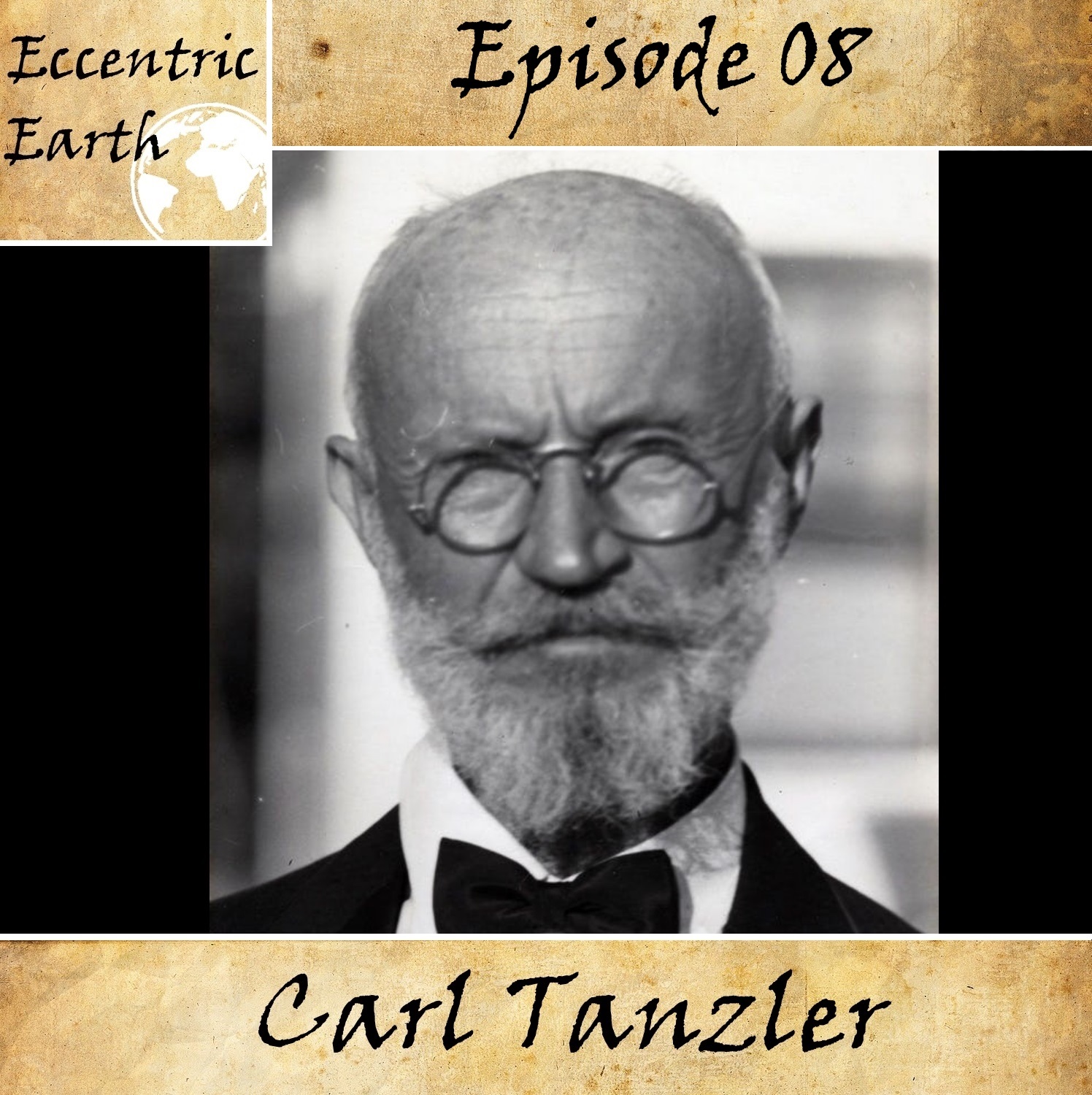
Episode Eight - Carl Tanzler


Karl Tänzler was born on February 8, 1877 in Dresden, Germany. There is little information about his parents, though it is confirmed that he had one sibling, a sister. Carl was a bright and curious youngster, though childhood was unremarkable, with one notable exception. Later in life, he would refer to an incident in which he claimed that a long-deceased relative, Countess Anna Constantia von Cosel, visited him. She revealed to him the face of a dark-haired girl whom he interpreted as being his one true love.

As a young man, Carl Tanzler displayed an ability to impress others, able to project a level of confidence which helped him to gain access into situations and opportunities that he should never have had. Much like the contestants on The Apprentice, he had an impressive resume, where he boasted that he had nine advanced degrees. This was a untrue. 

He held a variety of jobs, such as boatbuilding and as an engineer. Some of these jobs allowed him the opportunity and means to travel frequently. He visited countries such as Australia, India, and Italy. While he was in Australia, World War I broke out. 

Trial Bay Prison Camp in Australia circa 1915.
Because he was a German citizen, the government did not allow him to return home, instead, placing him in a prison camp. Tanzler was eventually placed in Trial Bay, a prison on the mid north coast of New South Wales. Whilst at Trial Bay Tanzler hatched a plan to escape in a sailing boat, along with a fellow prisoner, though this plan never came to fruition.

International law at the time forbade prisoners from returning to their native country, so at war’s end, the government shipped the Geman prisoner to a clearing house in the Netherlands. Now in his fourties, Karl met a young woman named Doris Shafer, whom he would go on to marry and father two children with.

Tanzler continued to travel around the world, which put considerable strain on his marriage. In 1926 he left his family and moved to Cuba, from which he then emigrated to the United States, settling in Zephyrhills, Florida; where his sister had moved to previously. Now living under the name Carl Von Cosel, and sometimes, Count Carl von Cosel. His family soon joined him in America.

Less than a year later he would leave his family again, this time moving to Key West in Florida, where he found employment as a radiological technician at a U.S. Marine Hospital. After taking the job at the hospital, Tanzler maintained a relatively low profile and mostly kept to himself. 

U.S. Marine Hospital, Key West, Florida, where Tanzler
was employed.
On 22 April, 1930, Tanzler would meet Maria Elena Milagro de Hoyos while working at the Marine Hospital in Key West. Elena was a local Cuban-American woman who had been brought to the hospital by her mother for an examination. Tanzler immediately recognized her as the beautiful dark-haired woman that had been revealed to him in the visions given to him by the ghost of his ancestor, and fell instantly in love with the young woman.

Born on July 31, 1909, in Key West, Florida, Elena was described as a strikingly attractive girl with luxurious dark hair and an appealing shyness. The middle of three daughters to a cigar maker and homemaker, Elena had a beauty that didn’t go unnoticed. She attracted a fair share of admirers. Early marriage was customary among the Cuban-American community, and Elena married Luis Mesa in 1926 at 16 years of age.

Unfortunately, the marriage proved to be ill-fated. Shortly after Elena miscarried with the couple’s child, Luis abandoned his young wife and moved to Miami.

On April 22, 1930, Aurora de Hoyos, concerned about her daughter Elena’s illness, brought her to the Marine hospital for examination. It was determined that the 20-year old was afflicted with tuberculosis, a disease generally considered incurable at the time, that eventually claimed the lives of almost all of her entire immediate family.

Convinced that saving Elena from certain death was his destiny, the love-struck doctor persuaded the hospital allow him to conduct his own experimental treatment on her, using his false medical credentials to convince them. 

Maria Elena Milagro de Hoyos.
He proceeded to administer a series of specialty treatments, consisting of homemade elixirs, herbs, and tonics of his own devising. He borrowed expensive hospital equipment without permission, including an X-ray machine, which he installed in the de Hoyos’ home. Tanzler created his own private hospital and laboratory in Elenas home. He even convinced her family to allow him to move into the home to better treat her.

The fake doctor also showered Elena with expensive gifts of jewelry and clothing, and even though she did not reciprocate his feelings, he constantly declared his undying love and devotion for her, using his position as her physician to try to woo her.

Despite relentless efforts, Elena died of tuberculosis at her parents' home in Key West on October 25, 1931. Tanzler insisted on paying for all funeral expenses, even hiring a mortician to embalm Elena. He also persuaded her family to allow him to purchase a costly stone mausoleum for her. After internment of Elena’s body, everyone assumed they could put this highly unusual episode behind them. Unfortunately, the doctor’s behavior only became more bizarre.

Tanzler owned the only key to the mausoleum, and he used it to make regular visits to Elena’s corpse. For two years his visits continued, and when locals took notice, rumors began to spread. This caused the hospital to terminate his employment.

Elena's tomb, to which Carl Tanzler had the only key.
One evening in April 1933, Tanzler crept through the cemetery where Elena was buried and removed her body from the mausoleum, carting it through the cemetery after dark on a toy wagon, and transporting it to his home. He reportedly said that Elenas spirit would come to him when he would sit by her grave and serenade her corpse with a favorite Spanish song. He also said that she would often tell him to take her from the gravesite.

Together again, Tanzler undertook extraordinary measures to better preserve Elena’s body, he attached the corpse's bones together with wire and coat hangers, and fitted the face with glass eyes. As the skin of the corpse decomposed, Tanzler replaced it with silk cloth soaked in wax and plaster of paris. As the hair fell out of the decomposing scalp, Tanzler fashioned a wig from Elena’s hair that had been collected by her mother and given to Tanzler not long after her burial in 1931. Tanzler filled the corpse's abdominal and chest cavity with rags to keep the original form, dressed Elena’s remains in stockings, jewelry, and gloves, and kept the body in his bed. Tanzler also used copious amounts of perfume, disinfectants, and preserving agents, to mask the odor and forestall the effects of the corpse's decomposition.

This continued for seven years.

Elena's body after Tanzler's modifications.
Disturbing rumors continued throughout the community. People had observed the doctor dancing with a giant doll made from the young girls corpse. Local residents also suspected that he was sleeping with Elena’s corpse. In October, 1940, Elena’s sister Florinda heard rumors of Tanzler sleeping with the disinterred body of her sister, and confronted Tanzler at his home, where Elena's body was eventually discovered. Florinda notified the authorities, and Tanzler was arrested and detained.

Tanzler was psychiatrically examined, and found mentally competent to stand trial on the charge of "wantonly and maliciously destroying a grave and removing a body without authorization." The court heard that not only had Tanzler stolen the young womans corpse, and performed homemade repairs to the body, but that examinations of the body confirmed that Tanzler frequently had sex with it, having installed a paper tube in the vaginal area of the corpse that allowed for intercourse. Even more bizarrely, Tanzler had built his own airplane in which he planned to fly himself and Elena’s body into the stratosphere ‘so that radiation from outer space could penetrate Elena’s tissues and restore life to her somnolent form’.

The plane that Tanzler built behind his home to save Elena.
The trial of Carl Tanzler attracted overflow crowds and became a media sensation. Taking the stand, the doctor was unapologetic, again declaring his ‘undying love and devotion’ for Elena, as well as confirming the airplane rumor. Unfortunately for the prosecution, the statute of limitations had expired for all of the crimes that he had committed due to the amount of time he had had the body, and the courts dropped all charges. Carl Tanzler left court a free man, though not before asking for Elena’s body back.

After the trial Elena's body was put on public display at the Dean-Lopez Funeral Home, where it was viewed by as many as 6,800 people for the cost of $1 each. Hoyos's body was eventually returned to the Key West Cemetery where the remains were buried in an unmarked grave, in a secret location, to prevent further tampering.

The facts underlying the case and the preliminary hearing drew much interest from the media at the time (most notably, from the Key West Citizen and Miami Herald), and created a sensation among the public, both regionally and nationwide. The public mood was generally sympathetic to Tanzler, who man, thanks to the media coverage, viewed as an eccentric 'romantic'.

In 1944, Tanzler moved to Pasco County, Florida close to Zephyrhills, Florida, where he wrote an autobiography that appeared in the Pulp publication, Fantastic Adventures, in 1947. His home was near his wife Doris, who apparently helped to support Tanzler in his later years. Tanzler received United States citizenship in 1950 in Tampa.

Tanzler holding the death mask he had made
after his release.

Separated from his obsession, Tanzler used a death mask to create a life-sized effigy of Hoyos, and lived with it until his death on July 3, 1952. His body was discovered on the floor of his home three weeks after his death.

It has been recounted that Tanzler was found in the arms of the Elena effigy upon discovery of his corpse, but his obituary reported that he died on the floor behind one of his organs. 

It has been theorised that Tanzler had the bodies switched or that Elena's remains were secretly returned to him, and that he died with the real body of Elena.

--------------------------------------------------------------------------------------------------------------------------

You can find Eccentric Earth on a number of podcast providers, including:
iTunes: Eccentric Earth
PodBean: Eccentric Earth

You can also follow Eccentric Earth on a number of social media sites:

Twitter: @Eccentric_Earth
Facebook: @EccentricEarth
Instagram: Eccentric Earth

You can watch out episodes over on Youtube too! Eccentric Earth Youtube Channel

Eccentric Earth Episode 8 - Carl Tanzler


Join me, your host Amy Walker, as I delve into stories from across history. This week I'm joined by Han Burch to talk about Carl Tanzler and the story of his true love.


Show Notes: Episode Eight Show Notes

Twitter: @Eccentric_Earth
Facebook: @eccentricearth
Instagram: Eccentric_Earth
Email: EccentricEarth@outlook.com

iTunes: Eccentric Earth
aCast: Eccentric Earth
Podbean: Eccentric Earth

Eccentric Earth is a Trans-Scribe Production
Hosted by Amy Walker
Theme music http://www.bensound.com/royalty-free-music

Friday, 16 February 2018

Stargate SG1: Top 10 Episodes


Originally published on Set The Tape

Stargate SG1 was an incredibly popular series, running for ten seasons, with two television movies, and inspiring two spin-off shows. With a new series set within the Stargate universe set to return to television screens it’s time to look back at some of the best episodes from the original show.


10. Within The Serpent’s Grasp/Serpents Lair

The two-part finale to the first season of the show saw the Stargate Programme shut down by the government just as the evil goa’uld Apophis (Peter Williams) launches an attack on the planet.

With SG-1 managing to sneak aboard on of the invading ships, they, and the Earth, seem hopelessly outmatched against their enemies. With desperate odds, imminent global destruction, and the lives of friends hanging in the balance the first season’s finale would go on to shape the tone of future story lines.


9. The Fifth Race

When Colonel O’Neill (Richard Dean Anderson) accidentally has an entire alien database downloaded into his brain he soon finds himself overwhelmed by the knowledge and faces certain death. Thanks to that knowledge, however, he’s able to find help in the form of the Asgard, an ancient race of aliens that have long been the enemies of the Gou’auld.

With the Asgard having appeared briefly in an earlier episode, ‘The Fifth Race’ was the first time that the diminutive grey aliens appeared in full. The episode not only acted as an introduction to a race that would go on to become a major part of the Stargate mythology, but also promised bigger things to come, including giving the people of Earth the hope of a brighter future.


8. The Pegasus Project

Despite not being the first time that Stargate SG1 and Stargate Atlantis would cross over, with characters from each show appearing in the other, ‘The Pegasus Project’ felt like the first real crossover between the two, with the SG1 team and the Atlantis expedition teaming up to find a way of stopping the hugely powerful Ori.

Not only does the episode move the main series plot forward in some big ways, particularly in the stopping of the Ori Super Gate, but also sees the destruction of both an Ori and a Wraith ship.

Despite this, it’s the personal interactions that make the episode stand out, with the members of both teams fitting in well with each other, demonstrating that the two series are just parts of a bigger whole, one amazing shared universe.


7. Prometheus Unbound

Stargate SG1 was a very serious series, often dealing with some very dark and adult themes. Despite this, it was also an incredibly fun and silly show at times. The season eight episode ‘Prometheus Unbound’ sees the titular ship hijacked by a devious, and slightly unhinged, thief Vala Mal Doran (Claudia Black), with only Daniel Jackson (Michael Shanks) on board to stop her.

The wackiness of Black’s portrayal, the spot on timing of the comedy and witty joke writing, and the wonderful chemistry between the two main leads made this an instant fan favourite episode.

The episode was so popular that the writers chose to bring Vala back as a recurring character in the next season, before making her a main character, and a part of the SG1 team for season 10. With Vala proving to be one of the more popular characters in the franchise, and her relationship with Daniel a highlight for many, this episode marked the beginning of one of the best periods of the series.


6. Window of Opportunity

One of the most popular comedy episodes of the entire series run, ‘Window of Opportunity’ saw Stargate SG1 doing Groundhog Day after Colonel O’Neill and Teal’C (Christopher Judge) stuck in a time loop.

Whilst the episode filled much of its run time with fun moments like O’Neill taking pottery classes, quitting the Air Force just so he could kiss Carter (Amanda Tapping), and even playing golf through the Stargate, the episode also had a strong emotional resolution, seeing O’Neill having to revisit the pain of his son’s death in order to stop the person responsible for the time loop. It might be one of the funniest episodes of the show, but it also had a lot of heart.


5. Lost City

Originally intended to be the end of Stargate SG1, ‘Lost City’ saw the final assault on the Earth by the Gou’auld Anubis. With the Earth facing off against a huge Gou’auld fleet, O’Neill once again facing death due to an Ancient database being downloaded into his mins, and the search for the lost city of Atlantis, the show packs a lot into its planned finale.

Thanks to the show being renewed for an eighth season the show was able to continue on many of these stories, but it doesn’t detract from the sense of danger and tension that permeates the events. With some superb acting and some excellently choreographed action sequences ‘Lost City’ would have acted as a great conclusion to the show, yet still manages to be an incredibly strong season finale.


4. Camelot

With the revamp of the series in season nine Stargate SG1 not only had some new cast members, but a new deadly enemy to contend with. Despite having defeated the Gou’auld the series heroes still felt a little outmatched over the course of season nine. ‘Camelot’ showed the audience, as well as the characters, just how outmatched they actually were.

When an Ori Super Gate is activated, allowing through just four Ori ships, they quickly destroy an entire fleet made up of Earth ships, the Asgard, the Free Jaffa Nation, and the Lucian Alliance.

With Daniel Jackson apparently killed, Carter adrift in a space suit, the only defence for the galaxy destroyed, and Vala trapped on an Ori ship, things never looked bleaker for SG1. A shocking and devastating season finale that promised amazing things to come in the next season.


3. Meridian

When SG1 discovers that an alien planet has a highly unstable for of the alien element Naquadah they try to secure some for themselves to help develop defence technology.  Unfortunately, the planet is already trying to fashion the element into a devastating weapon. After an accident causes Daneil Jackson to become doused with radiation he faces certain death.

An episode that has clear parallels to the development of nuclear weapons, and deals with the concept of weapons of mass destruction. It’s not an easy subject to tackle, but the episode does it well, and manages to also deal with the death of one of their own as Jackson succumbs to radiation poisoning. Although he ascends to a higher level of existence moments before he died, this was effectively the episode that killed him.

As such, ‘Meridian’ was filled with powerful and emotional scenes, in particular showcasing the relationship between Jackson and O’Neill with some of the best acting from both Michael Shanks and Richard Dean Anderson.


2. Heroes

Heroes was supposed to be a small episode, one with a low-cost and made with as little of the main cast as possible. Essentially telling the story of a documentary crew that had been given access to the SGC, it was filled with candid camera moments, talking head interviews, and background characters getting the chance to shine.

The episode evolved during its production stage, however, becoming a two-part story that featured a huge battle scene, and included the shock death of series regular Dr Fraiser (Teryl Rothery). The story looked at the role of the media in public opinion of the military, the importance of secrecy from the public, and the horrors of war.

Despite being set in a fictional universe the episode speaks well for the role of the military in the real world, how the soldiers who put their lives on the line every day are ordinary people with real lives and families. A heart breaking and devastating episode that will leave viewers in tears, ‘Heroes’ is a story that comes out of nowhere to shock the audience and forever change the series.


1. Unending

After planning for the series to end on several occasions, only to have the show renewed, the production team went into season ten ready to tell a story that would go on into an eleventh season. Unfortunately, the show was cancelled too far into production to end the story. Whilst the story of the Ori would be concluded in a television movie the choice was made to end the show on a celebration of the characters and the franchise.

Set on board the Odyssey, an Earth spaceship, SG1 and General Landry (Beau Bridges) end up stuck inside a time dilation field, effectively trapping them on board whilst the universe around them is stopped.

Spending the next fifty years together on the ship the team would go through personal emotional trials, joys, and devastating loss before finding a way to put things right. Whilst most of the events of the episode would be undone, it proved to be one of the best insights into the characters, and deliver some truly great moments.

A brilliant send off to the show, that gives each of the actors a moment to shine, it’s clear that this is a celebration of the franchise and the end of an era, with the tears in the actors eyes in the last scene being very genuine.


Go to Amy's Blog

Monday, 12 February 2018

Back to the Future: Time Served - Book Review


Originally published on Set The Tape

‘On a mission to uncover the secrets that sent Jailbird Joey Baines to prison, Marty is trapped in 1972-and the DeLorean has vanished! Things go from bad to worse when Biff Tannen teams with 18-year-old Joey to break into a house… and they drag Marty along! Their target: Doc Brown’s mom!!!’

The fifth volume of the ongoing Back To The Future comic series continues to tell the story of Joey Baines, Marty’s uncle, who went to prison when Marty was just a young boy. Having travelled back to the 1970’s in the previous volume to try to find out what happened to cause Joey to spend his adult life in prison, Marty and Professor Irving find themselves without the DeLorean, and entangled in Biff and Joey’s plot to steal $85,000 from Doc Brown’s mother.

With the stage having already been set in the fourth volume, the latest book concludes the story, and has much more character development, excitement, and revelations about the Back To The Future universe.

Throughout the course of the issues collected here we see Marty get forced into taking part in the robbery of Doc Browns mother, and actually end up being responsible for Joey getting caught and going to prison.

Instead of being something that causes Marty guilt, it actually brings him closer to his uncle, as by the end of the book he learns that Joey himself felt guilty for getting Marty caught up in events, and was willing to go to prison to not only make up for that, but to become a better person.

By the end of the book we see that Joey has become an honourable man, even going so far as to teaming up with the Biff in the present to track down the missing $85,000, not to take it for himself, but to return it to Doc Brown and apologise for what he did in the past.

It’s a surprisingly touching revelation, and the relationship shift between him and Marty is a genuine pleasure to see. It could have been very easy to fall into the trap of having Joey be the angry ex-con who just wants to get even with those who got him arrested, but playing him as a reasonable, well adjusted man who has acknowledged the mistakes of his past and learnt from them is a welcome take on the story.

The book is also filled with other fun little moments, with the meeting between Marty and Biff in the 1970’s being a particular favourite. With Biff and his gang recognising Marty as Calvin Klein, the mysterious youth who ruined their schemes in the 1950’s, Marty has to think on his feet and pretends to be Kleins son instead, even coming up with a very plausible 1950’s pregnancy scandal to explain away him (or as far as Biff knows, his father) suddenly disappeared from town.

It’s very clever writing, and avoids having Biff be too dumb to not realise he’d seen Marty before, as that would be too stupid even for Biff. This scene also adds further context to the world, as it shows some of the effect of Marty appearing in the 1950’s had, and how the people of Hill Valley who knew Calvin Klein would question his sudden disappearance.

The book also manages to work itself into the backstory of Doc Brown, explaining how a relatively poor ‘mad’ scientist was able to fund his experiments and the building of the time machine in the first film. To be honest, this wasn’t something I’d ever really questioned before reading this book, but it makes sense that Doc Brown would need a substantial amount of cash.

Back to the Future, Vol. 5: Time Served is a big improvement on the previous volume, and provides a lot of entertainment and enjoyment as it delves into the history of the Back To The Future universe and sets up for exciting things to come in the future.


Go to Amy's Blog

Eccentric Earth Episode 7 - The Mothman


Join me, your host Amy Walker, as I delve into stories from across history. This week I'm joined by Chris Haigh, who I will be introducing to the American legend of the Mothman, a strange creature that terrorised the residents of Point Pleasant in the 1960's.


Twitter: @Eccentric_Earth
Facebook: @eccentricearth
Instagram: Eccentric_Earth
Email: EccentricEarth@outlook.com

iTunes: Eccentric Earth
aCast: Eccentric Earth
Podbean: Eccentric Earth

Eccentric Earth is a Trans-Scribe Production
Hosted by Amy Walker
Theme music http://www.bensound.com/royalty-free-music

Friday, 9 February 2018

John Malin, Nazis, and SJWs…


Originally published on Set The Tape

Fandoms can be hard to be a part of, they’re often full of people from diverse backgrounds and experiences, and as such people will can have vastly different opinions and takeaways from certain films, TV shows, and any other form of fictional entertainment. One area where these kinds of divides are some of the most obvious are in the world of comics.

You don’t have to go very deep into the comic book fandom to find divisive views, even something as simple as ‘do you prefer Marvel or DC?’ can spark debate, and even full scale arguments between fans of the medium. The latest argument that seems to be taking over the comic fandom at the moment follows a tweet made by Cable artist Jon Malin made on Sunday evening (21 June).

When Malin tweeted about a recent live-stream interview he had taken part in, saying:

“In depth discussion of SJW insertion of identity politics into mainstream comics, the damage done, how to correct it and why modern art and Andy Kaufman suck.”

When another twitter uses responded to ask “Aren’t the X-Men LITERALLY Social Justice Warriors?“, Malin responded with the following;


“X-Men are closer to Jews in SJW Hitler’s Germany fighting for freedom because they see ideologies rising, silencing them, weaponizing hate, racism and socialism against people they claim are the root of social ills. SJWs are not Nazis but Nazis were SJWs and X-MEN aren’t SJWs.”

As to be expected from such a polarising response, the reactions on Twitter were extremely mixed.

Some users were quick to point out that Malin’s views seemed to go against the core nature of the X-Men, a group of heroes that have been a metaphor for downtrodden and targeted minorities for decades, a group that very much stands for equality and acceptance.

Co-host of the ‘Jay and Miles X-Plain the X-Men’ podcast, Jay Edidin, wrote: “Social Justice is a FUNDAMENTAL VALUE of Judaism. Fundamental. The reason you weren’t seeing a lot of discourse about it in WWII Germany is because Jews were FIGHTING TO SURVIVE. Holding up that forced silence as an ideal is beyond horrific.”

Other users retweeted the statement made by Malin, tagging Marvel Comics in their response to urge them to look more closely into his comments, feeling that someone that equated those striving for equality to Nazi’s to be problematic for an X-Men title.

Despite a large amount of outrage over the incident, many others came forward to support Malin, claiming that he is correct in his view that ‘Social Justice Warriors’ have ruined the comics industry, and Marvel in particular.

“Much respect Mr Malin, bought my first Cable book in over a decade today in support,” one user tweeted, whilst another said: “You are a legend.”

Malin went on to add fuel to the argument by tweeting:


“Glad to expose the vipers nest that is the growing SJW infestation of this industry that is killing creative voices that politically differ, afraid to take creative chances for fear of the slightest offence including attacking a 95 YO Stan Lee & closing comic shops everywhere.”

The attack against Stan Lee that Malin mentioned in his tweet is referring to allegations of sexual misconduct made against the creator by his nurses, claims that Lee denies.

So far the arguments have yet to end, with very clear lines forming online between those supporting Malin, and those who feel that he has stepped out of line by voicing such opinions.

Whilst I do not agree with Malin, and find his views go against everything that the X-Men stand for, he is entitled to have his own opinions. He’s also entitled to voice his opinions, as anyone is. But when you are working for a company such as Marvel, with a huge fanbase, should he be held accountable for voicing such opinions?

Some people have argued that as this is Malin’s own personal Twitter account he is allowed to post whatever he likes, and should be free to express his political and social beliefs. However, I find myself agreeing more with the other side of the argument, that as someone working on one of Marvels projects he becomes a voice for Marvel.

Anything expressed by those working for Marvel, or any comic book company, should be carefully considered and thought through before being said, as those words can have an effect on the company. If a writer or artist of a particular book were to express homophobic, racist, or sexist views, for example, it could damage the sales of those books. Marvel know this, and have in the past held its creators accountable for the things they say and do that could negatively affect them, as such it baffles me that Malin not only made these comments, but continues to do so, apparently with little to no fear that it may impact his employment.

Many fans have expressed their opinions that someone who compared those fighting for justice with Nazis shouldn’t be working for the company, and have made calls for him to be fired.

Whilst Malin may have been able to ‘get away’ with his initial comments if handled correctly, his doubling down of inappropriate comments makes it appear more likely that he will receive some form of reprimand from Marvel, possibly even losing his position with them.

After making his tweets he appeared on a Q&A on Youtube with DC artist Ethan Van Sciver, where he told the audience that comics had begun to reject creators because of their political views.

“The next guy like me, its going to be even more hard. These people are getting further and further into control of these companies, and when they find out you’re a Trump supporter, you’re gone.’ He said, before moving on to express his frustration with the current creative talent within Marvel, effectively insulting his colleagues. ‘We keep pulling these people from these indie markets that are drawing airplane manuals. They don’t know what they’re doing, they don’t know anything about comics. The writers, do not understand the intricacies of writing a plot so you can really build a story from panel to panel to panel.”

Unfortunately, this isn’t the first occasion that Malin has caused a stir amongst fans, as last October he was accused of overly sexualising the X-Men character Blink, putting her in a costume that barely covered her breasts, and making her breasts larger than her head.


When fans asked Malin to make the character more appropriate he first denied seeing anything wrong with the character, before going on to complain that those who were speaking out never complain about how men are represented in comics, leading to criticisms that Malin was taking a sexist stance.

It is interesting to note, that Malin was amongst the creators at Marvel who was in favour of artist Ardian Syaf losing his job with Marvel for placing religious messages within the art of ‘X-Men Gold’ #1.

Whilst I rarely wade into these kinds of arguments, especially on social media platforms such as Twitter where things can get extremely heated very quickly, I can’t help but feel disappointed by Malins comments.

The X-Men have often been used as a book to comment on many of the injustices in the world, including segregation, equal rights, discrimination, and even genocide. The X-Men have been harassed by bigots, been targeted by government officials, and even had campaigns of extermination made against them.

These are all areas that ‘SJW’s’ have fought against. Organisations that have been dedicated to combating racism have been slurred as being SJW’s. Those who have decried homophopbia and transphobia have been accused of pushing a SJW agenda. People fighting against sexism and coming forward with sexual assault revelations have been called SJW’s. To compare people who are the real world equivalents of the X-Men to the people that tried to exterminate an entire people is deplorable.

As a trans woman I’ve been on the receiving end of prejudice more times than I can count. I’ve lost jobs, been driven from my home town, been spat on in the street, I’ve had threats of death and sexual assault made against me. I identify with the X-Men. I see the kinds of pain and suffering that they go through, the hate and fear that they face and I recognise that in my own life.

But they never give in, they never let that hate beat them. And that’s inspirational. They’re telling us that those who stand up for what’s right, those who fight to be seen as people, to be accepted and loved even when the whole world is telling you you’re a monster are heroes.

I don’t know if I’d be the person I am today without the X-Men. They taught me such valuable lessons growing up, and instilled me with morals that inspire me even to this day. Someone who fails to see that, who compares those who fight the way they do with people who commit genocide is not the right person to be working on an X-Men book. I just hope that Jon Malin can see that and learn from this mistake.


Go to Amy's Blog

Wednesday, 7 February 2018

Who is Black Lightning?


Originally published on Set The Tape

The CW is adding yet another superhero show to its ever expanding DC Universe, this time with a new live action series focusing on the character Black Lightning. With most, if not all, of the heroes and villains from DC Comics to choose from, many people have been asking why did they go for Black Lightning, and just who is he anyway?

Created by Tony Isabella back in 1977, Black Lightning, or Jefferson Pierce, is a metahuman with the ability to generate and manipulate electricity.

During the late 1970’s, DC Comics wanted to appeal to a broader audience, and this included having a comic book headlined by a black superhero. According to a number of sources within DC, the original plan for this black led book was a character called Black Bomber.

Black Bomber was to be a book about a lead character that was white, and was racist, however, thanks to being exposed to a chemical designed to allow troops to blend in with natives during the Vietnam war, this man was able to transform into a black superhero when stressed or in danger. Both the white and black versions of the character had no memories of being the other, and would each have their own ‘racially appropriate’ girlfriends. Black Bomber would also wear a super hero outfit that was similar to the Harlem Globetrotters basketball kit.

Despite obviously being a horrible, horrible idea the concept was given the go-ahead by editors at DC, with scripts for the first two issues being produced.  Thankfully, the editor that gave the go-ahead for the project left DC, and the project was handed over to writer Tony Isabella, who had previously worked on the black superhero book ‘Luke Cage’ at Marvel.

Black Lightning's first appearance.
Speaking about the project many years later, Isabella said: 'I will say that I created Black Lightning after convincing DC not to publish another ‘black’ super-hero on which they had started work.

'The Black Bomber was a white bigot who, in times of stress, turned into a black super-hero. This was the result of chemical camouflage experiments he’d taken part in as a soldier in Vietnam. The object of these experiments was to allow our [white] troops to blend into the jungle.

'In each of the two completed Black Bomber scripts, the white bigot risks his own life to save another person whom he can’t see clearly (in one case, a baby in a stroller) and then reacts in racial slur disgust when he discovers that he risked his life to save a black person. He wasn’t aware that he had two identities, but each identity had a girlfriend and the ladies were aware of the change. To add final insult, the Bomber’s costume was little more than a glorified basketball uniform.

'DC had wanted me to take over writing the book with the third issue. I convinced them to eat the two scripts and let me start over. To paraphrase my arguments…

'Do you REALLY want DC’s first black super-hero to be a white bigot?’

'Okay, he wasn’t precisely their first black super-hero, but I made my point. The Black Bomber stories were deep-sixed and I went to work on my own creation.'

Isabella luckily had another character already in mind for the series, Black Lightning, and convinced DC executives that this would be a better direction to take the book in. With the character being teased to audiences for several months he was finally revealed in the first issue of his own title, ‘Black Lightning’ in 1977.

Tony Isabella would write the first ten issues of the book, before it was handed over to Dennis O’Neil. Unfortunately, Black Lightning was one of a number of books cancelled before its twelfth issue as part of a large-scale streamlining of titles.

Black Lightning with The Outsiders.
Despite this, Black Lightning proved to be a very popular character, and continued to appear across multiple titles ‘Detective Comics’ and ‘Justice League of America’. The character would go on to become a part of the Batman led team book ‘The Outsiders’ in several incarnations, including a number of television appearances.

Black Lightning had a second series in 1995, also written by Isabella, but this too was cancelled after just over a year.

Despite having his own titles cancelled more than one, Black Lightning continued to be a popular character, going on to become a member of the Justice League for a while, as well as having his personal stories expanded to include his two daughters Anissa and Jennifer, who have gone on to become superheroes themselves, Thunder and Lightning respectively.

Black Lightning may not be a household name, his own comic series may not have lasted long, and he’s probably not a lot of people’s first pick for favourite character, but he’s been a steady part of the DC Universe for more than four decades, playing roles across dozens of books, several television shows, and even video games. With representation and diversity being so important today, just as much as it was when he was first created, an older superhero of colour, with a family that includes a queer superhero of colour in the form of his daughter Thunder, makes Black Lightning the perfect choice for the next CW series.


Go to Amy's Blog

Tuesday, 6 February 2018

Looking Back At… Mighty Morphin Power Rangers (Season One)


Originally published on Set The Tape

In the first of my ongoing series to celebrate the 25th anniversary of the Power Rangers franchise I’m going to be taking a look back at the very beginning, Mighty Morphin Power Rangers season one.

--------------------------------------------------------------------------------------------------------------------------

Whilst on a business trip to Japan, Haim Saban, the founder of Saban Entertainment, came across a television series called Super Sentai, a live action superhero series. Ever the businessman, Saban saw an opportunity to make some money, and quickly formed a deal with Toei to secure the rights to the franchise.

Combining together the Japanese footage of the costumed heroes and their giant robots fighting monsters with brand new American footage, Power Rangers was born. Using the Super Sentai season Kyoryu Sentai Zyuranger as the basis for the show, a series featuring dinosaur themed heroes, an American cast was brought in and production began on the show.


When Mighty Morphin Power Rangers aired on televisions on August 28 1993 it became an overnight success, with the show being picked up all over the world, and merchandise flooding stores. Within a relatively short period the show had become a phenomenon.

Looking back at the first season of the series 25 years later its easy to see why it hooked kids the way it did (myself included). It’s costumes were amazing, the action was unlike anything we’d had before, and the music was amazing. Seriously, I challenge anyone to go listen to the original opening theme and not feel pumped up for something amazing.

Whilst at the time the show was perfect in my eyes, it’s blatantly obvious now just how little money and effort went into the show, something that has thankfully gotten better of the years as old fans have now come to work on the franchise that they loved growing up.

The american sets are pretty bad, with the Command Centre clearly being a room surrounded by black curtains with blinking fairy lights sticking through. The dubbing of Japanese footage is laughably bad, with poor Rita Repulsa (played by Machiko Soga, dubbed by Barbara Goodson) getting the worst of it. The worst part of the show, however, is the sometimes laughable attempt at making the Japanese footage work around an American plot.


The original Super Sentai series focuses on a group of young warriors from an ancient civilisation of dinosaur-evolved humans, who are awakened in the present after 170 million years in suspended animation to fight the evil witch Bandora, who is set loose from her prison on the Planet Nemesis by two astronauts.

Obviously, extremely different from the Power Rangers series, which saw five regular teenagers recruited by a space wizard to become super powered heroes in order to fight Rita Repulsa, an alien witch living on the moon.

Because the two shows were so vastly different in content the writers made some ‘creative’ plot decisions, which led to some disjointed and even downright bizarre episodes. As as child these were sometimes a little weird, even funny; watching the show as an adult, however, it’s downright bizarre.

The first season wasn’t completely bad though, the fight scenes are still great even today, with the casting of competent martial artists and gymnasts as the titular Power Rangers a good choice for ensuring that the audience gets what they signed on for, awesome action.

Whilst some of the cast weren’t the best actors, Austin St John and Walter Jones (the Red Ranger and Black Ranger respectively) proved competent enough to get by, and were more geared towards the physical side of the show in their story lines anyway. David Yost and Amy Jo Johnson (the Blue Ranger and Pink Ranger) were definitely the strongest of the main cast, something that the series very quickly realised, often giving them much bigger stories and asking them to take on more complex roles.

Surprisingly, it was supporting actors Paul Schrier and Jason Narvy, who played school bullies Bulk and Skull, would prove to be some of the best actors on the show, lasting for several years across multiple incarnations of the franchise. Narvy even went on to earn a masters degree and PhD in Theatre Studies, and now teaches as a professor.

The stand out for the first season, however, is Jason David Frank as Tommy Oliver, the Green Power Ranger. There are few people who will remember watching the series first time round who don’t have fond memories of the Green Ranger. Introduced with a five-part epic that saw him fighting against the power rangers, sporting a gold armour piece on his costume, and commanding his own giant Godzilla style Zord.


Jason David Frank would go on to become one of the most popular Power Rangers of all time, and despite loosing some of his appeal later in the franchise, he is brilliant in this first season.

Despite having a great season finale from the Super Sentai series to adapt, the massive popularity of the show meant that Saban didn’t want the series to end. As such, they commissioned Toei to make more footage for them from props and costumes that they had in storage. Because of this, the first season carries on beyond the point it was originally planned, and ends with just a regular episode, rather than something that stands out.

This wish to continue producing Power Rangers the way it was would lead to even greater creative challenges in the second season, though that will be covered in greater detail in the next Power Rangers article.

The first season of Mighty Morphin Power Rangers is a very mixed bag, it has some great moments that would be the foundation of the entire franchise, going on to be replicated even today, yet there are some very obvious moments where you can see just how flawed and poorly made it is too.

If you’ve never seen the original series before it’s definitely interesting to watch, even from a technical point of view of how the show was actually made. If, however, you saw it as a child, it’s sure to bring back some amazing childhood memories and nostalgia.


Go to Amy's Blog