Wednesday, 25 October 2017

B&B Review


Originally published on Set The Tape

STARRING: Paul McGann, Sean Teale, Tom Bateman, Callum Woodhouse, James Tratas

WRITTEN & DIRECTED BY: Joe Ahearne

‘Marc and Fred went to war when they were refused a double bed at a remote Christian Guest house. They won in court and now they’re back to claim their conjugal rights. Triumph turns to terror when another guest arrives, who they think may have something sinister in mind. Their weekend of fun turns into a bloody battle for survival in this smart, brutally funny and dark thriller.’

B&B was not the film that I was expecting. I’d read they films description, watched the trailer, but when it actually came to watching the film it completely subverted my expectations as to what was going to happen.

I believed that the film would be a simple and straightforward thriller, in which Marc (Tom Bateman) and Fred (Sean Teale) would have to fight against the Russian gay basher Alexie (James Tratas) in some desperate struggle for survival. Instead, what B&B delivers is a much more layered and nuanced film that puts human relationships first, and focuses on how far people are willing to go for those that they love.

I don’t want to talk too much about the story, I think it’s much better to see it unfold as you’re watching it, so that none of the twists and turns in the narrative are spoilt. What I can talk about, however, are the phenomenal performances from the films cast.

Tom Bateman and Sean Teale are very believable as they gay husbands Marc and Fred. Having previously taken the B&B to court for not allowing them to have a double bed they’ve come back a year later to stay there again. Throughout the course of the film we learn that this decision was Marc’s, and comes from him being ‘a sore winner’.

A lot of films would go out of their way to paint Marc and Fred as the poor downtrodden victims in such a scenario, and would have them return to the B&B in some kind of act of catharsis, or some way of putting their past trauma to bed. Here, however, it’s because Marc is a bit of a dick and just wants to piss off the owner, Josh (Paul McGann).

It’s a nice change to see a character that could very easily be played simply as a victim as a real person, and even pushing it into unpleasant at times. It plays wonderfully well against McGann’s Josh, who should be the villain of the film, a man who goes out of his way to discriminate against people because of his religious views, but instead he actually comes across as very likeable at times.


This may have been a bigger shock for me than the subversion of expectations for the plot, the fact that I didn’t just hate Josh. As a member of the LGBT+ community, and someone who has faced discrimination on more than one occasion, I was prepared to hate McGann’s character. When I ended up caring for him, even sympathising in some scenes I was honestly shocked with myself.

It’s a testament to how well the script is written, and how good an actor McGann is, but by the end of the film I couldn’t even decide how I thought about Josh. I disliked him, and even wanted to hate him, but I also cared about him, and in some ways respected him. I felt conflicted and disturbed by the developments his character took, and in the way the film ended, that I wasn’t prepared for.

In a world where the LGBT+ community faces discrimination, where gay men are regularly attacked in Russia by characters such as Alexie, and where they’re even put to death in some countries, stories that show the very real fears and dangers that the community faces, even in as tolerant a country as England, is important.

Whilst the fear of being attacked by a gay basher leads to a much more complex and disturbing set of events in this film, and hopefully something that people will never have to experience, that fear of abuse, the fear of an attack, is a very real reality for a lot of people; and this film captures that well in the early parts of the story.

A subject that a lot of people wouldn’t think about, believing that the advancements of LGBT+ rights will have eliminated much of it, focusing on these issues is important in film; not just because it lends itself well to telling a good thriller story, but because film can often find ways to have its audience think about subjects it wouldn’t normally.

B&B is a very well crafted film, well written, and with a level of acting that elevates the story and characters. It addresses difficult to talk about subjects, and manages to create three-dimensional characters rather than stock caricatures. Whether a member of the LGBT+ community or not, this film will be sure to entertain, thrill, and terrify throughout.


Go to Amy's Blog

Looking back at… In The Loop


Originally published on Set The Tape

In The Loop is the big screen version of Armando Iannucci’s popular television series The Thick of It, and sees the return of Peter Capaldi’s Malcolm Tucker, the spin doctor from hell, as he tries to steer a bumbling minister away from disaster during the buildup to war.

The story follows Minister for International Development, Simon Foster (played by Tom Hollander) after he makes a comment during a radio interview that he felt the looming war in the Middle-East was “unforeseeable”. As this goes against the government’s official neutral line he tries to correct his mistake by then stating that Britain may have to “climb the mountain of conflict”.

“You sound like a Nazi Julie Andrews!” Tucker screams at him as demands start to come in from America for Foster to take part in their war planning committee, with both those for and against the war trying to claim him as their own. What follows is a series of events where the British ministers are dragged into a round of talks in Washington and New York, whilst Foster tries to keep his career in one piece and Malcolm attempts to turn events to the government’s favour.

Whilst many television series struggle to make the leap to the big screen, In The Loop really stands out as a great example of a show managing to do it well. Part of this success may be down to the fact that the film doesn’t tie itself down to everything established in The Thick of It. Several cast members return for the film, though Tucker, his psychotic enforcer Jamie Macdonald, and Malcolm’s PA Sam, are the only characters to appear in both, with the other returning actors cast in new roles.


This may initially seem jarring for some, but it means that the film is able to tell its own story, in a way built for the big screen, without having to explain away certain characters, events, or connections to the series, making it much more accessible for new audiences. Whilst this does separate the film from its parent show, it does feel like it fits naturally enough into the world that they’d already established.

The move to the big screen also opens up the story to include bigger cast and locations than the series was able to do so, with a large portion of the story taking place in America. The American cast work seamlessly with their British counterparts, and add a sense of conflict that was missing from the parent series, with great performances from David Rasche (who would go on to appear in Veep, the American version of The Thick of It), and the late, great James Gandolfini.

In The Loop is funny, and at times ridiculous, look into the world of politics, one that’s full of spin, half-truths and outright lies as politicians and civil servants spend more time trying to keep their jobs than doing the right thing. There are no real heroes or villains in the film, only people with different agendas. Malcolm Tucker isn’t a nice person, but he’s not a monster, and there are moments where you feel genuinely sorry for the man. Simon Foster is someone in over his head having said the wrong thing, but wanting to do the right thing.

This may not be a film for everyone, it looks at people in government and paints them as idiots and fools; it makes the argument that you can’t trust information as it will be based on an agenda, spun and doctored to fit a specific narrative or viewpoint; and there’s a lot of swearing (the film uses the word fuck 135 times, with 86 of them being just Peter Capaldi!). However, if you find politics interesting, if you like ridiculous satire, or you just like seeing angry people screaming lines of obscenities at people this film will definitely appeal.

In The Loop is not only a great jump to film for a brilliant television series, it’s a great film in its own regards. The story is engaging and amusing, the characters feel very real, and the humour can go from incredibly subtle to ridiculous in the same scene. With Peter Capaldi stepping down from his role in Doctor Who and real world politics being in the state they are at the moment, I can only hope that we get to see more Malcolm Tucker in the future.


Go to Amy's Blog

Teenage Mutant Ninja Turtles Universe #15 - Comic Review


Originally published on Set The Tape

The fourth and final issue of the Karai’s Path story sees the ninja Karai returning to Tokyo, after finding a mystical ancient sword and new ally Yokai, in order to take over the criminal underworld.

Most of the focus of the issue follows Karai and her mutant allies attacking the Tokyo headquarters of the Yakuza crime lord Hayashi Toru, leaving only death and carnage in their wake.

The assault on the Yakuza building is an entertaining cross of traditional crime story, mythical ninja story elements, and huge mutant creatures tearing people apart. The scenes where we see Koya and Bludgeon working alongside their new ally Yokai to kill Hayashi Toru’s guards are brutal, and go a long way to showing the sheer ferocity that Karai’s mutant allies possess.

Korai herself has started to lose herself to the cursed sword that she worked so hard to acquire, with Hayashi Toru telling her that it will eventually consume her soul. Though only touched on slightly in this issue this is a very interesting story point that is being laid for future exploration, and is sure to be something that will appear to haunt the Turtles at a later date.

The scenes where Korai kills Hayashi Toru, and then goes on to take over the rest of the underworld when meeting with the heads of the other Yakuza families are straight out of Japanese crime dramas. They’re scenes that we’ve all seen before, but they work really well, and have the added impact of a humanoid hammerhead shark being around for proceedings.

The book manages to bring the Korai story to a satisfying conclusion, one that sets her up to return to New York as a force to be reckonned with at a later time, and also leaves enough plot threads open that there is a lot that can be explored at a later date; such as the effects that her new sword will have on her.

The artwork and colours are also stunning, with rough linework helping to sell the grittiness of certain scenes, helping to ground what we’re seeing in a more real world. It also makes some very good stylistic choices, such as draining all colour from the panel where the three mutants tear apart Yakuza henchmen apart from red, which not only makes the panel pop, but emphasised the brutality of what we’re seeing.

The removal of any background elements in the panels where Korai faces off against Hayashi Toru is also a great decision as it focuses attention solely on the two characters, heightening the drama of the moment. With Korai’s Path finally at it’s conclusion the final chapter brings the story to a stunning and strong finish.


Go to Amy's Blog

Uncle Scrooge #31 - Comic Review


Originally published on Set The Tape

As with previous issues, Uncle Scrooge #31 collects together several short stories previously published in other comics around the world, bringing them to a US audience. This issue contains four such adventures.

Story One – Sins of the Sorcery Summit

The first story of the issue, originally published in issue #44 of the Dutch Donald Duck comic, sees the evil witch Magica De Spell calling together a number of other witches to help her to steal Scrooge McDucks number one dime.

This first story  manages to weave two very separate stories together into one cohesive tale in surprising ways, with the A and B plots feeling very separate until the final moments. The adventure itself is very simple, yet manages to pack in a lot of mystery and twists that mean you’ll not see the end comic.

Story Two – Halloween Shivers

Originally published in Topolino #2183 in Italy, Halloween Shivers is a single page strip that sees Donald Duck at the movies with Daisy Duck, the two of them watching a horror movie. When Donald annoys her by narrating along with the movie, Daisy dumps her ice cream on top of him.

There’s little to talk about in regards to this part of the book, it only being a one page strip, however, it’s sure to entertain completionists who want to experience everything Ducktales has to offer.

Story Three – Belle, Book and Bungle

The third story, published in the Danish Anders and & Co. #9, sees the witch Magica Da Spell recruit Belle Duck to be her assistant.

After turning herself into a dragon in an attempt to seal Scrooge’s number one dime, Magica Da Spell receives an injury to her back, making her unable to perform any schemes. When Belle Duck is given a single penny from Scrooge to help towards repairing her boat Magica realises that she can use Belle to help get the dime.

Possibly the most enjoyable story in the issue, it’s nice to see a non-main character get given the spotlight for once, and given the chance to play opposite Magica. Belle turns out be something of a surprise hero, one who in the end is able to show her ingenuity in beating the villain. A simple but effective story.

Story Four – Celebrity Crushed

In the issue’s final story, originally published in Topolino #3045, Dickie Duck gets called to help April, May, and June, who find themselves heartbroken over their crushes, the boy band The Quacker Boyz announce their engagement to Duckstiny’s Child on Facebeak (yes, all these puns are in the book).

Dickie consoles the girls and manages to convince them that they can get over their childhood crushes, taking them out for ice cream. However, when they’re getting their ice cream Dickie finds out that her own childhood crush, the Hollywood actor John Ququak is nearby, she runs off declaring her love for him.

A quick and simple story, there’s not a great deal of depth to Celebrity Crushed, however, the ridiculous puns do manage to entertain.

Overall, Uncle Scrooge #31 delivers a mixture of stories and tones that brings together several characters and adventures from across the Ducktales universe.


Go to Amy's Blog

The DC TV Universe – Is It In Good Or Bad Health?


Originally published on Set The Tape

The DC Television Universe, also known as the Arrowverse, has developed from a single, grounded story about a vigilante into several shows that include superhumans, aliens, time travel, and parallel worlds. Whilst no one would have seen the creation of such a vast universe as a possibility when Arrow first began, it now feels like one complete, complementary whole.

This year sees Arrow moving into its sixth season, The Flash its fourth, plus Legends of Tomorrow and Supergirl coming back for a third season. But with so many shows making up their universe, are things becoming too bloated, or is it just a natural progression?

The introduction of The Flash was possibly the biggest hurdle that the DC Television Universe faced, making the leap from a very grounded and real world setting, to a universe that incorporated superpowers and time travel.


The first season of The Flash was possibly the most dangerous moment for the franchise. If the creators had pushed things too far it could have felt too much of a drastic change from Arrow, or it could even have made people feel like it had even gone on to spoil the parent series.

Luckily, The Flash had the right level of serious drama, humour, and some very, very clever writing to make the first season a success, fitting some universe changing concepts into their world in very natural ways. By the end of the first season The Flash felt like it belonged, and it worked brilliantly alongside Arrow.

Making their third series a combination of characters that had featured in both Arrow and The Flash was a clever choice, and helped to make Legends of Tomorrow a success. Using characters such as Firestorm, the Atom, and White Canary as an entry point to explore the history of their universe, to build upon the concept of time travel, and to introduce new characters made the series a lot easier to digest for new fans.

It was also granted huge freedom to try new things, to have superheroes in the wild west, the distant future, or even tease new developments for the futures of both The Flash and Arrow.


Including Supergirl in the DC Television Universe was a big gamble for the CW, however, as the series originally began on CBS, before being cancelled. Seeing the potential in the series, and thanks to a cheeky cross-network cross-over episode in the first season, the CW made the decision to incorporate it into their multi-verse, to have it be another parallel world within their shows.

Thanks to the second season of The Flash dedicating so much of its time to the concept of parallel worlds this felt like a natural fit, and it also meant that people who were unsure whether to jump into Supergirl going into its second season could ignore it if they wanted to, as it would remain largely separate to the rest of the universe.

Thankfully, for those fans who had been watching all four series, the CW brought them all together for ‘Invasion‘, having the characters from all of the shows teaming up together to save the world from a deadly alien invasion. Whilst the Supergirl episode was mostly a waste, with only the last 30 seconds part of the cross-over, the event was a huge success, boosting the visibility and popularity of the universe. It was so much of a success that a second, larger cross-over event will be happening this year.

Thanks to these successes the DC Television Universe will be expanding again with the introduction of Black Lightning, a series that will be focusing on a much older hero, one that has children on his own, and lives in much more complex world than Barry or Oliver. Whilst we do not yet know how this series will be received, it does look like the CW are trying something different yet again, a gamble that has been successful for them in the past.


Elsewhere in the DC Television Universe there is the small animated series Vixen, that introduced the titular character before her live action appearance. The upcoming animated series The Ray will also be set in another part of their multiverse, allowing for some vastly different stories. The appearance of John Constantine in Arrow also means that the NBC Constantine series has been retconned into the universe too.

Despite so much content being part of the universe, it doesn’t feel too big. This is probably because each series is different, not just in their characters, but their tones, their approach to storytelling, and even their medium. There’s currently no sign that the DC Television Universe is coming to an end, and if they can continue to deliver new, quality content that must surely be a good thing.


Go to Amy's Blog

Kid Lobotomy #1 Review


Originally published on Set The Tape

Kid Lobotomy is a new ongoing series from IDW’s new mature reader imprint, Black Crown. Written by comics veteran Peter Milligan (Shade The Changing Man, Red Lanterns, and Justice League Dark) and illustrated by Tess Fowler (Rat Queens), Kid Lobotomy is a horror series that focuses on a dysfunctional family that run a hotel filled with ghosts and other strange creatures.

Described by the series creators as ‘Kafka meets King Lear by way of Young Frankenstein’, Kid Lobotomy mixes horror, madness, and the mind.

The main character of the book, the titular Kid Lobotomy, is a failed rock star, medical school dropout, and the reluctant manager of his family hotel. The book also stars his volatile older sister, Rosebud, and his businessman father, Big Daddy. Outside of Kid Lobotomy’s family is the hotel maid Ottla, who appears to be more than she seems.

The first issue of Kid Lobotomy has a broken narrative thread, jumping backwards and forwards as it tells it’s story. In this first issue we learn a lot of Kid Lobotomy’s past, his failed rock career, his time in a psychiatric hospital, and his eventual experimental lobotomy. With all of this we begin to see some of the strange plans that his sister Rosebud is putting into play, as well as Kid’s attempts to ‘cure’ a hotel guest of his neural disorder.

Kid Lobotomy uses this broken narrative structure to help build a sense of unease and mystery. Along with the events in the story it’s hard to know exactly what is and isn’t real, if things are a part of Kid’s broken psyche, or if the supernatural and paranormal exist. Even in recent interviews Peter Milligan has said that not everything in the book can be trusted, but nor should the bizarre be ignored out of hand.

The book establishes questions, yet gives no real answers. Who is Kid and his family? Do monsters and the supernatural exist? How much is actually happening and what’s just in Kid’s head? Having read Milligan’s work in the past, these are sure to be questions that will take a lot of issues to be answered, and even then the answers will probably feel flimsy, and subject to change.

The art in the book is superb, with great character design and small touches within the panels that help to build the world around Kid and the hotel. With the way the book is structured I wouldn’t be surprised if in future issues we begin to learn more about these unusual characters and pieces in the background of panels in the first issue.

Kid Lobotomy is not just the first issue of its own series, but the first book in the Black Crown imprint, a shared universe where all of its stories not only happen in the same world, but on the same street, so it takes a lot of time to set the tone for this new comics world. An intriguing and bizarre introduction that messes with the mind and reader’s expectations. An excellent beginning to a brand new world.


Go to Amy's Blog

My Little Pony: Legends of Magic #7 Review


Originally published on Set The Tape

My Little Pony: Legends of Magic has been slowly revealing the secret history of Equestria, delving into the myths and legends that surround the magical kingdom. Whilst the first six issues of the title established the mystical heroes of Equestria, such as Rockhoof and Flash Magnus, issue #7 is the first part of a multi-issue story that will bring these heroes together into a team. Yep, this is the Avengers Assemble of My Little Pony.

When a young unicorn studying sea creatures heads to the beach one autumn morning he discovers three Sirens, Adagio, Sonata, and Aria; known as the Dazzlings. Adagio asks the young scholar to bring them to the townspeople so that they can perform their music for them.

When the pony tells the Dazzlings that he’s not sure the townspeople would want to listen to the Sirens they become angry, demanding that the town’s people ‘power them’. Managing to run away from the Dazzlings, the pony researches the myths surrounding them and discovers stories that suggest Sirens are very dangerous creatures.

Later that evening the Dazzlings appear in the centre of town, ensnaring the town with their music, draining the magic from them. Knowing that he cannot stop them himself the young pony flees the town to find a hero from legend to stop the Sirens. Travelling far the young pony comes to a town beneath a volcano. Falling inside a deep hole, the young pony finds himself staring up at the shadowy form of the hero Rockhoof.

Issue #7 of My Little Pony: Legends of Magic sets an interesting stage in which to draw its heroes together. The lead character, whilst unnamed, is interesting; a young pony who craves knowledge and enjoys pouring over books. It’s a similar template the to Twilight Sparkle at the start of the television series, and much like the series I’m expecting the unnamed pony to go on to become a hero in his own right. The fact that we never see the pony’s cutiemark, don’t hear his name, and he’s trying to bring together the ancient heroes of Equestria all come together to make me wonder if he may be a young Star Swirl the Bearded (pre-beard).

The Dazzling are a unique group to make the foes of the story, having appeared in small roles previously in past stories, both on screen and in comics, it’s nice to see them being given the spotlight. Whilst only the first part of the story, we’re given a solid base for more issues to come, and promise of excitement in the future. Hopefully the quality of the series will remain strong through to the conclusion of the adventure.


Go to Amy's Blog

Tuesday, 24 October 2017

Supergirl ‘Girl of Steel’ Review


Originally published on Set The Tape

Following the events of the Season Two finale and the Daxxamite attack on Earth, things have taken a darker turn for Kara (Melissa Benoist), as she has lost herself in her work as Supergirl.

Having lost Mon-El (Chris Wood), Kara has focused on rebuilding National City, and reducing crime to the lowest the city has ever seen. Unfortunately, it seems that she’s more interested in her role as a superhero than being herself, neglecting her friends and her family because of her grief.

This isn’t the first time that we’ve seen a hero from the CW’s DC Universe take this kind of character journey, but it is the first time that we’ve seen Kara act this way, and it’s such a contrast to her normal happy and bubbly self. Thankfully, this isn’t something that will continue on past this season premier, as more than an episode or two of a darker Supergirl would harm the spirit of the show.

Whilst things for Kara do return to a relative sense of normality it’s nice to see how the other characters react to the changes in her attitude. J’onn (David Harewood) understands how powerful grief can be due to his own history, and gives Kara space to grieve. James (Mehcad Brooks) tries to force Kara ou of her grief by making her focus on her work, something that backfires spectacularly when she quits her job.

One of the best parts of the change in Kara, however, is how it affects her relationship with her sister, Alex (Chyler Leigh), who is busy preparing for her wedding to Maggie Sawyer (Floriana Lima). The relationship between the two sisters is incredibly strained, and whilst Alex wants to give her sister the room to grieve it’s obvious that not having her sister there to celebrate her coming wedding hurts Alex deeply.


The loss of family, and the idea that family can be chosen as much as being who you are related to are the core themes of this episode, and it leads to some of the best scenes; Kara and Alex fighting about Kara’s new attitude, Alex telling Maggie that she can’t have her father at her wedding and how much that hurts her, and Alex asking J’onn to walk her down the aisle. All of these moments lead to an episode that packs a great emotional punch.

Outside of this, the episode introduces Morgan Edge (Adrian Pasdar) as a new antagonist for our hero. A corrupt businessman, one who is willing to steal alien technology in order to launch a strike on the poorest parts of National City so that he can redevelop the area; he feels very much like a rehash of Maxwell Lord from Season One, though lacks much of Lord’s charm.

Thankfully, this episode also begins to establish the new ‘big bad’ of the season, Reign. A character that debut in the Supergirl comics after the New 52 relaunch, Reign proved to be a powerful alien adversary for the girl of steel. Surprisingly, the character is introduced in the very first episode as the human Samantha Arias (Odette Anabele). Changing Reign into a human woman who is undergoing some kind of transformation into the villain from the comics is an interesting change from the source material, one that the show will hopefully be able to make compelling and interesting as the series progresses; unless they end up doing another Doomsday from Smallville.

With some well crafted and emotionally weighty character moments, genuine development, and the chance for Kara to shine as a hero (lifting the sub out of the ocean being particularly spectacular) ‘Girl of Steel‘ is a great beginning to the third season of Supergirl.


Go to Amy's Blog

The Flash ‘The Flash Reborn’ Review


Originally published on Set The Tape

With the conclusion of the third season of The Flash ending with Barry Allen (Grant Gustin) becoming trapped in the Speed Force forever in order to stop the destruction of Central City, Season Four has a dramatic starting point in which to explore a world without the Flash. Unfortunately, as with every other season openning of The Flash, it fails to live up to expectations, or promise. Much in the same way that the first episode of the third season resolved the Flashpoint timeline before the closing credits, here the lack of Barry Allen is resolved in episode one. This is easily the biggest disappointment of the episode.

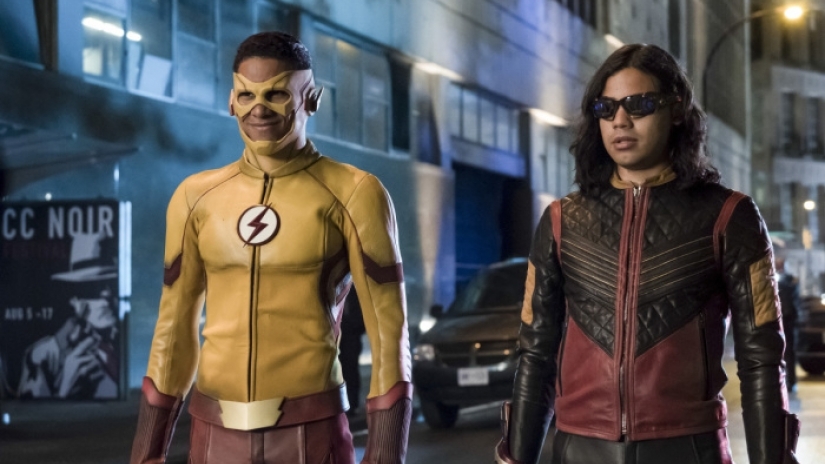
With Barry gone Central City is left under the protection of Wally West (Keiynan Lonsdale) as Kid Flash, and Cisco Ramon (Carlos Valdes) as Vibe and Steel (Nick Zano), though we only learn this in Legends of Tomorrow. This new status quo could have been something that the series could explore over a number of episodes, it could have given these secondary heroes the chance to step into the spotlight and show the audience that they were heroes in their own right, not just Barry’s back-up band. We all knew that Barry would return at some point this season, this was never in question, but the show could have at least pushed this back even by a week to give the other characters a chance to shine.

Instead, Cisco returns Barry to the real world to help fight a threat that he and Wally can’t go up against alone, a robot samurai. When Barry returns he’s not the man they remember, unable to understand what’s going on around him, speaking in gibberish, and writing on walls in a language that we’ve never seen. Yet again, this is something that the show squanders, as Barry is once again himself by the end of the episode, snapping out of his situation when he hears that Iris (Candice Patton) needs saving.


Getting Barry back could have easily taken two or three episodes, and his bizarre mental state upon his return could have also had a whole episode to itself, instead, the show condenses what could have been three or four interesting episodes into one. Don’t think that the episode is all bad, however, as the show is still filled with it’s usual charm and spectacle that these are only minor issues. Yes, the show could have done more with the story in this first episode, but it still manages to be a hugely enjoyable episode.

Getting to see Wally and Cisco working together, alongside Joe West (Jesse L. Martin) and the CCPD, to stop crime across the city is great, and the characters work really well with each other. The scene where they use their differing powers to stop a teleporting metahuman go on to showcase just how creative and exciting the action sequences in the show can be.

The episode also manages to squeeze in the return of Caitlin Snow (Danielle Panabaker) after her time as Killer Frost in the third season. Like most seasons of the show, Panabaker is given a slightly different version of Caitlin to play, this time being quite different due to having spent some time as her evil counterpart in the last season. With a tease towards the end of the episode that her and Killer Frost may not yet be done, it does leave a certain amount of mystery and excitement for the rest of the season.

The emotional heart of the episode, though, is Iris and how she’s been dealing with the loss of Barry. She’s become a harder version of her character, though not one that has completely shut herself off from those around her. She’s still part of the team, still leading everyone in protecting the city, but she’s dealt with her grief by giving Barry up as gone forever. Whilst everyone else is hoping that Barry will one day return, or actively trying to get him back like Cisco, she’s resigned to the idea that he’s not coming back. This leads to some friction between the team, particularly when they believe that their attempt to rescue Barry has failed. Ultimately, this does give us some very touching moments at the end of the episode.

The season premiere of The Flash has some story elements that feel a little rushed, and that could be spread out over a number of episodes, it manages to deliver an exciting and emotionally satisfying opener.


Go to Amy's Blog

Looking back at… South Park: The Stick of Truth


Originally published on Set The Tape

South Park: The Stick of Truth is not the first time that South Park has made the leap to the video game medium, but it’s easily the best available. With a story written by the series writing team, and an art style that seamlessly fits with the show, The Stick of Truth is like playing through a season of the show.

Using story beats established in the series most recent to the release of the game The Stick of Truth sees the children of the town playing a huge LARP game, allowing the game to intertwine traditional fantasy tropes into the South Park we all know and love.

Creating a brand new child that has just moved to town, you have the choice to join Cartman’s Humans, or Kyle’s Elves, all dressed in bad cosplay outfits. You even get to choose what class you want to play as: Fighter, Thief, Mage, or Jew. From here the game goes wildly out of control, featuring aliens, zombie Nazi’s, Underpants Gnomes, Crab People, and an 8-bit excursion to Canada.

The game’s combat plays like a typical RPG turn based game, though at times with characters reminding each other mid battle that they have to wait their turn to attack. The combat may be simple, but it’s a style that has worked well for decades within games, and it fits perfectly within this game. The usual turn based fighting tropes are all present, with class specific attacks, summons, and magic (fart attacks).


Despite a large number of attack options, classes, and quick time events the game is incredibly easy to get to grips with, though with enough differences and options available in the class systems to be able to try something different on a second, third, or even fourth playthrough. The basics are quick to learn but with enough options that you can tailor your character to your own way of playing.

The game even allows you to customise your character via unlockable armour, weapons, hairstyles, and accessories that allow you to make your character unique, though players wanting to make their character female do have to wait until a mission where you’re sent to infiltrate the girls in order to unlock female clothing and hair options.

The town of South Park itself is also well recreated within the game, allowing the player to explore iconic locations such as the school, the kids homes, and the park. Each area is lovingly recreated to look just like the show, and exploring the town is genuinely enjoyable.


A well made and surprisingly competent game, South Park: The Stick of Truth manages to recreate the look and feel of the show so well it’s a surprise that it took seventeen years to make a good game out of the franchise. The game isn’t perfect, there are some occassions where the controls don’t feel as good as they could do, but the flaws are small in comparison to everything that the game does well.

Fans of the show are sure to have a great time playing one of the most ridiculous games around.


Go to Amy's Blog